
A real-life story · California, United States, 1987
John Davis’ near-death experience
In 1987, John Davis was 21. He crashed his moped into a tree and needed surgery on his hand. He later said that during the operation his heart stopped for seven minutes. He said that in that time a guide named Alan showed him the other side, building by building. He also said that at the end a man dressed in white gave him a task: “You must tell them there is no death.”
John Davis’ story is a guided tour. John doesn’t see his body or the operating room. He opens his eyes directly on the other side. John says that there a guide shows him where the dead arrive. The guide shows him where a life is reviewed and where the next one is planned. He also shows him where the name of every soulmate is kept. What does he say he saw in each place?
Step 1
Before · 1987 · He is well · John Davis’ account
A 21-year-old Catholic with no interest in spirituality

John Davis is 21 and lives in California, in the United States. He can’t decide whether to go to college. He says he has no clue what to do with his life.
His father is a devout Catholic. He takes him to Mass two or three evenings a week, and on Sundays too. John believes what he is taught. But he struggles with one thing: “the fear of God that they put in you.” He says spirituality was “the last thing on my mind.”
His father has won a sales contest, and the prize is two mopeds. On weekends, John takes one out for a ride. One day, he crashes.
Step 2
1987 · In the operating room · His heart stops · John Davis’ account
He crashes into a tree, and during surgery on his hand his heart stops

He is riding the moped when he hits a tree. He lands in such a way that he tears the tendons off his right hand. He needs surgery.
He has never had an operation. He has hardly ever been inside a hospital. He doesn’t know what to expect.
In the operating room, they put in an IV and start the anesthesia. He has an allergic reaction, and his heart stops.
No medical record of this operation has been published. What we know about it comes from John Davis.
He says that in that very second he opens his eyes somewhere else.
Step 3
Seven minutes · His heart is not beating · John Davis’ account
Davis says he opens his eyes in a marble hallway that never ends
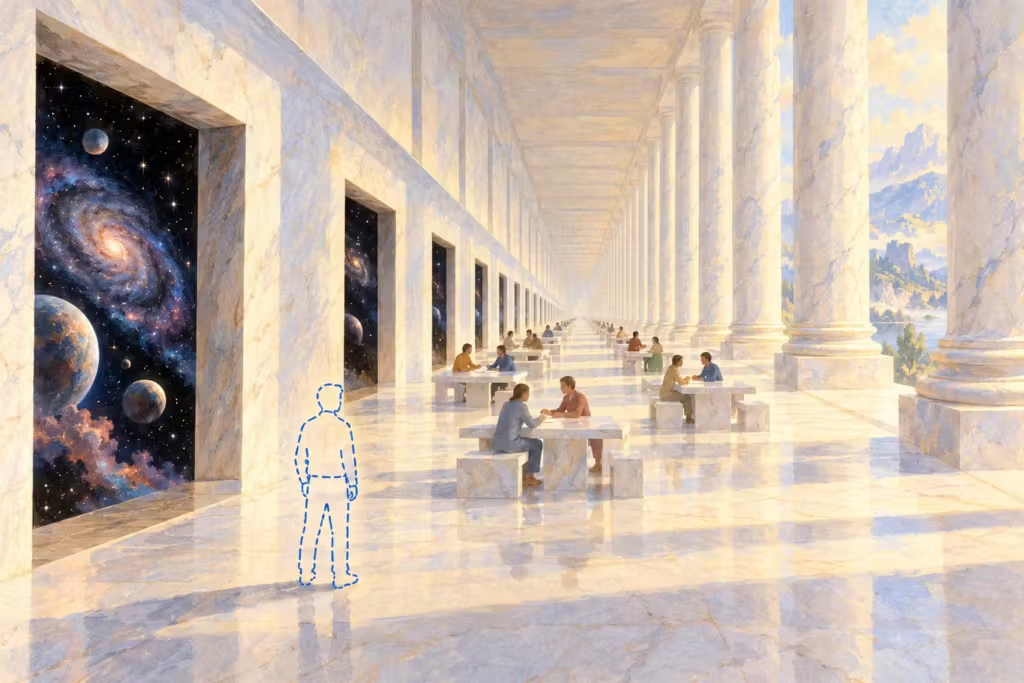
He is standing in the most beautiful building he has ever seen. His very first thought is: “Oh my God, I had no idea the hospital was big.” He doesn’t know he has died.
It is an immensely long hallway. He can’t see the end of it. On the right is a row of white marble columns. They are about 30 feet (nine meters) high. They stand five to ten feet (one and a half to three meters) apart. They go on as far as the eye can see.
Down the middle are marble tables, each with its own marble benches. They don’t end either. At every table, two people are sitting.
On the left is what amazes him most. It is a row of tunnels cut into the white, spotless marble. They are seven or eight feet (a little over two meters) high, with square corners, like a doorway. There is one across from each table. In another interview, John says the tunnels were black inside. He says that when he looked into the first one, “it was like looking at space and I could see stars and galaxies and planets.”
Then he hears a voice, right by his left ear.
Step 4
The orientation center · His heart is not beating · John Davis’ account
Davis says a voice tells him: “My name is Alan, I’m your spirit guide”

“My name is Alan, I’m your spirit guide.” John has no idea what that means. He doesn’t describe what Alan looks like, either. He remembers his voice. From then on, that voice explains everything he sees.
Alan is going to take him through several buildings. He shows him the outside of each one first, then the inside. And he tells him what each place is for.
The first is the building he is standing in. John says it looks like the Temple of Artemis, an ancient Greek temple that once stood in what is now Turkey. Alan tells him it is the orientation center.
John explains that in many of these experiences, people leave their body, go through a tunnel, and see a white light at the end. He skips all of that. He says his experience begins on the other side of that light.
Alan explains what the tunnels are for. They connect Earth to the other side. When someone’s life is over, they go into the light, come out through one of those tunnels, and arrive here.
Alan tells him to look at the next tunnel over. Someone is coming through.
Step 5
The orientation center · His heart is not beating · John Davis’ account
Davis says he watches an old man come through a tunnel and grow young again
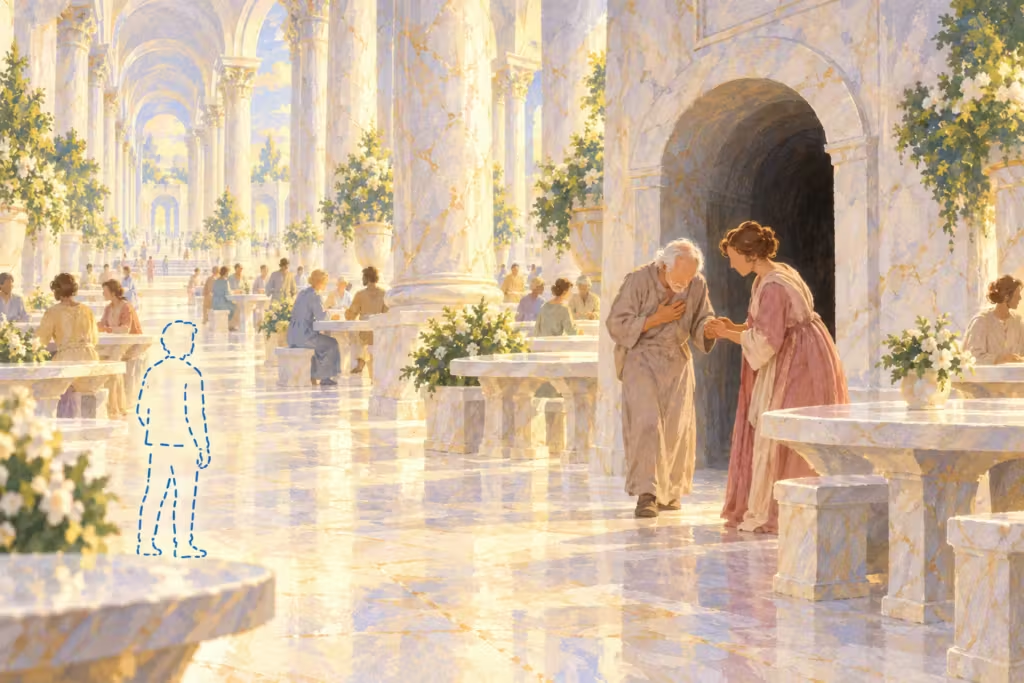
He is a man of 80 or 90. He has just finished his life. He comes out of the tunnel with his right hand pressed to his chest, as if he were in pain. Alan tells John he died of a heart attack.
Alan explains that the two people at each table are orientation counselors. Their job is to help new arrivals remember where they come from. He is told that when we are born, we forget the other side. Earth is a place to learn and grow. Our real home is there.
A woman gets up from one of the tables. She walks over to the man, takes his hands, and leads him to the table. They sit down. She talks to him the whole time, never letting go of his hands. John is too far away to hear what she says.
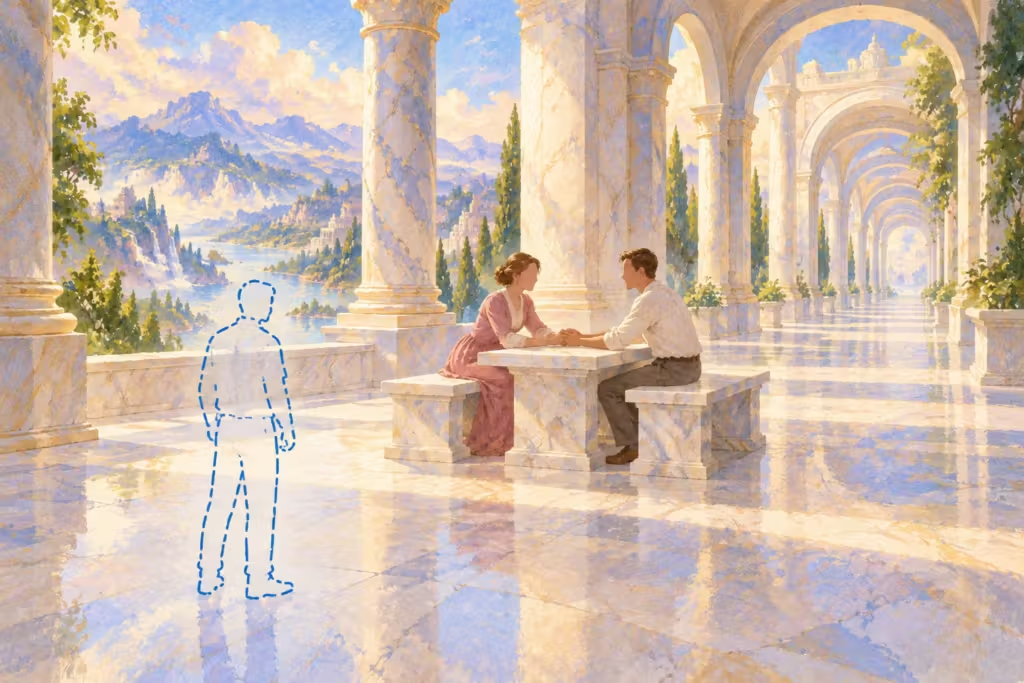
“Watch him,” Alan says. John watches. And the old man begins to change. He goes from a man in his 80s or 90s to a man of about thirty.
Nobody tells him why thirty years old. But John says that over there we are all about thirty. That is what orientation is. They remind the man that he has finished his life and come back home.
Then the man gets up, walks off to the right, and steps down three steps.
Step 6
The gardens · His heart is not beating · John Davis’ account
Davis says that in a garden, everyone you ever knew is waiting for you
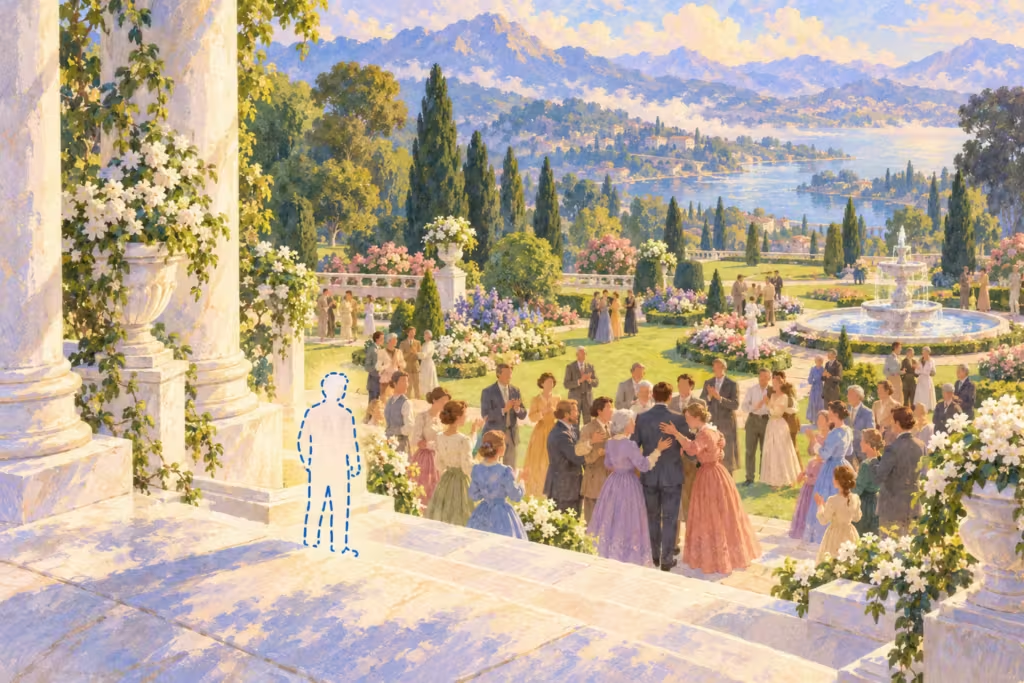
Down there the gardens begin. They are the most beautiful gardens you could imagine. They look like English gardens, perfectly kept, with gorgeous trees and flowers. What he remembers most is the grass. It is emerald green, the greenest grass he has ever seen.
They explain that this is where the reunions happen. When someone comes back from a life on Earth, everyone they knew is waiting: friends, family, cousins, grandparents. In another interview, John says the old man was welcomed with applause and hugs, “like a huge wonderful reunion.”
He is told that coming back from a life on Earth is a very big deal, because Earth is the hardest of all the planets.
As it was shown to him, the path goes like this. First you die and go into the tunnel. Then you pass through the light and are welcomed at orientation. After that you are reunited with your own.
Next, Alan takes him to another building. His own life is waiting for him there.
Step 7
The life review room · John Davis’ account
Davis says he sees his whole life on screens in a round room
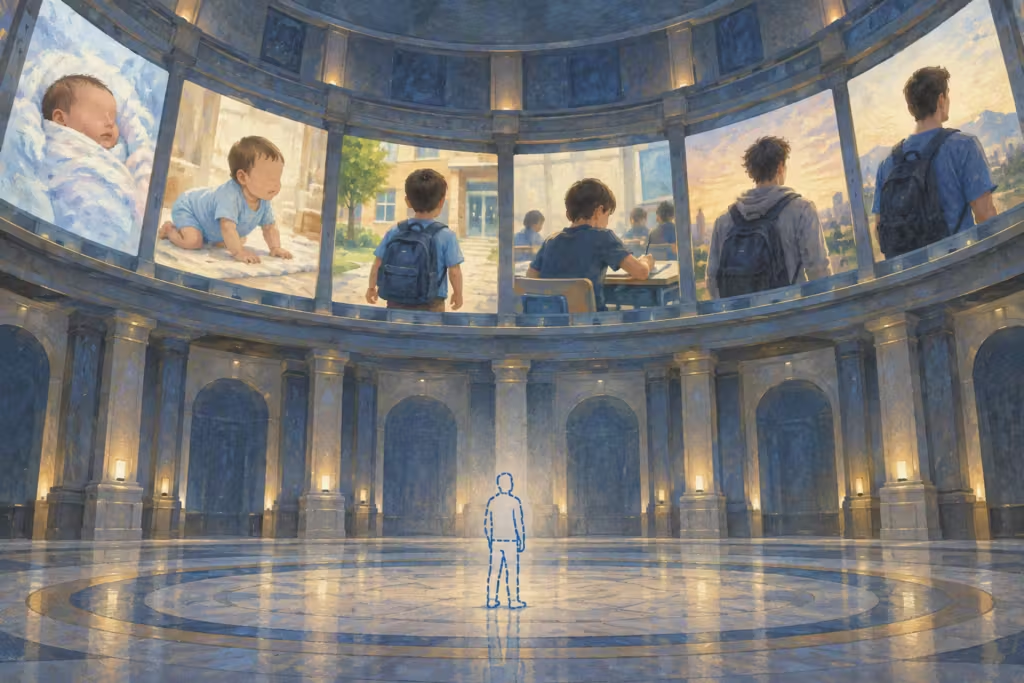
From the outside, the building is square, almost rectangular. White marble columns surround it. John says many of the places Alan takes him to look like Greek buildings.
Inside is a round room, very large. Up high, in a circle, are screens like movie screens. “This is your life review,” Alan tells him.
Suddenly the screens light up. It is like being at the movies. Each screen plays a different moment of his life. On one he is a newborn. On another, a baby. On another, he is starting school. And so on, up to age 21, the age he is now.
He is told that the review is there to see whether you accomplished what you wanted to accomplish before you were born. “None of us are accidents,” John says. Every life is planned.
The interviewer asks whether he felt what other people had felt, as other experiencers describe. John says no, there wasn’t time. They only wanted to show him that the review exists.
What comes next is harder for him to believe.
Step 8
The theater of past lives · John Davis’ account
Davis says that in a kind of movie theater, he is shown three lives he lived before
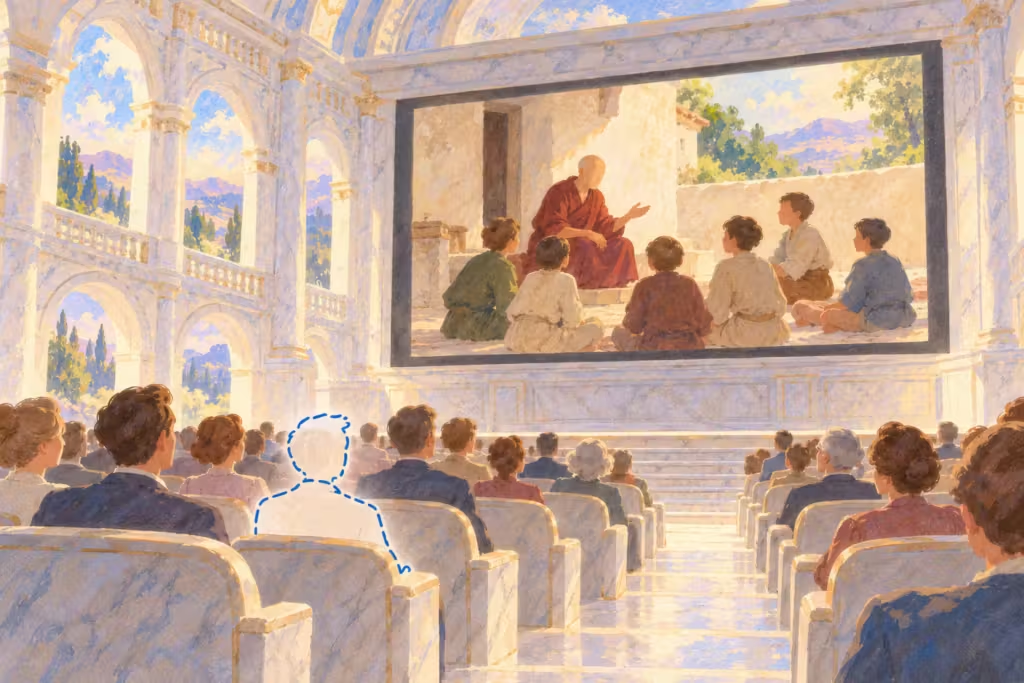
It is another square building with marble columns. Inside, it looks like an ordinary movie theater, with a single screen up front.
This is where past lives are shown. John finds it hard to accept. He was raised Catholic, and his faith has no room for past lives. But Alan wants him to be able to tell people that they exist. He is told that we are eternal and that each of us can live as many lives as we want.
Alan shows him three.
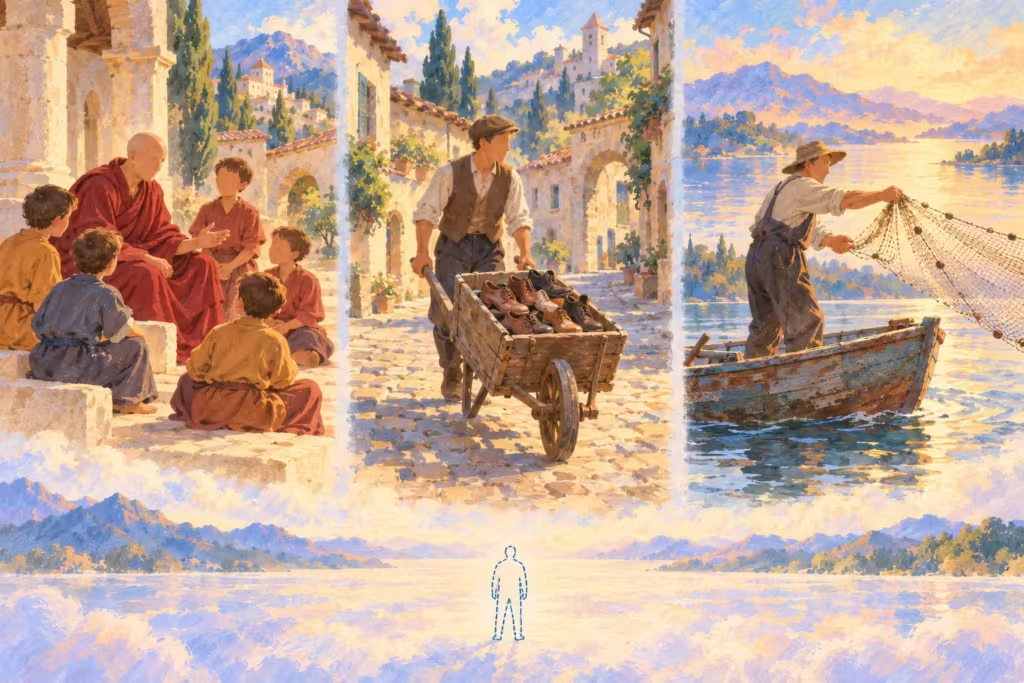
- A monk. He is about sixty, with a shaved head. He wears a sort of red robe. He teaches children about life in the monastery. It reminds John of a Buddhist monk.
- A shoe peddler. He lives in a village. He goes around with a wheelbarrow full of shoes. He collects people’s shoes, fixes them in his little shop, and brings them back.
- A fisherman. He has a raggedy old boat on a lake, and a net. He fishes so the village has food.
He is told that we come into life because we want to go through hard things. That is how we learn the most. It is like riding a bike. No one can explain what it’s like. You have to ride.
Next, Alan takes him to a round building with a dome. This is where every life is planned.
Step 9
The hall of scrolls · John Davis’ account
Davis says he finds the scroll where his life is planned, and it rolls itself back up
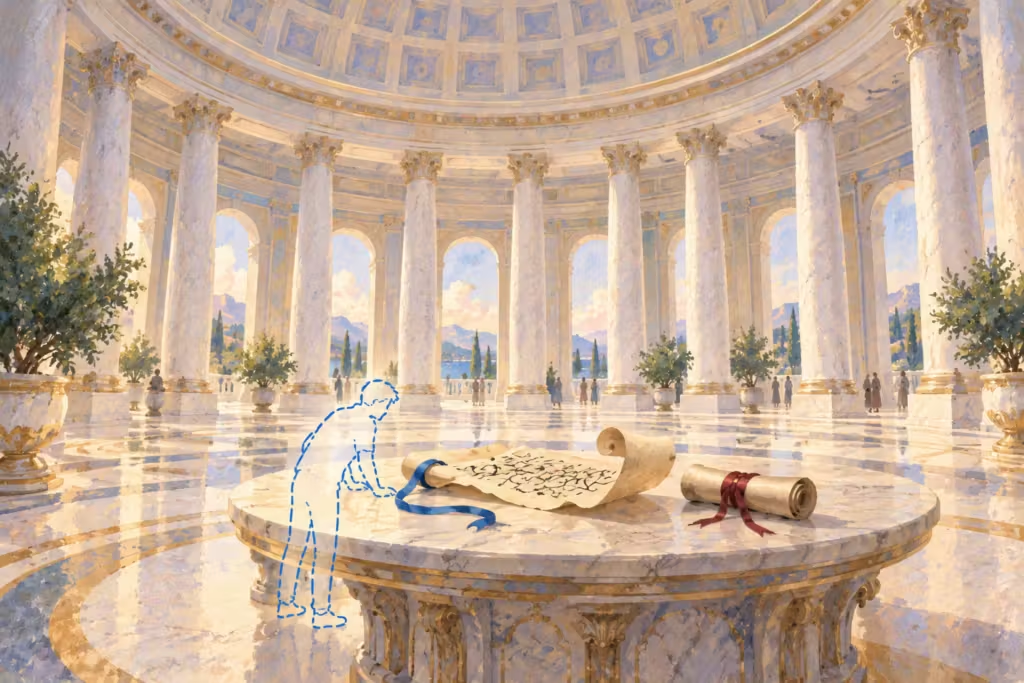
All the buildings are so enormous that John can’t find a way to describe it. This one is round, with marble columns in a circle and a domed roof.
Alan takes him to a marble table. On it are two rolled-up scrolls, like papyrus. One has a blue ribbon and the other a red ribbon. John doesn’t know why.
He picks up the one with the blue ribbon and unrolls it on the table. It is covered in black calligraphy, the kind you write by dipping a pen in ink. But when he tries to read it, the scroll rolls itself back up.
He is told he can’t read what it says about his life, because it might interfere with what he came to do in it.
John says they wanted him to know that lives are planned. The plan covers what country you will live in, what language you will learn, who your parents will be, whether you will go to college, and what work you will do. It also covers what you want to learn: more compassion, more love. The guides help plan it.
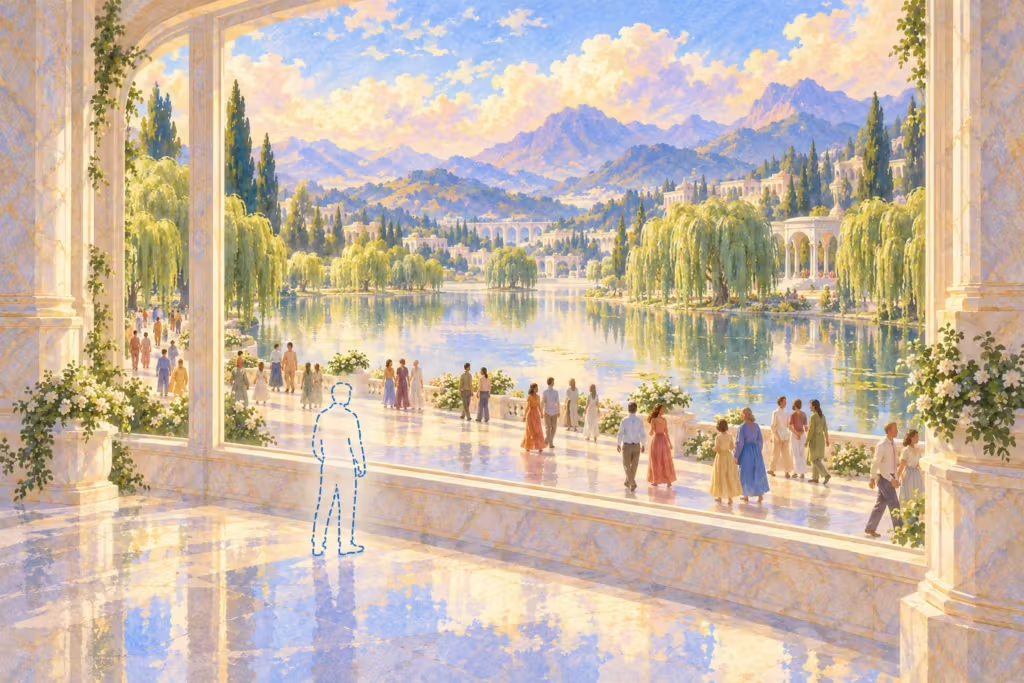
To his left is an enormous window. For the first time, he sees a lot of people. They are walking back and forth along a path. They are of every race and color, tall and short. They all have bodies, as solid as ours, but better: “they’re stronger, they’re lighter, they don’t get sick, they don’t age.”
Beyond them is a lake, the most beautiful he has ever seen. The water is so still it looks like glass. All around it are weeping willows, their leaves resting on the water.
In the same building, Alan shows him a book with a name on it.
Step 10
The soulmate library · John Davis’ account
Davis says he is shown the book of his soulmate, and that her name is Nina
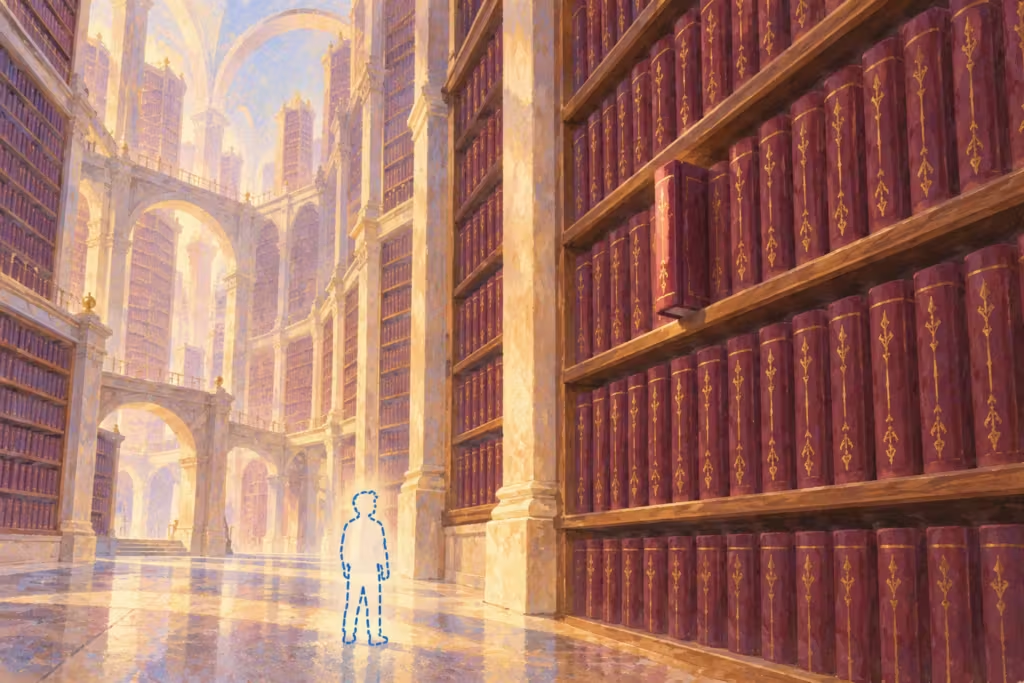
Alan wants John to tell people that soulmates are real. It is explained to him that God created each of us with a perfect mate. That mate stays with us for all eternity.
It is a gigantic library, like an enormous encyclopedia. There are shelves and shelves of identical books. They are all the same color, a purplish maroon. Each book has gold lettering. But the letters don’t run across, as they do here. They run from top to bottom.
Each book holds everything about one person: their past lives, what they learned, who they became. Alan leads him to one. It belongs to his soulmate. The gold letters spell N, I, N, A.
“My soulmate’s name is Nina,” John says.
But our soulmate doesn’t always come into life with us. Often they stay on the other side. He says that with a perfect mate you don’t learn all that much. You learn a lot from relationships here, especially the ones that hurt. So he gives this advice: don’t worry if you don’t find your soulmate in this life. They may still be over there.
The next building looks like a stadium. And it is empty.
Step 11
The planetarium · John Davis’ account
Davis says that in a planetarium he is shown millions of planets with life

It is like a football stadium. Inside are thousands of seats, and no one is there. There are only John, his guide, and a man behind him. That man’s job is to run the building. John doesn’t turn around to look at him.
It is a planetarium, like the ones he visited as a boy. But gigantic. “Let’s begin,” the man says. The lights go out and everything is pitch black. John sits down and looks up at the ceiling.
“When you look at the stars, this is what you see,” the man says. He means the people on Earth. On the ceiling appears our solar system: the Sun, Earth, Jupiter, Saturn, Uranus, and Neptune.

Then he says: “When we look at the stars, this is what we see.” He means those who are on the other side. And planets begin to appear, one after another. First there are dozens, then hundreds, then thousands. In the end there are millions and millions. In another interview, John says they came in many colors: brown, green, some with oceans.
The man tells him there is “far more life in the universe than you possibly know.” Earth is not the only planet with life. And you can live a life on any of them.
John loves astronomy. He once signed up for a college class and had to drop it because he couldn’t understand the math. Of the whole journey, the planetarium is one of his favorite parts.
The next building is the biggest of all.
Step 12
The great library · John Davis’ account
Davis says that in a vast library you can watch history as it really happened

It is a rectangular building, so long that, again, he can’t see the end. It has columns only across the front. They are white marble, like the columns of the Supreme Court building in Washington. To get in, you climb a great many steps. Everything is white marble.
Inside is a library. The bookcases are 30 or 40 feet (nine or twelve meters) tall and go on as far as the eye can see. It is full of people. Some are studying at tables, some are talking, some are looking for books.
On the left are small rooms, like the study rooms in libraries here. They are about the size of a bedroom.

John looks into one. Inside, a woman sits with her back to him. Her jet-black hair falls to her waist, and she is wearing a sort of purple robe. She is watching what today we would call a big flat-screen TV, mounted on the wall.
Alan tells him the woman is watching history. On the screen is a battle between the US Cavalry and the Plains tribes, such as the Lakota.
John doesn’t understand. Nobody had video cameras 200 years ago. How can she be watching it? “Everything is recorded,” Alan tells him. That is why everything can be seen in a life review. And in these rooms you can watch any moment in history as it really happened. For example, you can watch a battle in World War II or the Titanic going down.
He is told that over there you can also do anything you love to do. You can swim, hike, go to music festivals, paint, or write.
And then Alan takes him to a castle.
Step 13
The castle · John Davis’ account
Davis says a woman in a castle offers to help him, and he answers: “I’m just looking”
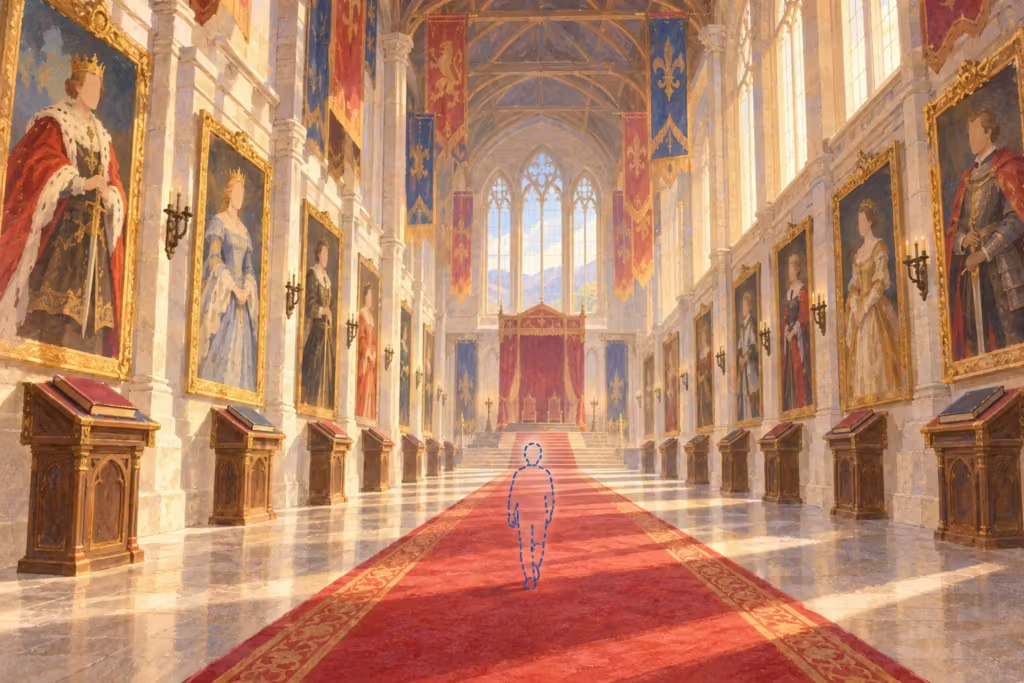
It is a castle like the ones in medieval Europe. It is huge, built of perfectly cut stone. Alan tells him to go inside.
Inside is a gorgeous red carpet. To the right and left rise enormous walls hung with life-size portraits of kings, queens, and other royals who lived in that castle. You can see what they looked like and what they wore.
In front of each portrait is a podium with a book. The book holds that person’s life. He is told that there are many castles there. What existed on Earth exists there too, for anyone who wants to know what that era was like.
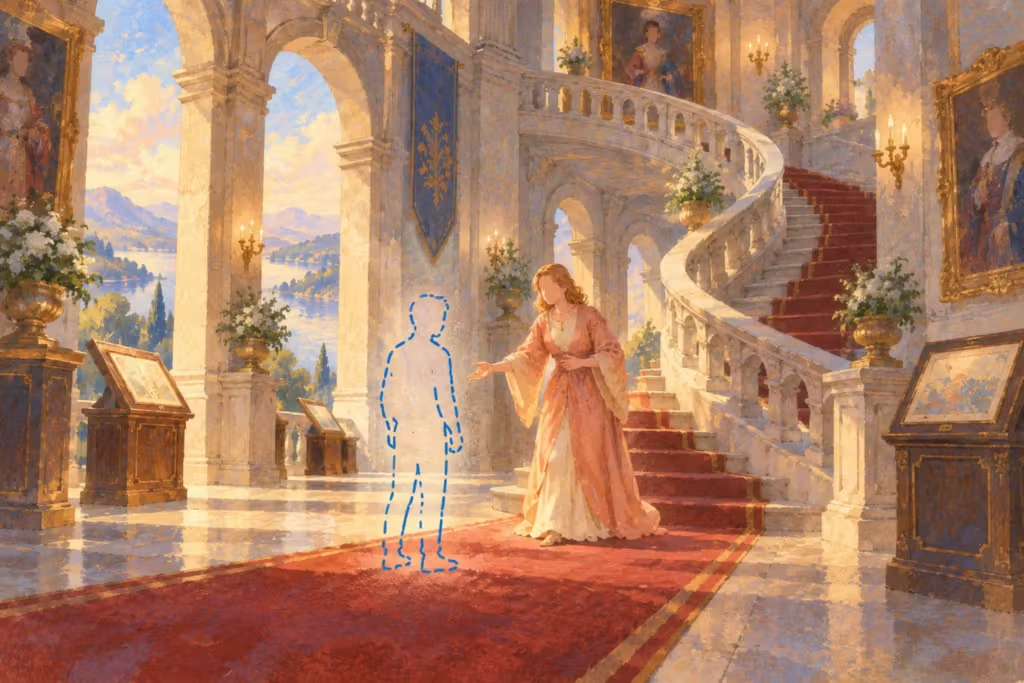
A woman comes down a spiral staircase. She has strawberry-blond hair and wears a sort of peach-colored gown. In another interview, John says it was “the first time that I saw someone that could see me.”
She walks up to him and asks: “Can I help you find anything?”
John could have asked her anything: where he was, what was happening with his surgery. Instead he answers: “Oh, no, thanks. I’m just looking.”
To this day he kicks himself for it. Alan explains who she is. Over there, no one works to pay bills. Everyone does what they love. She is passionate about that period of Earth’s history. She is a scholar, a person who knows a great deal about that period. You can ask her anything about that time.
There is just one place left. And there, Alan leaves.
Step 14
The field of flowers · John Davis’ account
Davis says that in a field of flowers, a man in a white robe tells him: “You must tell them there is no death”

Alan takes him to a field of the most beautiful wildflowers he has ever seen, on rolling golden hills. In another interview, John adds that the sun was out and there was a slight breeze.
And Alan leaves. John is alone.
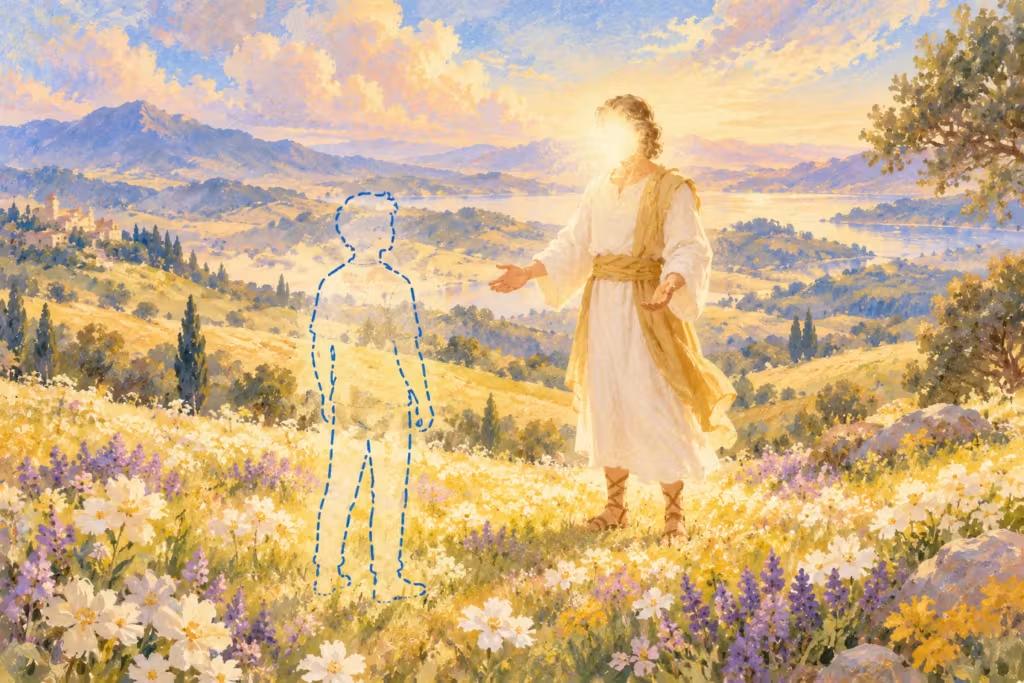
Suddenly a man appears in front of him. John can see his hair, which is brown. He can see his hands. He is wearing a white robe with a golden sash at the waist, and gold-colored sandals laced up his calves.
But John can’t see his face. So much light and so much energy come from the man that he can’t make out his face. He is different from everyone else.
Something inside him, or someone, tells him: “This is Jesus.” And the man speaks to him:
“You must tell them there is no death.”
At that very instant, John opens his eyes.
Step 15
In the operating room · His heart beats again · John Davis’ account
Davis says he wakes up in the operating room and the surgeon tells him: “We lost you for seven minutes”
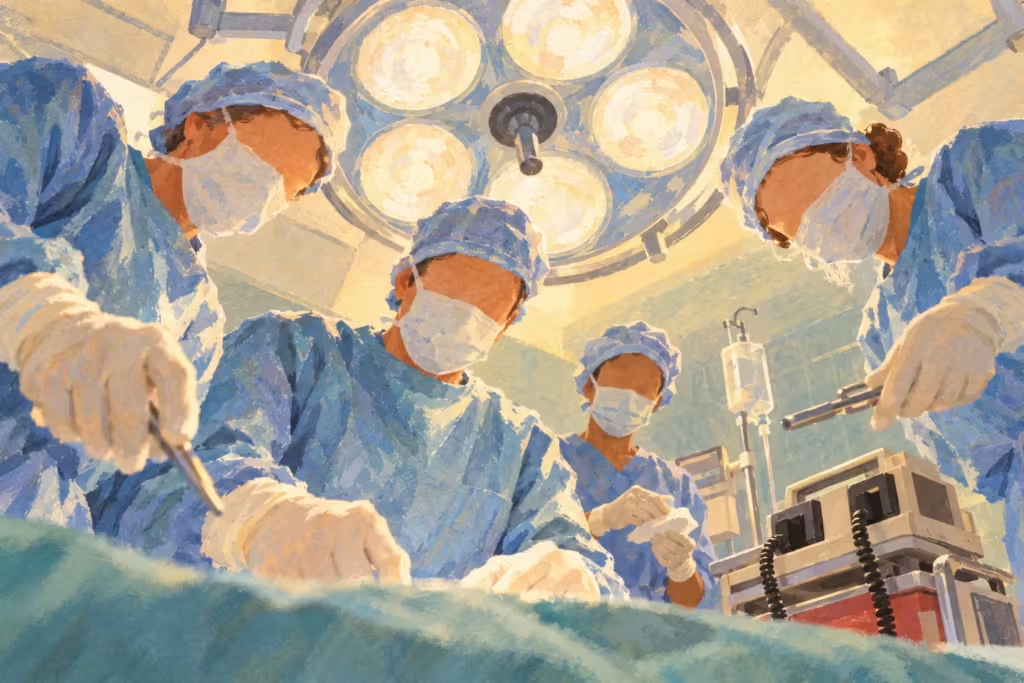
He is back on the operating table. Everyone is looking down at him. He asks the surgeon what just happened.
“We’d lost you. We lost you for seven minutes,” the surgeon answers. That is how he understands that his heart was stopped for seven minutes. In another 2023 interview, he adds that they had to use the paddles on him six times to bring him back.
He can’t believe it. It felt to him as if he had been gone an hour or more. John says that over there “there’s no such thing as time, like we have here.”
But he still doesn’t understand what has happened to him.
Step 16
The next two months · Recovering · John Davis’ account
Davis says he spends two months in bed, devastated at having to stay here

It takes him a day and a half to understand what happened. He tells his mother, and she gives him a book. It is Life After Life, by Raymond Moody, published in 1975. The book is about people who came close to dying. John reads it and thinks: “Oh, my gosh, this is what really happened.”
Then comes the worst part. For two months he goes through what he calls “a horrible suicidal depression.” He won’t get out of bed.
The depression isn’t because of anything bad he saw. It is the opposite. He can’t believe he will have to spend so many years here before going back. How could he make it here, knowing what life is really like over there?
When he tells how he came out of it, he remembers the words in the field. The man in the robe didn’t ask him a favor. He didn’t ask whether he could do it. He said “must.” So he starts telling people.
If you are going through something like this, you are not alone. You can talk to someone right now. In the United States, call 988, the Suicide & Crisis Lifeline. In Spain, call 024. In the UK and Ireland, call Samaritans at 116 123. It’s free, at any hour.
Step 17
From 1987 to today · John Davis’ account
Davis says that ever since, he has repeated what he was told: that there is no death
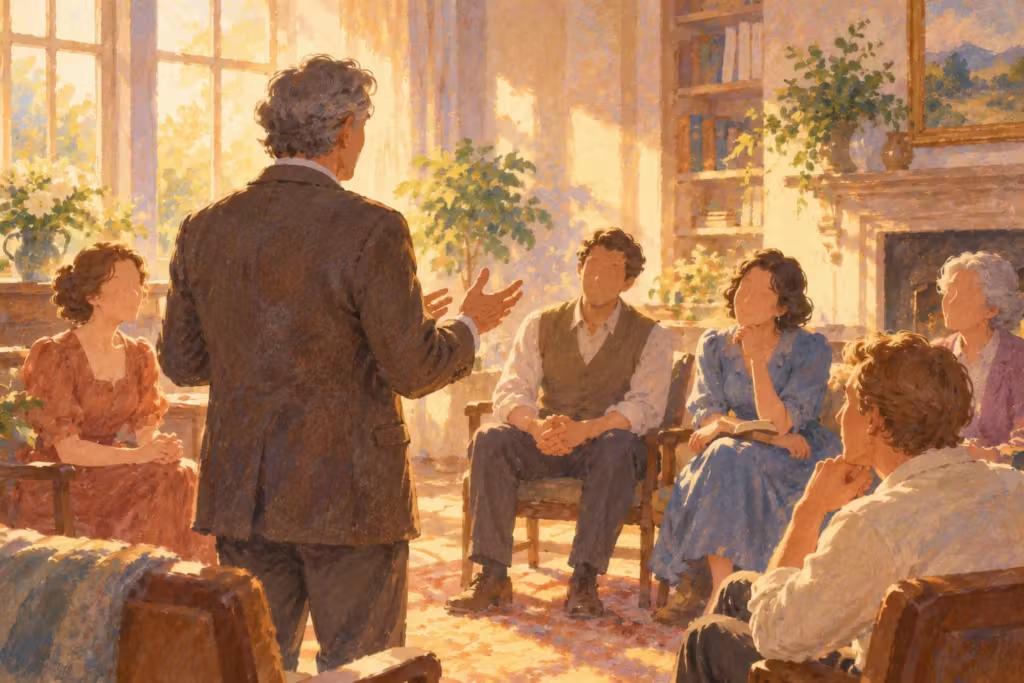
He tells anyone who will listen. At first, he takes what he saw for granted. John says that over the years he realizes few experiences are as detailed as his.
He says that since then he has a hard time calling himself a Christian, because of the church’s dogma. But he loves Jesus and often reads the New Testament. His mother knows all about it. His father was a Marine and is a devout Catholic. John still hasn’t told his father.
In 2023 he says he has no book, no website, and no podcast. He says he tells his story because “this experience, it wasn’t for me. It was for me to share it.”
And his message is this. The people we have lost aren’t really gone. They are in another place we can’t get to yet. Our animals are waiting there too. And there you can feel how much God loves you. According to John, we don’t feel that here. That is why he can’t wait to go back.
To anyone going through a hard time, he says: don’t give up, hold on. “It always gets better.”
On a 2023 podcast, he put it this way:
“When you finish this lifetime, and you get back, it’s like surviving a war. And you will be so proud of yourself.”
How many people have an NDE?
John Davis is not a one-off. For more than thirty years, several teams of doctors have asked people who survive a cardiac arrest what they remember. They do it in the hospital, a few days afterward.
Picture 100 of those people:
Each dot is a person. The 18 filled-in dots are the ones who described a near-death experience. That is what the largest study found. It was done in the Netherlands in 2001, with 344 people.
The other 82 didn’t describe one. Many remember nothing of their cardiac arrest.
| Where and when | People interviewed | Described an NDE |
|---|---|---|
| England, 2001 | 63 | 6% |
| Netherlands, 2001 | 344 | 18% |
| United States, 2002 | 30 | 23% |
| United States, 2003 | 116 | 10% |
| United Kingdom, United States, and Austria, 2014 | 101 | 9% |
| Vienna, Austria, 2023 | 126 | 4% |
| United States and United Kingdom, 2023 | 28 | 21% |
What these figures don’t tell you
- Only some people are asked. In the 2014 study, 330 people survived, but only 140 could be interviewed, and 101 reached the second interview. The rest died later, were too ill, or didn’t respond.
- Most cardiac arrests are never counted. These studies run in a few hospitals for a limited time. Outside them, no one keeps track. Also, the 2003 study interviewed 1,595 cardiology patients, not just the 116 with cardiac arrest in the table, and 81 of them described an NDE from an earlier occasion. The study did not count them, because it only counted those from that hospital stay.
- Some people keep quiet. In the accounts in our archive, at least 13 people say they kept their experience to themselves for a while. They kept quiet because they weren’t believed or because they were afraid of how others would react.
- It depends on how you count. If you count any memory of the cardiac arrest, the numbers go up. If you use a strict scale, they go down. In England in 2001, 7 of 63 people remembered something. But on the scale, only the memories of 4 people qualified as an NDE.
That’s why no one knows the real figure. But every study shows that it isn’t rare. Between 4 and 23 of every 100 survivors who are asked describe an NDE. John Davis’ case stands out for the way it begins. He doesn’t say he left his body or went through a tunnel. His account starts directly on the other side, with a guide who explains what each place is for.
Where this story comes from
In his own voice
- John Davis tells his story on Next Level Soul Español (2023), the long interview with Alex Ferrari, dubbed into SpanishWatch on YouTube
- John Davis tells his story on The Other Side en Español (2023), 21 minutes, dubbed into SpanishWatch on YouTube
- John Davis on Next Level Soul, with Alex Ferrari (April 2023), the full interviewWatch on YouTube
- John Davis on The Other Side NDE (March 2023), his story in 21 minutesWatch on YouTube
- John Davis on Beyond with Heather Tesch (May 2023), part oneWatch on YouTube
- John Davis on The Soul Inspired (June 2026)Watch on YouTube
- John Davis at the We Don't Die conference (Orlando, 2019), the oldest recording we have foundWatch on YouTube
- John Davis on Grief 2 Growth (September 2020)Watch on YouTube
The facts, with dates
- Life After Life, Raymond Moody’s book (1975), on WikipediaRead for free
Studies
- Nigel Harper and others (2018), on severe allergic reactions during anesthesia in the United Kingdom, British Journal of Anaesthesia 121(1):159-171Read for free
Our archive
- His record, with the April 2023 interview and the short version, as of October 11, 2026
Keep reading

Montreal, 2008
Patient J.S.
In 2008, a pregnant woman had surgery on her aorta in Montreal with her circulation stopped. She said that, with her eyes taped shut, she saw a nurse and some machines. According to the researchers, the surgeon confirmed it.
Mexico, 1998
David Rojas
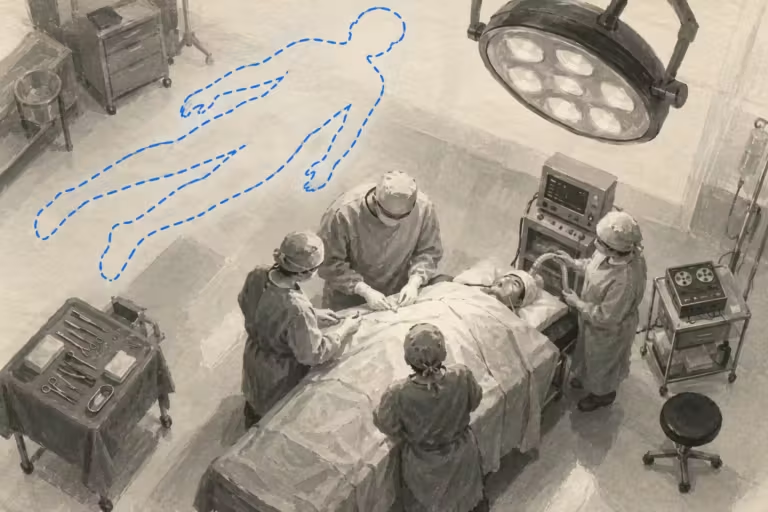
David Rojas says he saw the doctors operating on him from above and recognized the surgeon. According to David, the surgeon told him there were two doctors, not the three David describes.

California, 1997
Lucky Pettersen
At 4, Lucky came out of a coma and said his friend Big Gino had walked him back from heaven. Two weeks later, his family learned that Big Gino had died.
Reincarnation: The top 5 people who remember past lives
We asked them the same five questions as this story. A 32-page PDF, free in your inbox.
Check your email
We have sent you an email. Open it and press the button to confirm. If you cannot see it, check your spam folder.