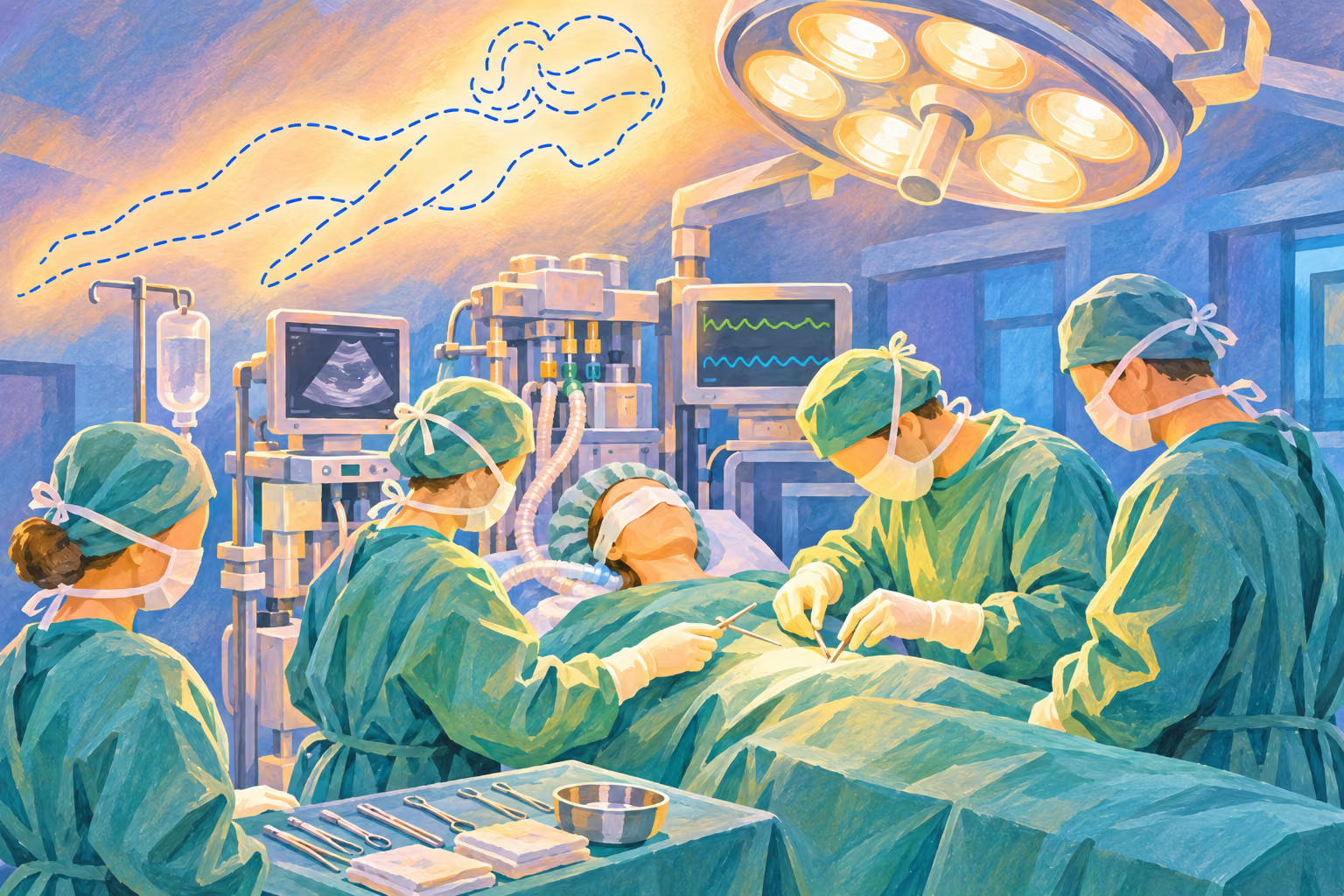
A real-life story · Montreal, Canada, 2008
Patient J.S.’s near-death experience
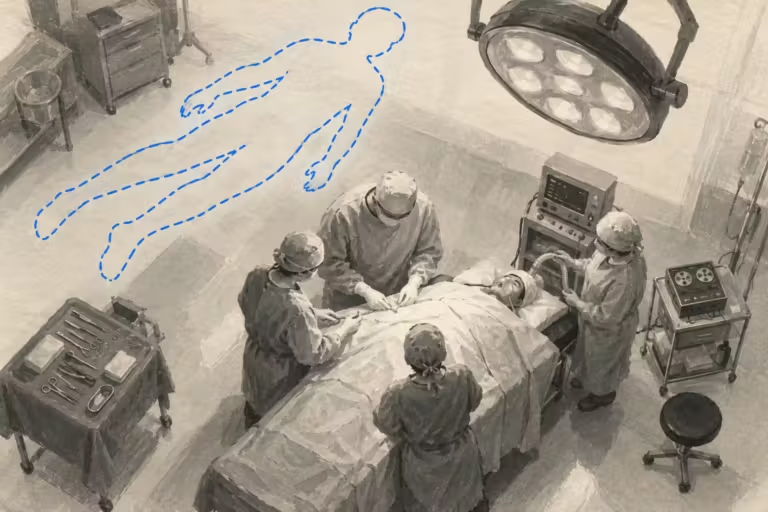
In October 2008, a pregnant 31-year-old woman had emergency surgery on her aorta at a hospital in Montreal. To operate, the surgeons cooled her body. Then they stopped her circulation for 15 minutes. She later said that she had left her body and had seen a nurse and some machines. According to the researchers, with her eyes taped shut, she could not have seen them. They say that the surgeon who operated on her confirmed that what she described was accurate.
The J.S. case was published in 2011 in a medical journal on resuscitation, in a letter from the neuroscientist Mario Beauregard and his team. Since then it has appeared in books and on lists of near-death experiences. What makes it special is the surgery. In an operating room, the doctors know when the circulatory arrest begins and when it ends, although J.S.’s times have not been published. We tell it step by step and then look at what can be checked. If you only want the evidence, skip straight to what can be checked. Could J.S. have seen the operating room with her eyes taped shut and under anesthesia?
Step 1
October 26, 2008 · Montreal, Canada · Mario Beauregard and his team’s account
A woman 31 weeks pregnant wakes up short of breath and is taken to the hospital
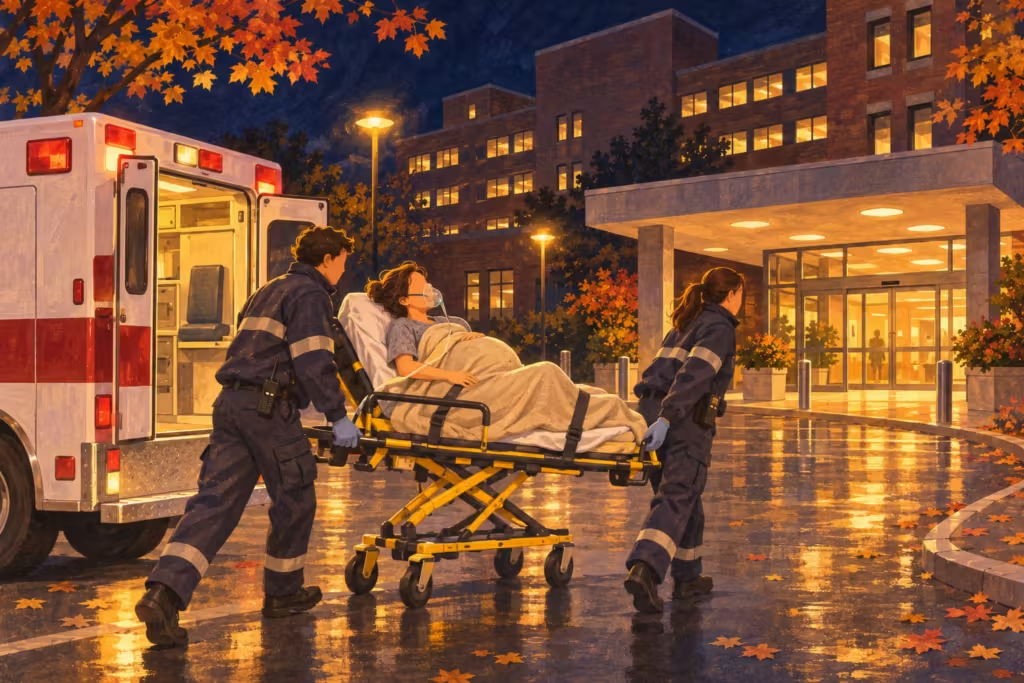
The researchers who published the case call her J.S., from her initials. They don’t give her name. She was 31 years old and 31 weeks pregnant.
On October 26, 2008, she woke up short of breath and very weak. An ambulance took her to Sacré-Coeur Hospital in Montreal, a research hospital of the University of Montreal.
The doctors looked for what was wrong with her.
Step 2
That same day · In the emergency room · Mario Beauregard and his team’s account
The doctors find a tear in the wall of her aorta and perform an emergency cesarean section

The aorta is the largest artery in the body. It leaves the heart and carries blood to the whole body. The doctors did an ultrasound through her esophagus and saw that the wall of her aorta had torn, next to the heart.
First they did an emergency cesarean section, and a baby boy was born.
Then she was taken to another operating room for surgery on her aorta.
Step 3
That same day · General anesthesia · Mario Beauregard and his team’s account
She has surgery on her aorta with her eyes taped shut, her body cooled, and her circulation stopped for 15 minutes
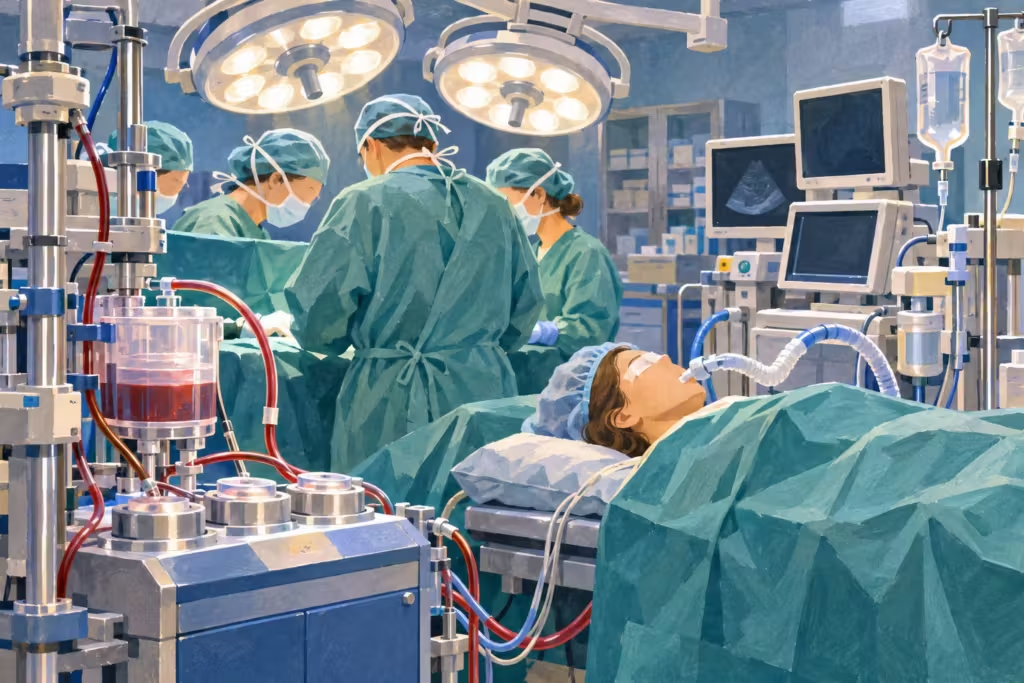
According to the researchers, when J.S. was wheeled into the operating room, she did not see the surgical team or speak with them. Nor could she see the machines behind the head of the operating table. She was given general anesthesia, and her eyes were taped shut.
To replace a section of the aorta, surgeons need the blood to stop flowing through it. So they connect the patient to a machine that cools the blood until the body is much colder than normal. Then they stop the circulation for a few minutes. In the cold, the brain uses much less energy and can last longer without blood. Doctors call this hypothermic circulatory arrest.
J.S.’s circulation was stopped for 15 minutes.
She says that, at some point during the operation, she saw what was going on around her.
Step 4
At some point during the operation · J.S.’s account
J.S. says that from outside her body she sees a nurse and the machines behind her head
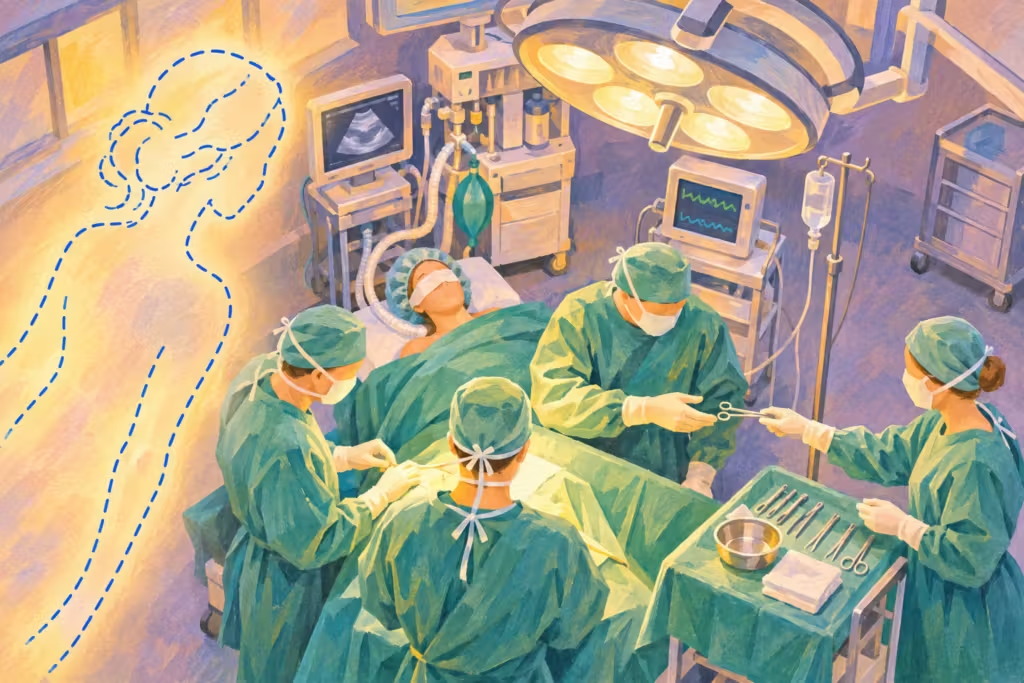
J.S. said that she left her body. From outside, she saw a nurse passing instruments to the surgeon. She also saw the anesthesia and ultrasound machines behind her head.
She felt peace and joy, and saw a bright light.
It is not known at what point in the operation she had this experience, or when she first told anyone about it. Her words have not been published. Everything we know about her account comes from the researchers.
A team at the University of Montreal was looking for accounts like hers.
Step 5
After the operation · Mario Beauregard and his team’s account
A research team asks 70 patients who had the same kind of surgery whether they remember anything

Mario Beauregard was a neuroscientist in the psychology department at the University of Montreal. He worked with two researchers from the same university and with Philippe Demers, a heart surgeon at Sacré-Coeur Hospital.
The team wanted to know how many people who have surgery with hypothermic circulatory arrest remember something of the operation. It sent a questionnaire to 70 people who had had this kind of surgery at that hospital between 2005 and 2010. The letter in which the team published the case doesn’t say when it sent the questionnaire or what it asked. Thirty-three people answered.
Of those 33 people, 3 said their mind had been active during the operation. The team interviewed them afterward. One of them was J.S.
The team checked what J.S. said she had seen.
Step 6
After the interview · Mario Beauregard and his team’s account
According to the researchers, the surgeon who operated on her confirms what she said about the nurse and the machines

This is how the researchers put it:
“We were able to verify that the descriptions she provided of the nurse and the machines were accurate.”
According to the letter, it was confirmed by the heart surgeon who operated on her. The letter doesn’t say who that was. Philippe Demers, who signed the letter, was a heart surgeon at that hospital, but the letter doesn’t say whether he was the one who operated on J.S.
The letter also doesn’t publish what the surgeon said or what J.S. described in her own words.
In 2011, the team published the case.
Step 7
From 2011 to today · Told by the letter and by those who retell the case
Beauregard publishes the case in a medical journal on resuscitation, and other authors retell it

Beauregard and his team signed the letter on September 26, 2011. It came out online in October of that year, and in print in January 2012, in Resuscitation, a medical journal devoted to resuscitation. It is one page long.
The authors themselves acknowledge that it cannot be known for sure whether J.S. had her experience during the 15 minutes of arrest itself. Even so, they say the case raises difficult questions. They hope it will encourage research into whether there can be conscious mental activity while the circulation is stopped.
Since then, the case has been told many times based on that letter. IANDS, an international association that studies these experiences, reported it in 2012. And in 2013 the physician Sam Parnia told it in a book. Parnia changes one detail. He says the questionnaire went to patients operated on from 2008 to 2010, while the letter says 2005 to 2010.
The question remains: could J.S. have seen the operating room with her eyes taped shut and under anesthesia?
How many people have an NDE?
J.S. is not a one-off. For more than thirty years, several teams of doctors have asked people who survive a cardiac arrest what they remember. They do it in the hospital, a few days afterward.
Picture 100 of those people:
Each dot is a person. The 18 filled-in dots are the ones who described a near-death experience. That is what the largest study found. It was done in the Netherlands in 2001, with 344 people.
The other 82 didn’t describe one. Many remember nothing of their cardiac arrest.
| Where and when | People interviewed | Described an NDE |
|---|---|---|
| England, 2001 | 63 | 6% |
| Netherlands, 2001 | 344 | 18% |
| United States, 2002 | 30 | 23% |
| United States, 2003 | 116 | 10% |
| United Kingdom, United States, and Austria, 2014 | 101 | 9% |
| Vienna, Austria, 2023 | 126 | 4% |
| United States and United Kingdom, 2023 | 28 | 21% |
What these figures don’t tell you
- Only some people are asked. In the 2014 study, 330 people survived, but only 140 could be interviewed, and 101 reached the second interview. The rest died later, were too ill, or didn’t respond.
- Most cardiac arrests are never counted. These studies run in a few hospitals for a limited time. Outside them, no one keeps track. Also, the 2003 study interviewed 1,595 cardiology patients, not just the 116 with cardiac arrest in the table, and 81 of them described an NDE from an earlier occasion. The study did not count them, because it only counted those from that hospital stay.
- Some people keep quiet. In the accounts in our archive, at least 13 people say they kept their experience to themselves for a while. They kept quiet because they weren’t believed or because they were afraid of how others would react.
- It depends on how you count. If you count any memory of the cardiac arrest, the numbers go up. If you use a strict scale, they go down. In England in 2001, 7 of 63 people remembered something. But on the scale, only the memories of 4 people qualified as an NDE.
That’s why no one knows the real figure. But every study shows that it isn’t rare. Between 4 and 23 of every 100 survivors who are asked describe an NDE. There is very little data on arrests that are induced on purpose in the operating room, like J.S.’s. We explain two studies of these patients on the page on hypothermic circulatory arrest.
Frequently asked questions
What is Mario Beauregard’s J.S. case?
It is a near-death experience from 2008 at Sacré-Coeur Hospital in Montreal. A pregnant woman, called J.S., said she had left her body during surgery on her aorta. She said she had seen a nurse and some machines. According to Mario Beauregard’s team, the surgeon who operated on her confirmed that it was accurate. Here we explain what can be checked.
What is hypothermic circulatory arrest?
It is a technique surgeons use to operate on the aorta. They cool the patient’s body a great deal and stop the circulation for a few minutes, because in the cold the brain can last longer without blood. J.S.’s circulation was stopped for 15 minutes. Here we explain two studies on what these patients remember.
Is it known who patient J.S. is?
No. The researchers give only her initials, her age, and that she was 31 weeks pregnant. Nor do they name the surgeon who, according to them, confirmed what she saw.
Where was the J.S. case published?
In a one-page letter by Mario Beauregard, Évelyne Landry St-Pierre, Gabrielle Rayburn, and Philippe Demers, “Conscious mental activity during a deep hypothermic cardiocirculatory arrest?” in the journal Resuscitation. It came out online in October 2011 and in print in January 2012.
Where this story comes from
The letter
- Mario Beauregard, Évelyne Landry St-Pierre, Gabrielle Rayburn, and Philippe Demers, “Conscious mental activity during a deep hypothermic cardiocirculatory arrest?” Resuscitation 83(1), 2012, page e19. Dated September 26, 2011View the letter
Those who retell the case
- IANDS, the international association that studies near-death experiences, “Veridical OBE Perceptions in a ‘Standstill’ Operation,” 2012. Copy saved in the Internet ArchiveRead
- Sam Parnia and Josh Young, Erasing Death (HarperOne, 2013), pages 142 and 143
- Titus Rivas, Anny Dirven, and Rudolf Smit, El yo no muere (2019), the Spanish edition of The Self Does Not Die, case 1.10. We cite the first edition.
A critique
- Pieter F. Craffert, “Do out-of-body and near-death experiences point towards the reality of nonlocal consciousness? A critical evaluation,” TD: The Journal for Transdisciplinary Research in Southern Africa 11(1), 2015Read for free
Learn more
- Two studies of patients who had aortic surgery with hypothermic circulatory arrestRead
- What is a near-death experience?Read
- What does science say about near-death experiences?Read
- How we check each storyRead
Our archive
- Our reading of the 2011 letter, of the versions that retell it, of Craffert’s critique, and of Beauregard’s book Brain Wars, which doesn’t mention the case, and the case’s score on our five criteria, as of November 5, 2026
Keep reading
Mexico, 1998
David Rojas
David Rojas says he saw the doctors operating on him from above and recognized the surgeon. According to David, the surgeon told him there were two doctors, not the three David describes.

California, United States, 1987
John Davis
He says that in 1987 his heart stopped for seven minutes. He says a guide showed him the afterlife, with a library of soulmates and a planetarium with millions of worlds. At the end he heard: “There is no death.”

California, 1997
Lucky Pettersen
At 4, Lucky came out of a coma and said his friend Big Gino had walked him back from heaven. Two weeks later, his family learned that Big Gino had died.

Reincarnation: The top 5 people who remember past lives
We asked them the same five questions as this story. A 32-page PDF, free in your inbox.
Check your email
We have sent you an email. Open it and press the button to confirm. If you cannot see it, check your spam folder.