What happens after death?
Neither science nor anyone else has been able to prove that there is life after death, but no one has been able to prove that there isn’t, either. What we do have are experiences described by thousands of people and studies that have measured them. Here we put them in order, with what has been checked and what hasn’t.
It is one of the oldest questions there is. According to a 2024 survey, 70 out of 100 adults in the United States believe there is life after death. In the United Kingdom, it is 53 out of 100. This page does not argue for one answer. It does not speak for any religion either. It covers what has been studied.
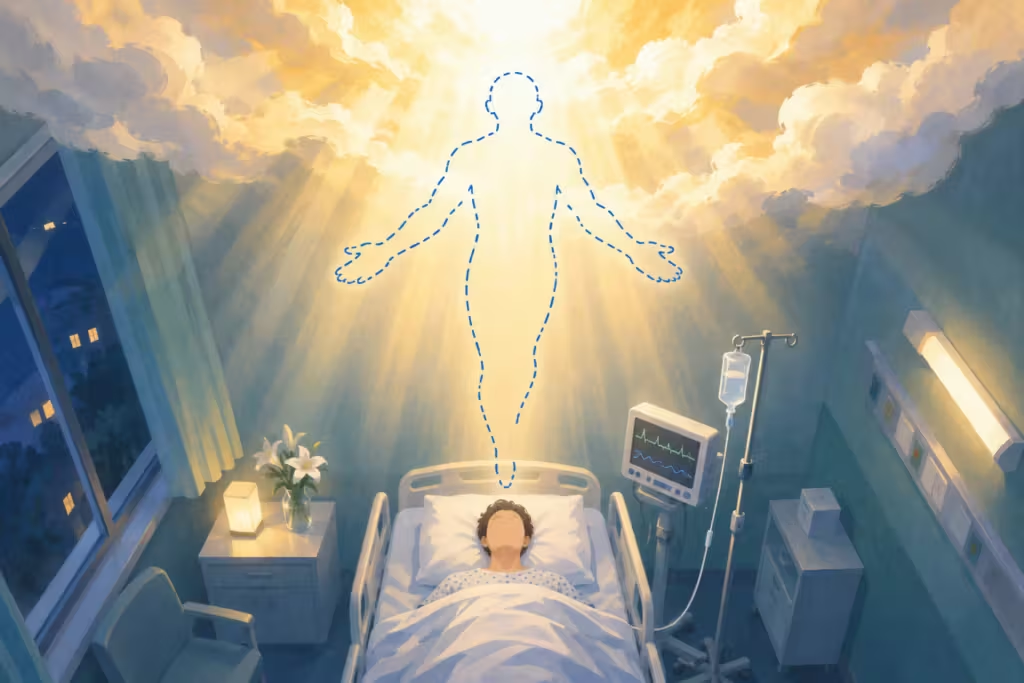
- The short answer
- No one knows. Neither science nor anyone else has been able to prove it, one way or the other.
- What is studied
- What people who came close to dying describe, what some dying people see, the lucidity of some patients at the end of life, and deaths that someone senses from far away.
- What the brain-based explanation says
- While we are alive, the mind depends on the brain. For many scientists, when the brain dies, everything ends.
- What the other explanation says
- Some researchers believe consciousness can carry on without the brain. They point to cases that the brain-based explanation has not yet accounted for.
- What would settle it
- An experiment with many people, where what will be measured is written down before it starts, and which another team then repeats. It has not yet been done with enough people.
This page is not about what happens to the body after death, or about paperwork. It is about whether something of the person carries on.
Why it can be studied
Today, a cardiac arrest can sometimes be reversed. For a few minutes, the heart does not pump and the person does not respond. Then some people come back. A cardiac arrest is the closest thing to dying that can be studied.
That is why almost everything we know comes from people who came back and described what they remembered. Some of it also comes from what dying people who did not come back said or did. Four groups of experiences have been studied methodically.
1. Near-death experiences
A near-death experience (NDE) is a very intense experience that some people have when they are about to die. Many say they left their body, saw a very bright light, or met relatives who had died. Many come back convinced that death is not the end.
What has been measured. Between 4 and 23 out of 100 people who survive a cardiac arrest describe an NDE. The figure changes from study to study. We explain this in “How many people have a near-death experience?” Some people describe things they saw or heard while they were unconscious. In some cases, a medical report or a witness confirms part of it. But no case has everything checked. What is almost always missing is a record from the time that says what the person described and at what time each thing happened. We go through them one by one in “‘Verified’ near-death experience cases: what has been checked.”
What was tested with hidden images. Two large studies placed images that could only be seen from above. In AWARE, 15 hospitals put them on high shelves. The people who said they had seen themselves from above were in rooms with no image. So there was nothing to get right or wrong. In AWARE II, a tablet above the person showed an image chosen at random. No one remembered the image.
How each side explains it. For some, the experience is produced by a brain in danger. For others, it is a sign that consciousness can carry on without the brain. We go into detail in “What does science say about near-death experiences?”
2. What some dying people see
Some people who are dying say they see someone that others don’t see. It is almost always a relative who has died or a religious figure, and they often say this figure has come to take them.
What has been measured. The psychologists Karlis Osis and Erlendur Haraldsson asked doctors and nurses in the United States and India about these visions. The doctors and nurses told them about 877 cases. Osis and Haraldsson published the data in 1977. According to the authors, patients with a high fever or on strong drugs did not have more visions of this kind than the others. Neither did patients with a brain disease. We cover this in the Osis and Haraldsson study.
What it lacks. The cases are memories of doctors and nurses, sometimes from years before. In the United States, only one in five of the doctors and nurses who were asked replied. And someone who believes in an afterlife may expect someone to come for them, and see exactly that.
The kind of case that matters most. Sometimes a dying person says they see someone who had died without them knowing. The physicist William Barrett collected some cases like this in a book from 1926. Few were written down at the time, and few have a named witness. We cover this in Barrett’s book.
3. Lucidity at the end of life
Some people have dementia so advanced that they barely speak anymore. Sometimes, shortly before they die, they suddenly start speaking clearly again for a while. Families have described this for a long time.
What has been measured. A team from the University of Wisconsin video-recorded 19 people with very advanced dementia in a palliative care unit. In total, it recorded 1,433 hours. Three of those people suddenly started making sense again. We cover this in the study of lucidity in dementia. What is known about how often it happens and how long it lasts is in “What is terminal lucidity?”.
What it lacks. No one measured what the brain was doing during those moments. That is why no one knows where that lucidity came from. Some researchers suggest that the networks of the damaged brain could reorganize for a while. Others believe these cases don’t fit with what is known about the brain today.
4. Deaths that someone senses from far away
A shared-death experience is when a healthy person says they sensed another person’s death just as it was happening. Often they are far away and know nothing. It can be a dream, a voice, or a vision. Later they find out that the person had died.
What has been measured. The Icelandic psychologist Erlendur Haraldsson interviewed hundreds of people who said they had perceived someone who had died. He checked the national register to find out who the dead were and what they had died of. Some people sensed the dead person close to the time of death, when they did not yet know about it. We cover this in Haraldsson’s study.
Why they matter. Someone who has an experience like this is healthy, and their brain is not failing. So it cannot be explained the way an NDE is sometimes explained, by a brain in danger.
What it lacks. In none of the cases we have reviewed is there anything written before the news and seen by another person at that moment. Instead, there are witnesses who heard about it before and confirm it afterward. If the account is told after the news, the memory can adjust, without meaning to, to what is already known.
There are other lines of research, such as children who say they remember another life or people who say they communicate with the dead. We will cover them on their own pages.
What the brain-based explanation says
Many scientists believe there is nothing after death. They rely on three things:
- The mind depends on the brain. While we are alive, a blow to the head, a drug, or an illness changes memory, personality, or the way we think. For these scientists, if the mind is the work of the brain, it ends when the brain dies.
- The dying brain stays active a little longer. In 2013, the brains of 9 rats showed a burst of activity for about 30 seconds after their hearts were stopped. In 2023, something similar was found in 2 of 4 people in a coma. We cover this in the gamma wave study.
- One model tries to explain the whole NDE with what happens in the brain. In 2025, a team from the University of Liège published NEPTUNE. According to this model, a brain in danger can create an NDE. Changes in the oxygen and carbon dioxide in the blood would play a part, and so would the substances the brain itself releases. We cover this in the NEPTUNE study.
What this explanation lacks. No study has measured a person’s brain during a cardiac arrest and known at what time they experienced each thing they describe. So we cannot say that the NDE comes from that burst of activity. Also, there are NDEs without a cardiac arrest. In an ICU in Belgium, 19 of 126 patients had an NDE, and only one of them had had a cardiac arrest. A burst of activity at death does not explain those cases. And this explanation does not yet account for how a person with very advanced dementia can start speaking clearly again.
What the other explanation says
Some researchers believe consciousness can carry on without the brain. They include the cardiologist Pim van Lommel and the psychiatrist Bruce Greyson. They rely on three things:
- Very clear experiences with the brain in poor condition. During a cardiac arrest, very little blood reaches the brain. Even so, some people describe orderly, vivid experiences that they remember in detail for years.
- Things the person could not have known. Some people describe what happened around them while they were unconscious. In some cases, a witness or a report confirms part of it.
- Other people’s experiences. Some dying people see relatives who have died, and some people sense a death from far away.
What this explanation lacks. No case has everything checked. No result has been confirmed by an experiment planned before it started and repeated by another team. And no one has explained how a person’s memory would carry on if it is the brain that stores it during life.
What would settle it
To settle it, the experiment would have to look like this:
- A hidden image, chosen at random, in many rooms where a cardiac arrest may happen.
- What the person describes, recorded before anyone tells them anything.
- The brain’s activity, measured from the very first second.
- What will be measured, written down before it starts, and the experiment then repeated by another team.
If people identified the image far more often than chance would predict, the idea of a consciousness without a brain would gain a lot of weight. If they never identified it, the brain-based explanation would gain weight. That experiment has not yet been done with enough people. That is why, today, there is no result either way.
What religions say
The major religions believe that something of the person carries on after death. These are the three main ideas, according to the Encyclopaedia Britannica:
| What they believe | Who believes it |
|---|---|
| After death comes a judgment. Depending on what they did in life, the person goes to heaven or to hell. | Christianity and Islam. The Catholic Church also believes in purgatory, a state of transition in which the soul can still be purified. |
| The soul is born again in another body. That body depends on how the person lived. | Hinduism. Buddhism also believes in rebirth. |
| Until the final judgment, the soul is as if asleep. At the end of time, the dead rise again and the judgment comes. | Many Christian churches. |
Religions hold these beliefs on faith, not because of an experiment. No study can say which of them is right. In NDEs, what people see tends to resemble the culture and religion of the person who goes through it. We cover this in “Are near-death experiences the same in other cultures?”
What people say that isn’t so
- “Science has proven there is nothing.” That isn’t so. No study has proven it. Many scientists believe it, which is something else.
- “Science has proven there is life after death.” Not that either. There are cases that are hard to explain, but none meets everything that would be needed to consider it proven.
- “The Southampton study recorded memories from patients whose brains had no activity.” No. In the Southampton study, from 2001, 4 of 63 resuscitated people described an NDE. None of them said they had left their body. And no one measured their brain activity.
- “The brain stays active for 7 minutes after death and replays your life.” No study has measured that. We explain this in “What does dying feel like?”
Frequently asked questions
Where does the soul go after death?
No one knows, and no study can answer it. Each religion has its own answer, which is taken on faith. What has been studied is what people who came close to dying describe. Many say they left their body and reached a place of light and peace.
Is there any proof of life after death?
There is no conclusive proof, either for or against. There are near-death experience cases with some parts checked, but none has everything checked. We go through them in “‘Verified’ near-death experience cases: what has been checked.”
What do you see when you die?
People who came close to dying and had a near-death experience mostly say they saw a very bright light. They also say they saw themselves outside their body and met relatives who had died. Most people who survive a cardiac arrest remember nothing. We cover this in “What does dying feel like?”
How many people believe in life after death?
A 2024 survey asked this question in 35 countries. In half of them, at least 64 out of 100 adults believed it. In the United States it was 70 out of 100, in the United Kingdom 53, and in Canada 56. The survey did not explain to the people answering what “life after death” meant.
Keep reading
- What does science say about near-death experiences?The two explanations, what supports each one, and what each one lacks.
- “Verified” near-death experience cases: what has been checkedThe most cited cases, with what has been checked and what hasn’t.
- Shared-death experiencesPeople who sensed a death from far away, just as it was happening.
Where these data come from
- What people believe: Pew Research Center (2025), “Believing in Spirits and Life After Death Is Common Around the World,” a survey carried out in spring 2024 in 36 countries. The question about life after death was asked in 35. Read for free
- Religions: Encyclopaedia Britannica, “Death: The fate of the soul” and “Christianity: Concepts of life after death.” Read on Britannica
- Near-death experiences: our pages on how many people, the cases we have checked, AWARE, AWARE II, and Southampton, each with its own sources.
- Dying people: Osis and Haraldsson (1977) and Barrett (1926), on their own pages.
- Lucidity: Gilmore-Bykovskyi et al. (2025), on its own page.
- Shared death: Haraldsson (2009) and our page on shared-death experiences.
- The brain: Borjigin et al. (2013), Xu et al. (2023), and Martial et al. (2025), the NEPTUNE model, on their own pages.