A review article · Belgium, Denmark, and the United States, published in 2025
The NEPTUNE model: the most complete brain-based explanation of near-death experiences to date
A near-death experience, or NDE, is a very intense experience that some people have when they are about to die. In 2025, a team of researchers from the University of Liège and two other centers published the NEPTUNE model. It brings almost all the brain-based explanations of NDEs together into a single one. According to the model, a lack of blood and oxygen makes the brain suddenly release its own chemicals. Each chemical would produce one part of the experience. The authors present it as a comprehensive explanation, but they acknowledge that it is theoretical and still has to be put to the test. None of its pieces has been measured during an NDE. That same year, the psychiatrist Bruce Greyson and the researcher Marieta Pehlivanova published a reply setting out what, in their view, is wrong with the NEPTUNE model.
The article’s question is: can the brain, when it is about to die, produce on its own everything people experience in an NDE? We tell it step by step. For each piece of the model, we say what evidence it has and what the authors admit is missing. At the end comes the reply they received. If you only want to know what is known, skip straight to the results.
Step 1
Before 2025 · The question
There are many brain-based explanations of NDEs, and each one goes its own way

Since the 1970s, many brain-based explanations of NDEs have been put forward. One says it all starts with a lack of oxygen. Another blames chemicals that the brain releases when it is in danger, similar to ketamine or DMT, two drugs that alter perception. Another points to an area of the brain that places the body in space. And another proposes that waking and dreaming get mixed up.
According to the authors of the model, each explanation was studied separately. No one had put them together into a single one.
There is another explanation, which the authors call dualist. According to it, the mind or the soul can separate from the body and keep working when the brain is barely working. The article names it, but leaves it out.
A team in Liège set out to bring all the brain-based explanations together into one model.
Step 2
2025 · Liège, Copenhagen, and Kentucky · As the article tells it
Seven researchers who have studied NDEs for years wrote the model

Charlotte Martial and Pauline Fritz are the lead authors of the article. Both work in the group at the University of Liège, in Belgium, that studies coma and consciousness. The neurologist Daniel Kondziella, from Copenhagen, and the neurologist Kevin Nelson, from the University of Kentucky in the United States, are also authors. Both had earlier proposed some of the explanations that the model brings together.
They did not run any new experiments. They went over studies done by others. Some were in rats. Others were in volunteers who were given a drug or made to faint. Others were in patients who were dying.
The article explains in writing why it leaves out the dualist explanation. The authors say neuroscience has no evidence for that explanation, and they add this:
“A fundamental tenet of neuroscience asserts that human experience arises from the brain.”
To explain NDEs with a single scenario, the model focuses on cardiac arrest. It is the most studied cause of NDEs in hospitals.
The model starts with what happens in the brain when the heart stops pumping.
Step 3
The first seconds of a cardiac arrest · What the model proposes
The brain gets little blood, runs out of energy, and its neurons fire
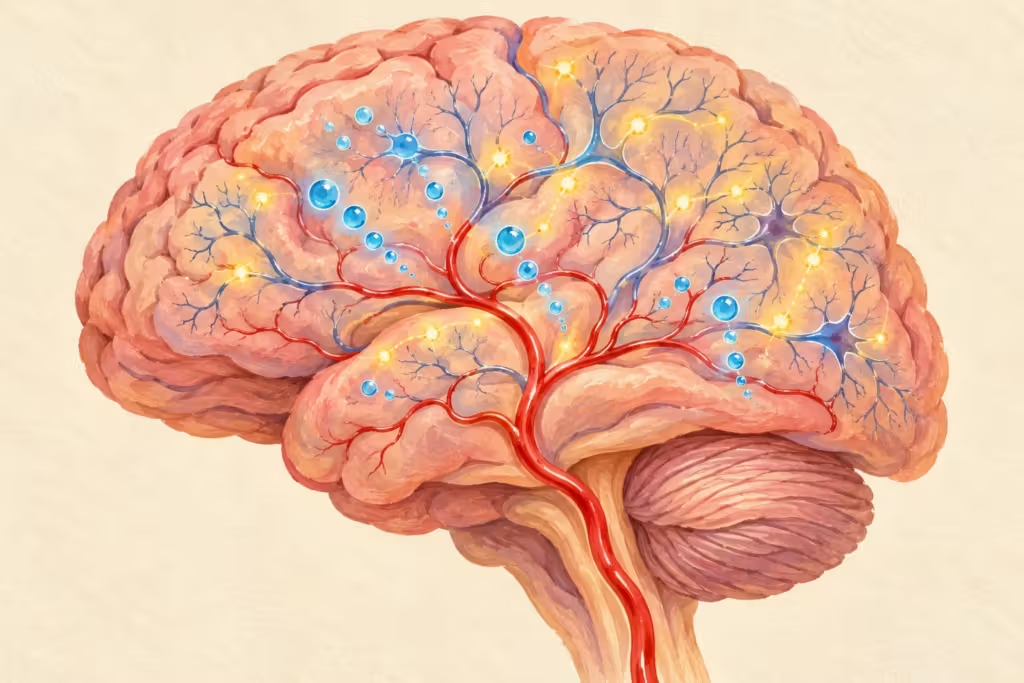
A cardiac arrest is when the heart stops pumping. Then very little blood reaches the brain. It lacks oxygen and it lacks sugar, and carbon dioxide builds up in it. The brain becomes more acidic.
Without oxygen or sugar, neurons cannot make the energy they need to work normally. According to the model, they become overexcited and release, in large amounts, the chemicals they use to communicate with each other. Those chemicals are called neurotransmitters.
This part rests on what is known about how a neuron behaves without oxygen. What has not been measured is this release in a person who later describes an NDE.
For the model, each chemical would produce a different part of the experience.
Step 4
The core of the model · What the model proposes
The peace, the visions, and the memory would come from different chemicals
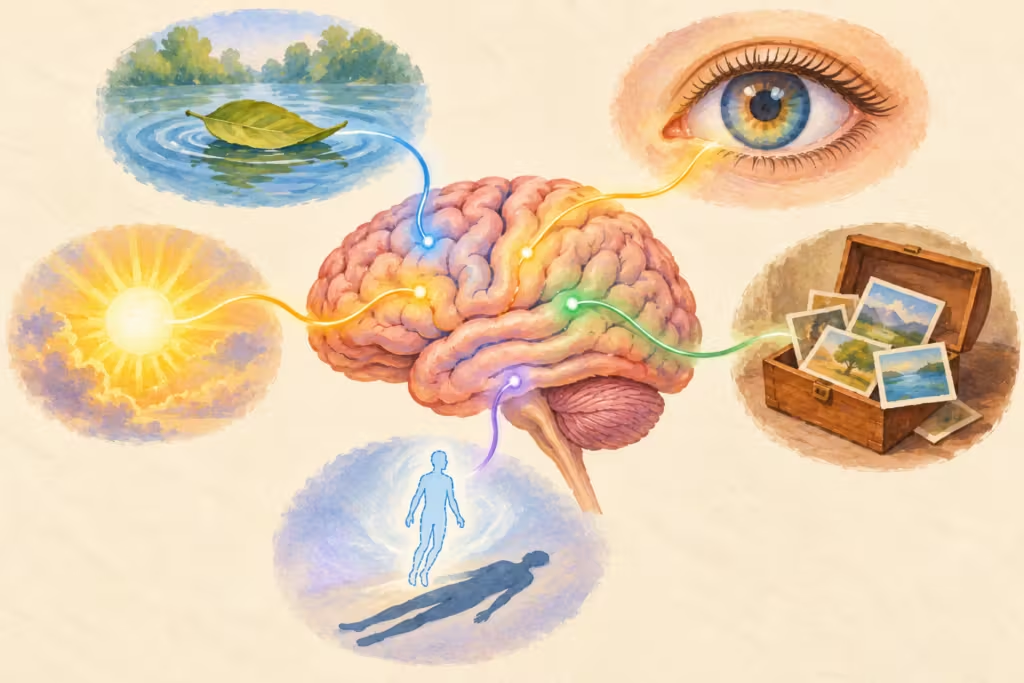
The model divides the features of an NDE among the chemicals the brain releases:
- The peace and calm would come from serotonin, endorphins, and GABA. Endorphins are the body’s own painkillers. GABA is the chemical that slows down the activity of neurons. The authors acknowledge that they do not know whether that peace lasts only as long as the experience or continues afterward.
- The visions would come from serotonin and dopamine. Serotonin acts on the same spot in the brain as LSD or DMT.
- The feeling that everything was more real than reality would come mainly from dopamine.
- Remembering it in such detail would come from noradrenaline, acetylcholine, and glutamate. These are chemicals that help store memories. The authors add that doctors often give adrenaline or noradrenaline during resuscitation, and that this could help the NDE be remembered.
- Feeling separated from the body might come from glutamate. The authors say this part is the least clear.
The most direct evidence comes from rats. In asphyxiated rats, serotonin in the brain reached 100 to 200 times its normal level. Dopamine rose more than sevenfold in one minute. In rats breathing carbon dioxide, noradrenaline rose six- to eightfold in less than a minute and a half.
In people, the evidence is indirect. Some drugs that act on serotonin produce experiences similar to an NDE. We cover this in the study of DMT and NDEs. None of these chemicals has been measured in a person during an NDE.
In 2024, Martial herself surveyed 31 people who had had both an NDE and an experience with one of those drugs. She compared each person’s two experiences. In 27 of the 31, the drug experience reached the score of an NDE. But the feeling of leaving the body was stronger in the NDE, and the images were stronger with the drug.
The article rules out an old idea. In the 1990s, it was proposed that the brain, when in danger, releases a chemical of its own similar to ketamine. The authors write that no evidence has been found that it exists. And they add that blocking what ketamine blocks makes it hard to store memories, while NDEs are remembered very well. Even so, they propose that other changes in glutamate could produce effects similar to those of that drug.
What remained was to explain where in the brain the experience would take shape.
Step 5
The areas of the brain · What the model proposes
An area that places the body in space, and a mix of waking and dreaming
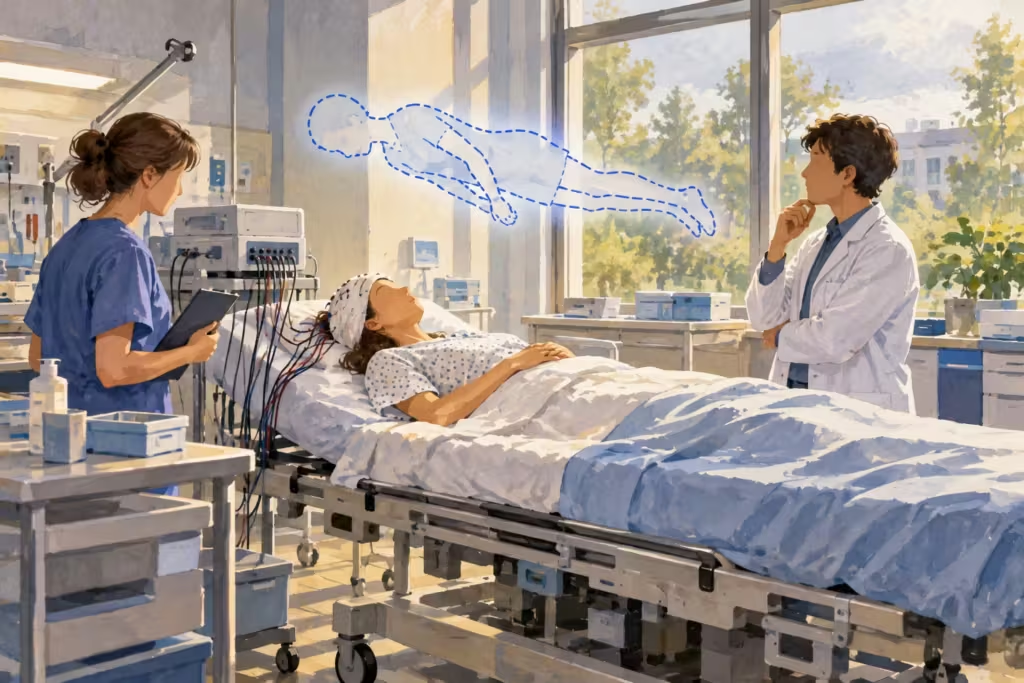
The model points to an area of the brain that sits above the ear. It helps us sense where our own body is. In some patients with epilepsy, doctors stimulated that area with electrodes before operating on them. One patient felt that she was floating and saw herself from above. Another felt that someone was behind her. The authors acknowledge that this does not fully resemble an NDE. They also write that no study has managed to reproduce the complete out-of-body experience that people with an NDE describe. According to them, this may be because those experiments stimulate a single spot, while in an NDE other areas and several chemicals would be acting at the same time. That combination has not been tested.
The second piece is dreaming. In the stage of sleep when we dream, the body goes limp and the brain is very active. Some people have fragments of that stage while awake, for example when waking up. According to the article, this happens to one in four people at some point. The authors write that three studies have shown that people who have had an NDE are “strongly predisposed” to these fragments of dreaming. Those studies find that the two things go together, but they could not tell which came first. Nelson wrote one of them and Kondziella another, and both are also authors of the model. We tell it in Kevin Nelson’s study of NDEs and sleep.
The third piece is a 2024 experiment by the Liège group itself. They made healthy volunteers faint for a short time. Some experienced something similar to an NDE, and in them the brain showed particular slow waves.
The hardest question remained. At what point during the cardiac arrest does the NDE happen?
Step 6
Before, during, or after the cardiac arrest · As the article tells it
The dying brain gives a last burst of activity, but no one could say what they experienced
The article goes over the studies that measured the brains of people and animals that were dying. In rats, when the heart stopped or when they were asphyxiated, the brain’s fast waves grew stronger and fell into sync for a few seconds. In 2023, something similar was seen in 2 of 4 patients in a coma, when the machine that breathed for them was removed. We cover this in the study of gamma waves in the dying brain.
The authors warn that those patients died and no one could ask them anything. That is why it is not known whether they experienced anything.
They also acknowledge three things that are not known:
- When the NDE happens. They write that it is still open whether it happens before, during, or after the cardiac arrest, while the brain recovers.
- Whether what people say they saw really happened. They acknowledge that there are accounts of people who saw things during their NDE. They write that no study has checked them with a rigorous enough method.
- A physical sign of the NDE. They write that none has been found.
They propose looking for the NDE in the minutes when the brain is recovering after resuscitation. A study in rats suggests that the NDE fits that moment better than the moment of the cardiac arrest.
The model still had to explain why some people have an NDE and others do not.
Step 7
The person and evolution · What the model proposes
People who tend to zone out would have more NDEs, and the experience would come from an animal defense

According to the article, some people zone out more easily, like someone who daydreams. The authors say these people report more NDEs. They base this on a study that followed patients after a long stay in the ICU. They acknowledge that this part is speculative. The other studies on this tendency asked people a long time afterward. And even in the ICU study, people were asked after the experience. That is why it is not known whether this tendency was already there before or changed afterward.
They also believe that what each person knows and believes before the experience plays a part. That would help them make sense of what they went through.
The last piece is evolution. Some animals play dead in front of a predator and stay still. In 2021, a group that included Kondziella and Martial proposed that the NDE comes from that defense. To link the two, the model uses serotonin. The spot in the brain where serotonin acts to calm has changed very little from insects to humans.
This piece has drawn criticism from within science itself. In 2026, the researcher J. A. Delgado-Ron reexamined the 2021 study. According to him, only 14 of every 100 NDEs in that study happened during something similar to a predator attack. He adds that playing dead starts with fear, while an NDE usually starts with peace.
With all the pieces together, the authors wrote their conclusion.
Step 8
2025 · The conclusion · As the article tells it
The authors call it a comprehensive explanation, and at the same time admit it is theoretical
The model is called NEPTUNE. The name stands for “Neurophysiological Evolutionary Psychological Theory Understanding Near-death Experience.” According to the model, the cardiac arrest leaves the brain without oxygen and without energy. The neurons release their chemicals, and each chemical produces one part of the experience. Each person’s character and evolution do the rest.
At the start of the article, the authors write that data from several fields are coming together to provide “a comprehensive explanation for NDEs.” At the end, they write this:
“Our NEPTUNE model, although theoretical at present, provides a foundation for the next research phase, which will entail empirical testing of each mechanism.”
They also acknowledge two more limits. They do not know what combination of pieces is needed for an NDE to happen. And the model does not explain every feature, such as the sense of knowing what is going to happen.
Seven months later came the most extensive reply to the model.
Step 9
October 2025 · As the critics tell it
Greyson and Pehlivanova reply that the model leaves out data that do not fit

Bruce Greyson is a psychiatrist at the University of Virginia who has studied NDEs for decades. He signed the reply with his colleague Marieta Pehlivanova. They begin by acknowledging that bringing all the explanations together into one model is an “admirable” effort. Then they give their reasons against the model. These are the main ones:
- The gases in the blood. According to them, people who describe an NDE did not have less oxygen or more carbon dioxide than others. The study they cite had 4 people with an NDE, and its own authors wrote that this was too few to draw conclusions. Greyson and Pehlivanova acknowledge that a 2010 study did find more carbon dioxide in those who had an NDE. In their view, more carbon dioxide could help people remember the experience, and that does not show that it produces the experience.
- The area above the ear. According to them, in those experiments the person still sees the room from inside their own body. If they see an image of themselves, that image does not move. In an NDE, by contrast, the person says they move around the room. Also, the stimulation is felt as an illusion, and the NDE as something very real. The patient in step 5 did say she saw herself from above. What no one has managed this way is to see something that could not be seen with the eyes.
- Dreaming. According to them, people who have had an NDE do not report these fragments of dreaming more often than the general population. They base this on a 2009 book chapter that Greyson wrote with two other authors. The three studies in step 5 did find more. Also, there are NDEs under general anesthesia, which suppresses that stage of sleep.
- The burst of activity when dying. They write that in those studies the heart kept beating the whole time and no one reported anything. One of the 2023 patients had a 33-second pause of the heart. But the burst of activity came earlier, while the heart was beating. During the pause, the fast waves did not rise, though they stayed in step with the slow ones. We explain this in the study of gamma waves.
- When the NDE happens. According to them, some people describe things that were checked afterward and that happened while they were unconscious. That would place the experience at that moment. The main example they cite is that of Eben Alexander. According to the medical report, it was on day 9 that he told what he had seen, four days after the visit he described. And what he described was some people praying beside his bed, something that can also be heard.
- Hallucinations. The model calls the visions hallucinations. They reply that the hallucinations the brain produces usually involve a single sense and are frightening. They add that NDEs are remembered for decades.
- The peace. According to them, the calm from endorphins lasts from minutes to hours, and the peace of the NDE ends when the experience ends.
- The AWARE II study. They point out that the people who had an NDE were not wearing the device that measures the brain, and those who were wearing it reported nothing. Only 2 of the 28 people interviewed were wearing that device. With two people, it is not possible to decide whether those waves go along with NDEs. We cover this in AWARE II.
- What the model does not explain. They mention people who say they saw things during their resuscitation that were checked afterward. They also mention people who say they saw someone who had died, without knowing that this person had died.
- Leaving out the other explanation. In their view, the idea that experience comes only from the brain is a philosophical idea, not a principle of neuroscience.
Greyson and Pehlivanova do not deny that the body plays a part. They write that NDEs usually begin with something physical, but that this alone is not enough to explain them.
In August 2025, the same journal that published the model published two critical letters. One was by Engmann and was titled “Perils and pitfalls of near-death experience research.” The other was by O’Grady and Varghese and was titled “Limitations of neurocentric models for near-death experiences.” Martial’s team replied to both.
The question from the start remains: does the brain, on its own, explain everything people experience in an NDE? Let’s look at what is known and what is not.
Where each piece was measured
These are the figures the article gives for its most direct evidence. None was measured during an NDE.
| What | Where | Figure |
|---|---|---|
| Rise in serotonin in the brain | asphyxiated rats | 100 to 200 times |
| Rise in dopamine in one minute | asphyxiated rats | more than 7 times |
| Rise in noradrenaline in 30 to 75 seconds | rats given carbon dioxide | 6 to 8 times |
| Patients with a burst of activity when dying | 4 patients in a coma | 2 |
| People who experienced it and could describe it | in all these studies | 0 |
What these figures don’t tell
- A rat cannot describe an NDE. The rises were measured in animals that could not say what they were experiencing.
- Rising is not causing. That a chemical rises in a brain without oxygen does not show that it produces the peace or the visions.
- How many people have an NDE is not part of the model. According to the article, between 10 and 23 of every 100 people resuscitated after a cardiac arrest report one. More figures in How many people have a near-death experience?
Frequently asked questions
What is the NEPTUNE model of near-death experiences?
It is a model published in 2025 by Charlotte Martial and her team at the University of Liège in the journal Nature Reviews Neurology. It proposes to explain NDEs through the brain. According to the model, a lack of oxygen makes the brain release its own chemicals, and each one would produce one part of the experience. Its authors call it theoretical.
Does the NEPTUNE model show that NDEs are produced by the brain?
No. The model brings together evidence measured in rats, with drugs, with fainting, and in patients who died without being able to report anything. No piece has been measured during an NDE, and its authors say the next step is to test them. Nor does it show that consciousness works outside the brain.
What do Greyson and Pehlivanova criticize about the NEPTUNE model?
Bruce Greyson and Marieta Pehlivanova, from the University of Virginia, say the model leaves out studies that do not fit with it. They also say it does not explain the people who report having seen things, later checked, while they were unconscious. And they criticize it for setting aside, without testing it, the idea that the mind can work outside the body.
Does the NEPTUNE model explain when the NDE happens?
No. Its authors write that it is still open whether the experience happens before, during, or after the cardiac arrest. They propose looking for it in the minutes when the brain is recovering after resuscitation. Greyson and Pehlivanova reply that some people describe things that happened while they were unconscious, and that this would place the experience at that moment.
Why does the NEPTUNE model leave out the idea that the mind leaves the body?
The authors write that neuroscience has no evidence for that idea and that, according to a principle of that science, experience arises from the brain. Greyson and Pehlivanova reply that this is a philosophical idea, not a fact.
Where this page comes from
The study
- Charlotte Martial, Pauline Fritz, Olivia Gosseries, Vincent Bonhomme, Daniel Kondziella, Kevin Nelson, and Nicolas Lejeune, “A neuroscientific model of near-death experiences,” Nature Reviews Neurology 21, 297–311 (2025)Read for free
Assessments and critiques
- Bruce Greyson and Marieta Pehlivanova, “A neuroscientific model of near-death experiences reconsidered,” Psychology of Consciousness (2025)Read for free
- J. A. Delgado-Ron, “Reappraising the claims of evolutionary continuity between thanatosis and near-death experiences,” Brain Communications (2026)Read for free
- The letters by Engmann and by O’Grady and Varghese, with the replies from Martial’s team, Nature Reviews Neurology 21, 461–464 (2025)View in the journal (paywalled)
To understand more
- DMT and NDEs: 13 volunteers and 165 drugs comparedRead
- Gamma waves in the dying brain: 9 rats and 4 patientsRead
- AWARE II: the brain measured during resuscitationRead
- What does science say about near-death experiences?Read
Our archive
- A full reading of the article by Martial and her team and of the reply by Greyson and Pehlivanova, compared page by page, as of October 29, 2026
More studies
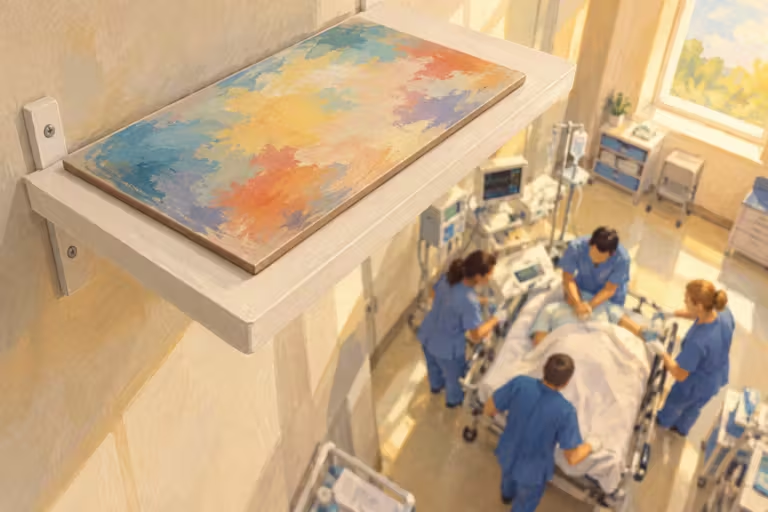
AWARE: the pictures hidden on the shelves
Fifteen hospitals put up pictures that could only be seen from the ceiling, to check whether anyone saw them during a cardiac arrest.
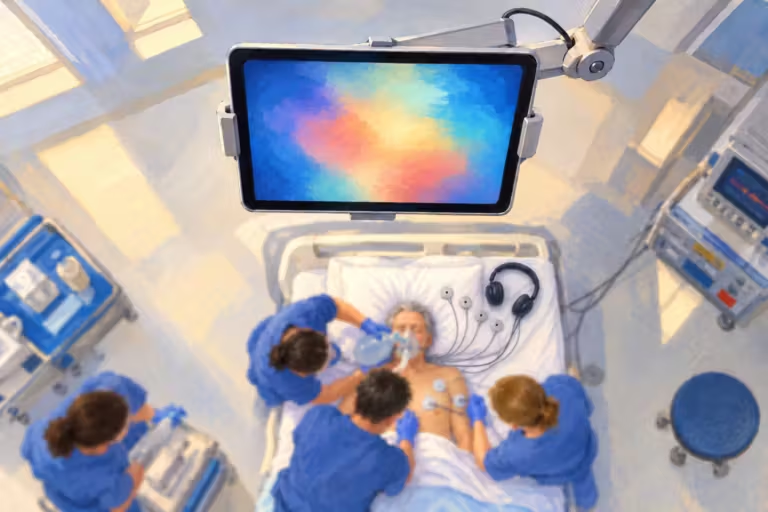
AWARE II: a random picture and the brain on the screen
Above the patient was a tablet with a random picture. Headphones said the names of three fruits. And the doctors measured the brain during resuscitation.
Van Lommel: 344 cardiac arrest survivors in ten hospitals
Ten hospitals asked every cardiac arrest survivor what they remembered. They saw them again after 2 and 8 years.