
A real-life story · Virginia, United States, 2008
Eben Alexander’s near-death experience
Eben Alexander is an American neurosurgeon. In November 2008 he spent a week in the hospital with a very severe case of meningitis. He was in a coma for most of that time. He later said that he had no memory of who he was, and that he traveled through a valley full of light alongside a young woman with blue eyes. He also said that months later he recognized that young woman in a photo of a birth sister he had never met.
It is one of the best-known NDEs in the world. His book, Proof of Heaven, has been read in many countries. And it is one of the few cases in which three doctors reviewed his medical records and published an article about the case. But what stands out most is the young woman in the valley. What can be checked about her?
Step 1
Before · Up to 2008 · Eben’s account
An adopted neurosurgeon searches for his birth family
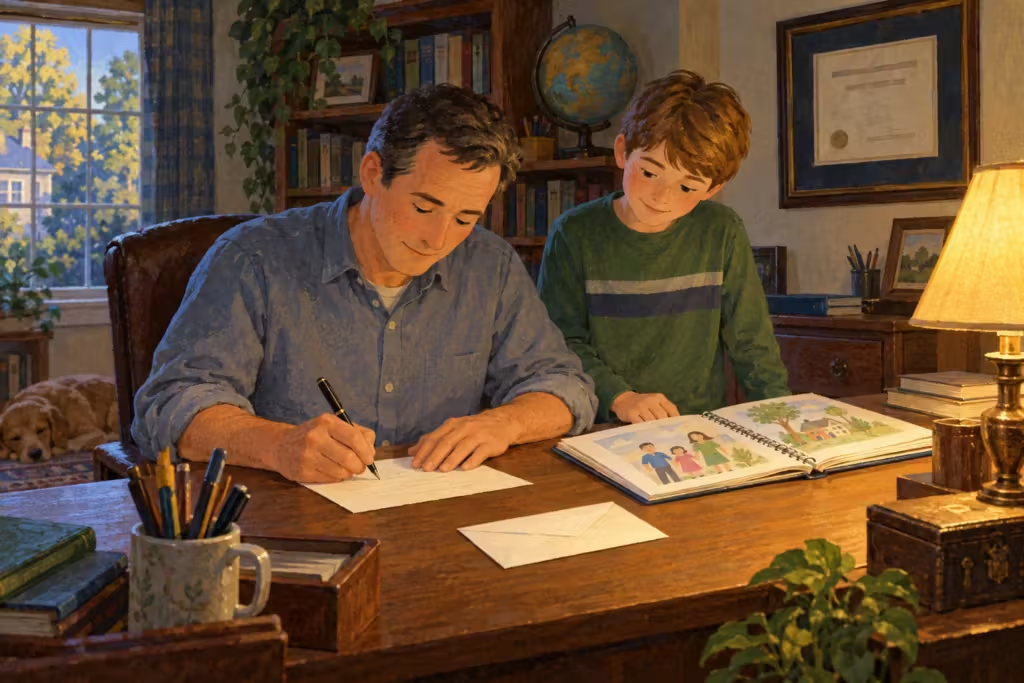
Eben Alexander is a neurosurgeon. He is a doctor who operates on the brain. He spent more than fifteen years teaching at Harvard Medical School, in the United States. He is married and has two sons.
He says that back then he thought the way many scientists do. He believed that the brain produces consciousness. He went to church as a young man, but he couldn’t see how anything could survive the death of the body.
He was adopted. His birth mother was 16 when he was born. Another family raised him. His adoptive father was also a neurosurgeon, and he died four years before this story.
In February 2000, his older son has to do a school project. Because of that project, Eben writes to the agency that handled his adoption. The agency gives him news he didn’t expect. His birth parents had married and had three more children. Their youngest daughter died in 1998, and the family is still grieving. They tell him it is not a good time to come forward.
He takes it as a rejection. He stops praying and stops taking his sons to church.
A year before he falls ill, he finally meets his birth family and spends time with them. That is how he learns that he had a sister, Betsy, who died in 1998. His family says she was “an angel.” Kathy, another sister, promises him a photo of Betsy. Eben never got to meet Betsy.
Step 2
November 10, 2008 · Morning · At home
He wakes up with a severe headache and within hours stops responding
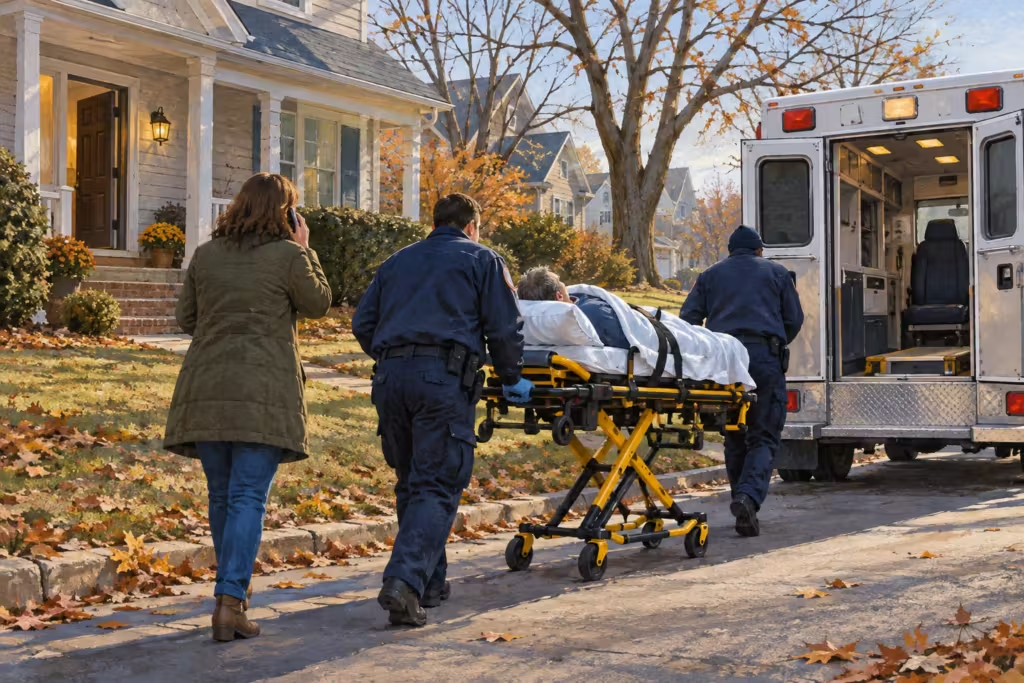
Eben is 54 and healthy. That morning he wakes up with severe pain in his head and back.
Before long he is confused and barely responds. When he starts having seizures, his wife calls an ambulance. The seizures continue on the way.
Eben says he was already in a deep coma two or three hours after the pain began.
He is taken to the emergency room of the hospital in Lynchburg, Virginia. That is where the tests begin.
Step 3
November 10 · In the emergency room · From his medical records
In the emergency room, doctors find he has a very rare meningitis
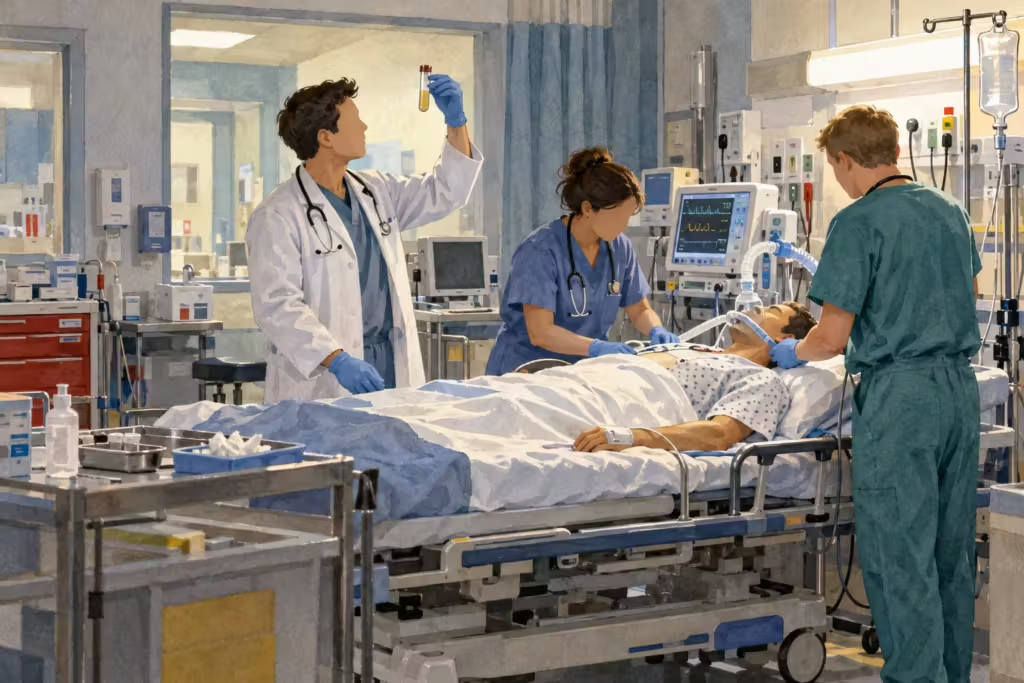
He arrives disoriented. He doesn’t speak and doesn’t respond when spoken to. Doctors measure how responsive he is with the Glasgow Coma Scale. A person who is awake and normal scores 15. The lowest score is 3. Eben scores 11.
They put a tube down into his lungs so that a machine can help him breathe. They also draw fluid from his back to test it. It is the fluid that surrounds the brain. It comes out cloudy and with almost no sugar. The doctors who later reviewed his medical records say this points to an extremely severe meningitis, with little chance of a full recovery.
Meningitis is an infection of the layers that wrap around the brain. His is caused by a bacterium, E. coli. In a healthy adult it is very rare.
He is given antibiotics and also sedatives, drugs that calm a person and put them to sleep. He is moved up to the intensive care unit, the ICU.
Because of the sedatives, it is harder to know how much of his coma was due to the illness and how much to the drugs.
Step 4
Days 1 to 5 · In a coma, in the ICU · From his medical records
He spends five days in a deep coma, sedated and with a breathing tube
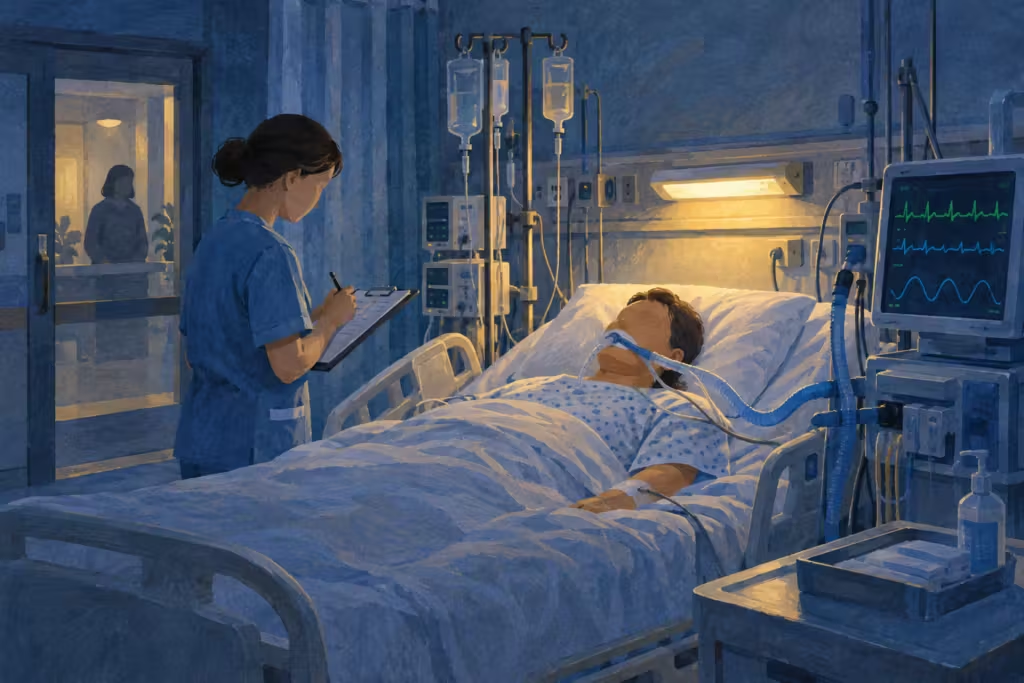
His Glasgow score is checked twice a day. He scores 6 or 7. That is a deep coma. His pupils are tiny, like the point of a pin. He barely reacts when someone rubs his chest hard.
An infectious disease specialist estimates that, with what he has, more than 97 out of 100 people would die.
He is kept on sedatives. They don’t run an electroencephalogram, the test that measures the brain’s electrical activity. His doctors don’t think it would help them decide anything.
Years later, the doctors who reviewed his medical records wrote that it is impossible to know how much of his unresponsiveness was due to the meningitis and how much to the sedatives.
On the fifth day, something happens in his room. Some people who are not family pray at his bedside. His family and the hospital staff say that this happened. In that ICU, usually only family members come in. Eben is in a deep coma.
Step 5
In a coma · Eben’s account
Eben says he didn’t know who he was and that a light with music pulled him out of a dark place

Eben remembered nothing of his life. He did not remember his name, or Earth, or words. “It was an empty slate,” he says.
It all begins in a place he calls “the earthworm’s-eye view.” It is primitive and murky, like dirty jelly. Around him he senses something like roots, or blood vessels. It seems to go on for a very long time.
Then a pure white light arrives. It spins slowly, and threads of silver and gold surround it. With the light comes a melody.
The light carries him upward, as if through a doorway.
Step 6
In a coma · Eben’s account
Eben says he flew over a valley on a butterfly’s wing

He reaches a place he calls “the Gateway Valley.” Below him is a green meadow full of flowers and buds. A forest surrounds it. He sees nothing dead or withered.
He has no body. He is “a speck of awareness” on a butterfly’s wing, among millions of butterflies flying in spirals.
In the meadow, thousands of beings dance with joy. Above, choirs sing chants and hymns that thunder through him.
He says all of it was more real than this world.
And he was not alone on the butterfly’s wing.
Step 7
In a coma · Eben’s account
Eben says a young woman with blue eyes went with him and spoke to him without words

Beside him is a very beautiful young woman. In his interviews he describes her with bright blue eyes, high cheekbones, a broad forehead, and a big smile.
She never says a word to him. Eben says she doesn’t need to, because the message reaches him directly, through emotion. Weeks after he woke up, he put it into words like this:
“You are deeply loved and cherished forever. You have nothing to fear. You are cared for.”
Eben doesn’t know who she is. He says he had never seen her before.
His adoptive father, who died four years earlier, doesn’t appear either. “If I had scripted it, he would have been there front and center,” he says.
That young woman is the best-known part of his story. How did Eben describe her before he knew who she was?
Step 8
In a coma · Eben’s account
Eben says he rose to a black place full of love

The choirs open another doorway for him, and he rises higher. He says he sees space and time fall apart.
He reaches what he calls “the Core.” It is an endless blackness, like ink. But it is filled to overflowing with love, and to him that love was God.
Eben says he has visions there. They teach him that souls are born again many times. He says he had never studied the subject.
He goes back and forth several times between the valley and the Core. To rise, he remembers the melody.
But each time he is told the same thing: “You’re not here to stay.”
Step 9
At the end of the coma · Eben’s account
Eben says thousands of beings were praying and that at the end he saw six faces
There comes a point when remembering the melody no longer works. He gets stuck down below, in the murky place where it all began.
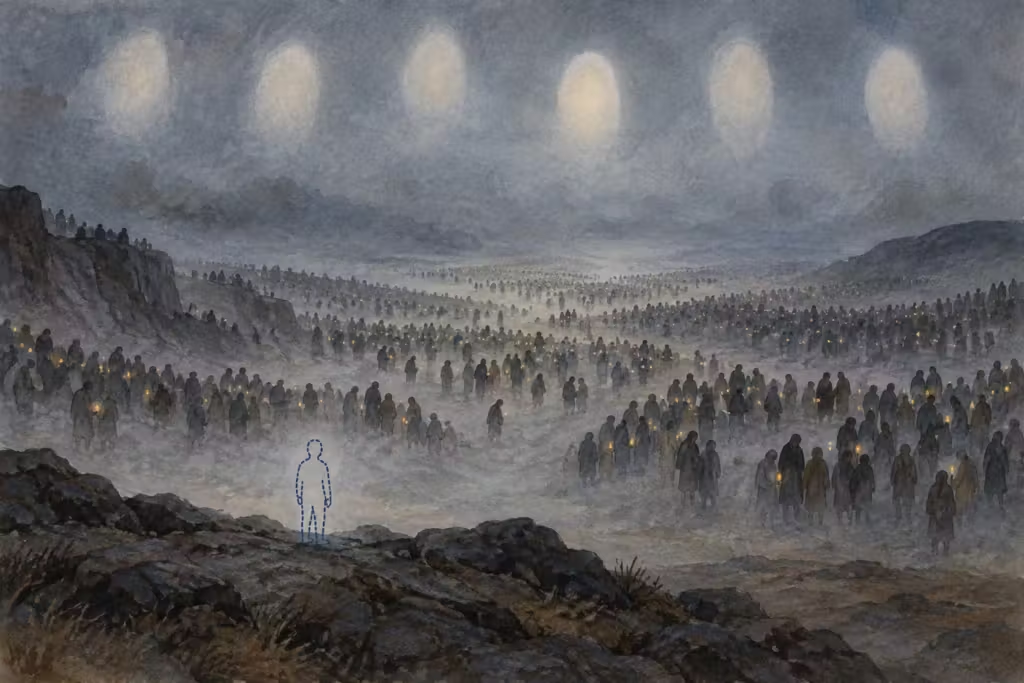
Then, in the distance, he sees thousands of beings with their heads bowed. Some are holding candles. An energy like a murmur comes from them. He feels enormous comfort, as he did in the valley.
Weeks later he wrote it down and called it “the power of prayer.”
The last thing he sees is six faces. They say words he doesn’t understand, and then they disappear.
Later he came to think they were people who had been in his ICU room during the last 24 or 48 hours of the coma. That is why he believes almost all of his journey took place in the first four or five days.
The sixth face was a child’s.
Step 10
Days 6 and 7 · He wakes up · Eben’s account and his medical records
Eben says his ten-year-old son opened his eyes and asked him to come back
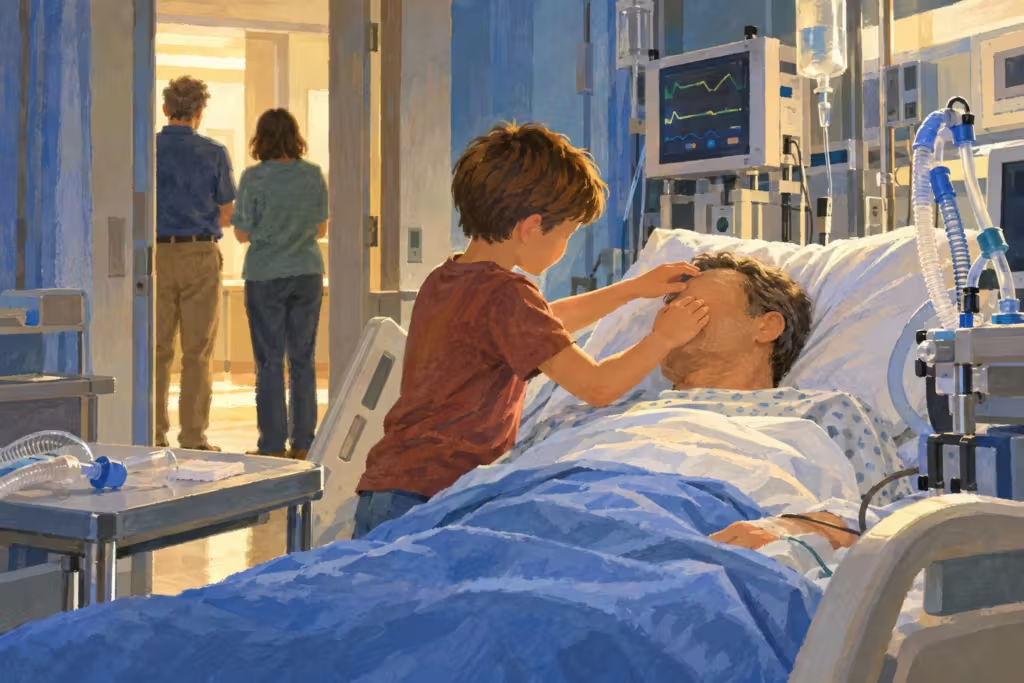
According to Eben, on the seventh day the doctors gather the family. They say his chances of survival have dropped from 10% to 2%. They don’t expect him to recover. They suggest stopping the antibiotics.
His younger son, Bond, is ten. He overhears and runs down the hallway to the bed. He lifts his father’s eyelids and says: “Daddy, you’re gonna be okay.”
Eben says he didn’t hear it with his ears or see it with his eyes. But the plea got through to him, and he felt he had to come back.
When he opens his eyes, he sees his mother, his sisters, and his sons. He doesn’t recognize any of them.
His medical records describe those days this way. On the sixth day the breathing tube comes out. On the seventh day he improves a great deal. He recognizes his family and his colleagues, although he keeps asking the same questions over and over.
Eben also describes something else. After the tube came out, he spent 36 hours in the ICU in a nightmare of fear and persecution. He says he knew it was an illusion, and that those memories faded within a few weeks. He says the memories of the journey have never faded.
Step 11
Day 9 and the days after · From his medical records and Eben’s account
He tells his family and his doctors that he saw some people praying at his bedside
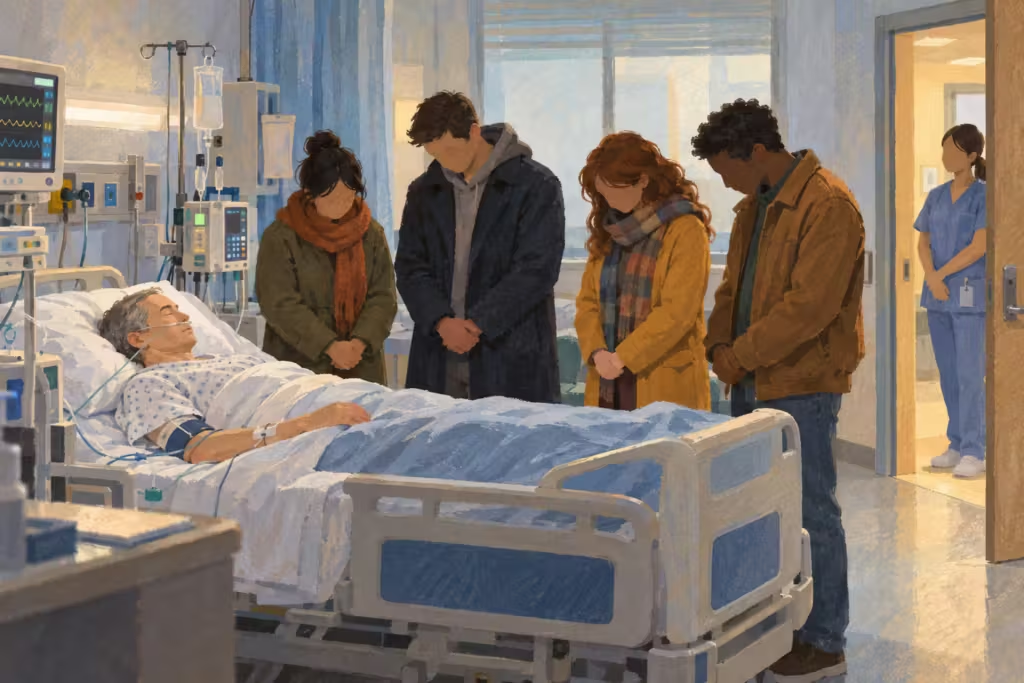
According to his medical records, on the ninth day Eben says he has had a near-death experience. He tells his family and his doctors that he saw specific people praying at his bedside. Those people were not family.
He is talking about the visit on the fifth day. His family and the hospital staff confirm that it happened.
By then he had been awake for two or three days, talking with his family. And his family knew about that visit.
When he tries to describe his journey, a fellow doctor pats him on the back and tells him his brain had been soaked in pus. They tell him that a dying brain plays tricks. At first, he agrees with them.
But to his older son he says something else: “It was way too real to be real.”
Step 12
From late November 2008 · At home · Eben’s account
Eben says he wrote 20,000 words before reading about anyone else’s experience

He is discharged from the hospital. Two days later it is the day before Thanksgiving. That day his older son comes home. He is studying the brain in college.
His son gives him some advice. He tells him to write down everything he remembers before reading about other people’s near-death experiences. Eben says that until then he had never read about the subject.
He takes the advice. He says that in six weeks he wrote about 20,000 words.
That text would help check his story, because it would come before what happened later. But it has not been published. No one has been able to see when it was written.
Meanwhile, his memory slowly comes back. Words come back within hours or days. Memories come back within weeks. His medical knowledge comes back in about two months. At two months, his neurologist writes that he has fully recovered.
And a few months later, a photo arrives.
Step 13
About four months after the coma · Eben’s account
Eben says he recognized the young woman in a photo of a birth sister who had died

Kathy is one of his birth sisters. She had promised him a photo of Betsy, the sister who died in 1998. At last she sends it.
Eben says that seeing it moved him deeply: “She just looked so, so familiar.”
The next morning he is reading a book by the psychiatrist Elisabeth Kübler-Ross. The book tells the story of a girl who meets a brother while she is in a coma. When the girl wakes up, her father tells her that the brother was real. The brother died before she was born, and they had never told her about him.
When he opens the envelope, the face seems strangely familiar to him, but he thinks it is because they are siblings. In his book he writes that at first he did not recognize her as the young woman in the valley. The photo did not have the blue dress or the light of the valley.
He looks up at Betsy’s photo. “I knew exactly who had been on the butterfly wing.”
After that, he calls his birth family every week to learn more about her. They tell him that she took in stray dogs and cats, and that she worked at a rape crisis center. They also tell him that many people said she was an angel.
His birth family knows on its own that Betsy existed and died in 1998. But only Eben can say that the young woman in the valley had her face. And before the coma, he already knew that he had a sister who had died and that her photo was coming.
Step 14
From 2012 on · Eben’s account, a magazine article, and a medical report
His book is read around the world, and his coma is debated

In 2012 he publishes Proof of Heaven. It sells widely. According to him, it has been translated into more than 40 languages.
In 2013, the journalist Luke Dittrich publishes an article in Esquire magazine. For the article, he talks to Laura Potter, the doctor who treated Eben in the emergency room. She says they couldn’t even take his pulse or his blood pressure. For his own safety, she decided to put him to sleep with drugs and connect him to the breathing machine. She says that in the ICU they kept him on sedatives, and that Eben became agitated and tried to shout every time they lowered them. She calls that state “conscious but delirious.” Eben replies that he stands by every word of his book.
The researcher Robert Mays responded to the article in 2013, in a report for the association that studies NDEs. In 2016 he published it in a journal. Mays says that people close to Eben’s family told him the doctor felt her words had been taken out of context. He also says he removed one of her quotes from his text because she asked him to. The doctor has not said anything in public about the article.
In 2018, three doctors who had not treated him review his medical records and publish the case in a medical journal. They write that his brain was already getting worse before the sedatives and began to improve before they were stopped. But they add that it is impossible to know how much of his unresponsiveness was due to the sedatives and how much to the meningitis.
Today Eben meditates for an hour a day or more, gives talks, and has written more books. His message is that consciousness does not end with the death of the body.
One question remains about the young woman on the butterfly’s wing: how did Eben describe her before he saw Betsy’s photo?
How many people have an NDE in intensive care?
Eben is not the only one. And the heart doesn’t have to stop for someone to have an NDE. Eben’s heart did not stop. He spent about six days in intensive care. A team at a hospital in Liège, Belgium, surveyed every patient who left intensive care after more than seven days.
Picture 100 of those people:
Each dot is one person. The 15 filled dots are the ones who reported a near-death experience: 19 of 126 patients, in a study published in 2023.
Of those 19 people, only one had had a cardiac arrest. NDEs were more common among patients who had been sedated or on a breathing machine, as he was, than among the others.
What these figures don’t tell you
- Few people survive an illness like his. Between 1982 and 2006, a hospital in Barcelona studied 40 adults with meningitis caused by bacteria of this kind. Of them, 53% died in the hospital.
- It is a single hospital. The Liège figure comes from one hospital and one particular group of patients. Elsewhere it may be different.
- Only those who can talk about it are counted. People who died or who remembered nothing are left out.
There is more on this, with other studies, in How many people have a near-death experience? Eben’s case stands out for two reasons. His coma is documented in medical records that were reviewed and published. And he says he recognized a sister he never met when he saw her photo.
Frequently asked questions
Has Eben Alexander’s near-death experience been debunked?
It hasn’t been disproved. It hasn’t been proven, either. In 2013, the doctor who treated Eben in the emergency room spoke to Esquire. She said Eben was “conscious but delirious” whenever his sedatives were lowered. Eben replied that he stands by every word of his book. We explain this in “What can be checked.”
Was Eben Alexander’s brain shut down during his coma?
No one knows. Eben had a very severe case of meningitis and spent five days in a deep coma. But he was also given sedatives, and no one ran the test that measures brain activity. In 2018, three doctors reviewed his medical records. According to them, his brain was already getting worse before the sedatives. But they also say it’s impossible to know how much of his coma came from the meningitis and how much from the sedatives.
Was Eben Alexander an atheist before his near-death experience?
By his own account, he was not entirely an atheist. Eben Alexander grew up going to a Methodist church, but as a neurosurgeon he couldn’t see how anything could survive the death of the body. In 2023 he said that before his coma he had stopped praying and no longer knew whether God existed. Even so, he says he wasn’t “totally atheistic.”
What is heaven like, according to Eben Alexander?
Eben Alexander says he reached a green valley full of flowers and butterflies, which he calls “the Gateway Valley.” He also says he rose to an endless black place filled with love, which he calls “the Core.” To him, that love was God. We tell it step by step in his story.
What books has Eben Alexander written?
The best known is Proof of Heaven (2012), where he tells the story of his experience. He has written others since, such as The Map of Heaven (2014), with Ptolemy Tompkins, and Living in a Mindful Universe (2017), with Karen Newell. Proof of Heaven is listed in the sources at the end.
Where this story comes from
Books
- Eben Alexander, La prueba del cielo (Zenith, 2024), the Spanish edition of Proof of Heaven (2012)Buy the book
Interviews
- Eben Alexander on Experiencias Cercanas a la Muerte [Near-Death Experiences] (2025): when he wrote down his account, and his sister’s photo; dubbed into Spanish
- Eben Alexander on The Other Side en Español (2023): his full account, dubbed into SpanishWatch on YouTube
- A conversation with the physician Manuel Sans Segarra (2025), dubbed into SpanishWatch on YouTube
- Next Level Soul (2023): his birth family, the coma, and his son BondWatch on YouTube
- Afterlife TV (2015). He tells the story of Betsy’s photo starting at minute 54Watch on YouTube
The medical report
- Surbhi Khanna, Lauren Moore, and Bruce Greyson (2018), the review of his medical records, Journal of Nervous and Mental DiseaseRead for free
What has been debated about the case
- Luke Dittrich, “The Prophet,” Esquire (August 2013), with the interview with the emergency room doctorRead for free
- NBC News (July 2, 2013), on the article and Eben’s responseRead for free
- Robert Mays (2016), a response to the article, Journal of Near-Death StudiesRead for free
Studies
- Bruce Greyson and Marieta Pehlivanova (2025), Psychology of ConsciousnessRead for free
- Rousseau, Martial, and others (2023), NDEs in an ICU in Liège, Critical CareRead for free
- Pomar and others (2013), meningitis caused by these bacteria at a hospital in Barcelona, BMC Infectious DiseasesRead for free
Learn more
- What does science say about near-death experiences?Read
Our archive
- His record, with his interviews, and our assessment of what he described, as of October 11, 2026
Keep reading
Seville, 2010
Emilio Carrillo
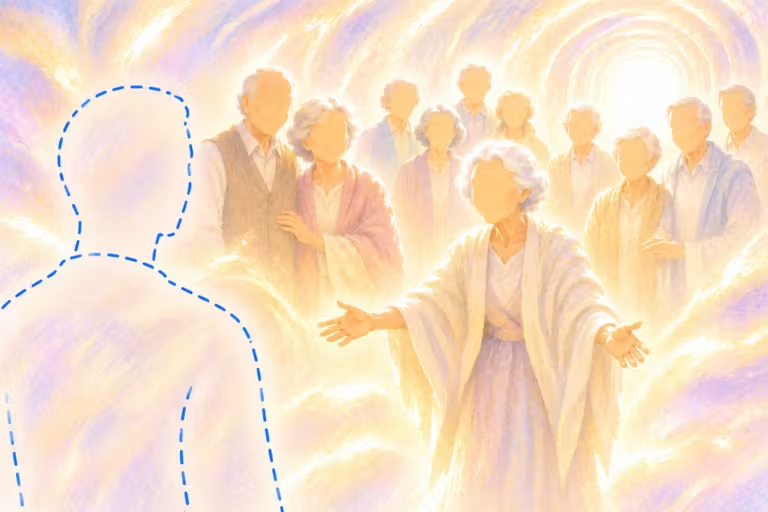
Emilio Carrillo says that in 2010, in the ICU, he saw his dead parents and his aunt María, whom he believed to be alive. According to him, the aunt had died that same day.
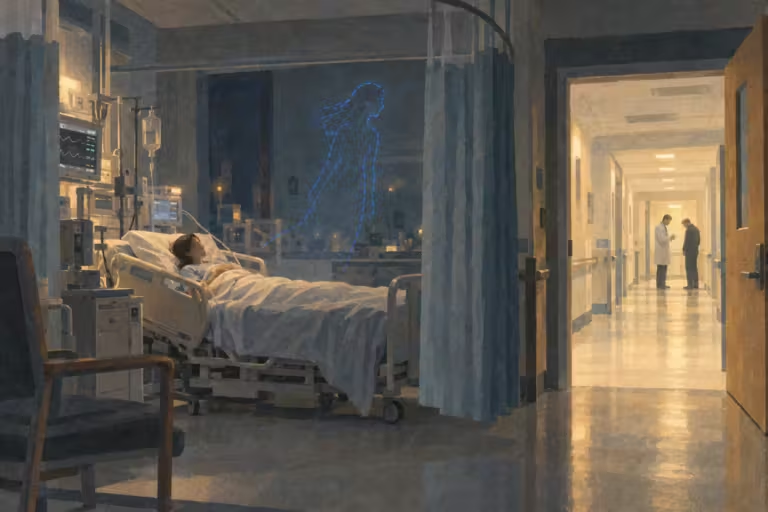
Hong Kong, 2006
Anita Moorjani
Anita Moorjani was in a coma from cancer. She says she heard a doctor in the hallway tell her husband she would not survive the night. The coma is in her medical records. The doctor’s words appear only in Anita’s own account.
Virginia, United States, 1973
Holly
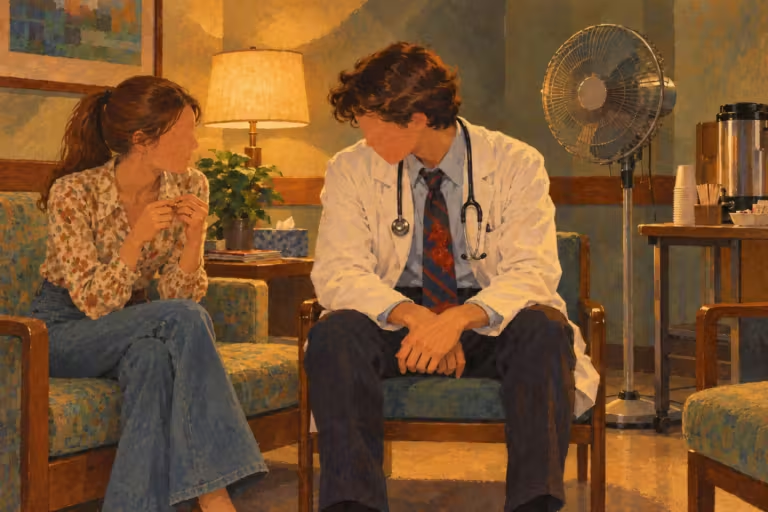
Holly was unconscious in the emergency room after an overdose. She later said she had seen her doctor talking with her roommate in another room. And she said the doctor’s tie had a tomato stain on it.

Reincarnation: The top 5 people who remember past lives
We asked them the same five questions as this story. A 32-page PDF, free in your inbox.
Check your email
We have sent you an email. Open it and press the button to confirm. If you cannot see it, check your spam folder.