A real-life story · Virginia, United States, 1973
Holly’s near-death experience
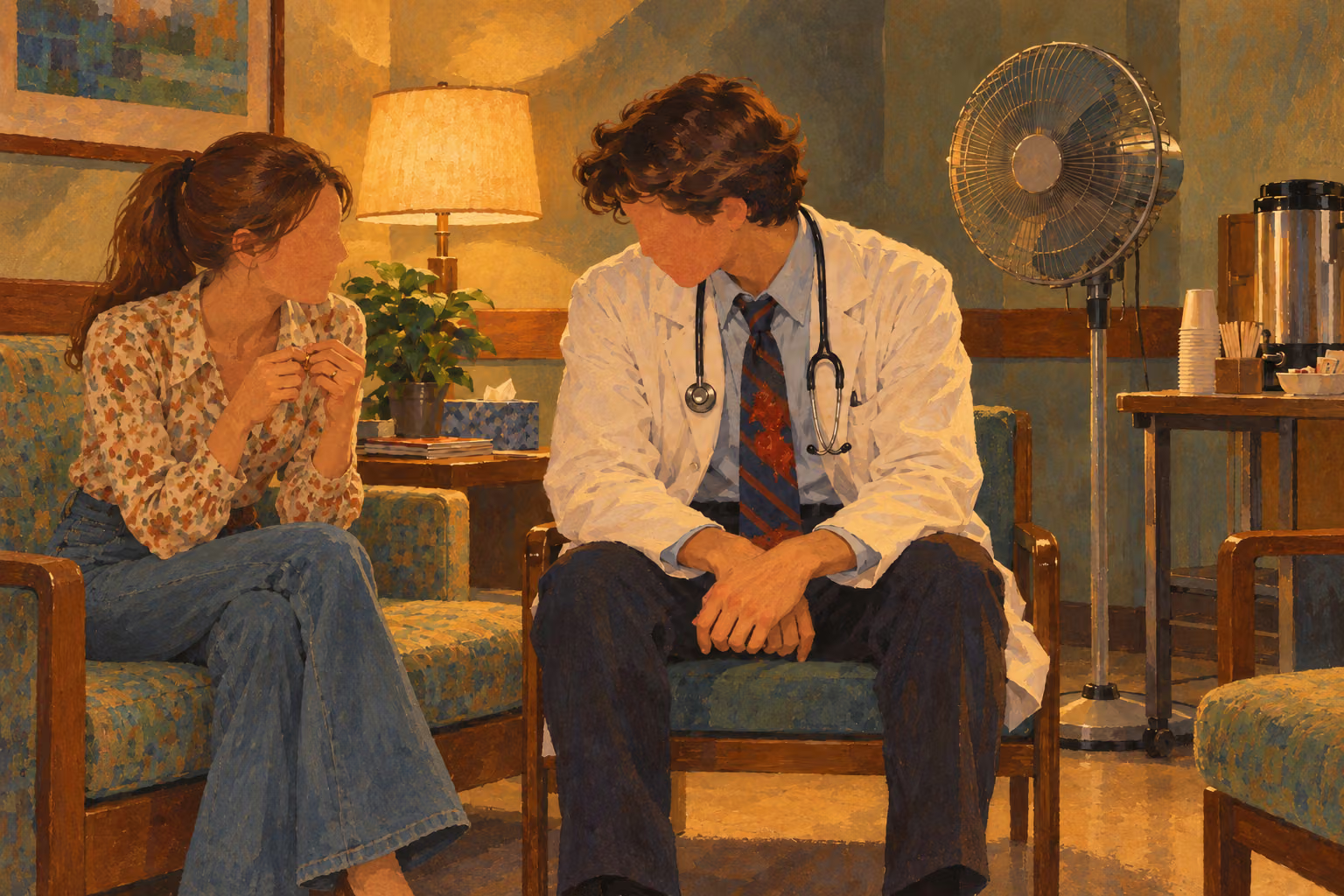
In 1973, Holly was a first-year college student. She was brought to the emergency room unconscious after an overdose. The next morning, Holly told the doctor who had seen her that she had watched him in another room, talking with her roommate. She also told him he had been wearing a tie with a red stain on it.
Bruce Greyson is a psychiatrist who has spent decades studying these experiences. For him, it all began with Holly’s story and with a tomato stain on his own tie. This is how Greyson tells it, fifty years later. How could Holly know what happened in a room she wasn’t in?
Step 1
A late-summer evening · In the hospital cafeteria · Bruce Greyson’s account
Greyson says he stained his tie with tomato sauce when his pager went off
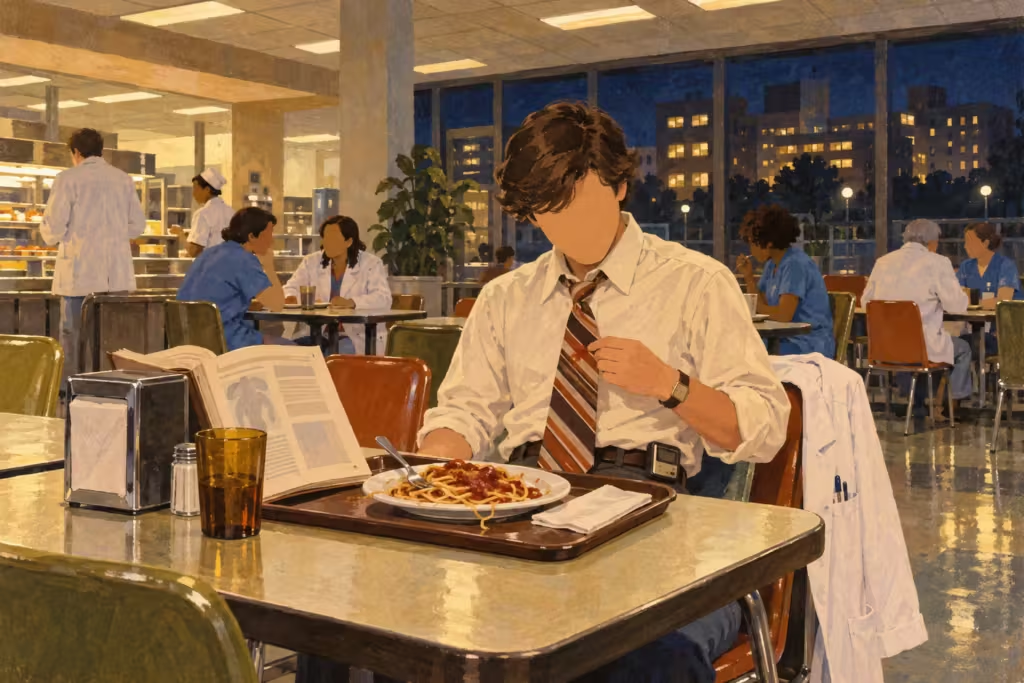
Bruce Greyson had just finished medical school. For a few months he had been working as a psychiatry intern at a hospital in Virginia, in the United States.
He was eating spaghetti in the cafeteria, with an emergency psychiatry handbook open next to his tray. Then the pager on his belt went off. It startled him so much that he dropped his fork, and tomato sauce splashed onto his tie.
He dabbed at the stain with a wet napkin. It became less red, but bigger. There was no time to change, so he put on his white coat and buttoned it up to hide the stain.
The call was from the emergency room. A young woman had come in after an overdose.
Step 2
That night · In the emergency room · Holly is unconscious · Bruce Greyson’s account
Greyson finds Holly asleep and unresponsive
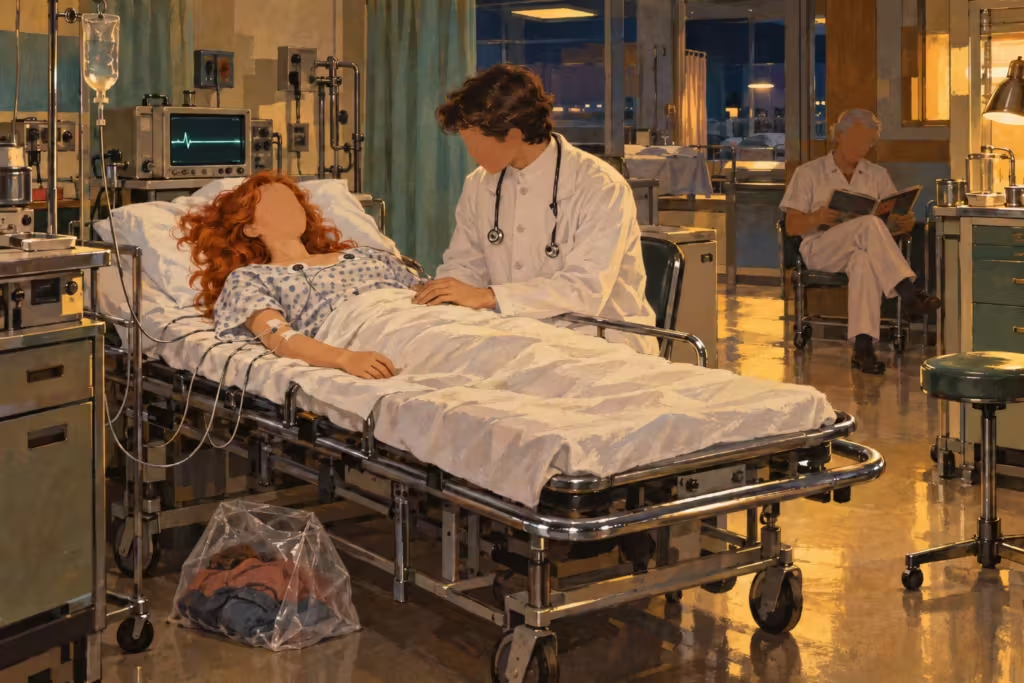
Holly was a first-year student at the university. Her roommate had found her unconscious on her bed. An ambulance took her to the hospital, and the roommate followed in her car.
Greyson found her lying on a gurney, with an IV in her arm and hooked up to a heart monitor. Her eyes were closed. He called her name and touched her arm. She didn’t respond.
In the corner there was a sitter. A sitter is a man whose job is to keep watch over patients. He told him she hadn’t moved the whole time.
Holly’s pulse was normal, but every so often her heart skipped a beat. Greyson left her there and went to talk with the roommate. The roommate was waiting in the family lounge, at the far end of the hallway.
Step 3
That night · In the family lounge, at the end of the hallway · Bruce Greyson’s account
Greyson talks with Holly’s roommate and unbuttons his coat
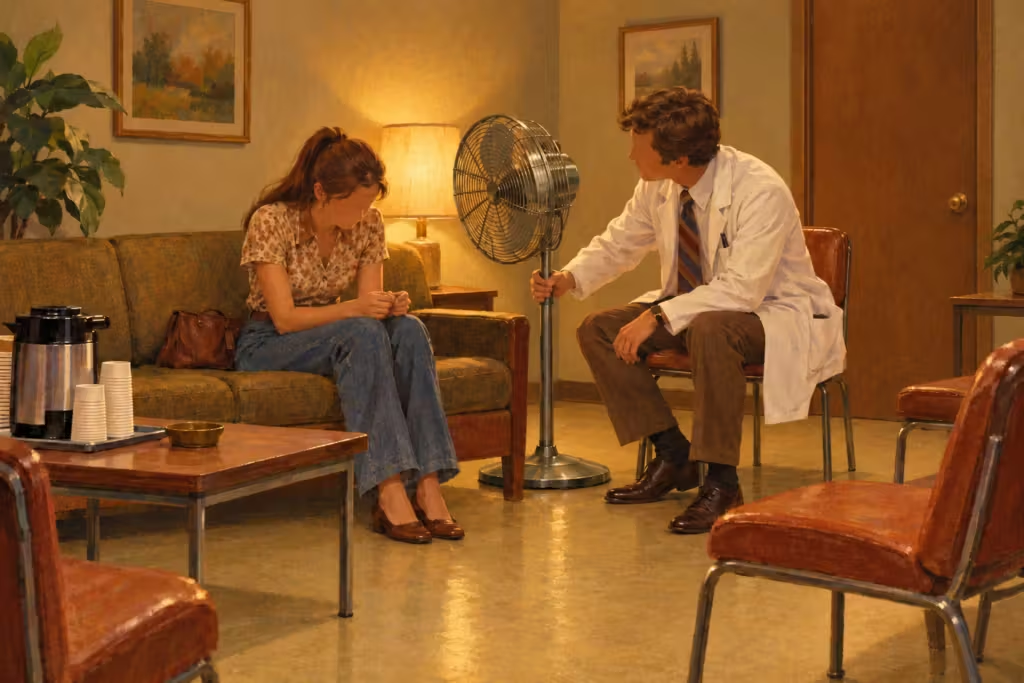
The roommate’s name was Susan. She was pacing the room, nervous. Greyson asked her to sit on the couch, and he sat on a chair next to her.
The room had no air conditioning, and it was hot. He moved the fan closer and unbuttoned his coat. With the coat open, the stain on his tie was in plain view.
He asked about the pills, about Holly’s health, and about how she was doing at college. Susan told him that Holly was taking an antidepressant and that she was having problems with a guy she was dating.
As they said goodbye, Greyson told her to go back to her dorm and that she could check on Holly in the morning. With his coat open, Susan could have seen the stain. And Susan was the only person, besides Greyson, who knew what they had talked about.
Step 4
That night · Holly is moved to the ICU · Bruce Greyson’s account
Holly spends the night in intensive care
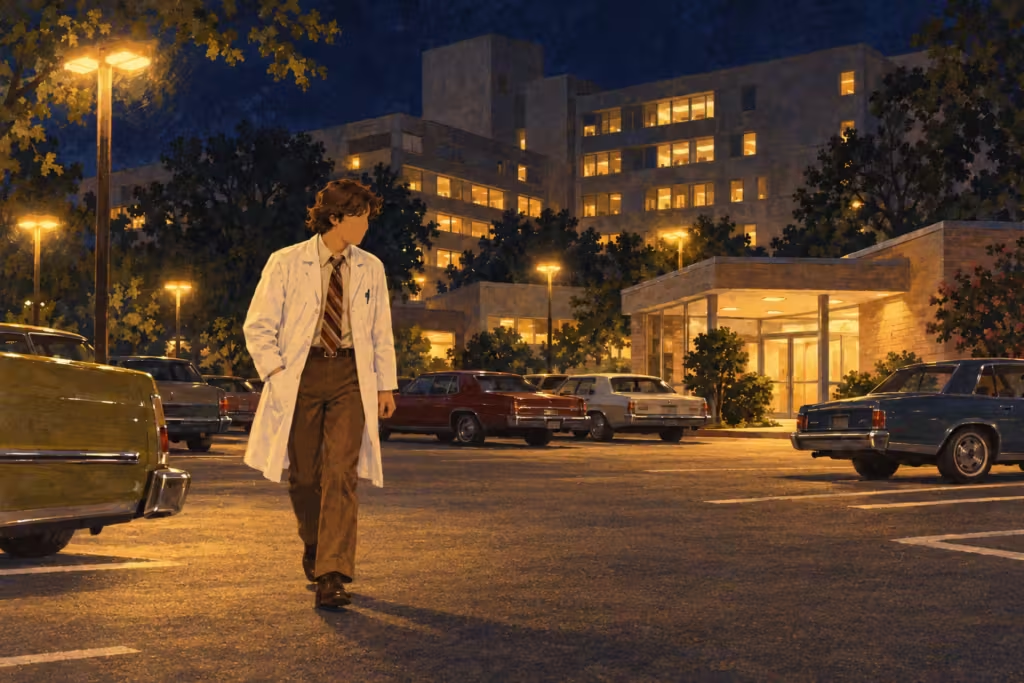
Greyson went back to Holly’s room. Holly still hadn’t woken up, and the sitter told him she hadn’t moved.
Her heart was beating irregularly. The doctor in charge of her decided to admit her to the ICU to keep an eye on her heart.
Greyson went to sleep in the on-call room, across the parking lot. He changed his clothes there.
The next morning he had to talk with Holly before eight o’clock.
Step 5
The next morning · In the ICU · Holly is awake · Bruce Greyson’s account
Holly tells Greyson she saw him talking with Susan
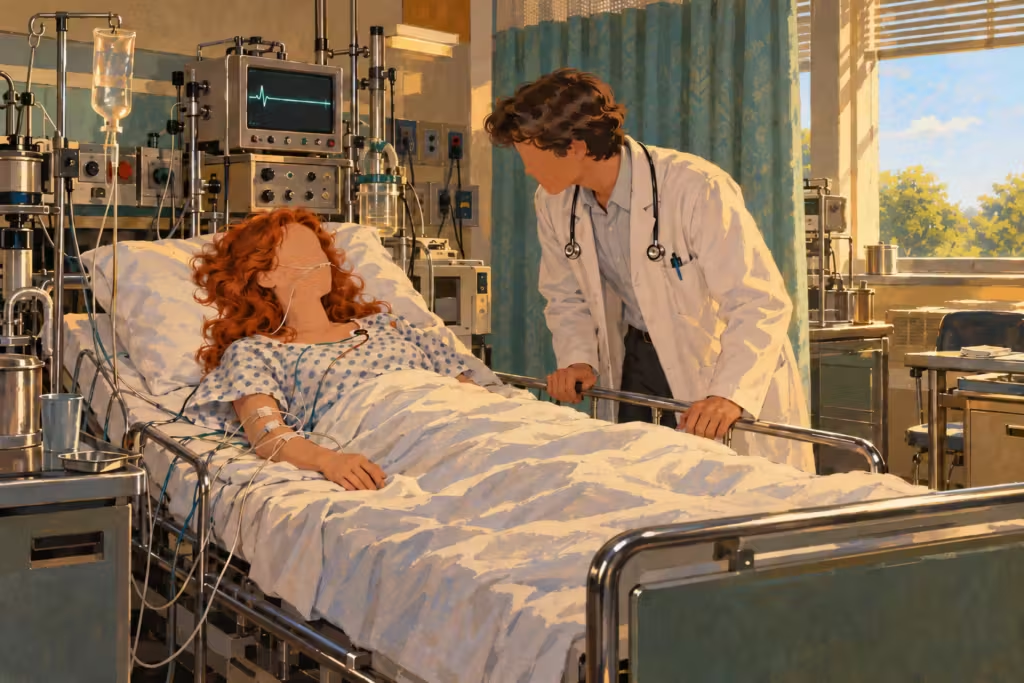
Holly was awake, though still very drowsy. Greyson introduced himself. Holly opened one eye and told him slowly that she already knew who he was. She remembered him from the night before.
Greyson answered that she had looked as if she were asleep. Holly told him she hadn’t seen him in her room. She had seen him talking with Susan, who was sitting on the couch.
Greyson thought someone at the hospital must have told her. He asked her. Holly said no, she had seen him.
She also described what he had been wearing:
“You were wearing a striped tie that had a red stain on it.”
Greyson says that she then went over the whole conversation without a single mistake. She repeated Greyson’s questions and Susan’s answers. She also told him that Susan had been pacing the room and that he had moved the fan.
Step 6
That same day · Bruce Greyson’s account
Greyson doesn’t write it down and tells no one
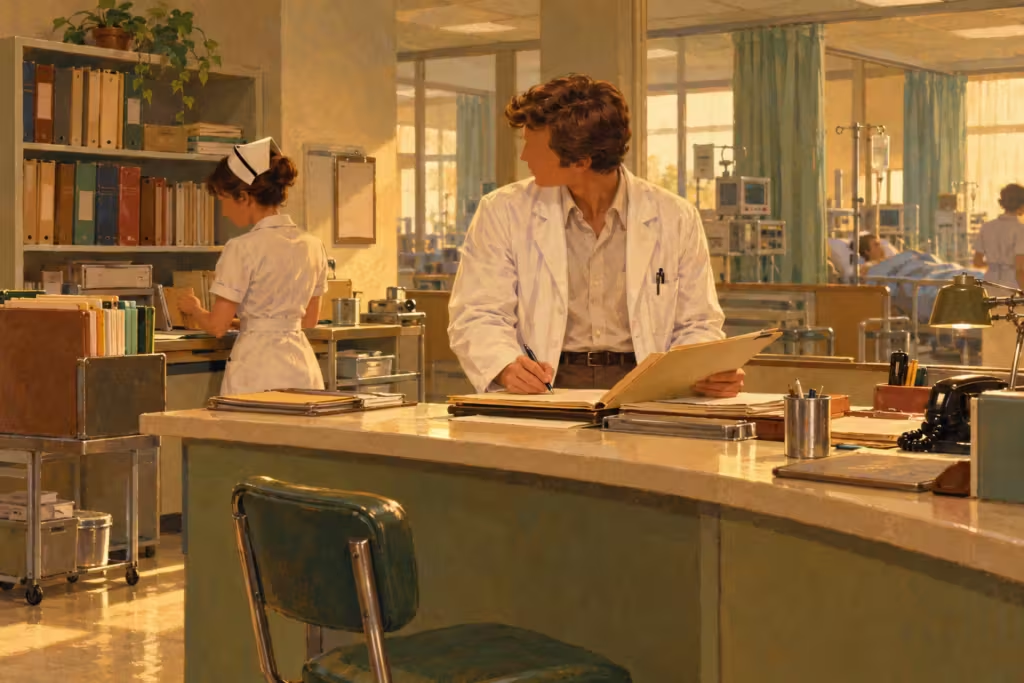
Greyson looked for an explanation. He thought of a prank between the two young women, but no one could have planned the tomato stain. He thought of the hospital staff, but no one else had been in the family lounge.
He couldn’t find an explanation. So he decided to say nothing. The note he wrote that morning left out everything Holly had told him. He didn’t tell his supervisors, or his wife. He was afraid they would think he had lost his mind.
Not a single piece of paper from that morning records what Holly said. And Greyson never asked Susan whether she had seen the stain, or whether she had talked with Holly before he did.
Step 7
From 1975 on · At the University of Virginia
Greyson learns that what happened to Holly has a name, and starts to study it
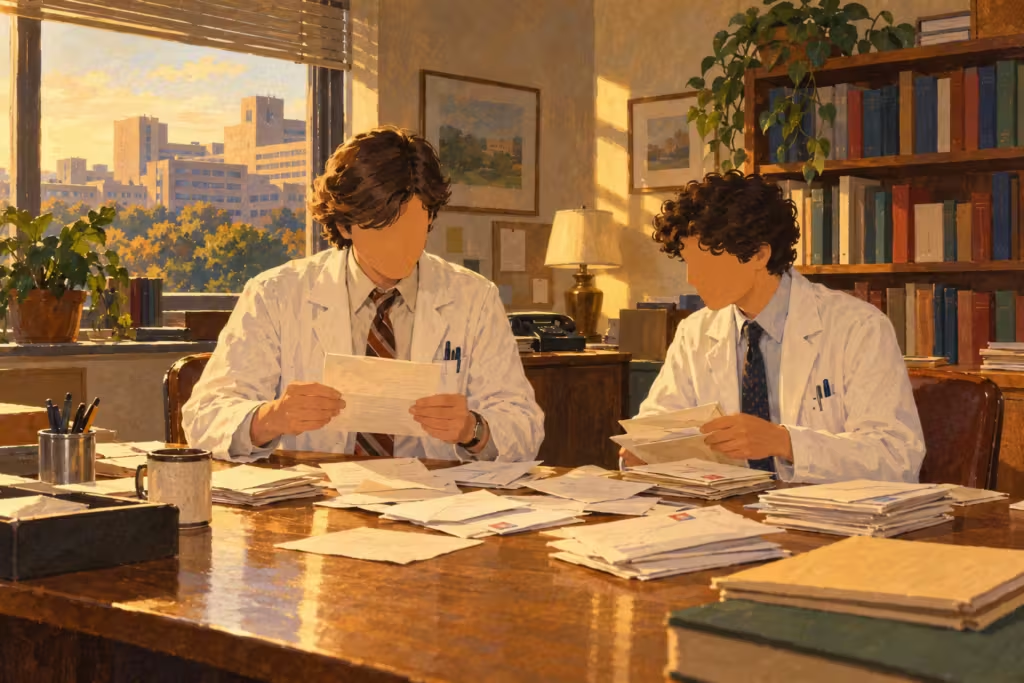
Two years later, in 1975, a medical student named Raymond Moody published the book Life After Life. It collected many accounts from people who had come close to dying. Moody gave what they described the name near-death experience. The book sold enormously, and readers began sending Moody letters.
In 1976, Moody began his psychiatry training at Greyson’s hospital. Greyson was his supervisor in the emergency room, and he helped Moody answer the letters. That is how he found out that Holly wasn’t the only one. Other people said they had left their body while they were very ill and had seen things happening somewhere else.
Greyson spent the rest of his career studying these experiences. But he knows little more about Holly. Holly didn’t talk to him about spirits or about relatives who had died. If she experienced anything else, he doesn’t know, because back then he didn’t know what to ask her.
Step 8
2021 · Bruce Greyson’s account
Greyson tells the story in his book, almost fifty years later
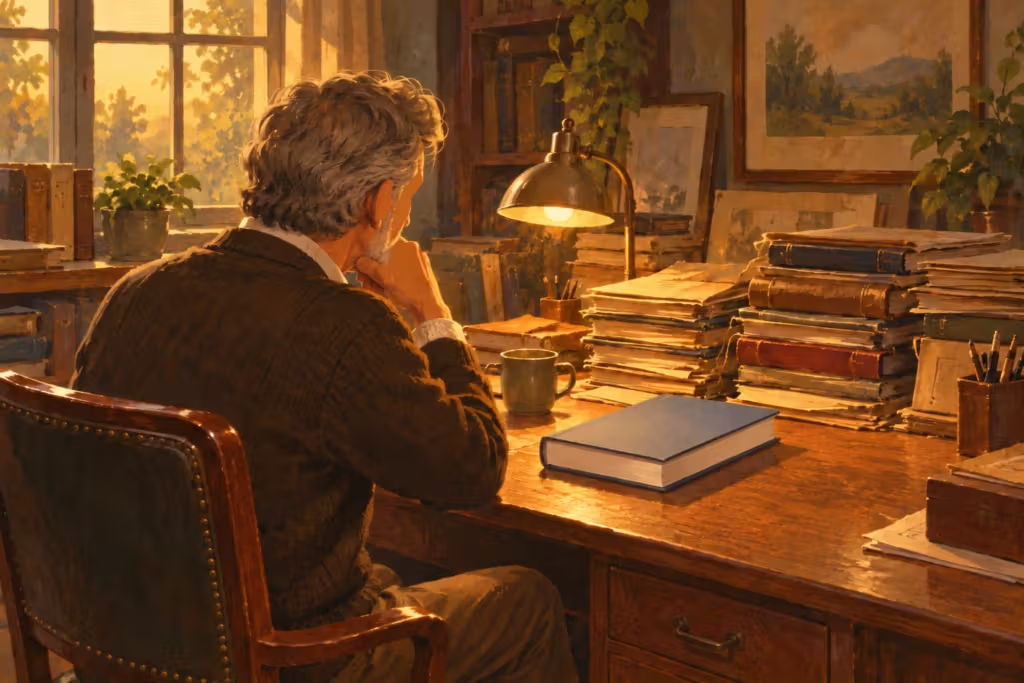
In 2021, Greyson published After. The book opens with Holly and the stain on his tie. Greyson says the question from that morning led him to half a century of research.
He also writes that he kept wondering whether Holly could have found out all of this in some ordinary way that he just couldn’t see. We only know what Holly said from Greyson’s memory. And he admits himself that he didn’t look into it that morning.
What can still be checked today about that night in 1973?
How many people have an NDE after a suicide attempt?
Holly’s heart did not stop. She came to the hospital because of an overdose. Years later, Greyson himself studied people admitted to the hospital after a suicide attempt.
Picture 100 of those people:
Each dot is a person. The 26 filled-in dots are the people who described a near-death experience. Greyson studied 61 people admitted one after another after a suicide attempt. Of them, 16 described an NDE.
The other 45 didn’t describe any.
| Where and when | People interviewed | Described an NDE |
|---|---|---|
| United States, 1986 (after a suicide attempt) | 61 | 26% |
| Netherlands, 2001 (after a cardiac arrest) | 344 | 18% |
| United States, 2003 (after a cardiac arrest) | 116 | 10% |
What these figures don’t tell you
- It is a single study, and a small one. With 61 people, a few more or a few fewer change the percentage a lot.
- Describing an NDE is not the same as describing something that can be checked. Holly said she saw something that could be checked. In these studies, almost no one says that.
- Holly isn’t part of any study. Her story came earlier, and we know it only through Greyson.
That’s why no one knows the real figure. We explain more in How many people have a near-death experience? What the studies do show is that it isn’t rare. Holly’s case stands out for two reasons. It is the one that led Greyson to his research. And it has a tomato stain that no one could have planned.
Where this story comes from
Books
- Bruce Greyson, After (St. Martin’s, 2021), introduction. In Spanish, Después de la muerte (Vergara, 2021)Buy the book
- Xavier Melo and Luján Comas, Vida más allá de la vida [Life beyond life] (2025), interview with Bruce Greyson, in SpanishBuy the book
Studies
- Greyson (1986), NDEs after a suicide attempt, Suicide and Life-Threatening Behavior 16(1):40–45View in the journal (paywalled)
- Van Lommel and colleagues (2001), ten hospitals in the Netherlands, The Lancet 358:2039–2045View in the journal (free with registration)
- Greyson (2003), cardiac unit at the University of Virginia, General Hospital Psychiatry 25:269–276View in the journal (paywalled)
Our archive
- The accounts in the portalecm archive
Keep reading
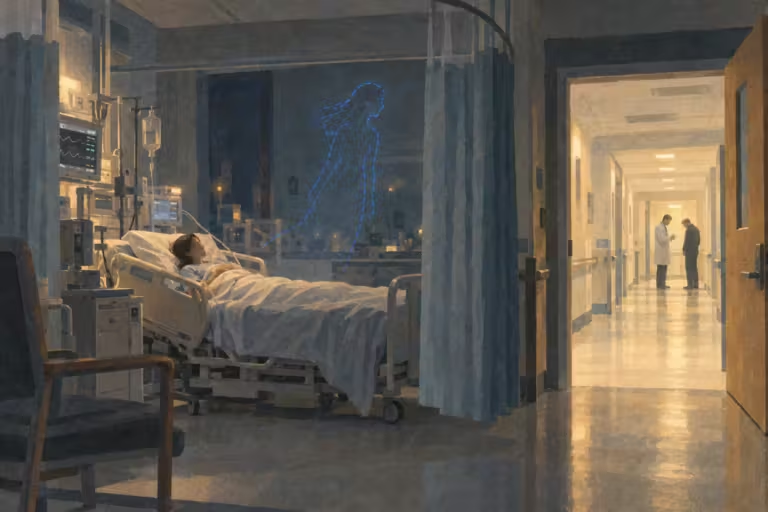
Hong Kong, 2006
Anita Moorjani
Anita Moorjani was in a coma from cancer. She says she heard a doctor in the hallway tell her husband she would not survive the night. The coma is in her medical records. The doctor’s words appear only in Anita’s own account.
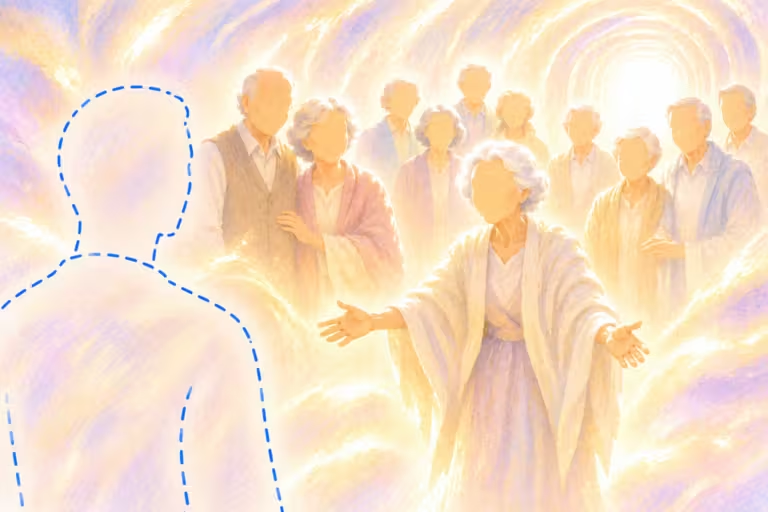
Seville, 2010
Emilio Carrillo
Emilio Carrillo says that in 2010, in the ICU, he saw his dead parents and his aunt María, whom he believed to be alive. According to him, the aunt had died that same day.
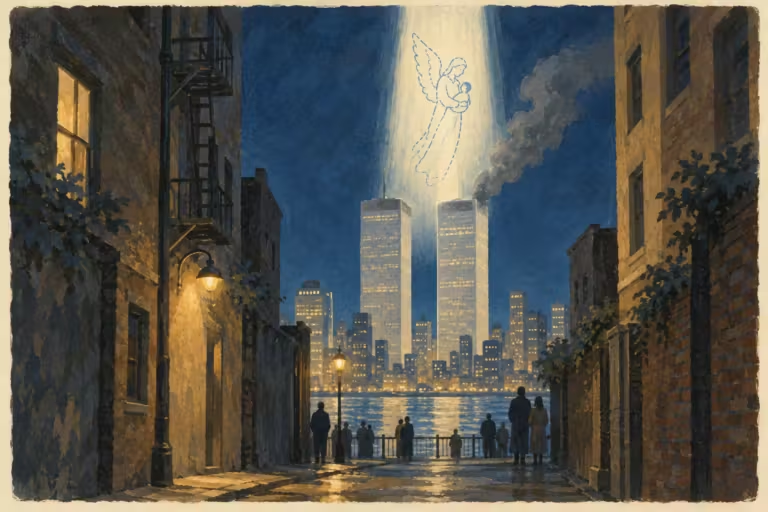
Mexico City, 2001
José Manuel Ramos Montalvo
He says he was in a coma after being hit with a rock and that he saw the Twin Towers burn on September 11. The attack is public record. Only he says he knew about it before anyone told him.
Reincarnation: The top 5 people who remember past lives
We asked them the same five questions as this story. A 32-page PDF, free in your inbox.
Check your email
We have sent you an email. Open it and press the button to confirm. If you cannot see it, check your spam folder.