What is a near-death experience?
A near-death experience (NDE) is a very intense experience that some people have when they are about to die, or when they believe they are going to die. Many say they left their body, saw a light, or met relatives who had died.
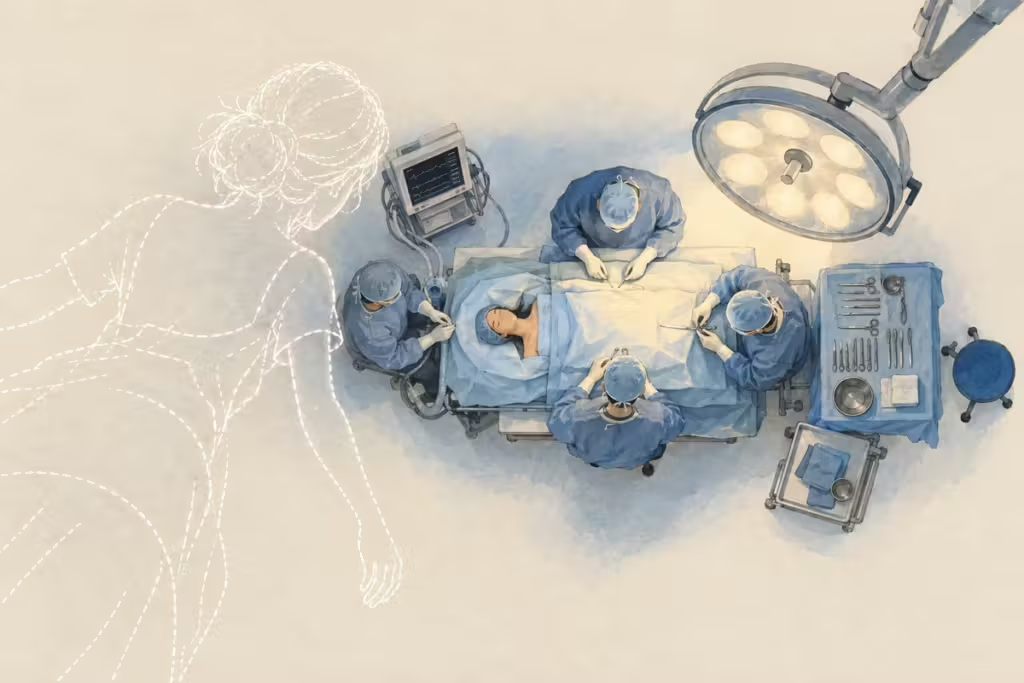
- What it is
- It is a very intense experience that happens close to death and is remembered in great detail.
- When it happens
- During cardiac arrest, surgery, an accident, a coma, or serious danger. Sometimes it happens with no real danger.
- How many people have one
- In the most-cited study, it happened to 18 out of every 100 people who survived cardiac arrest.
- What it feels like
- It is almost always peaceful. Sometimes it is frightening.
- What it is not
- It is not an ordinary dream, and it is not made up. Nor is it, on its own, proof that there is life after death, or that there isn’t.
Here we explain what these people go through, how often it happens, who it happens to, and what changes afterward. Why it happens is a separate question, and we answer it separately.
Where the name comes from
The term became famous in 1975 with the book Life After Life. It was written by the American Raymond Moody, who was then a medical student. Moody gathered accounts from people who had come close to death and noticed how much they resembled one another. Similar accounts existed before, but they had no common name.
Today researchers use a test to decide whether an experience counts as an NDE. It is the Greyson NDE Scale. It asks 16 questions about what the person felt and perceived. Each answer scores 0, 1, or 2 points. The maximum is 32. A score of 7 or more counts as a near-death experience.
What people go through in a near-death experience
Every experience is different, but some things come up again and again. The first step is to listen to the people who went through it.
As of October 9, 2026, our archive includes 253 people who have described their experience in books, interviews, or videos. This is what they describe, from most to least common:
| What they describe | People | Out of 100 |
|---|---|---|
| Beings or presences. Figures of light, guides, or a presence they can’t name. | 194 | 77 |
| A light, very intense, that often draws them in. | 187 | 74 |
| Leaving the body. They feel they are outside it, and sometimes they see themselves from above. | 176 | 70 |
| Seeing what was going on around them. Doctors, relatives, the room. | 130 | 51 |
| Time changes. It stops existing, or it passes in a different way. | 129 | 51 |
| Relatives or friends who had died. | 84 | 33 |
| Deciding to come back, or being made to decide. | 79 | 31 |
| Seeing their life go by, like a movie. This is the “life review.” | 76 | 30 |
| A boundary. If they crossed it, they could not come back. | 71 | 28 |
| A tunnel or a dark passage. | 70 | 28 |
These are people who chose to tell their story in public. They are not a random sample. In this group, unusual or striking features may show up more often here than they really occur. That is why we compare them with studies done in hospitals.
Here are two examples from our stories. Al Sullivan said he saw himself from above during heart surgery. He also saw a light and his mother, who had died. Vicki Umipeg was blind from birth. She said she saw herself from the ceiling of the emergency room after a car accident.
What they feel
We did another count from the archive with 192 of those people. Out of 100, 68 say they felt peace, 60 describe love, 53 describe joy, and 52 say they did not want to come back. But 36 out of 100 also describe fear at some point.
What hospital studies find
The most-cited study was carried out in ten hospitals in the Netherlands and published in 2001 in the medical journal The Lancet. It followed 344 people who had survived cardiac arrest. Of them, 62 had an NDE. This is what those 62 went through:
- Half felt they were dead and had pleasant emotions.
- About 30 out of 100 saw a tunnel, a heavenly-looking landscape, or people who had died.
- About 25 out of 100 had an out-of-body experience, communicated with a light, or saw colors.
- 13 out of 100 saw their life go by. 8 out of 100 reached a boundary.
These proportions are lower than in our archive. That is what you would expect, because in a hospital everyone is asked, not just the people who chose to tell their story in public.
It isn’t always pleasant
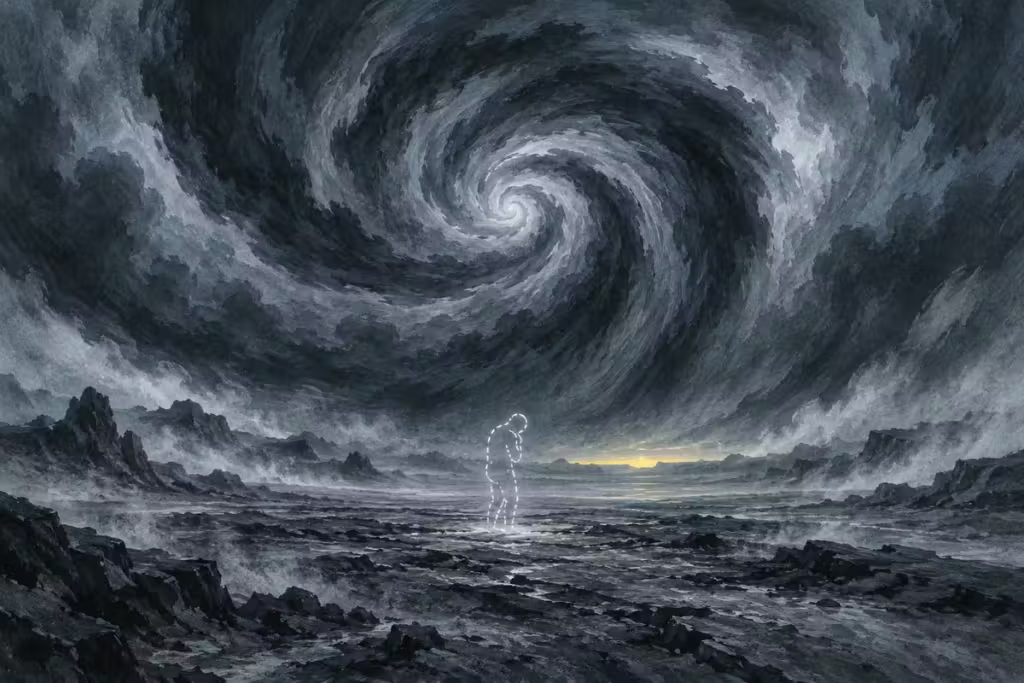
Some experiences are full of fear, anguish, or loneliness. Researchers call them distressing NDEs. There are three main types. In some, the person goes through the same things as in a pleasant NDE, but with terror. In others, the person feels lost in a dark void. And in others, the person sees scenes that resemble hell.
No one knows exactly how common they are, because many people never talk about them. A review of thirty years of studies concludes that up to one in five may be distressing. The University of Virginia has a database that covers 546 people. In it, 11 out of 100 experiences are distressing.
A distressing NDE has nothing to do with being a good or bad person, or with religion. What does come up repeatedly is that distressing NDEs are more common in people who fought to stay in control during the experience than in other people.
Is it like a dream?
People who have had one say no. And memory studies back them up on one point: the memory is different. A team at the University of Liège, in Belgium, compared memories of NDEs with memories of real events and of imagined ones. The NDE memories had more detail and more emotion than either. We tell it in Thonnard’s study.
Another study by the same team compared NDE memories with “flashbulb” memories, the especially vivid kind people keep of the day they heard some major news. The NDE memories had more than three times as many details and mattered more to the person’s sense of identity.
Over the years, the answers change little. In one study, 72 people filled in a questionnaire about their NDE twice. About 19 years passed between the two. The average score barely changed. The study did not compare every detail of the accounts. We tell it in Greyson’s study of accounts 19 years later.
A vivid memory doesn’t tell you what caused it. But it does show that this is not a dream that fades when you wake up.
Who has them?
- No one can predict it. The Lancet study looked at how long the heart had stopped, medication, religion, sex, and education. It found no clear link between these things and having an NDE.
- You don’t need to have heard of them. One study compared accounts from before 1975 with accounts from afterward. Before that year, the term was not yet known. The accounts were almost the same. Only one thing changed. The tunnel shows up far more often since the term became famous.
- Children have them too. They describe things similar to what adults describe. There is one difference. In a study of 17 children, none had a life review.
- It happens in many cultures. There are accounts from all over the world, and some features change with culture. In India and Thailand, messengers appear who come to take the person away, and there is almost no tunnel. Accounts from Muslims closely resemble Western ones.
- Sometimes it happens without being close to death. Some people go through something very similar when they faint, when they are very frightened, or when there is no real danger at all.
What changes afterward?
Many people say they lose their fear of death, care less about material things and more about other people, and feel they have something they are meant to do in life. In the study from the Netherlands, after two years, the people who had an NDE had changed more than the other survivors. They had more empathy, more appreciation for ordinary things, and less fear of death. After eight years, everyone had changed for the better, including those who had no NDE. But the people who had an NDE were still different from the others in three things. These were interest in spirituality, belief in an afterlife, and fear of death.
It isn’t always easy. Some people don’t dare to talk about it, and others find it hard to return to the life they had before.
Why does it happen?
There is no agreement on this. There are two main explanations:
- One says everything happens in the brain. A brain in danger can run short of oxygen and release many of its own chemicals at once. That could produce an experience like this.
- The other says consciousness can carry on without the brain. According to this explanation, part of what people experience would be real, and would happen outside the body.
What is clear is that the experience is real. People genuinely go through it. They don’t make it up. What is debated is the cause. We ask both explanations for the same evidence. We explain this in “What does science say?”
Frequently asked questions
Are near-death experiences real?
Yes, in the sense that the people who have them genuinely live through them. What can be checked in each account is a separate question. And their cause has not been proven. No one knows whether they come from the brain, or whether consciousness can carry on without it.
What does a near-death experience feel like?
Most people describe peace, love, and a feeling of being home, often with a very bright light. Some describe fear or distress.
Does it happen to everyone who comes close to death?
No. In hospital studies, between 4 and 23 out of every 100 cardiac arrest survivors report an NDE. The figure varies from one study to another. We explain this in “How many people have an NDE?”
Can what they describe be checked?
Sometimes it can. When someone says they saw something from outside their body, we can look at whether it really happened and whether they could have learned about it in an ordinary way. We do this for every story, using five questions.
Keep reading
- Pam Reynolds’ storyHer heart was stopped so surgeons could operate on her brain. She said she watched the operation from above.
- How we check each storyThe five questions we ask to find out what can be shown.
- Understanding NDEsThe other questions almost everyone asks.
Where these figures come from
- Our archive: 253 accounts, each with its own record, as of October 9, 2026. For 192 of those accounts, we counted what people felt twice and separately.
- van Lommel et al. (2001), study in ten hospitals in the Netherlands, The Lancet 358:2039-2045. View in the journal (free with registration). The frequency of each feature, from van Lommel (2013), Journal of Consciousness Studies 20:7-48.
- Greyson (2023), the darker side of NDEs, Journal of Scientific Exploration 37(4):683-698. Read for free in the journal
- Bush and Greyson (2014), distressing NDEs, Missouri Medicine 111(6):486-490. PubMed 25665233. Read for free
- Thonnard et al. (2013), NDE memories, PLoS ONE 8(3):e57620. Download for free (PDF, CC BY licence)
- Cassol et al. (2020), NDE memories and flashbulb memories, Frontiers in Psychology 11:888. Download for free (PDF, CC BY licence)
- Greyson (2007), answers about the NDE over 19 years, Resuscitation 73:407-411. Read for free
- Athappilly, Greyson, and Stevenson (2006), accounts from before and after 1975, Journal of Nervous and Mental Disease 194(3):218-222. View in the journal (paywalled)
- Martial et al. (2018), similar experiences with no real danger, Frontiers in Psychiatry 9:190. Download for free (PDF, CC BY licence)
- Moody (1975), Life After Life. Buy the book