What does dying feel like?
Many people who have come close to dying say the pain went away, that they felt deeply loved, and that they were wrapped in a peace beyond words.
“There’s no fear, there’s no pain, there’s no cold.”
David Rojas, while he was being operated on for a gunshot wound in Mexico, in 1998 (translated from Spanish).
“I feel loved, I feel sheltered.”
María Teresa Álvarez Aramendía, in a coma in Asturias, Spain, in 2005.
Their accounts don’t answer all our questions, but something invites us to listen to them.
People with different lives and beliefs describe similar feelings.
What did they go through? And what does science say?
Here we look at their stories and at what science has been able to measure.
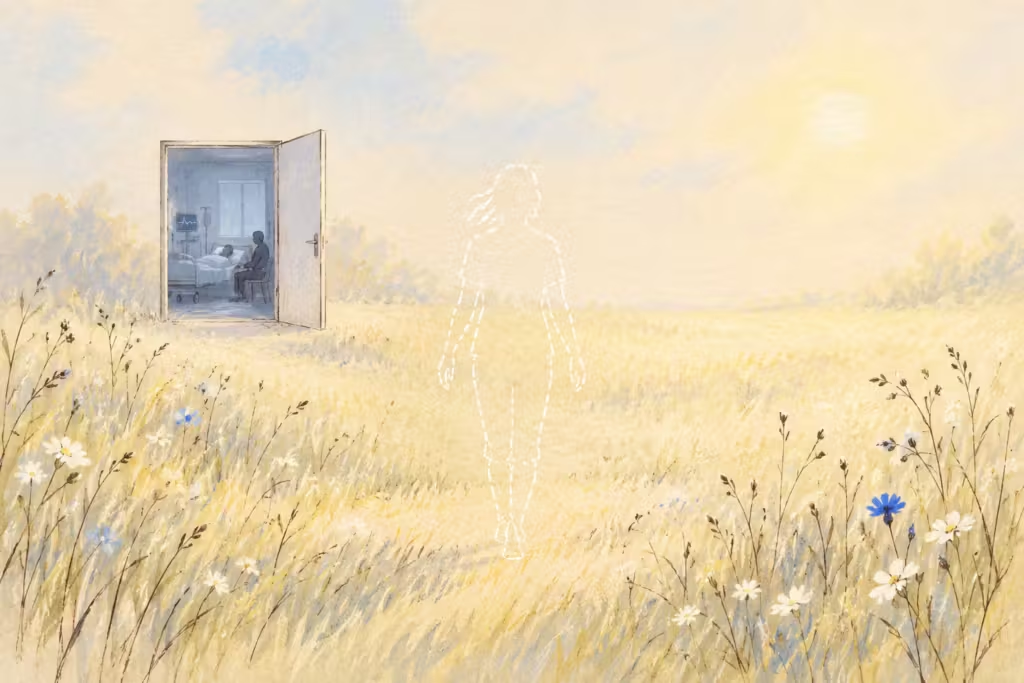
- What people describe
- They usually say they felt peace and that the pain went away. Very few people say they felt afraid.
- How many people
- In the most cited study, 18 out of 100 people who survived a cardiac arrest described an experience like this. The rest described nothing of the kind.
- Does it hurt?
- People who had a near-death experience often say they felt no pain, and that the pain came back when they woke up. Not all of them say this.
- The brain
- In rats and in some people in a coma, the brain gives a burst of activity as it dies. No one knows whether anything is experienced at that moment.
- What they say afterward
- Many come away convinced that death is not the end. Science has not been able to prove it. It has not been able to prove the opposite either.
This page is not about end-of-life care or the signs that someone is about to die. For that, the best thing is to talk to the medical or palliative care team. This page covers what people who came back say and what has been measured.
What people who came close to dying describe
The first step is to listen to the people who went through it. Many of them had a near-death experience (NDE). An NDE is a very intense experience that some people have when they are about to die. What they felt is their experience. Here we record it as they tell it. A separate question is why they experienced it that way.
In our archive, people who went through an experience like this talk most about peace, love, and joy. Many also say they didn’t want to come back. And some say they felt fear at some point.
Many also say they left their body, saw a very bright light, or met relatives who had died. We explain this in “What is a near-death experience?”
These people come away convinced that death is not the end. In the Dutch study, eight years later, those who had an NDE believed more in an afterlife and were less afraid of death than the other survivors.
Most people remember nothing
Imagine 100 people who have survived a cardiac arrest:
Each dot is one person. The 18 filled dots are the people who described an NDE. That is what the study in ten hospitals in the Netherlands found, published in 2001. It followed 344 survivors. The other 82 out of 100 described no experience of this kind.
In that study, 62 people had an NDE. Of them, 31 said they felt they were dead. And 35 said they felt pleasant emotions. The study does not say how many reported both. None described a frightening experience.
In the AWARE II study, from 2023, researchers interviewed 28 people who had survived a cardiac arrest. 17 remembered nothing. 11 remembered something, and 6 of them described an NDE.
If someone remembers nothing, that does not mean they experienced nothing. Maybe they experienced nothing, or maybe they forgot. No one knows.
Some experiences are frightening
Not all of them are peaceful. According to most estimates, between 11 and 22 out of 100 near-death experiences involve fear, distress, or an overwhelming loneliness. The best-known case is that of Howard Storm. He was a professor who did not believe in God. His experience does not begin with peace and light, but with fear. We cover this in “What if a near-death experience is frightening?”
Does dying hurt?
All we know is what people who came very close say. Many say the pain went away during the experience, and came back all at once when they returned to their body:
- David Rojas was shot in the leg in 1998. He says that during the surgery he saw himself from above. This is what he says he felt: “There’s no fear, there’s no pain, there’s no cold.” When he woke up, it all came back: the anguish, the pain, and the cold.
- Miguel Ángel Pertierra says he felt no pain in his abdomen or his arm. When he went back into his body, the pain came back too.
- Israel Vargas was on a ventilator with COVID-19 in 2020. He says he reached a white valley and that there he no longer felt pain, or fever, or anything at all. Only peace.
- Patient 10 was a 60-year-old man in an intensive care unit in Wales. He says that when he went back into his body he felt terrible pain, worse than before.
In 1982, the cardiologist Michael Sabom published the interviews he had done with cardiac arrest survivors in the United States. The survivors mostly described calm and peace. It was very different from the pain they felt before and after. One man described watching as they pounded on his chest to revive him. It cracked a rib, and he said it didn’t hurt.
But it is not always like that. In the AWARE II study, one person remembered being resuscitated and said this: “I could feel someone rubbing quite hard. It was quite painful.”
There are two explanations for why the pain goes away, and neither has been proven:
- That the brain does it. A brain in danger may release its own pain-relieving substances, similar to morphine.
- That the person was no longer in their body. Many of those who went through it understand that they felt no pain because they were outside their body.
But these accounts have two limits. Someone who remembers nothing cannot say whether it hurt. And all of these people came back. They are sure that what they went through is what comes next. That has not been proven. The opposite has not been proven either.
What does the brain do in the last minutes?
For a long time, it was taken for granted that the brain shuts down as soon as the heart stops. Three studies have measured what happens at that moment:
- In 2013, with 9 rats. A lab at the University of Michigan anesthetized the rats and stopped their hearts. For about 30 seconds, their brains gave a burst of very fast, organized waves. These waves are called gamma waves. Then the line went flat.
- In 2023, with 4 people in a coma. The same lab looked for something similar when the machine that breathed for them was removed. It found it in 2 of the 4. In all 4, the heart kept beating for 10 to 25 minutes after the machine was removed.
- In 2022, with a single 87-year-old man. Some fast waves in his brain rose just before his heart stopped. The recording ended 3 minutes later.
These studies cannot tell us whether anything is experienced during that activity. Neither the rats nor those people could say. And no one who has had an NDE had their brain measured at that moment. Nor is it known exactly when an NDE happens. We go through it step by step in the gamma wave study.
The 7-minute theory
An idea going around the internet says the brain stays active for 7 minutes after death and replays your memories. No study has measured that. The figure was already circulating in 2014, with no source at all. The study usually cited is the one of the 87-year-old man, from 2022. Its authors suggested he may have relived his memories, but they could not know, because he could not tell them. We cover it in Vicente’s study.
Many people with an NDE do describe seeing their life pass before them, like a film. 13 out of 100 describe it in the Dutch study, and so do many of the people in our archive.
Can a dying person still hear?
Possibly, at least sounds. In 2020, a study in a hospice in Canada measured the brains of 5 dying patients who no longer responded. All 5 still reacted to a series of tones, just like healthy people. They died between 5 hours and almost 5 days later.
But the study used tones, not words. It cannot say whether those people understood anything or were aware. And they were dying slowly, not people whose heart had stopped. Even so, the authors support the advice to keep talking to someone who is dying.
Some people with an NDE say they heard what was going on around them while they seemed unconscious. Pam Reynolds described what the doctors said about her groin during brain surgery. Her ears were blocked by earphones that made a lot of noise. Her story covers what could be checked.
Do you know you have died?
No one knows, because the only people we can ask are the ones who recovered. In the Dutch study, half of the 62 people with an NDE said they felt they were dead.
In 2017, some newspapers ran headlines saying “you know you’re dead.” That did not come from a new study. It came from remarks by Dr. Sam Parnia, who led the AWARE studies.
What we don’t know
- People who had an NDE are sure that life goes on after death. Science has not been able to prove it. Nor has it been able to prove that it doesn’t. We cover this in “What happens after death?”.
- We can’t say that what they describe is what everyone who dies goes through. Nor can we say it isn’t.
- We can’t say the peace comes only from the brain. Nor can we say that it comes from outside it. We explain this in “What does science say?”
- We don’t know why some people remember an experience and others don’t. In the Dutch study, neither how long the heart was stopped nor the medication explained it.
Frequently asked questions
What do you see when you die?
People who came close to dying and had an NDE mostly say they saw a very bright light. They also say they saw themselves outside their body and met relatives who had died. Most cardiac arrest survivors remember nothing.
Is dying frightening?
Most people who had an NDE describe peace, not fear. But between 11 and 22 out of 100 experiences involve fear or distress. We cover this in “What if a near-death experience is frightening?”
Does everyone go through the same thing when they die?
No. In hospitals, between 4 and 23 out of 100 cardiac arrest survivors describe an NDE, depending on the study. And every experience is different, although some things come up again and again. We explain this in “How many people have a near-death experience?”
Keep reading
- What is a near-death experience?What people go through, how often, and what changes afterward.
- Gamma waves in the dying brainWhat was measured in 9 rats and 4 patients, and what could not be known.
- Vicente’s studyThe brain of an 87-year-old man, recorded as he died.
- David Rojas’ storyHe was shot and says he saw himself from above during the surgery.
Where these data come from
- Our archive: the accounts, each with its own record. Two people counted separately what people felt.
- van Lommel et al. (2001), study in ten hospitals in the Netherlands, The Lancet 358:2039-2045. View in the journal (free with registration). The frequency of each feature, from van Lommel (2013), Journal of Consciousness Studies 20:7-48.
- Parnia et al. (2023), the AWARE II study, Resuscitation 191:109903. Read for free
- Sabom (1982), Recollections of Death, interviews with cardiac arrest survivors. Buy the book
- Greyson (2023), the dark side of NDEs, Journal of Scientific Exploration 37(4):683-698. Read for free in the journal
- Borjigin et al. (2013), brain activity in dying rats, PNAS 110(35):14432. Read for free
- Xu et al. (2023), brain activity in dying people, PNAS 120(19):e2216268120. Read for free
- Vicente et al. (2022), the brain of an 87-year-old man as he died, Frontiers in Aging Neuroscience 14:813531. Read for free
- Blundon, Gallagher, and Ward (2020), hearing at the end of life, Scientific Reports 10:10336. Read for free
- The stories of David Rojas, Miguel Ángel Pertierra, Israel Vargas, Patient 10, Howard Storm, and Pam Reynolds, each with its own sources.