Two studies · Ann Arbor, Michigan (United States), 2013 and 2023
Gamma waves in the dying brain: 9 rats in 2013 and 4 patients in 2023
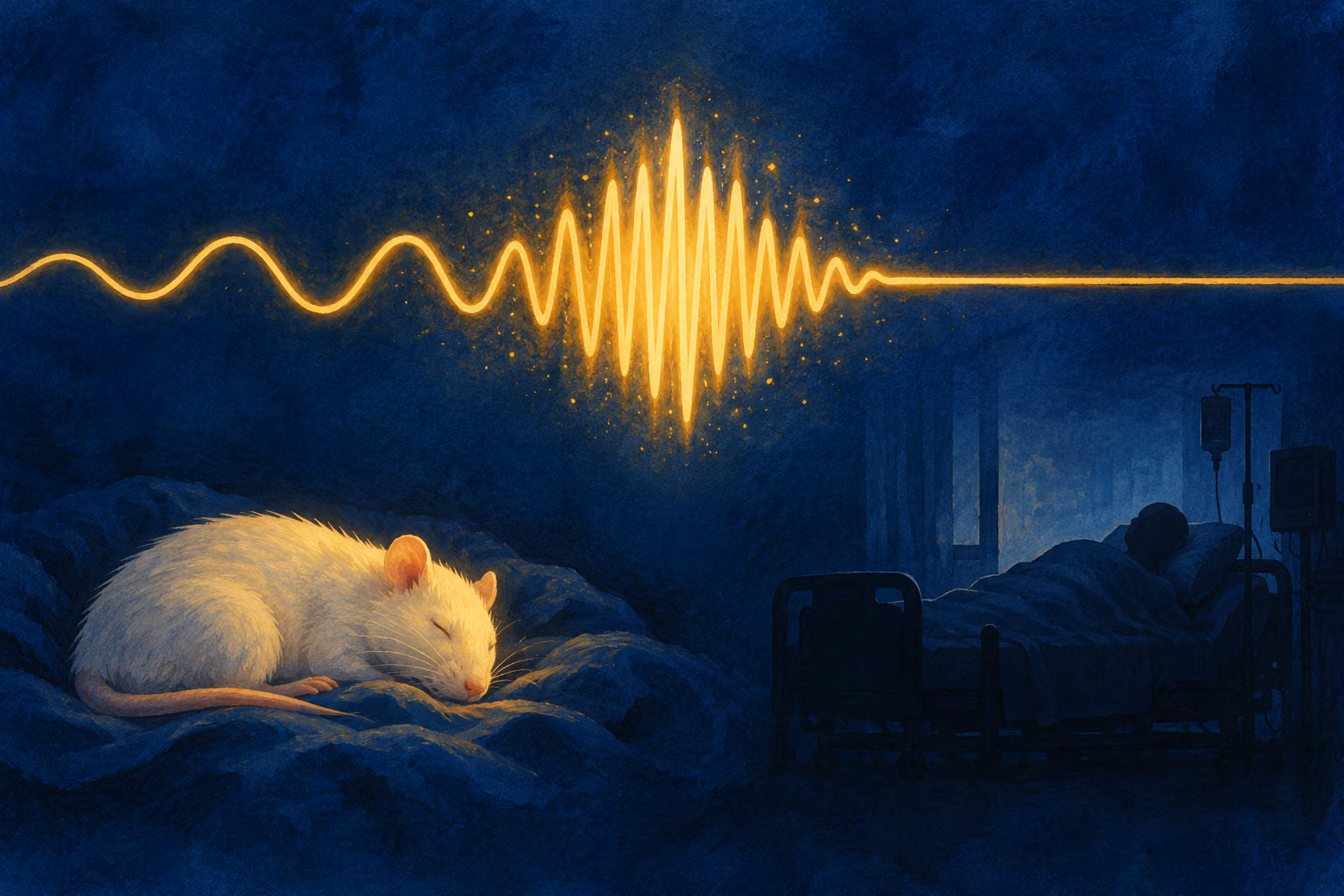
In 2013, a lab at the University of Michigan stopped the hearts of 9 anesthetized rats that had sensors in their brains. Their brains gave off a burst of very fast, orderly waves for about 30 seconds. In 2023, the same lab looked for something similar in 4 people in a coma. It looked at the moment their breathing support was withdrawn.
The question is simple: does the brain shut down all at once when we die, or does it do something that could explain an NDE? News reports said the brain surges into activity at death. We go through it step by step, with what was measured and what couldn’t be known. If you only want to know what they found, skip to the results.
Step 1
Before 2013 · The question
It was taken for granted that the brain shuts down when the heart stops
Some people who survive a cardiac arrest describe a very vivid NDE, sometimes “realer than real.” But during a cardiac arrest, no blood or oxygen reaches the brain. It was assumed that the brain could do almost nothing.
In 2009, doctors at George Washington University noticed something odd in 7 patients who were dying in intensive care. A brain monitor showed a brief spike when their blood pressure dropped completely. That monitor is used to measure sedation. The spike usually lasted between 30 seconds and 3 minutes. The doctors themselves said that linking this spike to NDEs was pure speculation.
Jimo Borjigin reasoned that if the brain does something after a cardiac arrest, it must be possible to measure it. She also reasoned that if NDEs come from the brain, there must be some sign of it.
What does the brain do in the first few seconds after the heart stops?
To take a close look, she started with animals.
Step 2
Around 2013 · According to the study
A Michigan lab places sensors in the brains of 9 rats

The experiment took place at the University of Michigan, in the city of Ann Arbor. The team used 9 laboratory rats, both male and female.
Each rat was wired up for an electroencephalogram, or EEG. The EEG listens to the brain’s electricity, like a microphone picking up the murmur of millions of neurons. That electricity shows up as wavy lines. These are the brain’s waves.
- The sensors were placed inside the skull, in 6 areas. They were at the front, middle, and back, on both sides.
- Other sensors measured the heart and a neck muscle. That way the team knew whether a signal came from them or from the brain.
- After surgery, the rats rested for at least a week.
On the day of the experiment, recording began at 10 a.m. First they recorded at least half an hour with the rat awake. Then they recorded half an hour with the rat under anesthesia.
That gave the team three moments to compare: awake, anesthetized, and after the heart stopped.
Step 3
At second zero · The heart stops
Their hearts are stopped with an injection, once they are under anesthesia
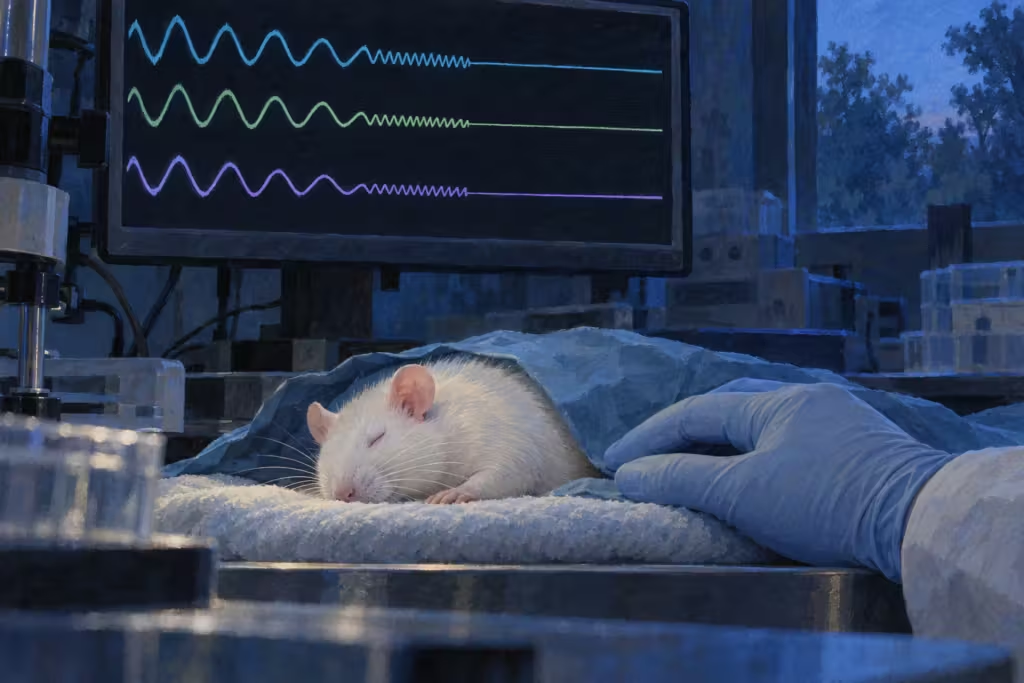
With the rat under anesthesia, the team injected potassium chloride into its heart. It is a salt that stops the heart. That moment is second zero.
In less than a second, the signals from the heart and the muscle went flat.
The brain’s signals didn’t go flat. Its waves stayed the same for about 3 seconds. Then they became very small and very fast, and stayed that way until about the 30-second mark. Then the line went flat, and it didn’t change over the next 20 minutes.
Since the muscle and the heart had already gone silent, those waves weren’t coming from them.
So what were those fast waves?
Step 4
The first 30 seconds · According to the study
Within 30 seconds, the rats’ brains give off a burst of gamma waves
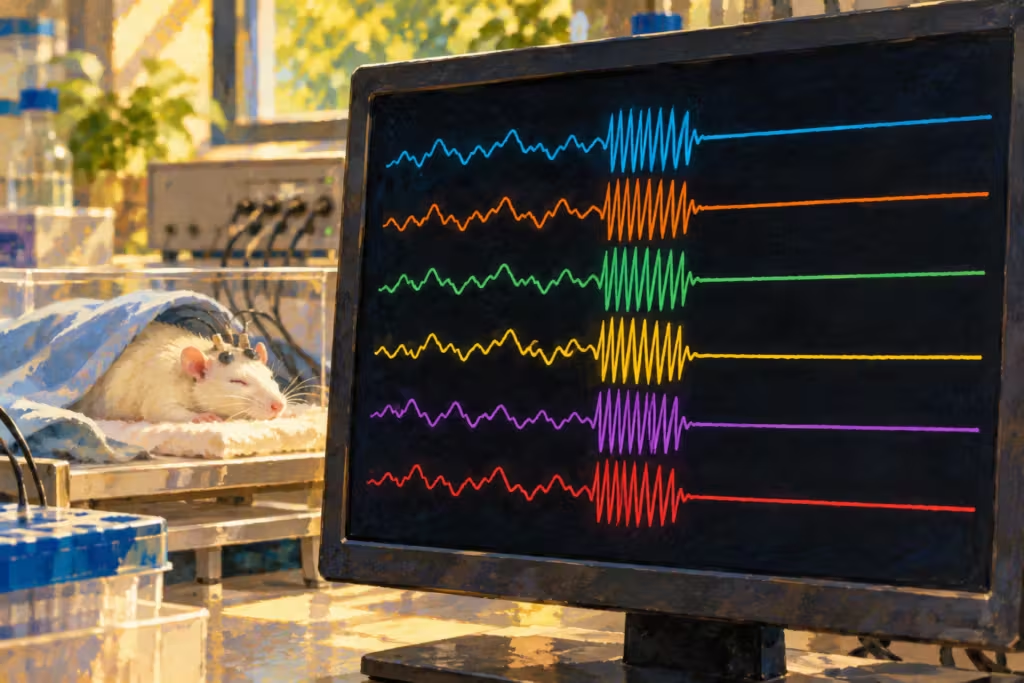
Brain waves are told apart by how fast they rise and fall. The fastest are called gamma waves. They rise and fall more than 25 times per second. Other studies have linked them to being awake, to dreaming, and to meditation.
After the heart stopped, all 9 rats had the same sequence. It had four phases:
- About 4 seconds of very fast gamma waves.
- About 6 seconds of gamma waves mixed with slower ones.
- A short burst of slow waves, lasting less than 2 seconds.
- About 20 seconds of slower gamma waves, 35 to 50 per second, closely in step across the whole brain.
After that, the line went flat.
The burst appeared in all 9 rats, and it had the same shape every time.
Meanwhile, the other waves dropped sharply. At the peak, the slower gamma waves made up more than half of all the brain’s activity. With the rat awake, they made up less than 5 in 100.
Step 5
In the last phase · According to the study
Areas of the brain are more in step than when the rat is awake
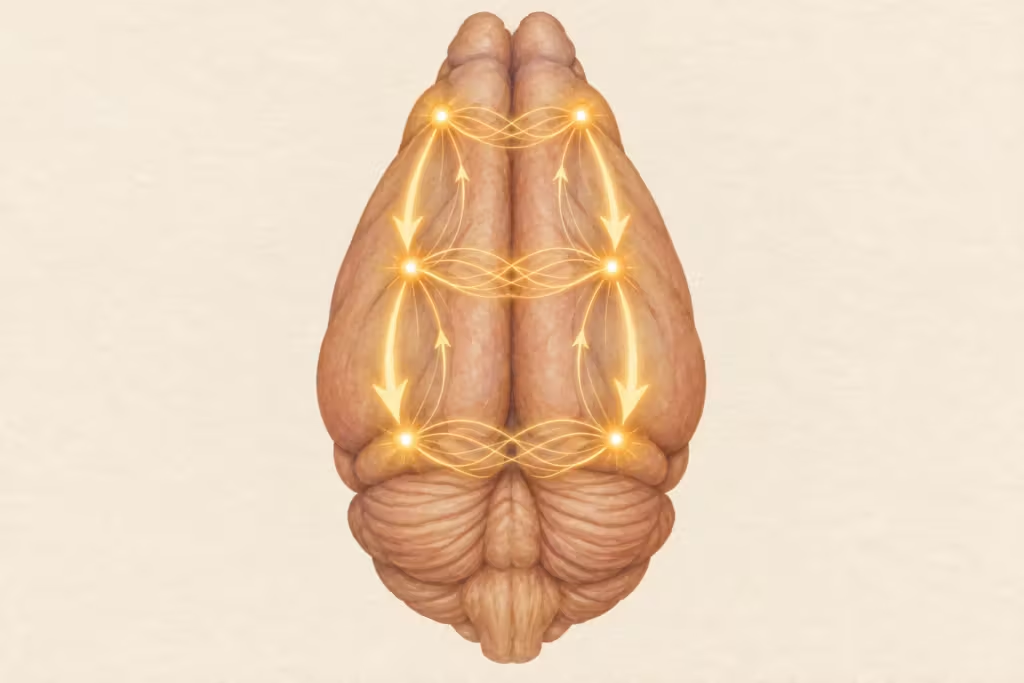
The team didn’t just measure how many gamma waves there were. It also looked at whether areas of the brain were working together.
- Coherence measures whether two areas keep the same beat, like two choirs singing the same song at the same time. Gamma coherence was more than double what it was with the rat awake.
- Connectivity measures whether one area “passes information” to another, and in which direction. It is like a conversation where you can tell who is talking and who is listening. From front to back, it rose 8 times higher than in the awake rat. From back to front, it rose 5 times higher than in the awake rat.
- The gamma waves were locked to the rhythm of slower waves. Those slower waves are called theta and alpha. According to the paper, this kind of coupling has been seen when people see and remember things.
That is why the authors wrote that the activity “exceeded” that of the waking brain.
But not everything was compared the same way. For the amount of gamma waves in the awake rat, the team used a 10-minute average. After the heart stopped, it used the highest value instead, measured in 2-second windows. For connectivity they also used the highest value, because those 20 seconds only gave one or two values. Coherence was compared using averages. Also, the brain’s total activity was much lower than before the heart stopped. The only thing that went up was the gamma waves.
One question remained: did the burst need the heart to stop?
Step 6
Another group of rats · According to the study
In 8 more rats that die of asphyxia, the heart keeps beating
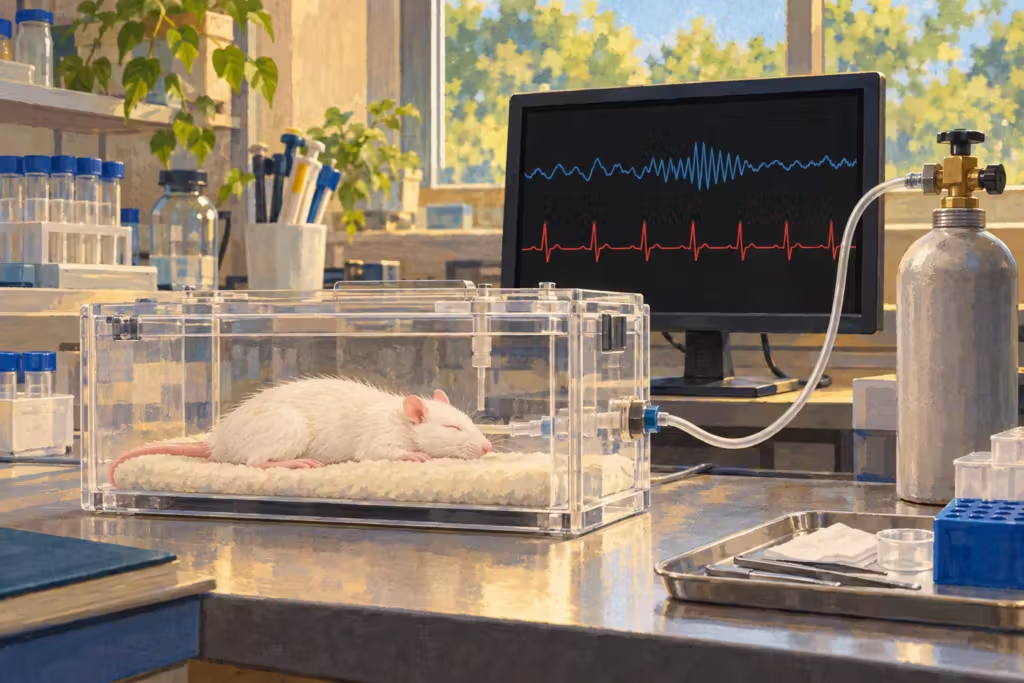
The team repeated the experiment in a different way with 8 more rats, also anesthetized. This time their hearts were not stopped. They were made to breathe nothing but carbon dioxide for 2 minutes, and they died of asphyxia from lack of oxygen.
Their hearts kept beating for more than 10 minutes.
- The same four-phase sequence appeared, again within about 30 seconds.
- Gamma coherence rose above the level of the awake rat.
- The amount of gamma waves reached that of the awake rat, but didn’t go beyond it.
The burst didn’t need the heart to stop. A lack of oxygen in the brain was enough.
For the authors, this second experiment also ruled out the idea that the burst was caused by the pain of the injection.
Step 7
August 2013 · According to the authors and the press
The authors speak of a starting point for explaining NDEs

The paper was published online on August 12, 2013, in PNAS, the journal of the US National Academy of Sciences. It can be read for free.
The authors write that the mammalian brain can, “albeit paradoxically,” give signs of heightened conscious processing near death. They think this gives a scientific basis “to begin to explain” NDEs.
That same day, National Geographic ran the story under the headline “In Dying Brains, Signs of Heightened Consciousness.” The next day, another news story said: “Near-death experiences may be triggered by surging brain activity.”
Two other doctors gave their views in that National Geographic story:
- Steven Laureys leads a group that studies coma at the University of Liège, in Belgium. He said it was very hard to know what the rats perceived, but that the study showed much more activity than expected.
- Sam Parnia is the doctor who led the AWARE studies. He said that comparing these rats to NDEs was “extremely premature.” He explained that when blood stops flowing, calcium enters the neurons and damages them. That could also show up on the EEG.
No one knew whether those rats experienced anything, or what.
Step 8
November 2013 · According to the critics and the authors
Three Virginia researchers write to the journal, and the authors reply

Bruce Greyson is a psychiatrist who has studied NDEs for decades. Greyson wrote a letter to the journal with Edward Kelly and Ross Dunseath. All three were at the University of Virginia. They gave seven reasons not to link the burst to NDEs. These are the main ones:
- There is no way to know whether the rats were experiencing anything, or what they were experiencing.
- After the heart stopped, the brain’s total activity was much lower than before.
- In people, the EEG goes flat 10 to 20 seconds after a cardiac arrest.
- In some NDEs, the person describes things that happened well beyond those 30 seconds.
- Some NDEs happen without a cardiac arrest, and without any drop in blood flow to the brain.
- All the rats had the burst. But only 10 to 20 in 100 people who survive a cardiac arrest describe an NDE.
Another of their reasons was that there are NDEs under anesthesia. The letter also said that the rats “did not show the observed postarrest EEG patterns under anesthesia.” That sentence may mean that anesthesia alone, without cardiac arrest, produced no burst. But in 2015 Greyson went further. He wrote that anesthesia completely eliminated the burst. In the paper, the rats were already anesthetized when their hearts were stopped, and the burst appeared in all of them.
Borjigin, Michael Wang, and George Mashour replied in the same journal:
- The waves linked to consciousness rose in every rat, even though the others dropped.
- In people, the EEG is measured with sensors on the scalp. In the rats, the sensors were inside the skull, and they pick up much more.
- People who survive a cardiac arrest are very different from one another. The rats, on the other hand, are very much alike. Also, perhaps more people have an NDE but don’t remember it.
The authors speak of “electrical fingerprints” of consciousness in the rats. But they can’t say what the rats experienced.
Step 9
From 2014 · According to the 2023 study
The same lab looks for the burst in people dying in the ICU
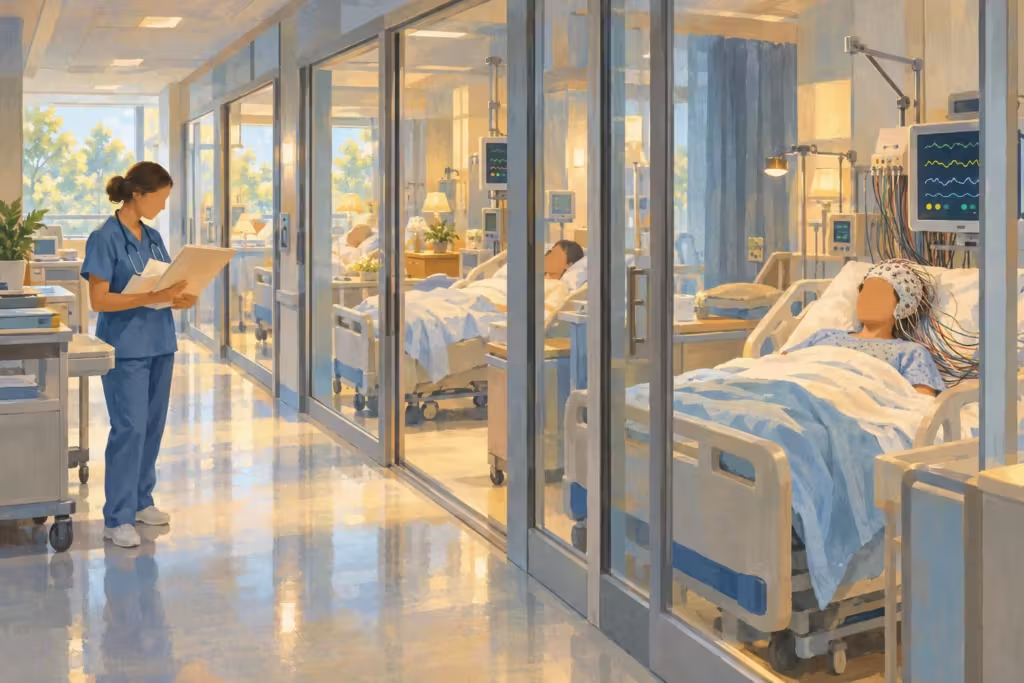
Ten years later, Borjigin’s team moved from rats to people. Gang Xu was the paper’s first author.
This time it was not an experiment. The team went through the records of patients who had died since 2014 in the neurological ICU of the University of Michigan’s hospital. They were looking for people who were wearing an EEG when they died. They found 4 such patients.
- Three were in a coma after an earlier cardiac arrest. The lack of oxygen had damaged their brains.
- One was in a coma because of a major bleed in the brain.
- All four had 3 or 4 points on the Glasgow Coma Scale. It is a test from 3 to 15 points that checks whether someone opens their eyes, speaks, or moves. 3 points is the lowest score, and 4 is very close to it. In their last 24 hours they showed no sign of being conscious.
These patients’ EEG had 19 sensors attached to the scalp.
The doctors believed they would not recover. Their families agreed to withdraw life support.
Step 10
As the ventilator is withdrawn · The heart is still beating
Their breathing support is withdrawn, and their hearts keep beating for 10 to 25 minutes
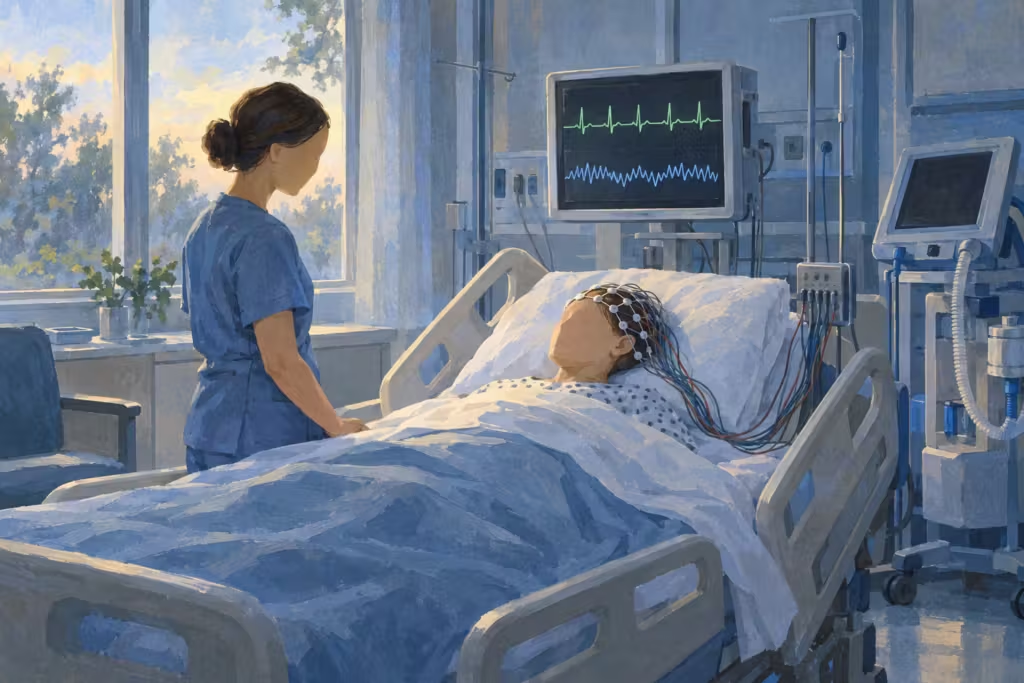
The four patients were taken off the ventilator, which is the machine that breathed for them. From that moment on, less and less oxygen reached their bodies.
Their hearts didn’t stop right away. According to a commentary published in the same journal, the last heartbeat came between 10 and 25 minutes later.
The team divided those minutes into stages, according to how the heart was beating. Then it compared the EEG from each stage with the EEG from the hours before, when the patients were still on the ventilator.
This isn’t a cardiac arrest like the rats’. It is a death in which the oxygen runs out first, and the heart stops afterward.
Step 11
Seconds after the ventilator is withdrawn · According to the study
In 2 of the 4 patients, the brain gives off a burst of gamma waves
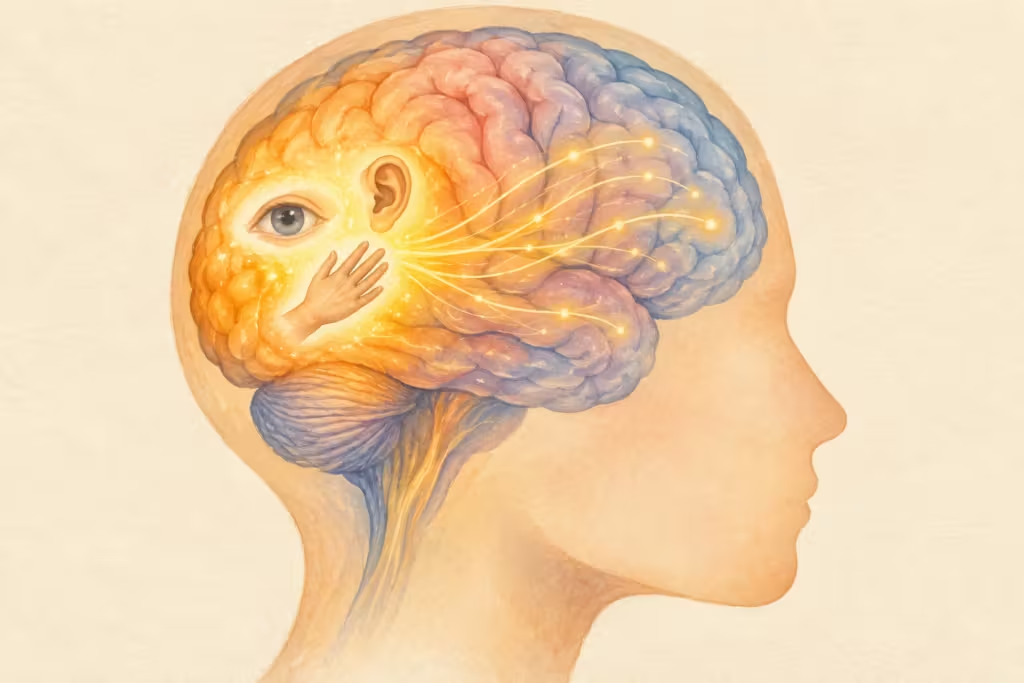
In two patients, nothing of the kind happened. They only had slow waves, and then the line went flat.
In the other two, both women, gamma waves rose a few seconds after the ventilator was removed, while their hearts were still beating. Depending on the area of the brain, they rose to between 2 and 391 times higher than before.
The team focused on a part of the brain that some scientists call the hot zone. It sits at the back and sides of the head. That is where the areas that see, hear, and feel the body meet. According to one theory of consciousness, that zone is where what we experience is put together, like a film on an editing table.
- Gamma coherence and connectivity rose in that zone in both patients.
- The activity rose again as the heart got worse.
- In one of them, the heart stopped for 33 seconds. Her gamma waves locked tightly onto slower ones during that pause and afterward.
The two patients with the burst had something in common. Both had had epileptic seizures.
One had them only during her pregnancies. The other had a very long seizure the day before she died. A specialist saw no seizures in the EEG from their last 24 hours. Also, they were the only two whose hearts sped up when the ventilator was removed.
Step 12
When the paper came out · According to the authors
The authors themselves say what they can’t know
The paper was published on May 1, 2023, also in PNAS. It can be read for free. The authors conclude that the human brain “can be active” during cardiac arrest.
All four people died. None of them could tell anyone anything.
That is why the authors write that the activity in the hot zone suggests something conscious but doesn’t prove it. It may have nothing to do with experiencing anything. It may be no more than what a damaged brain does as it dies.
They also checked whether the waves could be coming from somewhere else:
- Movement: in one patient, movement while the breathing tube was being removed may have made the rise look bigger.
- Muscles: in the other, two sensors on the forehead were also picking up muscle signals. When those signals were taken out, the rise got smaller but didn’t go away. And the coherence in the hot zone didn’t change.
- Epileptic seizures: the team saw none. But it can’t rule out a seizure deep in the brain. Sensors on the scalp can’t pick up those areas.
The paper made the news again.
Step 13
May 2023 · According to the press and the critics
The headlines return, and two NDE researchers respond

On that same May 1, the journal Science ran the headline “Burst of brain activity during dying could explain life passing before your eyes.”
A few weeks later, PNAS published a commentary by Christof Koch, a neuroscientist who studies consciousness. Koch wrote that the study gave strong evidence that the dying brain is not necessarily a quiet place. But he added that such a large rise in gamma waves is also compatible with an epileptic seizure. Koch would be more confident if something like this were seen in healthy people. For example, in people who take substances that cause experiences similar to an NDE.
Pim van Lommel is the Dutch cardiologist who led the ten-hospital study. Van Lommel and Bruce Greyson published a critique in the journal of the association that studies NDEs. This is what they say:
- There is no evidence at all that this activity was conscious.
- It wasn’t a cardiac arrest, but the removal of ventilators from patients in a coma whose hearts were still beating.
- In a cardiac arrest, the EEG goes flat within 10 or 20 seconds, and it stays flat during resuscitation. That is why they believe that NDEs during cardiac arrest happen while the EEG is flat.
- The electrical activity would be the way the brain processes the experience, not its cause. It is like reading. Your neurons fire, but they are not the ones writing the words on the page.
Some things in this critique don’t quite fit the papers. Van Lommel and Greyson describe both patients as “known with epilepsy,” but one had seizures only during her pregnancies. The people in the studies they cite never had an EEG on during their cardiac arrest. Also, one of the 2023 patients had a 33-second pause in her heartbeat. During that pause, the EEG was already very suppressed and gamma waves did not rise. Even so, her waves stayed locked together.
We have not found any published reply from the authors to this critique.
Step 14
From 2015 to 2025 · What came next
More rats, a review by the same group, and a study without the gamma peak

Other studies kept investigating. These are the ones that help most in understanding the burst:
- 2015, the same lab. In rats asphyxiated with CO2, coherence and connectivity rose, and the heart’s rhythm changed. The brain released a flood of serotonin in the first 2 minutes, more than 20 times the normal level.
- Other rat studies saw the rise before the heart stopped, not after. In people, it also shows up before.
- 2022, an 87-year-old man. He died in a hospital hooked up to a full EEG. His gamma waves rose just before his heart stopped and fell afterward. We cover it in Vicente’s study.
- 2022, 8 patients whose life support was withdrawn. In 4 of them, there was a rise in activity before their blood circulation stopped. Also, the EEG usually went silent more than a minute before the circulation stopped. In half of the patients, it went silent 78 seconds before or earlier.
- 2023, AWARE II. This study measured the brain during resuscitation. In some of the pauses, nearly normal waves appeared, but no gamma waves. None of the people who remembered something had been wearing the EEG.
- 2025, another lab. It studied 39 rats that were put down with CO2 at the end of a migraine study. In the rats that were awake, all the waves rose at once, at 3 minutes. The team saw no clear changes in the fastest gamma waves, but doesn’t publish those data. It didn’t measure coherence or connectivity either. It wasn’t a repeat of the 2013 experiment. The authors think the difference with 2013 is because in 2013 the salt was injected into the heart. However, in 2013, the burst also appeared in the rats asphyxiated with CO2.
In 2024, Mashour and three other researchers from the Michigan group reviewed everything that had been published. The first thing they say is that they reject any explanation that doesn’t come from the brain. Then they write three things:
- There is no evidence linking these bursts to any experience.
- The bursts may have nothing to do with consciousness.
- Other researchers have argued that the burst in the first few seconds may be too short for something as rich as an NDE, and the review notes this. The authors suggest the experience could take shape at another moment, while dying or while recovering. They don’t even rule out the time when the EEG is flat.
The question from the beginning remains: is that burst the NDE? Let’s look at what could be learned and what couldn’t.
From 17 rats to no accounts
The rats produced a clear burst, again and again. But a rat can’t tell us what it experiences.
So these figures say what the brain does as it dies, but not whether anything is experienced.
| Stage | Rats |
|---|---|
| Anesthetized rats whose hearts were stopped | 9 |
| Had the burst of gamma waves, lasting about 30 seconds | 9 |
| Anesthetized rats asphyxiated with CO2, with their hearts beating | 8 |
| Could describe what they experienced | 0 |
From 4 patients to no accounts
In 2023 the team found 4 people who died while wearing an EEG. Only 2 had the burst, and both had had epileptic seizures.
| Stage | People |
|---|---|
| Patients in a coma who died while wearing an EEG | 4 |
| Had a burst of gamma waves when the ventilator was removed | 2 |
| Of those, had had epileptic seizures | 2 |
| Survived | 0 |
| Could describe what they experienced | 0 |
What these figures don’t tell you
- “More than when awake” depends on how you compare. In the rats, after the heart stopped, the team took the highest value of the amount of gamma waves and of the connectivity. That value was compared with a 10-minute average while the rats were awake. Coherence was compared using averages. And the brain’s total activity was much lower than before the heart stopped.
- 2 of 4 is not a rate. With 4 people, there is no way to know how many have the burst when they die. How many people describe an NDE after a cardiac arrest is covered in How many people have a near-death experience?
- Zero accounts doesn’t mean they experienced nothing. It means there is no way to know. More about the brain and NDEs in What does science say about near-death experiences?
Where this page comes from
The studies
- Jimo Borjigin, UnCheol Lee, Tiecheng Liu, Dinesh Pal, and others (2013), “Surge of neurophysiological coherence and connectivity in the dying brain,” PNAS 110(35):14432–14437Read for free
- Gang Xu, Temenuzhka Mihaylova, Duan Li, and others (2023), “Surge of neurophysiological coupling and connectivity of gamma oscillations in the dying human brain,” PNAS 120(19):e2216268120Read for free
Letters, commentaries, and critiques
- Bruce Greyson, Edward F. Kelly, and W. J. Ross Dunseath (2013), “Surge of neurophysiological activity in the dying brain,” letter in PNAS 110(47):E4405Read for free
- Jimo Borjigin, Michael M. Wang, and George A. Mashour (2013), “Reply to Greyson et al.: Experimental evidence lays a foundation for a rational understanding of near-death experiences,” PNAS 110(47):E4406Read for free
- Bruce Greyson (2015), “Western Scientific Approaches to Near-Death Experiences”, Humanities 4(4):775-796Read for free
- Christof Koch (2023), “Do not go gently into that good night: The dying brain and its paradoxically heightened electrical activity,” commentary in PNAS 120(22):e2305985120Read for free
- Pim van Lommel and Bruce Greyson (2023), “Critique of Recent Report of Electrical Activity in the Dying Human Brain,” Journal of Near-Death Studies 41(1):3–8Read for free
What came next
- Duan Li, Omar S. Mabrouk, Tiecheng Liu, and others (2015), “Asphyxia-activated corticocardiac signaling accelerates onset of cardiac arrest,” PNAS 112(16):E2073–E2082Read for free
- George A. Mashour, UnCheol Lee, Dinesh Pal, and Duan Li (2024), “Consciousness and the Dying Brain,” Anesthesiology 140(6):1221–1231Read for free
- Julieta Trejo, Kaitlin M. Killian, Zhen Wang, and Yuan B. Peng (2025), “Local field potential changes during euthanasia may parallel with near death experience,” Scientific Reports 15:11404Read for free
- Lakhmir S. Chawla and others (2009), “Surges of Electroencephalogram Activity at the Time of Death: A Case Series,” Journal of Palliative Medicine 12(12):1095–1100View in the journal (paywalled)
Press
- Ed Yong, “In Dying Brains, Signs of Heightened Consciousness,” National Geographic, August 12, 2013Read
- “Near-death experiences may be triggered by surging brain activity,” LiveScience, published by Fox News, August 13, 2013Read
- S. Reardon, “Burst of brain activity during dying could explain life passing before your eyes,” Science, May 1, 2023Read
To understand more
- The AWARE II study: a random image and the brain on screenRead
- Vicente’s study: the brain of an 87-year-old man, recorded as he diedRead
- What does science say about near-death experiences?Read
- People with very advanced dementia who suddenly speak again: lucidity caught on videoRead
- How many people have a near-death experience?Read
- What does dying feel like?Read
Our archive
- Our reading of the 2013 and 2023 papers, the letters and the critique, and the studies that came after, as of October 14, 2026
More studies

AWARE: the pictures hidden on the shelves
Fifteen hospitals put up pictures that could only be seen from the ceiling, to check whether anyone saw them during a cardiac arrest.
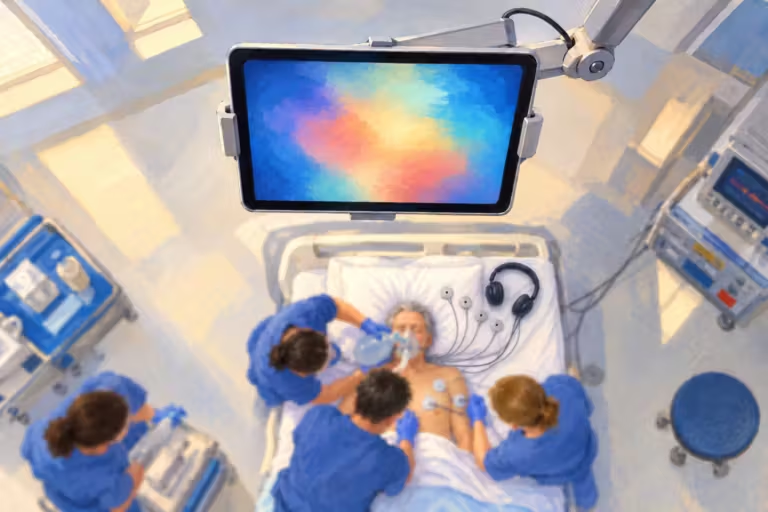
AWARE II: a random picture and the brain on the screen
Above the patient was a tablet with a random picture. Headphones said the names of three fruits. And the doctors measured the brain during resuscitation.
Van Lommel: 344 cardiac arrest survivors in ten hospitals
Ten hospitals asked every cardiac arrest survivor what they remembered. They saw them again after 2 and 8 years.