One study · United States, 2025
People with very advanced dementia who suddenly speak again: the Gilmore-Bykovskyi study (2025)
A team from the University of Wisconsin studied 20 people with very advanced dementia between 2021 and 2024. It video-recorded 19 of them. They were in a hospice unit. In all, the team recorded 1,433 hours. Three of those people suddenly began speaking coherently again. One of them did so for two days in a row, ten days before dying.
The question is: can a person whom dementia had stripped of almost all their words speak coherently again? Families have been describing it for a long time. This team wanted to see it and record it as it happened. We go through it step by step. If you only want to know what they found, skip straight to the results.
Step 1
Before 2021 · The question
Families say some people with dementia suddenly start speaking again
Advanced dementia, such as late-stage Alzheimer’s disease, gradually takes away memory and words. Doctors consider it a loss that can’t be reversed.
But doctors and families have been telling stories for more than 200 years about people who suddenly speak clearly again. They recognize their loved ones and remember things from their lives. Afterwards, they go back to how they were before.
This is called paradoxical lucidity. When it happens shortly before death, it is called terminal lucidity.
Almost everything known about it came from accounts told afterwards, from memory. No study had observed it and recorded it as it happened.
Step 2
United States, 2019 · From the study
The US government funds several studies to check it

In 2019, the US National Institute on Aging put up money to study lucidity in dementia. One of the teams was Andrea Gilmore-Bykovskyi’s, in Madison, Wisconsin.
Their plan was different from earlier studies. They were not going to ask families afterwards. They were going to set up cameras and record people with very advanced dementia for weeks or months.
That way they could compare each lucid moment with how that same person was on the other days.
Step 3
December 2021 to April 2024 · The participants
Twenty people with severe dementia join the study
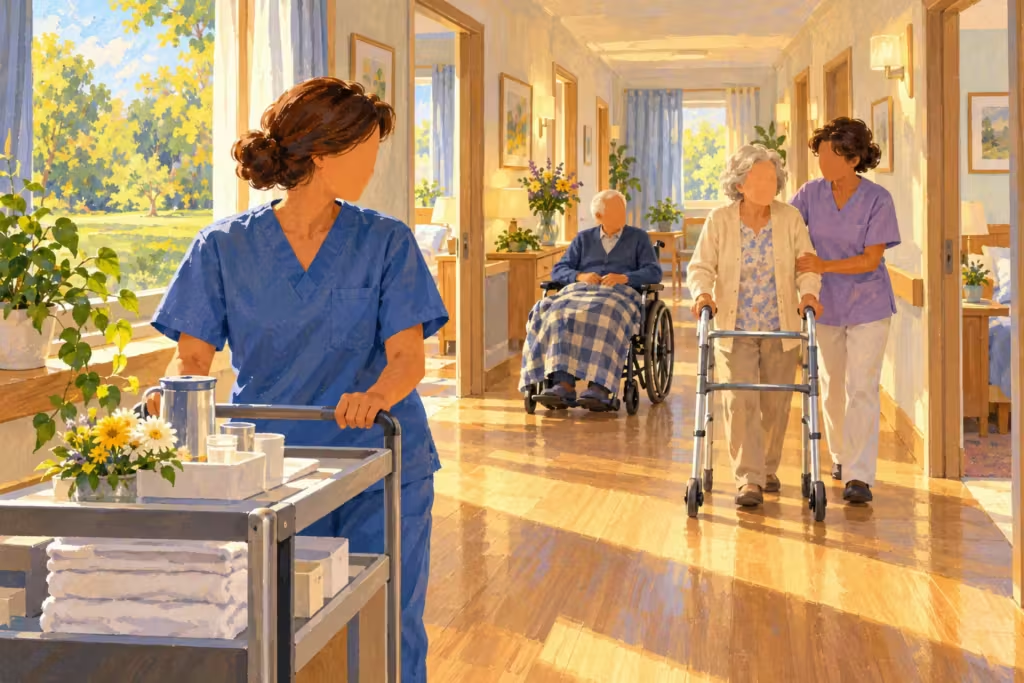
The team worked in a hospice unit for people with dementia. It had 12 beds. They chose it because earlier accounts said lucidity is more common near death.
- All of them had a diagnosis of severe dementia. Severity was measured with a clinical scale. To take part, a person needed a score of 37 or more. That score already means severe dementia. The average score in the study was 48.
- None of them could make decisions for themselves. Each person’s legal representative gave permission. 84 out of every 100 families who were asked agreed.
- They were between 71 and 89 years old, and three were 90 or older. There were 12 women and 8 men.
One of the 20 people died before recording began. That left 19 people.
Step 4
For months · The cameras
The team records 1,433 hours of video
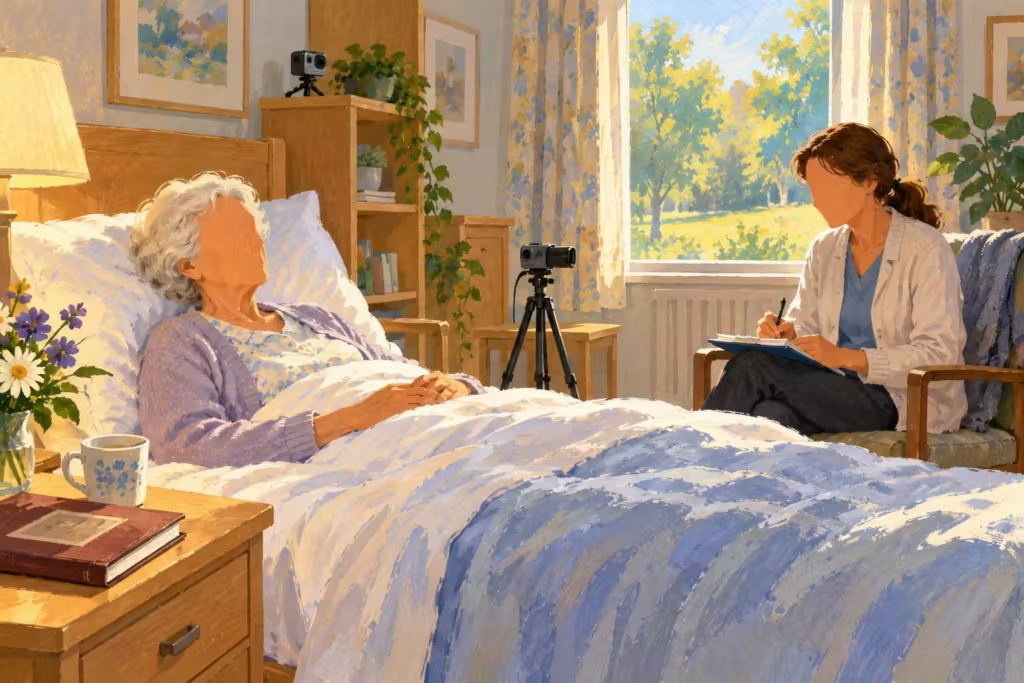
The team placed small cameras in the room, pointed only at the person. When needed, they also put a sound recorder nearby.
They recorded between 8 a.m. and 6 p.m., always with someone from the team present. They did not record while the person was being washed or dressed.
- In all, there were 539 recording sessions. Each person had between 2 and 127 sessions.
- They almost always kept recording until shortly before death. The family and the person themselves decided.
It was a lot of video for a few people. The hard part was knowing which moment was different from the rest.
Step 5
The comparison · From the study
They measure how each person communicates on an ordinary day

To know whether a moment was special, they first had to know what an ordinary day looked like for that person.
The team picked a stretch of video at random from each recorded day and analyzed it in detail. They counted the words, how many made sense, the gestures, the glances, and the laughter. That was each person’s usual state.
They only analyzed the stretches in which the person was doing something that could be measured. These stretches were between a third and a half of what was recorded for the three people who had lucid moments. Because of this, the authors think the real difference from the lucid moments is larger than what they measure.
Each person is compared with themselves, not with the others.
Step 6
The review · From the study
Relatives and clinicians decide what counted as a lucid moment

A possible lucid moment was picked up in two ways. Sometimes a relative, a staff member, or someone from the team who had seen it reported it. Other times, the team found it while reviewing all the videos.
Each case was then reviewed at a meeting with several people who knew the patient. There were 42 meetings, with 10 relatives or friends and 8 clinicians from the hospice.
- They reviewed 16 possible lucid moments, in 6 people.
- They accepted 9 moments, in 3 people. For all 9, everyone who took part in the meeting agreed.
There is still no settled definition of a lucid moment. That is why the final decision was made by the people who knew the patient.
The videos were used to measure the change. In those moments, all three people used many more meaningful words and sounds than on an ordinary day.
Step 7
Participant A · From the study
A woman who no longer remembered her family says their names while looking at photos

Participant A had Alzheimer’s disease and another dementia caused by problems in the brain’s blood vessels. She hardly spoke. Sometimes she answered with a single word. She did not remember her family.
One day, looking at old photos, she said the names of several relatives. It lasted about 5 minutes. One of her children said she had not called them by name for five or six months. That child also wondered whether it had to do with the photos. They were old photos, from when her children were younger.
- Another day she remembered the name she had given a stuffed animal and joked about it. It lasted 7 and a half minutes.
- Another day she answered several questions about her life and her family. Her answers were accurate. It lasted half an hour.
One of the clinicians spoke at the review. This clinician said that they would usually ask her a question and have to wait a very long time. Sometimes there was no answer at all. This time was different:
“That was just like you were having a conversation with anybody.”
She lived another year and a half to almost two years. The lucidity did not come at the end of her life.
Step 8
Participant C · From the study
A woman who hardly said a word speaks clearly for an hour
Participant C had had Alzheimer’s disease for seven years. She rarely said a word anyone could understand. Sometimes she answered with a single word.
She had four lucid moments in two months:
- At lunchtime, she spoke in clear sentences to a staff member. It lasted 10 minutes.
- She answered questions clearly and asked her partner to come closer. It lasted 4 minutes.
- She answered questions, said what she needed, and asked questions. It lasted 61 minutes.
- She asked a question in a full sentence and answered it with another. It lasted one minute.
At the review, one of her caregivers said of her voice: “it sure sounded from a depth.” The caregiver thought that “it may well be that [participant C]’s soul is back,” or that something was going on inside her that she was beginning to become aware of.
She died between two and four months after those moments.
Step 9
Participant B · From the study
A man who had been fading for two weeks walks, eats, and says “I’m leaving soon”
Participant B had had Alzheimer’s disease for ten years. How much he spoke varied a lot, it barely made sense, and he repeated a few short phrases.
One day he spoke in full sentences all day long. He started conversations, asked questions, and said the names of his family members. He remembered his Social Security number. He got up and walked. He was 52 days from his death.
He then spent two weeks fading. The staff thought he was reaching the end. Then he walked again. He ate and drank. He spoke in full sentences, asked questions, talked about his parents, and recognized his family. He seemed content. He said, “I’m leaving soon.” It lasted two days. He died nine or ten days later.
- His family and the staff saw it. Four clinicians confirmed it. The family could not come to the meeting, but the video shows they experienced it as something unexpected.
- Both moments lasted longer than the recording hours. When they began and ended was set partly from what the people who saw them said.
One of the clinicians put it like this at the review:
“It’s just so nice to see a glimpse of who he was, you know, before we knew him.”
This is the moment that most resembles what families call terminal lucidity. It happened in the last ten days of his life.
Step 10
The results · When and how often
The lucid moments come between 9 days and 20 months before death

Many accounts describe lucidity as a farewell in the last few days. In this study, the lucid moments came between 9 days and 20 months before death. The authors conclude that lucidity does not always mean death is near.
In all, the team observed 556 days. On 10 of them there was a lucid moment. That works out to one every 56 days on average.
- The margin is very wide. With these data, the true figure could be anywhere from one every 35 days to one every 116 days.
- To narrow the figure down, about five times more observation time than in this study would be needed. That is what the authors themselves calculate.
Three of the 20 people had at least one lucid moment. The authors say it may not be as rare as was thought.
Lucidity doesn’t happen often, but it does happen, and it can be recorded.
Step 11
What wasn’t measured
Nobody measured what the brain was doing during those moments
The study recorded what the people did and said. It did not measure their brains.
- There were no brain tests. Nobody measured its electrical activity or did any brain imaging. The authors suggest measuring it in future studies.
- The article does not say whether medication changed or whether there were other changes in health on those days.
- It was a single site, with few people. 19 of the 20 were white.
- Two people spoke more than one language. The team could not analyze what they said in any language other than English. One of them had lucid moments.
- The study plan was not registered before it began. The authors say so. The data are not public, but they can be requested with ethics approval.
The question from the start remains: how does someone whom dementia had stripped of words speak again? Let’s see what could be found out and what couldn’t.
From 20 people to 3 with lucid moments
How many remained at each step of the study.
Some possible lucid moments were not accepted. That doesn’t mean they didn’t happen. It means the people who knew the person weren’t sure about them.
| Step | People |
|---|---|
| Joined the study | 20 |
| Were recorded | 19 |
| Had at least one possible lucid moment (16 in all) | 6 |
| Had at least one accepted lucid moment (9 in all) | 3 |
The nine lucid moments
How long each one lasted and how long that person had left to live.
| What happened | Lasted | Before death |
|---|---|---|
| A: says her family’s names while looking at photos | 5 min | 20 months |
| A: remembers a stuffed animal’s name and jokes | 7.5 min | 19 months |
| A: answers questions about her life | 30.5 min | 18 months |
| B: talks, asks questions, and walks | 1 day | 52 days |
| B: walks, eats, and says “I’m leaving soon” | 2 days | 9–10 days |
| C: speaks in clear sentences at lunch | 10 min | 4 months |
| C: answers and asks her partner to come closer | 4 min | 3 months |
| C: answers, asks for things, and asks questions | 61 min | 3 months |
| C: one question and her answer to it | 1 min | 2 months |
What these figures don’t tell
- How many people with dementia have lucid moments. With so few people and a single site, no figure can be drawn for everyone.
- What happened in the brain. The figures measure what was seen and heard, not what was going on inside.
Where this page comes from
The study
- Andrea Gilmore-Bykovskyi, Haley Kottler, Amy Cochran, Kayla Dillon, Alison Coulson, Clark Benson, Jess Fehland, and Kimberly Mueller (2025), “A prospective observational study of lucid episodes in advanced dementia”, The Gerontologist 65(9):gnaf178. All rights reservedRead for freeView in the journal
- The study plan, published before the results: Gilmore-Bykovskyi and others (2024), “An observational study protocol to capture, validate and characterise lucid episodes in people living with advanced dementia receiving hospice care”, BMJ OpenRead for free
How each side reads it
- Michael Nahm, Bruce Greyson, Emily Williams Kelly, and Erlendur Haraldsson (2012), “Terminal lucidity: A review and a case collection”, Archives of Gerontology and Geriatrics 55(1):138–142View in the journal (paywalled)
- Maria Tollock, Natalia Leontovich, Anelly Gonzalez, and Sam Parnia (2025), “A Multi-Site Prospective Study of Paradoxical Lucidity in Moderate to Severe Dementia”, conference abstract in Innovation in Aging 9(Suppl. 2), CC BY licenseRead for free
- George Mashour and others (2019), “Paradoxical lucidity: A potential paradigm shift for the neurobiology and treatment of severe dementias”, Alzheimer’s & Dementia 15(8):1107–1114, CC BY-NC-ND licenseRead for free
To understand more
- Gamma waves: what has been measured in the brain just before deathRead
- What does science say about these experiences?Read
- What is an NDE?Read
Our archive
- A full reading of the article and of its table of the nine lucid moments, as of October 21, 2026
More studies
AWARE: the pictures hidden on the shelves
Fifteen hospitals put up pictures that could only be seen from the ceiling, to check whether anyone saw them during a cardiac arrest.
AWARE II: a random picture and the brain on the screen
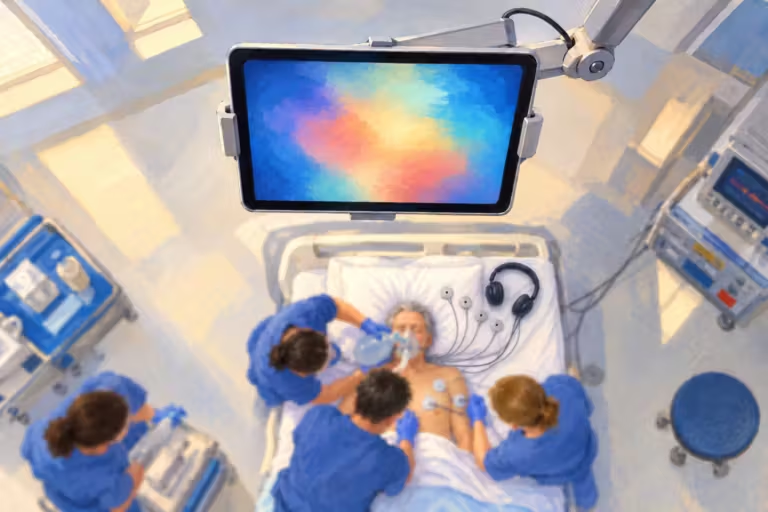
Above the patient was a tablet with a random picture. Headphones said the names of three fruits. And the doctors measured the brain during resuscitation.

Van Lommel: 344 cardiac arrest survivors in ten hospitals
Ten hospitals asked every cardiac arrest survivor what they remembered. They saw them again after 2 and 8 years.