A study · St. Louis (United States), 1991 to 1994, published in 2002
The Schwaninger study: 174 cardiac arrests and 7 near-death experiences
For almost three years, a team at a hospital in St. Louis followed every person who had a cardiac arrest there. 55 survived, and only 30 were able to do the interview. 7 of those 30 described a near-death experience. Six months later, according to the authors, those who had an NDE said their lives had changed more than those who didn’t have one.
The study’s question is: how many people who survive a cardiac arrest describe an NDE, and does anything change in their lives? To answer it, the team spoke with the survivors a few days after the arrest and wrote to them again six months later. We tell it step by step. If you only want to know what it found, go straight to the results.
Step 1
Before the study · The question
Almost everything known came from memories of years before

In 1975, the physician Raymond Moody gave near-death experiences their name. In the years that followed, almost every researcher collected accounts from people describing what they had been through long before.
A few studies gave figures. In 1977, the cardiologist Michael Sabom and a colleague asked 50 patients who had come close to dying. 11 described an NDE. In 1983, another study asked 32 college students who had been close to death, and 7 described one.
Those people almost always told their experience much later, sometimes years later. And researchers didn’t know how many people had come close to dying without experiencing anything.
To find out, someone had to ask everyone who survived a cardiac arrest, and do it within a few days.
Step 2
St. Louis, Missouri · According to the study
A cardiology nurse organizes the study at her hospital

Janet Schwaninger led the study. She was a nurse who coordinated heart care at a large university hospital in St. Louis, Missouri.
Three researchers from the Washington University School of Medicine worked with her. Paul Eisenberg was the physician who ran the cardiac intensive care unit. Alan Weiss was a professor of cardiology. Kenneth Schechtman was the team’s statistician.
The university’s ethics committee approved the study. That committee checks that a study with patients does them no harm.
Step 3
April 1991 to February 1994 · According to the study
Every cardiac arrest in the hospital is included
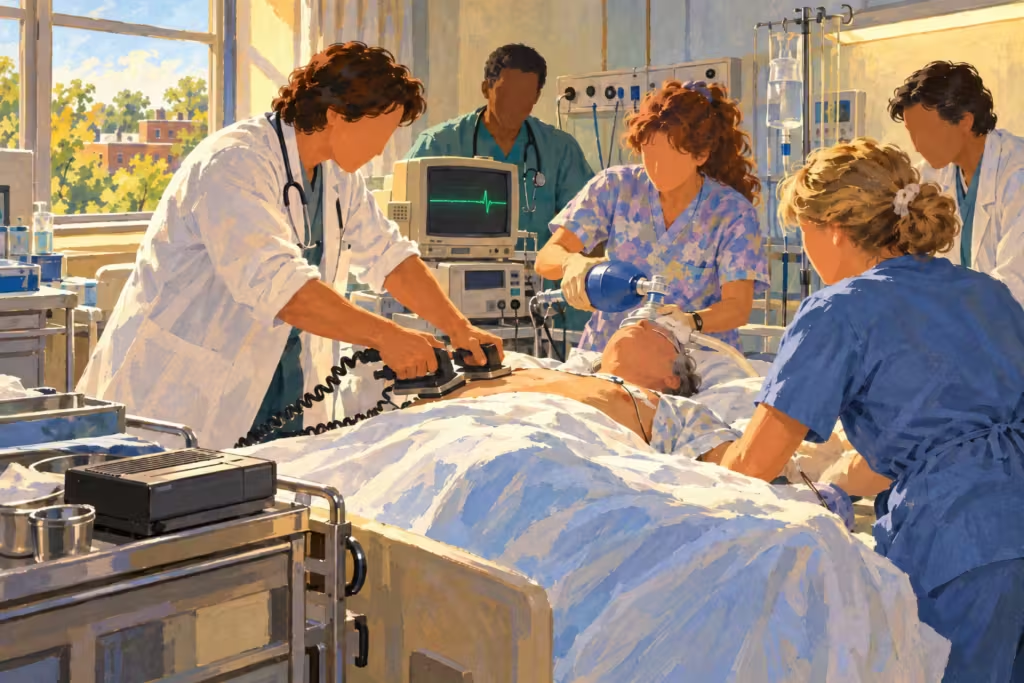
For almost three years, the team recorded every cardiac arrest in the hospital. Only the surgical intensive care unit was left out, because it was hard to keep track of each arrest there.
In this study, a cardiac arrest is when the heart has no rhythm that moves the blood. The heart may stop completely, or it may quiver without pumping. The second is called ventricular fibrillation. Either way, the person has no blood pressure and isn’t breathing.
Some people could not take part in the study:
- those whose arrest was caused by an overdose;
- those who already had a diagnosed mental illness;
- and those who were too ill to answer questions.
Step 4
Over those three years · According to the study
Of 174 people with a cardiac arrest, only 30 can tell anything
Over those years, 174 people had a cardiac arrest in the hospital. 119 died. That is 68 in 100.
55 survived. 25 of them could not be interviewed. Some had brain damage, and others still had a breathing tube when they left the hospital.
That left 30 people. Half were men and half were women. They were between 23 and 86 years old, 60 on average.
The study’s figures come from these 30 people.
Step 5
2 or 3 days after the arrest · According to the study
A few days later, a recorded interview
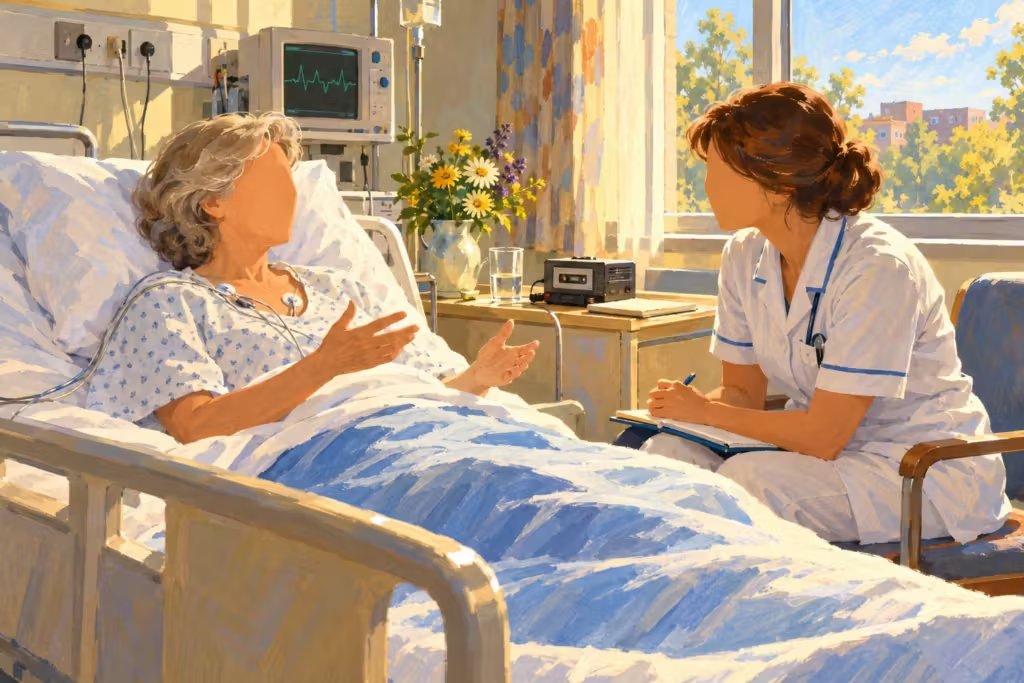
The team waited at least 24 hours after the arrest. That gave time for the confusion to pass and for the patient to become stable. The interview took place before the patient left the hospital, 2 or 3 days after the arrest on average.
First, the patient described in their own words what they had been through. That way the team didn’t influence them with its questions.
Then came the questions of Kenneth Ring, a psychologist who had studied NDEs in the 1970s. There are 14 questions about the experience, each with several parts, and 5 about the patient’s religion before and after the experience.
Anyone who remembered nothing of the arrest did not go through all the questions. The interview lasted half an hour on average. The patient chose whether it was recorded or written down by hand.
Step 6
After each interview · According to the study
The scale is filled in by the team, not by the patient

To decide who had an NDE, the team used the scale of Bruce Greyson, an American psychiatrist. It has 16 questions, and each thing experienced adds points, for example peace, a light, seeing a relative who had died or leaving the body. With 7 points or more, it counts as an NDE.
In this study, the patient did not answer the scale. The ethics committee asked that patients not be given the scale, so as not to influence what they said. So it was the team that listened to each interview and scored the scale.
How many of the 30 people scored 7 points?
Step 7
At the first interview · According to the study
7 of the 30 people describe an NDE during that arrest

7 people described an NDE during the arrest they had just had. That is 23 in 100 of the people interviewed.
In the drawing, each circle is one person in 100. The 23 filled circles are, roughly, the ones who described an NDE during that arrest. In the study, it was 7 of 30.
Another 4 people did not have an NDE during that arrest. But they described one they had had before, on another occasion when they came close to dying. They told it in as much detail as if it had just happened.
For the comparisons, the team put these 4 people together with the 7 above. That made a group of 11 people with an NDE. The other 19 had never had one. Of those 19, 16 remembered nothing of the arrest and 3 remembered something that did not amount to an NDE.
One of the 7 patients, besides the NDE during the arrest, had already had another one before. This patient said they met the same spiritual being both times.
Step 8
When they experienced it is unknown · According to the patients
What they describe: peace, being apart from the body and no fear
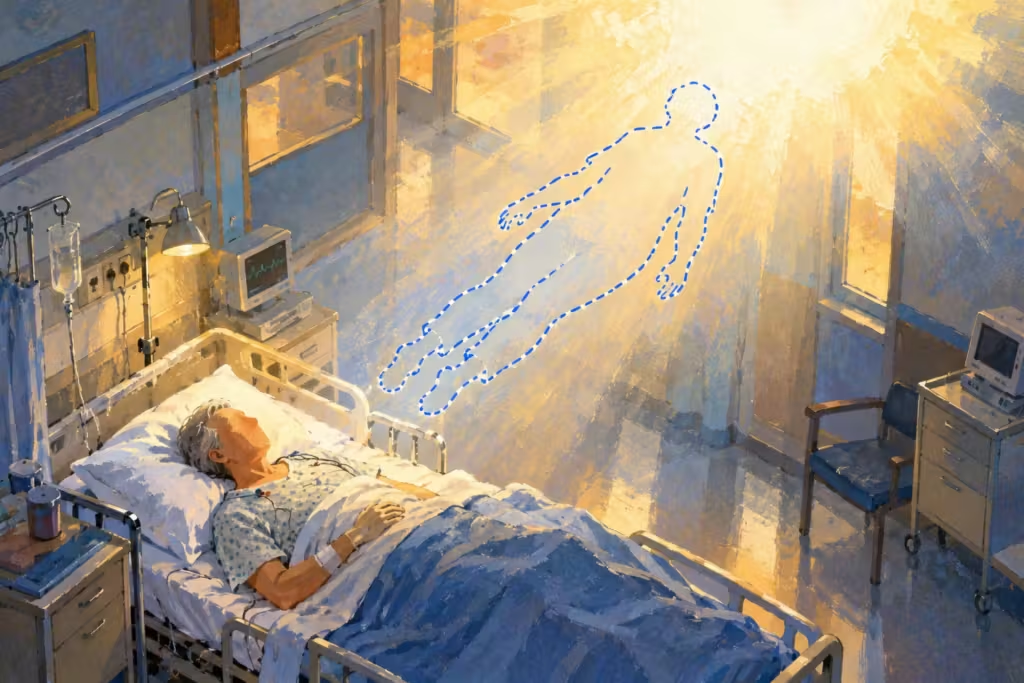
This is what the 11 people with an NDE described:
- All 11: felt peace and said what they experienced could not be put into words.
- 10: felt separated from their body. Only 2 said they actually saw it.
- 8: saw people who had died or religious figures. 6 spoke of God or a higher power, 4 of angels and 3 of relatives who had died.
- 7: saw a light that did not hurt their eyes.
- 5: reached a border that could not be crossed.
- 4: went through a tunnel.
- 1: saw their life pass before them.
None of the 11 people felt fear, anguish or despair. One spoke of beings that seemed neither good nor bad.
In other studies, some people say they learned things they could not see or hear from their bed. Here, none said so. 9 of the 11 felt that what they experienced was real.
9 of the 11 people with an NDE were Protestants. Many explained their experience through their religious beliefs.
Step 9
In her NDE · According to the study, in one sentence
A patient says she saw a brother who had died and whom she had never known

Among the cases, the article describes one in a single sentence. A patient said that in her NDE she met a brother of hers who had died and whom she had never known. Later, her parents confirmed that this brother existed.
The article gives no more details. It does not say what she described about the brother, whether she said his name, or whether she had heard about him at home as a child. Nor does it say whether that NDE was the one during the study’s arrest or an earlier one.
Without those details, the case can neither be checked nor ruled out.
Step 10
Six months later · According to the study
Six months later, a questionnaire by mail

Six months after the interview, the team mailed a questionnaire to everyone. 8 of the 11 people with an NDE and 10 of the 19 without one answered. Of those who did not answer, 4 had died and one could not be found. The article does not say why the rest did not answer.
The questionnaire was another one by Kenneth Ring. It has 42 questions about how each person’s life had changed. It asks, for example, about their wish to help others, their faith or the meaning of their life.
The people with an NDE answered that they had changed more than the people without one in 26 of the 42 questions. They said they prayed more, felt God’s presence more, understood others better and found more meaning in life.
But there was no difference in fear of death. At six months, the two groups gave almost the same answer. Their fear of death had not changed. At the first interview, by contrast, 10 of the 11 people with an NDE had said they were less afraid of dying.
The authors point out a problem. They made so many comparisons that some differences may have come out by chance.
Step 11
2002 · According to the study
The study is published, and the authors draw three conclusions

The article was published in the summer of 2002 in the Journal of Near-Death Studies, a journal devoted to near-death experiences. The authors draw three conclusions:
- NDEs are fairly common after a cardiac arrest. 7 of the 30 people interviewed described one.
- An NDE changes a person’s life. According to the authors, those who had one place more value on spirituality, on others and on their own life.
- Talking about the experience helps patients. The 8 people with an NDE who answered the questionnaire said it had helped them a lot to tell it before leaving the hospital. The authors ask hospital staff to learn to listen to these experiences.
The authors acknowledge two limits. Very few people survive a cardiac arrest. And no one can measure someone’s personality before they have an NDE, to compare it with afterward.
The study did not measure anyone’s brain activity. Nor does it know when each person had their experience.
Let’s see what can and can’t be known from these data.
From 174 cardiac arrests to 7 experiences
Most of the people with a cardiac arrest died or could not talk.
So all of the study’s figures come from very small groups.
| Group | People |
|---|---|
| Had a cardiac arrest in the hospital | 174 |
| Died | 119 |
| Survived | 55 |
| Were able to do the interview | 30 |
| Described an NDE during that arrest | 7 |
| Described an NDE from another occasion | 4 |
| Answered the questionnaire at six months, with NDE / without | 8 / 10 |
What these figures don’t tell you
- The NDE group mixes two moments. 7 of the 11 NDEs are from the study’s arrest and 4 are from another occasion, told from memory.
- Only those who could do an interview were included. The most seriously ill don’t appear. More in How many people have an NDE?
- The six-month comparisons are very small: 8 people with an NDE and 10 without.
Frequently asked questions
What did Janet Schwaninger’s 2002 study of cardiac arrests find?
Of 174 people who had a cardiac arrest at a hospital in St. Louis, 55 survived and only 30 were able to do the interview. 7 of those 30 described a near-death experience during that arrest. That is 23 in 100. It’s all in “What the Schwaninger study found.”
Does having a near-death experience change your life, according to the Schwaninger study?
According to its authors, yes. At six months, those who had an NDE said they had changed more than those who didn’t. The difference showed up in 26 of 42 questions, mostly on faith and the meaning of life. But only 18 people answered, and fear of death was no different between the two groups.
Why did the Schwaninger study interview only 30 people?
Because of the 174 people who had a cardiac arrest, 119 died. Of the 55 who survived, 25 could not do the interview because they had brain damage or still had a breathing tube. With so few people, the study’s figures are not very reliable.
Has anyone seen, in a near-death experience, a relative who had died and whom they never knew?
Yes, a patient in Janet Schwaninger’s 2002 study said so. She said she saw a brother who had died and whom she had never known. Her parents later confirmed that this brother existed. The article gives it only one sentence. It does not say what she described or whether she had heard of him before. So the case cannot be checked.
Where this page comes from
The study
- Janet Schwaninger, Paul Eisenberg, Kenneth Schechtman and Alan Weiss (2002), “A Prospective Analysis of Near-Death Experiences in Cardiac Arrest Patients,” Journal of Near-Death Studies 20(4):215-232View in the journal (paywalled)
Assessments
- Joshua Kovoor et al. (2024), “Near-death experiences after cardiac arrest: a scoping review,” Discover Mental Health 4:19Read for free
- Penny Sartori (2008), The Near-Death Experiences of Hospitalized Intensive Care Patients: A Five Year Clinical Study, Edwin Mellen PressBorrow it on archive.org
To understand more
- The Greyson study: 1,595 heart patients and 27 near-death experiencesRead
- The van Lommel study: 344 resuscitated people in ten hospitalsRead
- The Southampton study: 63 resuscitated peopleRead
- How many people have an NDE?Read
- How does life change after an NDE?Read
Our archive
- Our reading of the full article, with its five tables, checked on October 22, 2026
More studies
AWARE: the pictures hidden on the shelves
Fifteen hospitals put up pictures that could only be seen from the ceiling, to check whether anyone saw them during a cardiac arrest.
AWARE II: a random picture and the brain on the screen
Above the patient was a tablet with a random picture. Headphones said the names of three fruits. And the doctors measured the brain during resuscitation.
Van Lommel: 344 cardiac arrest survivors in ten hospitals
Ten hospitals asked every cardiac arrest survivor what they remembered. They saw them again after 2 and 8 years.