A study · Southampton (United Kingdom), published in 2001
The Southampton study: 63 cardiac arrest survivors and boards on the ceiling
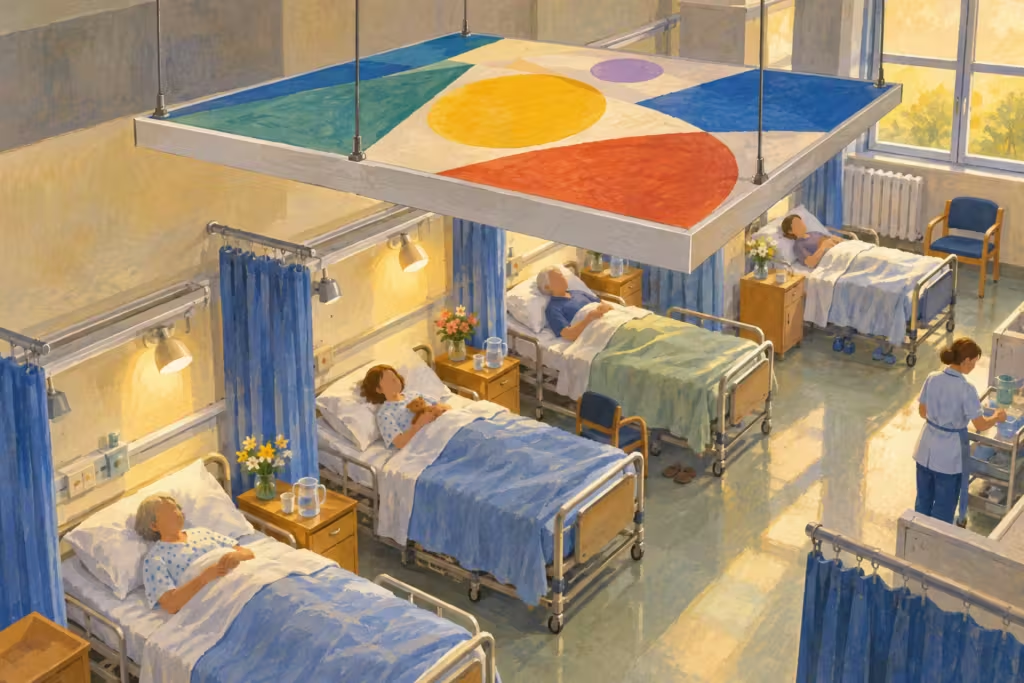
A team of doctors at a hospital in Southampton, England, spent one year talking to every person who survived a cardiac arrest. It asked them what they remembered. 63 people survived. Before they started, the researchers hung boards from the ceiling with drawings that could only be seen from above.
The authors wanted to know how many people have an NDE, what causes it, and whether people who say they leave their body really see what is in the room. It was one of the first studies to ask every survivor in a hospital within a few days. It also hid some drawings to test whether people really see from above. Other researchers had already tried that idea in some hospitals. We go through it step by step. If you only want to know what it found, skip to the results.
Step 1
Before the study · The question
Hundreds of accounts, and no way of knowing when they happened

The authors had collected about 750 accounts from people who described an NDE or said they had left their body. All of them were told after the fact.
Those accounts had a problem that couldn’t be solved. It was never clear whether the experience had happened before the person lost consciousness, while they were unconscious, or as they were waking up.
No study had done two things at once. One is asking patients within a few days. The other is comparing what they describe with measured medical data, such as the oxygen in their blood.
So they decided to run a trial in a single hospital. This is called a pilot study.
Step 2
Over one year · According to the study
A year at Southampton General Hospital
The study was led by Sam Parnia, a doctor at Southampton General Hospital. He worked with D. G. Waller and R. Yeates from the same hospital, and with Peter Fenwick of the Institute of Psychiatry in London. Their own department paid for the study. The paper doesn’t say what year it was carried out.
The team spent one year looking for every person who survived a cardiac arrest on the medical wards, in the emergency department, or in the coronary care unit. To find them, they used the log kept by the hospital switchboard. Every cardiac arrest call is recorded in that log.
To be interviewed, each person had to meet five conditions:
- Have survived a cardiac arrest in one of those units.
- Be over 18.
- Score 10 out of 10 on a short mental test, to leave out anyone who was confused.
- Have the agreement of the doctors and nurses caring for them.
- Give their consent after the study had been explained to them.
Before the first interview, they set up one more thing.
Step 3
Before it began · According to the study
Boards with drawings that can only be seen from the ceiling
Some people who have had an NDE say they saw themselves from the ceiling while they were being resuscitated. They also say they saw things they couldn’t have seen from the bed. The authors note that doctors and nurses later confirmed some of those accounts.
To put this to the test, the authors hung boards from the ceilings of the wards before the study began. The boards had drawings on the top side, the one facing the ceiling. From the floor, the drawings couldn’t be seen.
If someone said they had left their body and been up near the ceiling, they should be able to say what drawing was there.
The authors explain it this way. If the mind creates those perceptions, no one will name the right drawing.
Step 4
During a cardiac arrest · The heart isn’t pumping
A cardiac arrest is the closest thing to dying that can be studied
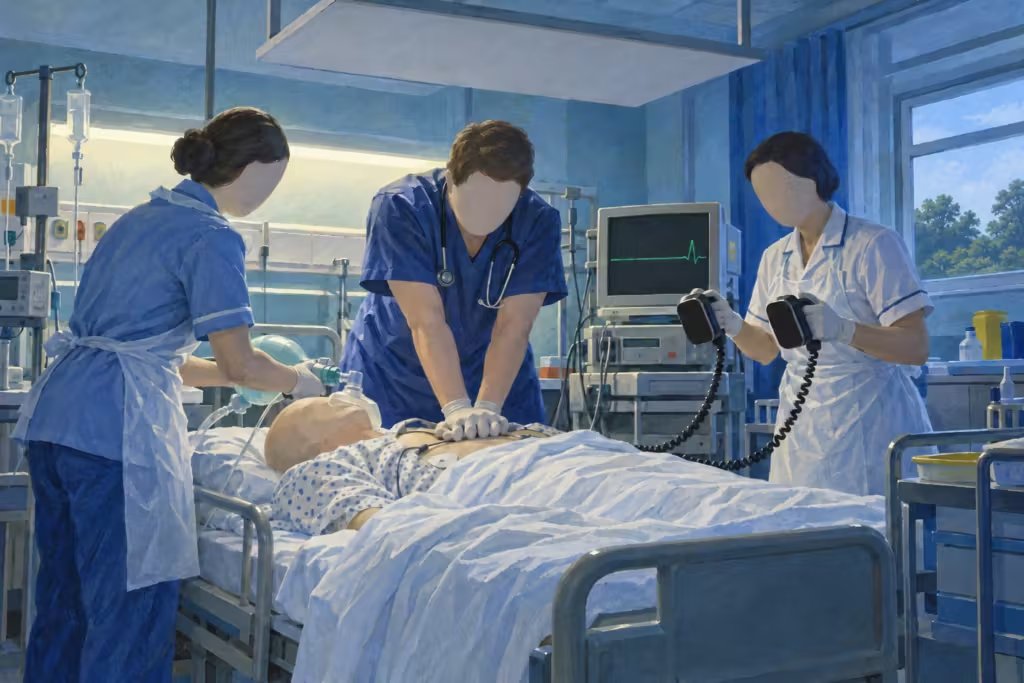
A cardiac arrest is when the heart stops pumping blood and the person stops breathing on their own. According to the authors, those are two of the three signs doctors use to pronounce someone dead. The third sign is that the pupils stop reacting to light, and it usually appears in a cardiac arrest too.
That is why they chose cardiac arrest survivors. Also, everyone was resuscitated following the same protocol and given similar medications.
Once they recovered, they were asked a single question.
Step 5
Within the following week · According to the study
A single question, with no mention of NDEs

The team interviewed them in the hospital, within a week of the cardiac arrest. They were told the researchers wanted to find out what people remember after being in a coma following a cardiac arrest.
Then they were asked an open question. The team asked whether they remembered anything from the time they were unconscious.
They were not asked anything about NDEs or about leaving the body.
What they described was scored on the scale created by Bruce Greyson, an American psychiatrist. It has 16 questions, and each thing the person went through adds points, for example peace, a light, seeing a relative who had died or leaving the body. A score of 7 points or more counts as an NDE.
The team also took several kinds of data from each patient’s medical records. In the blood tests, they looked at oxygen, CO2, sodium, and potassium. They also looked at the medications and the heart rhythm during the cardiac arrest. And they asked each person about their religion.
Step 6
At the interview · According to the study
Of 63 people, 56 remembered nothing and 4 described an NDE
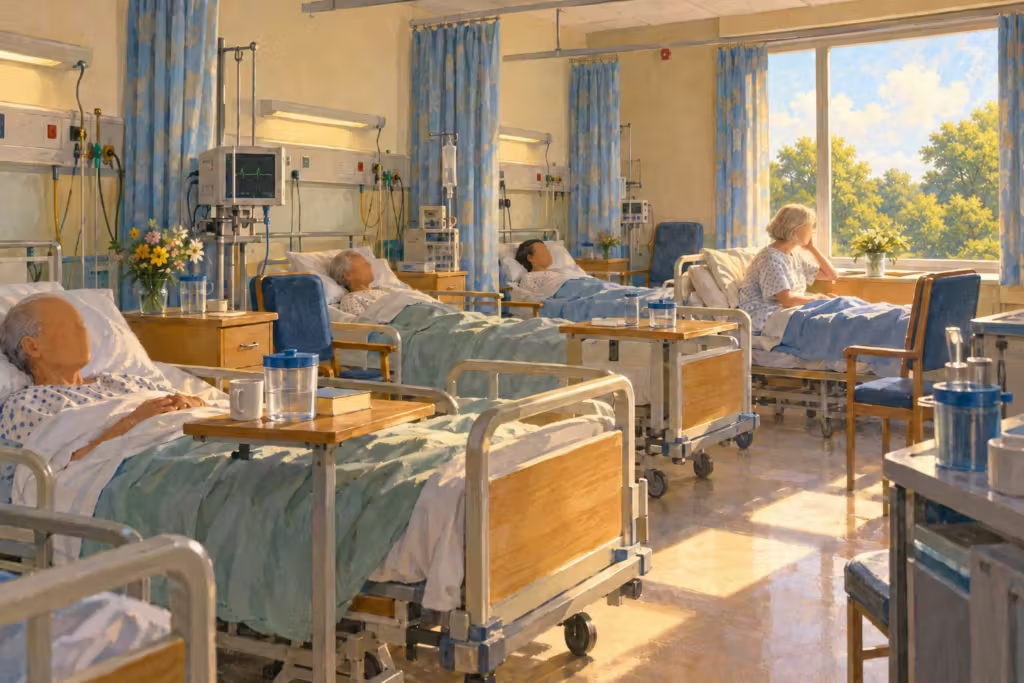
That year, 63 people survived, and all of them were interviewed.
- 56 remembered nothing from the time they were unconscious.
- 7 remembered something. That is 11 out of 100.
- 4 of those 7 described an NDE, scoring 7 points or more. That is about 6 out of 100.
Each dot stands for one person out of 100. The 6 filled-in dots are the people who described an NDE. That was 4 of the 63 people.
The other 3 people who remembered something scored under 7 points. Two described a few things typical of an NDE, such as peace or seeing relatives who had died. The third had a confused memory of unknown people jumping off a mountain.
What did the 4 people with an NDE describe?
Step 7
Timing unknown · According to the patients
What they describe: a border, a light, peace

They were two men and two women. They scored 10, 10, 10, and 13 points. This is what they went through:
- All 4: reaching a border, a point from which there was no return.
- 3 of the 4: seeing a bright light, and feeling peace and joy.
- 2 of the 4: seeing a relative who had died, entering another world, feeling that time had sped up, and losing awareness of their body.
- 1 of the 4: meeting a being they didn’t recognize.
None of the 4 said they had left their body. And none of them had a distressing experience.
All 4 were Christians, but none practiced their religion. None of them saw a religious figure. One of them also described himself as a Pagan.
Step 8
At the end of the year · According to the study
No one described leaving their body, and no one got to look at the boards
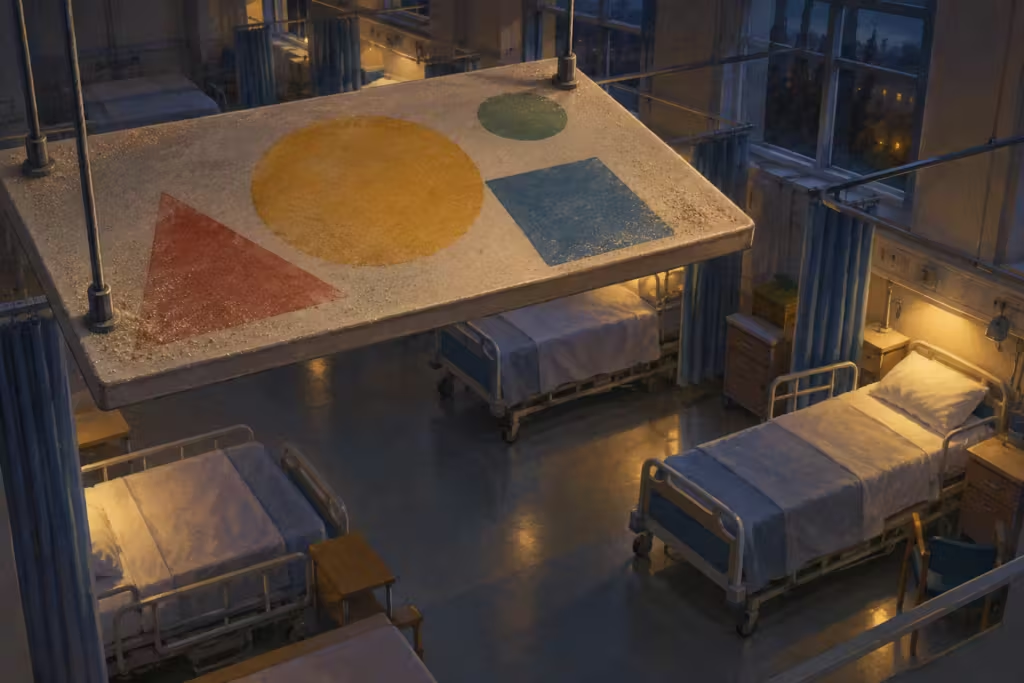
The boards stayed up all year. But none of the 63 people said they had left their body.
So there was never a chance to check whether anyone could see the drawings.
For the authors, it is not clear whether people who say they watch their own resuscitation from above are really seeing it or are hallucinating. Some may know things they couldn’t have known while unconscious. But those things may also have reached them through their senses, in the ordinary way.
What the researchers could compare were the blood tests.
Step 9
Comparing the blood tests · According to the study
More oxygen in those who had an NDE, but in only 4 people

One idea put forward to explain NDEs is that the brain runs out of oxygen. The authors compared the 4 people who had an NDE with the other 59.
- The oxygen in the blood was twice as high in those who had an NDE as in the others. Those who had an NDE had 33.1 kPa on average. The others had 16.8 kPa. The kPa is the unit it is measured in.
- Sodium, potassium, and CO2 were similar in both groups.
- Heart rhythm: 3 of the 4 people had a rhythm called ventricular fibrillation or ventricular tachycardia. The fourth had asystole. Asystole is when the heart is not beating at all.
The authors say 4 people were not enough for statistical testing. They give only the averages.
The authors offer two possible explanations. First, it may be “simply a skewed result due to the low patient numbers.” Second, the people who had an NDE may have had more oxygen in their blood. In that case, a lack of oxygen would not be what causes the experience. In the end, the authors conclude that “it would be unwise, with such small numbers, to draw any significant conclusion.”
There is one more detail. The paper says the blood samples were taken during the cardiac arrest. A footnote says the data were recorded from the time the patient was on the ward. That footnote may only mean from when the data were reviewed. But the paper doesn’t give the time of each sample.
Step 10
Discussing the data · According to the study
At what moment does the experience happen?
The authors think the NDE probably happened while the person was unconscious. And they call this “a surprising conclusion.” With the brain so impaired, no one should be able to experience something so complex, or to remember it afterward.
The authors also consider another possibility. The experience could happen as consciousness is lost or as it returns. But the authors think it unlikely:
- As consciousness is lost: in a cardiac arrest, consciousness goes within a few seconds. And no one said their experience began at that moment.
- As consciousness returns: memories are usually confused, and these were not.
The authors did not measure the timing. They themselves write that more data are needed to confirm it.
There is one more thing to keep in mind. To be in the study, people had to score 10 out of 10 on the mental test. That left out confused people. And they are the ones who might report confused memories.
Step 11
February 2001 and after · According to other researchers
The study is published, and its oxygen figure gets cited both ways
The paper was published in 2001 in Resuscitation. At the end of the paper, the authors call for a study in many hospitals at once. They wanted enough people to look in detail at both body and mind. They also wanted to study out-of-body experiences.
In 2003, the psychiatrist Bruce Greyson relied on the Southampton study in his own, with 1,595 heart patients. He wrote that “those models that have been studied empirically, such as the influence of blood gases, have been disconfirmed.” But that study ran no statistical tests, and its authors warned against drawing conclusions.
In 2010, another study, in Slovenia, measured the same thing in 52 people resuscitated outside the hospital. There, the 11 people who had an NDE had less oxygen than the others. But that difference wasn’t conclusive either. They also had more CO2 than the others, and that difference was conclusive. We cover this in the Klemenc-Ketis study.
The multi-hospital study the authors had called for came in 2014. It was called AWARE. Now let’s look at what is known from the Southampton study.
From 63 people to 4 NDEs
The study was small on purpose. It was a trial run in one hospital, before a large study.
That is why its figures are useful for seeing what NDEs look like when everyone is asked. But they are not useful for looking for their causes.
| Step | People |
|---|---|
| Survived a cardiac arrest and were interviewed | 63 |
| Remembered nothing | 56 |
| Remembered something | 7 |
| Described an NDE, with 7 points or more | 4 |
| Said they had left their body | 0 |
| Named a drawing on the boards | 0 |
What these figures don’t tell you
- 11 out of 100 is the figure for memories, not NDEs. Some books say 11% had an NDE, but there were 4 NDEs, about 6 out of 100. More in How many people have a near-death experience?
- Nobody named the drawings on the boards, but that is not a failure. No one had a chance to look at them.
- The oxygen difference has no statistical test behind it. More in What does science say about near-death experiences?
Where this page comes from
The study
- Parnia, Waller, Yeates, and Fenwick (2001), “A qualitative and quantitative study of the incidence, features and aetiology of near death experiences in cardiac arrest survivors,” Resuscitation 48:149–156View in the journal (paywalled)
What others said later
- Bruce Greyson (2003), “Incidence and correlates of near-death experiences in a cardiac care unit,” General Hospital Psychiatry 25:269–276View in the journal (paywalled)
- Zalika Klemenc-Ketis, Janko Kersnik, and Stefek Grmec (2010), “The effect of carbon dioxide on near-death experiences in out-of-hospital cardiac arrest survivors,” Critical Care 14:R56Read for free
To learn more
- The AWARE study: the images hidden on the shelvesRead
- The van Lommel study: 344 cardiac arrest survivors in ten hospitalsRead
- What does science say about near-death experiences?Read
- How many people have a near-death experience?Read
Our archive
- Our reading of the full paper, with its tables and its footnote on the blood tests, and the predictions we wrote down before reading it, as of October 12, 2026
More studies
AWARE: the pictures hidden on the shelves
Fifteen hospitals put up pictures that could only be seen from the ceiling, to check whether anyone saw them during a cardiac arrest.
AWARE II: a random picture and the brain on the screen
Above the patient was a tablet with a random picture. Headphones said the names of three fruits. And the doctors measured the brain during resuscitation.
Van Lommel: 344 cardiac arrest survivors in ten hospitals
Ten hospitals asked every cardiac arrest survivor what they remembered. They saw them again after 2 and 8 years.