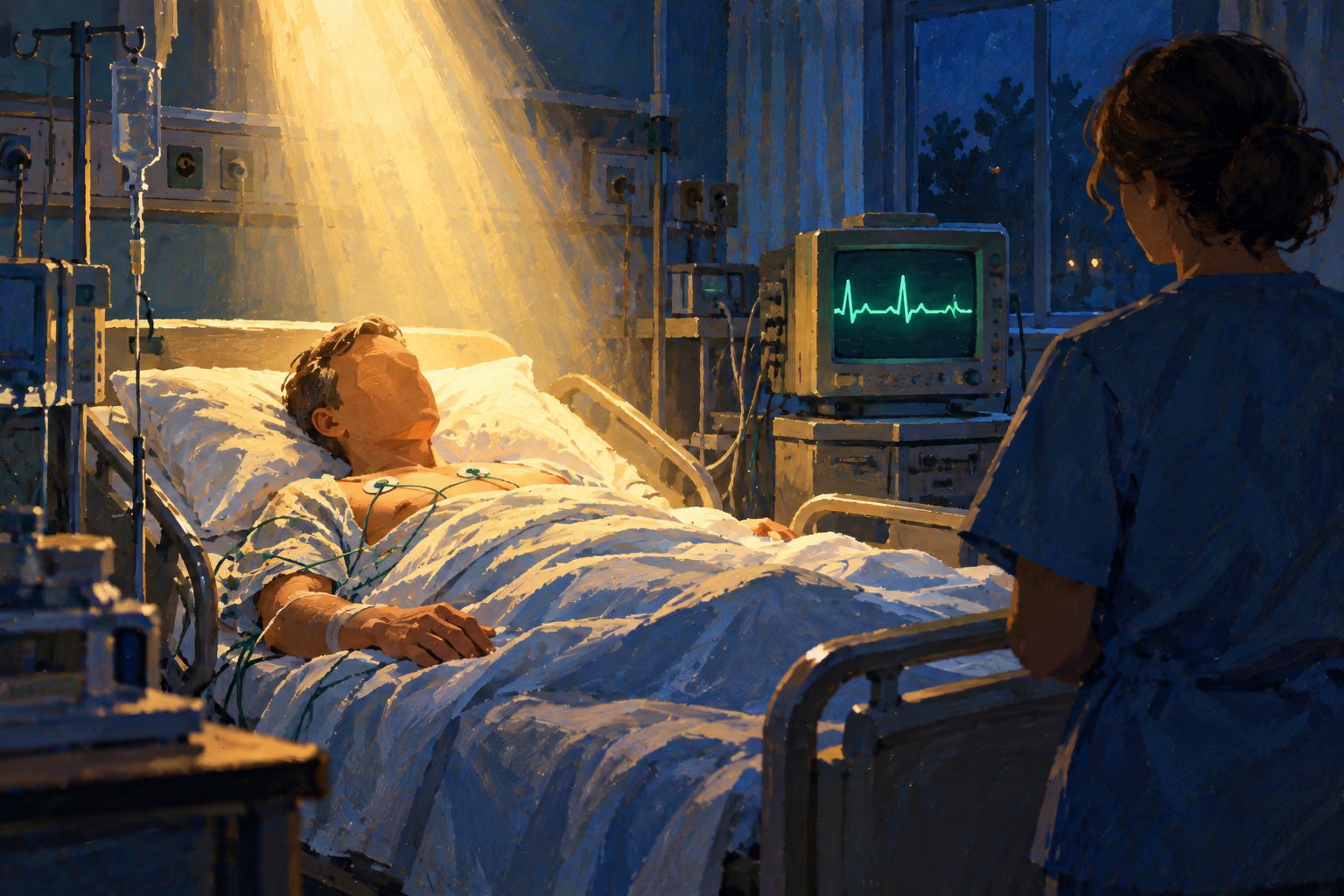
A study · Virginia (United States), published in 2003
The Greyson study: 1,595 heart patients and 27 near-death experiences
For two and a half years, a University of Virginia psychiatrist and his team spoke with every patient admitted to cardiology. They asked them what they had experienced during their heart problem. Of 1,595 people, 27 described a near-death experience. These experiences were ten times more common among patients who had had a cardiac arrest than among patients without one.
The question of the study is: are NDEs more common the closer a person comes to death? To answer it, Greyson made two comparisons. He compared patients who had a cardiac arrest with everyone else. And he compared each person who had an NDE with a similar patient who didn’t, of the same age, the same sex and the same illness. We go through it step by step. If you only want to know what it found, skip to the results.
Step 1
Before the study · The question
Nobody had asked every heart patient

In 1978, two psychiatrists in Boston estimated how many people have an NDE after a cardiac arrest. They came up with about 2 out of 100. It was an estimate, not the figure from a study.
Between 2001 and 2002, three studies were published that asked every cardiac arrest survivor in their hospitals. One is the van Lommel study, in the Netherlands. Another is the Southampton study, in England. The third is the Schwaninger study, in the United States, with 30 people. Each study gave a different figure. Between 6 and 23 out of 100 survivors described an NDE.
Those studies only asked people who had had a cardiac arrest. Nobody knew what happened with other heart patients, such as those who had a heart attack.
A cardiac arrest is when the heart stops pumping, and a heart attack is when part of the heart is damaged but it usually keeps beating.
Greyson expected NDEs to be more common with a cardiac arrest than with a heart attack or another heart problem. If NDEs have to do with being about to die, that is how it had to be.
Step 2
Charlottesville, Virginia · As the study tells it
A University of Virginia psychiatrist sets up the study

Bruce Greyson led the study. He was a psychiatrist at the University of Virginia and had been studying NDEs for more than twenty years. In 1983 he created a scale to measure them. Today that scale is used all over the world.
Ian Stevenson, another psychiatrist at the same university, helped him design the study. The nurse Christina Fritz and the doctors Tiffany Pankow and Jim Tucker interviewed the patients and reviewed their medical records.
The study was done at the University of Virginia hospital, in the city of Charlottesville. It was paid for by a German institute in Freiburg that studies paranormal phenomena and other subjects psychology doesn’t usually cover.
The team spoke with every patient admitted to cardiology for two and a half years.
Step 3
For two and a half years · As the study tells it
Every cardiology patient is included, not just those with a cardiac arrest

The study included everyone admitted to the cardiology ward or to the coronary care unit, which is its intensive care area. The only people left out were those too ill to talk, those with a serious mental illness and those with memory problems.
There were 1,595 people. Their average age was 63. 61 out of 100 were men.
They were admitted for different reasons:
- 116 people, for a cardiac arrest.
- 490, for a heart attack.
- 624, for angina that was getting worse. Angina is chest pain caused by too little blood reaching the heart.
- 365, for other heart problems, such as an abnormal rhythm, fainting, or a heart that pumps weakly.
In this study, a cardiac arrest can be three things:
- The heart stops beating completely.
- The heart quivers without pumping. This is called ventricular fibrillation.
- The heart beats so fast for so long that it pumps poorly. This is called sustained ventricular tachycardia.
Step 4
A few days later · As the study tells it
A few days later, a 15-minute interview
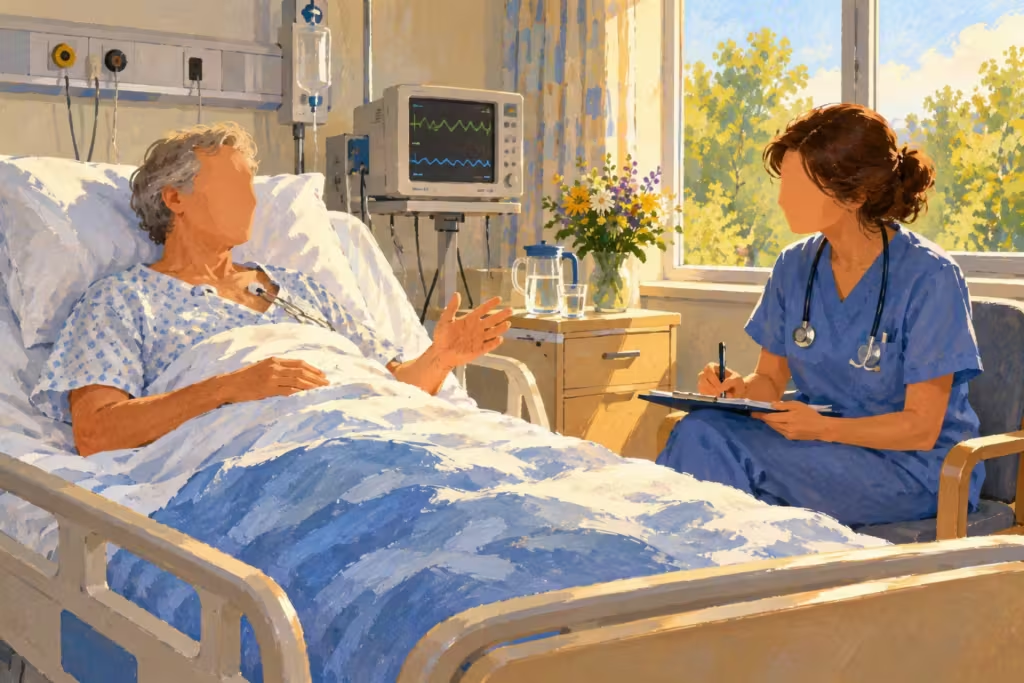
As soon as a patient was out of danger, someone from the team explained the study. If the patient agreed, they did an interview of about 15 minutes. 9 out of 10 had it within the first 6 days of their hospital stay.
First they were asked what had happened to their heart. Then they were asked the questions of the Greyson scale. It has 16 questions about what the person might have experienced. For example, whether time went faster or slower, whether they felt peace, whether they left their body, or whether they reached another world.
Anyone who scored 7 points or more counted as a person with an NDE.
They were also asked two things about what they believed:
- Whether they lost consciousness. 302 people said yes.
- Whether they came close to dying. 37 people said they had died. 245 said they came close. More than half of the patients couldn’t say whether they had come close to dying.
Step 5
In the first interview · As the study tells it
Of 1,595 people, 27 describe an NDE

27 people scored 7 points or more. That is about 2 out of 100.
In the drawing, each circle is one person in 100. The 2 filled circles are, roughly, the people who described an NDE. In the study, it was 27 of 1,595.
People with an NDE scored far more points than everyone else. The 27 people with an NDE scored between 7 and 23 points. Of everyone else, 96 out of 100 didn’t score a single point, and nobody went above 5.
Another 81 people described an NDE they had had before, on another occasion. Those NDEs were left out of the figures, because the study only looked at what happened during that hospital stay.
How many of those 27 people had had a cardiac arrest?
Step 6
Comparing diagnoses · As the study tells it
With a cardiac arrest, an NDE is ten times more common

Of the 116 people admitted for a cardiac arrest, 11 described an NDE. That is about 10 out of 100.
Of the other 1,479 people, 16 described an NDE. That is 1 out of 100.
It was what Greyson expected. For him, having ten times more NDEs with a cardiac arrest supports the idea that NDEs have to do with being close to death.
But the same figures say something else. There were many more patients without a cardiac arrest. So there were more NDEs among them: 16, compared with 11 with a cardiac arrest. Most of the NDEs in the study did not happen during a cardiac arrest.
What did those 27 people experience?
Step 7
When they lived it is unknown · As the patients tell it
What they describe: peace, a light, leaving the body
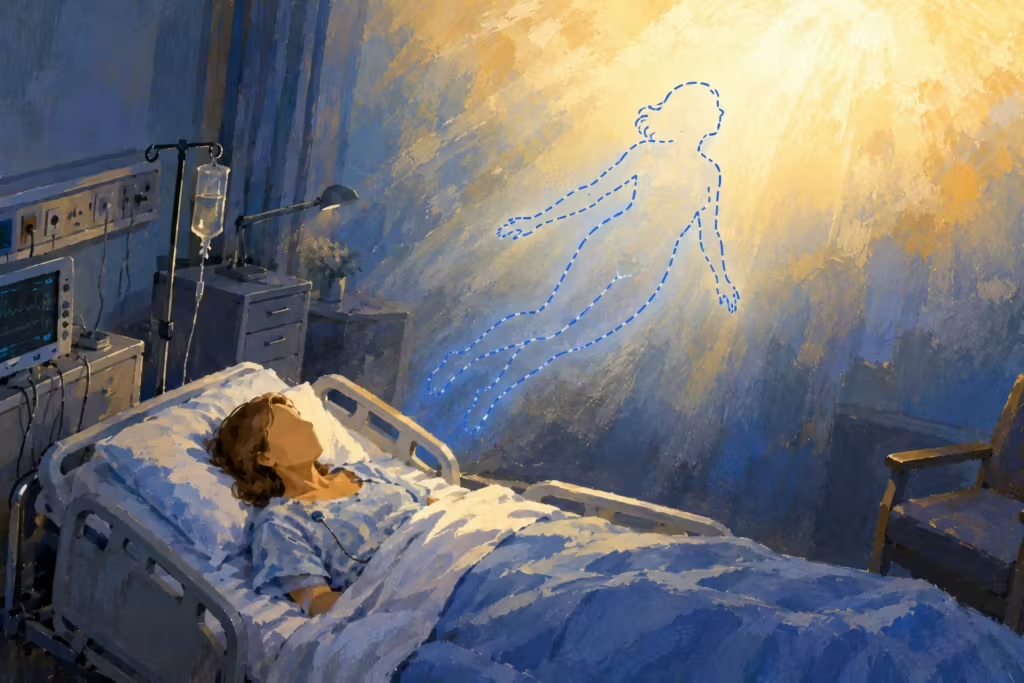
This is what the 27 people with an NDE reported on the scale:
- 23 people: felt peace.
- 19: saw a light or felt surrounded by light.
- 19: felt they were outside their body.
- 18: sensed time differently, faster or slower.
- 18: felt joy.
- 17: were in a place that was not of this world.
- 14: felt at one with everything.
- 14: sensed dead people or spiritual beings.
- 11: reached a border that could not be crossed.
- 8: saw their life pass before them.
3 people said they learned of things they couldn’t have seen or heard from where they were. 2 said they saw things in the future. The article doesn’t say what they saw, or that anyone checked it.
The article gives figures, but doesn’t describe any single experience.
Step 8
During the study · As the study tells it
Each person with an NDE is paired with a similar patient

Greyson looked for people to compare those 27 people with, to find out what was special about them.
Each time a person described an NDE, the team waited for the next patient without an NDE who was similar to them. That patient had to have the same heart condition, the same sex and nearly the same age, with at most 5 years’ difference. We call that similar patient their match. They found a match for 23 of the 27 people. For the other 4, nobody similar was admitted in the rest of the study.
The team gave the 27 people with an NDE and their 23 matches a second interview of 30 to 60 minutes. The interview measured their memory, their health before the hospital stay, the help they had from other people, and what they thought about death. It also asked whether they had had experiences before that they considered paranormal.
In addition, two members of the team read each patient’s medical record. They didn’t know whether that patient had had an NDE. They scored three things:
- How close they came to dying, on four levels. The lowest was “not seriously ill”. The highest was “lost vital signs”, meaning pulse and breathing.
- How badly their heart was working.
- A score of how their illness was likely to develop.
Step 9
Comparing the pairs · As the study tells it
The medical records show no differences

According to the medical records, the people with an NDE did not come closer to dying than their matches.
Of the 27 people with an NDE, 7 lost their vital signs. Of their 23 matches, also 7.
There were no differences either in how badly their heart was working or in the score of how their illness was likely to develop. There were none in their memory, their earlier health, the help they had, or how satisfied they were with their life.
With the same medical data, some people had an NDE and others didn’t.
The differences lay in what each person believed had happened to them.
Step 10
Comparing the pairs · As the study tells it
What does change: believing you have died
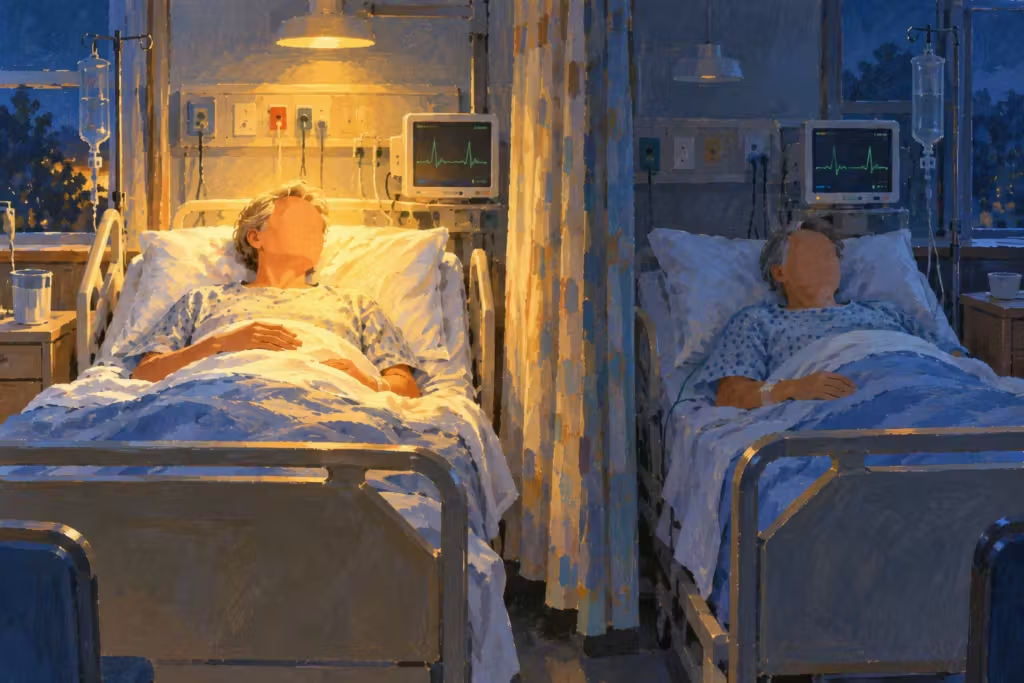
People with an NDE said more often that they had died or come close:
- Believed they had died: 7 of the 27 people with an NDE, and 1 of their 23 matches.
- Believed they came close to dying: 14 of the 27, and 8 of the 23.
- Said they lost consciousness: 17 of the 27, and 7 of the 23.
The second interview turned up two more differences. People with an NDE saw death as a passage to something pleasant more often than their matches. And they described more experiences they had had before and that they consider paranormal.
Greyson points out a problem. Those beliefs and earlier experiences were asked about after the NDE. Those beliefs may help a person have an NDE. Or it may be the other way round. Someone who has had an NDE may then believe they were dead, see death with less fear, and remember what they lived through before differently.
Greyson says that with these data it can’t be known which is cause and which is effect.
Step 11
July 2003 · As the study tells it
The study is published, and Greyson draws three conclusions

The article was published in July 2003 in General Hospital Psychiatry, a psychiatry journal for hospital doctors. Greyson draws three conclusions:
- NDEs have to do with being close to death, because they are ten times more common after a cardiac arrest than in other patients.
- The study doesn’t support the idea that something in the body causes them, because the people with an NDE and their matches don’t differ in anything medical. Greyson admits that changes in the body may have lasted only a very short time and not been noted in the medical records.
- Consciousness may not be located only in the brain. For Greyson, it is hard to explain someone having a clear mind when their brain is getting little blood. To say this, he relies on the van Lommel and Southampton studies.
The study didn’t measure anyone’s brain activity, or the oxygen in their blood. Nor does it know at what moment each person had their experience.
Let’s see what can be known from these data and what can’t.
From 1,595 people to 27 experiences
The study asked a great many people, but there were few NDEs.
That is why the comparisons between people with an NDE and their matches come from small groups: 27 and 23.
| Group | People |
|---|---|
| Admitted to cardiology and included in the study | 1,595 |
| Admitted for a cardiac arrest | 116 |
| Described an NDE from that stay | 27 |
| … with a cardiac arrest / without one | 11 / 16 |
| … who lost their vital signs, according to their records | 7 |
| Matches found for comparison | 23 |
| Described an earlier NDE, left out of the figures | 81 |
What these figures don’t tell you
- The article doesn’t give the details of each cardiac arrest. Greyson’s cardiac arrest group included patients whose heart stopped completely, patients with ventricular fibrillation, and patients with sustained ventricular tachycardia. The article doesn’t say which of these three problems each patient had or how long it lasted.
- Only people who could do an interview were included. The most seriously ill, and those who remembered nothing, don’t show up. More in How many people have an NDE?
- Beliefs and earlier experiences were asked about after the NDE. It isn’t known whether they are cause or effect.
Frequently asked questions
What did Bruce Greyson’s 2003 study in a cardiac care unit find?
27 of 1,595 heart patients described a near-death experience. That is about 2 out of 100. Bruce Greyson’s team spoke with every patient admitted to cardiology at the University of Virginia hospital over two and a half years. NDEs were ten times more common among those who had had a cardiac arrest than among everyone else. You’ll find it all in “What the Greyson study found.”
Do you have to be about to die to have a near-death experience?
Not always. In Bruce Greyson’s 2003 study, 16 of the 27 people who described an NDE had not had a cardiac arrest. According to their medical records, only 7 of the 27 lost their pulse or breathing. It is true that with a cardiac arrest an NDE was ten times more common than without one.
Does the Greyson study show that the mind works without the brain?
No. Bruce Greyson’s 2003 study didn’t measure anyone’s brain and doesn’t know when each experience happened. So it doesn’t show that the brain creates the experience either. Greyson believes his data call into question whether consciousness is located only in the brain. Other researchers believe the study can’t settle it.
Who is Bruce Greyson?
Bruce Greyson is an American psychiatrist. He was a professor of psychiatry at the University of Virginia. He has studied near-death experiences since the 1970s. In 1983 he created the Greyson scale, which is used all over the world to measure them. In 2021 he published the book After.
Where this page comes from
The study
- Bruce Greyson (2003), “Incidence and correlates of near-death experiences in a cardiac care unit”, General Hospital Psychiatry 25:269-276View in the journal (paywalled)
Assessments
- Pim van Lommel and Bruce Greyson (2023), “Critique of recent report of electrical activity in the dying human brain”, Journal of Near-Death Studies 41(1):3-8Read for free
- Kevin Nelson and others (2006), “Does the arousal system contribute to near death experience?”, Neurology 66(7):1003-1009View in the journal (paywalled)
- Penny Sartori (2008), The Near-Death Experiences of Hospitalized Intensive Care Patients: A Five Year Clinical Study, Edwin Mellen PressBorrow it on archive.org
To understand more
- The van Lommel study: 344 cardiac arrest survivors in ten hospitalsRead
- The Southampton study: 63 cardiac arrest survivorsRead
- How many people have an NDE?Read
- What does science say about these experiences?Read
Our archive
- A reading of the full article, with its three tables, checked on 22 October 2026
More studies

AWARE: the pictures hidden on the shelves
Fifteen hospitals put up pictures that could only be seen from the ceiling, to check whether anyone saw them during a cardiac arrest.
AWARE II: a random picture and the brain on the screen
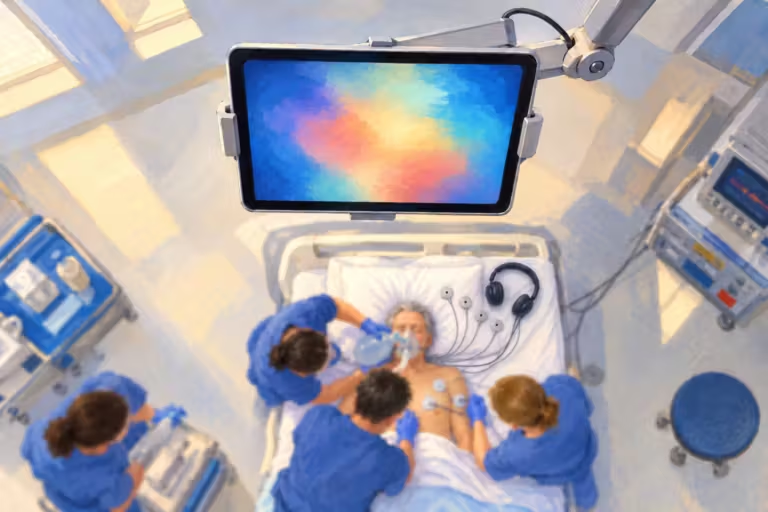
Above the patient was a tablet with a random picture. Headphones said the names of three fruits. And the doctors measured the brain during resuscitation.

Van Lommel: 344 cardiac arrest survivors in ten hospitals
Ten hospitals asked every cardiac arrest survivor what they remembered. They saw them again after 2 and 8 years.