A study · United States, United Kingdom, and Bulgaria, 2017–2020
The AWARE II study: a random image and the brain on screen
Between 2017 and 2020, a team followed 567 cardiac arrests in 25 hospitals. The team placed a tablet above people whose hearts had stopped. The tablet showed an image chosen at random. The team also put headphones on them that repeated the names of three fruits. In some of these patients, the team measured brain activity during resuscitation.
According to its authors, it was the first study to look for signs of consciousness in the brain during resuscitation. Did anyone remember the image or the fruits? And what did the brain show? We go through it step by step. If you only want to know what it found, skip to the results.
Step 1
Before the study · The question
The first AWARE study leaves two questions unanswered
The first AWARE study was published in 2014. Fifteen hospitals had put up about a thousand high shelves with images on top that could only be seen from the ceiling.
The researchers wanted to know one thing. If someone said they had seen themselves from above during their resuscitation, could they tell what the image was? But almost none of the cardiac arrests happened under a shelf. No one had the chance to get an image right or wrong.
Can a person whose heart has stopped see or hear what is going on around them? And what state is their brain in at that moment?
During a cardiac arrest, the person shows no sign of being conscious. They don’t open their eyes, move, or speak. But some of them describe memories from that time when they wake up.
If all you have is the account, you can’t tell when the memory was formed or how the brain was working. The doctor behind the first study decided to try a different approach.
Step 2
2013 to 2020 · According to the study
The same doctor sets up the study in 25 hospitals

Sam Parnia led the study once again. He is a critical care doctor. He now works at New York University’s school of medicine. There, he directs research on critical care and resuscitation.
The paper has 37 authors, from hospitals and universities in the United States, the United Kingdom, and Bulgaria.
The study was built up in phases. First, the equipment was tested in one hospital, from 2013 to 2015. Then it was tested in five hospitals, from 2015 to 2017. Finally, the study ran in 25 hospitals, from May 2017 to March 2020.
The study included only adults who had a cardiac arrest inside the hospital and needed 5 minutes or more of resuscitation. Also, the cardiac arrest had to happen from Monday to Friday, 8 a.m. to 5 p.m. Those were the study team’s working hours.
Three bodies funded the study. They were the John Templeton Foundation, the Resuscitation Council (UK), and New York University’s school of medicine. The John Templeton Foundation is a private foundation. The authors state that they have no interests that could have influenced the work.
This time, the image wouldn’t be high up on a wall. The team would carry it with them.
Step 3
Arriving at the cardiac arrest · According to the study
They bring a tablet with a random image, and headphones
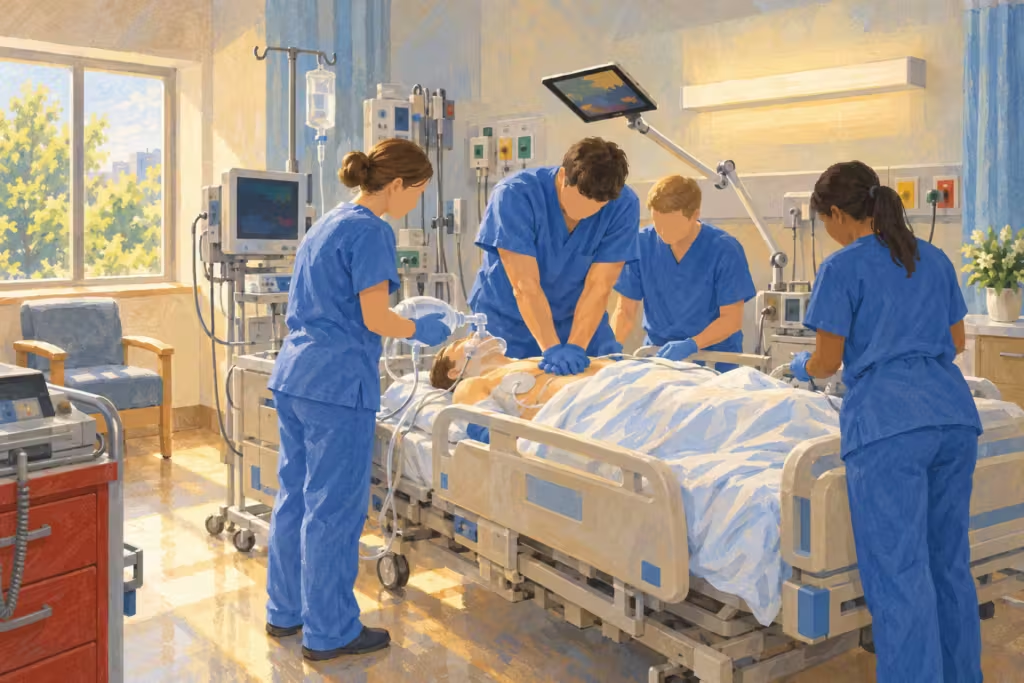
When a cardiac arrest happened, an alert went out to the study team. The team arrived with a tablet, which is a small computer with a screen. They fixed it above the patient’s head, away from where the chest was being pressed.
One minute after it was switched on, the tablet picked one of its 10 images at random and put it on the screen.
The patient was also given headphones. After five minutes, they began to play the names of three fruits: apple, pear, and banana. The names played once a minute for five minutes.

- 1. ShowA randomly chosen image, on a tablet above the patient.
- 2. PlayThree fruits through the headphones, once a minute.
- 3. AskIf the patient survives, what they remember of their resuscitation.
Survivors were asked in two ways. First, they were asked what they remembered, and also whether they remembered the image or the fruits.
Then they were asked to pick one image out of the 10 and to name any three fruits that came to mind. They were asked this even if they remembered nothing. The idea was to look for a memory the person doesn’t know they have. According to the paper, memories like this have been found in people under general anesthesia.
The team knew when the image was shown and when the fruits were played.
If someone remembered the image or the fruits, it would be possible to tell in which minute of the resuscitation they had perceived something. And if that person’s brain was being monitored, we would know what state their brain was in during that minute.
For that, another device was needed.
Step 4
During resuscitation · The heart is not beating
They measure the brain during pauses in resuscitation
In a cardiac arrest, the heart stops pumping blood and the person stops breathing. The team pushes down hard on the chest to keep the blood moving. This is called doing chest compressions.
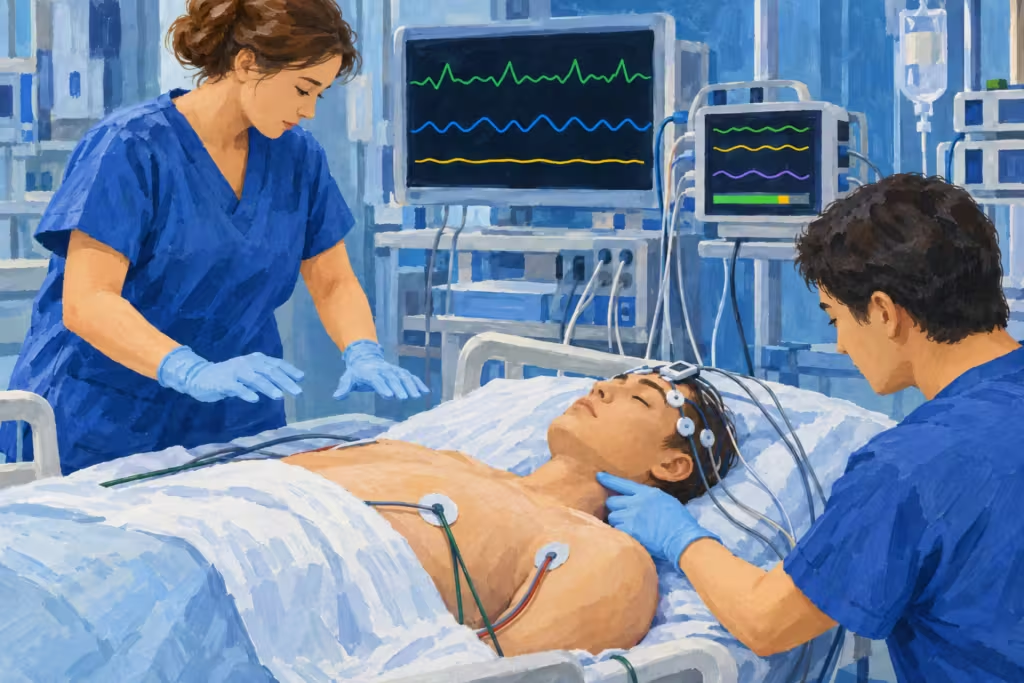
In nine of the hospitals, the study team had a portable electroencephalogram. It is a device that measures the brain’s electrical activity through sensors stuck to the head. It is called an EEG for short. The EEG in this study had only four sensors, on the forehead and the sides of the head.
Compressions shake the whole body and spoil the reading. So the EEG was read only during the pauses. A pause is when the team stops for 3 to 5 seconds to check for a pulse. During each pause, one image of the screen was saved per second. According to the paper, there was no pulse during those pauses.
All the hospitals also used a cerebral oximeter. It is a sensor on the forehead that uses light to measure how much oxygen is reaching the brain. According to the paper, a normal reading is about 70 out of 100.
The study team wasn’t there from the very start.
In half of the cardiac arrests, it took the team 4 minutes or more to arrive. And it needed about 5 more minutes to set up the equipment. So the first minutes of each cardiac arrest were never measured.
How many people survived to tell what they remembered?
Step 5
Leaving the hospital · According to the study
Out of every 100 cardiac arrests, 9 people survive
The study followed 567 cardiac arrests. In 213 of those cardiac arrests, the heart started beating on its own again for 20 minutes or more. But only 53 people left the hospital alive.
Each dot is a cardiac arrest in the study. The 9 filled-in dots are the people who left the hospital alive.
Of those 53 people, 44 left in good condition. They could take care of themselves.
Only 28 people did the interview. The other 25 didn’t. 4 declined and 7 had some kind of disability. 3 didn’t do it for other reasons. In 11 cases, the reason wasn’t recorded.
The tablet and headphones were set up in 365 of the 567 cardiac arrests. The paper doesn’t say how many of the 28 people interviewed had them.
Those 28 people were asked what they remembered.
Step 6
2 to 4 weeks later · According to the study
They are asked what they remember, in three interviews
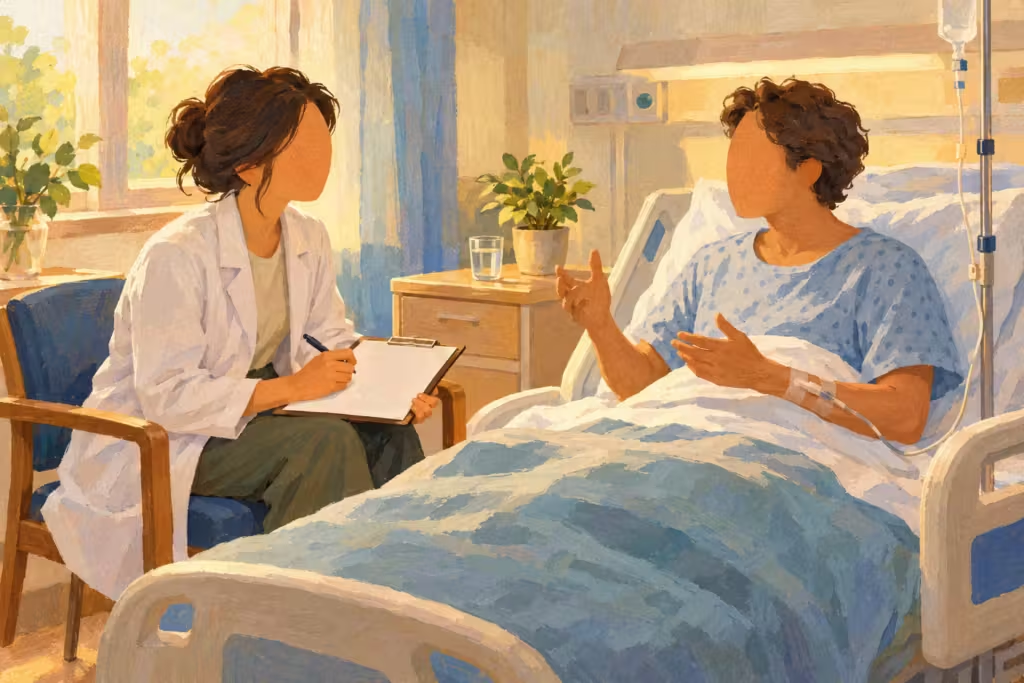
The interviews took place in the hospital between 2 and 4 weeks after the cardiac arrest. The day depended on how each person was recovering.
Before the interview, a short test checked whether the person was thinking clearly. Anyone who didn’t pass it wasn’t interviewed.
The first interview asked what they remembered of the resuscitation.
The second went deeper. It had open-ended questions and the Greyson scale. The Greyson scale is 16 questions about things people often experience in an NDE, such as feeling at peace or feeling separated from the body. Anyone who scores 7 or more counts as a person who had an NDE.
The third was for anyone who said they had seen or heard something from their resuscitation. It was used to compare what they described with what the hospital had recorded.
What did they remember?
Step 7
In the interviews · According to the patients
Eleven of 28 people remember something, and six describe an NDE
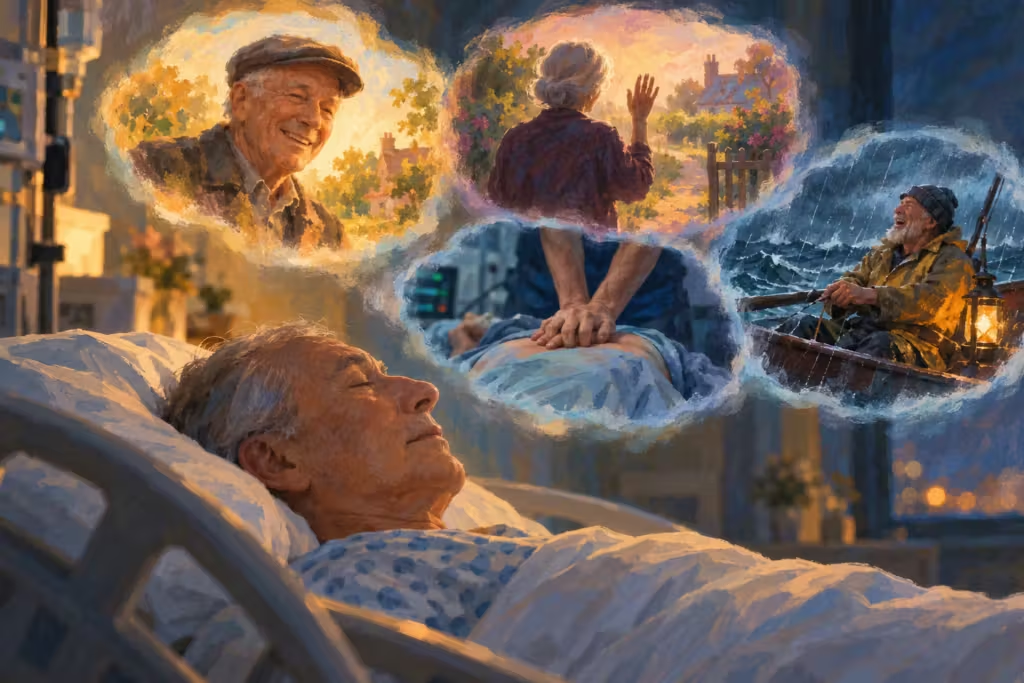
Of the 28 people, 17 remembered nothing. The other 11 did remember something. That is about 4 in 10.
None of them had shown any sign of being conscious during resuscitation. No one groaned or moved.
The researchers sorted their memories into four types. Some people described more than one:
- Waking up during resuscitation: 2 people. They noticed things from the resuscitation, such as someone pressing on their chest.
- Waking up afterward, once in intensive care: 2 people.
- Dreams, or something like a dream: 3 people.
- A near-death experience: 6 people. They scored 7 or more on the scale.
The authors don’t call this experience an NDE. They call it a “recalled experience of death.” They say the term NDE is not well defined.
One patient“I remember seeing my dad.”
Another patient“I thought I heard my grandma [who is passed] saying ‘you need to go back.’”
Another patient“I could feel someone doing something on my chest. […] I could feel someone rubbing quite hard. It was quite painful.”
Another patient“There was a fisherman singing a sea shanty over me and it was raining.”
Six out of 28 is more than 2 in 10. With so few people, each person moves the figure by almost 4 percentage points.
To learn more about these experiences, the study looked for more accounts outside the hospitals.
Step 8
Outside the hospitals · According to 126 survivors
Another 126 survivors describe in writing what they went through
Very few people survived. So the study had a second part, which the authors call the community arm. This part gathered the written accounts of 126 people who had survived a cardiac arrest somewhere else.
Some people mailed their accounts to the team. Other accounts came from the public website of a foundation that collects NDE accounts. It is called the Near-Death Experience Research Foundation (NDERF).
In these accounts, the researchers found the same four types of memories. And they found one more type, delusions. Here, a delusion is something real in the hospital that the person experiences as something terrible. For example, one person felt the burning of an IV line that had leaked out of the vein. They experienced it as burning in hell.
The NDEs kept following the same five-part path:
- Feeling separated from your body, sometimes seeing what is going on around you, with a clear mind and without distress.
- Heading toward a place.
- Reviewing your life, and what you have done to others.
- Arriving at a place that feels like home.
- Deciding to come back.
One person“I was above my body and directly below the ceiling of the intensive therapy room.”
Another person“I told them that my two sons needed me and I had to go back.”
These accounts show what these experiences are like for the people who have them. They were not compared with what happened during each resuscitation.
In the hospitals, two people described something more specific.
Step 9
During resuscitation · According to two patients
Two people say they heard their resuscitation, and one says he saw it
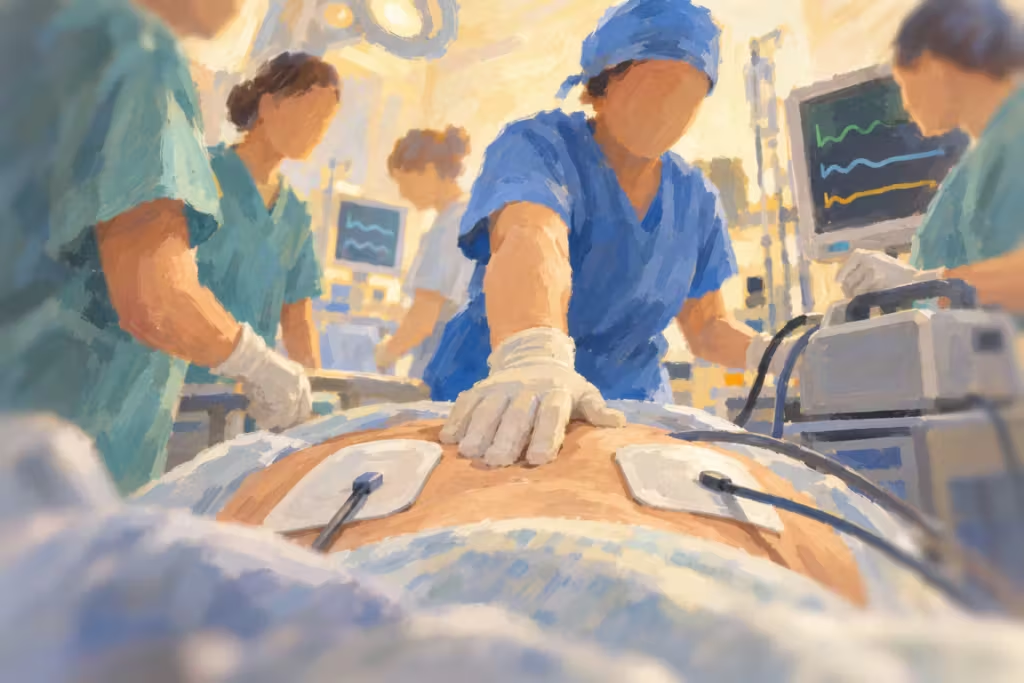
One of them says: “I remember […] they were putting those two electrodes to my chest, and I remember the shock.”
The other is a man. He says he heard people talking and that he was given drugs. He gives no details.
He also says he could see what was going on. He saw the doctors getting organized, and one doctor in a “surgical hat and blue scrubs.” And he could feel someone “rubbing the bony bit” on his chest.
This man is the only one of the 28 people who says he saw something. The paper doesn’t say whether he saw himself from outside his body. Among its examples of NDEs, the paper quotes a person who says this: “I could see what was going on […] I stood next to the bed, it was very odd.” But the paper doesn’t say who that person is.
In the third interview, the researchers compared what the two of them described with their medical records.
According to the paper, the medical records confirm the shock that the first person described. Nothing else could be confirmed.
The paper doesn’t say whether there was a tablet at either person’s cardiac arrest. And the authors acknowledge another uncertainty. Some patients may already know what a resuscitation is like, for example that shocks are given. The authors couldn’t check whether that influenced what the patients described.
In the first AWARE study, another man also mentioned someone in a blue cap. His account is in the story of the blue-cap patient.
What about the image and the fruits?
Step 10
In the interviews · According to the study
No one remembers the image or the fruits

None of the 28 people remembered seeing the image on the tablet or hearing the fruits.
When asked to pick one image out of the 10, no one chose the one that had been shown.
When asked to name any three fruits that came to mind, one person said apple, pear, and banana. These were the same fruits as in the headphones.
These are very common fruits. The paper doesn’t work out how often someone would name them by chance.
The authors themselves acknowledge that very few people survived. So they couldn’t test for the memory a person doesn’t know they have.
That left the question of what the brain had shown.
Step 11
During resuscitation · According to the study
In some pauses, the brain shows near-normal waves
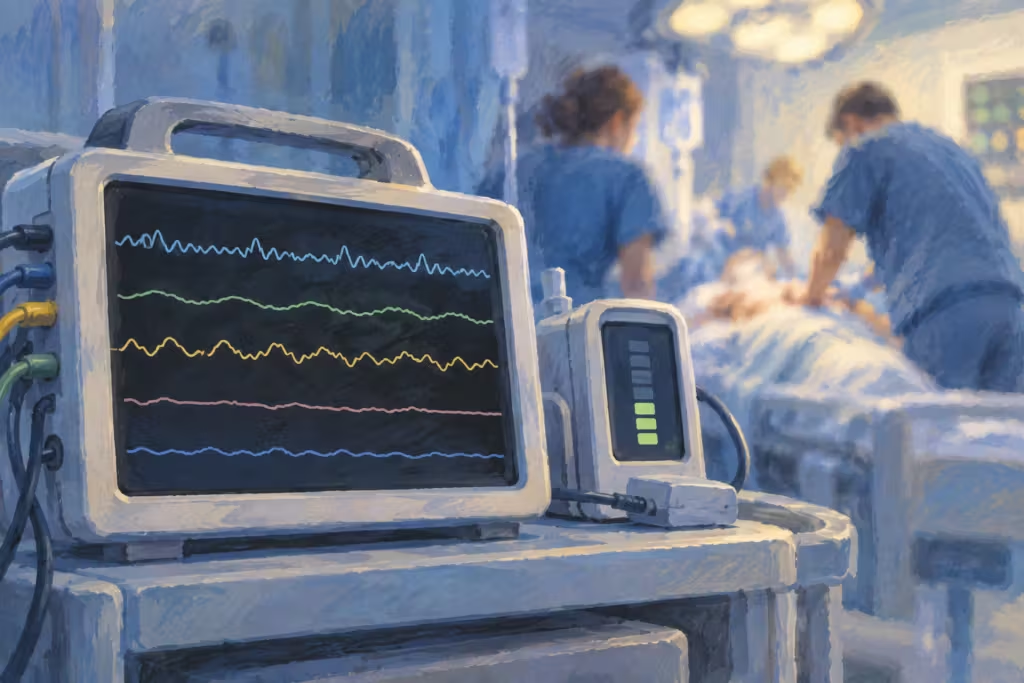
The team recorded the EEG of 85 people and saved 851 images of the screen. Many couldn’t be read, because of interference, faulty sensors, or movement. In the end, 466 images, from 53 people, could be read.
The oximeter showed an average of 43 out of 100, when the normal level is about 70. Very little oxygen was reaching the brain.
This is what the readable EEG images showed:
- Almost half of the images showed no activity. That was 47 out of every 100, and in them the line was flat.
- In 5 out of every 100, there was activity that looked like an epileptic seizure.
- In others, there were waves that the paper calls “near-normal.” They are the same kinds of waves a working brain produces. There were delta waves in 22 out of every 100 images, theta in 12, alpha in 6, and beta in 1.
Delta and theta waves showed up as late as 60 minutes into resuscitation. Alpha waves showed up as late as 35 minutes. The longer the resuscitation went on, the less often these waves appeared, especially after 50 minutes. And the flat line showed up more often.
These figures count images, not people. The paper doesn’t say how many people had near-normal waves.
The authors say these waves are consistent with consciousness. They also acknowledge that they couldn’t tell whether the alpha waves were normal or a sign of alpha coma. Alpha coma is an alpha rhythm seen in some people in a coma. To settle this, they call for a study with a full EEG.
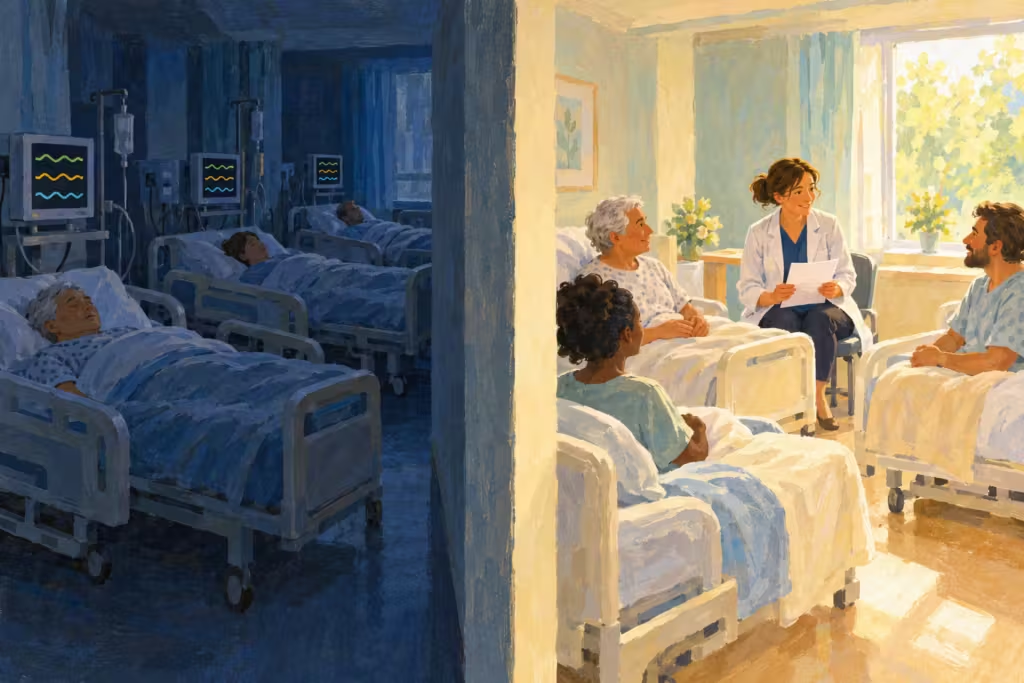
That left the most important question: did the people who remembered something have those waves?
Only 2 of the 28 people interviewed had an EEG, and they were not among those who remembered something.
There are no accounts from the other people with an EEG.
The oximeter does add one more piece of data. The people who remembered something had an average of 53 out of 100. The people who remembered nothing had 47. The paper says this is similar. It doesn’t say how many of the people with memories had the oximeter.
Even so, the results made it into the press.
Step 12
2022 to 2023 · According to the authors and the press
The study is presented in 2022 and published in 2023

Parnia presented the first results on November 6, 2022, at an American Heart Association conference in Chicago. That same year, the team also posted a version of the paper online that had not yet been reviewed by other scientists.
The reviewed paper was published in 2023 in Resuscitation, the same medical journal that published the first AWARE study.
The authors write that consciousness and mental activity may occur during a cardiac arrest. They also put forward an idea. With too little oxygen, the brain may stop holding back circuits that are normally switched off. That could allow the person to understand, with lucidity, “new dimensions of reality.”
On the same page, the authors acknowledge that finding signals in the brain doesn’t tell us what causes consciousness. If two things happen together, that doesn’t mean that one causes the other. And they end by saying that, so far, no one has been able to fully prove that these experiences are real, or to rule it out either.
Their university put out a press release on September 14, 2023. It said that some patients had clear memories “up to an hour” after their heart stopped. It also mentioned gamma waves.
But in the paper, that hour refers to the waves, not to the memories. And there are no gamma waves among the waves the study found.
The opening question remains: can we tell whether someone perceives anything during a cardiac arrest, and what state their brain is in at that moment? Let’s look at what could be learned and what couldn’t.
From 567 cardiac arrests to no one who remembers the image
Many people dropped out at every step of the study. Some died, some weren’t well enough to talk, and some remembered nothing.
In the end, no one remembered the image or the fruits, and only one man said he had seen something from his resuscitation.
| Step | People |
|---|---|
| Cardiac arrests followed | 567 |
| Heart beat again for 20 minutes or more | 213 |
| Left the hospital alive | 53 |
| Did the interview | 28 |
| Remembered something from the cardiac arrest | 11 |
| Described a near-death experience | 6 |
| Said they heard something from their resuscitation | 2 |
| Said they saw something from their resuscitation | 1 |
| Remembered the image or the fruits | 0 |
| Named the three fruits when asked for any three | 1 |
From 85 people with an EEG to no one who remembers anything
The EEG could be read in 53 people. Only 2 of them did the interview, and they didn’t remember anything from the cardiac arrest.
| Step | Number |
|---|---|
| People with an EEG during resuscitation | 85 |
| People with a readable EEG | 53 |
| EEG images saved | 851 |
| Readable images | 466 |
| Interviewed people who had an EEG | 2 |
| People with an EEG who remembered something | 0 |
What these figures don’t tell you
- Only some people were asked. Of the 53 survivors, 25 didn’t do the interview. We don’t know what they remembered.
- Short cardiac arrests weren’t included. Only those lasting 5 minutes or more, during office hours, counted. Parnia gave a talk in November 2022. In it, he showed that there were also 411 people whose hearts started beating again before the study team arrived. It’s on one of his slides, not in the paper. Agudo, Fulco, and Rivas report this. Those 411 people aren’t in these figures.
- Six out of 28 is too few for comparisons. With 28 people, each person moves the figure by almost 4 out of 100. Other studies find that between 4 and 23 out of every 100 cardiac arrest survivors report an NDE. More in How many people have a near-death experience?
- The EEG figures count images, not people. “47 out of every 100” means 47 out of every 100 images of the screen. For what is said about these measurements, see What does science say about near-death experiences?
Frequently asked questions
What were the results of the AWARE II study?
AWARE II followed 567 cardiac arrests in 25 hospitals and interviewed 28 survivors. Eleven remembered something and six described a near-death experience. But no one remembered the image on the tablet or the fruits in the headphones. In some pauses during resuscitation, the brain showed near-normal waves. But no one who remembered anything had been wearing the brain monitor. It’s all in “What AWARE II found.”
What are the criticisms of the AWARE II study?
Researchers with very different views on NDEs have criticized the study. Most of the criticism is about the brain waves. Psychiatrist Bruce Greyson points out that no one with memories had those waves, and no one with those waves reported memories. To him, the waves are not a sign of NDEs. But only 2 of the 28 people interviewed had an EEG. With so few people, it can’t be known. Neurologist Steven Novella thinks the memories may have formed on waking up, not during the cardiac arrest. More in “How each side reads it.”
Who is Sam Parnia, the doctor behind the AWARE studies?
Sam Parnia is a critical care doctor. He directs critical care and resuscitation research at NYU Grossman School of Medicine in New York. He led both AWARE studies, published in 2014 and 2023 in the medical journal Resuscitation. Researchers with very different views dispute how he reads his results, especially the brain waves.
Is there an AWARE III study?
We don’t know of any AWARE III study. As of October 2026, the website of Sam Parnia’s lab at NYU mentions only AWARE and AWARE II. The AWARE II authors call for a new study that measures the brain with a full EEG. What it would take is in “What would settle it.”
Where this page comes from
The study
- Parnia et al. (2023), “AWAreness during REsuscitation - II: A multicenter study of consciousness and awareness in cardiac arrest,” Resuscitation 191:109903Read for free in the journal
- Parnia et al. (2022), the same study on SSRN: the version before peer reviewRead for free
- Sam Parnia presents the results at the American Heart Association’s meeting (November 6, 2022). The slide with the 411 people is at minute 5:25. Alejandro Agudo pointed us to itWatch on YouTube
Commentary and criticism
- Agudo, Fulco, and Rivas (2023), “Comments on the Results of the AWARE II Study,” Journal of Near-Death Studies 41(1):9–22Read for free
- Greyson and Pehlivanova (2025), “A neuroscientific model of near-death experiences reconsidered,” Psychology of ConsciousnessRead for free
- Steven Novella, “AWARE-II Near Death Experience Study,” NeuroLogica Blog, November 7, 2022Read
Press
- NYU Langone Health, “Patients Recall Death Experiences After Cardiac Arrest,” press release, September 14, 2023Read
To learn more
- The first AWARE study: the images hidden on the shelvesRead
- Sounds during cardiac arrest, chosen by a quantum computer: the Escolà-Gascón study (2026)Read
- The near-death experience of the blue-cap patientRead
- What does science say about near-death experiences?Read
- How many people have a near-death experience?Read
Our archive
- Our reading of the full paper, of its earlier version, of the commentary by Agudo, Fulco, and Rivas, and of Parnia’s 2022 talk, as of October 16, 2026
More studies
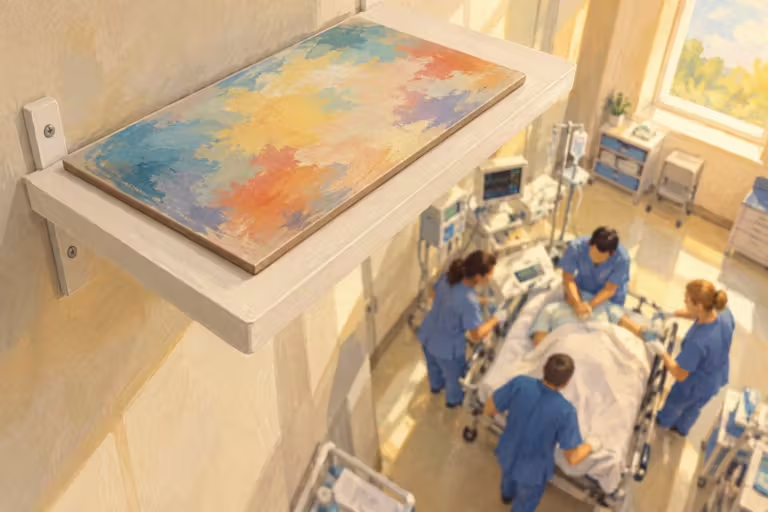
AWARE: the pictures hidden on the shelves
Fifteen hospitals put up pictures that could only be seen from the ceiling, to check whether anyone saw them during a cardiac arrest.
Van Lommel: 344 cardiac arrest survivors in ten hospitals
Ten hospitals asked every cardiac arrest survivor what they remembered. They saw them again after 2 and 8 years.
Greyson: 1,595 heart patients and 27 NDEs
A hospital asked its cardiology patients what they had been through. With a cardiac arrest, an NDE was ten times more common than without one. But most happened without one.