A real-life story · AWARE study, United Kingdom, United States, and Austria, 2014
The near-death experience of the blue-cap patient
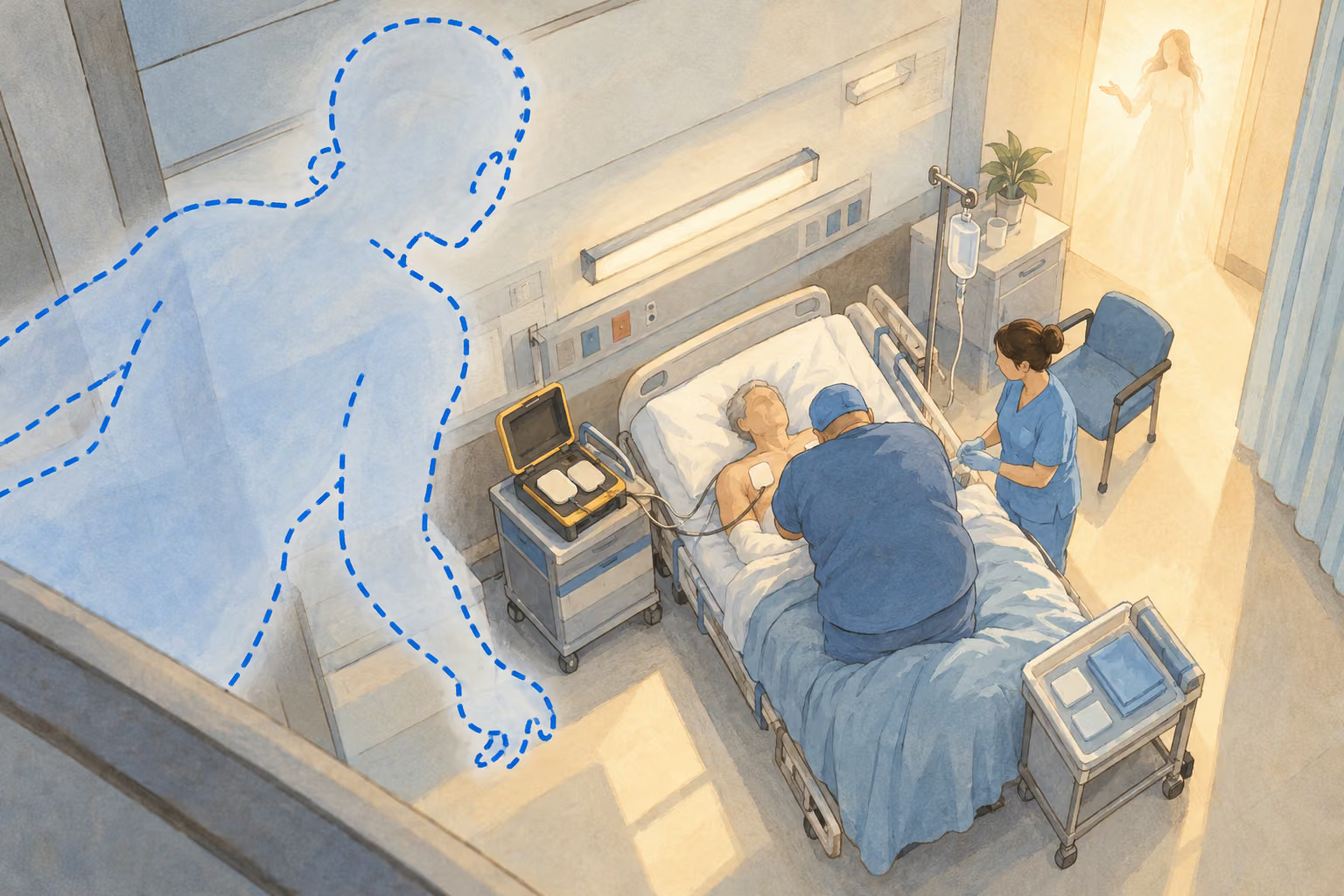
A 57-year-old man went into cardiac arrest in a hospital that was taking part in a study of near-death experiences. He later said he heard a voice saying “shock the patient” and saw himself from the ceiling. He also said he saw a bald man in a blue cap, and that he recognized him the next day.
It is the most cited case from the AWARE study. AWARE is one of the largest hospital studies of what people remember from a cardiac arrest. The researchers went through this man’s medical records and were able to check part of what he described. What could be checked in his account, and what couldn’t?
Step 1
2008 to 2012 · According to the study
A study to test what people see from the ceiling
Many people who survive a cardiac arrest say they saw themselves from above. A team led by the physician Sam Parnia set out to check this in real hospitals.
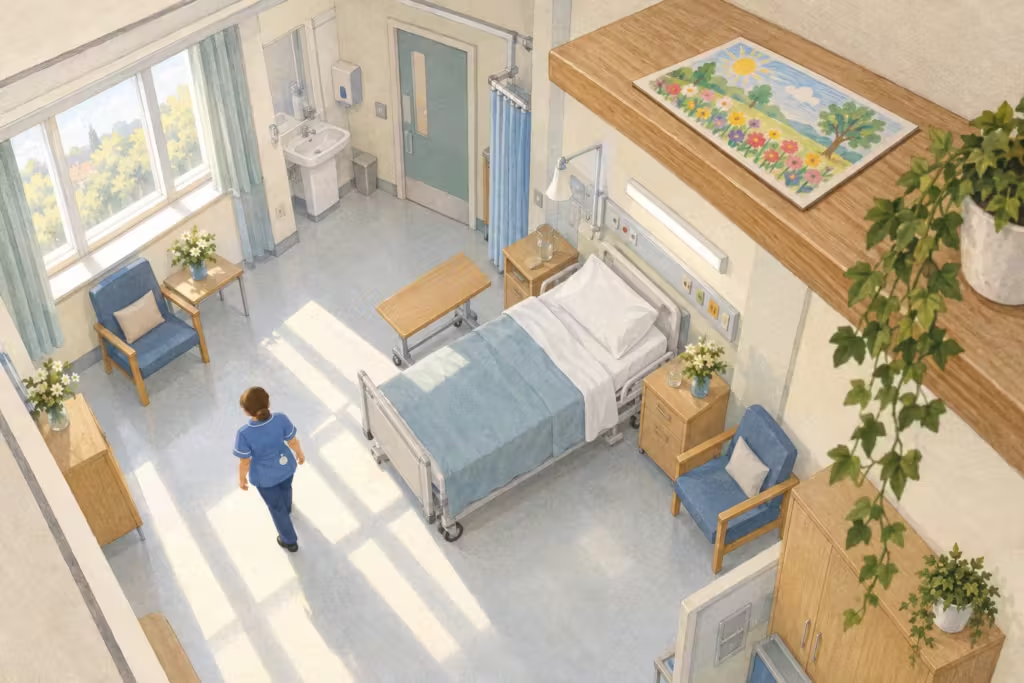
15 hospitals in the United Kingdom, the United States, and Austria followed every cardiac arrest they could between 2008 and 2012. Each hospital put up between 50 and 100 high shelves in its wards. On top of each shelf was an image that could only be seen from the ceiling.
If someone said they had seen themselves from above in a room with a shelf, the researchers could ask what the image showed.
None of the patients’ names were published. In the paper, this man appears as “a 57 year old man.”
Step 2
Before the cardiac arrest · Awake · His account
Pressure in his groin
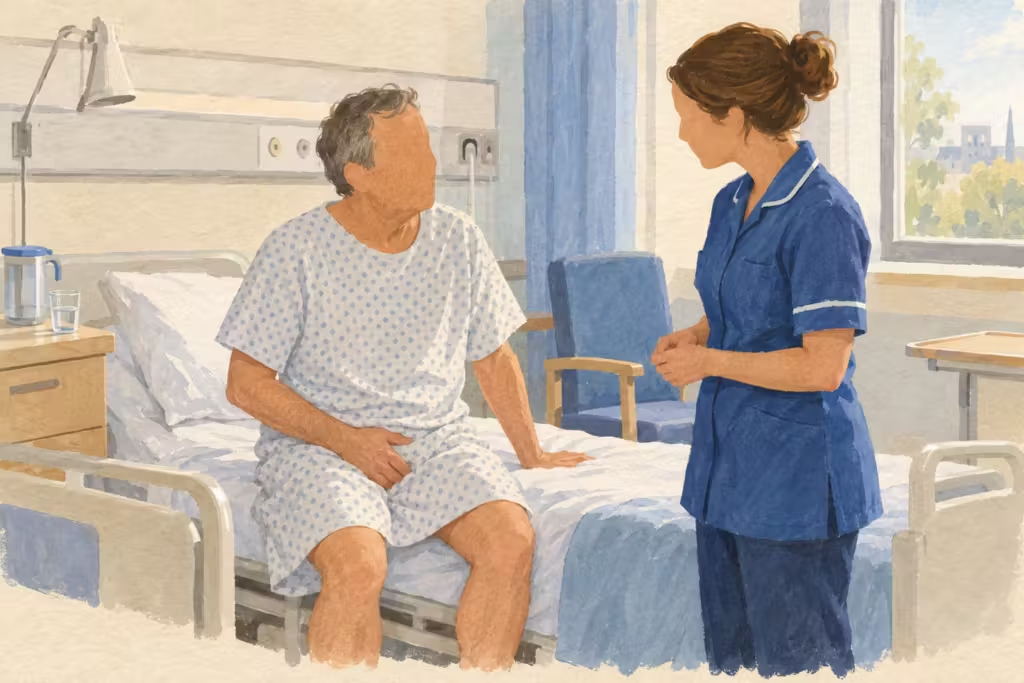
He is on a hospital ward that isn’t intensive care. He is talking to the nurse.
He feels very strong pressure in his groin. It doesn’t hurt. It’s as if someone were pushing down hard on him.
He says he keeps answering the nurse. Then, all of a sudden, he stops.
His heart goes into ventricular fibrillation. Ventricular fibrillation is when the heart beats so chaotically that it stops pumping. This is a cardiac arrest.
Step 3
During the cardiac arrest · His account
He says he hears an automated voice
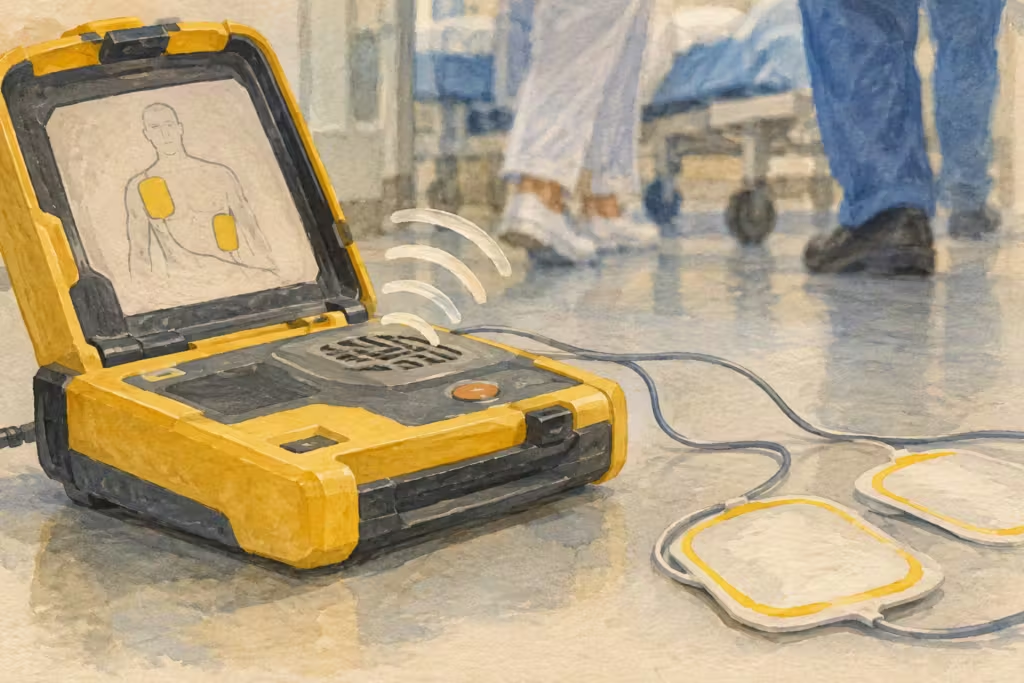
The next thing he remembers clearly is an automated voice.
“Shock the patient, shock the patient.”
That is what an automated defibrillator says. It is the device that gives the heart electric shocks to get it beating in a regular rhythm again. He didn’t see the device. He heard it.
Step 4
During the cardiac arrest · His account
He says a woman beckons him from the ceiling
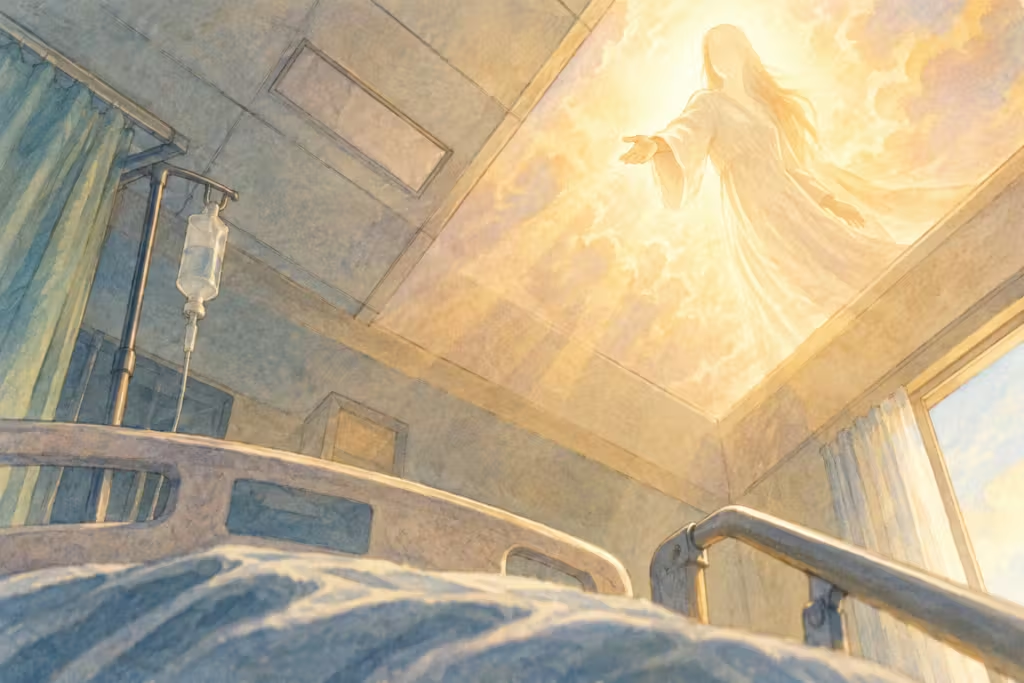
At that moment he sees a woman up in a corner of the room, by the ceiling. She is beckoning him to come up.
“I can’t get up there,” he thinks. She beckons him again.
“I felt that she knew me, I felt that I could trust her.”
He feels she is there for a reason, but he doesn’t know what it is.
Step 5
During the cardiac arrest · His account
He says he sees himself from above, with a man in a blue cap
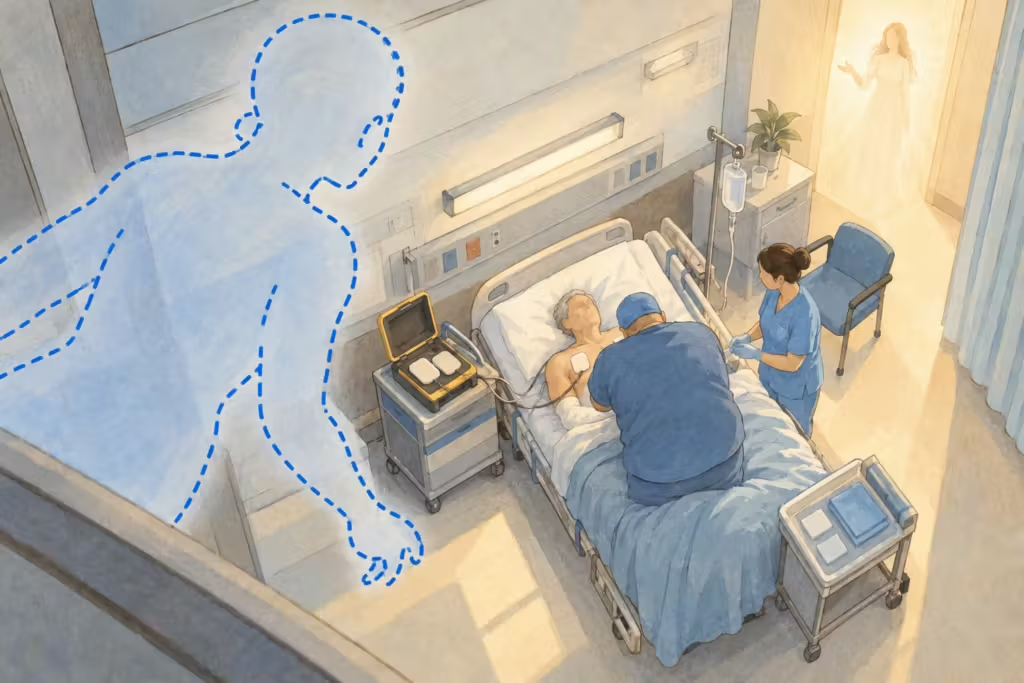
“And the next second, I was up there,” he says. From there he looks down at himself.
Below him he sees the nurse and another man. He can’t see the man’s face, only his back. “He was quite a chunky fella.”
The man is wearing blue scrubs and a blue cap. He can tell the man has no hair from the way the cap sits.
Step 6
Waking up · His account
He wakes up not knowing whether it was real
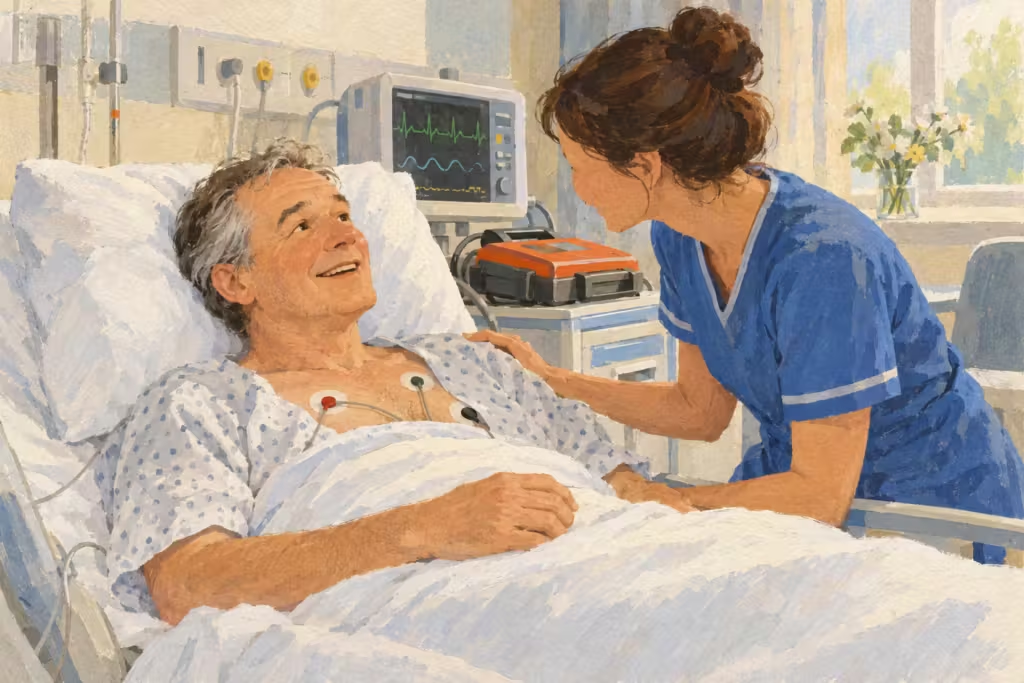
The next thing he remembers is waking up in bed. The nurse says to him: “Oh you nodded off… you are back with us now.”
He isn’t sure himself: “Whether she said those words, whether that automated voice really happened, I don’t know.”
What he does remember is feeling euphoric.
Step 7
The next day · His account
He recognizes the man in the blue cap
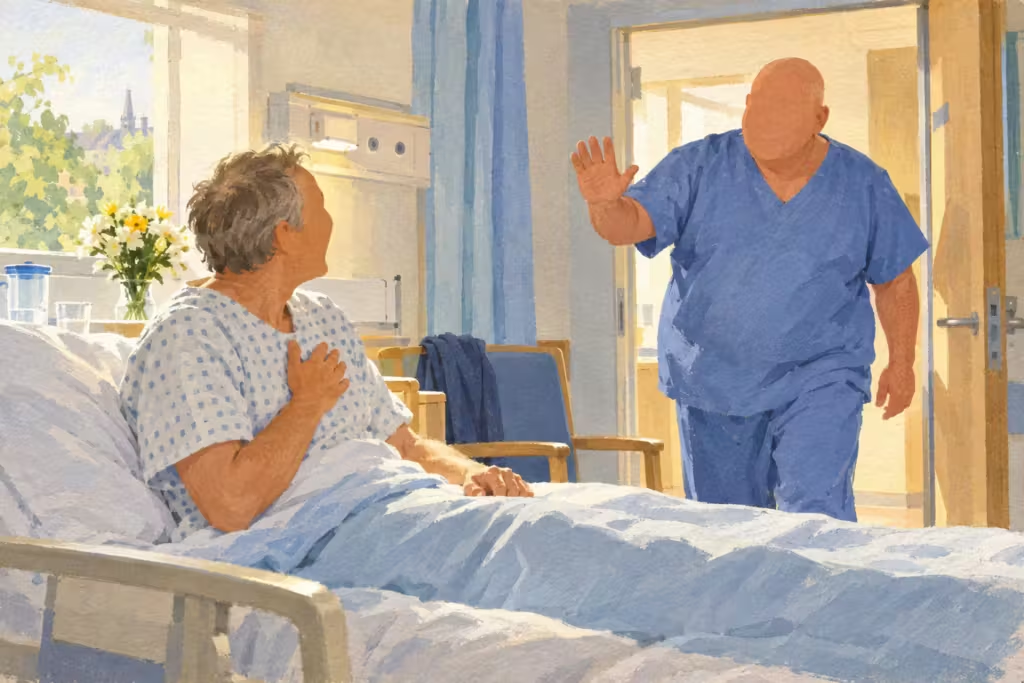
He didn’t know the man’s name. He says the man came to see him the next day.
“I saw this man [come to visit me] and I knew who I had seen the day before.”
He says this in the study interview. The date of that interview was never published.
Step 8
Afterward · According to the study
The researchers review his medical records
This man was one of two patients in the study who said they had seen or heard something real from their resuscitation. The other patient couldn’t complete the full interview because of poor health.
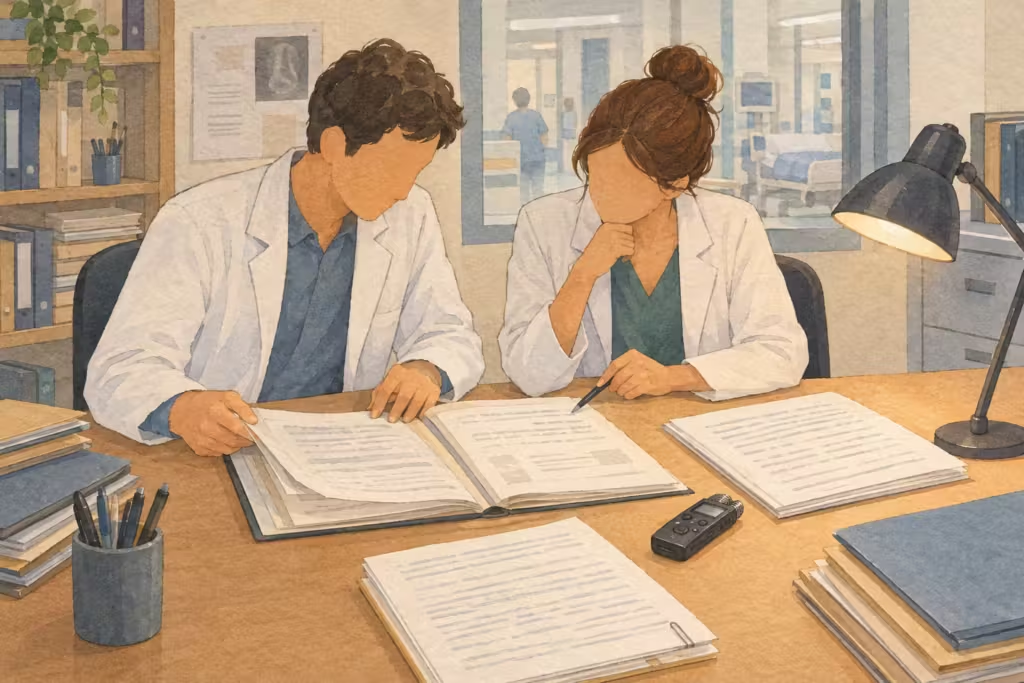
The researchers compared what he described with his medical records.
According to the paper, the records confirmed three things. They confirmed that an automated defibrillator was used. They confirmed which medical team was at the cardiac arrest. And they confirmed what role the man he recognized played in it.
The records don’t confirm the man’s appearance, the blue cap, or what the nurse said. And the paper doesn’t give the time of any shock.
Step 9
Afterward · According to the study
How long had he been without a heartbeat?
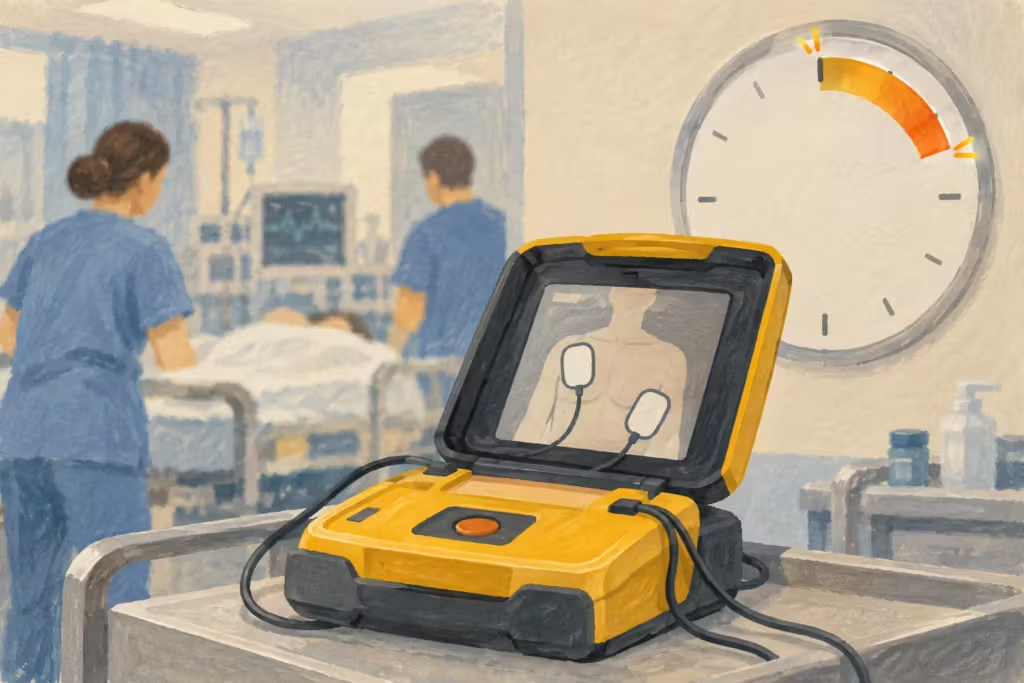
The researchers work it out from the way the defibrillator operates. After the first shock, the device requires at least two minutes of CPR. Only then does it analyze the heart again and give a second shock.
According to the researchers, if he heard two separate shocks, he was conscious up to about three minutes into the cardiac arrest.
It is an estimate, not a measured time. The paper doesn’t say whether he heard two shocks or the same command repeated.
Step 10
Afterward · According to the study
There was no shelf on his ward
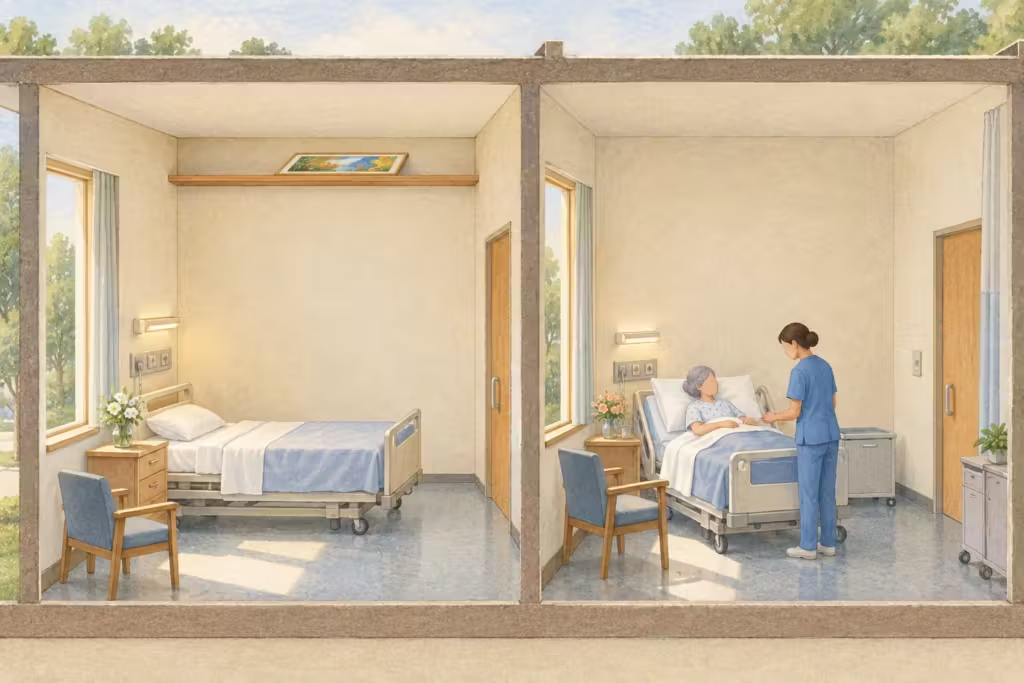
The hospitals put up about a thousand shelves. But only 22 of every 100 cardiac arrests happened in rooms with a shelf.
His happened in a room without one. There was no image to ask him about.
The same was true of the other patient. So the image test was never carried out with either of them.
Step 11
October 2014 · According to the press
The case makes headlines around the world

The study is published in October 2014 in the medical journal Resuscitation. The case appears in newspapers around the world.
Parnia explains why this case matters. These experiences are often assumed to be hallucinations that happen before the heart stops or after it starts beating again. People don’t usually think of them as experiences of “real” events while the heart is stopped.
The press adds details that aren’t in the paper. It says the man was a social worker. And it says he heard two “bleeps” from a machine “at three minute intervals.” The paper speaks of a voice and of at least two minutes.
Step 12
2023 · According to the study
Another blue cap, nine years later
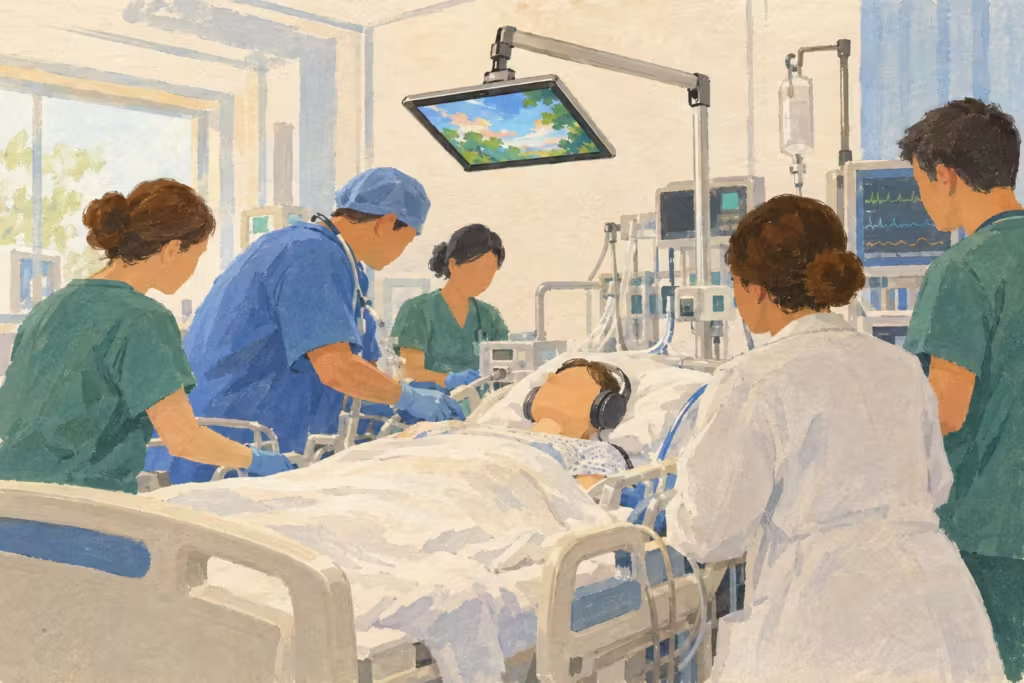
In 2023, the second part of the study, AWARE II, is published. This time, the researchers place a tablet over the patient during resuscitation. The tablet shows a randomly chosen image. They also put headphones on the patient that repeat the names of three fruits.
The team interviews 28 survivors. None of them remembers the image or the fruits. Then they are asked to name any three fruits. One says apple, pear, and banana. Those are the fruits on the recording. But they are among the most common fruits. No one calculated how much chance could have played a part.
One survivor says he saw the doctors getting organized. He saw a doctor in a “surgical hat and blue scrubs.” And he felt someone rubbing his chest. None of that could be checked.
The paper doesn’t say whether this patient saw himself from outside his body. The authors classify his case as regaining consciousness during CPR. And the blue cap turns up in both studies, because it is what a lot of people wear in a hospital.
Another survivor remembers them putting two electrodes on his chest, and he remembers the shock. His medical records do confirm that part.
Out of 2,060 cardiac arrests, one case
The blue-cap patient is the only one in his study with an account that could be compared with his medical records. Almost everyone else dropped out along the way.
Picture 100 cardiac arrests from the study:
Each dot is a cardiac arrest. The 22 filled-in dots are the cardiac arrests that happened in a room with a shelf. Only in those rooms could what someone saw from the ceiling have been put to the test.
And out of all the cardiac arrests, this is what was left:
| Step | People |
|---|---|
| Cardiac arrests studied | 2,060 |
| Survived to hospital discharge | 330 |
| Able to do the first interview | 140 |
| Completed the in-depth interview | 101 |
| Described a near-death experience | 9 |
| Described seeing or hearing real events from their resuscitation | 2 |
| Could be compared with medical records | 1 |
What these figures don’t tell you
- If no one remembers it, that doesn’t mean no one experienced anything. The authors themselves think more people may have had mental activity. But they may have forgotten it because of brain injury or sedatives.
- The image test never took place. The two people who described something had their cardiac arrests in rooms without a shelf.
- This case can’t tell us whether the patient saw from outside his body. His room had no shelf and no image to check it. That is why AWARE II was carried out. And in AWARE II, no one remembered the image either.
For more figures on how many people have these experiences, see How many people have a near-death experience?
Where this story comes from
Studies
- Parnia et al. (2014), the AWARE study, Resuscitation 85:1799–1805. His words are quoted from Table 2View in the journal (paywalled)
- Parnia et al. (2023), AWARE II, Resuscitation 191:109903Read for free
Articles
- The Local (Austria), “Multi-nation study offers evidence of life after death,” October 10, 2014Read
To learn more
- The AWARE study, told step by stepRead
- The AWARE II study, told step by stepRead
- What does science say about near-death experiences?Read
Our archive
- Our assessment of the case using the five questions, and its comparison with AWARE II, as of October 10, 2026
Keep reading
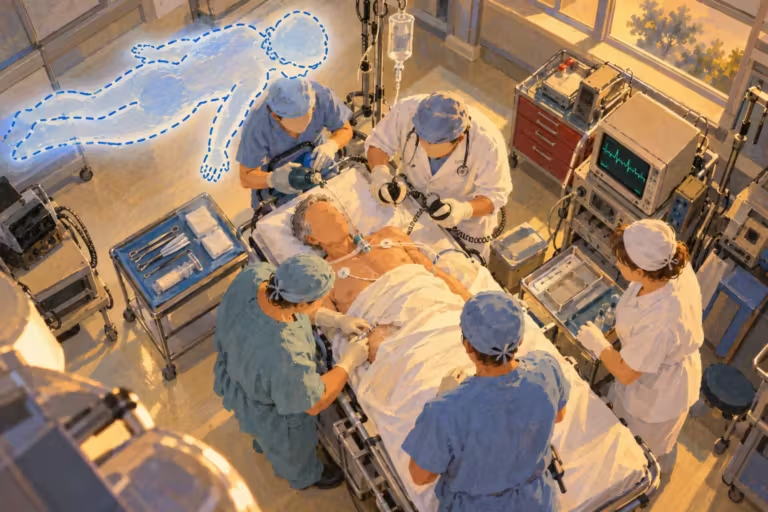
United States, 1978
Mr. M.
He was resuscitated in the ER. He said he saw them put a needle into his groin. The medical record confirms that blood was taken from his groin, but on the opposite side from the one he named.
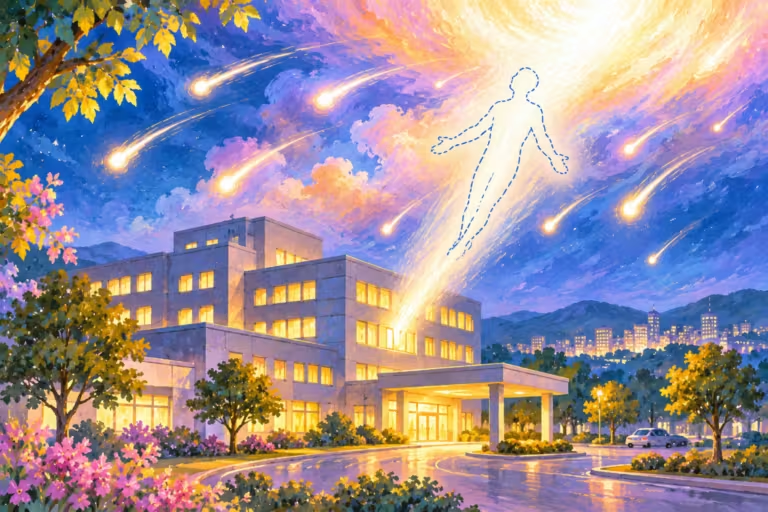
Seattle, 2006
Dean Braxton
Dean Braxton’s heart stopped in 2006, and doctors worked to resuscitate him for more than an hour. He said he stood before Jesus, who told him three times to go back.
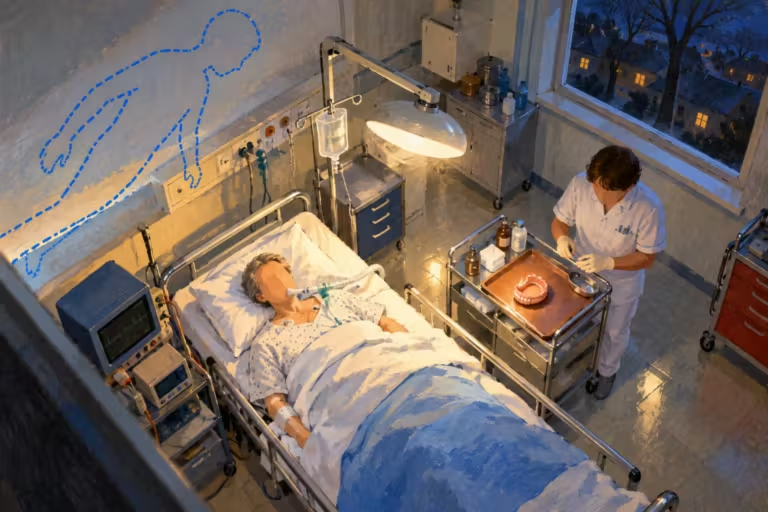
The Netherlands, 1979
The man with the dentures
A man arrived ice-cold and with no pulse at a hospital. A nurse took out his dentures to resuscitate him. According to the nurse, more than a week later the man told him where he had left them.
Reincarnation: The top 5 people who remember past lives
We asked them the same five questions as this story. A 32-page PDF, free in your inbox.
Check your email
We have sent you an email. Open it and press the button to confirm. If you cannot see it, check your spam folder.