A real-life story · Nijmegen, the Netherlands, 1979
The near-death experience of the man with the dentures
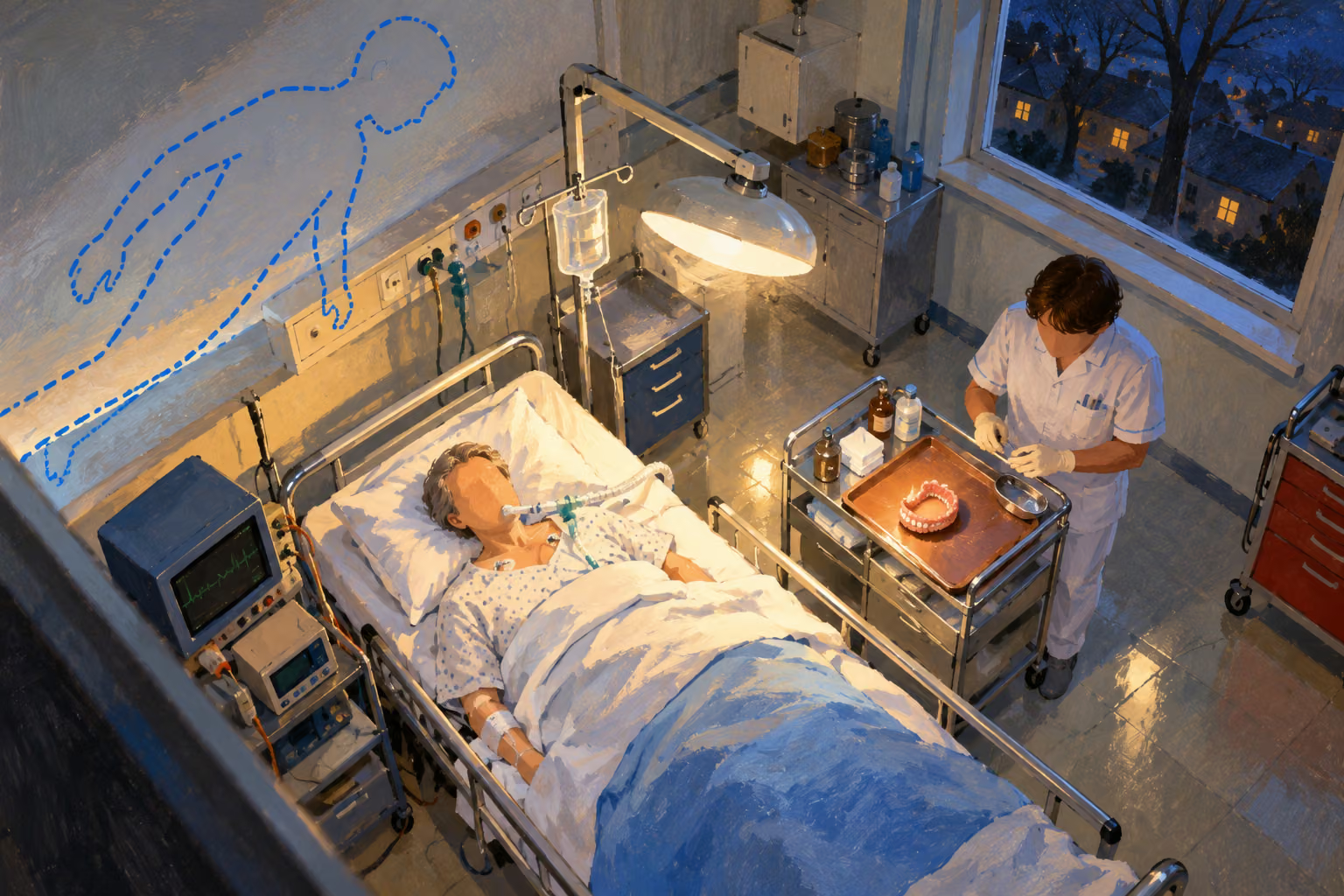
In late 1979, a 44-year-old man arrived ice-cold and with no pulse at a hospital in the Netherlands. To resuscitate him, a nurse took out his dentures and left them on a cart. More than a week later, according to the nurse, the man recognized him and told him where he had left the dentures. He said he had watched his whole resuscitation from above.
It is one of the most famous cases in the world. The medical journal The Lancet published it in 2001, within the study by the cardiologist Pim van Lommel. Nobody ever interviewed the man. Everything he said is known through the nurse. How did the man know where his dentures were? We tell it step by step and then look at what could be checked. If you’re in a hurry, go straight to the check.
Step 1
Late 1979, at night · No pulse · Told by the nurse
Passers-by find an ice-cold man in a meadow
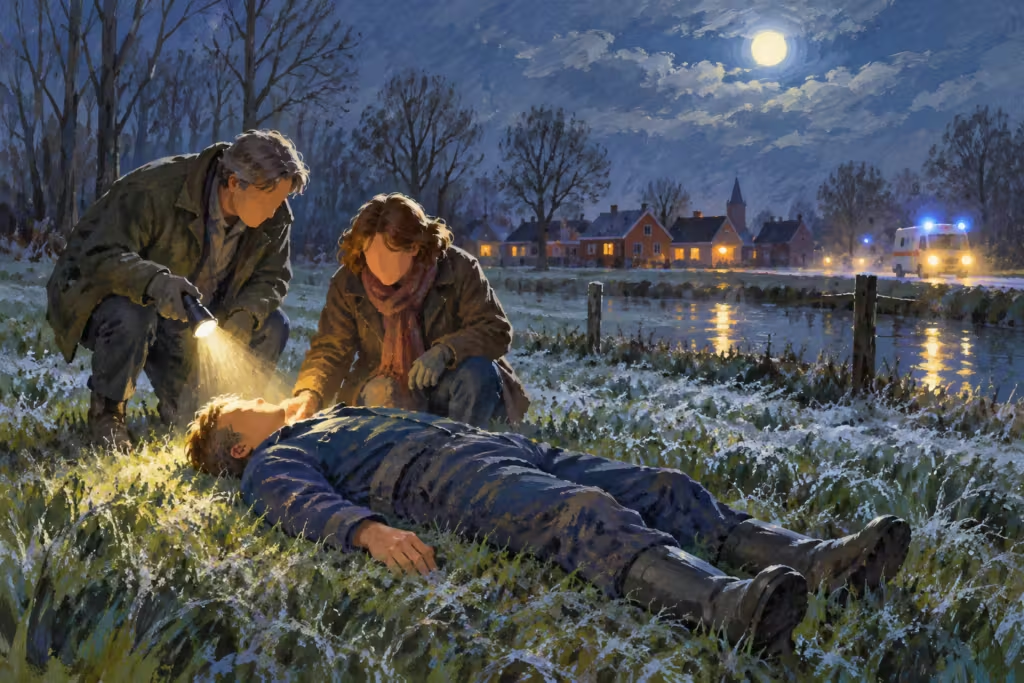
The man was 44 years old and lived in Ooy, a village near the city of Nijmegen. According to the nurse, he worked in steel. The articles written about the case later call him B.
One cold night, passers-by found him lying in a wet meadow. Nobody knows how long he had been there. He had no pulse and was not breathing.
The ambulance crew saw how young he was and decided to try to resuscitate him. They tried on the way, without result. They took him to the Canisius hospital in Nijmegen.
A nurse from the coronary care unit, the intensive care area for the heart, was waiting for him there.
Step 2
In the resuscitation room · No pulse · Told by the nurse
The team believes it is resuscitating a dead man
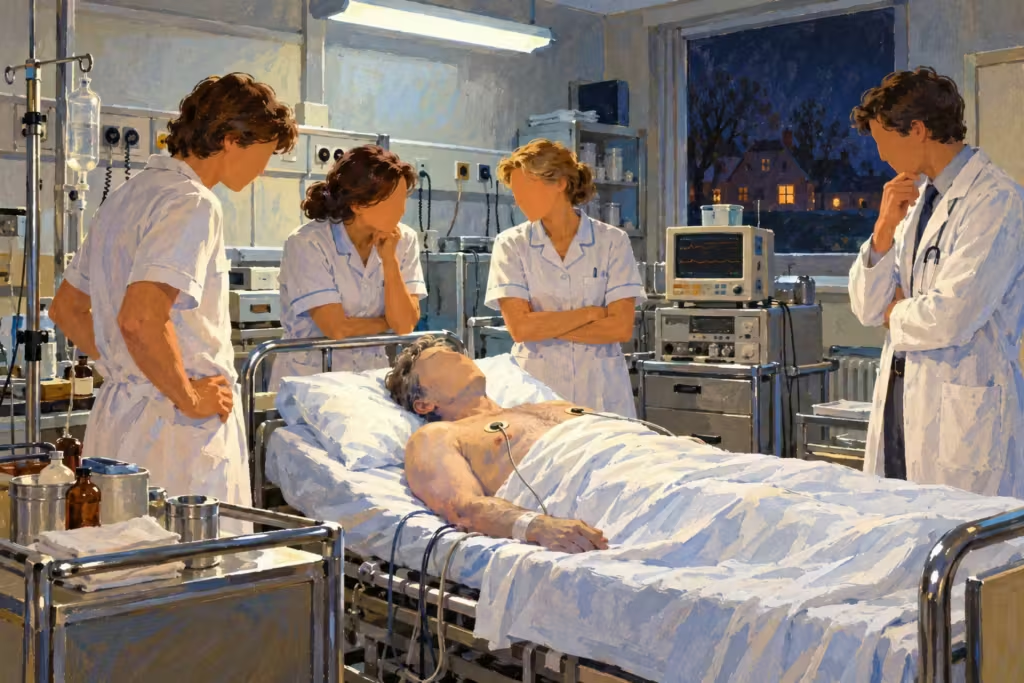
The nurse asked for his name not to be given. The articles call him T. G. That night he was leading the resuscitation team for the first time. Two student nurses were helping him, and a junior doctor was there.
According to the nurse, the man arrived as cold as ice. His skin had bluish patches, like a corpse. His pupils did not react to light, and his eyes were closed.
The nurse says that after 15 minutes they were all convinced they were working on a dead man. They looked at each other as if to say it made no sense. They went on because the man was young, and because the doctor did not dare to tell them to stop.
Step 3
As the resuscitation begins · No pulse · Told by the nurse
The nurse takes out his dentures and leaves them on the cart
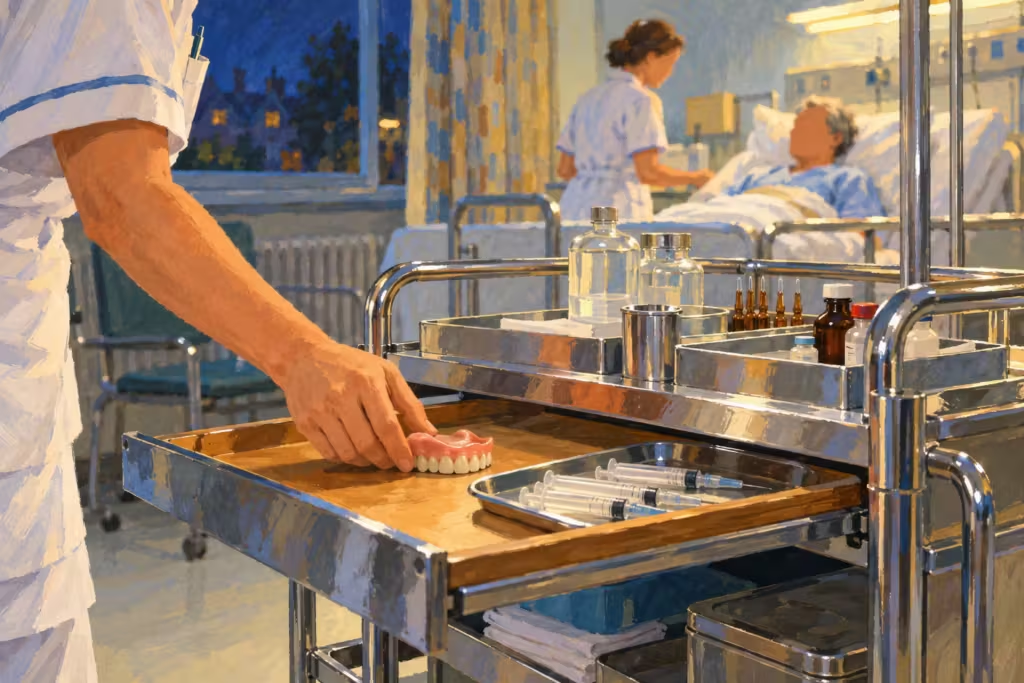
So the man could get air, a tube had to go down his mouth. While doing it, the nurse saw that he still had his upper dentures in. They had not yet switched on the machine that would do the chest compressions. He took them out and left them on the crash cart, the trolley with the medicines and drips.
It was not an ordinary cart. The hospital itself had made it from a kitchen trolley of metal tubes. On top it had compartments with bottles and ampoules. Underneath it had a wooden shelf that slid out. The shelf was already pulled out, because the nurse had put the prepared syringes there. He himself says it was the only place where he could put the dentures down with ease.
He put the dentures down on the wood and carried on with the resuscitation.
He forgot about them.
Step 4
During the resuscitation · Told by the nurse
A machine pounds his chest for a long time
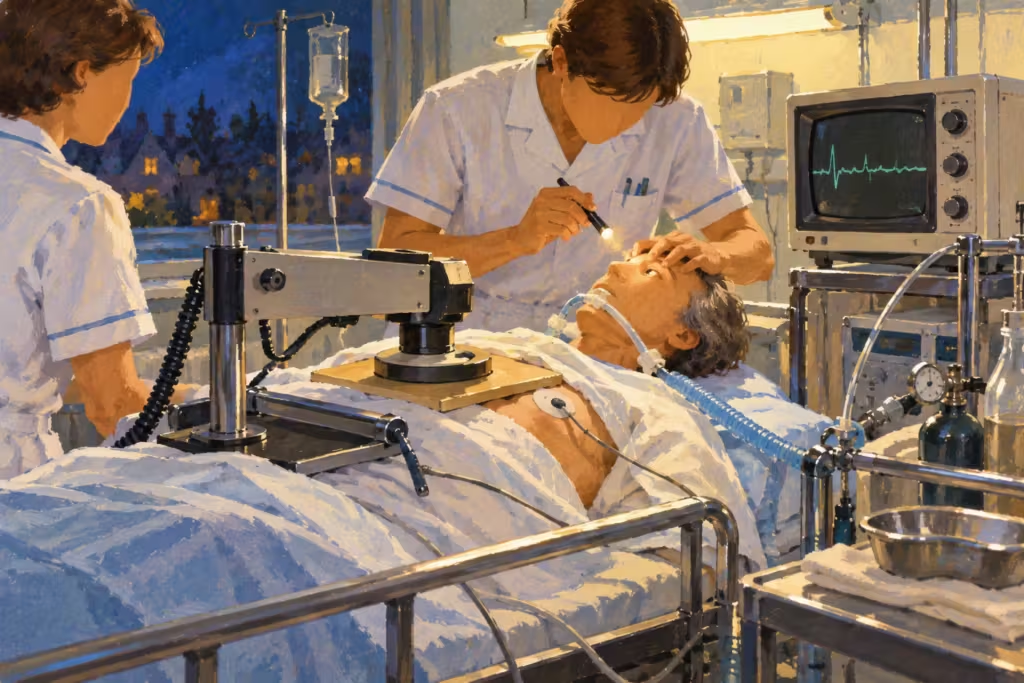
They gave him chest compressions, first by hand and then with a machine that pounds the chest over and over. They gave him five electric shocks to get the heart beating again.
Every now and then, the nurse opened his eyes to check his pupils. They never reacted.
After a long time, a little heartbeat and a little blood pressure came back. The man began to breathe a little on his own. They took him to intensive care, still in a coma and on a breathing machine.
The nurse’s shift ended that night. The dentures, it seems, got lost when the room was tidied up.
Step 5
The following week · In intensive care
B. wakes up and asks about his dentures
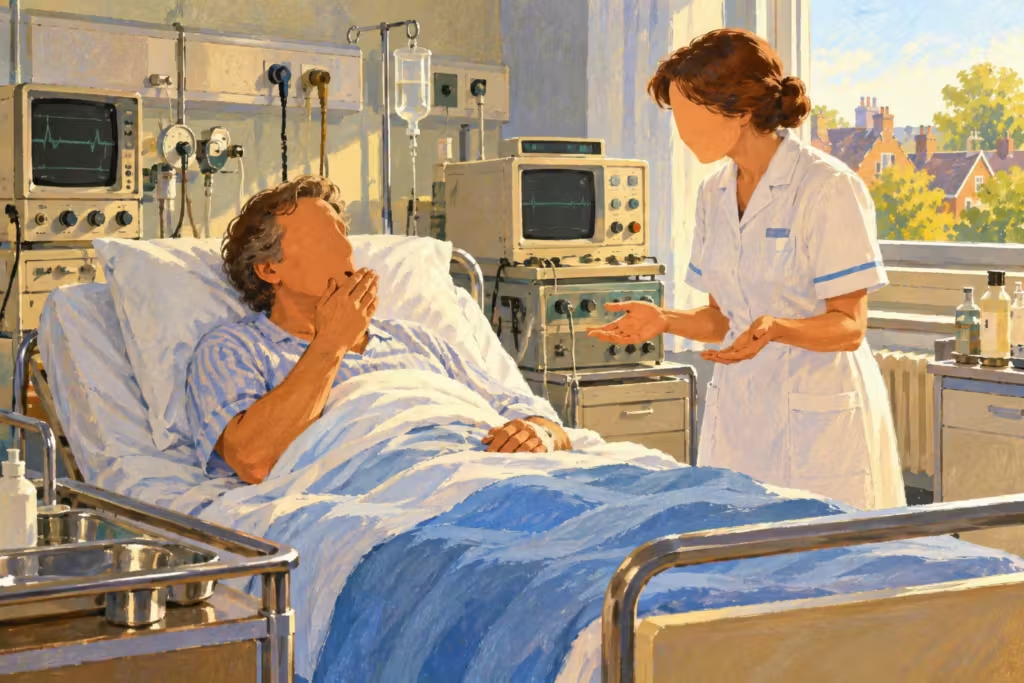
The doctors later found that B. had had a very large heart attack before he collapsed in the meadow.
Little by little, B. recovered in intensive care. At some point he asked where his dentures were. Nobody knew, because the dentures had not come with him to intensive care.
The nurse had five days off and then worked in another part of the ward. More than a week went by without him seeing B.
Step 6
More than a week later · Awake · Told by the nurse
“You know where my dentures are”
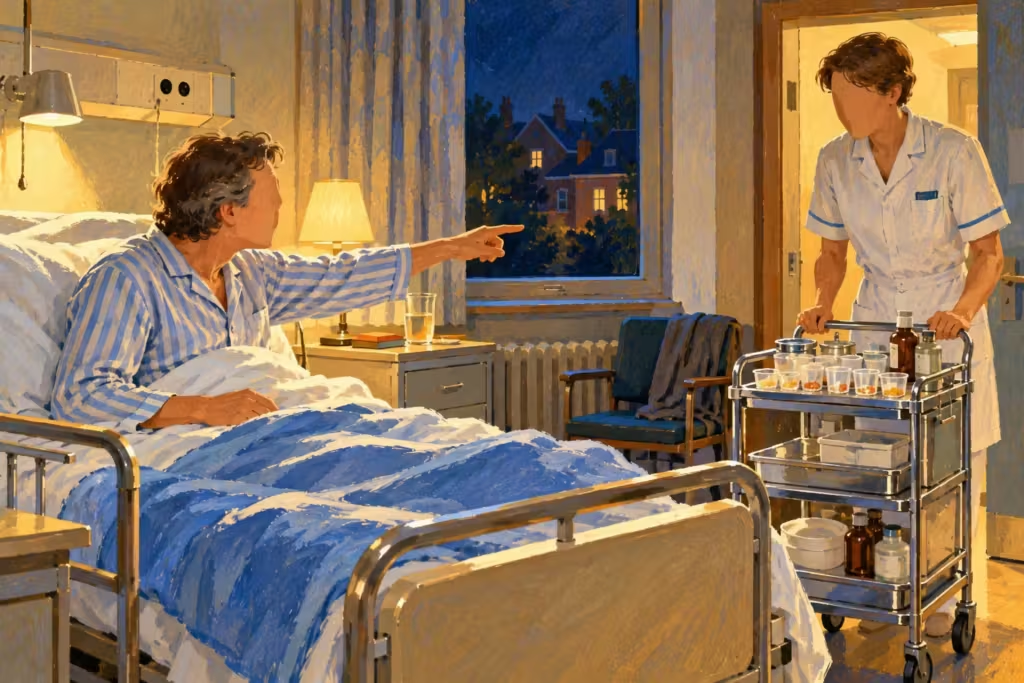
At the start of his night shift, the nurse went in to hand out medication on the recovery ward. B. was there, in his bed. The nurse was already surprised to see him looking so well.
According to the nurse, B. looked at him and said this:
B.“Hey, yes you, you know where my dentures are!”
The nurse“How do you know that?”
B.“You were there when I was brought into the hospital, and you removed my dentures from my mouth and put them upon that cart that was there. […] Yes, there were all sorts of bottles on it, and it did rattle a lot, and there was also a sliding plate upon which you put the dentures.”
The nurse was stunned. The last time he had seen B., B. was in a coma.
Step 7
More than a week later · Told by the nurse
B. says he saw it all from a corner near the ceiling
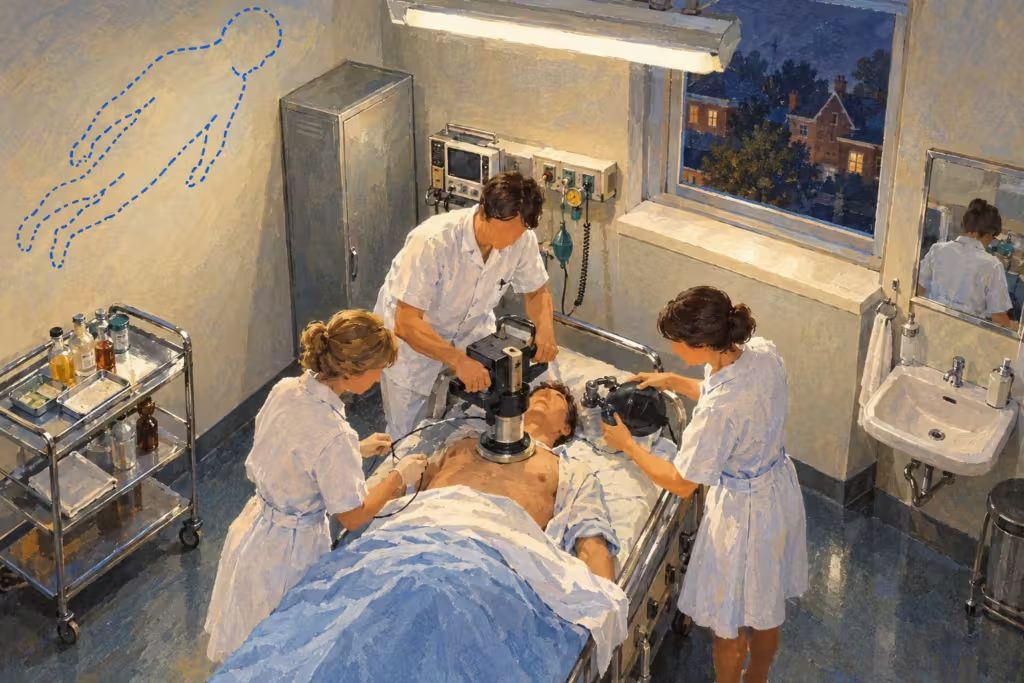
According to the nurse, B. described the resuscitation room. It was very small. To the right of the bed there was a washbasin, and also a mirror. To the left was the cart, and there was a narrow metal cabinet.
B. also described the people resuscitating him, for example what one of the nurses looked like. He said he saw himself lying on the bed from the corner where the cabinet was, floating above the team. He found it very strange.
At the same time, B. felt the nurse’s weight on him and the pain of the compression machine. According to the nurse, B. told him this:
“I saw you; you were doing the heart massage on me. And I wanted to tell you all the time: ‘Ouch, stop doing this because it hurts so much! I am still here; my heart does not stand still! I am alive!’ But you did not hear me.”
In another account, the one The Lancet published in 2001, B. asked for the opposite. He wanted them to keep resuscitating him, because he was afraid of dying. In 2008, the nurse explained that B. wanted both things, at different moments of the resuscitation.
Step 8
The following weeks and years · Told by the nurse
B. goes home and the nurse loses track of him

According to the nurse, B. told it all plainly, without being amazed by any of it. He did not strike the nurse as someone with a wild imagination.
B. went home four weeks after arriving at the hospital. The nurse never spoke to him again and regrets not having kept in touch. He saw him once more, from a distance, at a check-up. B. looked very ill with his heart.
A few years later, the nurse read in the newspaper the death notice of a man from Ooy with the initial B.
Nothing of what B. told was written in his medical record. In those years, such things were not written down.
Step 9
From 1991 to 2010 · Told by the researchers
The story goes around the world without anyone asking B.

The nurse told his colleagues, who shrugged it off. One of them took the story to a researcher, who published it in a Dutch magazine in 1991. In 1994, an interviewer from the Dutch association that studies these experiences spoke at length with the nurse. And in 2001, the case appeared in The Lancet.
By then it was no longer possible to talk to B. In 2008, the researcher Rudolf Smit tracked down the nurse, and Titus Rivas did a long interview with him. The nurse repeated the essentials. An anesthesiologist, Gerald Woerlee, proposed a medical explanation, and Smit and Rivas answered him. We tell that investigation and its debate on another page, “The dentures case.”
The question from the beginning remains: how did B. know where his dentures were? Let’s see what could be checked.
How do experts rate cases like the dentures case?
B. is not a unique case. Other people say that, during their experience, they saw something that was later checked.
In 2025, thirteen researchers of these experiences created a scale. It measures how far each case supports the idea that the person saw something they could not have known. They then used it themselves to rate 17 cases published in scientific journals. One was the dentures case, as Smit told it in 2008.
Eleven of those experts rated the dentures case, and 6 said “strong.” Three artificial intelligence programs rated it too, and all three said “strong.”
| Level | Cases |
|---|---|
| Strong, including the dentures case | 4 |
| Between strong and moderate | 1 |
| Moderate | 7 |
| Low | 3 |
| Very low | 2 |
What these figures don’t tell
- The cases are not random. Two of the authors chose them from cases published in scientific journals.
- The experts did not always agree. For the dentures case, 6 of 11 said “strong,” just over half.
- Who does the rating matters too. The authors themselves admit it. An expert convinced that consciousness can work without the brain may give a case more points than it deserves. Van Lommel himself was among the authors.
- The scale rates the case as it was published. It values how credible the witness is, but does not ask whether anything was written down at the time.
So this scale does not say these cases are proof, or that they are not. There is more on this in What does science say?
Frequently asked questions
Who was the man with the dentures?
He was a 44-year-old man from Ooy, a village near Nijmegen, in the Netherlands. The articles only call him B. He was resuscitated in late 1979 after being found ice-cold and with no pulse in a meadow. The nurse who treated him read, years later, the death notice of a man from Ooy with his initial.
Is the story of the man with the dentures true?
The nurse who took out the dentures has told the essentials the same way for years. But nobody interviewed the man, and nothing was written down at the time. So it cannot be fully checked. We explain it on the page “The dentures case.”
Where this story comes from
Studies
- Pim van Lommel and others (2001), The Lancet 358:2039-2045View in the journal (free with registration)
- Rudolf Smit (2008), the 1994 interview with the nurse and what he said in 2008, Journal of Near-Death Studies 27(1):47-61Read for free
- Gerald Woerlee (2010), Journal of Near-Death Studies 28(4):181-191Read for free
- Rudolf Smit and Titus Rivas (2010), with the nurse’s 2008 text, Journal of Near-Death Studies 28(4):193-205Read for free
- Greyson and others (2025), the scale for checked cases, Frontiers in Psychology 16:1661390Read for free
Books
- Titus Rivas, Anny Dirven and Rudolf Smit, El yo no muere (2019), the Spanish edition of The Self Does Not Die, case 3.7, with the 2008 interview. We cite the first Spanish edition. The link goes to the English edition, where the case numbers may differ.Buy the book
To understand more
- The dentures case: Smit’s investigation and his debate with WoerleeRead
- Van Lommel: 344 resuscitated people in ten hospitalsRead
- What does science say about these experiences?Read
Our archive
- Our assessment of the case with the five questions of the check, as of October 23, 2026
Keep reading
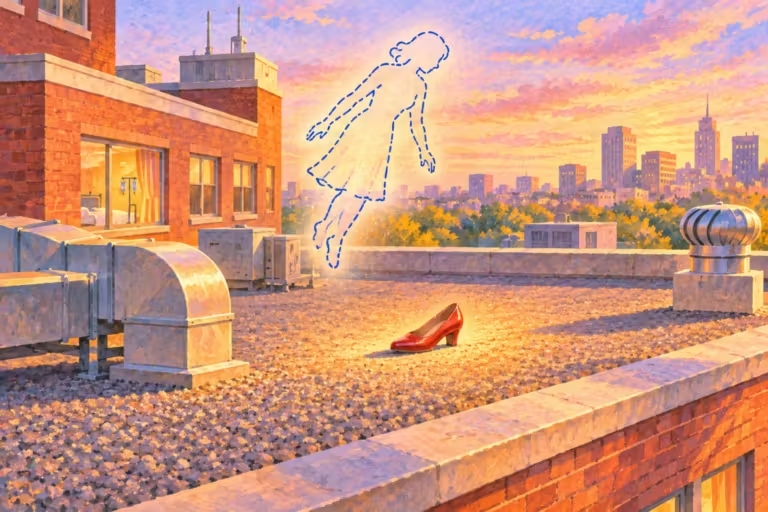
Hartford, 1985
The red shoe patient
In 1985, a woman resuscitated in a Hartford hospital said she saw a red shoe from above the roof. According to the nurse, a skeptical doctor went up and found it.

Texas, 1943
George Ritchie
In 1943, George Ritchie, a 20-year-old soldier, was pronounced dead in an army hospital in Texas. He said he flew to a city by a river and saw a cafe that he recognized months later in Vicksburg.

California, United States, 1987
John Davis
He says that in 1987 his heart stopped for seven minutes. He says a guide showed him the afterlife, with a library of soulmates and a planetarium with millions of worlds. At the end he heard: “There is no death.”

Reincarnation: The top 5 people who remember past lives
We asked them the same five questions as this story. A 32-page PDF, free in your inbox.
Check your email
We have sent you an email. Open it and press the button to confirm. If you cannot see it, check your spam folder.