A real-life story · Hartford, Connecticut, United States, 1985
The red shoe patient’s near-death experience
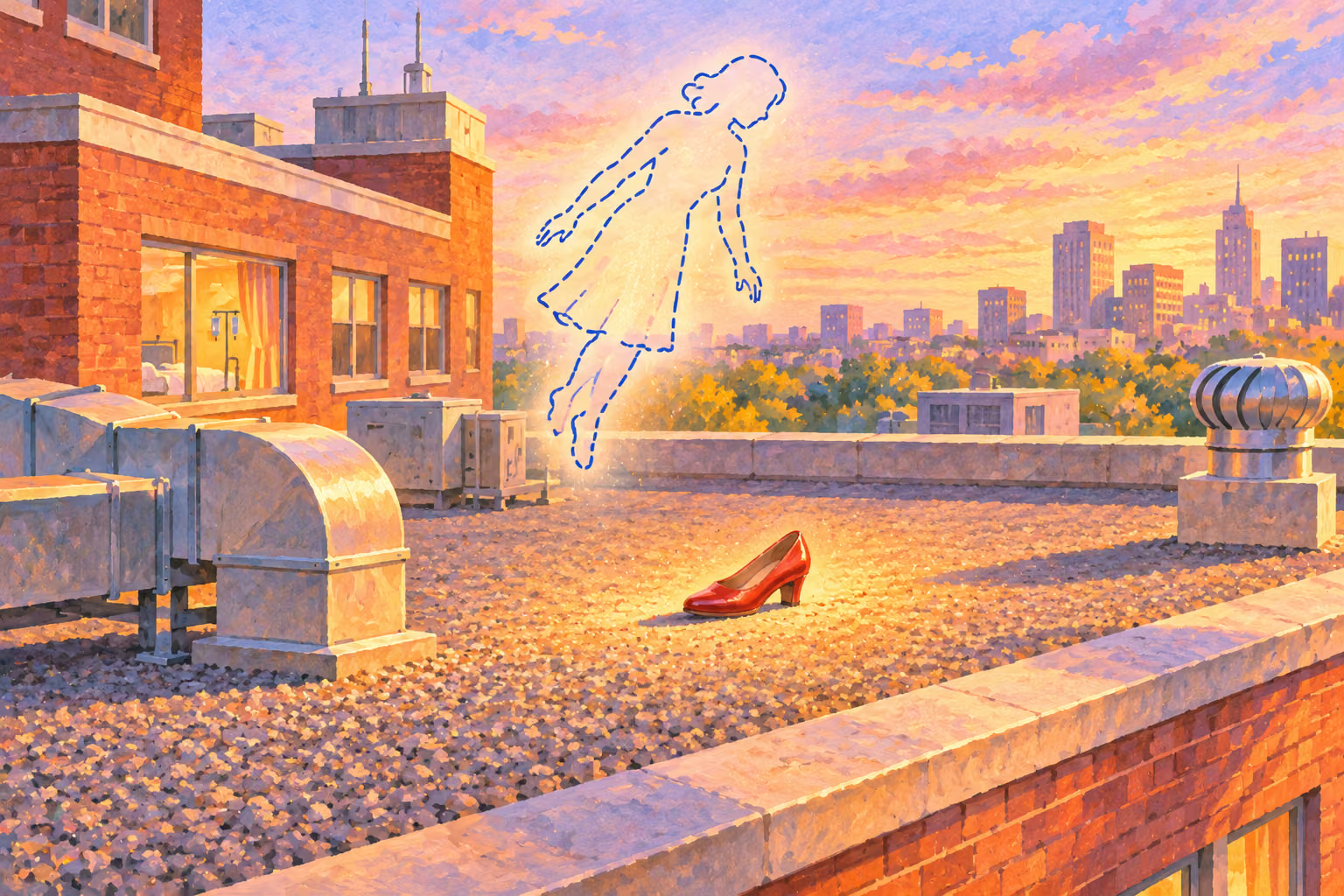
In 1985, a woman was resuscitated at Hartford Hospital, a large hospital in the northeastern United States. She later told a nurse that she had left her body and, from above the roof, had seen a red shoe. According to the nurse, a young doctor who didn’t believe it went up to the roof and came back with a red shoe.
The Hartford red shoe case appears on many lists of “verified” near-death experiences. It is very similar to the case of Maria and her tennis shoe, in Seattle. Here, what the patient said she saw was on a roof, and, according to the nurse, the person who went to look for it was a skeptic. We tell it step by step and then look at what can be checked. If you only want the evidence, skip straight to what can be checked. How did that woman know there was a red shoe on the roof?
Step 1
1985 · Hartford Hospital, Connecticut · Kathy Milne’s account
Kathy Milne, a nurse at Hartford Hospital, takes an interest in near-death experiences
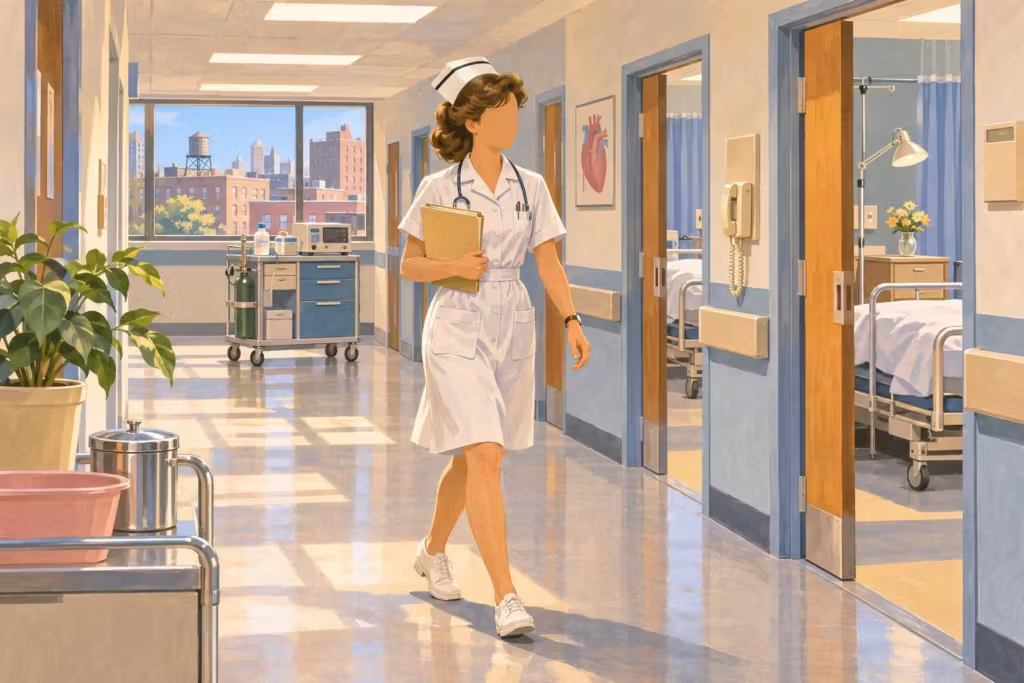
Kathy Milne worked as a nurse at Hartford Hospital, a large hospital in Hartford, the capital of Connecticut, in the northeastern United States.
Milne was already interested in near-death experiences. Years later, in 1995, she published a study on the ones that heart patients have. She is the one who tells this case. She put it in writing in 1992, seven years later, in a letter to the researcher Kenneth Ring.
One day in 1985, Milne got talking with a patient.
Step 2
1985 · In the hospital · Kathy Milne’s account
A woman who has just been resuscitated tells Milne what she went through

She was a woman who had been resuscitated a short time before. Milne doesn’t give her name, her age, why she was in the hospital, or the date. She only says that the woman had had a near-death experience and told her about it.
The woman began with the moment she was resuscitated.
Step 3
During the resuscitation, according to the patient · Kathy Milne’s account
The patient says she leaves her body and rises up through several floors

According to Milne, the woman said she floated above her body and watched for a while as they tried to resuscitate her. Then she felt something pulling her upward, through several floors of the hospital.
And suddenly she was outside the building.
Step 4
During the resuscitation, according to the patient · Kathy Milne’s account
The patient says that from above the roof she sees Hartford and a red shoe
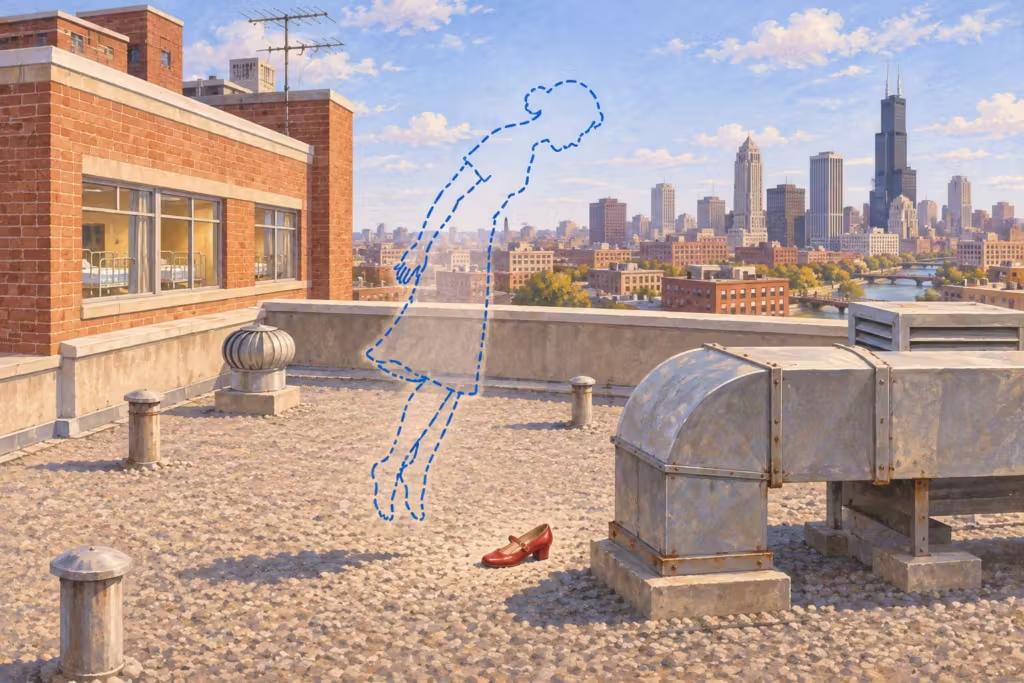
The woman found herself above the hospital roof, looking at the Hartford skyline. She found it a very interesting view. Then she saw something red out of the corner of her eye. This is how Milne puts it in her letter:
“It turned out to be a shoe.”
The woman thought about the shoe and suddenly felt herself “sucked up” into a black hole. According to Milne, the rest of what the woman went through was like what many other people describe.
Milne decided to tell someone.
Step 5
1985 · In the hospital · Kathy Milne’s account
Milne tells a resident, who walks off making fun of it

A resident is a young doctor who is still finishing their training in the hospital. Milne told the story of the shoe to one who didn’t believe in these things. According to her, the resident walked off making fun of it.
The resident didn’t forget about the shoe.
Step 6
Later that same day · On the hospital roof · Kathy Milne’s account
Milne says the resident goes up to the roof and comes back with a red shoe
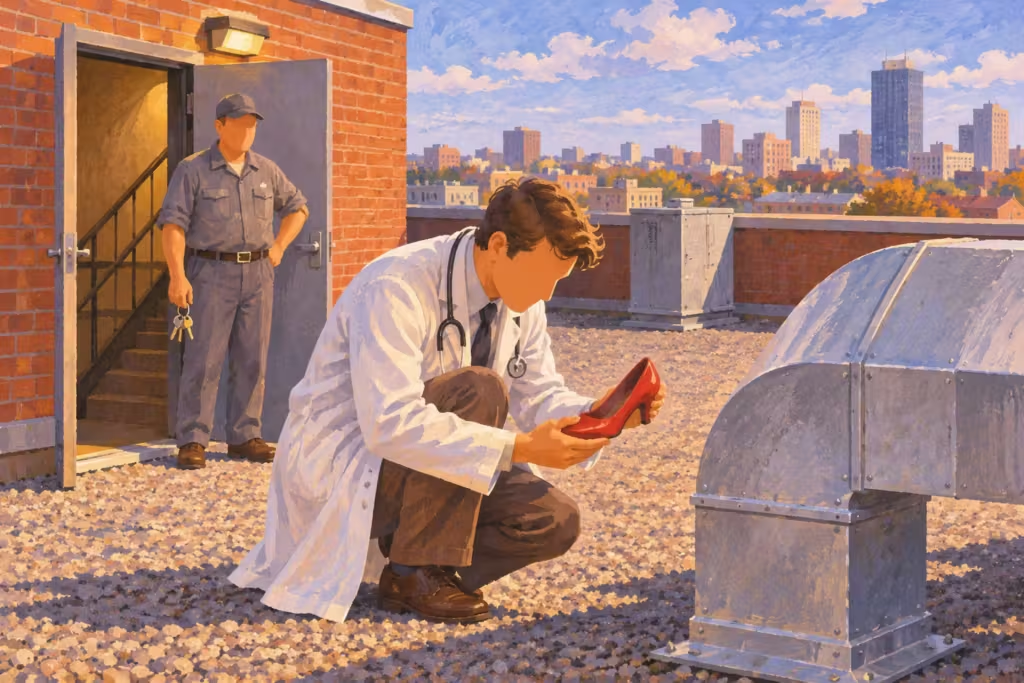
According to Milne, the resident got a janitor to take him up to the roof. She didn’t see him go up. This is how she puts it in her letter:
“When I saw him later that day, he had a red shoe and became a believer, too.”
Milne doesn’t say what kind of shoe it was, which roof it was on, or what the resident and the janitor were called.
Seven years went by before the story was put in writing.
Step 7
From 1992 to today · Told by Kenneth Ring and those who retell the case
Kenneth Ring publishes the case, and the story starts to change as it is retold

Kenneth Ring was a psychologist at the University of Connecticut who studied near-death experiences. In August 1992 he talked with Milne on the phone, and in October she sent him the letter. In 1993, Ring and Madelaine Lawrence published it in a scientific journal about these experiences. Lawrence was the head of nursing research at Hartford Hospital. Ring told the case again in a book in 1998.
Ring asked Milne whether she knew Maria’s case. Maria is the woman in Seattle who said in 1977 that she had seen a tennis shoe on a window ledge. According to Ring, Milne didn’t know it and was amazed that there was another story so similar.
Since then, the case has been told many times, sometimes with changes. In a 2005 book, the patient becomes a man who had had a heart attack. In other texts, the person who goes up to the roof is a doctor or a hospital employee. In 2022, the writer Erie Chapman told another version, which doesn’t come from Ring’s article. Chapman says it was told to him by the hospital’s president at the time, some thirty years earlier. In his version there is a car accident, a red tennis shoe, and the security guards go up to the roof.
The question remains: how did that woman know there was a red shoe on the roof?
How many people have an NDE?
The red shoe patient is not a one-off. For more than thirty years, several teams of doctors have asked people who survive a cardiac arrest what they remember. They do it in the hospital, a few days afterward.
Picture 100 of those people:
Each dot is a person. The 18 filled-in dots are the ones who described a near-death experience. That is what the largest study found. It was done in the Netherlands in 2001, with 344 people.
The other 82 didn’t describe one. Many remember nothing of their cardiac arrest.
| Where and when | People interviewed | Described an NDE |
|---|---|---|
| England, 2001 | 63 | 6% |
| Netherlands, 2001 | 344 | 18% |
| United States, 2002 | 30 | 23% |
| United States, 2003 | 116 | 10% |
| United Kingdom, United States, and Austria, 2014 | 101 | 9% |
| Vienna, Austria, 2023 | 126 | 4% |
| United States and United Kingdom, 2023 | 28 | 21% |
What these figures don’t tell you
- Only some people are asked. In the 2014 study, 330 people survived, but only 140 could be interviewed, and 101 reached the second interview. The rest died later, were too ill, or didn’t respond.
- Most cardiac arrests are never counted. These studies run in a few hospitals for a limited time. Outside them, no one keeps track. Also, the 2003 study interviewed 1,595 cardiology patients, not just the 116 with cardiac arrest in the table, and 81 of them described an NDE from an earlier occasion. The study did not count them, because it only counted those from that hospital stay.
- Some people keep quiet. In the accounts in our archive, at least 13 people say they kept their experience to themselves for a while. They kept quiet because they weren’t believed or because they were afraid of how others would react.
- It depends on how you count. If you count any memory of the cardiac arrest, the numbers go up. If you use a strict scale, they go down. In England in 2001, 7 of 63 people remembered something. But on the scale, only the memories of 4 people qualified as an NDE.
That’s why no one knows the real figure. But every study shows that it isn’t rare. Between 4 and 23 of every 100 survivors who are asked describe an NDE. The Hartford case stands out because of where the shoe was, on the roof. And, according to the nurse, it was found by a doctor who didn’t believe it.
Frequently asked questions
What is the Hartford red shoe case?
It is a near-death experience from 1985 at Hartford Hospital, in Connecticut, in the United States. According to the nurse Kathy Milne, a resuscitated patient said she had seen a red shoe from above the roof. And, according to Milne, a resident went up and found it. Kenneth Ring and Madelaine Lawrence published it in 1993. Here we explain what can be checked.
How is the Hartford red shoe like Maria’s tennis shoe?
In both cases, a resuscitated patient said she had left the building and seen a shoe in a place she couldn’t reach. And in both, according to the person who tells it, someone from the hospital found it. Maria’s case happened in Seattle in 1977, and it is told by the social worker who looked for the shoe. Here we tell Maria’s story.
Is it known who the red shoe patient was?
No. Kathy Milne didn’t give her name, her age, or the date. It is also not known who the resident was who, according to Milne, went up to the roof, and he has never spoken in public.
Where was the Hartford red shoe case published?
In 1993, in Kenneth Ring and Madelaine Lawrence’s article “Further evidence for veridical perception during near-death experiences,” in the Journal of Near-Death Studies. Ring told it again in 1998 in his book Lessons from the Light.
Where this story comes from
The study
- Kenneth Ring and Madelaine Lawrence, “Further evidence for veridical perception during near-death experiences,” Journal of Near-Death Studies 11(4), 1993, pages 223 to 229. It includes Kathy Milne’s letter of October 19, 1992Read for free
Books
- Kenneth Ring and Evelyn Elsaesser Valarino, Lessons from the Light (Insight Books, 1998), pages 67 and 68
- Mary Roach, Spook: Science Tackles the Afterlife (W. W. Norton, 2005). One of the versions with changes
Other versions
- Erie Chapman, “The Radiance of the Afterlife,” Journal of Sacred Work, April 18, 2022. The version the hospital’s president told himRead
Learn more
- What is a near-death experience?Read
- What does science say about near-death experiences?Read
- How we check each storyRead
Our archive
- Our reading of the 1993 article, the 1998 book, and the later versions, our search of Kenneth Ring’s papers at the University of West Georgia, and the case’s score on our five criteria, as of November 5, 2026
Keep reading
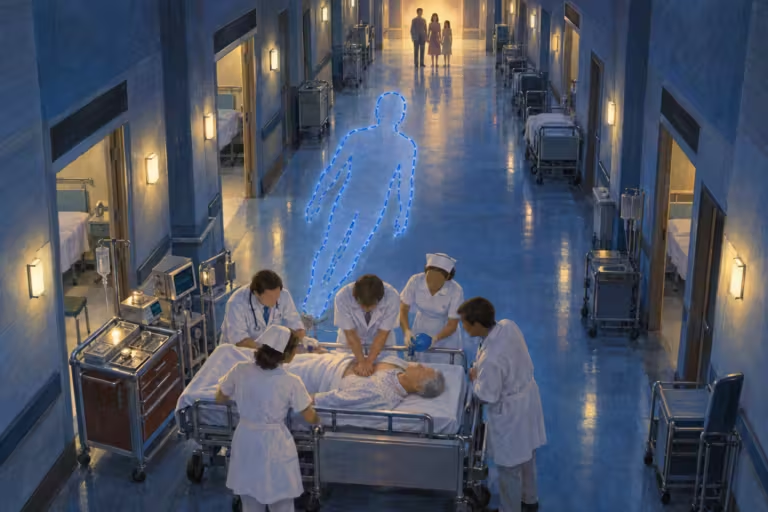
United States, 1976
Mr. O.
He was resuscitated in the hospital corridor. He said he saw his wife and two of his children at the far end. They had come unannounced, and a nurse stopped them a long way off.
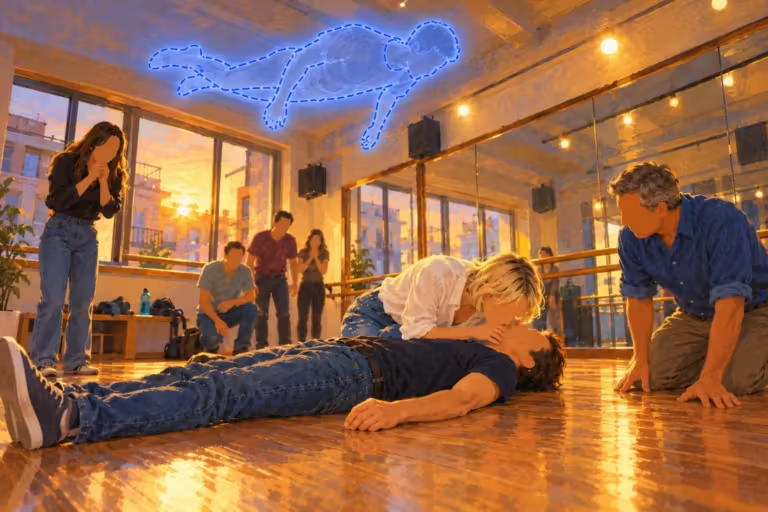
Madrid, 2017
Andrés Sampedro
Andrés Sampedro collapsed while dancing salsa. He says he watched from the ceiling as a nurse he didn’t know gave him CPR. He says that when he woke up he could describe her. The earliest description on record is from an interview six months later.

Barcelona, Spain, 2022
Juan Carlos Madrid
His heart stopped in the ICU. Ten days later he wrote the number 45 on a whiteboard. It was the number of minutes his resuscitation lasted, and he says no one had told him.

Reincarnation: The top 5 people who remember past lives
We asked them the same five questions as this story. A 32-page PDF, free in your inbox.
Check your email
We have sent you an email. Open it and press the button to confirm. If you cannot see it, check your spam folder.