A real-life story · United States, 1976
The near-death experience of Mr. O.
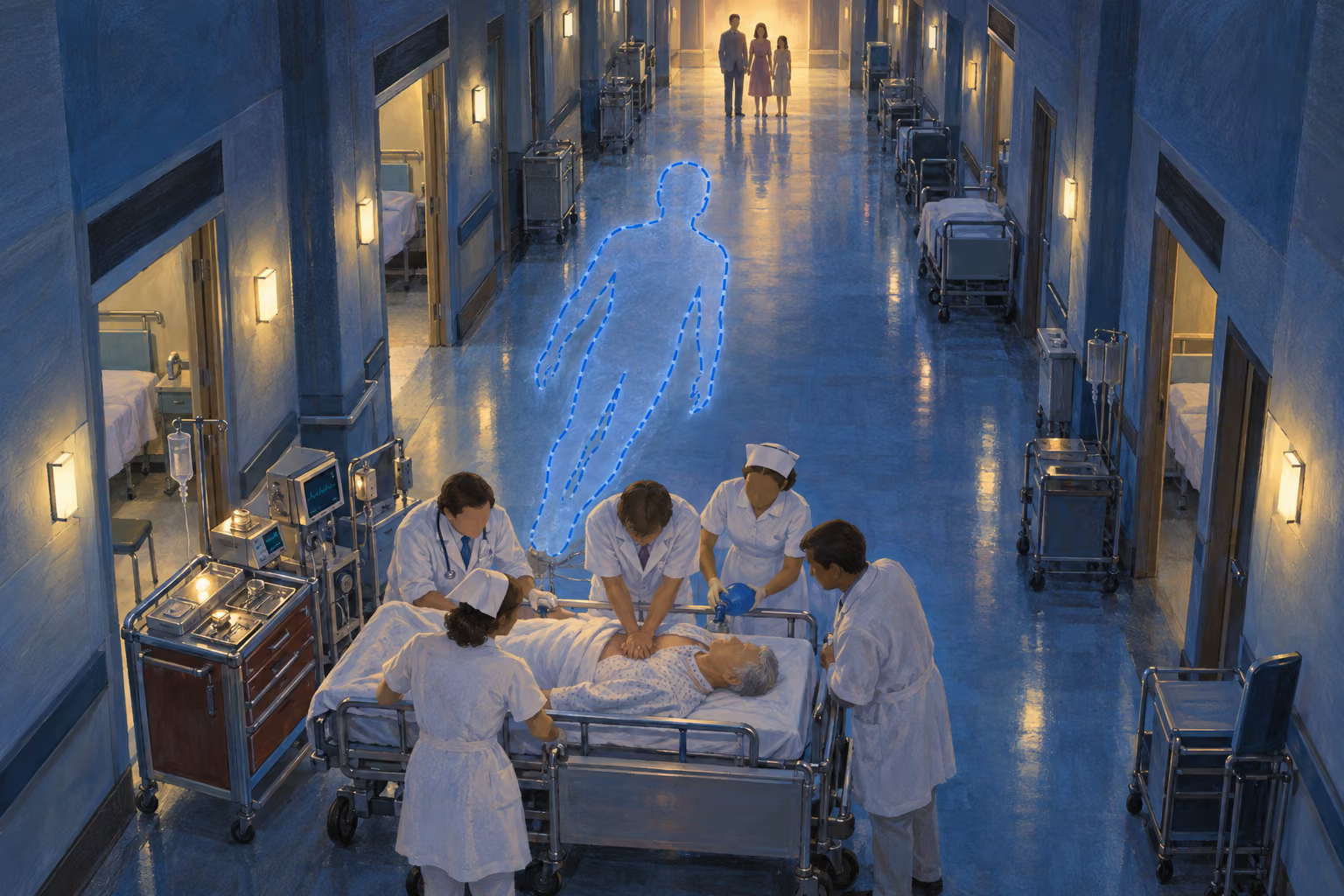
In 1976, a retired laborer was in hospital and was due to go home the next day. That night his heart stopped, and he was resuscitated. He later said that he rose above his body. As he rose, he saw his wife, his eldest son and his eldest daughter at the end of the corridor. They had come to see him as a surprise.
The cardiologist Michael Sabom calls him Mr. O. to keep his name private. His wife told Sabom that they had not planned to visit that night. She also told him that a nurse stopped them about ten rooms away. Mr. O.’s face was turned the other way. We tell it step by step and then look at what could be checked. If you only want the evidence, skip straight to what can be checked.
Step 1
July 1976 · On a hospital ward · His wife’s account
A retired laborer is waiting to go home after a heart attack
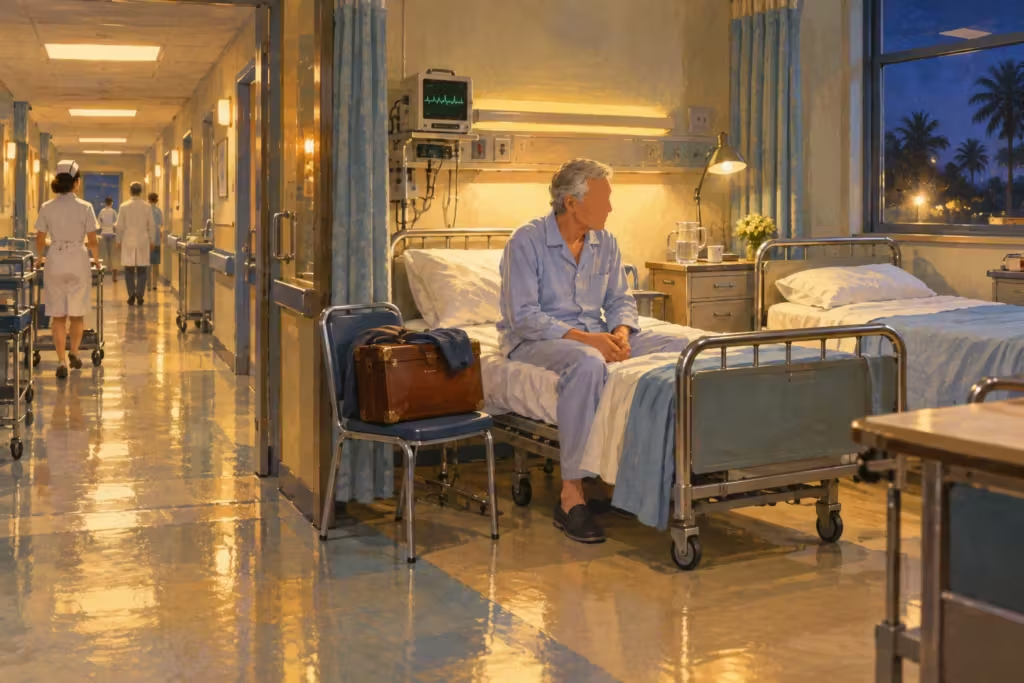
Mr. O. was 60 and a retired laborer. In July 1976 he was in hospital with heart trouble. He was already better and was in a small double room on a regular ward. The next day he was due to be discharged.
His wife was not planning to visit him that night. He was coming home the next day.
His case was studied by the cardiologist Michael Sabom. On the page about his book, we explain how Sabom worked and what the limits of his study are.
Step 2
That night · At home · His wife’s account
His eldest son and daughter drop by unannounced and decide to surprise him
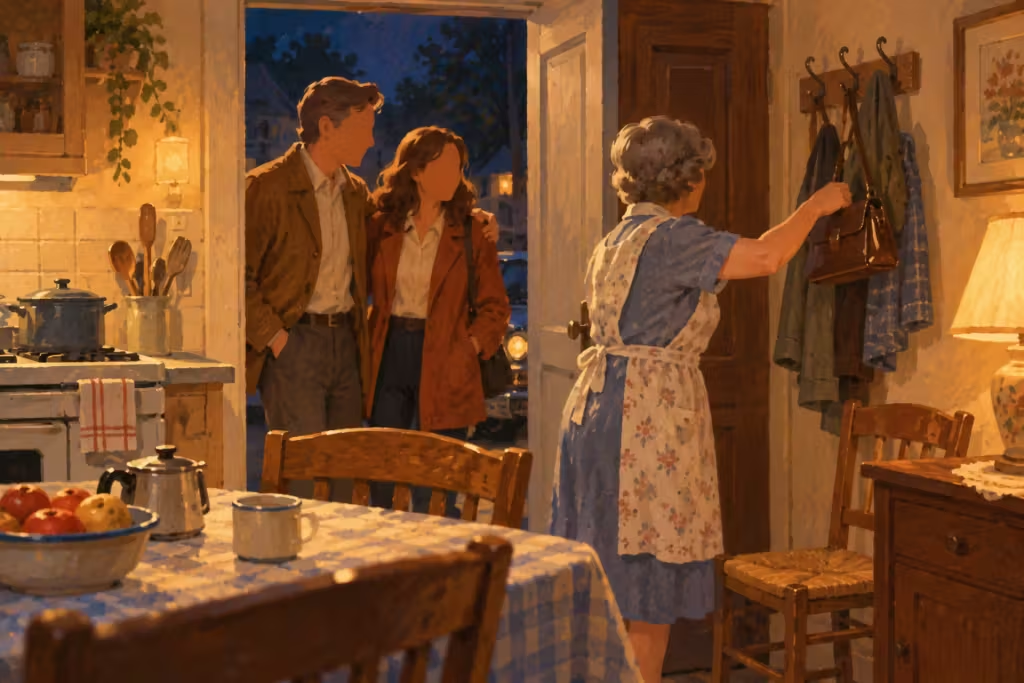
That night, his eldest son and eldest daughter came by to see her without warning. Since they had nothing better to do, the three of them decided to go to the hospital and surprise Mr. O.
They did not phone ahead. No one at the hospital knew they were coming.
Mr. O. had six children, and different people visited him each time.
Step 3
That night · His heart stops · Mr. O.’s account
He has another heart attack, and his heart stops
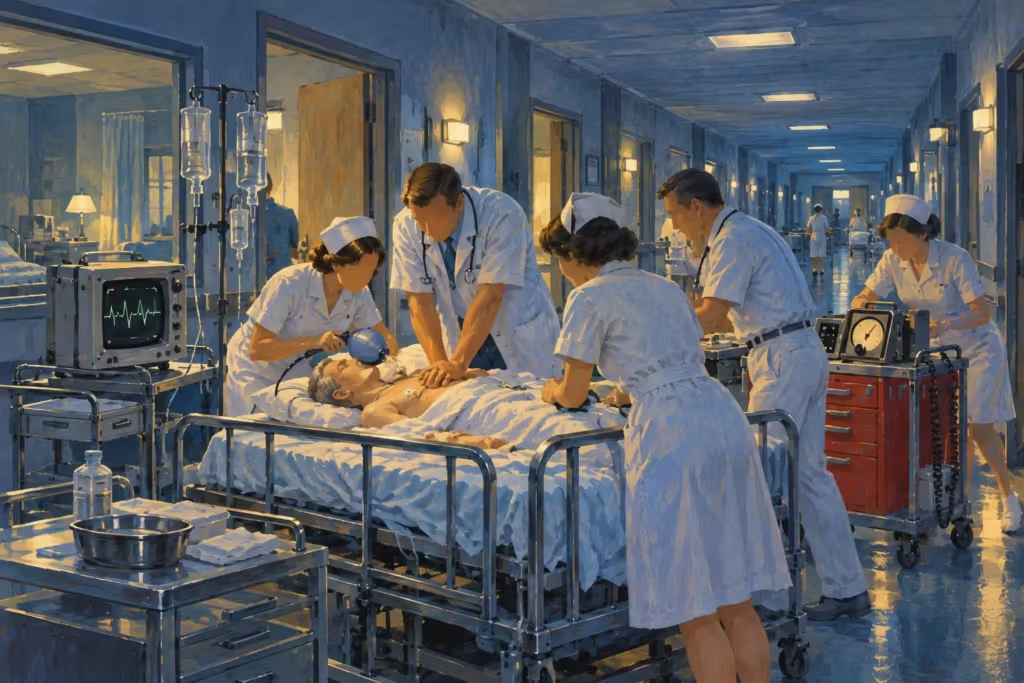
That night he had another heart attack, a very bad one. Later he was told that he went into spasms.
They wheeled him in his bed out of his room into the corridor. There, several doctors and nurses began resuscitating him.
The part of the medical record for that night was never found.
Step 4
During the resuscitation · Mr. O.’s account
He says he rises slowly and watches them resuscitate him
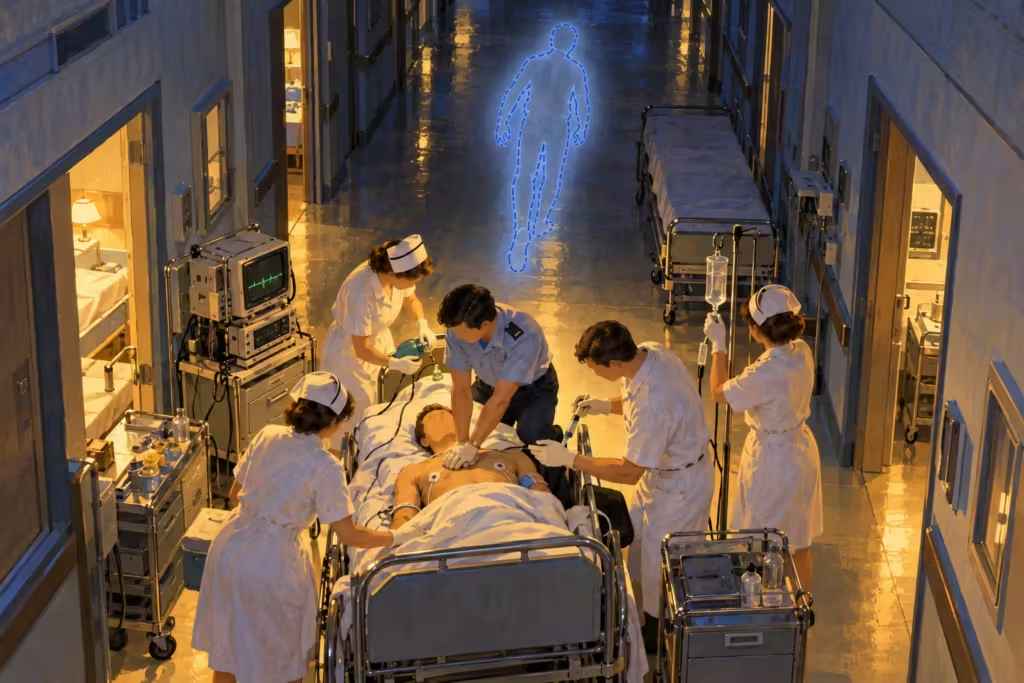
As he was going, he looked back and saw his body lying there. At first he did not know who it was. He looked closely and saw it was him. He felt no regret.
He was rising slowly, as if floating up a dark corridor. Below, the doctors were working hard. They climbed on top of him with their knees, pounded his chest and plunged a needle almost into the center of his chest.
He could see everything very clearly. He could not hear anything, not a sound.
And then he looked toward the end of the corridor.
Step 5
During the resuscitation · Mr. O.’s account
He says he sees his wife, his son and his daughter at the end of the corridor
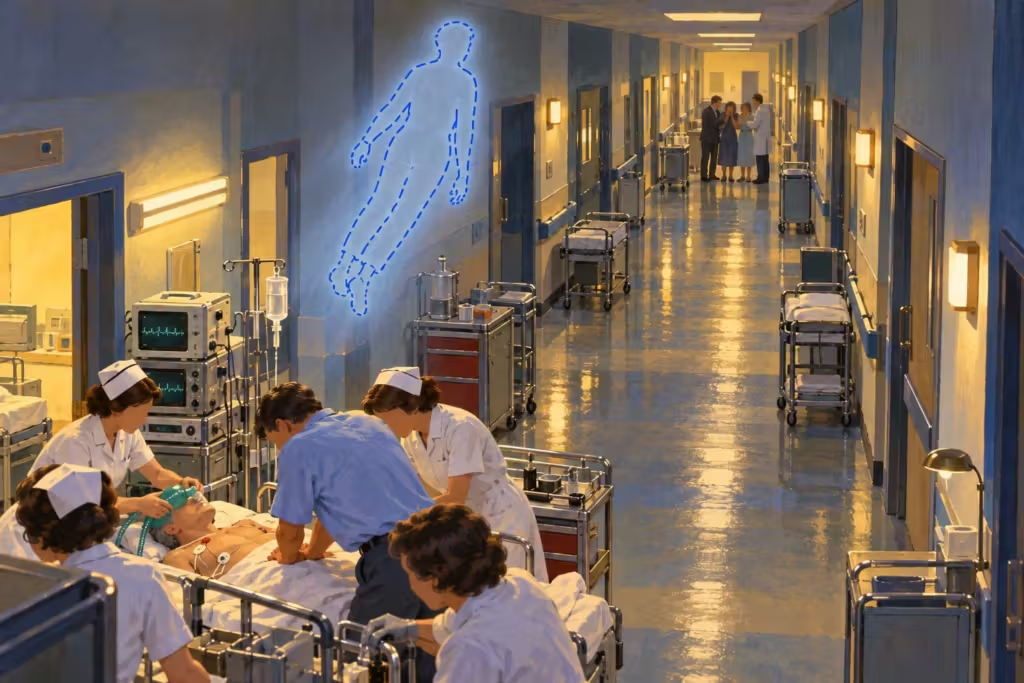
At the end of the corridor he saw his wife, his eldest son and his eldest daughter, standing with the doctor. He did not understand why they were crying. This is how he told it to Sabom:
“I remember seeing them down the hall just as plain as could be. … There was no way, being out, that I could have seen anybody. … I knew damn well they were there.”
Then he kept rising, and he says he came to a different world.
His wife lived that night from the corridor, and she tells it differently.
Step 6
That night · In the corridor · His wife’s account
A nurse stops them about ten rooms away, and his wife only sees his gray hair
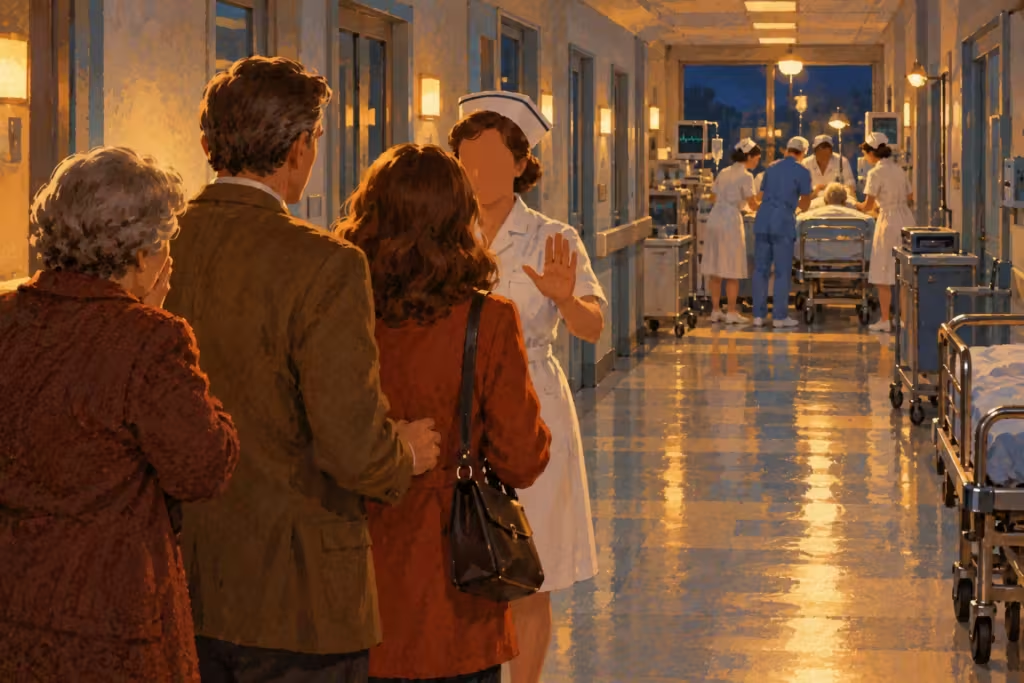
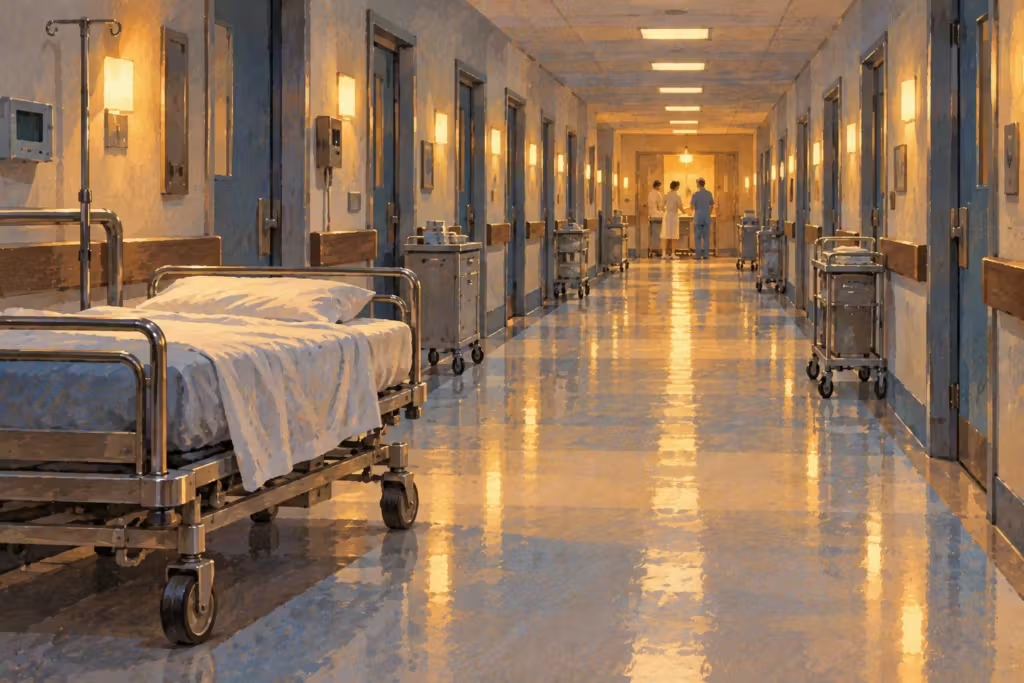
They arrived at the hospital and began walking down the corridor toward his room. They saw a lot of commotion near his door. A nurse stopped them “at least ten rooms down.”
His wife recognized his gray hair and knew something was wrong. He had been wheeled in his bed out of his room and they were resuscitating him. His face was turned the other way. She could only see the top of his head.
Then they took him straight up to intensive care, on another floor, without passing by them.
It took Mr. O. three days to be able to talk.
Step 7
The next morning and three days later · His wife’s account
Three days later, he tells his wife he saw them in the corridor
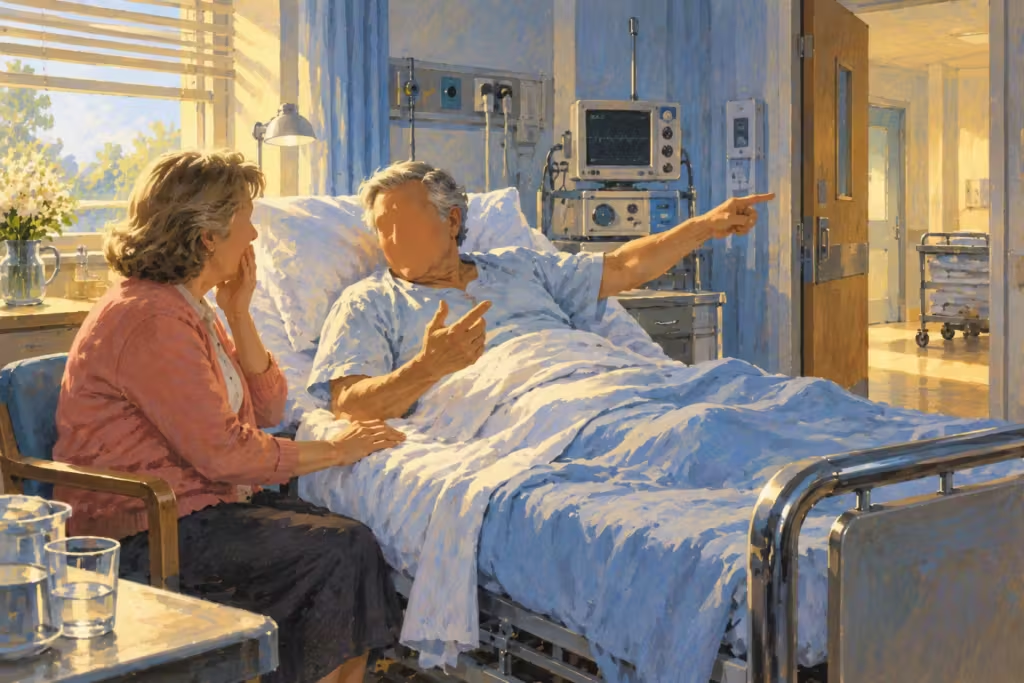
The next morning they were allowed to see him. He was disoriented. He could not talk because he had tubes in his mouth and nose.
Three days later he was better and told his wife what had happened. This is how she remembers it:
“He swore he’d seen us, and I said he couldn’t have. … And he told me who was there. … He said he seen us standing there talking to the doctor. And we were.”
His wife says he could not have known who had come that night. They had six children, and different people went to see him each time. She also says he always tells it the same way.
No one knows what he was told during the visit the next morning.
Step 8
August 1977 · A year later · Michael Sabom’s account
A year later, Sabom talks with him, his wife and his daughter
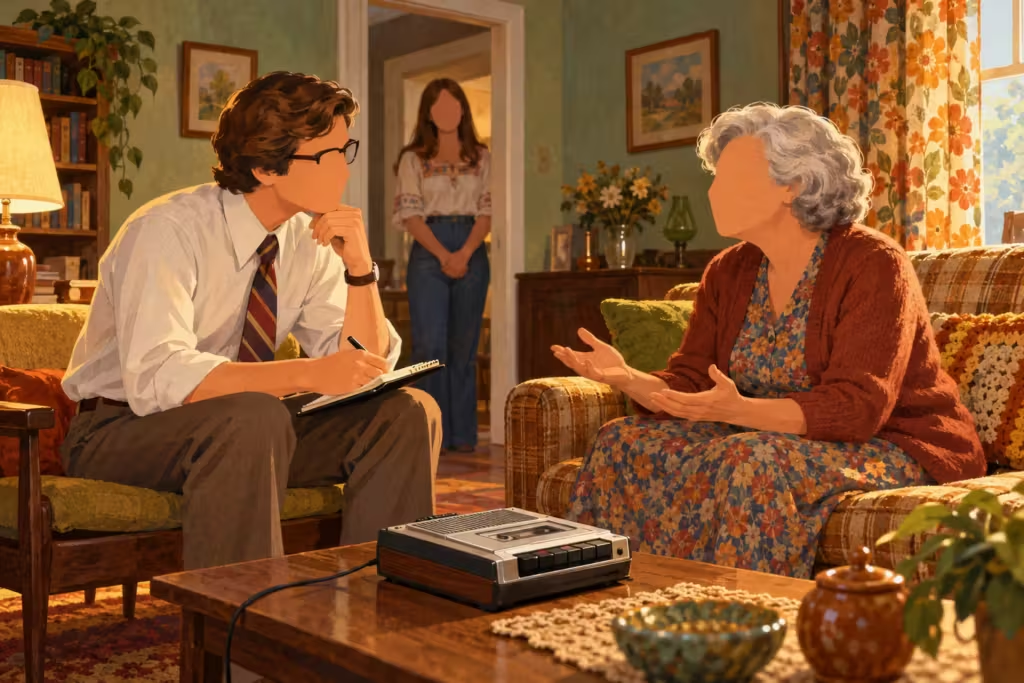
In August 1977, Sabom interviewed Mr. O. Mr. O. was not one of the patients Sabom asked without knowing anything about them. His case reached Sabom because Mr. O. was already telling people about his experience.
Afterwards, Sabom interviewed his wife separately. She told him what happened in the corridor. Sabom also spoke with the daughter who was there that night. The daughter remembered arriving at the hospital with her mother and brother right at the time of the arrest. She remembered it because it was unexpected, the night before his discharge. She did not remember the details, because her father was in hospital several times that year.
Sabom looked for the medical record from that night.
Step 9
After the interviews · Michael Sabom’s account
The part of the medical record for that night cannot be found

Sabom could not find the part of the medical record describing the arrest. It is not known what time it happened or what was done to him.
Mr. O. described how they resuscitated him, with the chest compressions and the needle in his chest. None of this could be compared with any document.
The only thing that confirms his account is what his family remembers.
Step 10
1982 · Michael Sabom’s account
For Sabom, what matters is not what the doctors did, but who was in the corridor
Sabom published the case in 1982. Sabom writes that the most interesting part is that Mr. O. says he saw his family at the end of the corridor. Mr. O. also admits that he could not have seen anyone while he was unconscious.
This case is different from the other five cases Sabom was able to compare in detail. In this case, what is confirmed is not something done in a resuscitation. What is confirmed is who arrived that night unannounced.
What can be checked today about the family Mr. O. says he saw in the corridor?
Where this story comes from
Books
- Michael Sabom, Recollections of Death (Harper & Row, 1982), chapter 7 (case 6)Buy the book
Case documents
- Sabom’s interviews with Mr. O., his wife and his daughter, in his book (1982)
Studies
- Michael Sabom’s study: 116 people and 25 who imagined a resuscitationRead
To understand more
Keep reading

Madrid, 2017
Andrés Sampedro
Andrés Sampedro collapsed while dancing salsa. He says he watched from the ceiling as a nurse he didn’t know gave him CPR. He says that when he woke up he could describe her. The earliest description on record is from an interview six months later.

Barcelona, Spain, 2022
Juan Carlos Madrid
His heart stopped in the ICU. Ten days later he wrote the number 45 on a whiteboard. It was the number of minutes his resuscitation lasted, and he says no one had told him.
United States, 1973
Mr. S.
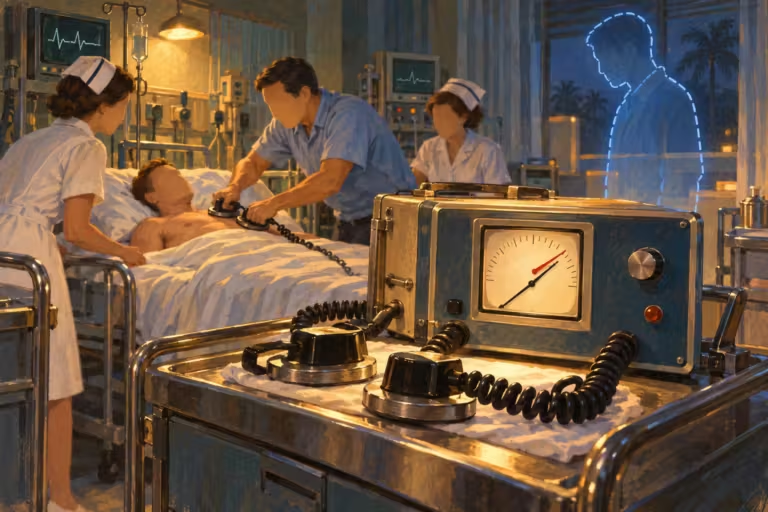
He was resuscitated in the early hours in a coronary care unit. He described how the two needles moved on the defibrillator, the machine that delivers the shocks. The medical record does not say which machine it was.

Reincarnation: The top 5 people who remember past lives
We asked them the same five questions as this story. A 32-page PDF, free in your inbox.
Check your email
We have sent you an email. Open it and press the button to confirm. If you cannot see it, check your spam folder.