A study · The Netherlands, published in 2008
The dentures case: a man in a coma and the nurse who took out his dentures
In 1979, a nurse in Nijmegen took out the dentures of a man in a coma so he could resuscitate him. More than a week later, according to the nurse, the man recognized him and told him where he had put them. In 2008, the researcher Rudolf Smit tracked down the nurse and reconstructed the case. He concluded that the man was in no state to notice, in a normal way, that his dentures were being taken out or where they were put. An anesthesiologist answered him with a medical explanation, and the debate went on until 2010.
The question of the study is: what really happened to the man with the dentures, and could he have known without seeing it? We tell it step by step. If you only want to know what it found, go straight to the results.
Step 1
Before the study · The question
A famous story that nobody had checked

In 2001, the cardiologist Pim van Lommel published a study of 344 resuscitated people in the journal The Lancet. The article also told a story that did not come from any of those patients. A nurse had taken out the dentures of a man in a coma, and the man later knew where he had put them.
The story went around the world. Critics soon asked whether anyone had checked it. The psychologist Christopher French wrote in the same journal that the article did not say whether anyone had tried to confirm it with the patient. And in 2004, the anesthesiologist Gerald Woerlee suggested that the man was partly conscious and heard what was going on.
Nobody yet knew who the nurse was, or exactly where the story came from.
Step 2
2007 · Told by the study
A researcher finds the original papers

Merkawah is the Dutch branch of the International Association for Near-Death Studies. Rudolf Smit edited its magazine. Ruud van Wees was one of the authors of the Lancet article. In the summer of 2007, he handed Smit some folders from Merkawah’s archive.
Among them were the two documents the story came from. The first was a 1991 article by Vincent Meijers, another author of the Lancet article. Meijers wrote it from what a colleague of the nurse had told him. The second was a 12-page interview with the nurse himself. An interviewer from Merkawah did it in February 1994, and it was never published.
The nurse asked for his name not to be given. The articles call him T. G. They call the patient B.
Step 3
Late 1979 · Told by the nurse
What the nurse told
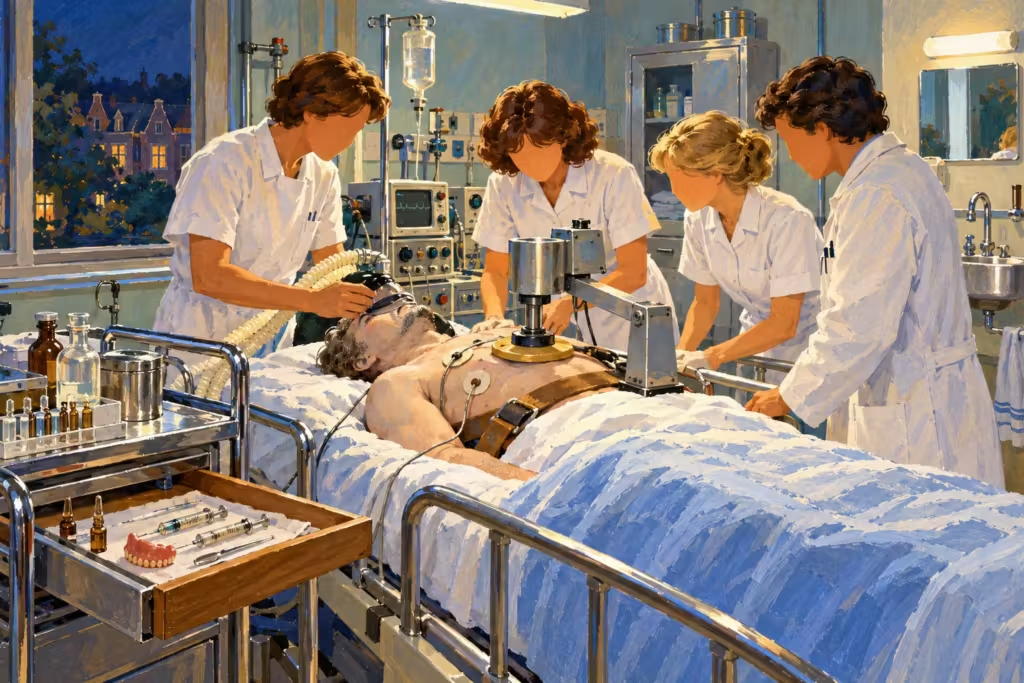
One night, an ambulance brought a 44-year-old man to the coronary care unit of the Canisius hospital in Nijmegen. A coronary care unit is the intensive care area for the heart. Passers-by had found him in a meadow. According to the nurse, he arrived ice-cold, with no pulse, with his eyes closed and with pupils that did not react to light.
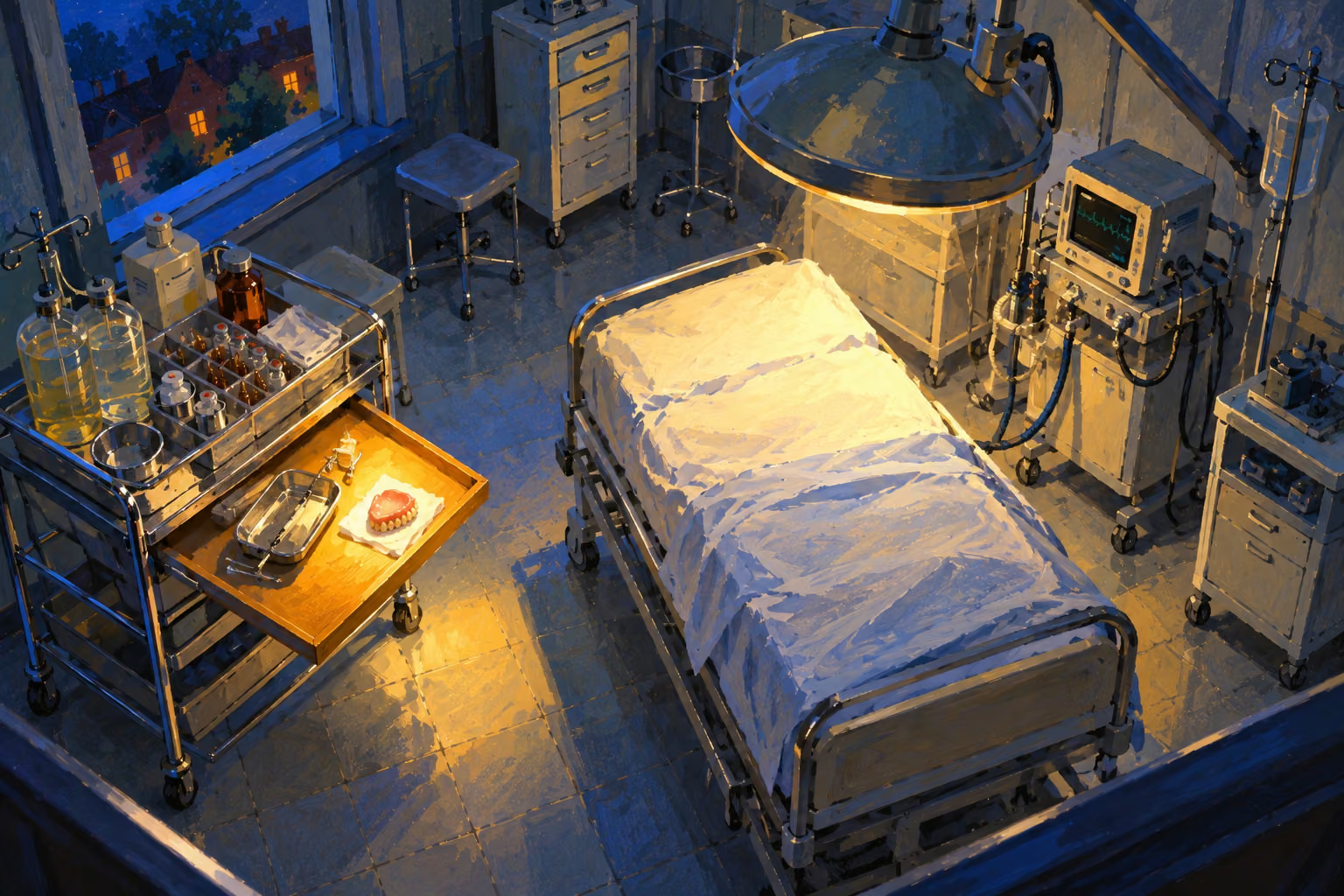
To put in the breathing tube, the nurse took out the man’s upper dentures. He left them on a wooden shelf of the crash cart, which was already pulled out. They resuscitated him with hand compressions, with a machine that pounds the chest and with five electric shocks. Then he was moved to intensive care, still in a coma.
More than a week later, B. had already asked about his dentures, and nobody knew where they were. According to the nurse, when B. saw him, he told him that he was the one who had taken them out and where he had put them. He described the cart, the room and the people resuscitating him as if he had seen them from the ceiling. He also said he felt the pain of the compression machine.
We tell it in full in the story of the man with the dentures.
Step 4
April 2008 · Told by the study
Smit finds the nurse, 29 years later

Smit could not find the nurse. He did find the colleague named in the 1991 article. That colleague told him he had had nothing to do with the case. He had only passed the nurse’s story on to Meijers. He gave Smit the nurse’s phone number.
Smit spoke to the nurse by phone in April 2008. Then Titus Rivas did a long interview with him. According to Smit, the nurse repeated the essentials of what he had told in 1994 and said he remembered it as if it had happened the day before.
The nurse insisted on one point. He took out B.’s dentures as soon as he arrived, before the resuscitation in the room began. To him, it was unthinkable that B. could have noticed in a normal way that his dentures were being taken out. And the cart was unique in the whole hospital. It had been made there, and it was only in that room.
Step 5
2008 · Told by the study
What doesn’t match from one account to another

Smit compared the documents and found differences. He published them himself:
- What B. wanted. In The Lancet, B. was afraid they would stop resuscitating him. In the 1994 interview, he wanted them to stop because it hurt. In 2008, the nurse explained that these were two different moments of the resuscitation.
- How he left the hospital. In The Lancet, B. left healthy four weeks later. In 2008, the nurse said he later saw him from a distance and that he looked very ill with his heart. A few years later he read in the newspaper the death notice of a man from Ooy with the initial B.
- How long the resuscitation lasted. The nurse spoke of three quarters of an hour and of more than an hour. The Lancet says an hour and a half.
Nobody could ask B. As early as 1994, when the nurse was interviewed, Merkawah looked for him and could not find him. Smit believes he died a few years later.
Step 6
2008 · Smit’s conclusion
For Smit, the man could not have seen it in a normal way

Smit concludes that the Lancet story matches well with what the nurse says. For him, B. was not conscious enough to notice in a normal way how his dentures were taken out and where they were put.
Smit admits two limits. The case is too old to check every detail, and there is no interview with the patient. That is why he writes that it cannot be definitive proof that consciousness continues when the body dies. Even so, he believes the nurse’s testimony confirms that something extraordinary happened.
Step 7
2010 · Gerald Woerlee’s response
An anesthesiologist proposes a medical explanation

Gerald Woerlee is an anesthesiologist and a professor at Leiden University. In 2010 he answered Smit in the same journal. He does not dispute what the nurse saw. He disputes what the nurse concludes from it.
For Woerlee, the key is the cold. B. had been lying in a cold meadow for a long time. With the body that cold, the lack of a pulse and pupils that don’t react do not mean that the brain has died. Emergency doctors have a saying for frozen patients: you’re not dead until you’re warm and dead. Cold also protects the brain when it gets little blood.
Woerlee cites cases of patients who regained consciousness during chest compressions. And he points out that the nurse himself said some patients woke up with that machine. According to Woerlee, B. may have been conscious but unable to move. He could not move because his brain was getting little oxygen. For Woerlee, the fact that B. felt the pain of the compressions is a sign that he was conscious.
So B. could have felt his dentures being taken out and heard them being put down on the wood. He could have heard the doctors, and the nurse’s voice, which the nurse himself says is very easy to recognize. And he could have seen the nurse’s face when the nurse opened his eyes to check his pupils. With all of that, Woerlee believes, B. later built a picture of the scene.
Step 8
2010 · Smit and Rivas reply
Smit and Rivas reply: the dentures came out before the machine
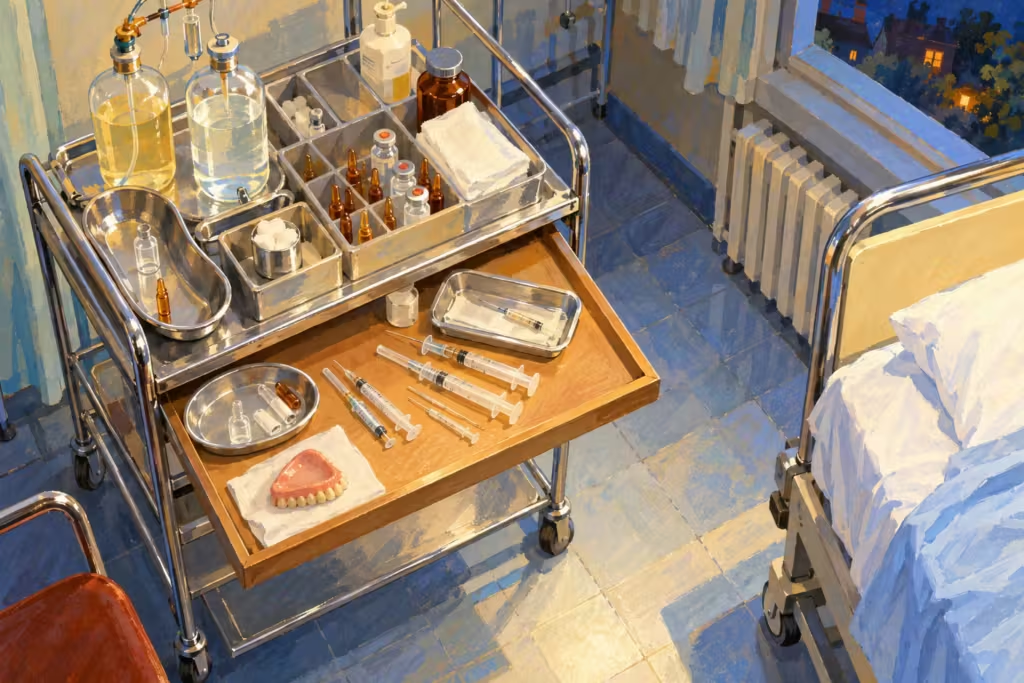
Smit and Rivas replied in the same issue of the journal. They quote a 2008 text in which the nurse answered the ideas Woerlee had published in 2004. The nurse says it took more than five minutes to bring B. up to the coronary care unit, with hardly any resuscitation. In the room, more than a minute went by without compressions and without circulation. And in that time, before the machine was switched on, he took out the dentures.
For Smit and Rivas, B. could not have pictured the cart from the noise alone. The nurse accepts that B. could have heard the bottles. But, according to him, the noise would not have told B. that there was a wooden shelf with his dentures on it. The nurse also accepts that the shelf was the only place where he could put them down with ease. Otherwise he would have had to put them among the bottles, and that is not done.
About the pain, Smit and Rivas admit they have no clear explanation. They offer two. It may have been an imagined pain, triggered by seeing the machine from outside the body. Or it may have been real pain, felt at the same time as B. was watching the scene from above.
Smit and Rivas acknowledge that everything rests on a single witness, and that this does not guarantee the case is solid. In 2019, with Anny Dirven, they published a book of cases that reproduces Rivas’s 2008 interview. In that interview, the nurse told the order the other way around. First they put the machine on, and it may have given some circulation. Then the nurse took out the dentures. The interview came before the written text. In the text against Woerlee, the nurse corrected the order emphatically. According to the book, in the interview he had listed the steps without thinking about their order.
Let’s see what can be known from these data and what can’t.
A case from 1979, first told in 1991
The first written account came 12 years later, and the nurse did not write it.
The nurse told it in person 15 years later and again 29 years later.
| Item | Figure |
|---|---|
| Year it happened | 1979 |
| Age of the patient | 44 |
| Electric shocks during the resuscitation | 5 |
| Years until the first article, by Vincent Meijers | 12 |
| Years until the 1994 interview with the nurse | 15 |
| Years until the 2008 interviews | 29 |
| Interviews with the patient | 0 |
What these figures don’t tell
- How long the resuscitation lasted. The accounts give three quarters of an hour, more than an hour and an hour and a half.
- The exact date. All that is known is that it was in late 1979.
Frequently asked questions
What is the dentures case?
It is a case from the Netherlands, from 1979, that Pim van Lommel published in 2001. A nurse took out the dentures of a man in a coma during resuscitation. According to the nurse, the man recognized him more than a week later and told him where he had put them. Rudolf Smit investigated it in 2008.
Has the dentures case been checked?
Not fully. Everything the patient said is known from the nurse’s memory, told 15 and 29 years later. Nobody interviewed the patient and, according to the researchers, the hospital records were destroyed.
How does Gerald Woerlee explain the dentures case?
Woerlee is an anesthesiologist. He believes the cold protected the patient’s brain and that the chest compressions gave him back some consciousness. According to Woerlee, the patient could not move, but he heard and felt what was going on. The researchers Rudolf Smit and Titus Rivas reply that the dentures came out before the chest compression machine was switched on.
Why did nobody interview the man with the dentures?
When researchers became interested in the story, they could no longer find him. According to Smit, he had probably already died. Years later, the nurse read in the newspaper the death notice of a man from Ooy with the initial B.
Where this page comes from
The study
- Rudolf Smit (2008), “Corroboration of the dentures anecdote involving veridical perception in a near-death experience,” Journal of Near-Death Studies 27(1):47-61Read for free
Assessments and criticism
- Gerald Woerlee (2010), “Response to ‘Corroboration of the dentures anecdote involving veridical perception in a near-death experience’,” Journal of Near-Death Studies 28(4):181-191Read for free
- Rudolf Smit and Titus Rivas (2010), the reply to Woerlee, Journal of Near-Death Studies 28(4):193-205Read for free
- Christopher French (2001), “Dying to know the truth: visions of a dying brain, or false memories?,” The Lancet 358:2010-2011View in the journal (free with registration)
- Titus Rivas, Anny Dirven and Rudolf Smit (2019), The Self Does Not Die, the book of cases that reproduces the 2008 interviewBuy the book
- Greyson and others (2025), the scale of veridical cases, Frontiers in Psychology 16:1661390Read for free
To understand more
- Van Lommel: 344 resuscitated people in ten hospitals, the study that published the caseRead
- The 14 Virginia cases: seeing what could not be knownRead
- Cardiac arrest with cold in the operating roomRead
Our archive
- Our reading of the three articles from 2008 and 2010 and of the chapter on the case in the book by Rivas, Dirven and Smit, checked on October 23, 2026
More studies
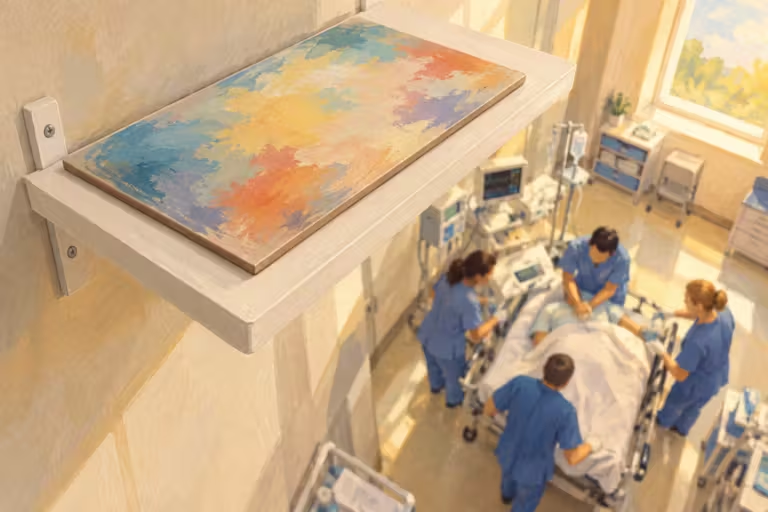
AWARE: the pictures hidden on the shelves
Fifteen hospitals put up pictures that could only be seen from the ceiling, to check whether anyone saw them during a cardiac arrest.
AWARE II: a random picture and the brain on the screen
Above the patient was a tablet with a random picture. Headphones said the names of three fruits. And the doctors measured the brain during resuscitation.

Van Lommel: 344 cardiac arrest survivors in ten hospitals
Ten hospitals asked every cardiac arrest survivor what they remembered. They saw them again after 2 and 8 years.