Two studies · Montreal (Canada), published in 2011, and Rennes (France), published in 2021
Cold circulatory arrest in surgery: 3 memories in Montreal and none in Rennes
In some operations on the aorta, surgeons cool the body and stop the circulation of the blood for a few minutes. Two teams asked these patients whether they had experienced anything. In Montreal, 3 of 33 people said yes, and one said she saw the operating room from outside her body. In Rennes, none of 101 people who had the operation remembered anything.
The question of both studies is: do people whose circulation is stopped in the operating room describe an NDE? The two answers are very different. We tell it step by step. If you only want to know what they found, go straight to the results.
Step 1
Before the studies · The question
In the operating room, it is known when the blood stops
No one knows exactly how long the brain goes without blood when someone has a cardiac arrest on the street or in the hospital. Doctors arrive, resuscitate and write down what they can.
Some operations are different. Surgeons stop the circulation on purpose, at a time that is recorded and for minutes that are measured. Some researchers thought this operation made it possible to study NDEs with more data.
If these patients described an NDE, it would be much clearer what state their body was in at that moment.
Step 2
The operation · According to the studies
To operate on the aorta, they cool the body and stop the circulation
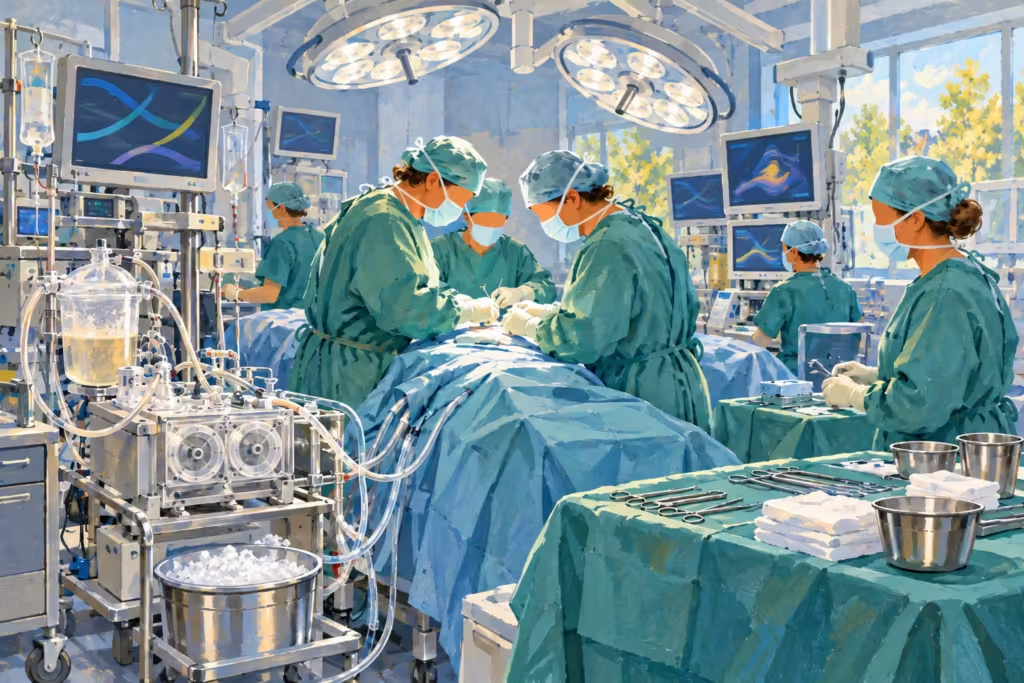
The aorta is the largest artery in the body. It leaves the heart and carries blood to the whole body. When it tears or widens, a section sometimes has to be replaced.
To sew in that section, surgeons need no blood to flow through it. So they connect the patient to a machine that cools their blood until the body is much colder than normal. Then they stop the circulation for a few minutes. In the cold, the brain uses much less and can go longer without blood.
Doctors call it hypothermic circulatory arrest. On this page we call it cold circulatory arrest.
Pam Reynolds was operated on in 1991 with a similar technique, to remove a bulge in an artery in her brain. Her body temperature was lowered to about 15 degrees Celsius.
Step 3
Montreal, 2005 to 2010 · According to the 2011 letter
In Montreal, a questionnaire to 70 patients

Mario Beauregard led the first study. He was a neuroscientist in the psychology department of the University of Montreal. Two researchers from the same university worked with him, along with Philippe Demers, a heart surgeon at Sacré-Coeur Hospital in Montreal.
The team looked for the people who had aortic surgery with cold circulatory arrest at that hospital between 2005 and 2010. Some had had the operation years before. The team sent a questionnaire to 70 of these patients. The letter does not say when it was sent or what it asked. 33 people answered.
The study was funded by the Nour Foundation.
Step 4
On reading the questionnaires · According to the letter
3 of the 33 people say their mind was active

Of the 33 people who answered, 3 said they had conscious mental activity during the operation. That is about 9 in 100. The team interviewed them after receiving the questionnaires.
The letter does not say what two of them experienced. It describes only one case, that of a patient it calls J.S.
Step 5
October 26, 2008 · According to the letter
The only case the letter describes: J.S. says she saw a nurse and some machines from outside her body
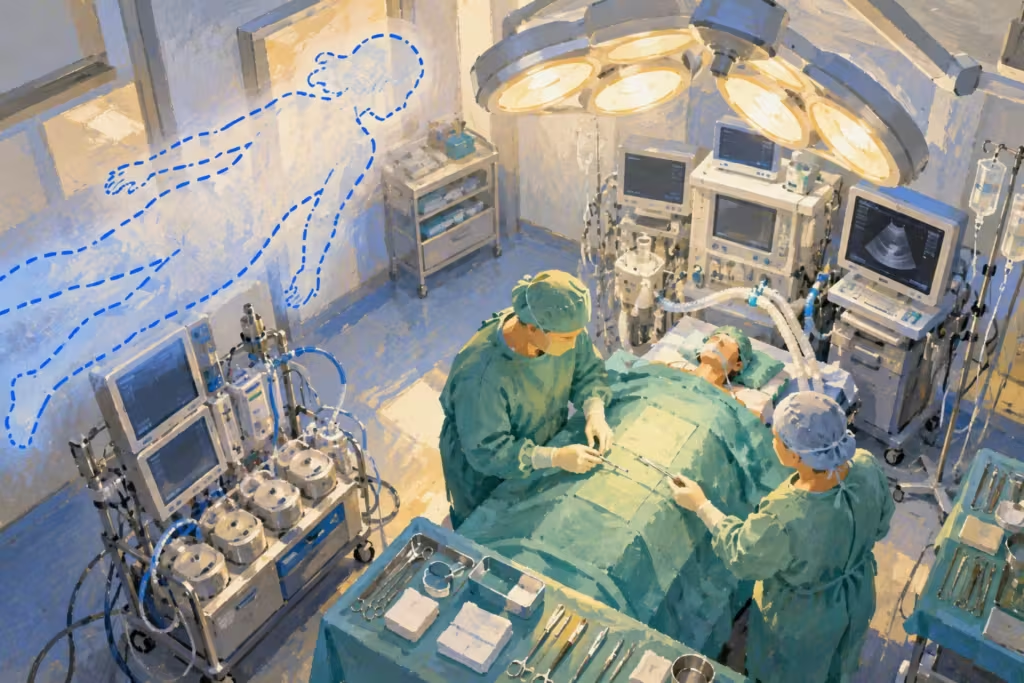
J.S. was 31 years old and 31 weeks pregnant. After an emergency cesarean section, she had surgery on her aorta with cold circulatory arrest, under general anesthesia and with her eyes taped shut. She said that at some point during the operation she left her body. She also said that she saw a nurse and the machines behind her head. According to the letter, the surgeon who operated on her confirmed that this was accurate.
The letter does not publish J.S.’s words or the surgeon’s. The cold circulatory arrest lasted 15 minutes, and the authors themselves acknowledge that it cannot be known whether J.S. experienced this during the arrest itself. We tell the whole story in J.S.’s story.
The study never measured J.S.’s brain activity.
Step 6
Rennes, July 2018 to September 2019 · According to the 2021 study
In Rennes, they ask the patients as they come in

Marion Mauduit led the second study, in the heart surgery department of the university hospital in Rennes, France. Six other doctors from the same department also signed the article.
For just over a year, the team included in the study the patients who had aortic surgery, one after another. There were 101 people. 67 had their operation with cold circulatory arrest. The other 34 had their operation without stopping the circulation, and served for comparison.
The patients knew nothing about the study before their operation. The team explained it to them afterward, and all of them agreed to take part. The article does not say how many patients were left out for being too ill.
Step 7
During the operation · According to the study
An arrest of about 27 minutes, at about 24 degrees, under anesthesia

In the 67 operations with arrest, the body was cooled to 23.7 degrees Celsius on average. The circulation was stopped for about 27 minutes on average, though some operations took much less time than others. During the arrest, the patient’s head was packed in ice.
In 21 of those operations, the surgeons kept sending some blood to the brain through a separate tube. In the other 46, the brain received no blood during the arrest.
All patients were under general anesthesia. Before the circulation was stopped, those who were going to have the arrest also received 1,000 milligrams of thiopental, another anesthetic. No anesthetic was given during the arrest.
The operation lasted about 5 hours. Afterward, the patients stayed asleep in the ICU for at least 3 more hours. In total, general anesthesia lasted about 14 hours on average.
Step 8
4 to 9 days later · According to the study
A 15-minute interview on the ward

Once the patient was stable and on the ward, the same doctor always did an interview of about 15 minutes. It took place 4 to 9 days after the operation.
First the doctor asked whether the patient remembered anything from the time they were unconscious, and what. Then the doctor gave them the scale of Bruce Greyson, an American psychiatrist. It has 16 questions, and each thing experienced adds points, for example peace, a light, seeing a relative who had died or leaving the body. With 7 points or more, it counts as an NDE.
Step 9
When the interviews were done · According to the study
None of the 101 people remembers anything

None of the 101 people remembered anything from the time they were unconscious. Neither the 67 who had the cold circulatory arrest nor the 34 who did not remembered anything.
So no one reached 7 points on the scale. In this study there was no NDE.
The authors expected to find some. Between 6 and 12 in 100 people who survive a cardiac arrest describe an NDE, according to other studies. According to the authors, 67 people were enough to find some cases.
Step 10
2021 · According to the study
The authors look for why no one remembers anything

The article was published in 2021 in AORTA, a journal of aortic surgery. The authors suggest several reasons for the result:
- Anesthesia. Anesthetics can make people forget what they experienced, or prevent an NDE from happening.
- The hours without consciousness. There were about 14 on average, because anesthesia lasts so long in this operation.
- The time until the interview. Several days went by, although the authors point out that in another study NDEs were not forgotten over the years.
- The cold. The cold, and whether or not blood reached the brain, may have changed its activity. They did not measure it, so they do not know what state it was in. They also point out that the brain may not need to be shut down for an NDE to happen.
The authors conclude that it is still unknown whether cold circulatory arrest triggers NDEs.
From 70 questionnaires and 101 patients to 3 memories
The two studies asked small groups, in very different ways.
So their figures can’t simply be compared.
| Group | People |
|---|---|
| Montreal: received the questionnaire | 70 |
| Montreal: answered it | 33 |
| Montreal: remembered something of the operation | 3 |
| Rennes: patients in the study | 101 |
| Rennes: operated on with cold circulatory arrest | 67 |
| Rennes: remembered something of the operation | 0 |
What these figures don’t tell you
- Montreal asked only once, in writing. The letter does not say when the questionnaire arrived or what it asked.
- Rennes does not say how many patients were left out for being too ill for the interview.
- Neither study measured the brain. More on what is known about the brain at death in the gamma wave study.
Frequently asked questions
Do people who have surgery with their circulation stopped and their body cooled have near-death experiences?
There are two studies and they don’t agree. In Montreal, 3 of 33 patients who answered a questionnaire remembered something of the operation. In Rennes, none of 101 patients remembered anything. It’s all in “What the two studies found.”
What did patient J.S. in Mario Beauregard’s study see?
J.S. said that during her aortic surgery in 2008 she left her body. She saw a nurse passing instruments to the surgeon and the machines behind her head. According to Beauregard’s letter, the surgeon confirmed it was accurate. It is not known whether she experienced it during the 15 minutes when her circulation was stopped.
Why did no one remember anything in the Rennes study?
It is not known. According to the authors of the Rennes study, in France, the deep anesthesia and the nearly 14 hours without consciousness may have erased the memories. The fact that the interview took place several days later may also have played a part.
Is it the same operation as Pam Reynolds’?
It is similar. Pam Reynolds’ body was cooled to about 15 degrees Celsius and her heart was stopped to operate on an artery in her brain. In the Rennes study, the body was cooled to about 24 degrees on average to operate on the aorta. Her story is in “Pam Reynolds’ near-death experience.”
Where this page comes from
The studies
- Mario Beauregard, Évelyne Landry St-Pierre, Gabrielle Rayburn and Philippe Demers (2011), “Conscious mental activity during a deep hypothermic cardiocirculatory arrest?,” Resuscitation 83(1):e19Read for free
- Marion Mauduit et al. (2021), “Does Hypothermic Circulatory Arrest for Aortic Surgery Trigger Near-Death Experience?,” AORTA 9(2):76-82Read for free
Assessments
- The editor’s commentary in AORTA, published with Mauduit’s article (2021)Read for free
To understand more
- 52 cardiac arrests induced on purpose, a hidden screen and no near-death experienceRead
- Pam Reynolds’ near-death experienceRead
- Gamma waves in the dying brainRead
- How many people have an NDE?Read
Our archive
- Our full reading of Beauregard’s letter and Mauduit’s article, checked on October 22, 2026
More studies

AWARE: the pictures hidden on the shelves
Fifteen hospitals put up pictures that could only be seen from the ceiling, to check whether anyone saw them during a cardiac arrest.
AWARE II: a random picture and the brain on the screen
Above the patient was a tablet with a random picture. Headphones said the names of three fruits. And the doctors measured the brain during resuscitation.

Van Lommel: 344 cardiac arrest survivors in ten hospitals
Ten hospitals asked every cardiac arrest survivor what they remembered. They saw them again after 2 and 8 years.