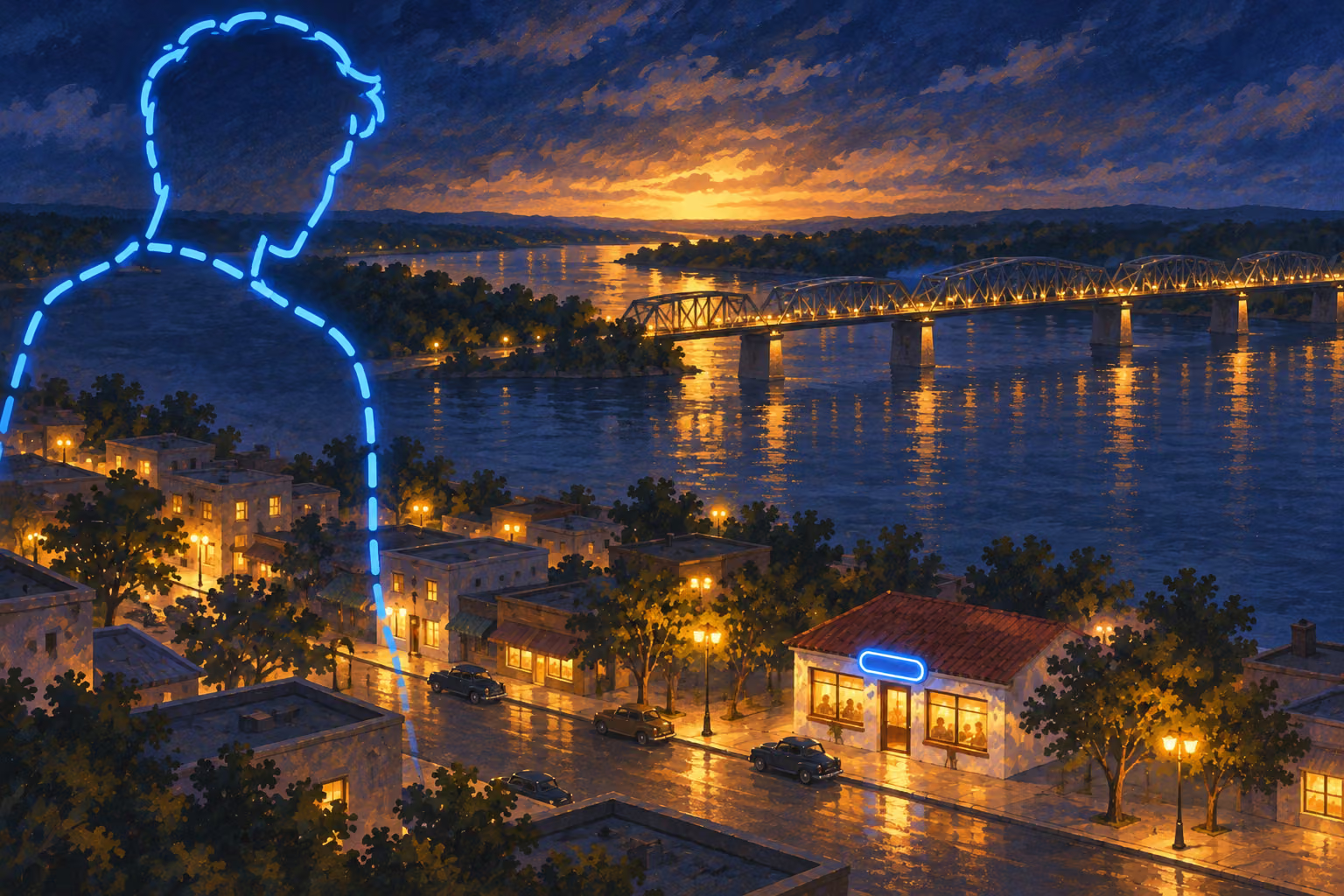
A real-life story · Camp Barkeley, Texas, United States, 1943
George Ritchie’s near-death experience
In December 1943, George Ritchie, a 20-year-old soldier, collapsed with pneumonia in an army hospital in Texas. The medical officer on duty pronounced him dead twice, and he was revived with a shot of adrenaline into the heart. He later said he had left his body and flown to a city by a river. And he said that afterward he met a light that, for him, was Christ.
It is a well-known near-death experience. Raymond Moody, the author who made these experiences widely known in the 1970s, heard it in 1965, when he was a philosophy student. Years later he dedicated his book “Life After Life” to George. The story has one detail that can be checked. George says that on that night he saw a cafe in a city he didn’t know. Months later he recognized it in Vicksburg, on the Mississippi River. We tell it step by step and then look at what can be checked. If you only want the evidence, skip straight to what can be checked. Did George really see that cafe?
Step 1
December 1943 · Camp Barkeley, near Abilene, Texas · George’s account
A 20-year-old soldier waits for the train that will take him to medical school
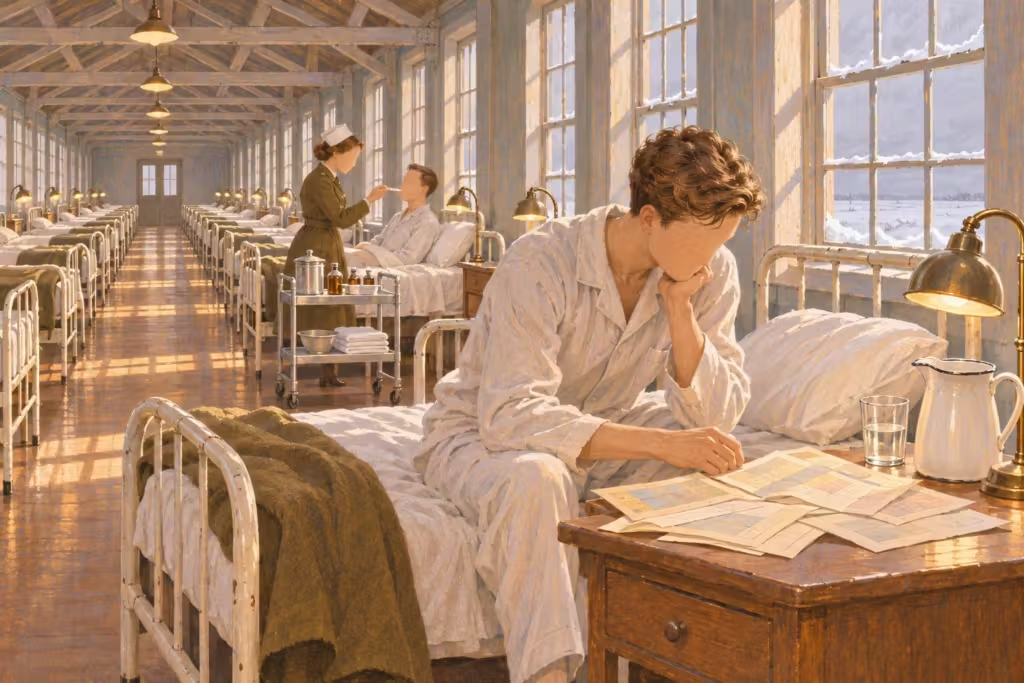
George Ritchie was from Richmond, Virginia. He had finished premed at 19 and had enlisted in the army. He was doing his basic training at Camp Barkeley, an army camp in the desert of West Texas.
At the end of November he got news he didn’t expect. The army needed doctors and was sending him to medical school in his hometown. Classes started on December 22 at the Medical College of Virginia. If he didn’t get there in time, his place would go to another soldier.
In early December he caught a cold and was admitted to the camp hospital. His fever went up and down. On December 19 he was finally moved to the recovery ward. A jeep was going to pick him up in the small hours of that night to take him to the station.
That night his fever came back.
Step 2
Early morning, December 20, 1943 · In the camp hospital · George’s account
George coughs up blood, has a fever of 106.5°F and collapses at the X-ray machine
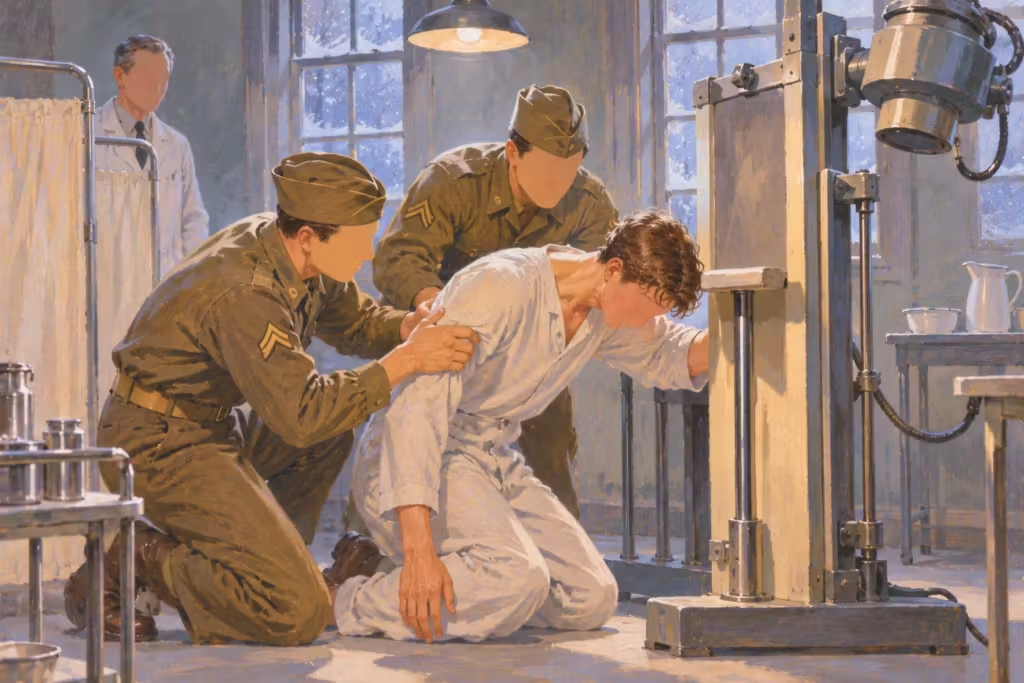
George didn’t want anyone to find out about the fever, and he took some aspirin. Around three in the morning he got up to get dressed. His legs were shaking, and the cup he had been spitting into was full of blood. He asked the orderly for a thermometer. It read 106.5 degrees Fahrenheit, more than 41 degrees Celsius.
The orderly told the nurse, and the nurse told the doctor. They took him by ambulance for a chest X-ray. The technician asked him to stand in front of the machine for a moment.
George heard the machine hum. His knees buckled and he fell to the floor.
The next thing he remembers is a room he didn’t know.
Step 3
After he collapsed · In a small room in the hospital · George’s account
George says he gets out of bed and sees someone else lying in it
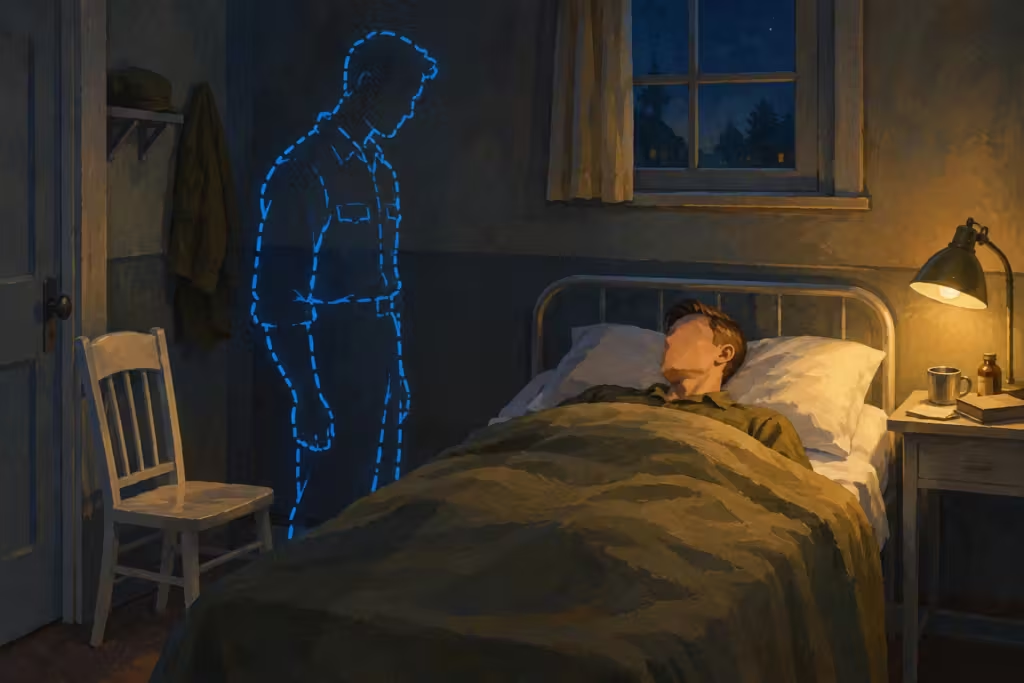
George says he woke up in a small room and jumped out of bed. He thought he was going to miss his train. He looked for his uniform and couldn’t find it. When he turned around, he saw someone lying in the bed he had just gotten out of. It was a young man, lying very still. Later George would notice that the man was wearing his college fraternity ring.
He went out into the hallway. A sergeant was coming toward him carrying a tray. George spoke to him, and then shouted at him to get out of the way. The sergeant kept walking as if he didn’t see him, and George never knew how they missed each other.
George went out the door of the building. He says that all of a sudden he was flying at top speed over the desert scrub, heading east. He wanted to get to Richmond.
Sleeping towns passed by below him.
Step 4
During his experience · In a city by a large river · George’s account
George says he stops in a city by a river and sees an open cafe
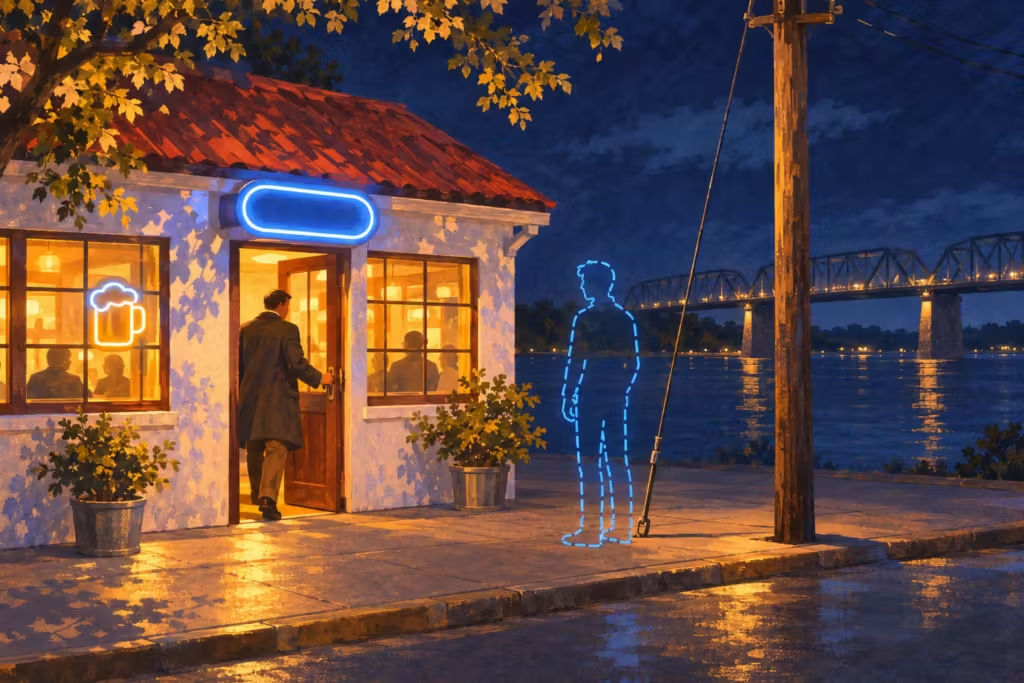
George says he crossed a very wide river with a long, high bridge, and saw a city on the other bank. He wanted to ask someone whether he was heading the right way for Richmond, so he came down. On a corner there was an all-night cafe. In the book he published in 1978, he describes a one-story building with a red roof. Over the door, the word “Cafe” glowed in blue neon. In the window there was a sign for Pabst Blue Ribbon beer.
A man of about forty was coming down the sidewalk, wearing an overcoat and no hat. George asked him what city this was. The man didn’t answer and went into the cafe. George tried to touch his shoulder, and his hand touched nothing. He leaned against the guy wire that held up a telephone pole, and his body passed right through it.
The first time he told it himself, in a magazine in 1963, he gave fewer details. He said only that he stopped by a telephone pole in a town by a large river, and that his hand passed through the wire.
George thought about the young man in the bed. He understood that no one could see or hear him, and that the body had to be his own.
He decided to go back and find it.
Step 5
During his experience · Back at the hospital · George’s account
George finds his body under a sheet, and the room fills with light
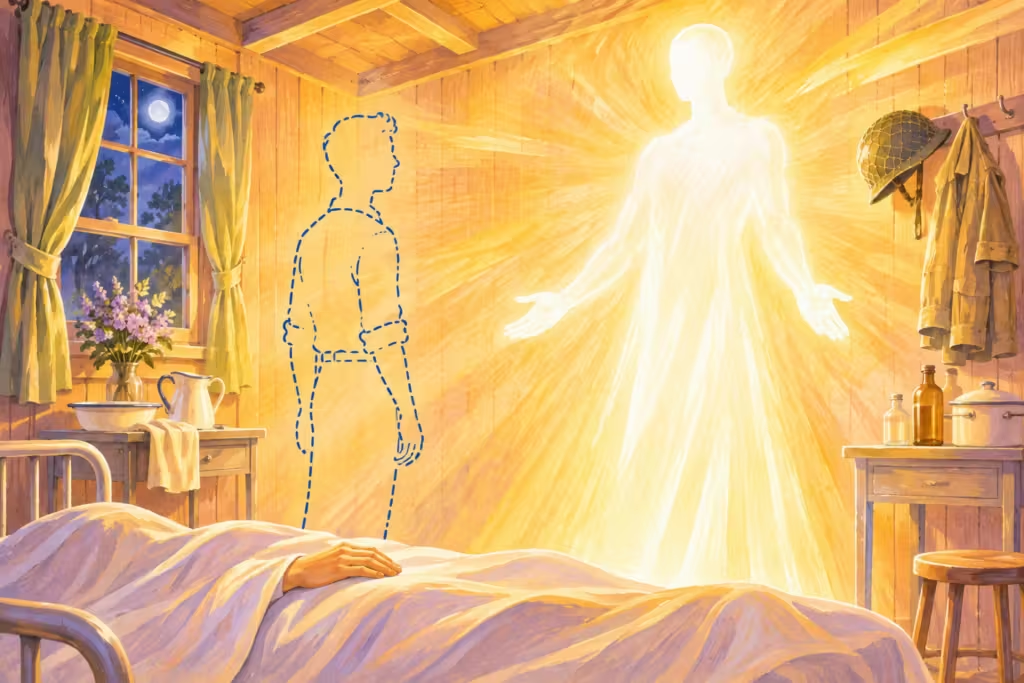
George says he was back at the hospital in an instant. He didn’t know which ward his body was in, and he searched for it room by room. He looked at the left hands of the sleeping soldiers to see whether any of them was wearing his ring. In the end he found it in a small room. A sheet covered the body’s face, and the ring was on its hand.
Then the room filled with a light brighter than all the light bulbs in the world. George says it wasn’t a light but a man made of light, and that he knew he was in the presence of the Son of God. He felt that this being loved him without conditions.
At the same time, he saw his whole life, every moment of his twenty years. And a question came to him: “What did you do with your life?” George understood that it wasn’t asking about his achievements. It was asking how much he had loved other people.
After that, he says, the light showed him other worlds.
Step 6
During his experience · George’s account
George says he sees people trapped on earth, great libraries, and a city of light
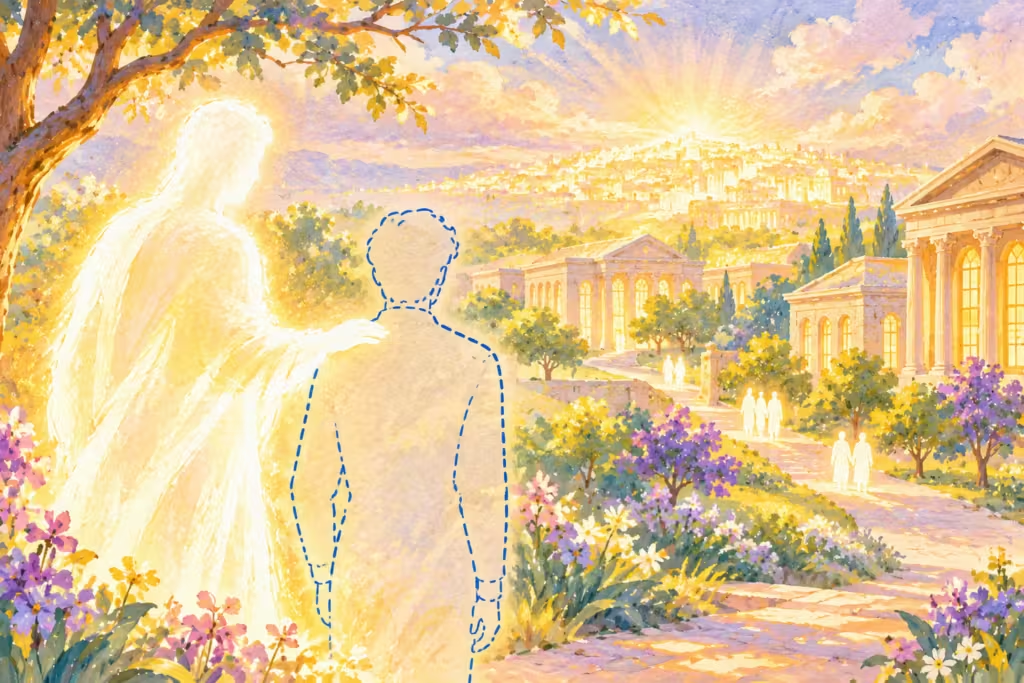
George says the light took him to see three worlds. In the first, people who had died were still tied to what had mattered to them in life. He saw businessmen trying to get their colleagues to pay attention to them. He saw a mother following her grown son around, giving him advice. No one heard them. George says they were the saddest faces he had ever seen.
The second world was very different. There were universities, great libraries, and laboratories, and the people there were searching for the truth.
He saw the third only for a moment. Far away, he saw a city made of light, with streets and houses that shone, and beings as bright as the one beside him. In an instant, the walls of the small room closed in around him again.
Meanwhile, in that room, the orderly was making his rounds.
Step 7
Between December 20 and 22, according to the accounts · In the small room · Told by George and by nurse Retta Irvine
The doctor pronounces him dead twice, and he gets a shot of adrenaline into the heart
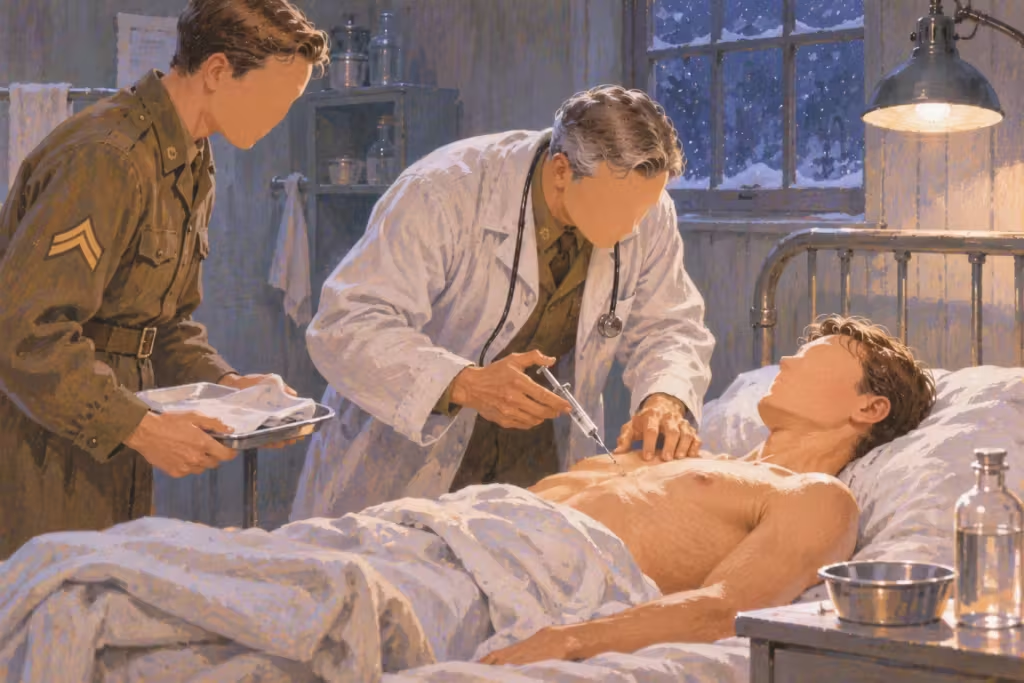
George didn’t see this part. He was told about it later. In his 1978 book he says it happened early in the morning of December 21, a day after he collapsed. In other accounts he gives other dates. The ward orderly came by the room with the medicines and couldn’t find a pulse or any breathing. He called the medical officer on duty. The doctor examined him, pronounced him dead, and told the orderly to prepare him for the morgue.
A few minutes later, the orderly came back to the room. He thought the body had moved, and he went to get the doctor again. The doctor examined him again and once more pronounced him dead. The orderly asked him to give George a shot of adrenaline into the heart. The doctor gave it, and George’s heart started beating again.
George says the doctor told him that about nine minutes had passed since he first pronounced him dead. The nurse in charge of his case, Retta Irvine, described what happened in a notarized statement some fourteen years later. She says she remembers that the medical officer on duty pronounced him dead twice and that he revived after the shot into the heart.
George didn’t wake up until Christmas Eve.
Step 8
December 24, 1943, to January 1944 · In the hospital · George’s account
George wakes up on Christmas Eve and can’t put what he lived through into words
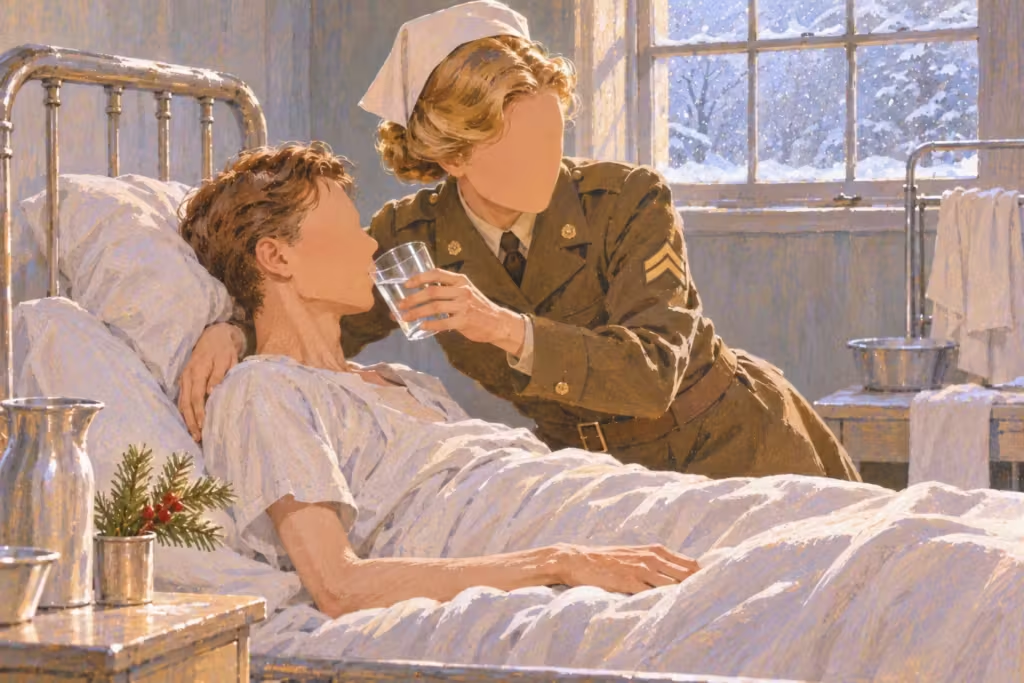
George opened his eyes with a terrible headache. A nurse told him it was Christmas Eve and that he had very nearly not made it. She was Lieutenant Retta Irvine, the nurse in charge of his case. George tried to tell her what he had lived through, but he couldn’t find the words, and even breathing was hard for him.
He had pneumonia in both lungs. He spent weeks in the hospital and lost a lot of weight. The medical school held his place for him, and in January 1944 he was discharged and took the train to Richmond.
Almost no one wanted to listen to him. His stepmother did. George says that one night he told her about his flight toward Richmond.
That year, things didn’t go well for him at medical school.
Step 9
October 1944 · Vicksburg, Mississippi · George’s account
Passing through Vicksburg, George says he recognizes the cafe
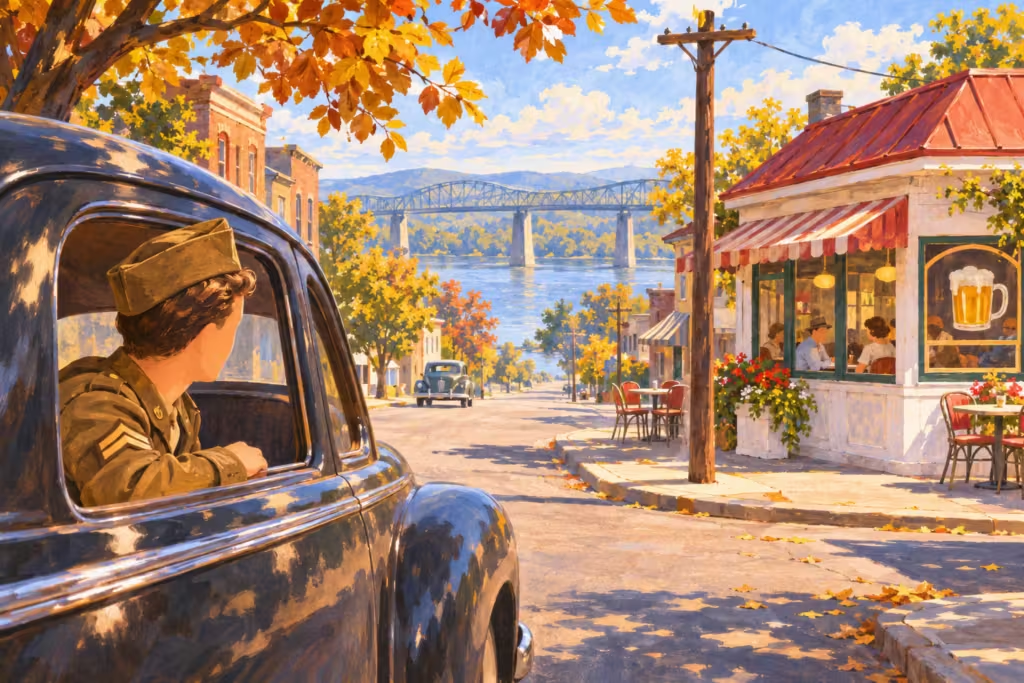
The medical school dropped him, and the army sent him back to Texas. He was traveling by car with three other students who had left medical school. They were driving down along the Mississippi River to cross it on the bridge at Vicksburg. It is a city in the state of Mississippi, and George says he had never set foot there.
George says that as they drove into the city, everything felt familiar. He knew how the streets would cross before he saw them. He asked the driver not to turn toward the bridge and to keep going straight. On a corner, a white, one-story wooden cafe came into view. It had a red roof and the Pabst sign in the window. George recognized the sidewalk, the telephone pole, and the wire.
On a map, George drew a line from Abilene, the city next to the camp. Vicksburg was in a straight line to the east. He told his companions nothing. In a second book, from 1991, he tells it differently. There he says they reached Vicksburg at night and that he recognized the cafe the next morning.
It took George years to tell his story in public.
Step 10
1957 to 2007 · Told by his books and by people who knew him
George becomes a psychiatrist, and his story reaches Raymond Moody

After the war, George finished medical school. He was a family doctor in Richmond for many years and later trained as a psychiatrist at the University of Virginia. He devoted much of his life to working with young people.
His story was first published in 1957, told by the writer Catherine Marshall in a book. Marshall doesn’t give George’s last name and tells of no journey outside the hospital. She writes that George did not yet feel free to tell all of it. In 1963, George told it in his own words in Guideposts magazine. In 1965, Raymond Moody heard it. Moody later gathered hundreds of similar accounts and dedicated his 1975 book to George.
In 1978, George published the book “Return from Tomorrow” with the writer Elizabeth Sherrill. Its Spanish edition is titled “Regreso del futuro.” It is the fullest account, and the first one we have found that mentions the cafe. He died in 2007, in Virginia.
One question remains: did George really see that cafe in Vicksburg?
How many people have an NDE?
George Ritchie is not a one-off. For more than thirty years, several teams of doctors have asked people who survive a cardiac arrest what they remember. They do it in the hospital, a few days afterward.
Picture 100 of those people:
Each dot is a person. The 18 filled-in dots are the ones who described a near-death experience. That is what the largest study found. It was done in the Netherlands in 2001, with 344 people.
The other 82 didn’t describe one. Many remember nothing of their cardiac arrest.
| Where and when | People interviewed | Described an NDE |
|---|---|---|
| England, 2001 | 63 | 6% |
| Netherlands, 2001 | 344 | 18% |
| United States, 2002 | 30 | 23% |
| United States, 2003 | 116 | 10% |
| United Kingdom, United States, and Austria, 2014 | 101 | 9% |
| Vienna, Austria, 2023 | 126 | 4% |
| United States and United Kingdom, 2023 | 28 | 21% |
What these figures don’t tell you
- Only some people are asked. In the 2014 study, 330 people survived, but only 140 could be interviewed, and 101 reached the second interview. The rest died later, were too ill, or didn’t respond.
- Most cardiac arrests are never counted. These studies run in a few hospitals for a limited time. Outside them, no one keeps track. Also, the 2003 study interviewed 1,595 cardiology patients, not just the 116 with cardiac arrest in the table, and 81 of them described an NDE from an earlier occasion. The study did not count them, because it only counted those from that hospital stay.
- Some people keep quiet. In the accounts in our archive, at least 13 people say they kept their experience to themselves for a while. They kept quiet because they weren’t believed or because they were afraid of how others would react.
- It depends on how you count. If you count any memory of the cardiac arrest, the numbers go up. If you use a strict scale, they go down. In England in 2001, 7 of 63 people remembered something. But on the scale, only the memories of 4 people qualified as an NDE.
That’s why no one knows the real figure. But every study shows that it isn’t rare. Between 4 and 23 of every 100 survivors who are asked describe an NDE. George Ritchie’s case stands out for another reason. It was one of the first to be told in public, and it led Raymond Moody to study these experiences.
Frequently asked questions
Who was George Ritchie?
George Ritchie was a doctor and psychiatrist from Virginia, in the United States. He was born in 1923 and died in 2007. In December 1943 he was a 20-year-old soldier. He was pronounced dead in an army hospital in Texas and revived with a shot of adrenaline into the heart. He told the story of his experience in two books, “Return from Tomorrow,” from 1978, and “My Life After Dying,” from 1991.
What is the connection between George Ritchie and Raymond Moody?
Raymond Moody heard George Ritchie describe his experience in 1965, when Moody was a philosophy student. Years later he began collecting similar accounts, and in 1975 he published “Life After Life,” dedicated to Ritchie. Moody also wrote the foreword to Ritchie’s 1978 book. Read about Moody’s book here.
Was George Ritchie dead for nine minutes?
That is what he says the doctor told him. Nurse Retta Irvine said in a notarized statement that the medical officer on duty pronounced him dead twice. She says he revived after a shot into the heart, but she gives no minutes. His medical records have not been published. Here we explain what can be checked.
Did the Vicksburg cafe that George Ritchie saw really exist?
In 1944 there was a restaurant on Levee Street, by the river in Vicksburg, that broadly matches what George describes. The researchers Robert and Suzanne Mays found it. It doesn’t match in every detail, and George only described it in detail after he had seen it in 1944. Here we explain it.
Where this story comes from
His books
- George G. Ritchie and Elizabeth Sherrill, Return from Tomorrow (1978). Foreword by Raymond MoodyBuy the book
- George G. Ritchie and Elizabeth Sherrill, Regreso del futuro, the Spanish edition of Return from Tomorrow (1978)Buy the book
- George G. Ritchie, My Life After Dying (1991). Foreword by Ian Stevenson. It includes the doctor’s and the nurse’s statements. Available to borrow on Internet ArchiveView
The earliest accounts
- Catherine Marshall, To Live Again (1957), chapter “Is There Life after Death?” Available to borrow on Internet ArchiveView
- George C. Ritchie, “Return From Tomorrow,” Guideposts magazine, June 1963. Reprinted in John Myers, Voices from the Edge of Eternity (1968). Available to borrow on Internet ArchiveView
The search for the cafe
- Robert G. Mays and Suzanne B. Mays, “Investigation of George Ritchie’s NDE OBE” (2008–2010), with the Vicksburg phone directories, property records, and floor plansRead for free
Learn more
- Raymond Moody, “Life After Life” (1975)Read
- What is a near-death experience?Read
- What does science say about near-death experiences?Read
- How we check each storyRead
Our archive
- Our reading of his two books, of Catherine Marshall’s 1957 account, of the 1963 Guideposts account, and of the Mays’ investigation, plus the case’s score on our five criteria, as of November 6, 2026
Keep reading
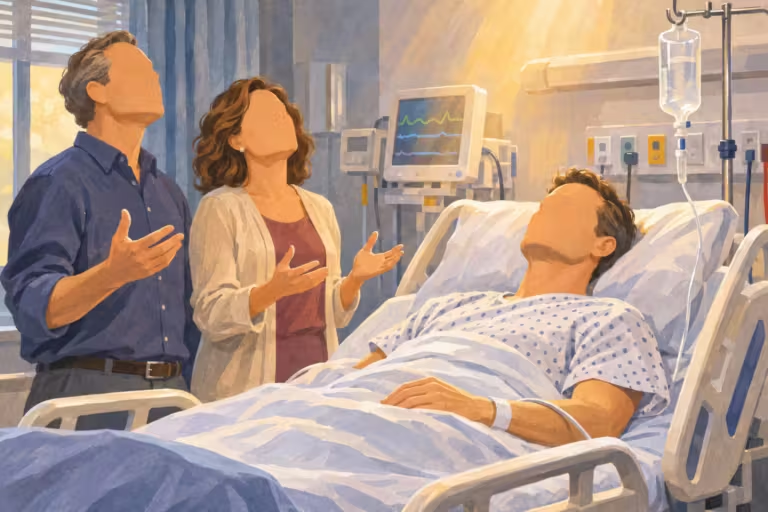
San Diego, 2004 or 2005
Randy Kay
Randy Kay, a medical-company executive in San Diego, was hospitalized with blood clots in his lungs and caught a very serious infection in the hospital. He said his heart stopped, that he met Jesus, and that when he came back he heard beside him the same song he had heard with Jesus.
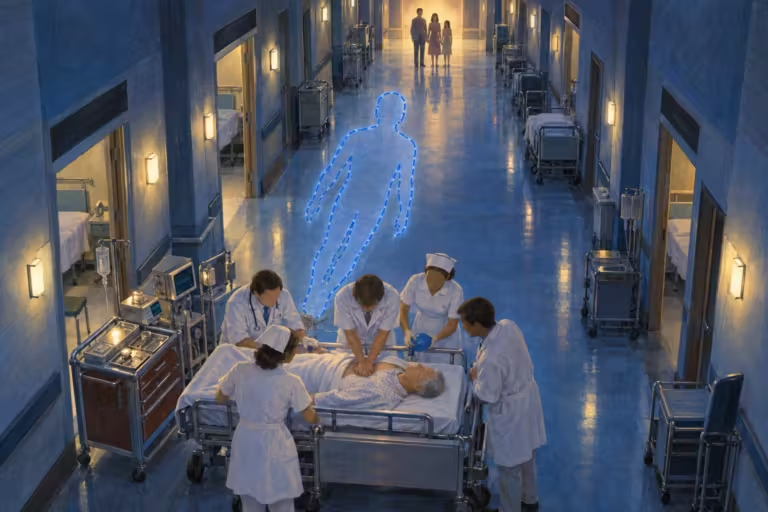
United States, 1976
Mr. O.
He was resuscitated in the hospital corridor. He said he saw his wife and two of his children at the far end. They had come unannounced, and a nurse stopped them a long way off.
Asturias, Spain, 2005
María Teresa Álvarez Aramendía
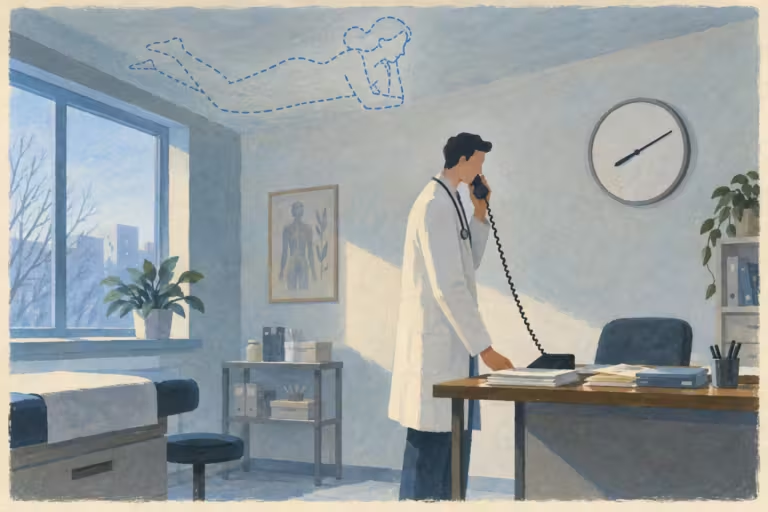
She says that while she was in a coma she saw her doctor call another doctor from the health center at 8:10. According to her, months later he told her that he had made that call.
Reincarnation: The top 5 people who remember past lives
We asked them the same five questions as this story. A 32-page PDF, free in your inbox.
Check your email
We have sent you an email. Open it and press the button to confirm. If you cannot see it, check your spam folder.