A real-life story · Asturias (Spain), 2005
María Teresa Álvarez Aramendía’s near-death experience
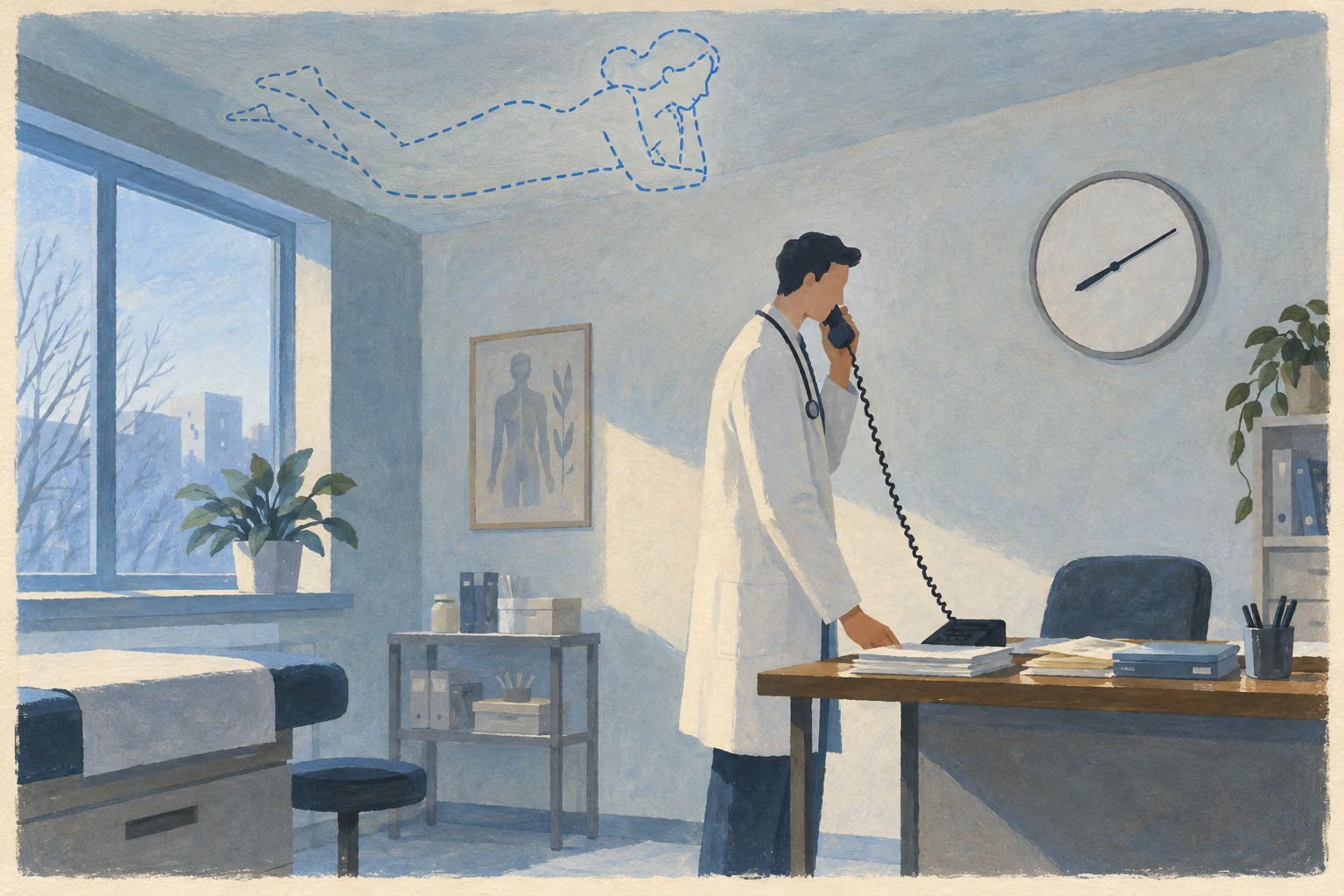
María Teresa Álvarez Aramendía says she spent about two weeks in a coma in December 2005, in Asturias. A back injury had become much worse. She later said she saw herself from the ceiling while her family doctor was holding her hand. She also said she saw that doctor make a phone call from the health center at 8:10. María Teresa says that months later the doctor told her he had made that call.
What sets this story apart is who confirms it. According to María Teresa, it is confirmed by her family doctor, someone outside the family. When he heard her, the doctor burst into tears and said, “There’s no way you could know this” (translated from Spanish). How did María Teresa know about a call made somewhere else?
Step 1
Before · María Teresa’s account
An accountant who never felt at home

María Teresa lives in Asturias. She is an accountant. “I’m a numbers person,” she says.
Since childhood she has felt that she doesn’t fit in: “I don’t know why I’m here. I can’t relate to these people.” From the age of 10 she reads books about India, Buddhism, and reincarnation. They have to be ordered from Argentina and take two months to arrive.
She is Catholic. She says she prays every night because she wants to leave this place. At the same time, she is terrified of death. She believes that when you die, everything ends.
Two years before the events she is about to describe, her adopted son, Alex, died. He had come from Colombia already ill. María Teresa says she felt as if her insides were being torn out.
Step 2
October 17 to early December 2005 · Conscious · María Teresa’s account
A back strain that keeps getting worse
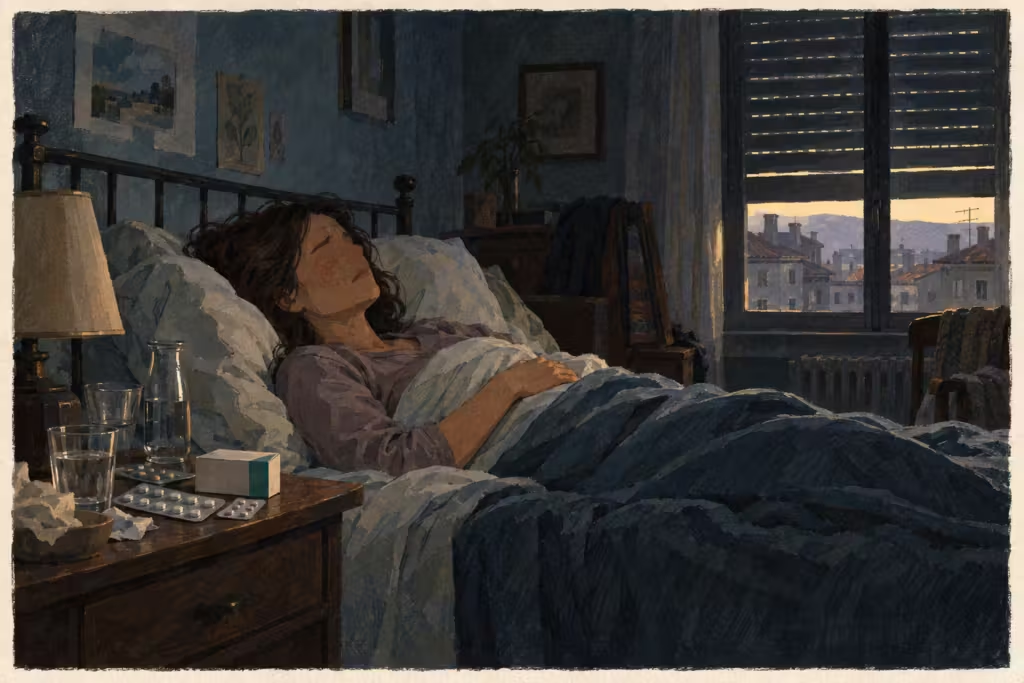
On October 17 she leaves for work like any other day and strains her back. She has had a lower-back injury for years. She is prescribed rest, corticosteroids, and a painkiller called tramadol. She doesn’t improve. Instead, she gets much worse. She loses all feeling on her right side.
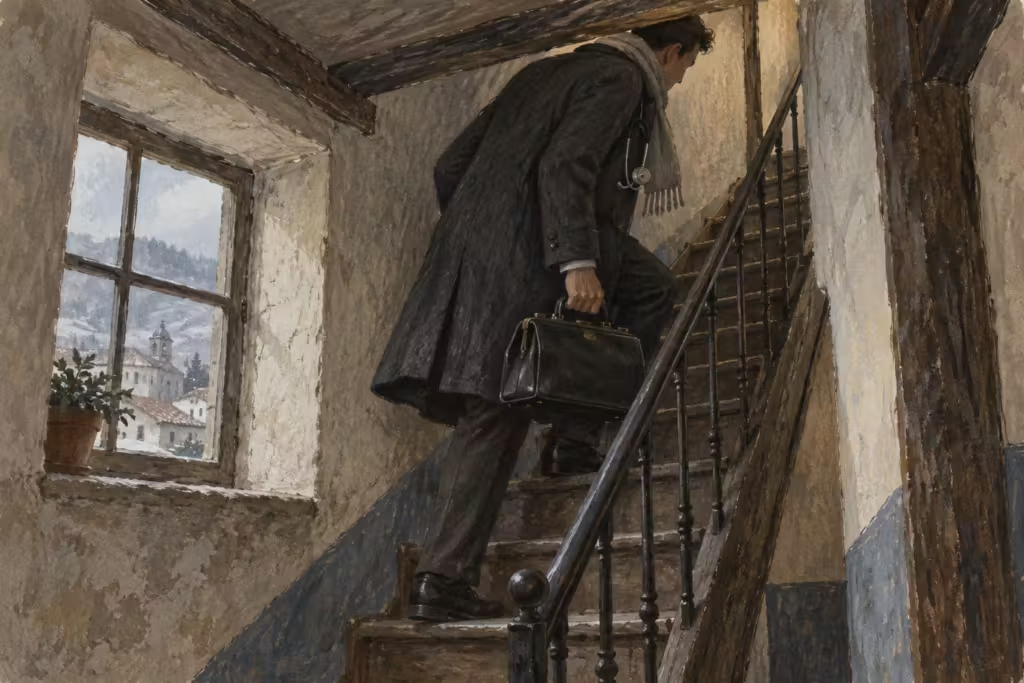
She lives on a fifth floor, “which was really like a seventh.” The staircase is so narrow that the dead were carried down in a chair. Her family doctor, Enrique, consults a neurologist in Oviedo. They fear she could end up in a wheelchair for good if she is carried down in a chair. So she stays home.
Since she isn’t improving, she is given a fentanyl patch. It is a very strong painkiller. She still remembers that the box was white and green. María Teresa says she was allergic to fentanyl and nobody knew. Her bladder stops working.
For more than a month she lies with the blinds down and her eyes closed. But she says she was fully conscious.
Step 3
December 6, 2005 · Public holiday · María Teresa’s account
The day everyone says goodbye to her
December 6 is a public holiday in Spain. It is Constitution Day. That day everyone says goodbye to her. She can’t breathe. Her chest is heaving. She feels her body shutting down, little by little.
Enrique isn’t working that day. The day before, he saw her in very bad shape, and he decides to go to her home: “If I wait until tomorrow, I probably won’t see her alive.”
Enrique has been her family doctor for a very long time. He sits down by the bed and takes her left hand.
Step 4
December 6 · In a coma, she says · María Teresa’s account
María Teresa says she sees herself from the ceiling
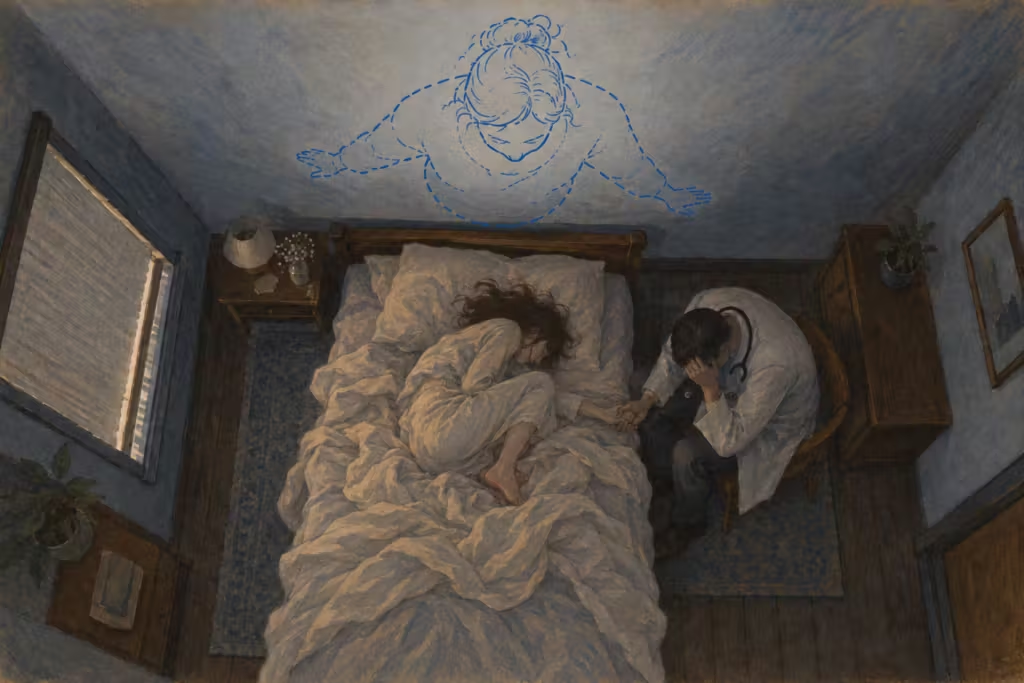
“By then I wasn’t in the bed anymore. I was already up on the ceiling.”
From above she sees her body, “all bent over, all twisted.” She sees the suffering down there, but she doesn’t feel it. Nothing hurts. She is at peace and doesn’t want to go back.
She sees Enrique. He is a man nearly two meters tall. He is crying with his head bowed. He holds her hand and says nothing.
Without speaking, she tells him: “It’s all right, Enrique. I’m fine, I’m at peace, nothing hurts. You’ve done everything you could for me.”
Step 5
One day during the coma, first thing in the morning · María Teresa’s account
María Teresa says she sees Enrique make a call from the health center
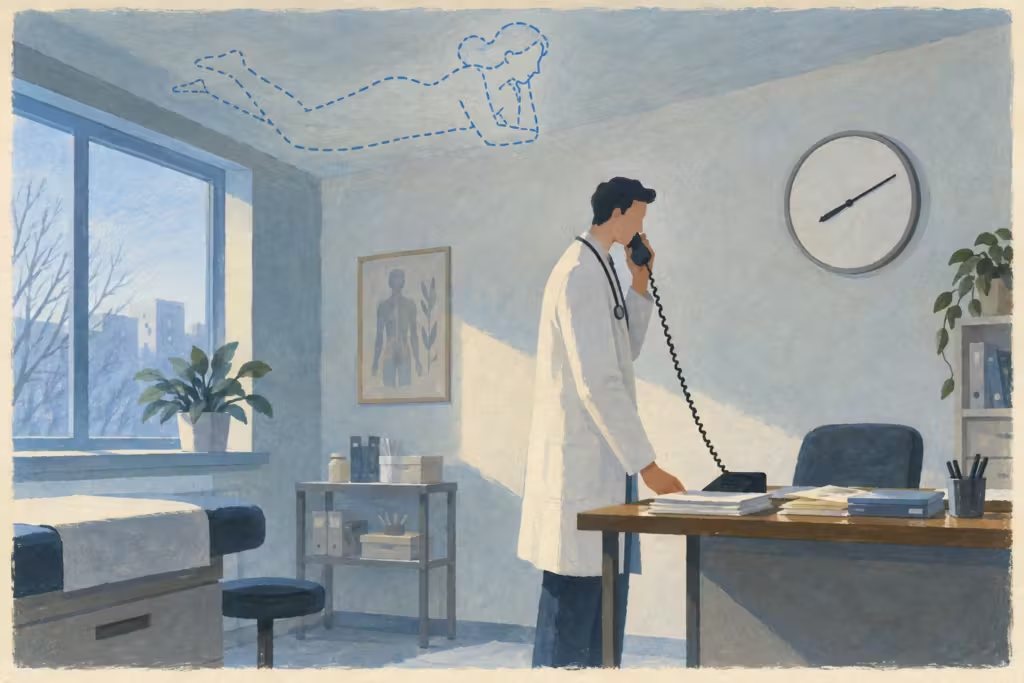
In the coma, María Teresa heard everything, “but not just what was around me.” She also heard conversations far away. And she says she could see, too.
One day she sees Enrique at the health center. He is making a phone call to another doctor.
She sees that the clock reads 8:10.
She doesn’t say what day it was. Twenty years later, she tells it as if it had happened yesterday.
Step 6
During the coma · María Teresa’s account
María Teresa says she goes to say goodbye to her mother
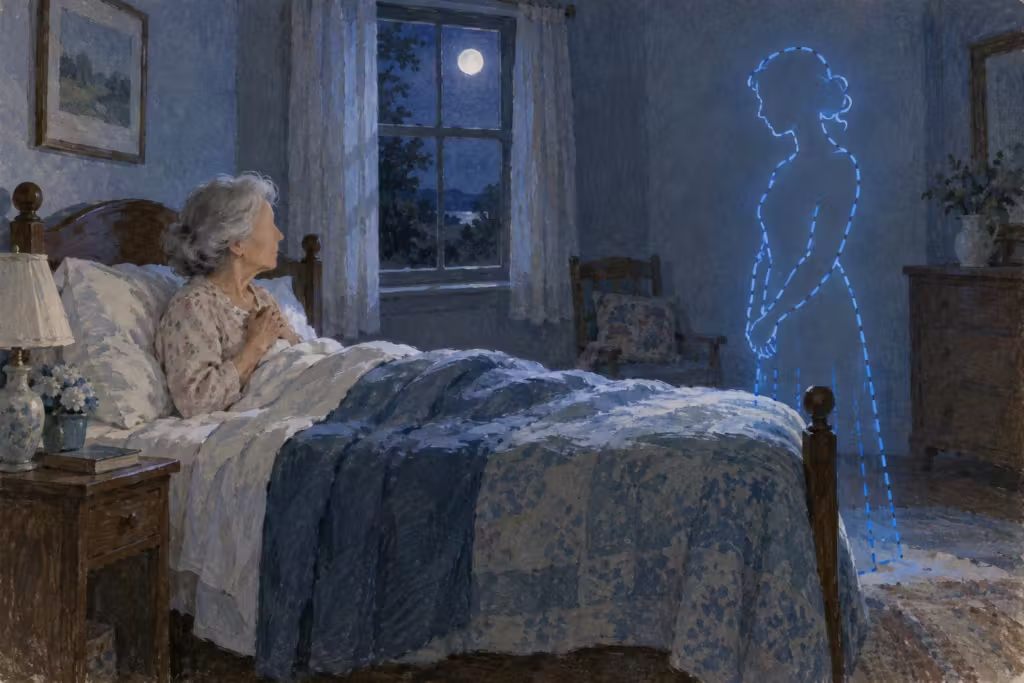
She believes she won’t be coming back. So she goes to say goodbye to her mother. Her mother lives a long way from her.
She says she also goes to some friends’ house. In the kitchen she hears a friend say she isn’t ready to lose her. Not long before, another friend had died suddenly. The friend says: “I’m not ready to lose Tere.”
None of these people knows yet that she has seen them.
Step 7
In a coma, she says · María Teresa’s account
María Teresa says she falls down an endless hole

After that calm part on the ceiling, she falls. She puts it this way: “I fall, like, into a huge hole that had no end.”
“Dark, dark, dark, dark, dark.”
The interviewer asks whether she went “through the tunnel,” and she says yes. But when she describes it in her own words, she doesn’t talk about a tunnel. She talks about a dark hole.
Step 8
In a coma, she says · María Teresa’s account
María Teresa says she reaches a light surrounded by beings
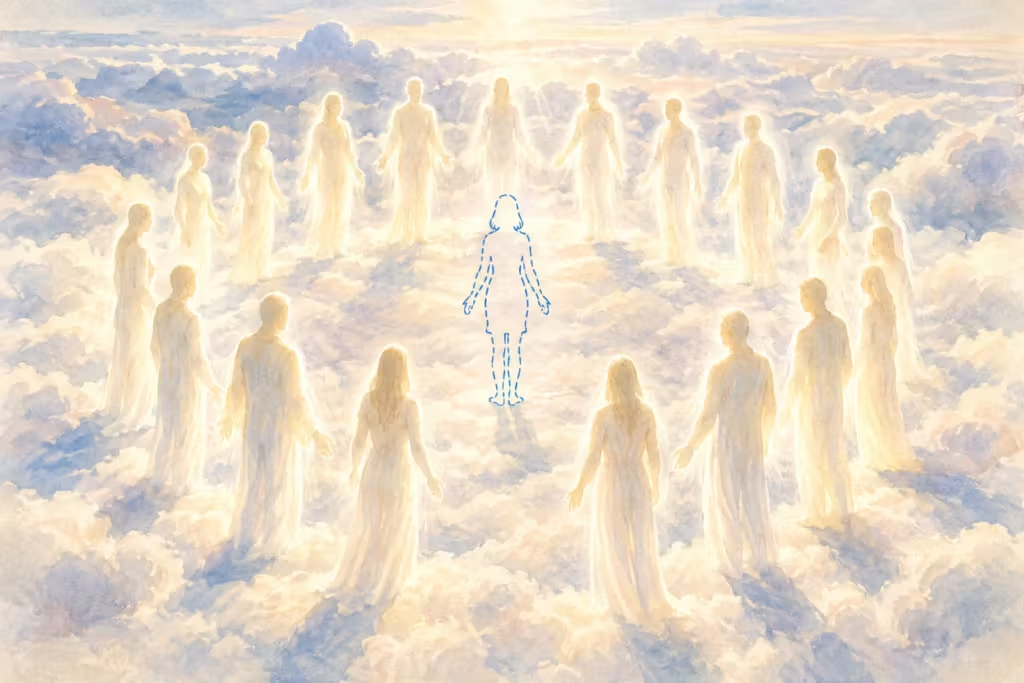
She arrives at a place full of light. It is a white light, like clouds seen from an airplane.
Around her is a large circle of about 18 beings. She can’t say whether they are men or women, because she never sees their faces. She is in the middle.
She doesn’t know who they are, but she feels at home: “I feel loved, I feel sheltered.”
She says that to describe what she feels there, “language falls very short.”
Step 9
In a coma, she says · María Teresa’s account
María Teresa says she relives her life from age 3
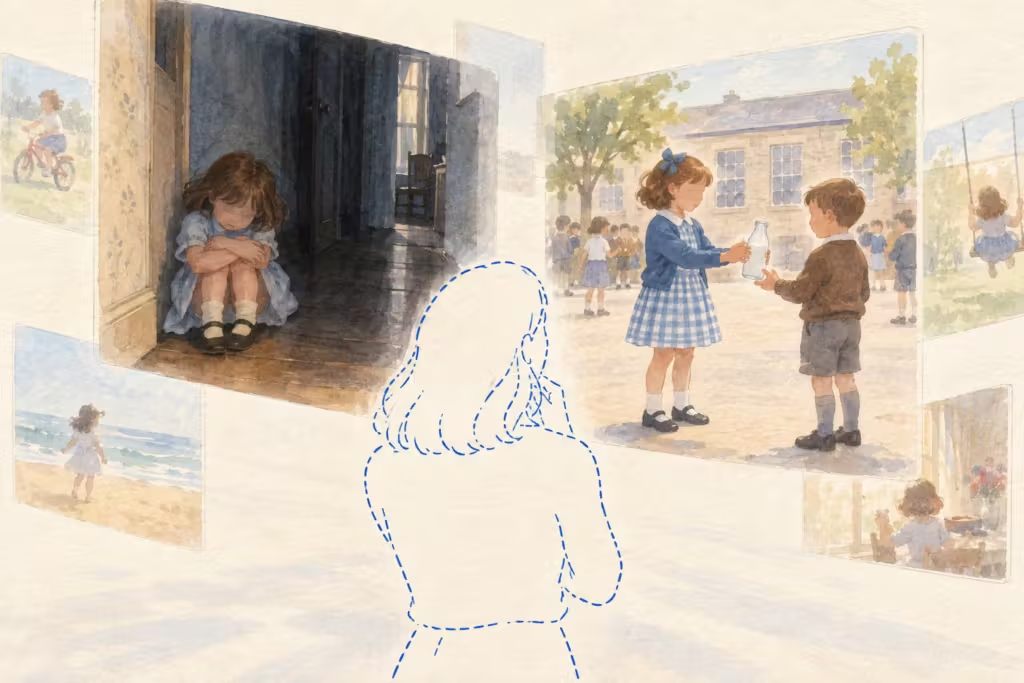
She begins to see scenes from her life, like a movie, starting when she was 3. She doesn’t just remember them, she also feels again what she felt then.
She is the three-year-old girl again, scared to death, with the screaming and the terror of that time. “It’s not all so idyllic,” she warns.
She is also shown the good things. For example, one day at recess, when she was 6, she didn’t want her bottle of milk, so she gave it to another child.
As she relives it, they explain to her what each thing was for. “In the light, they don’t judge you.”
Step 10
In a coma, she says · María Teresa’s account
María Teresa says her son Alex persuades her to come back
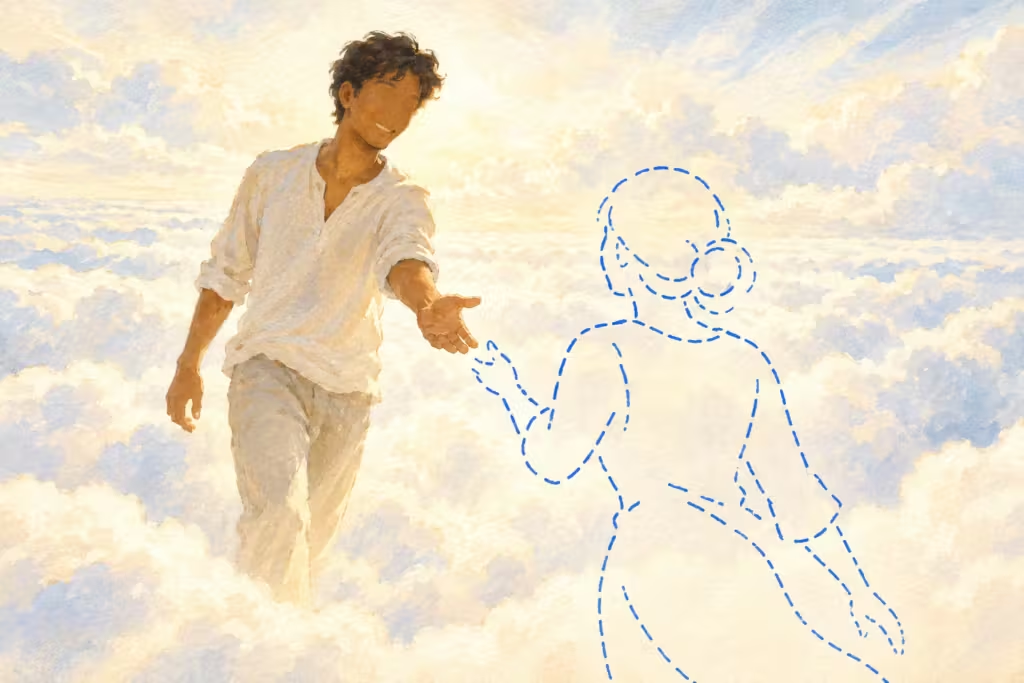
She doesn’t want to come back. She asks them: “Just leave me here, please.” Each of the beings there tells her something different to convince her. They tell her she was brought there so that she would go back and tell people about it. They also tell her: “Your real life begins now.”
Then her son Alex appears. He had died two years earlier. “Mom, do you remember…?” he says.
She believes they used Alex to convince her. “I never said no to him about anything,” she says.
Step 11
December 22, 2005 · Awake · María Teresa’s account
She wakes up thinking it’s November

She begins to open her eyes. She hears people talking about Christmas and can’t make sense of it: “But that’s still a long way off. Christmas is two months away.” They tell her Christmas Eve is the day after tomorrow. The last thing she remembers is November.
It is the first day she remembers being able to talk. She talks with her daughter.
She says she is left severely impaired. She can’t speak. It takes her years to learn to read and write again, like a small child. And it takes her nine months to walk again. Four years of recovery lie ahead, with doctors from the pain unit, psychologists, and psychiatrists.
Step 12
Months later · María Teresa’s account
She asks her mother whether she saw her

One day she is home alone and her mother calls. Her mother tells her she isn’t sleeping and that very strange things are happening to her.
María Teresa doesn’t know why, but she asks her: “Did you see me when I went to say goodbye to you?”
She had never heard her mother cry. Her mother bursts into tears: “Oh, honey, honey, it isn’t normal, but I saw you in my room.” She says she saw her at the foot of the bed.
María Teresa also tells her friends. According to her, people told her it was impossible. She was lying in bed dying, and that conversation had taken place somewhere else. Neither her mother nor her friends have given their own account.
Step 13
Months later · María Teresa’s account
She tells Enrique, and he starts to cry

She tells Enrique about the 8:10 call. He starts to cry.
“Tere, I did make that call. I don’t know if it was 8:10.”
According to María Teresa, Enrique explains that he started work at 8. He went in a little early to call that doctor. He wanted to ask what to do with her, because she was getting worse and worse. And he tells her: “But of course, there’s no way you could know this.”
Again according to her, Enrique also tells her something else. He says that on the day he went to her home, he wasn’t crying because he was watching her die. He tells her: “What you’re telling me, I was hearing it in my head.” He also tells her that he felt a peace that wasn’t normal.
Enrique was the first to tell her: “You’re not crazy, Tere. You didn’t dream it, it isn’t the medication. This happens a lot.” He gave her two books: one by Elisabeth Kübler-Ross and one by Viktor Frankl. Enrique has not told his side publicly.
Step 14
Afterward and today · María Teresa’s account
She leaves her home and helps others through grief

She says that in the life review “the masks come off.” She saw who truly loved her. She had been married for thirty-some years. Once she recovers, she leaves home with nothing, and in poor health: “I walked out of my house at 49 years old, 49 kilos.”
Before, she was so afraid of death that she wouldn’t even go to pay her condolences. Today she says she is sure life doesn’t end. Juan, her partner, dies of a heart attack. She gets into bed with him and tells him: “Darling, go to the light.” She says that before, she could never have done that.
Today she leads grief support groups. A little over a year ago she received an award for that work.
Her story is missing someone else telling it. Enrique, her mother, and her friends have not given their accounts.
Does every NDE include a life review?
María Teresa says she relived her life from age 3. It is one of the best-known images of these experiences, but it is not one of the most common.
Picture 100 people who have had an NDE after a cardiac arrest:
Each dot is one person. The 13 filled dots are the people who described a life review. The data come from a study at ten hospitals in the Netherlands, with 62 people who had an NDE.
The figure changes a lot depending on who is asked:
| Who was asked | How many |
|---|---|
| Cardiac arrest survivors with an NDE, the Netherlands, 2001 (62 people) | 13% |
| Written NDE accounts after a coma caused by lack of oxygen, Belgium (34 accounts) | 24% |
| People with an NDE who answered online, 2024 (31 people) | 42% |
What these figures don’t tell you
- The groups are small. With 31 or 62 people, a few more or a few fewer can move the percentage a lot.
- People who answer online are not a random sample. Those who had a fuller experience are more likely to respond.
- Each study measures in its own way. Some use a questionnaire; others read accounts written years later.
That is why no one knows the real figure. There is more about this in How many people have an NDE? All three studies agree that a life review appears in fewer than half of these experiences.
Where this story comes from
Interviews
- Interview on the Experiencias Cercanas a la Muerte [Near-Death Experiences] channel, “Mi vida cambió para siempre” [My life changed forever] (2025), in SpanishWatch on YouTube
Studies
- Van Lommel et al. (2001), ten hospitals in the Netherlands, The Lancet 358:2039-2045. The life-review figure is given by the author himself in Journal of Consciousness Studies 20(1-2):7-48 (2013)View in the journal (free with registration)
- Michael, Luke, and Robinson (2025), using the accounts collected by Cassol et al. (2018), Frontiers in Psychology 16:1532937Read for free
- Martial, Carhart-Harris, and Timmermann (2024), Neuroscience of Consciousness 2024(1):niae033Read for free
To understand more
Our archive
- Her record and our assessment of the call and of her farewell to her mother, as of October 10, 2026
Keep reading
Leeds, 1880
John Ogle
John Ogle was dying in Leeds and said George Hanley’s name in surprise. According to his mother, George Hanley had died ten days earlier, and no one had told John.

Oklahoma, 2009
Crystal McVea
In 2009, Crystal McVea, a teacher from Oklahoma, stopped breathing in a hospital. She said she was with God and saw a little girl with a basket. Afterward, her mother found a photo.

Texas, 1943
George Ritchie
In 1943, George Ritchie, a 20-year-old soldier, was pronounced dead in an army hospital in Texas. He said he flew to a city by a river and saw a cafe that he recognized months later in Vicksburg.

Reincarnation: The top 5 people who remember past lives
We asked them the same five questions as this story. A 32-page PDF, free in your inbox.
Check your email
We have sent you an email. Open it and press the button to confirm. If you cannot see it, check your spam folder.