One study · Spain and the United Kingdom, 2026
Sounds chosen by a quantum computer during cardiac arrest: the Escolà-Gascón study (2026)
In 2026, a team from Spain and the United Kingdom published a study of 142 people who had a near-death experience during cardiac arrest. While they were being resuscitated, a speaker in the room played sounds. A quantum computer chose which ones. Afterwards, the patients had to say which sounds had played. Two of the three groups got a few more right than chance would give.
The question is: can a person remember the sounds played while they are being resuscitated from cardiac arrest? The authors think so, and that the patients picked them up without their senses. We go through it step by step. If you only want to know what they found, skip straight to the results.
Step 1
Before 2026 · The question
They want to know whether anything can be perceived with the heart stopped
Some people who survive cardiac arrest say they saw or heard things while they were being resuscitated. Many researchers have tried to check this.
In the AWARE studies, for example, they placed hidden images in hospitals and played sounds through headphones. Nobody said they remembered them.
Álex Escolà-Gascón’s team tried something else. They played sounds in the room during the arrest. And they added something that, according to the authors, nobody had tried before. A quantum computer would choose which sounds played.
They wanted to know two things. They wanted to know whether the patients remembered the sounds. And they wanted to know whether they remembered them better when the quantum computer chose them in a special way.
Step 2
Spain and the United Kingdom · From the study
They work with 13 hospitals that ask not to be named

The study says 13 hospitals and clinics in Spain and the United Kingdom took part. All of them were run by Catholic religious orders. All of them asked not to be named.
Together they monitored about 15,000 patients at high risk of cardiac arrest. Each one was told about the study and asked for permission to use their medical data without their name.
- Before any arrest, each patient was put into a group at random. A technician did this. Neither the patients nor the authors knew which group each person was in.
- The study says it was double-blind. A double-blind design is meant to stop what the patients and the researchers expect from influencing the results.
If a patient had an arrest, the team had less than two minutes to get the sounds ready.
Step 3
The patients · From the study
Out of 2,418 arrests, 142 people who had an NDE remain

Of the 15,000 patients monitored, 2,418 had a cardiac arrest and doctors tried to resuscitate them. 677 survived.
The survivors were asked whether they had experienced anything during the arrest. The researchers kept the 142 people who described an NDE. Only they took the sound test.
- 71 were from the United Kingdom and 71 from Spain.
- They were between 49 and 65 years old. 109 were men.
- To be included, the arrest had to last between 2 and 6 minutes. If the person came back before 2 minutes, nothing was done.
That is far more people than in other studies. In AWARE II, with 25 hospitals, only 28 survivors were able to do the interview.
Step 4
During the arrest · From the study
Two minutes into the arrest, sounds start playing through a speaker
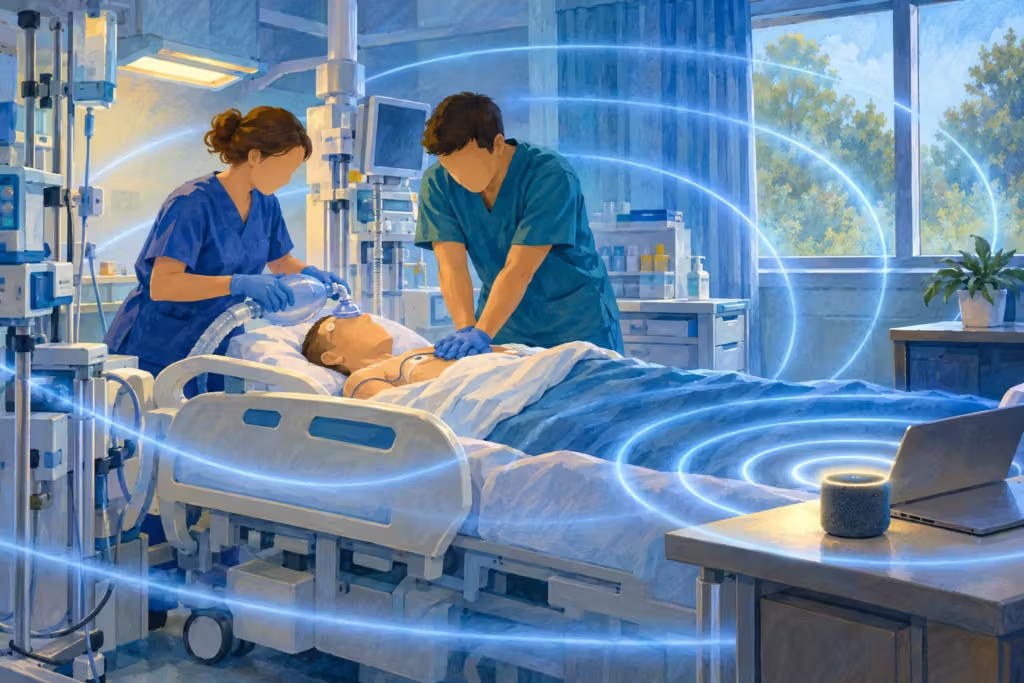
While the doctors were resuscitating the patient, someone came into the room with a laptop and a speaker.
From 2 minutes into the arrest, the speaker played up to five sounds. Each sound lasted 20 seconds. They could be heard all over the room.
At the same time, the team measured the oxygen in part of the brain, with a sensor on the forehead. They also took blood samples and the temperature of the brain.
The article does not publish the brain’s electrical activity. The authors say they recorded it only in some patients, and that they will study it in another article.
Step 5
The three groups · From the study
Some hear sounds of nature and others, melodies nobody had heard

The patients were split into three groups. Each group heard one kind of sound.
- Group A, 47 people: sounds of nature, such as waves, rain, wind, fire or birds.
- Group B, 49 people: new melodies, made with artificial intelligence for this study. Nobody had heard them before.
- Group C, 46 people: the same new melodies as group B.
The new melodies were a control. A person may think they remember the sound of rain because they have heard it a thousand times. A melody that has never been played is harder to confuse with an old memory.
Groups B and C had another difference, and it is the most important one. It was the way the sounds were chosen.
Step 6
The choice · From the study
An IBM quantum computer decides whether each sound plays
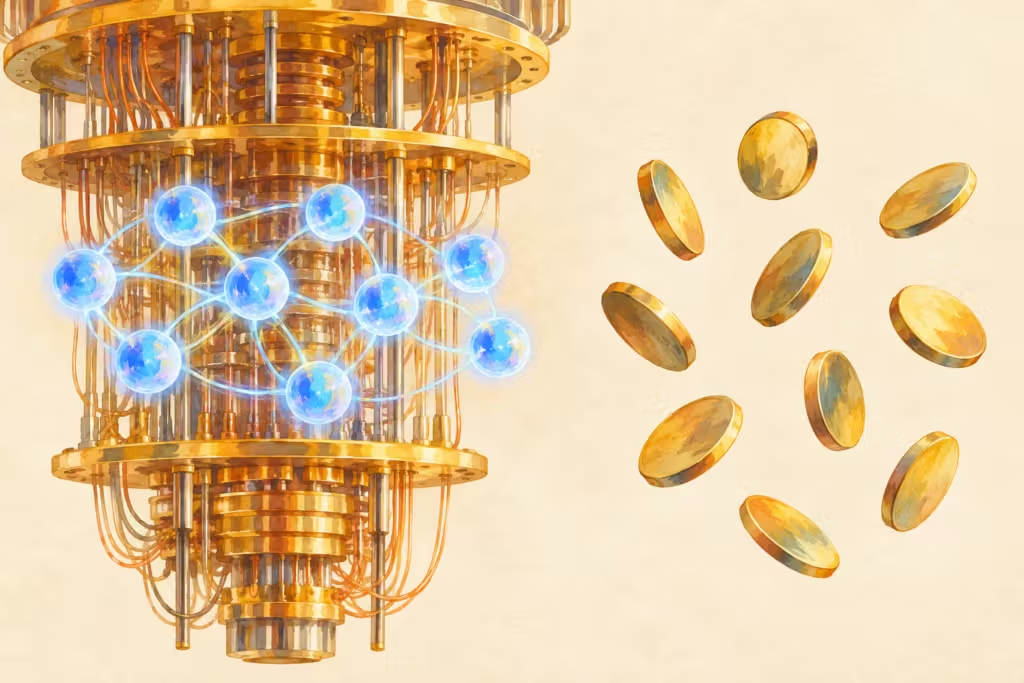
A quantum computer does not work like an ordinary one. Instead of zeros and ones, it uses pieces called qubits. When a qubit is measured, it gives a 0 or a 1.
Over the internet, the team used an IBM quantum computer with 10 qubits. Each qubit decided whether a sound played. If it gave a 1, the sound played. If it gave a 0, the sound did not play.
- In groups A and B, the 10 qubits were entangled. It is a quantum state in which the qubits are linked. What comes out of one depends on what comes out of the others.
- In group C, each qubit went its own way. It was like tossing 10 coins.
The authors’ idea is that this entanglement could help the patient pick up the sounds better.
Step 7
After resuscitation · The test
On waking, they listen to 10 sounds and point out which ones played
When the patient recovered, they took a test. They listened to 10 sounds. According to the study, 5 had played during their arrest and 5 had not.
The patient had to say which ones they thought they had heard. Each right answer scored one point. Guessing at random, the usual result is 5 out of 10.
They also filled in two questionnaires. One was the Greyson scale, which measures whether a person has had an NDE. The other looked for symptoms of psychosis, to see whether the NDE could be a hallucination.
This test measures memory. The question is whether they remembered more than chance gives.
Step 8
The results · From the study
The groups with entangled qubits get a few more right
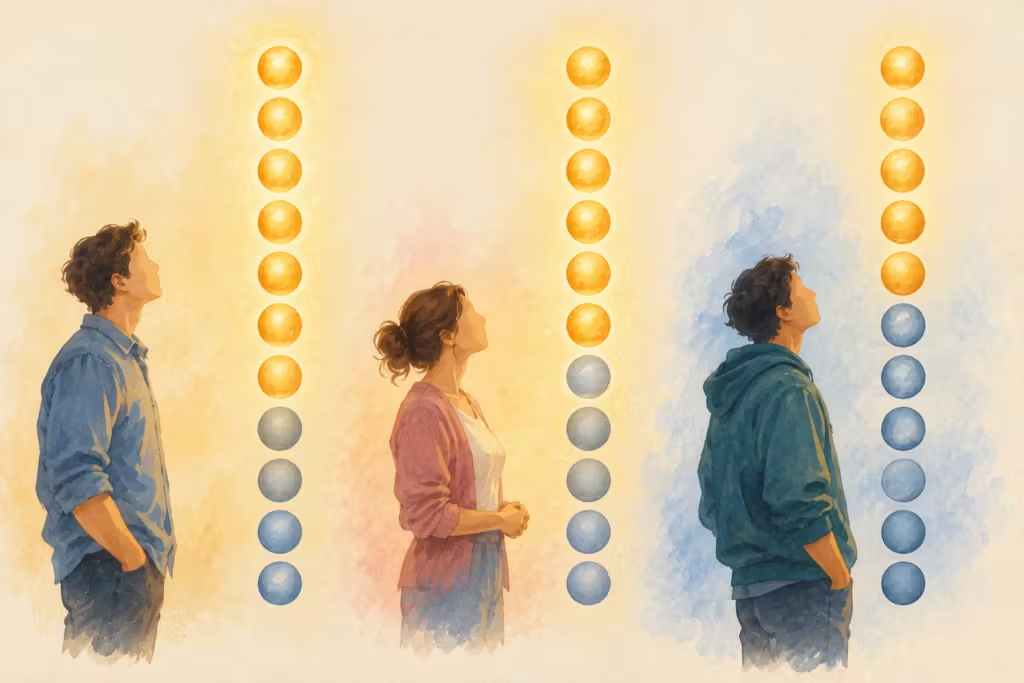
These are the average right answers in each group, out of 10:
- Group A, sounds of nature with entangled qubits: 6.68.
- Group B, new melodies with entangled qubits: 6.00.
- Group C, the same melodies with qubits going their own way: 4.94. That is what chance gives.
The difference between the groups was clear for the statistics. Group A, with familiar sounds, did not get many more right than group B, with new melodies. For the authors, this rules out that the right answers come from false memories.
It is a difference of one or two right answers out of 10.
Step 9
The results · Oxygen
With less oxygen in the brain, more NDEs and more right answers
During the arrest, the sensor on the forehead showed very little oxygen. It showed about 15%.
The authors found that the less oxygen the sensor showed, the more intense the NDE and the more sounds the patient got right. The authors built a statistical model with oxygen, blood acidity and other measures. That model explains more than half of the differences in right answers in group A.
Symptoms of psychosis did not explain the NDEs. For the authors, this means the NDEs were not hallucinations.
We don’t know how much these patients’ brains were working during resuscitation, because the analysis of electrical activity is missing.
Step 10
2026 · What the authors conclude
The authors conclude that people perceive without the senses, but they say nothing about an afterlife
In the article, the authors reach three conclusions:
- NDEs are real and are not symptoms of psychosis.
- During NDEs, information is perceived without the senses. They call it nonlocal perception.
- Quantum entanglement seems to help people remember better what happens around them.
They also say what they do not claim. They claim nothing about life after death. They write that their quantum test does not show that the information arrives by a quantum route. And they write that they cannot rule out other explanations.
In an interview in August 2026, Álex Escolà-Gascón explained that the sounds could be heard in the room. He also said that if a patient remembers the melody, it is because they heard it. His summary was that the brain remembers more than we think. The article also says they were ordinary sounds, and that the effect lies in memory.
The open question is how those sounds reached memory, and whether the qubits had anything to do with it.
Step 11
What can’t be concluded · The sounds
The sounds could be heard in the room, so they don’t prove that anyone perceives without ears
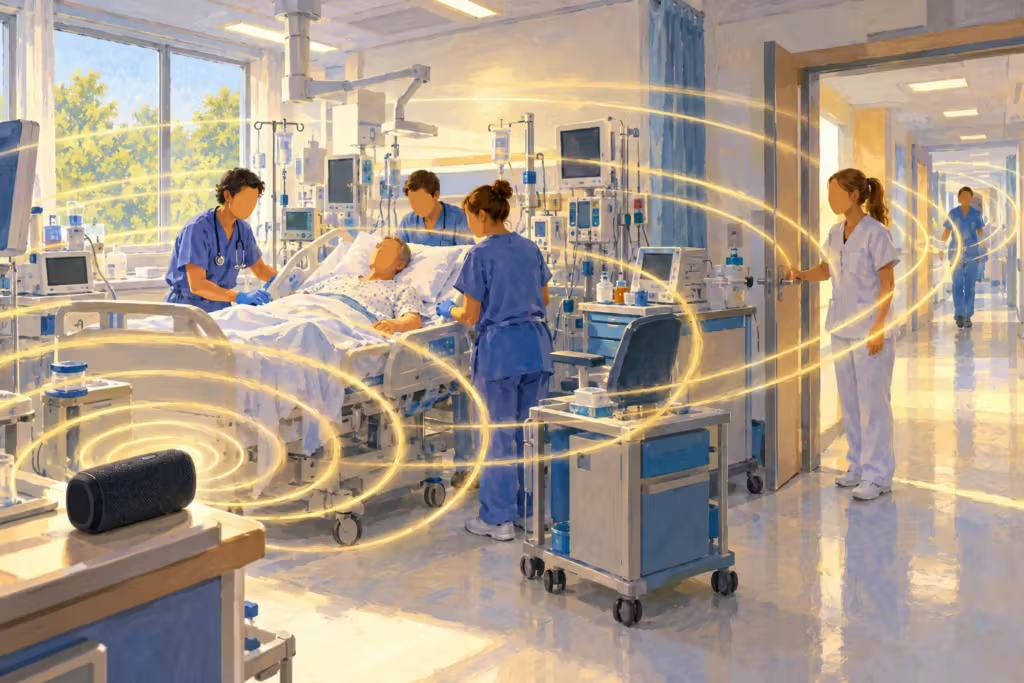
The sounds came from a speaker in the same room. The doctors and anyone else there could hear them. If the patient remembered them, it may be because they heard them with their ears.
To find out whether someone perceives without the senses, what they have to perceive must be hidden. For example, an image nobody can see, or a sound nobody can hear.
If patients remembered a sound from the room, that would also matter. It would mean the brain picks up something during resuscitation. But that is a different question.
The most striking part of the study is the part about the qubits. That part depends on how the sounds were chosen.
Step 12
What can’t be checked
There isn’t enough public information to check how the study was done
A study can be checked when we know where it was done and can see its data. In this study, much of that is not visible.
- The hospitals have no names. The text says 13 hospitals, and the diagram in the appendix shows 14.
- The article gives no trial registration number. Nor does it appear in the United States trial registry.
- The data for each patient are not public. The authors say they may give them to researchers who ask and meet their conditions.
- The ethics committees of the authors’ universities gave the approval. The article does not mention those of the hospitals.
In September 2026, two researchers asked questions on PubPeer, a website where scientists comment on articles. Nicholas Brown asked which Catholic hospitals with an ICU there are in the United Kingdom. He says that if there were only one or two, anonymity would protect nobody. Leonid Schneider asked about the trial registration, the ethics and the patients’ consent. As of 20 October 2026, the authors had not replied.
None of this shows that the study was done badly. It means that, with what has been published, nobody outside can check what happened with each patient.
Step 13
The circuit · We worked it out
The article doesn’t explain how five sounds out of ten came about
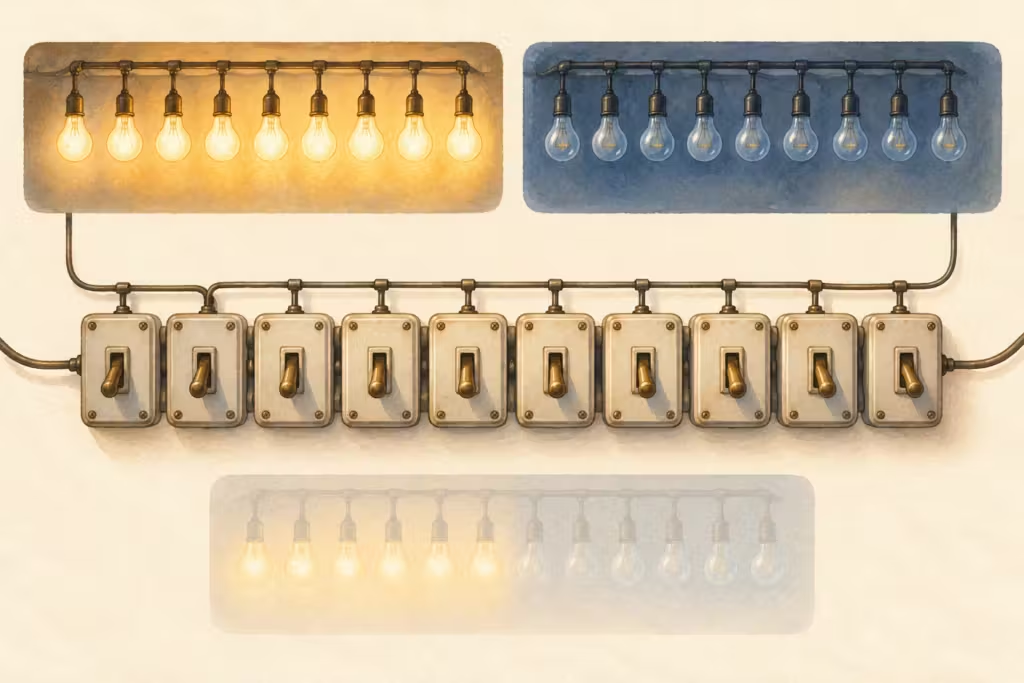
According to the authors, the difference between groups B and C is what shows the quantum effect. If we don’t know how the sounds were chosen, we don’t know what each group heard.
The question from the start remains: can anything be perceived with the heart stopped? Let’s see what could be found out and what couldn’t.
From 15,000 patients monitored to 142 tests
Only people who survived and described an NDE took the sound test.
So these figures say how much people who had an NDE remembered, but not how much any resuscitated person remembers.
| Step | People |
|---|---|
| High-risk patients monitored | about 15,000 |
| Had an arrest and doctors tried to resuscitate them | 2,418 |
| Survived | 677 |
| Described an NDE and took the test | 142 |
Right answers in each group
These are the average right answers out of 10 sounds. Guessing at random, the usual result is 5.
| Group | People | Right answers |
|---|---|---|
| A: sounds of nature, entangled qubits | 47 | 6.68 |
| B: new melodies, entangled qubits | 49 | 6.00 |
| C: new melodies, qubits going their own way | 46 | 4.94 |
What these figures don’t tell
- We don’t know how many sounds each patient heard. The study says each patient heard up to five sounds. It also says the test included five sounds that had played.
- The figures can’t be checked from outside. The data for each patient are not public. To find out how many people describe an NDE after an arrest, read How many people have an NDE?. What science says about its cause is in What does science say about these experiences?
Where this page comes from
The study
- Álex Escolà-Gascón, Kenneth Drinkwater, Andrew Denovan, Neil Dagnall and Julián Benito-León (2026), “Quantum evidence of nonlocal consciousness during clinical death”, The Innovation 7(9):101355, CC BY licence. The circuit diagram is in figure A3 of the appendixRead for freeView in the journal
The author talks about the study
- Álex Escolà-Gascón on “Un podcast con acento”, by Daniel Fopiani, 2 August 2026, in Spanish. He talks about the sounds in the room around minute 20 and about the remembered melody around minute 34Watch the interview
Assessments and critiques
- The questions from Nicholas Brown and Leonid Schneider on PubPeer, September 2026Read
How we worked out the circuit
- Our calculation with the circuit the authors publish, step by step and with the code to repeat it.See calculations
To understand more
- AWARE II: sounds through headphones during cardiac arrestRead
- What does science say about these experiences?Read
- What is an NDE?Read
Our archive
- A full reading of the article, its appendix and the author’s interview, as of 20 October 2026
More studies

AWARE: the pictures hidden on the shelves
Fifteen hospitals put up pictures that could only be seen from the ceiling, to check whether anyone saw them during a cardiac arrest.
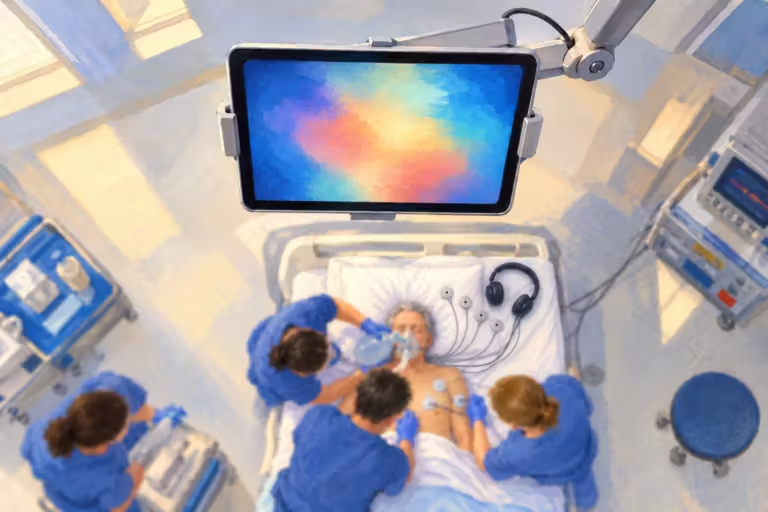
AWARE II: a random picture and the brain on the screen
Above the patient was a tablet with a random picture. Headphones said the names of three fruits. And the doctors measured the brain during resuscitation.
Van Lommel: 344 cardiac arrest survivors in ten hospitals
Ten hospitals asked every cardiac arrest survivor what they remembered. They saw them again after 2 and 8 years.