A book · Bristol (England), 1993
“Dying to Live”: Susan Blackmore explains NDEs with the brain
In 1993, the British psychologist Susan Blackmore published a book that explains near-death experiences without a soul leaving the body. In her view, a brain that is starting to fail produces the tunnel, the light, the peace, and leaving the body. Twenty years earlier, she herself had felt that she was leaving her body.
The book asks a simple question: can the brain explain every part of an NDE? We go through it step by step, with what Susan Blackmore proposes, what her critics say, and what has been checked since. If you only want to know what the book argues, skip to the results.
Step 1
November 1970 · Susan Blackmore’s account
An Oxford student feels she is leaving her body and comes to believe the soul survives
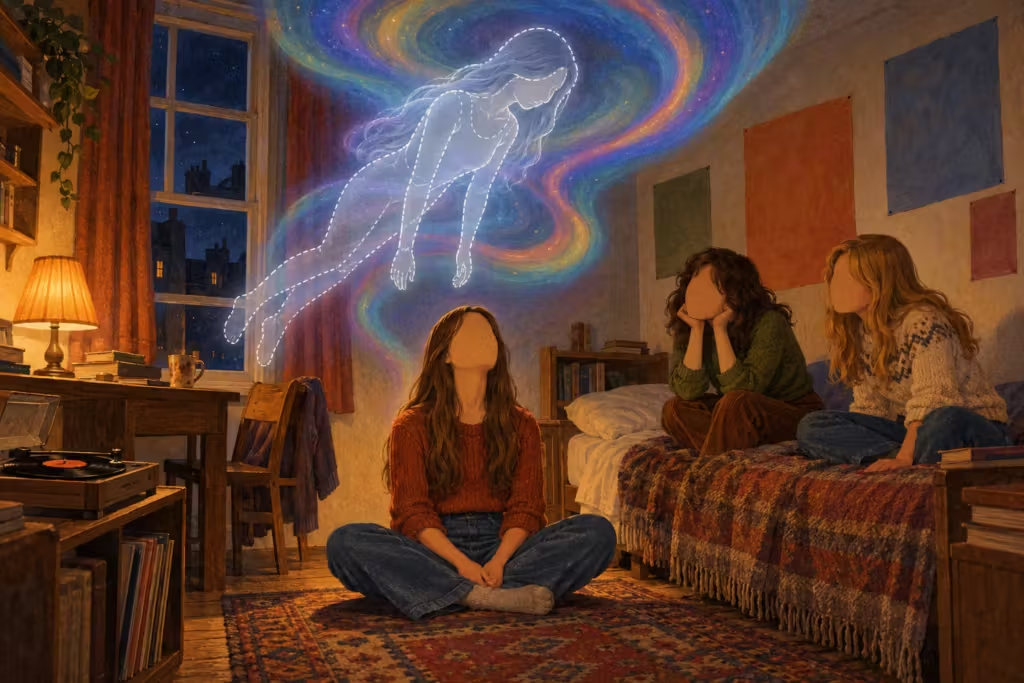
In 1970, Susan Blackmore was a student at the University of Oxford, in England. One night in November, she was very tired after a Ouija board session. She went up with two friends to one of their rooms, and they smoked hashish.
With her eyes closed, she began moving through tunnels of very bright colors. Half an hour later, she realized she was up near the ceiling, looking down at her own body. One of her friends asked her where she was. For hours, she kept telling him what she was going through.
She flew over the rooftops of Oxford and much farther. Then she felt she was growing until she filled the Earth and the universe. It was very hard for her to get back into her body.
She typed it all up a few days later. That account still exists, and she published it in 2001.
For years, Susan believed that her soul had left her body and that death was not the end.
That is why she went into parapsychology, which studies phenomena that science can’t explain. She looked for evidence for years. She says she found no evidence that held up under scrutiny. And she changed her mind.
Susan was not close to dying, so what she went through was not an NDE. But she went through things that many people with an NDE describe, like the tunnel, seeing herself from above, and the struggle to come back.
Step 2
1992 and 1993 · According to the book
Twenty years later, she writes a book to explain NDEs without a soul leaving the body

In 1993, Susan Blackmore was a lecturer in psychology at the University of the West of England, in Bristol. She had spent twenty years researching parapsychology. That year she published Dying to Live.
The book opens with a letter. In the letter, a 70-year-old widow describes an operation she had about 29 years earlier. Blackmore calls her “Mrs Freeman.” The woman says she heard from above that the surgeon say he was going to Portugal on a fishing trip. Months later she asked if it was true, and was told yes. Blackmore doesn’t analyze that detail.
Then she sets out the two possible explanations:
- The afterlife hypothesis. An NDE is a glimpse of life after death. The tunnel is a passage to another life, and the light belongs to the other world.
- The dying brain hypothesis. Everything a person goes through in an NDE is produced by a failing brain. It ends when the brain stops.
Blackmore argues for the second. She writes that there is no soul, no spirit, and nothing that leaves the body and survives death.
She also sets a condition for any explanation. It has to say why people see a dark tunnel with a light at the end, and not “a green gate with a ditch in front of it.” It can’t make up other worlds. And it has to predict things that can be checked.
Most of the book brings together studies by other researchers. Blackmore’s own tests are few:
- A survey in India.
- Another survey, on people born by cesarean section.
- A computer simulation.
- Conversations with cardiac arrest survivors at a hospital in Bristol. She gives no figures for those conversations.
The book goes part by part. It covers the tunnel, the light, the peace, leaving the body, and the life review.
Step 3
When oxygen runs short · What the book proposes
She proposes that it all starts when the brain runs short of oxygen
Whatever a person dies of, there comes a moment when the brain doesn’t get enough oxygen. Blackmore thinks this lack of oxygen can trigger an NDE. And she thinks it matters how fast that lack of oxygen sets in:
- If it sets in very fast, the person blacks out at once and experiences nothing.
- If it sets in very slowly, the person gets tired and confused.
- At a speed in between, as in drowning, the NDE appears.
Many researchers cited one case against this. The cardiologist Michael Sabom had measured a patient’s oxygen during his cardiac arrest, and it came out high. Blackmore replies that the blood was drawn from an artery in the leg. That blood doesn’t show how much oxygen is reaching the brain.
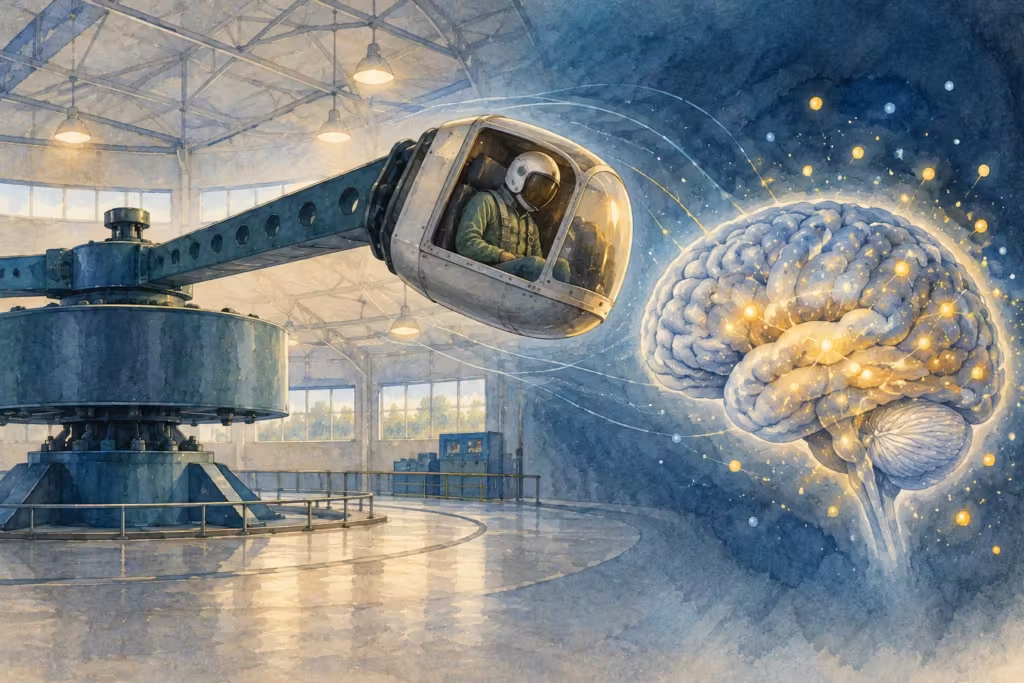
Blackmore turns to studies of pilots to see what a lack of oxygen does when a person is not close to dying. The pilots spin very fast in a machine called a centrifuge. Blood stops reaching their heads and they pass out. A US Navy doctor named James Whinnery recorded more than 500 blackouts like these. They lasted from 2 to 38 seconds.
- The pilots said they floated, felt happy, and had beautiful visions, sometimes of people they loved.
- At least two felt they were leaving their bodies, after blacking out several times in a row.
- None described a life review or a mystical experience.
As they came to, the pilots could hear before they could move.
For Blackmore, this is very important. A person can look unconscious and still hear what is going on around them.
What remains is what happens to neurons without oxygen. Blackmore cites studies on rat cells. According to those studies, without oxygen the neurons lose their “brakes” before their “accelerator.” Many neurons fire at once, in no order. For Blackmore, that disorder would be what all NDEs have in common.
Blackmore didn’t measure the oxygen of anyone who had an NDE. She answers Sabom’s case with an argument, not with another measurement. Later, other studies measured oxygen in resuscitated people. Some studies found one thing and others found the opposite, with no clear difference.
Step 4
The tunnel and the light · What the book proposes
She explains the tunnel and the light with noise in the neurons we see with
The psychiatrist Bruce Greyson had made a scale to measure NDEs. He found that the tunnel wasn’t linked to any other feature. Blackmore thinks that is why the tunnel needs its own explanation.
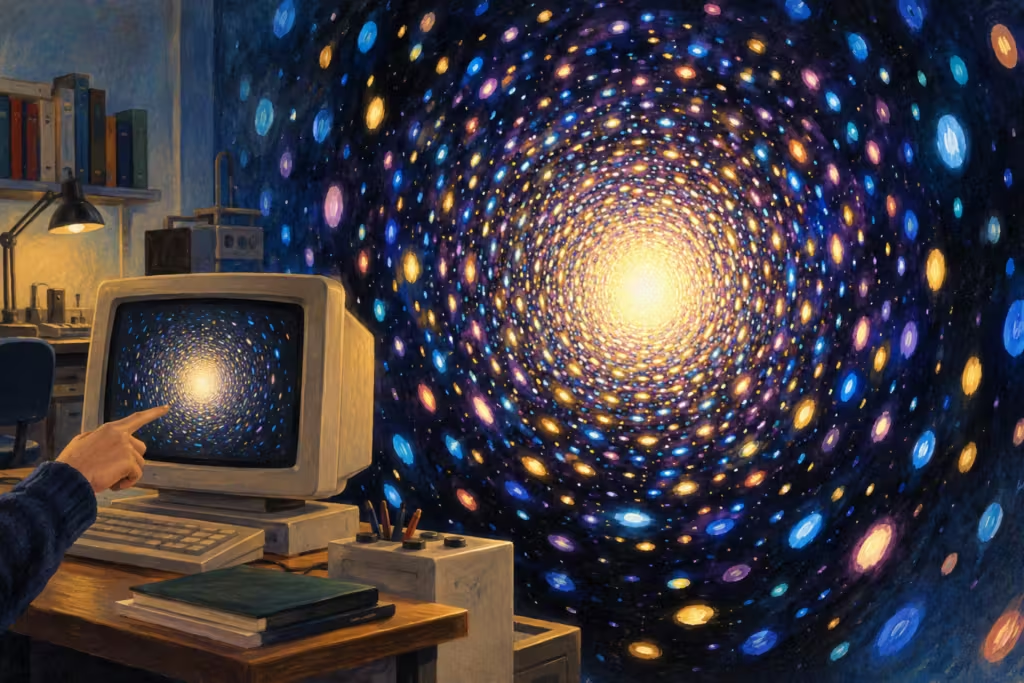
The part of the brain that handles vision has many more neurons for the center of what we look at than for the edges. Blackmore asked what would happen if all those neurons fired at random. A person should see something bright in the center that fades toward the sides. Something like that looks like a tunnel.
She tested it on a computer, together with Tom Troscianko. Troscianko was a vision researcher in Bristol. If more and more neurons fire, the light in the center grows. And it looks as if you are moving down the tunnel toward the light. When they all fire, everything is light, and you “enter” it.
- Why the light doesn’t dazzle: it doesn’t pass through the eyes.
- What color it will be: white or yellow, because all the colors mix. A London study with about 300 questionnaires found white or yellow lights, and almost never any other color.
- Who shouldn’t see it: people who take tranquilizers that slow the neurons down, and people with damage to the part of the brain that handles vision. People who are blind because of their eyes should see it.
Blackmore also tested another idea. According to that idea, the tunnel is a memory of being born. She asked 254 people. Of them, 36 had been born by cesarean section and never went through the birth canal. They described tunnels just as often as the others. In both groups, 36 in every 100 described a tunnel.
With this idea, Blackmore says what shape and color the tunnel should have, and who shouldn’t see it. These are predictions that can be checked. But in 1993 no one had checked them, and the model was a computer simulation, not a measurement in people.
Step 5
The peace and the life review · What the book proposes
She explains the peace and the life review with the chemicals the brain releases under stress
The peace doesn’t only appear close to death. People who thought they were going to die, but were not in danger, describe it too. That is why Blackmore thinks it is caused by stress, not by a lack of oxygen.
Under stress, the brain releases endorphins. They are substances similar to morphine. They take away pain and bring calm and pleasure. Blackmore tells the case of a 72-year-old man with cancer who was in a coma. To bring him out of it, he was given naloxone. It is a drug that blocks the effect of morphine. The man had been going through something blissful, and it turned into horror. It is a single case, and no one has measured a person’s endorphins while they were having an NDE.
A 1990 study in the journal The Lancet compared patients who really were close to dying with others who only believed they were. The first group described more light and thought more clearly. Blackmore proposes that fewer thoughts are left when we are dying, and that the ones that remain seem clearer. She herself writes that more needs to be known to decide.
Then there is the life review. Blackmore says she didn’t find a full life review in any of the cases she had collected. Other researchers found one in one in every four NDEs, or in one in every three.
- It is more common in drowning. It is described by almost half of those who nearly drowned, and by 16 in every 100 of those who fell.
- It appears more often when death comes suddenly, and less often in people who have been ill for a long time.
- Her explanation: endorphins make it easier for the parts of the brain that store memories and emotions to fire.
If that is so, naloxone should prevent the life review, or stop it if it has already begun.
Step 6
Leaving the body · What the book proposes
She says leaving the body is an image the brain builds from memory
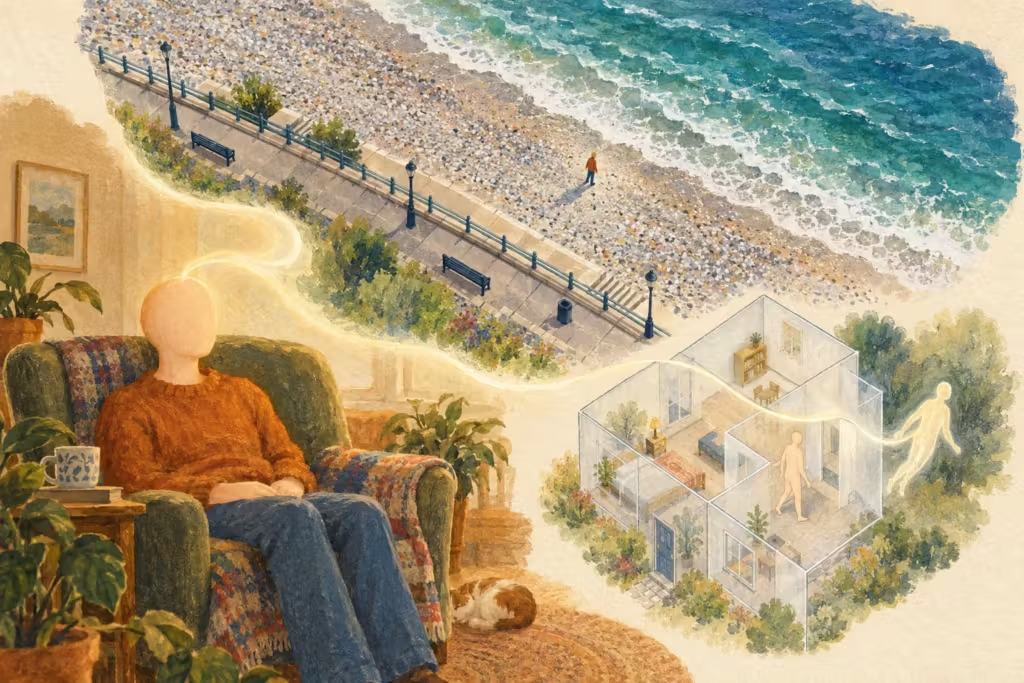
For Blackmore, the brain is always building a model of the world and of its own body. It does this with what comes in through the senses. The most stable model is the one we take to be reality.
Close to death, that model breaks down. Little information comes in, or it comes in confused by pain. Then the brain tries to rebuild the model from memory and imagination.
Many memories are stored as if seen from above. Blackmore gives an example. If you remember the last time you walked on the beach, you may see yourself from above, and not through your own eyes. If the model that wins is one seen from above, the person feels they are up above, outside their body.
- Why people pass through walls: when you picture your house, you also go from one room to another through the walls.
- What supported the idea in 1993: people who say they have left their bodies are better at finding their way in space. And they dream more often of seeing themselves from above.
- What was still to be checked: whether people who leave their bodies in an NDE dream and imagine from above more often.
Theories in which something leaves the body predict that people can see clearly at a distance. Blackmore predicts they can’t. Her idea rested on similarities, not on a direct test. One of her predictions was tested in 1998 with a single question put to 40 people, and it didn’t bear her out. Another fits what blind people described later. Both are in step 11.
Step 7
The resuscitation cases · What the book proposes
Faced with people who say they watched their own resuscitation, she looks for what they could have heard or felt
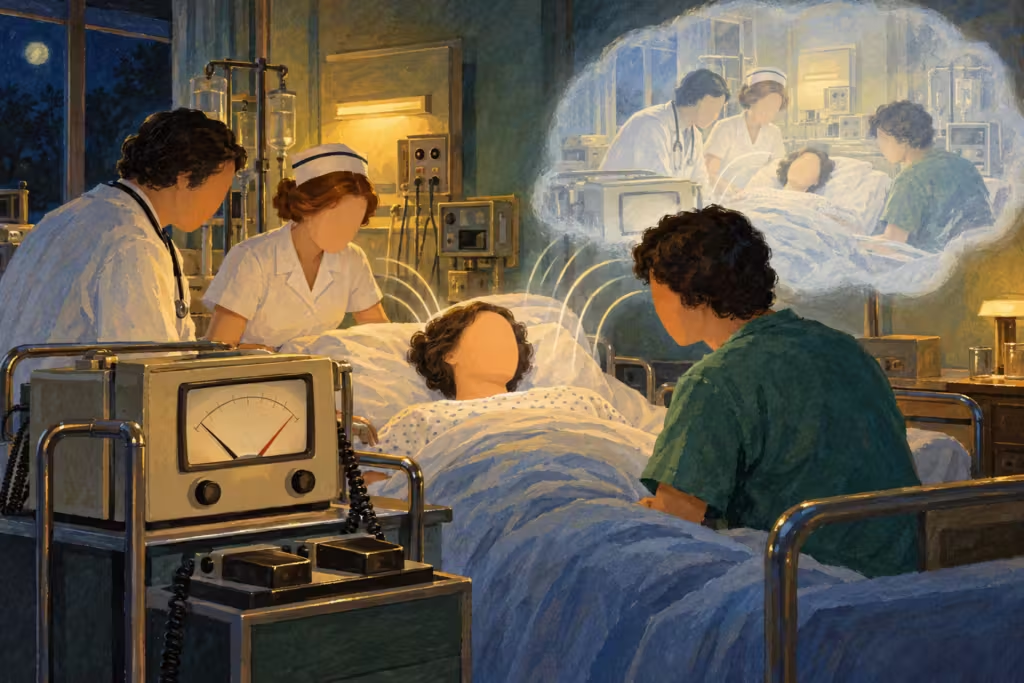
Some people say they saw what the doctors were doing during their cardiac arrest. They also say they got it right. Blackmore writes that if that were true, her theory would not be enough. That is why she devotes a chapter to these cases.
She proposes four ordinary ways a person could know what happened:
- What they already knew about hospitals and resuscitation.
- Imagination and lucky guesses.
- The senses that are still working. In a study of people who woke up during anesthesia, 85 in every 100 remembered hearing something. About 40 felt pain, and one in three saw something.
- Memory, which keeps what was right and forgets what was wrong.
Michael Sabom had studied a retired pilot who had a cardiac arrest in 1973. Five years later, the pilot described the machine that delivered the shocks. He said it had two needles. One was fixed and the other rose slowly. The medical record confirms the cardiac arrest and the shock, but not the machine. Blackmore thinks he may have learned those details later without realizing it. We tell it in the story of Mr. S.
Sabom also asked 25 heart patients without an NDE to imagine a resuscitation. Eighty percent made at least one major mistake. Blackmore thinks this group is no good for comparison. These people didn’t go through a resuscitation, so they couldn’t hear or feel it. We tell Sabom’s study step by step on the page about his book.
Another of Sabom’s patients said he was given an injection in the groin. In fact, blood was drawn from an artery in his groin. Sabom thinks this mistake shows that he saw it rather than heard it. Blackmore thinks he may have felt the needle. We tell it in the story of Mr. M. We also tell another of Sabom’s cases in the story of Mrs. M. It is the case of a woman who saw blood being drawn from her hand.
For Blackmore, we can’t know where each detail came from unless we know everything that happened during the resuscitation. But what she proposes are possible routes. In none of these cases does she show that this is what happened.
Step 8
The shoe and the blind · According to Blackmore
She looks for cases with evidence, like Maria’s shoe or blind people, and finds none documented

To rule out the senses, you need details that no sense could have picked up. Blackmore wrote to the authors of these cases to ask for more information.
- A 7-year-old boy, Pat, described the colors of the helicopter that carried him while he was in a coma. The researcher wrote to his mother to confirm it, and she didn’t reply.
- A 6-year-old boy, Ben, said what color hair his two dead grandfathers had. His mother confirmed it, but said the newspaper had exaggerated the story. Blackmore thinks “brown” and “black” are easy to get right by chance.
- Maria’s shoe is a case from a hospital in Seattle. Blackmore summarizes the case and writes that she couldn’t get any more information. She calls it “fascinating but unsubstantiated.”
People blind from birth were the clearest test. They have never seen colors or shapes. Blackmore writes that if they described things that can be seen, it would be very important for a supernatural explanation.
Blackmore read the case of Sarah in a book by the physician Larry Dossey. Sarah was a woman blind from birth who saw everything during her cardiac arrest. In March 1991, Blackmore wrote to him to ask if she could talk to her. Dossey replied that Sarah didn’t exist. She was a made-up character.
Then she asked the psychologist Kenneth Ring, who argued the opposite of her view. Ring told her he knew of cases told at conferences, but never published. And he let her quote what he told her. Ring knew of no case of a blind person with documented evidence of having seen accurately.
Blackmore thinks there are many accounts like these because what happens in an NDE feels real. And because many people want to believe they will survive death. This is her conclusion:
“It is my impression that it probably never does happen.” But she adds that the evidence that would convince her may still turn up.
Step 9
Around 1992 · According to Blackmore
To see whether NDEs are the same in other cultures, she places an ad in an Indian newspaper

If the brain produces the NDE, it should look similar all over the world, because we all have similar brains. In India there were doubts.
The researchers Satwant Pasricha and Ian Stevenson had collected 16 cases from India. Many described a case of mistaken identity. A man named Chhajju Bania said that messengers took him before the king of the dead. There, someone said they had made a mistake. They were looking for another man with the same name, who was a potter. And he was sent back to life. His account had no tunnel, no bright light, and no leaving the body.
Some researchers said this showed that NDEs are not the same everywhere. To check, Blackmore placed an ad in the Times of India, an English-language newspaper in Bombay. She asked for accounts from people who had been close to death. She didn’t say what she was looking for.
- She received 19 accounts. Twelve described some kind of experience.
- Four were dreamlike, such as a hen with her chicks or a fight with a monster.
- Eight had features of the typical NDE. 3 described a tunnel or a dark space. 4 described a bright light, and 4 described joy or peace.
Blackmore concludes that the features are similar to those in the West. For her, NDEs are similar everywhere, but not identical. They change with each person, each culture, and each situation.
In her paper on this survey, Blackmore set out a condition. If it were confirmed that another culture has no tunnels, that would count against brain-based explanations.
But finding tunnels everywhere doesn’t only favor her explanation. Blackmore acknowledges that some theories that are not about the brain also expect tunnels everywhere. One of them is by Kenneth Ring.
Step 10
The last chapter · According to Blackmore
She takes up Kenneth Ring’s challenge and says what would change her mind

In 1980, Kenneth Ring had issued a challenge. A brain-based explanation would have to explain, all at once, leaving the body, the tunnel, the light, the presence, the relatives who had died, and what the person knows without any way of knowing it. Ring wrote that it was now up to those who believe in that explanation to prove it.
Blackmore answers him: “I am happy to take on this burden.”
Blackmore goes over the four arguments for the afterlife. They are that NDEs are alike, that they feel real, the perception cases, and the changes in people’s lives. For each one, she thinks the brain explains it better. She ends by writing that, for her, the evidence and the arguments are “overwhelming.” And she writes that her view will remain a minority one for a long time, especially among people who have had an NDE.
She also says what would change her mind. Her theory would fall if truly convincing paranormal cases were documented.
She adds that she will keep looking for the evidence that could prove her wrong. And she writes down several predictions that anyone can check.
Step 11
From 1994 to 2023 · What came next
After the book, studies arrive that put some of its ideas to the test
Other researchers kept studying what the book deals with. These are the studies that help most to understand it:
- 1994, India. Four researchers, including Pasricha and Stevenson, reviewed Blackmore’s survey. According to a 2008 summary, none of the eight said “tunnel” on their own. The three who spoke of darkness described it on their own. Only one person accepted the word “tunnel,” which came from the question.
- 1997 and 1999, blind people. Kenneth Ring and Sharon Cooper found 31 blind people who had had an NDE or said they had left their bodies. Most said they had seen something. 8 of the 21 with an NDE described a tunnel or a dark space. Blackmore had predicted that people blind through their eyes would have tunnels like anyone else. We tell it in the Ring and Cooper study, along with the stories of Vicki Umipeg and Brad Barrows.
- 1998, dreams. Michael Sabom tested one of Blackmore’s predictions with 40 people who had had an NDE. Those who left their bodies didn’t dream from above any more than the others. It was a single question about dreams. It didn’t measure imagination, which was also part of the prediction.
- 2001, how many people. In the van Lommel study, 62 of 344 resuscitated people remembered something of an NDE. That is 18 in every 100. Blackmore had written that it was fewer than half.
- 2008 to 2020, hidden images. In AWARE, no one who said they had seen their resuscitation had their cardiac arrest in a room with an image. In AWARE II, none of the 28 people interviewed remembered the image or the fruit.
- 2013 and 2023, the dying brain. A lab in Michigan measured a burst of brain activity at death, in rats and in 2 of 4 patients. No one could say what they experienced. We tell it in gamma waves in the dying brain.
- 2019, drugs. A study compared 625 NDE accounts with about 15,000 accounts of 165 drugs. The closest match was ketamine. Blackmore had already accepted it in 1993 as another possible mechanism.
Other predictions in the book are still unchecked. We have not found any study of the tunnel in people with damage to the part of the brain that handles vision. Nor have we found a study that compares what resuscitated people with and without an NDE heard.
Meanwhile, a critic published a review of the book, and Blackmore answered him.
Step 12
From 2001 to 2004 · According to Greg Stone and Susan Blackmore
A critic says the book is conjecture, and Blackmore replies that no one can prove it

Greg Stone wrote a critique of Dying to Live. It was published on the website of NDERF, a foundation that collects NDE accounts. Stone says the book doesn’t prove the brain-based explanation. For him, it is conjecture that doesn’t fit what experiencers describe. And he says the book doesn’t examine the afterlife explanation.
In March 2001, Blackmore replied. She says she has never claimed that her work proves the dying brain hypothesis. And she says no research could prove it. What she tried to do was show that NDEs can be explained without a soul or a life after death. And she acknowledges that there will always be people who say that something carries on when the brain stops.
She also tells her 1970 experience again. She no longer believes that something left her body. She has practiced Zen Buddhism for almost twenty years, and she says she has lost her fear of death. But that is not because she believes she will go on living. She explained it with the same idea the book ends with: “There is no one to die.”
Blackmore says she will change her mind again if convincing evidence of the paranormal or of life after death turns up. As of 2001, it hadn’t.
That leaves the question we started with: can the brain explain every part of an NDE? Let’s see what can be said and what can’t.
From 19 letters to 3 tunnels
The India survey is the test of her own that Blackmore uses to say that NDEs are similar everywhere.
These figures show what the readers of one newspaper described. They don’t show how many NDEs there are in India.
| Step | Accounts |
|---|---|
| Accounts received through an ad in the Times of India | 19 |
| Described some kind of experience | 12 |
| Dreamlike | 4 |
| With features of the typical NDE | 8 |
| Of those, with a bright light | 4 |
| Of those, with a tunnel or a dark space | 3 |
36 in every 100, with or without a cesarean
Blackmore asked 254 people to check whether the tunnel is a memory of being born. Those born by cesarean section described tunnels just as often as everyone else.
| Group | People |
|---|---|
| People who responded | 254 |
| Born by cesarean section | 36 |
| Described a tunnel, per 100 people, in each group | 36 |
What these figures don’t tell you
- Readers of an English-language newspaper in Bombay are not all of India. The 16 village cases collected by Pasricha and Stevenson had no tunnels. More in Are near-death experiences the same in other cultures?
- “Tunnel” may be the questioner’s word. According to a 1994 review, none of the eight said “tunnel” on their own. Only one accepted the word when it was offered. That review calls 3 people out of 8 “38 percent.”
- The birth survey isn’t about NDEs. It asks about tunnels in general, close to death or not. How many people report an NDE is covered in How many people have a near-death experience?
Frequently asked questions
Who is Susan Blackmore?
Susan Blackmore is a British psychologist born in 1951. She researched parapsychology for about twenty years without finding evidence that convinced her. In 1993 she was a lecturer in psychology at the University of the West of England, in Bristol. Later she wrote about consciousness and about Zen Buddhism. One of those books, Zen and the Art of Consciousness, came out in Spanish as El zen y el arte de la conciencia (Paidós, 2012).
Did Susan Blackmore have a near-death experience?
Not exactly. In 1970 she was a student at Oxford. One night she was very tired, smoked hashish, and felt she was leaving her body. She went through a tunnel of colors, saw herself from the ceiling, and found it hard to come back. She was not close to dying. She typed it up a few days later. That 1970 account has colored tunnels, but no light at the end. In the 1993 book, she describes it as an experience “complete with the tunnel and light.”
What is the dying brain hypothesis?
It is the idea that a brain failing close to death produces everything a person goes through in an NDE. According to this idea, the NDE comes from lack of oxygen, from the chemicals the brain releases, and from the way the brain builds reality from memory. And the experience ends when the brain stops. Susan Blackmore defended it in 1993 in Dying to Live. It has not been proven. Neither has the opposite. We explain it in What does science say about near-death experiences?
Has Dying to Live been translated into Spanish?
We haven’t found any Spanish edition. The book came out in English in 1993. It was published by Grafton in London and by Prometheus Books in New York. You can find it in the sources at the end of the page.
Does Susan Blackmore still think the same?
As of 2001, she still did. That year she wrote that she still hadn’t found any evidence of the paranormal that held up under scrutiny. She also wrote that she would change her mind if convincing evidence of the paranormal or of life after death turned up.
Where this page comes from
The book
- Susan Blackmore, Dying to Live: Near-Death Experiences (Prometheus Books, 1993; first published in London by Grafton)Buy the book
Other writings by Susan Blackmore
- Susan Blackmore (1993), “Near-Death Experiences in India: They Have Tunnels Too,” Journal of Near-Death Studies 11(4):205–217Read for free
- Allan Kellehear, Ian Stevenson, Satwant Pasricha, and Emily Cook (1994), “The Absence of Tunnel Sensations in Near-Death Experiences from India,” Journal of Near-Death Studies 13(2):109–113Read for free
- Susan Blackmore, “An Out-of-body Experience,” the account she wrote in November 1970, on her websiteRead for free
Critiques and replies
- Greg Stone, a critique of Dying to Live, with Susan Blackmore’s reply (March 2001) and Stone’s rejoinder (updated in 2004), on the NDERF website, in a machine translation into SpanishRead for free
- Kenneth Ring and Sharon Cooper, Mindsight: Near-Death and Out-of-Body Experiences in the Blind (1999) (the link goes to the second edition, where page numbers may differ)Buy the book
- Michael Sabom, Light and Death (1998)Buy the book
- Michael Sabom, Recollections of Death (Harper & Row, 1982)Buy the book
To understand more
- The Ring and Cooper study: 31 blind people who describe a near-death experienceRead
- Gamma waves in the dying brain: 9 rats in 2013 and 4 patients in 2023Read
- The AWARE study: the images hidden on the shelvesRead
- Maria’s near-death experienceRead
- What does science say about near-death experiences?Read
- Are near-death experiences the same in other cultures?Read
Our archive
- Our reading of the whole book, the India paper, the 1970 account, and Stone’s critique with Blackmore’s reply, as of October 17, 2026
More studies
AWARE: the pictures hidden on the shelves
Fifteen hospitals put up pictures that could only be seen from the ceiling, to check whether anyone saw them during a cardiac arrest.
AWARE II: a random picture and the brain on the screen
Above the patient was a tablet with a random picture. Headphones said the names of three fruits. And the doctors measured the brain during resuscitation.
Van Lommel: 344 cardiac arrest survivors in ten hospitals
Ten hospitals asked every cardiac arrest survivor what they remembered. They saw them again after 2 and 8 years.