Are near-death experiences the same in other cultures?
In the essentials, yes. Everywhere there are people who say they went to another world, met beings or relatives who had died, were sent back, and lost their fear of dying. But the details vary a great deal. The characters, the setting, and even the reason they come back all change.
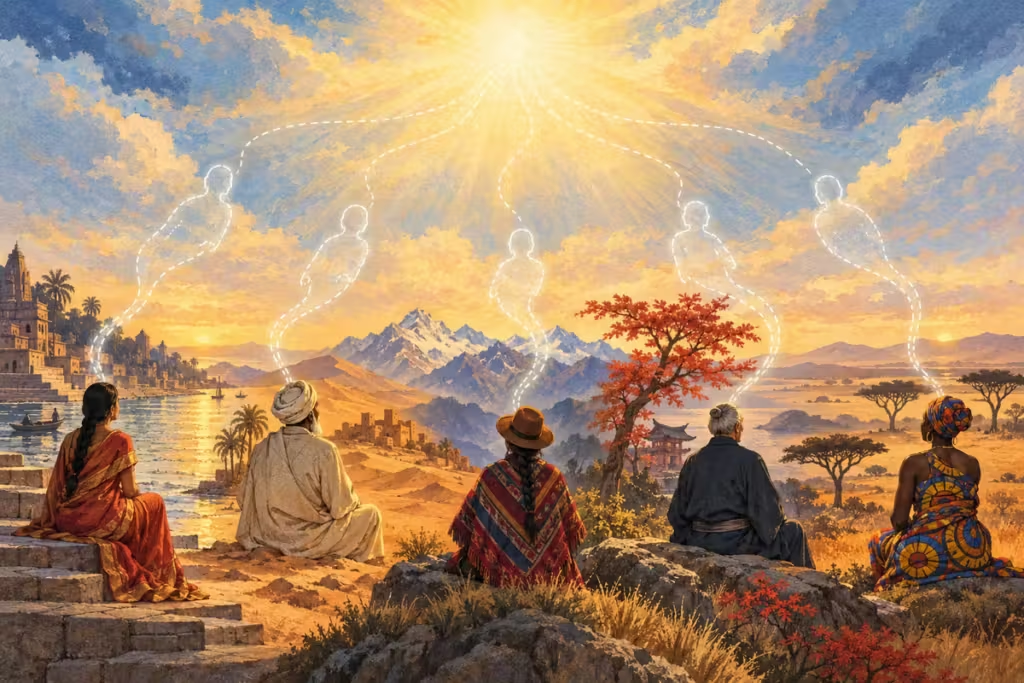
- What repeats
- Going to another world, meeting beings or the dead, coming back, and losing the fear of death.
- What changes
- Who appears, what the place is like, and why you are sent back. In villages in India, messengers and a man with a book appear.
- The names
- People name what they see after figures from their own tradition: Jesus, Allah, the goddess Kalika.
- What we don’t know
- Whether it is the experience itself that changes, or the way it is told. Sometimes the experience is told twenty years later.
What repeats everywhere
There are studies from India, Thailand, Iran, Japan, and China, as well as from Europe and the Americas. A common core appears in all of them:
- Going to another place. In villages in southern India, 95 out of 100 describe it.
- Meeting beings or relatives who had died.
- Being sent back to life.
- Losing the fear of dying. In India, 56 out of 100 describe it.
There is a US website that collects accounts from around the world. There, we compared 71 accounts from people in non-Western countries and non-Christian traditions with 75 accounts from Westerners. The 71 included Muslims, Hindus, people from East Asia, and others with no stated religion. On many points, the two groups came out almost the same:
| Out of 100, how many mention… | Non-Christian | Western |
|---|---|---|
| Light | 54 | 55 |
| Peace | 48 | 48 |
| Tunnel | 30 | 27 |
| Fear | 25 | 25 |
| A God who speaks | 24 | 24 |
| Relatives who had died | 18 | 15 |
These accounts have a limit. They come from people writing in English on a US website. Also, to be included, their experience had to score high on a scale built from Western experiences. That makes it easier for the accounts to look alike.
What changes
Some studies ask people in the local language, in villages, or study popular texts. In those, different characters and different steps appear:
- In villages in southern India. Messengers come to fetch the person. 94 out of 100 describe this. The person is taken before a man with a book. 74 out of 100 describe this. And the person is sent back because there has been a mistake or because it was not their time. 89 out of 100 describe this. 34 out of 100 say someone else died in their place. There is almost never a tunnel or a life review.
- In Thailand. The messengers of the god of death appear in 9 of 10 accounts. In half of them there is a mix-up, because the wrong person had been taken.
- In Japan. A flower garden appears in 16 of 22 accounts. A border or boundary appears in 12. Light appears in only 3 accounts, and in them the light is not a being.
- In the West. The reason for coming back is usually a mission: they are not finished yet, or they have something to do. In the website comparison, 12 of the 75 Westerners said this, and none of the 71 from non-Christian traditions.
Each culture supplies the names
When someone sees a being and gives it a name, it almost always comes from their own tradition. In the website comparison, all 12 named figures in the Western accounts were Christian. In the accounts from non-Christian traditions, there were 7 named figures. 5 of them came from the person’s own religion. They were the Hindu goddess Kalika, Allah, or Muhammad. The other 2 were Christian, but the name was given by other people afterward.
What about Muslim countries?
Studies in Iran find experiences very similar to Western ones, with light, a tunnel, leaving the body, and a life review. The same is true of a hospital study with resuscitation survivors. They were interviewed in Persian, without using any scale. The names, however, are Islamic: God, the prophets, the profession of faith.
What popular tradition says about dying does not appear in any group of Muslims studied. The angel of death, the questioning in the grave, the book, and the bridge do not appear.
A psychiatrist was looking for experiences among Muslims. After an earthquake, he sent a student to villages in Kashmir. They found no experiences. We don’t know how many people who had come close to death were asked. So that zero tells us little.
Why it varies so much depending on where you ask
Something curious happens in India. The same country produces two kinds of account. In the villages, with interviews in the local language, the messengers and the book come up. Other people answered an ad in an English-language newspaper, or wrote to the US website. In their accounts, darkness, light, and peace come up.
Each way of asking has its own filter. The website asks about the light and the tunnel. The village surveys ask about the messengers and the book. And in India, an average of about twenty years passes between the experience and the account. The accounts that get collected depend in part on how they are collected.
What this says about the two explanations
Both theories accept that culture shapes how the experience looks. But neither can win on this evidence alone:
- The classic theory: the brain produces them. It accounts well for each person seeing what their culture has taught them. But if the brain produced the tunnel or the life review at the point of death, they should appear everywhere. And in rural India they hardly appear at all. The psychologist Susan Blackmore supports this theory. She admits that this would count against it if it were confirmed. She looked in India herself and found accounts with darkness or a tunnel, but she asked only a few people, by letter.
- The modern theory: consciousness carries on without the brain. It accounts well for the common core found all over the world. It also accounts for why some people say they did not find what their religion had told them to expect. But it has to accept that what is found there adapts to each person. Not only the names adapt. The setting, the characters, and the reason for coming back adapt too.
A study that does not yet exist would help. It would ask resuscitation survivors in rural India or Thailand. And it would record what they say in the first few days, without using checklists of features. Those accounts would help show which differences are already there at the start. Later, they could be compared with what the same people say years afterward.
Frequently asked questions
Are near-death experiences the same in all religions?
In the essentials, they are alike. There is another place, beings or the dead, a return, and less fear of dying. In the details, they are not alike. The characters and the setting change with the culture, especially when people are asked in the local language.
Do people who are not Christian see Jesus?
Almost never. People usually name what they see after figures from their own tradition. Only 2 of 71 accounts from non-Christian traditions mentioned a Christian figure. In both, the name was given by other people afterward.
Are there near-death experiences in Islam?
Yes. The studies from Iran and accounts from Muslims in other countries describe light, leaving the body, and peace, with Islamic names. The popular account of the angel of death and the questioning in the grave does not appear.
Keep reading
- What is a near-death experience?What people go through, how often it happens, and what changes afterward.
- What does science say?The two explanations, the evidence for each, and what each lacks.
- What if the experience is frightening?Experiences of fear or distress, told with the same care.
Where these figures come from
- Pasricha (1993), survey in southern India, Journal of Scientific Exploration 7(2):161-171.
- Pasricha (2008), India, Journal of Near-Death Studies 26(4):267-282. Read for free
- Murphy (2001), Thailand, Journal of Near-Death Studies 19(3):161-178. Read for free
- Blackmore (1993), India, Journal of Near-Death Studies 11(4):205-217. Read for free
- Ohkado and Greyson (2014), Japan, Journal of Near-Death Studies 32(4):187-198. Read for free
- Zhi-ying and Jian-xun (1992), survivors of the Tangshan earthquake (China), Journal of Near-Death Studies 11(1):39-48. Read for free
- Ghasemiannejad et al. (2014), Iran, Journal of Near-Death Studies 33(1):30-42. Read for free
- Khoshab et al. (2020), resuscitation survivors in Iran, Iranian Journal of Nursing and Midwifery Research 25(5):414-418. Read for free
- Behzadi et al. (2025), coma patients in Iran, BMC Psychology 13:1073. Read for free
- Kellehear (2008), NDEs outside the West, Journal of Near-Death Studies 26(4):249-265. Read for free
- Nahm and Nicolay (2010), eight NDEs of Muslims, Journal of Near-Death Studies 29(1):255-263. Read for free
- Kreps (2009), the search for NDEs among Muslims, Journal of Near-Death Studies 28(2):67-86. Read for free
- Our archive: the comparison of 71 accounts from non-Christian traditions and 75 Western accounts from the NDERF website, with two independent readers, dated October 1, 2026.