A real-life story · United States, 1978
The near-death experience of Mrs. M.
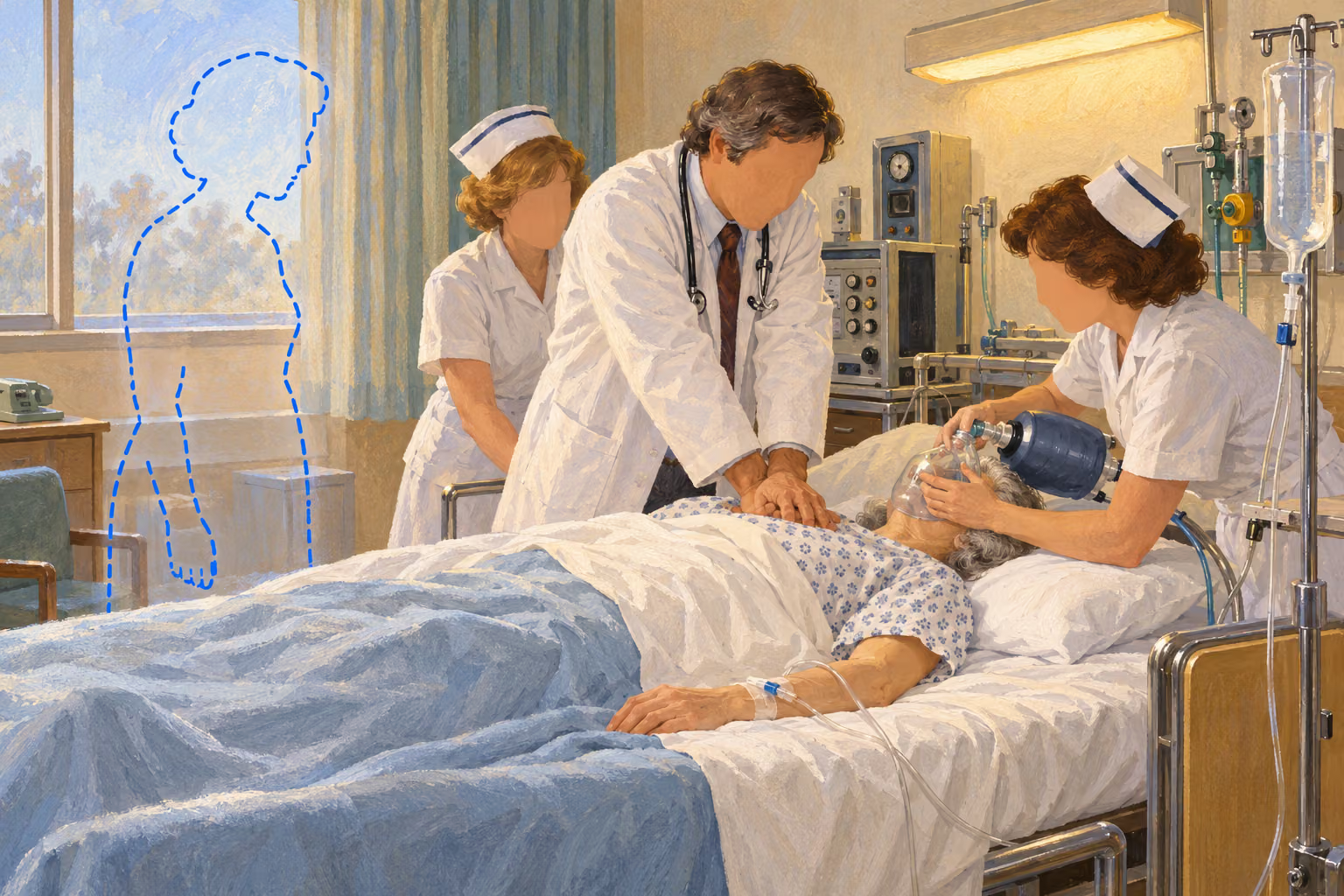
In January 1978, a 60-year-old woman lost consciousness in a hospital bed, and the doctors resuscitated her. She later said she had left her body and watched them resuscitate her. She also said she saw them prick her hand with a small needle to draw blood.
Michael Sabom was a cardiologist who didn’t believe in these experiences. Sabom calls her Mrs. M. to keep her name private. Sabom looked up her medical record from that morning. The record says that at 7:30, blood was drawn from one of her arteries. According to Sabom, Mrs. M. had never seen that medical record. How did she know about the needle?
Step 1
1976 · In Gainesville, Florida · Michael Sabom’s account
A cardiologist who didn’t believe in these experiences decides to check them

Michael Sabom was a cardiologist at the University of Florida. One Sunday in 1976, a social worker named Sarah Kreutziger presented the book Life After Life, by Raymond Moody, at his church. The book collected accounts from people who had come close to dying.
He was the only doctor in the room, and they asked him what he thought. He answered, “I don’t believe it.”
He had taken part in more than a hundred resuscitations. He knew very well what one looks like. He thought that if a patient said they had seen their own resuscitation, he would find mistakes in the account.
Sabom began interviewing people who had survived a life-threatening crisis, together with Sarah Kreutziger. He also looked up their medical records to compare. One of those people was a woman from Ohio. On the page about his book we explain how Sabom worked and what the limits of his study are.
Step 2
January 1978, at 7 a.m. · In her hospital bed · Mrs. M.’s account
Mrs. M. says she felt very strange while waiting for breakfast
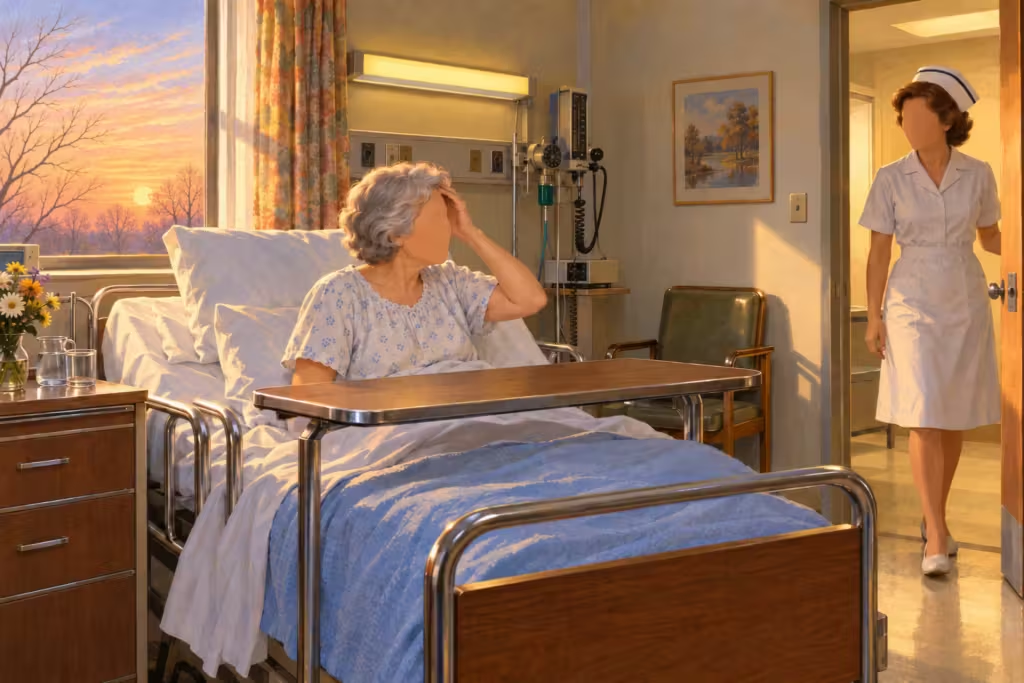
Mrs. M. was 60 years old and a homemaker in Ohio. She was in the hospital for very severe back pain. She was diabetic and had heart disease.
One morning, she was in bed waiting for breakfast. Suddenly she felt very strange. She looked toward the door and saw the nurse. She told her, “Something’s wrong.” That is the last thing she remembers before losing consciousness.
The medical record gives the time. At 7:00, she told a nurse that she felt weak and dizzy.
Ten minutes later, the nurse could no longer measure her blood pressure.
Step 3
Between 7:10 and 7:20 · Critically ill · From her medical record
The nurse can’t find her blood pressure and calls a cardiac arrest alert
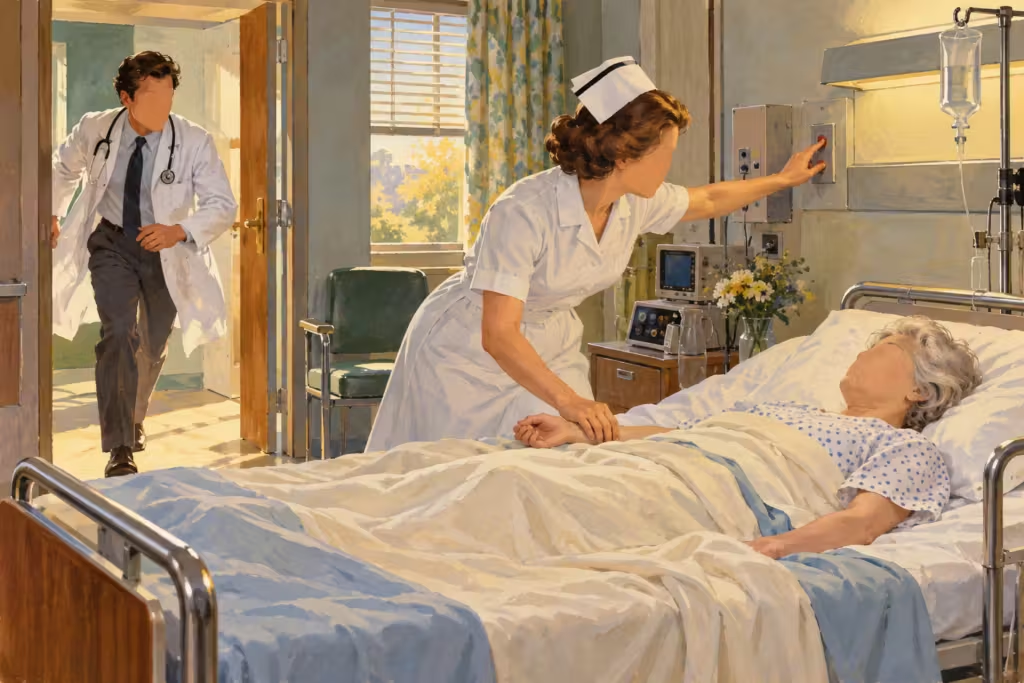
At 7:10, the nurse noted that Mrs. M. had a very weak pulse and was barely breathing. The nurse couldn’t measure her blood pressure. At about 7:15, she called a cardiac arrest alert, and a doctor arrived right away.
At 7:20, she wasn’t responding. They started an IV. They gave her an injection of sugar in case her blood sugar had dropped too low, but she didn’t react. More doctors and nurses arrived, and they began to resuscitate her.
Some time later, the nurse told her what she had found when she got to the bed. Mrs. M. had no pulse and wasn’t breathing. She learned part of what happened because the nurse told her.
Mrs. M. says that, all this time, she was outside her body.
Step 4
During the resuscitation · Mrs. M. is not responding · Mrs. M.’s account
Mrs. M. says she left her body and saw the resuscitation team arrive
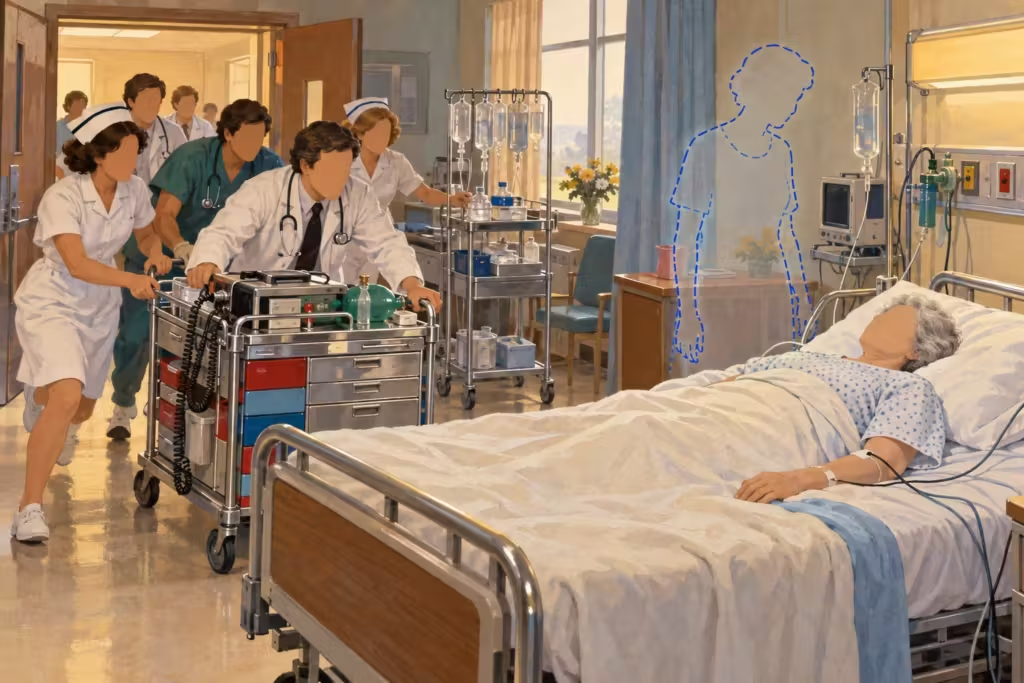
Mrs. M. had left her body. She was off to one side of the bed, “in sort of like a tube.” From there she could see what they were doing to her body.
She saw the resuscitation team come in with a cart full of equipment. She saw the doctors and nurses rushing around. Everyone was doing something.
She could see the faces of the people on one side of the bed. She saw the backs of the people on the other side. She watched the expressions on their faces.
Then she paid attention to what they were doing to her body.
Step 5
During the resuscitation · Mrs. M. is not responding · Mrs. M.’s account
Mrs. M. says she saw them pushing on her chest but couldn’t feel it
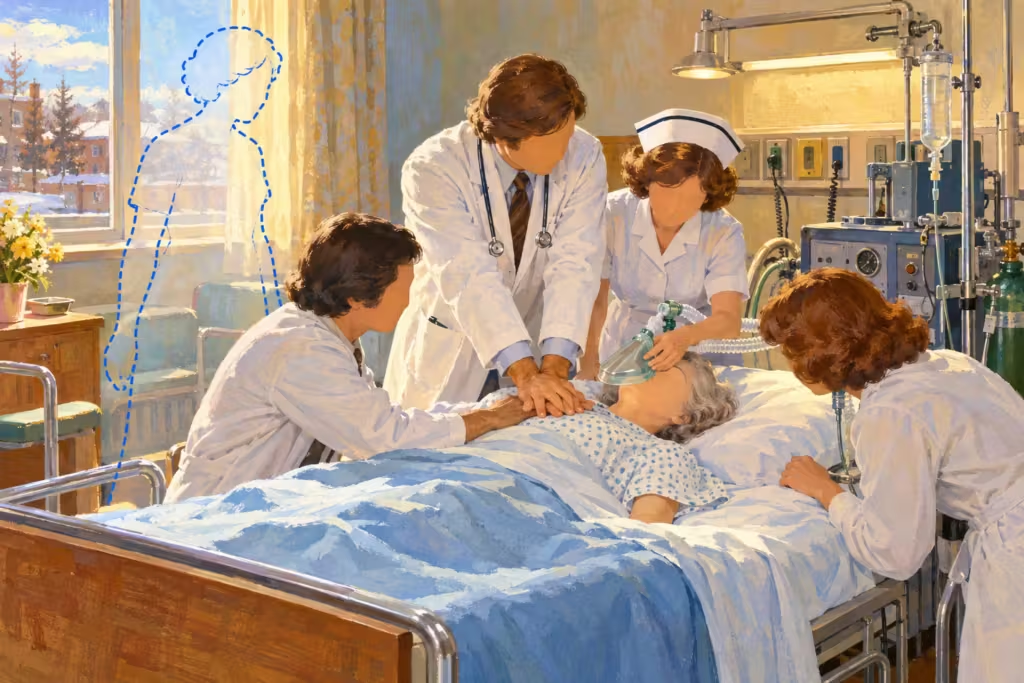
Mrs. M. saw a doctor push on her chest over and over. They put a cone-shaped oxygen mask on her face that covered her nose. They took it off soon after.
She saw her own face very clearly. She saw them lift her eyelids to look at her eyes. And she saw them feel for the pulse in her neck.
She didn’t feel anything. She could see them pushing on her chest, but it didn’t hurt.
Then she saw a small needle.
Step 6
During the resuscitation · Mrs. M. is not responding · Mrs. M.’s account
Mrs. M. says she saw them prick her hand with a small needle
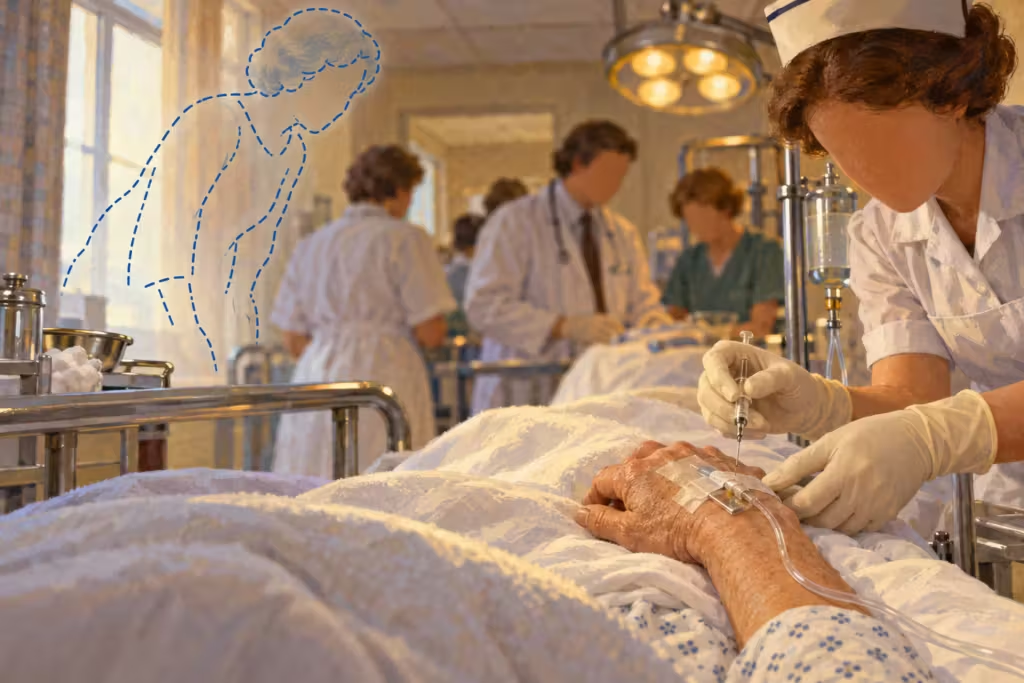
Mrs. M. saw them start an IV in her right hand. She also saw a small needle going into her hand.
This is how she told it to Sabom:
“I could see the little needle they were putting in my hand. Something about the blood gases.”
Blood gases are a test. A little blood is drawn from an artery to measure how much oxygen it carries. During a resuscitation, the test shows whether oxygen is reaching the body.
She didn’t feel the needle go in. That surprised her, because you usually feel it.
Mrs. M. names the test: “the blood gases.” She herself says she could hear what the doctors were saying. She heard a doctor ask for something for the IV.
Meanwhile, someone was gathering up her belongings.
Step 7
During the resuscitation · Mrs. M. is not responding · Mrs. M.’s account
Mrs. M. says a young woman was packing her things into bags to take up to the ICU
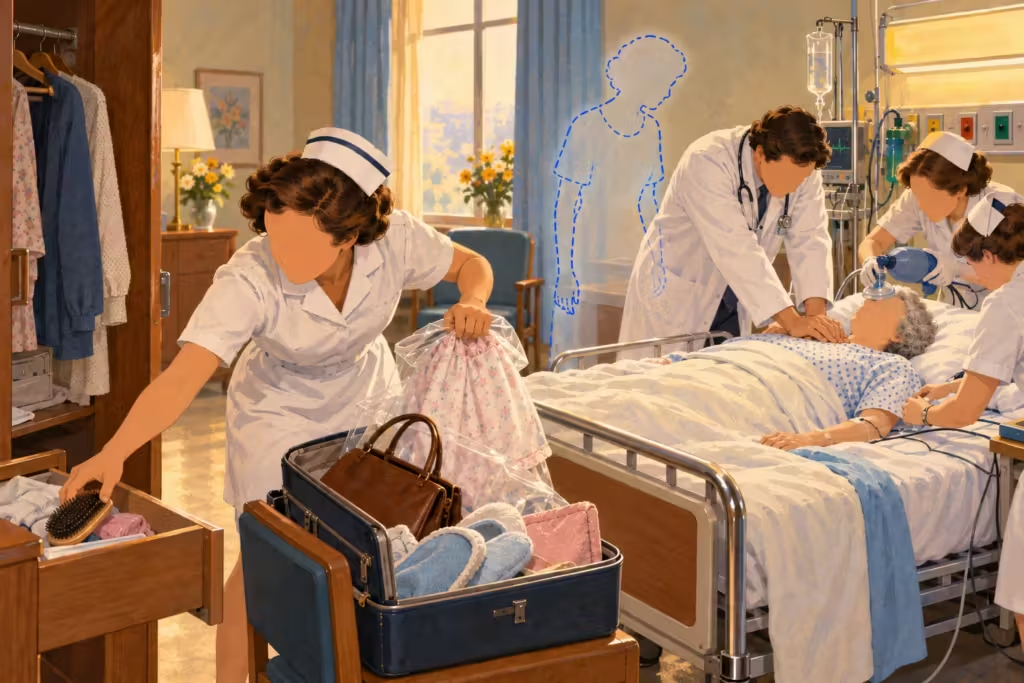
Mrs. M. heard the doctor say, “We’re going to have to get her up to ICU.” The ICU is the intensive care unit.
Then she saw a young woman take all her things out of the drawer and the locker at the foot of the bed. The young woman packed everything into bags and suitcases.
When she came to, everything had been labeled with her name, ready to go upstairs.
Mrs. M. saw the labeled bags later, once she was awake. And in the end, she was never moved to the ICU.
Step 8
At 8:00 · Mrs. M. wakes up · From her medical record
Mrs. M. comes to with a pain in her chest, and she is not moved to the ICU
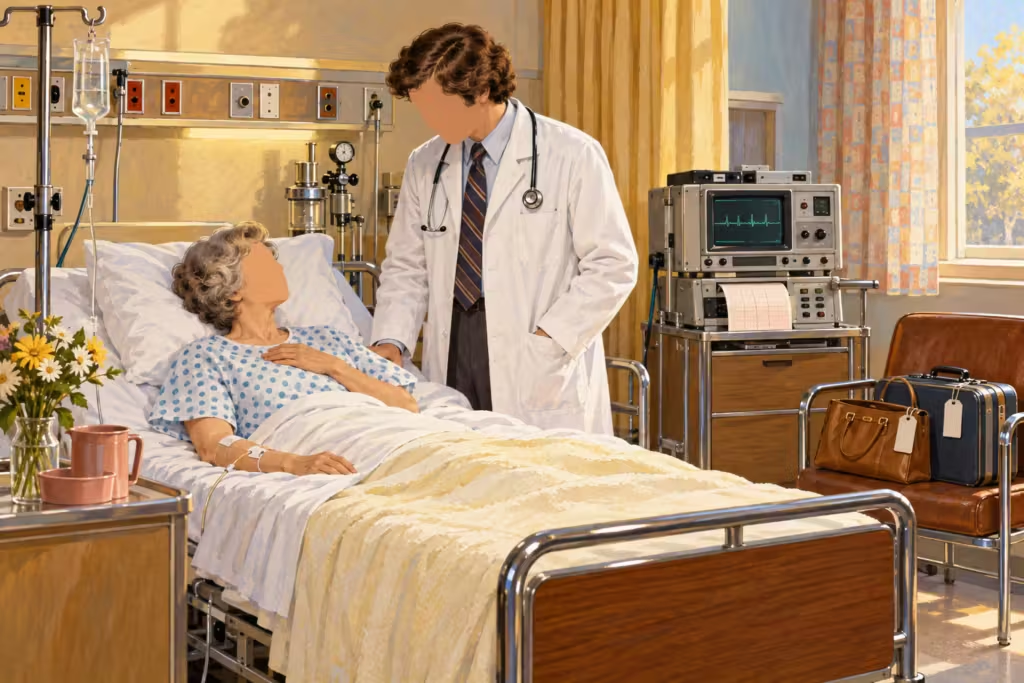
Mrs. M. says that, suddenly, she was back in her body. She was lying in bed, looking up at the doctor.
The medical record says that her blood pressure came back up between 7:30 and 8:00. At 8:00 she was fully awake. She had a mild pain in her chest. They did an electrocardiogram and it was normal. An electrocardiogram is the test that measures the rhythm of the heart.
The doctors thought her heart had briefly lost its normal rhythm. Her back pain could have triggered it in a woman who was diabetic and had heart disease.
The medical record doesn’t say her heart stopped. It says her blood pressure couldn’t be measured and she wasn’t responding. She was in that state for less than an hour.
Seven months later, she told Michael Sabom about what she had been through.
Step 9
August 1978 · Seven months later · Michael Sabom’s account
Mrs. M. tells Sabom about her experience, and he records the interview
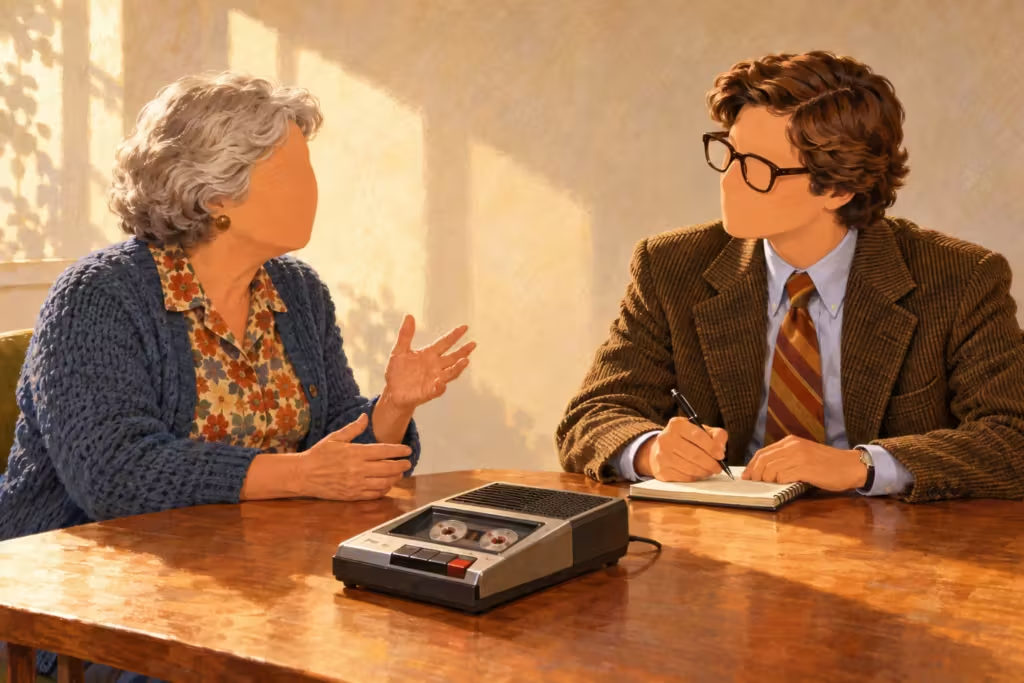
Sabom interviewed many survivors in the hospital without knowing whether they had had an experience like this. Mrs. M. was not one of them. She came to Sabom because she was already talking about her experience.
Sabom recorded the interview. He asked her specific questions. He asked where she was watching from, what equipment was there, and what they did with it. Mrs. M. told him there was a cart with lots of things on it, but she didn’t know what they were.
This interview is the earliest version we know of her account. There is nothing in writing from before it.
Afterward, Sabom looked up her medical record from that morning.
Step 10
After the interview · Michael Sabom’s account
Sabom finds the blood drawn at 7:30 in her medical record
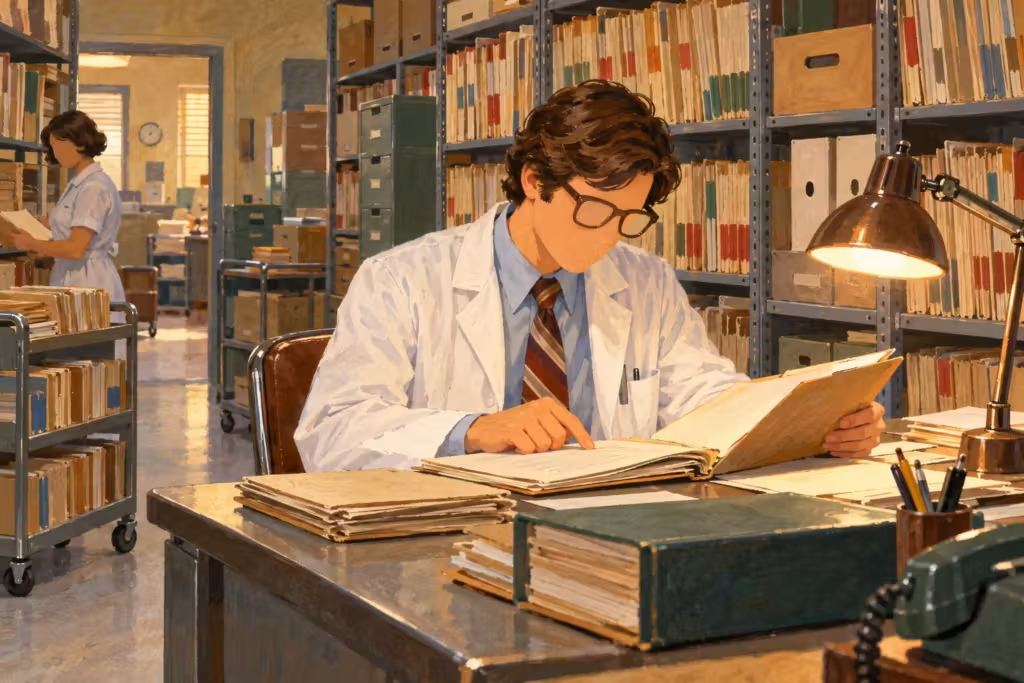
Sabom says Mrs. M. had never seen her medical record. The record had the times from that morning. The dizziness came at 7:00. By 7:10 her blood pressure could no longer be measured. And the cardiac arrest alert came at about 7:15.
The blood gas test was there too. At 7:30, blood was drawn from an artery and sent to the laboratory. That was in the middle of the time when she was seriously ill.
This part could be checked. Sabom writes that the medical record specifically mentions this test. Sabom doesn’t say clearly whether the record says it was in her hand.
Other things are not in the medical record. The record says they started an IV, but not in which hand. And it says nothing about the bags for the ICU.
One question remained. Could she have guessed what a resuscitation is like?
Step 11
During the same years · In a cardiac unit · Michael Sabom’s account
Sabom asks 25 heart patients to imagine a resuscitation, and 20 get it wrong
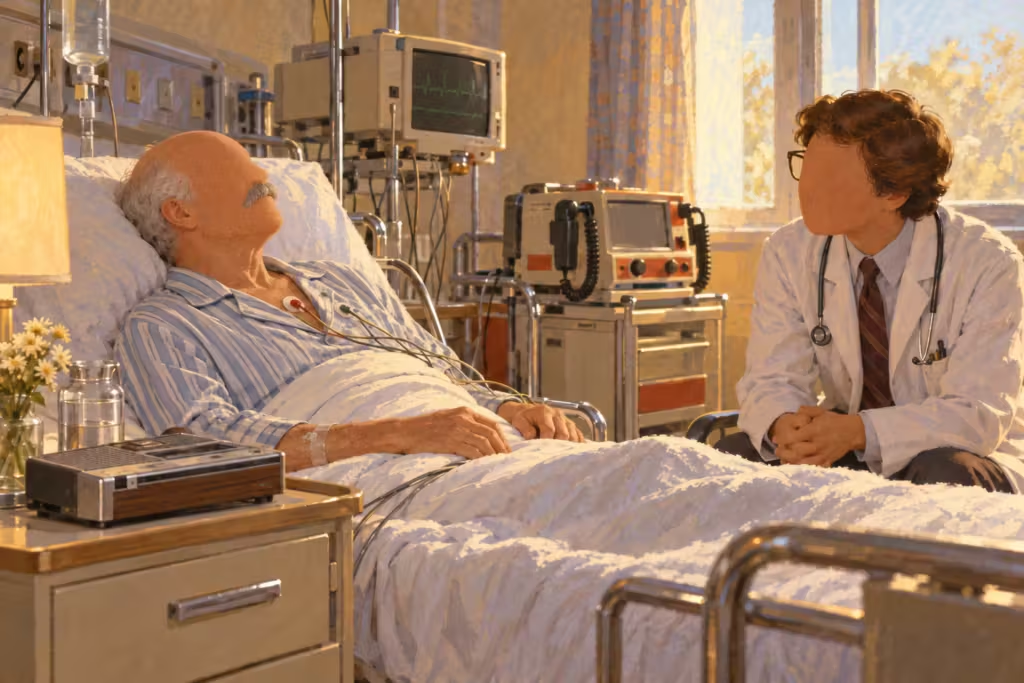
To find out, Sabom interviewed 25 heart patients in a coronary care unit. They had been ill for years, and almost all of them had had a heart attack. They knew hospitals well.
He asked them to imagine they were watching someone being resuscitated from a corner of the room. They were to describe only what they were sure they would see.
Twenty of the 25 made at least one major mistake. The most common one was thinking that doctors give mouth-to-mouth, which is hardly ever used in the hospital. Others said the patient is struck on the back, or that the chest is opened.
Mrs. M.’s account has no mistakes of that kind. But there is a difference. Those 25 patients had not been through a resuscitation. She had been through one. During her resuscitation she may have heard or felt things.
Step 12
1982 · Michael Sabom’s account
Sabom publishes Mrs. M.’s case in his book

In 1982, Sabom published his book Recollections of Death. Mrs. M. is one of the six cases that he was able to compare in detail.
Sabom had started out saying, “I don’t believe it.” In the book, he writes that what she described matched what her medical record noted. He says that, from a doctor’s point of view, her account was very realistic. She described the IV, the chest compressions, the mask, and the checks of the pulse in her neck and of her eyes.
What can be checked today about the needle that she says she saw that morning?
How many people have an NDE?
Mrs. M. is not a one-off. For more than thirty years, several teams of doctors have asked people who survive a cardiac arrest what they remember. They do it in the hospital, a few days afterward.
Picture 100 of those people:
Each dot is a person. The 18 filled-in dots are the ones who described a near-death experience. That is what the largest study found: 344 people in the Netherlands, in 2001.
The other 82 didn’t describe one. Many remember nothing of their cardiac arrest.
| Where and when | People interviewed | Described an NDE |
|---|---|---|
| United States, 1982 (Sabom) | 78 | 43% |
| England, 2001 | 63 | 6% |
| Netherlands, 2001 | 344 | 18% |
| United States, 2002 | 30 | 23% |
| United States, 2003 | 116 | 10% |
| United Kingdom, United States, and Austria, 2014 | 101 | 9% |
What these figures don’t tell you
- Sabom didn’t ask only people who had had a cardiac arrest. Of his 78 survivors, 66 had had a cardiac arrest. The others had been in a coma or had been in an accident. That is why his figure can’t be fully compared with the others.
- Only some people are asked. In the 2014 study, 330 people survived, but only 140 could be interviewed, and 101 reached the second interview. The rest died later, were too ill, or didn’t respond.
- Most cardiac arrests are never counted. These studies run in a few hospitals for a limited time. Outside them, no one keeps track. Also, the 2003 study interviewed 1,595 cardiology patients, not just the 116 with cardiac arrest in the table, and 81 of them described an NDE from an earlier occasion. The study did not count them, because it only counted those from that hospital stay.
- Some people keep quiet. In the accounts in our archive, at least 13 people say they kept their experience to themselves for a while. They kept quiet because they weren’t believed or because they were afraid of how others would react.
- It depends on how you count. If you count any memory of the cardiac arrest, the numbers go up. If you use a strict scale, they go down. In England in 2001, 7 of 63 people remembered something, but only 4 qualified as an NDE on the scale.
That’s why no one knows the real figure. Every study shows that it isn’t rare. Mrs. M.’s case stands out because her medical record has times. The record places the test she says she saw at 7:30.
Where this story comes from
Books
- Michael Sabom, Recollections of Death (Harper & Row, 1982), chapters 1 and 7Buy the book
Case documents
- Mrs. M.’s medical record, as quoted by Sabom in his book (1982)
Studies
- Michael Sabom’s study: 116 people and 25 who imagined a resuscitationRead
- Van Lommel and colleagues (2001), ten hospitals in the Netherlands, The Lancet 358:2039-2045View in the journal (free with registration)
Our archive
- The accounts in the portalecm archive
Keep reading

Zurich, 1944
Carl Gustav Jung
After a heart attack in 1944, Carl Gustav Jung said he saw the Earth from space. According to him, his doctor appeared to him to say he had to go back, and from then on Jung feared for the doctor’s life. The doctor died months later.

Oklahoma, 2009
Crystal McVea
In 2009, Crystal McVea, a teacher from Oklahoma, stopped breathing in a hospital. She said she was with God and saw a little girl with a basket. Afterward, her mother found a photo.
London, 1924
Doris
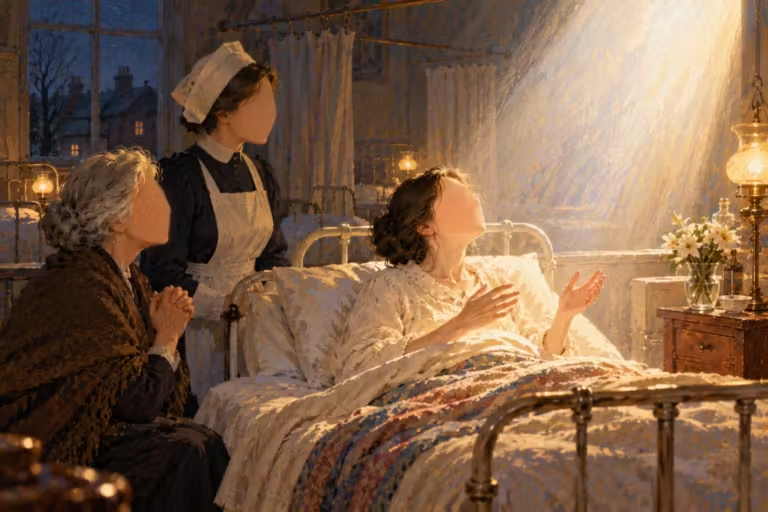
Doris was dying after giving birth and said she could see her sister Vida. Vida had died 18 days earlier, and no one had told Doris.

Reincarnation: The top 5 people who remember past lives
We asked them the same five questions as this story. A 32-page PDF, free in your inbox.
Check your email
We have sent you an email. Open it and press the button to confirm. If you cannot see it, check your spam folder.