
A real-life story · Zurich, Switzerland, 1944
Carl Gustav Jung’s near-death experience
In February 1944, Carl Gustav Jung, the Swiss psychiatrist, was 68 when he broke his leg. About ten days later he had a heart attack. He later said he saw himself high up in space, looking at the Earth, and that he saw a huge rock floating there with a temple inside. He also said his doctor appeared to him and told him he had to go back. According to Jung, from then on he feared for that doctor’s life.
Jung, the psychiatrist who founded analytical psychology, described this vision in his memoirs. His doctor died on June 30, 1944, and an obituary from the time confirms it. But we have found nothing written about Jung’s fear before that death. We tell it step by step and then look at what can be checked. If you only want the evidence, skip straight to what can be checked. Did Jung fear for his doctor’s life before the doctor died?
Step 1
February 1944 · Near Zurich, Switzerland · Told by his biographer Gerhard Wehr and by Barbara Hannah, a student of Jung’s
Jung slips in the snow, breaks his leg, and is admitted to a clinic in Zurich

Carl Gustav Jung was 68. He was the Swiss psychiatrist who founded analytical psychology, and he lived in Küsnacht, a town next to Zurich.
One day in February 1944, he went out for one of his long walks. A few kilometers from home, he slipped in the snow and broke his fibula, one of the bones of the leg. With great effort he dragged himself to the nearest house and called a taxi.
He was admitted to the Hirslanden private clinic in Zurich. To heal, he had to lie still in bed. Barbara Hannah, a student of Jung’s, told the story years later. According to her, at first Jung happily read his books on alchemy.
According to Hannah, his body, used to being active, rebelled against so much inactivity.
Step 2
About ten days later · Critically ill · Told by Barbara Hannah and by Jung
He has a thrombosis in his heart and two more in his lungs, and spends weeks at death’s door
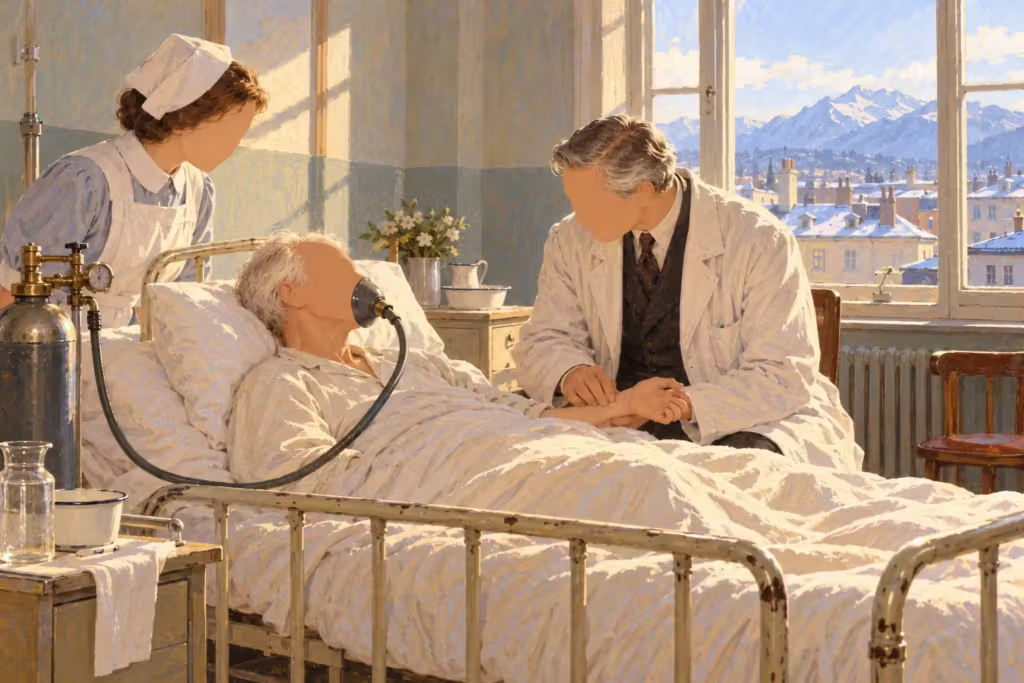
According to Barbara Hannah, about ten days after entering the clinic, Jung had a very serious thrombosis in his heart. Two more thromboses reached his lungs. A thrombosis is when a clot blocks a blood vessel. In his memoirs, Jung calls what happened to his heart a heart attack.
No one expected it. His wife, Emma, got a room in the same clinic and stayed there until he went home. Jung was at death’s door for several weeks.
He was treated by Dr. Theodor Haemmerli, a Zurich cardiologist with an international reputation. According to an obituary published in 1945, the doctor had been in poor health as a young man, but after that he had not fallen ill again. He turned 60 in November 1943, and at that time no one thought he would die soon.
Jung writes that he was given oxygen and camphor. A nurse later told him he had seemed to be surrounded by a glow, something she had sometimes seen in people who were dying.
Jung says that this is when the visions began.
Step 3
February or March 1944 · Unconscious, in danger of death · Jung’s account
Jung says he sees himself high up in space, looking at the Earth

Jung does not know whether he was dreaming or in ecstasy. He saw himself high up in space. Far below was the Earth, bathed in a beautiful blue light. He could see the deep blue sea and the continents.
Right beneath his feet lay the island of Ceylon, now Sri Lanka, and in front of him lay India. To the left he could see the Arabian desert, a reddish-yellow color, and the Red Sea. Far in the distance, he could just make out a piece of the Mediterranean. The snowy mountains of the Himalayas were wrapped in clouds.
He later found out that a view like that is only possible from about 1,500 kilometers up. This is how he remembers it in his memoirs:
“The sight of the Earth from that height was the most glorious and enchanting thing I had ever experienced.”
He knew he was about to leave the Earth.
Then he turned around.
Step 4
During the same vision · Jung’s account
Jung says he sees a huge rock floating in space, with a temple inside

Near him, a huge block of dark stone floated in space, like a meteorite. It was as big as his house, or bigger. A temple had been carved into it. Jung had seen granite rocks like that, with temples carved into them, on the coast of the Bay of Bengal, in India.
At the entrance, an Indian man dressed in white sat cross-legged on a stone bench, waiting for him in silence. Countless little coconut-oil flames burned around the door. Jung had seen a door like that years before, at a temple in Kandy, in Ceylon.
As he approached the steps, he felt everything he thought, wanted, or desired fall away from him. It was very painful. But he still had everything he had lived and done. He sums it up like this:
“I am this bundle of what I have done and what I have been.”
He was sure that inside the temple he would find the people he truly belonged with. And that there he would finally understand why his life had been the way it was.
Before he could go in, something rose up from Europe.
Step 5
During the same vision · Jung’s account
Jung says his doctor rises from Europe as a king of Kos and tells him he must go back

From below, from Europe, an image rose up. It was his doctor, Dr. Haemmerli, framed by a gold chain or a golden laurel wreath. Jung recognized him at once.
Kos is a Greek island. Hippocrates, who is considered the father of medicine, was born there. And Kos had a famous temple of Asclepius, the Greek god of medicine.
Jung writes that his doctor came “in his primal form,” as “a Basileus of Kos.” Basileus means “king” in Greek. For Jung, that figure from Kos had always existed, and in life his doctor was its embodiment. Now the doctor was appearing to him as he really was, deep down. In 1955, Jung wrote that only later did he learn that the great physicians of Kos called themselves kings.
Without words, the doctor let him know that the Earth had sent him with a message. There was a protest because Jung was leaving, and Jung does not say who was protesting. He could not leave the Earth and had to go back.
As soon as he understood this, the vision ended. Jung writes that he felt enormously disappointed. Now he would not be able to enter the temple or join his people.
He was back in his bed at the clinic.
Step 6
The next three weeks · Very weak · Jung’s account
Jung says that, back in bed, he fears his doctor is going to die
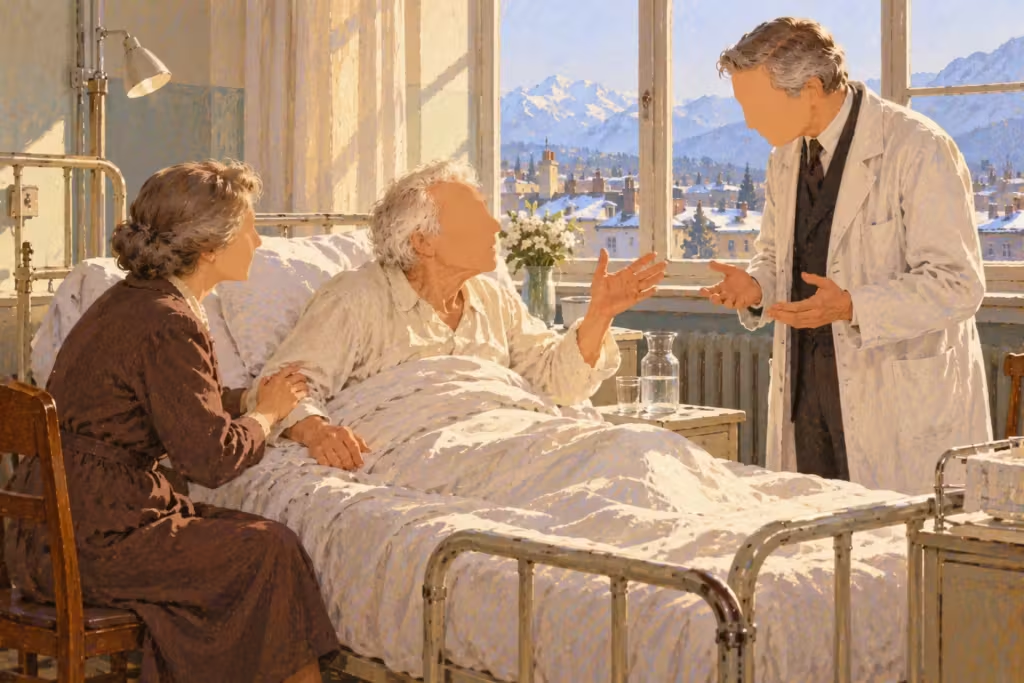
It took him about three weeks to decide to live. During the day he couldn’t eat. From his bed he could see the city and the mountains, and they looked to him like a painted curtain full of black holes. Life seemed like a prison.
Every night he woke up around midnight and spent about an hour in a state of complete happiness, with new visions. During the day, the sadness came back.
He resented his doctor for bringing him back to life. And at the same time he was worried about him. He thought that anyone who appears in his primal form must die, because he already belongs with “his people.” They were like the people Jung expected to meet in the temple. And suddenly a thought frightened him. He thought the doctor was going to die in his place.
Jung writes that he tried to talk to the doctor about it, but the doctor didn’t understand him, and that made him angry. His wife reproached him for being so unpleasant to the doctor.
Jung says he remembers one date very well.
Step 7
April 4, 1944 · Beginning to recover · Jung’s account
Jung says that on the day he first sits up in bed, his doctor takes to his bed, never to get up again

On April 4, 1944, Jung was allowed to sit on the edge of his bed for the first time. According to Jung, that same day his doctor went to bed and never got up again.
Jung writes that he heard the doctor had a fever from time to time. He does not say when he learned this. Jung also writes that he was Dr. Haemmerli’s last patient.
According to Jung, the doctor died soon after of septicemia, a serious infection that spreads to the blood.
The doctor’s death was also recorded in his hometown.
Step 8
Spring and summer 1944 · Told by a 1945 obituary
Dr. Haemmerli falls ill in the spring and dies in Zurich on June 30, 1944

In 1945, a journal from Lenzburg, the Swiss town where the doctor was born, published his obituary. It says that Theodor Haemmerli fell ill in the spring of 1944. He himself knew that his illness could only be eased and could no longer be cured. He died on June 30, 1944, in Zurich. He was 60.
The obituary does not say what he died of. It doesn’t name Jung either.
A few days after that death, Jung started writing letters again.
Step 9
July 1944 to February 1945 · Told by Jung’s letters
In his letters from 1944 and 1945, Jung names the dead doctor and describes the vision, but says nothing about his fear
The published edition of his letters has none from January to July 1944. The editor of the letters puts this down to Jung’s illness. In August, Jung wrote to one of his students, the psychologist Alwine von Keller, and mentioned Dr. Haemmerli. It is the first time he names him in writing. According to Jung, the doctor had died “on the eve of his fame.” He said nothing about the vision or his fear.
In February 1945, Jung wrote in English to Kristine Mann. She was an American doctor and psychologist who was dying of cancer. He told her about the vision. He wrote about the Earth, the rock with the temple, and the little oil flames. He wrote that, at that moment, “a messenger from the world” arrived and told him he was not allowed to leave. He did not say who the messenger was.
The first thing we have found in writing about that fear dates from 1955.
Step 10
1955 and 1962 · Jung’s account
Jung writes about his fear for the doctor, in a letter to the doctor’s brother and in his memoirs
In 1955, Arnim Haemmerli, a doctor in Zurich and Dr. Haemmerli’s brother, sent Jung a postcard from the island of Kos. In October, Jung answered with a handwritten letter. He told him that Dr. Haemmerli had appeared to him in his delirium, framed by the golden wreath of Hippocrates. According to the letter, the doctor told Jung he had no permission to go any farther from the Earth. Then Jung added this:
“From the moment of this vision I feared for the life of your brother.”
In the same letter, he told him what happened on April 4, 1944. That day Jung was able to sit up in bed for the first time, and Dr. Haemmerli took to his bed, never to get up again. The letter was written eleven years after the doctor’s death.
Jung died in 1961. A year later his memoirs came out. He had told them, over time, to his collaborator Aniela Jaffé. The whole story is there, with his attempt to talk to the doctor and his wife’s reproach. In English they were published as Memories, Dreams, Reflections.
One question remains: did Jung fear for his doctor’s life before the doctor died?
Do you have to be close to death to have an NDE?
In Jung’s case, we don’t know what state his heart was in during the vision, because his medical records have not been published. That is why a study that checked other people’s medical records, to see whether they had really been close to death, is useful.
In 1990, three researchers at the University of Virginia reviewed the medical records of 58 people who described an NDE. Most of them believed they had been close to death.
| According to their medical records | People | Saw a very bright light |
|---|---|---|
| Had really been close to death | 28 | 21 |
| Had not been close to death | 30 | 12 |
What these figures don’t tell you
- The experiences were very similar in both groups. The same share of people in both groups said they had left their body. The tunnel and believing they were dying came up a little more often among those who had really been close to death, but the difference was so small it could have been chance. Only two things stood out among those who had really been close to death. They more often saw a bright light, and they more often said they were thinking more clearly.
- These are people who wrote to the university on their own. Half of them did so seven years or more after their experience.
So an NDE alone doesn’t tell you how close someone came to dying. Without his medical records, there is no way to measure how ill Jung was. His case stands out for what he said about his doctor.
Frequently asked questions
What did Carl Gustav Jung see in his near-death experience?
Jung said he saw himself high up in space, looking at the Earth bathed in blue light. He also saw a rock floating there with a temple inside. Before he entered the temple, his doctor appeared to him as a king of the Greek island of Kos. The doctor told him he had to go back. Jung told the whole story in his memoirs, published in 1962.
Did Carl Gustav Jung predict his doctor’s death?
There is no way to know. Jung wrote that he feared for his doctor’s life from the time of the vision, and the doctor died on June 30, 1944. But the first thing we have found in writing about that fear is a letter from 1955, eleven years later. Here we explain what can be checked.
Who was the doctor who appeared to Jung in his vision?
He was Dr. Theodor Haemmerli, a Zurich cardiologist with an international reputation, who treated Jung after his 1944 heart attack. He was born in 1883 in Lenzburg, Switzerland, and died in Zurich on June 30, 1944, at age 60.
Where did Carl Gustav Jung describe his near-death experience?
Jung described it in a 1945 letter to the American psychologist Kristine Mann and in another letter, in 1955, to his doctor’s brother. He told the whole story in his memoirs, which came out in 1962, a year after his death. In English, they are titled Memories, Dreams, Reflections.
Where this story comes from
The book
- Carl Gustav Jung, Memories, Dreams, Reflections, recorded and edited by Aniela Jaffé. German original: Erinnerungen, Träume, Gedanken (Rascher, 1962), chapter “Visionen,” pages 293–299
Letters and biography
- C. G. Jung Letters, volume 1 (Princeton University Press, 1973), pages 343–345 and 357–359, letters of July 11 and August 21, 1944, and February 1, 1945Buy the book
- C. G. Jung Letters, volume 2 (Princeton University Press, 1975), pages 272–273, letter to Arnim Haemmerli of October 25, 1955Buy the book
- Gerhard Wehr, Jung: A Biography (Shambhala, 1987), pages 338–340, with Barbara Hannah’s accountBuy the book
Case documents
- Heinrich Geissberger, obituary of Dr. Theodor Haemmerli-Schindler, Lenzburger Neujahrsblätter, no. 16, 1945, pages 56–59, in GermanRead for free
Learn more
- Mary Neal: another NDE with a warning of a death, told only after the death had happenedRead
- What is a near-death experience?Read
- What does science say about near-death experiences?Read
- How we check each storyRead
Our archive
- Our reading of the obituary, of the 1944, 1945, and 1955 letters, and of the memoirs in German, and the case’s score on our five criteria, as of October 30, 2026
Keep reading
United States, 1978
Mrs. M.
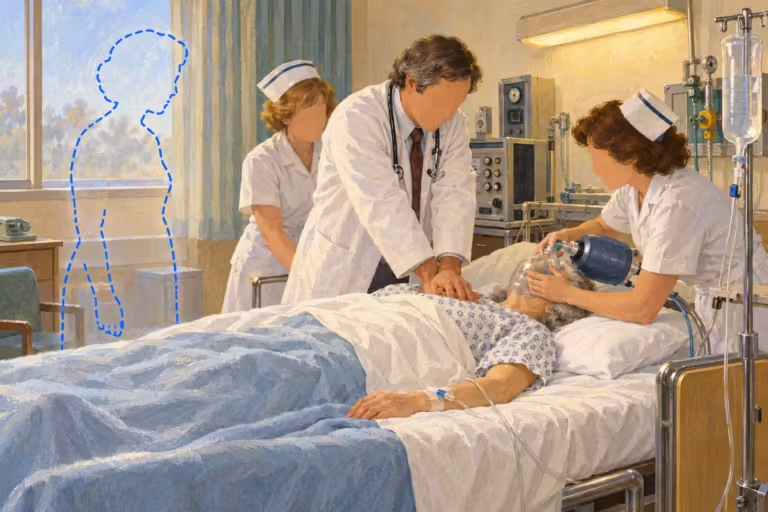
She was resuscitated in her hospital bed. She later said she saw them prick her hand with a small needle, and she talked about blood gases. Her medical record notes that blood was taken from an artery at 7:30.

London, 1924
Doris
Doris was dying after giving birth and said she could see her sister Vida. Vida had died 18 days earlier, and no one had told Doris.
Colombia, around 1985
Luding Coenen
She had a hemorrhage in childbirth and says she saw her grandparents and a light. She says that years later she saw buildings falling at two in the morning. It was the time of an earthquake in Turkey.

Reincarnation: The top 5 people who remember past lives
We asked them the same five questions as this story. A 32-page PDF, free in your inbox.
Check your email
We have sent you an email. Open it and press the button to confirm. If you cannot see it, check your spam folder.