A study · three hospitals in Slovenia, 2008 and 2009 (published in 2010)
The Klemenc-Ketis study: 52 resuscitated people and the CO2 in their blood
A near-death experience, or NDE, is a very intense experience that some people have when they are about to die. In 2010, the physician Zalika Klemenc-Ketis and two colleagues published a study of 52 people resuscitated after a cardiac arrest in Slovenia. Eleven of them described an NDE. Those eleven had more CO2 in their blood than the others. CO2 is carbon dioxide, the gas the body gets rid of when we breathe out. The authors think CO2 could be one of the factors that trigger an NDE. That same year, the psychiatrist Bruce Greyson suggested another explanation to them. In his view, high CO2 might only show that the blood was flowing better, and that is why these people remember better. The authors accepted it as possible.
The study’s question is: do people who have an NDE during a cardiac arrest have something different in their blood? We tell it step by step: whom they studied, what they measured, and what came out. If you only want to know what is known, skip straight to the results.
Step 1
Before 2008 · The question
An old idea: that blood gases trigger the NDE
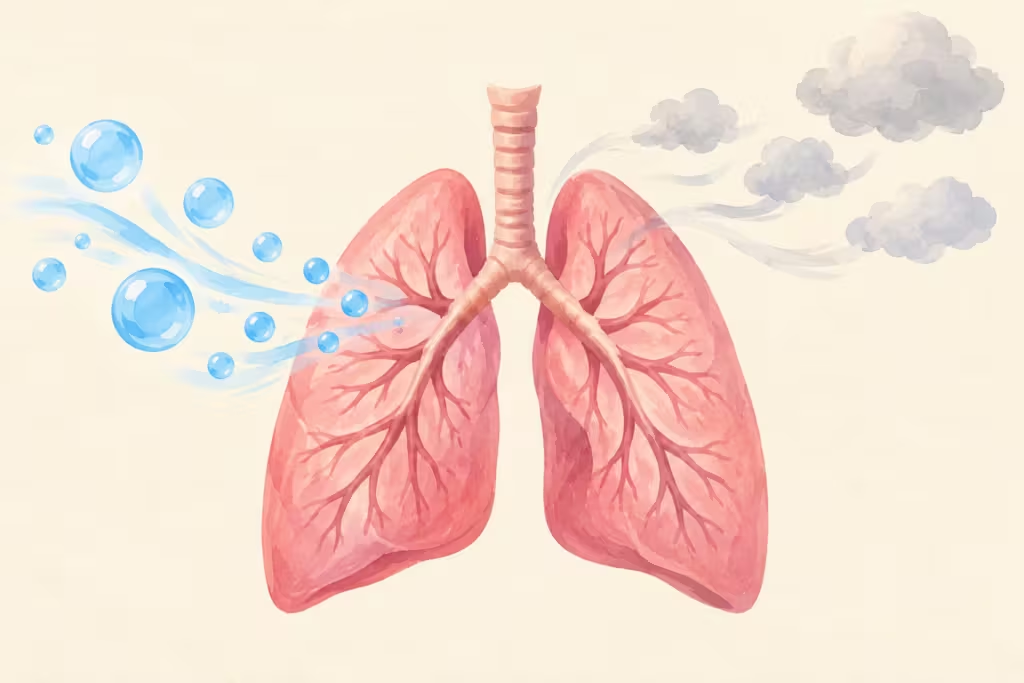
A cardiac arrest is when the heart stops pumping. The blood then stops carrying oxygen to the brain, and CO2 builds up in the body. That is why, for decades, some researchers have thought that a lack of oxygen or too much CO2 might trigger the NDE.
The authors recall something from the 1950s. Some psychiatrists had their patients breathe CO2 as a treatment. Several patients described experiences similar to an NDE.
Until 2010, almost no one had measured these gases in people who had actually had a cardiac arrest. In 2001, a team in Southampton, England, looked at the blood of 63 survivors. Only 4 had an NDE, too few to draw conclusions. We cover this in the Southampton study.
A physician in Slovenia decided to measure it in her country’s three largest hospitals.
Step 2
2008 · Slovenia · As the study tells it
Three hospitals in Slovenia record every person resuscitated outside the hospital
Zalika Klemenc-Ketis is a family doctor at the University of Maribor, in Slovenia. She did the study with Janko Kersnik, also a family doctor, and with Štefek Grmec, an emergency physician in Maribor.
The study took place in the intensive care units of Slovenia’s three largest hospitals: Ljubljana, Maribor, and Celje. Most people in the country who have a cardiac arrest are taken there. The team recorded everyone who arrived between January 2008 and June 2009, one after another, without choosing.
The study only included people whose cardiac arrest began with a heart problem, not with suffocation or another cause. Emergency teams also had to have resuscitated them outside the hospital. And they had to have come out of the cardiac arrest with their brain unharmed.
Out of more than four hundred cardiac arrests, 52 people remained.
Step 3
2008 and 2009 · The interviews · As the study tells it
Of 426 people in cardiac arrest, 52 enter the study, and none refuses to answer

Emergency teams tried to resuscitate 426 people. The heart started beating again in 178. Seventy-six left the hospital alive. Of these, 24 didn’t meet the study’s conditions, which left 52.
A member of the team visited each of them while they were in the hospital. They explained the study and asked for permission. No one refused. Each person filled in the Greyson scale, a 16-question questionnaire that researchers use to decide whether an experience is an NDE. With 7 points or more, the experience counts as an NDE.
Then the team took two kinds of CO2 measurements from the medical records:
- The CO2 in the air coming out of the lungs. Emergency teams measure it with a device during resuscitation. The study used the first measurement written down in the medical records.
- The CO2 and oxygen in the blood. The study used the first blood test, the one done within five minutes of arriving at the hospital. It also used the sodium and potassium from that test, two salts in the blood that change during a cardiac arrest.
Both measurements are from the resuscitation or from arrival at the hospital. No one knows at what moment, between the cardiac arrest and arrival at the hospital, each person had their NDE.
The people who described an NDE came out different on CO2.
Step 4
2010 · The results · As the study tells it
The 11 people with an NDE had more CO2 than the others

Of the 52 people, 11 described an NDE. That is 21 in 100. It is a figure similar to that of other cardiac arrest studies.
CO2 came out higher in the people with an NDE on both measurements. In the air from the lungs, they had an average of 5.7, compared with 4.4 in the people without an NDE. In the blood, they had 6.6, compared with 5.3. Both figures are in kilopascals, the unit used to measure a gas in the blood. According to the authors’ tests, these differences are unlikely to be chance.
Oxygen came out lower in the people with an NDE, 16.4 compared with 25.3, also in kilopascals. But oxygen varied a lot from one person to another, and that difference could have been chance. Blood potassium didn’t separate those who had an NDE from those who didn’t. But across everyone, the more potassium a person had, the more points their experience scored on the Greyson scale.
Two people had already had an NDE before. Both had another one during this cardiac arrest.
Having an NDE wasn’t linked to sex, age, education, or religion. Nor was it linked to fear of death, to how long it took for the pulse to return, or to the drugs given during resuscitation.
Next, the team did a calculation that looks at several things at once. It included blood CO2, potassium, and having had an NDE before. These were the three that had come out linked to the NDE or to its score. Of the three, only blood CO2 was still linked to having an NDE.
With these data, the authors drew their conclusions.
Step 5
April 2010 · The conclusion · As the study tells it
The authors think CO2 could trigger the NDE, but not that it explains all of it

The authors write that CO2 could be one of the main factors that trigger the NDE. They point out that CO2 changes the acidity of the brain, and that this can produce lights, visions, or the feeling of leaving the body.
They themselves explain what the CO2 in the air from the lungs means during resuscitation. If it is high, it means that chest compressions are moving the blood well. That measurement is taken during resuscitation. For the authors, the fact that resuscitation CO2 comes out higher in those who had an NDE supports the idea that the NDE happens during the cardiac arrest.
They also write that the NDE can’t be explained by bodily processes alone. In their view, the memories that brain processes produce tend to be fragmented and confused. NDEs, on the other hand, are clear and orderly, and they are easy to remember.
They acknowledge that their biggest weakness is the number of people. With only 11 people with an NDE, they call for larger studies in more hospitals.
Six weeks later, a psychiatrist in Virginia wrote to the same journal.
Step 6
May 2010 · The letter · As Bruce Greyson tells it
Bruce Greyson suggests that high CO2 may only show that these people remember better

Bruce Greyson is the University of Virginia psychiatrist who created the Greyson scale. He wrote a letter to the journal. He was surprised by the result, because other studies hadn’t found that link. He cites the 2001 Southampton study and a 1982 case from the cardiologist Michael Sabom. In that case, the CO2 measured during the NDE was lower than normal.
Greyson suggests another explanation, using the same fact the authors gave: high CO2 shows that the blood is flowing well. If the blood flows better during resuscitation, the CO2 in the air comes out higher. With more blood, the brain suffers less, and the person forgets less of what happened during the cardiac arrest. So those with more CO2 would remember better, and that is why they would describe more NDEs. CO2 wouldn’t trigger them.
He adds that the CO2 in the blood isn’t a good guide to how much CO2 there is in the brain. And he calls for caution, because of the small number of people in the study and the other studies that say the opposite.
The authors replied in the same journal. They write that Greyson’s explanation may also be true, and that it should be tested. But they maintain that CO2 could also trigger the NDE. They suggest a way to find out. Cardiac arrests caused by suffocation leave more CO2 than cardiac arrests that begin in the heart. If there were more NDEs in cardiac arrests caused by suffocation, the case for CO2 would get stronger.
That study hasn’t been done. Fifteen years later, the debate is still at the same point.
Step 7
2025 · What came next
No one has repeated the study, and each side still reads CO2 in its own way
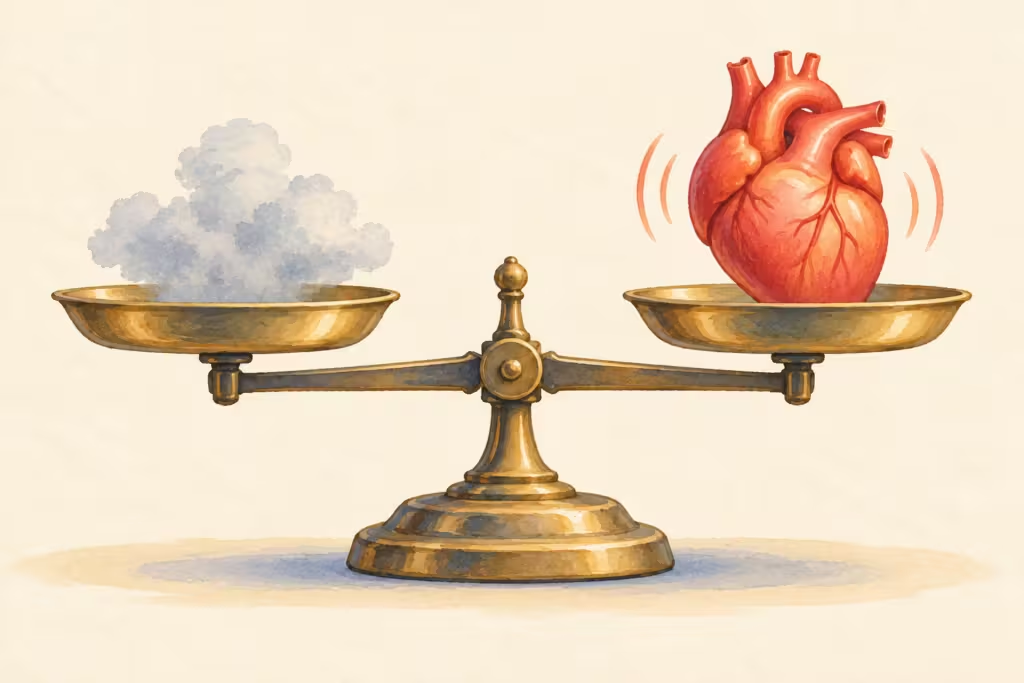
We don’t know of any study that has repeated this measurement with more people.
In 2025, a team from the University of Liège, in Belgium, published the NEPTUNE model. It is an attempt to explain the NDE through what happens in the brain. In it, too much CO2 during a cardiac arrest is one of the pieces. According to the model, excess CO2 makes the brain more acidic and changes how neurons work.
That same year, Bruce Greyson and the researcher Marieta Pehlivanova replied to the model. They repeat the argument from the 2010 letter. In their view, high CO2 shows that the blood was flowing better, and that helps people remember the NDE, not have it.
The question from the beginning remains: do people who have an NDE have something different in their blood? Let’s look at what is known and what isn’t.
The measurements in each group
The average of each measurement in the 11 people who described an NDE and in the 41 who didn’t. Gases are in kilopascals, and sodium and potassium in millimoles per liter.
| Measurement | With an NDE | Without an NDE | Conclusive difference? |
|---|---|---|---|
| CO2 in the air from the lungs | 5.7 | 4.4 | Yes |
| CO2 in the blood | 6.6 | 5.3 | Yes |
| Oxygen in the blood | 16.4 | 25.3 | No |
| Potassium | 4.6 | 4.1 | No |
| Sodium | 139.2 | 140.4 | No |
| Minutes until the pulse returned | 8.3 | 8.8 | No |
What these figures don’t tell
- They are averages from very small groups. A single person with a very high or very low measurement can shift the average of the 11 people with an NDE.
- They are measurements from resuscitation and from arrival at the hospital. They don’t say how much CO2 there was at the moment of the NDE, or in the brain.
- “Conclusive” means that the difference passed the authors’ statistical test. It is unlikely to be chance, although not impossible. It doesn’t say what causes it.
Frequently asked questions
Does CO2 cause near-death experiences?
No one knows. A 2010 study in Slovenia followed 52 resuscitated people. The 11 who described an NDE had more CO2 in their blood than the others. But high CO2 also shows that the blood was flowing better, and that might only help people remember the experience. The authors themselves accept that explanation as possible.
What did the Klemenc-Ketis study find about NDEs?
The physician Zalika Klemenc-Ketis studied 52 people resuscitated after a cardiac arrest in three hospitals in Slovenia. Eleven of them described an NDE, and those 11 had more CO2 than the others. Age, sex, religion, and the drugs given had nothing to do with it.
Do people who have an NDE lack oxygen?
It isn’t clear. In the 2010 study in Slovenia, oxygen came out lower in the people with an NDE, but the difference could have been chance. The 2001 Southampton study looked at the blood of 63 cardiac arrest survivors. The 4 people with an NDE had more oxygen, but they were too few to draw conclusions.
How did Bruce Greyson respond to the CO2 study?
The psychiatrist Bruce Greyson wrote in 2010 that high CO2 shows that the blood was flowing better during resuscitation. With more blood, the person would forget less of what they experienced during the cardiac arrest, and so they would describe more NDEs. The authors replied that this explanation may also be true.
Where this page comes from
The study
- Zalika Klemenc-Ketis, Janko Kersnik, and Štefek Grmec, “The effect of carbon dioxide on near-death experiences in out-of-hospital cardiac arrest survivors: a prospective observational study,” Critical Care 14(2):R56 (2010)Read for free
Assessments and critiques
- Bruce Greyson, “Hypercapnia and hypokalemia in near-death experiences,” with the authors’ reply, Critical Care 14(3):420 (2010)Read for free
- Charlotte Martial et al., “A neuroscientific model of near-death experiences,” Nature Reviews Neurology 21:297–311 (2025)View in the journal (paywalled)
- Bruce Greyson and Marieta Pehlivanova, “A neuroscientific model of near-death experiences reconsidered,” Psychology of Consciousness (2025)Read for free
To understand more
- The Southampton study, which also looked at survivors’ bloodRead
- The NEPTUNE model: a 2025 attempt to explain NDEs through the brainRead
- What does science say about near-death experiences?Read
Our archive
- A full reading of the article by Klemenc-Ketis, Kersnik, and Grmec, and of Greyson’s letter with the authors’ reply, compared page by page, as of October 30, 2026
More studies
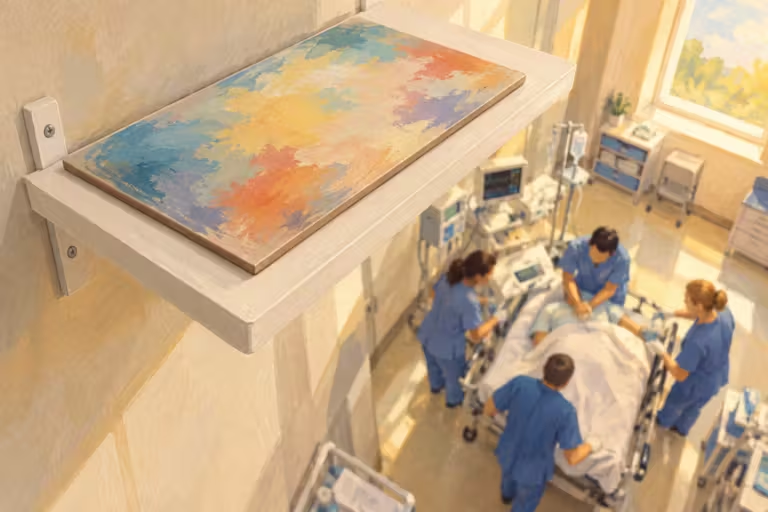
AWARE: the pictures hidden on the shelves
Fifteen hospitals put up pictures that could only be seen from the ceiling, to check whether anyone saw them during a cardiac arrest.
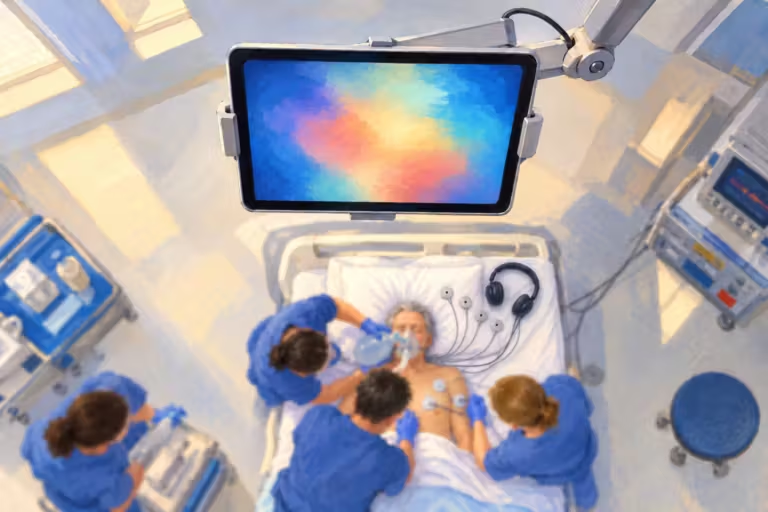
AWARE II: a random picture and the brain on the screen
Above the patient was a tablet with a random picture. Headphones said the names of three fruits. And the doctors measured the brain during resuscitation.
Van Lommel: 344 cardiac arrest survivors in ten hospitals
Ten hospitals asked every cardiac arrest survivor what they remembered. They saw them again after 2 and 8 years.