How does life change after a near-death experience?
Many people say they are no longer the same after a near-death experience. The change they mention most is that they lose their fear of dying. They also say they care more about other people and less about things. Some changes last for decades. And not all of it is easy. Many people keep what happened to them to themselves for years.
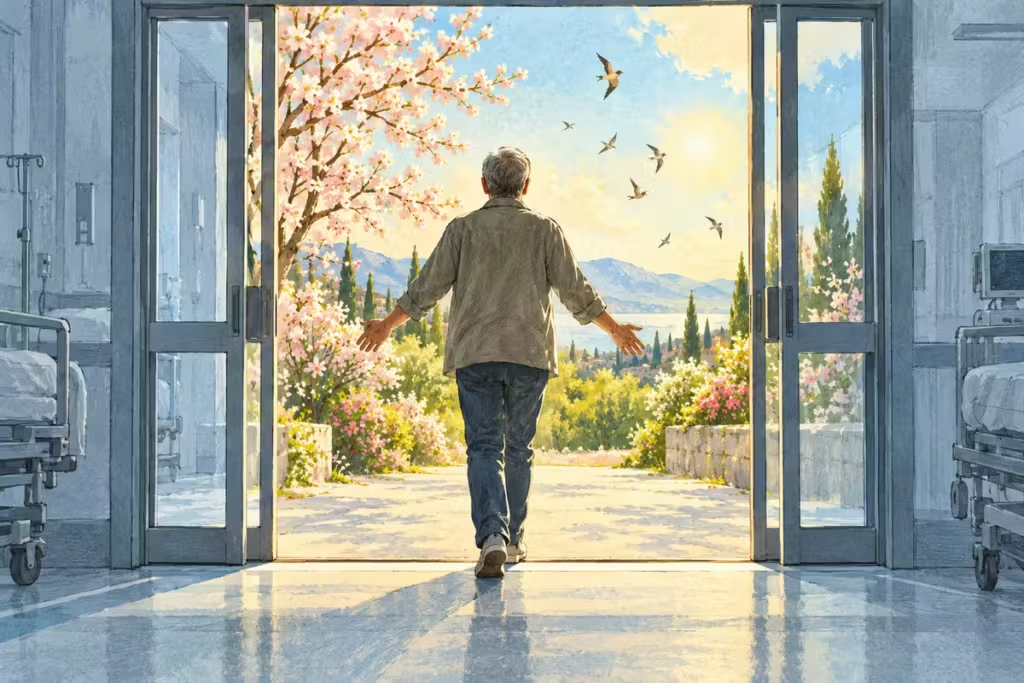
- Most common
- Losing the fear of death. Also more love and empathy, a greater appreciation of everyday life, and more interest in the spiritual.
- How long it lasts
- In the strongest study, the changes last at least eight years. In surveys, they last decades.
- The hard part
- Many people keep quiet for fear of not being believed. Some doctors tell them it was the anesthesia. And some studies find more divorces.
- What we don’t know
- How much is due to the experience itself and how much to having come close to death.
What changes most
The most cited study was carried out in ten hospitals in the Netherlands. The researchers compared two groups two years after the cardiac arrest. One group had 35 people who had had a near-death experience. The other had 39 who had not. The two groups were matched for age and sex.
Those who had had one had changed more than the others in 13 of the 34 areas measured. Four stood out:
- More love and empathy for others.
- Greater appreciation of everyday life.
- Less fear of death.
- Stronger belief in an afterlife.
People with a shallow experience changed just as much as those with a very deep one.
Other studies find the same thing for the main change, which is losing the fear of death:
| Where and when | Lost their fear of dying |
|---|---|
| India, 2008 | 56 out of 100 |
| Japan, 2014 | 13 of 22 people |
| Online survey, 2022 (only people whose experience changed how they saw death) | 88 out of 100 |
In India, 41 out of 100 also became more religious and more generous.
How long it lasts
- At least eight years. The Dutch researchers went back to them after eight years. The changes were clearer than at two years. According to the authors, the change takes years to settle in.
- Decades, by people’s own account. Some surveys asked people whose experience was some 18 or 23 years earlier. They still describe those changes. But they are the ones recalling it, years later. And only those who want to answer do so.
- After one year, in the ICU in Liège, quality of life was the same for people who had had a near-death experience as for those who had not.
Is it only the people who have one who change?
Not entirely. This is one of the most interesting questions, and the data point both ways:
- Coming close to death changes people too. In the Netherlands, the people who had not had the experience had also changed for the better after eight years. They were more self-assured, more attentive to others, and more religious. But those who had had one were still different in their interest in the spiritual, in their belief in an afterlife, and in their fear of death.
- Some psychedelic experiences bring similar changes. In a 2022 survey, 88 out of 100 people lost their fear of death after a near-death experience. After a psychedelic experience, the figure was 89 out of 100.
- But more people rank the near-death experience as the most meaningful of their lives than rank the psychedelic one that way. In the same survey, 76 out of 100 said the near-death experience was the most meaningful experience of their lives. After psychedelics, 52 out of 100 said so. Another study asked 31 people who had had both experiences. The near-death experience eased their fear of death a little more than the psychedelic one.
When an experience changes a life this much, it tells us it was very intense and very real to the person who lived it. But on its own, that change does not tell us where the experience comes from. There are two explanations, the classic theory and the modern one. Both expect that change. We explain them in What does science say?
What they say they bring back
In our archive we have reviewed the accounts of 192 people who talk about their experience in public. Almost all of them bring back some message from it. These are the figures as of October 9, 2026:
- That they have something to do now that they are back: 148 of 192. Most were told this by a being during the experience.
- That death is not the end: 139. Most reach this conclusion afterward.
- That life is for learning: 112.
- That we should live in the present and let go of material things: 85 of 172.
These are people who chose to speak in public. So they do not represent everyone.
What is hard
- Keeping quiet. In the accounts in our archive, at least 13 people say they kept their experience to themselves for a time, sometimes for decades. One of them was told by the surgeon that it had been the anesthesia. That person did not talk about it again for 30 years.
- Not being understood. According to the Dutch study, the change takes time to settle in. One reason is other people’s rejection and the fear of ridicule.
- More divorces, according to one study. A 2005 doctoral dissertation found 65 divorces per 100 couples after a near-death experience. After another serious life event, there were 19 divorces per 100 couples. It is a small study, with 26 people in each group, and it does not take age properly into account. The figure of “70 to 80 out of 100” circulates online, but it does not come from this study.
- When the experience was frightening. After a distressing experience, people change less than after a pleasant one. And some carry it with them for years. We cover this in What if the experience is frightening?
Less common changes
Some people describe changes that science has not checked:
- More intuition or unusual perceptions. In 1983, a survey asked 69 people about extrasensory perceptions. Before the experience, 25 out of 100 said they had them. After the experience, 55 out of 100 said they had them. Nobody checked those perceptions. And the author himself says these people may simply pay more attention to such things.
- Devices that fail. Some people say their watches stop or their light bulbs burn out. Our archive has several accounts like this, but there are no studies.
Frequently asked questions
Do people lose their fear of death after a near-death experience?
In most studies, yes. Anywhere from half to nearly nine in ten people lose it, depending on the study. But in one small study in the United States, fear of death was the same in those who had one and in those who did not.
Does it change your personality?
Many people say it does. They say they have more empathy, less interest in material things, and more interest in the spiritual. In the Dutch study, these people had changed more than other survivors. And the changes were still there after eight years.
Is it true that many people get divorced afterward?
A 2005 study found more divorces after a near-death experience than after other serious life events, but it was small and had limitations. No other study has confirmed or refuted it.
What helps someone after a near-death experience?
Above all, being listened to without being judged. A 2025 survey asked 167 people who had an NDE. 85 out of 100 needed to talk about it, but more than half were afraid to. Sometimes the first person they told reacted well. In those cases, the support they looked for later helped them much more often. Most of the people who answered belonged to an association for NDE experiencers. So the survey doesn’t represent everyone.
Keep reading
- Howard Storm’s storyAfter his experience, he left academia and became a pastor.
- What is a near-death experience?What people go through, how often it happens, and what changes afterward.
- What if the experience is frightening?Experiences of fear or distress, told with the same care.
Where these figures come from
- van Lommel et al. (2001), ten hospitals in the Netherlands, The Lancet 358:2039-2045. View in the journal (free with registration)
- Pasricha (2008), India, Journal of Near-Death Studies 26(4). Read for free
- Ohkado and Greyson (2014), Japan, Journal of Near-Death Studies 32(4). Read for free
- Sweeney et al. (2022), survey on death after an NDE or a psychedelic experience, PLoS ONE 17(8):e0271926. Read for free
- Martial, Carhart-Harris, and Timmermann (2024), the same person having an NDE and a psychedelic experience, Neuroscience of Consciousness niae033. Read for free
- Rousseau, Martial, et al. (2023), ICU in Liège, Critical Care 27:76. Read for free
- Schwaninger et al. (2002), St. Louis, Journal of Near-Death Studies 20(4):215-232. View in the journal (paywalled)
- Christian (2005), marriage after an NDE, doctoral dissertation, University of North Texas. Read for free
- Greyson (1983), psychic phenomena after an NDE, Theta 11(2):26-29.
- Greyson (2023), the darker side of near-death experiences, Journal of Scientific Exploration 37(4). Read for free
- Our archive: accounts with their records, and the count of what 192 people bring back, as of October 9, 2026.