A real-life story · Mexico, 1998
David Rojas’ near-death experience
David Rojas says that in June 1998 he was shot in the leg during an attempted kidnapping in Mexico. He had surgery at a public social security hospital. He later said that during the operation he saw himself from above and saw the doctors operating on him. He also said that when he woke up he recognized the surgeon. The surgeon told him there had been one fewer doctor in the operating room than David had seen.
According to David, the surgeon was surprised that David recognized him. And that same surgeon also told him that one of the doctors he described wasn’t there. In the same scene there is a hit and a miss, and the witness is the same. What did David see in the operating room?
Step 1
Before · David’s account
A musician whose career is going very well

David Rojas is a musician. As a boy, he picked out by ear on his grandmother’s piano the songs he heard on the radio. He studied music for ten years in Montreal and came back to Mexico eager to try everything. He even earned a pilot’s license.
In the end, he chose music. He sets up his own recording studio in Ciudad Satélite, just outside Mexico City. He is musical director of the OTI Festival and of artists such as Emmanuel. He is doing very well. He has a good car and a good house.
He says he is Catholic, “not a fanatic” (translated from Spanish). In 1998 he has no interest at all in the paranormal.
Step 2
Wednesday, June 3, 1998 · 10:12 p.m. · David’s account
An attempted kidnapping outside his studio
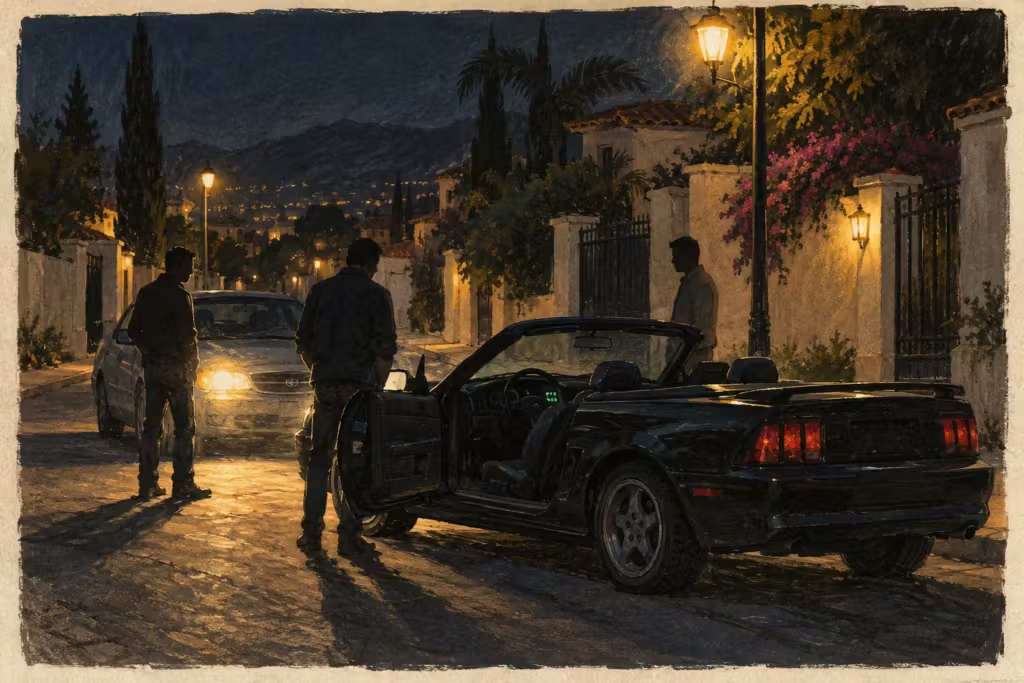
He arrives at his studio with his girlfriend. He has plans to watch Game 1 of the NBA Finals with some friends: the Chicago Bulls against the Utah Jazz.
He stops on the private street where the studio is. He notices a car pulling up behind him. When he opens the door, someone hits him on the head with the butt of a pistol. There are four or five men. They push his girlfriend into the back seat and shove him over the gearshift.
The car’s digital clock shows 22:12 (10:12 p.m.) on Wednesday, June 3. David says he remembers it as if he were living it right now.
His car has an anti-theft system. If the door is opened and closed, the car shuts off. And it won’t start again without a code. The car won’t start.
Step 3
That night · David’s account
Shot in the leg
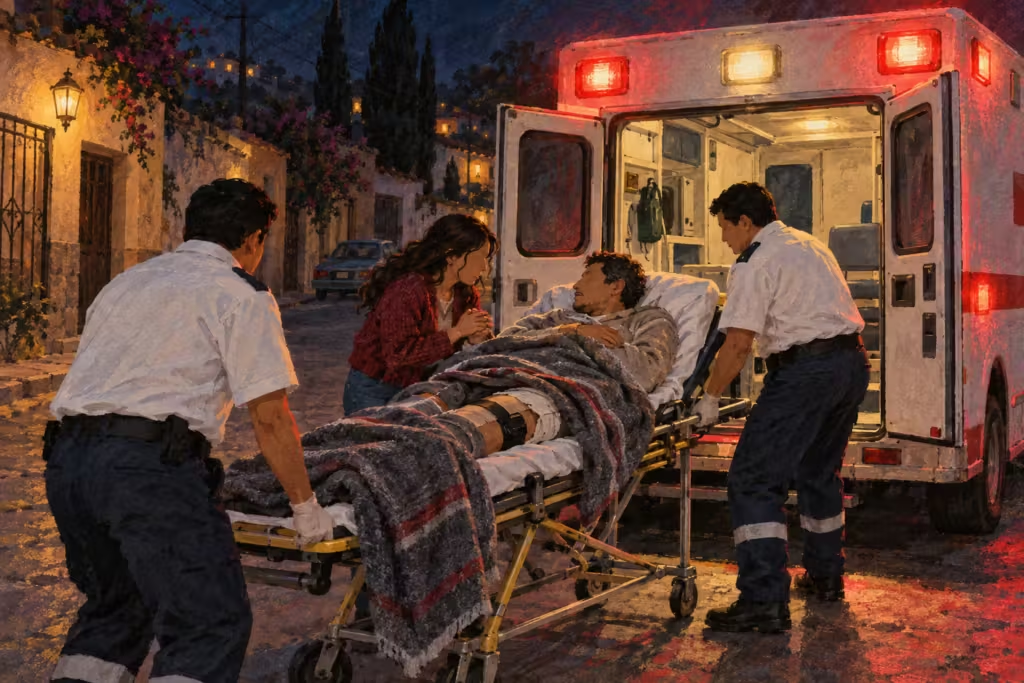
One of the men pulls out a 9 mm pistol and shoots him in the left leg. It doesn’t hurt. It feels like a kick. The attackers run off, firing five times at his girlfriend. They miss.
The bullet has shattered his femur and passed very close to the femoral artery. He can’t get up. He is losing a lot of blood. To slow the bleeding, he pushes a finger into the hole where the bullet came out, near his groin.
The ambulance takes a long time. He doesn’t know how long. It may have been fifteen minutes or half an hour. He is terribly cold, even though it is June. They put a tourniquet on him and take him away.
Step 4
At the hospital · Semiconscious · David’s account
He arrives at the hospital semiconscious
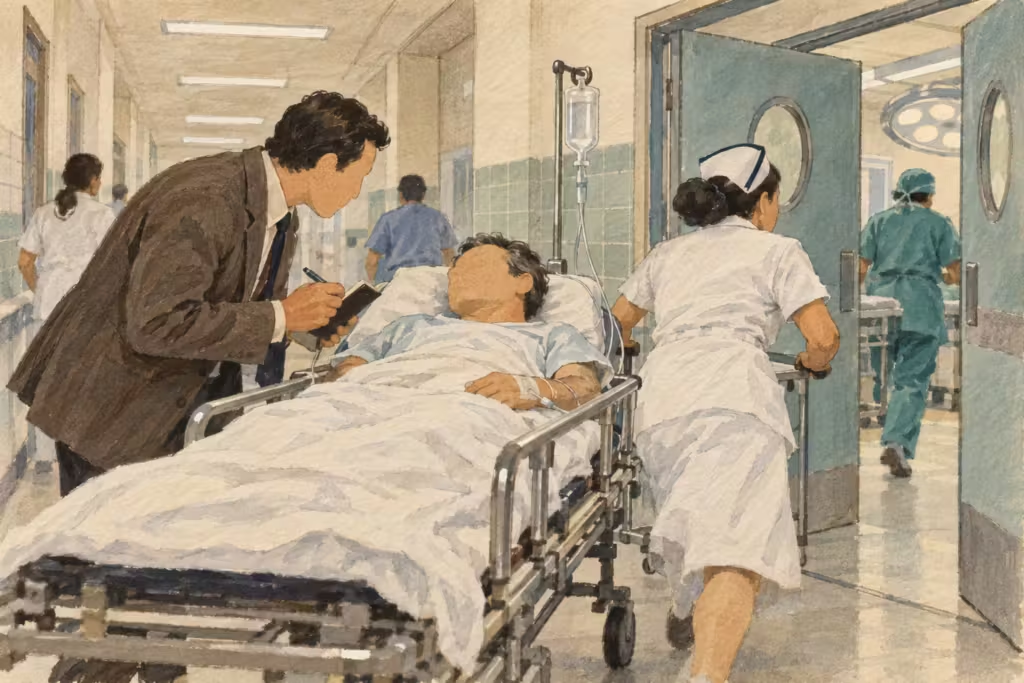
He is taken to a public social security hospital. He estimates that he has lost more than a liter of blood. He arrives “semiconscious.”
An investigator from the public prosecutor’s office arrives before he goes into the operating room, because gunshot victims have to give a statement.
David can’t speak. They wheel him into the operating room.
Step 5
In the operating room · Under anesthesia · David’s account
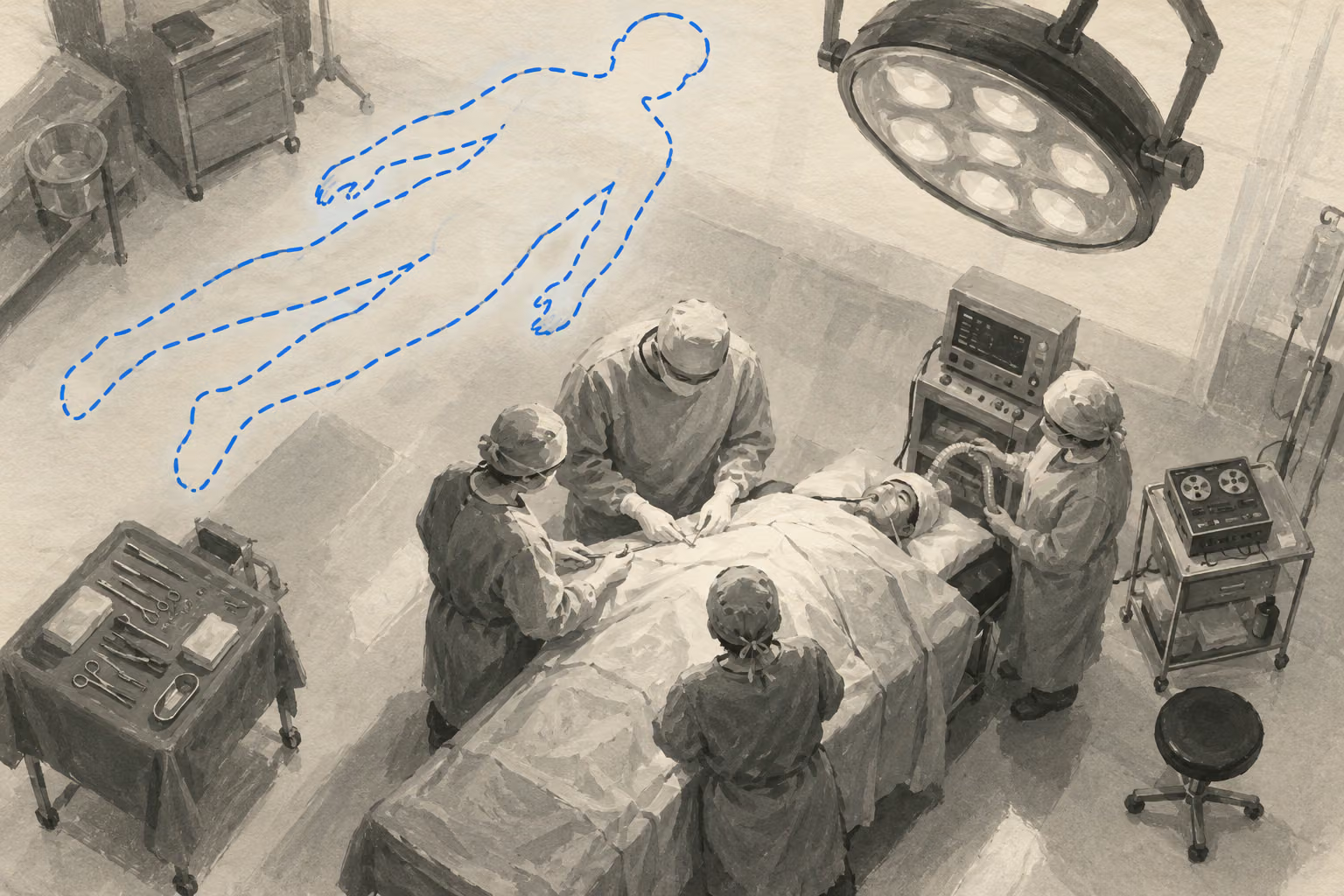
David says he sees himself from above, in black and white
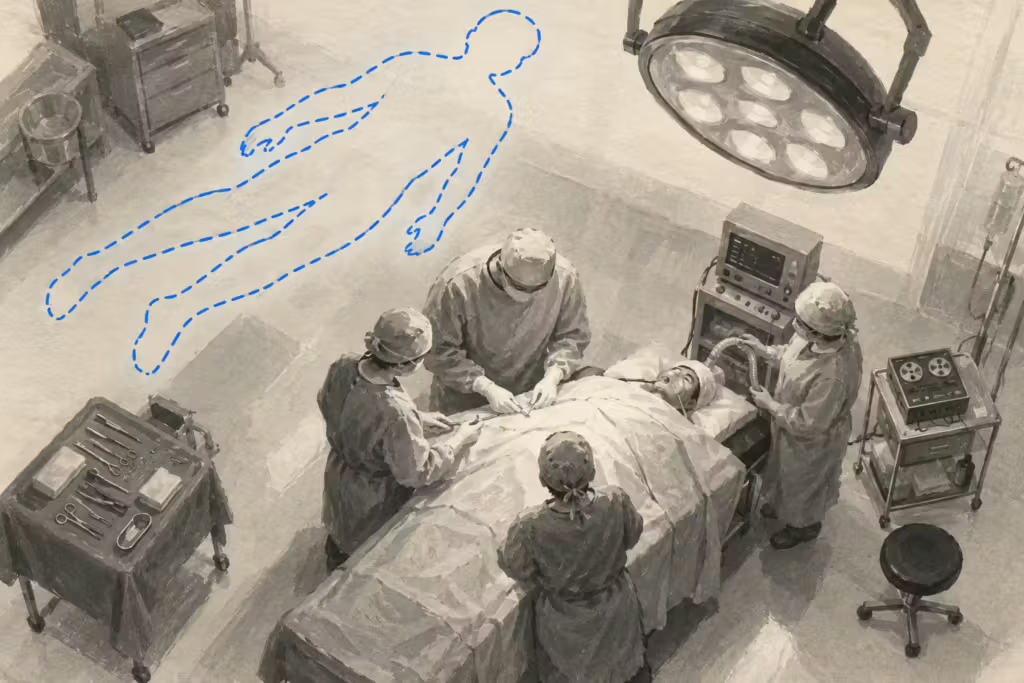
“The next thing I see is me.” He is up above, and he sees himself lying there as if asleep. Everything is in black and white, “like quick photographs.”
He sees a young woman giving him the anesthesia. He sees three doctors operating on him, in order of height. One is tall, one is of medium height, and one is shorter.
He sees his leg held open with something like forceps. And he sees what state his bone was in.
He can hear, too. The anesthesiologist has a tape recorder playing classical music. Albinoni’s Adagio is playing.
Step 6
In the operating room · David’s account
David says he feels no fear, no pain, and no cold
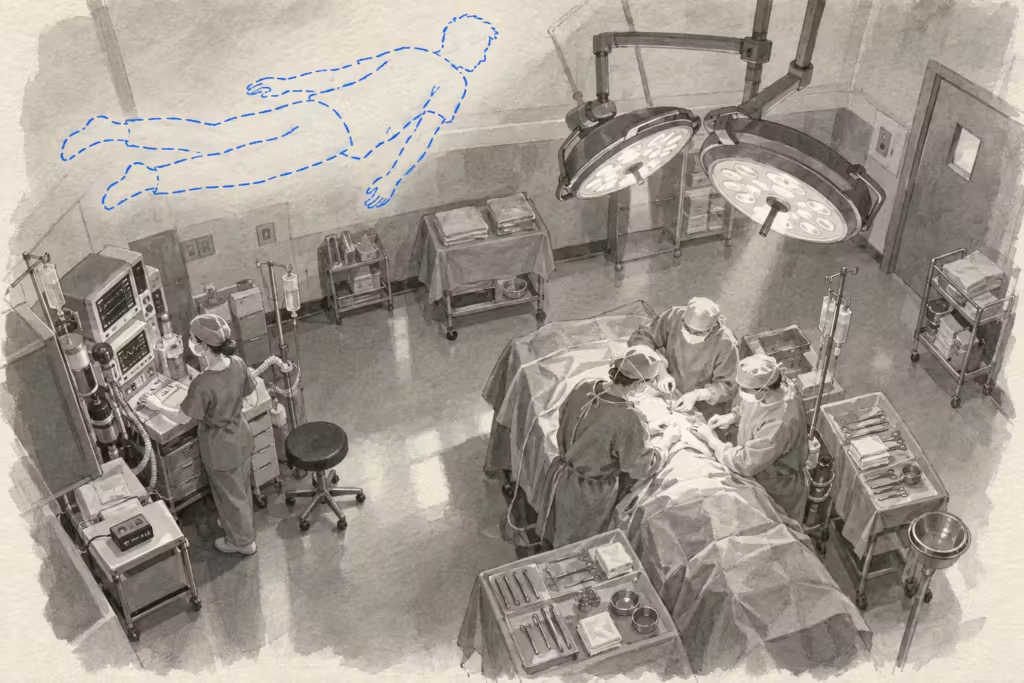
What he feels up there is a very deep peace. “There’s no fear, there’s no pain, there’s no cold.” The terrible cold he felt in the car is gone.
“Time and space don’t exist.”
David says that later the chief surgeon told him what had happened: “We lost you for 5 minutes. We didn’t know what to do. We had to do compressions.”
He believes those minutes with his heart stopped are the ones he saw from above. No document from the operation has been published.
Step 7
After the operation · Awake · David’s account
He wakes up not knowing whether he is alive
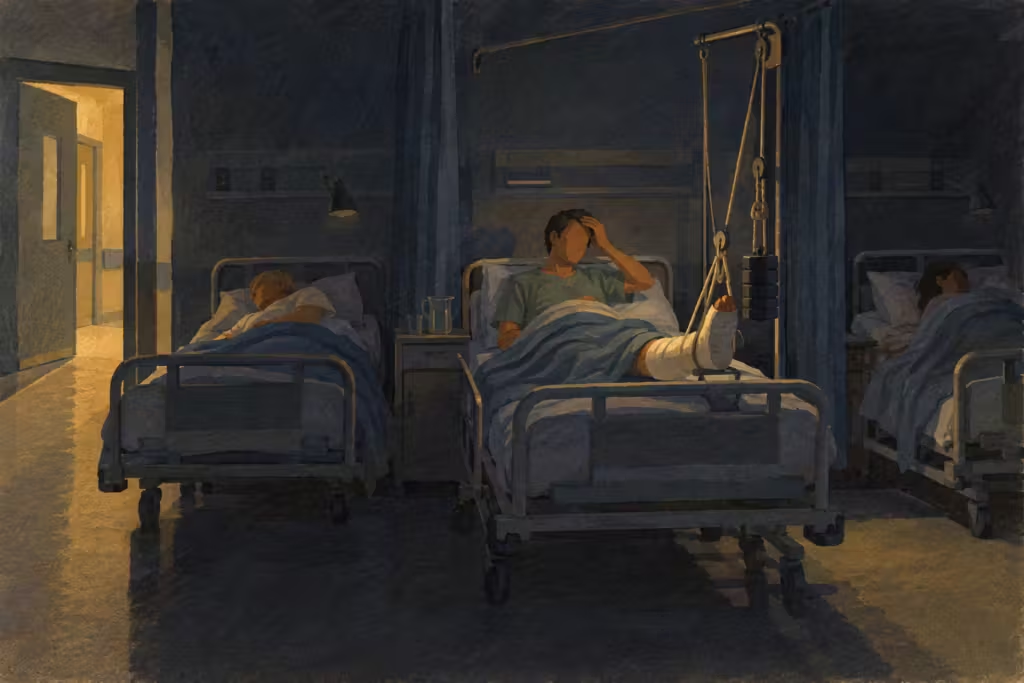
The next thing he remembers is a fairly dark ward, with two or three patients next to him. The anguish, the pain, and the cold all come back at once.
He doesn’t know whether he is alive or dead. He wonders whether what he saw really happened or whether he dreamed it.
Step 8
On waking · David’s account
He recognizes the surgeon who operated on him
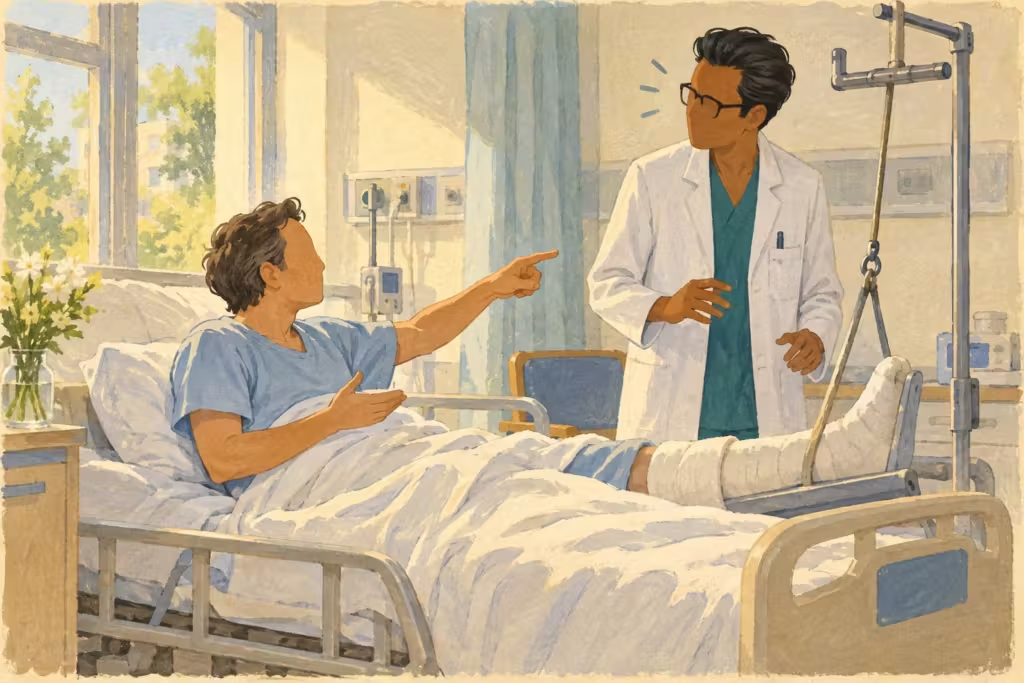
He is almost convinced he dreamed it. Then a doctor walks in. David asks him for something for the pain. Then he asks: “Hey, you operated on me, didn’t you?”
“Yes. How do you know?” “Because I remember you.”
“How can you remember me? We’d never met.”
It is the chief surgeon, Dr. Gilberto Eduardo Mesa. He is tall, thin, and dark, with glasses and his hair combed back. David also describes the second doctor to him, shorter and blond. He later learns that this is Dr. Alegre. The name means “cheerful” in Spanish. He jokes that Dr. Alegre “was anything but.”
Step 9
On waking · David’s account
A doctor who wasn’t there
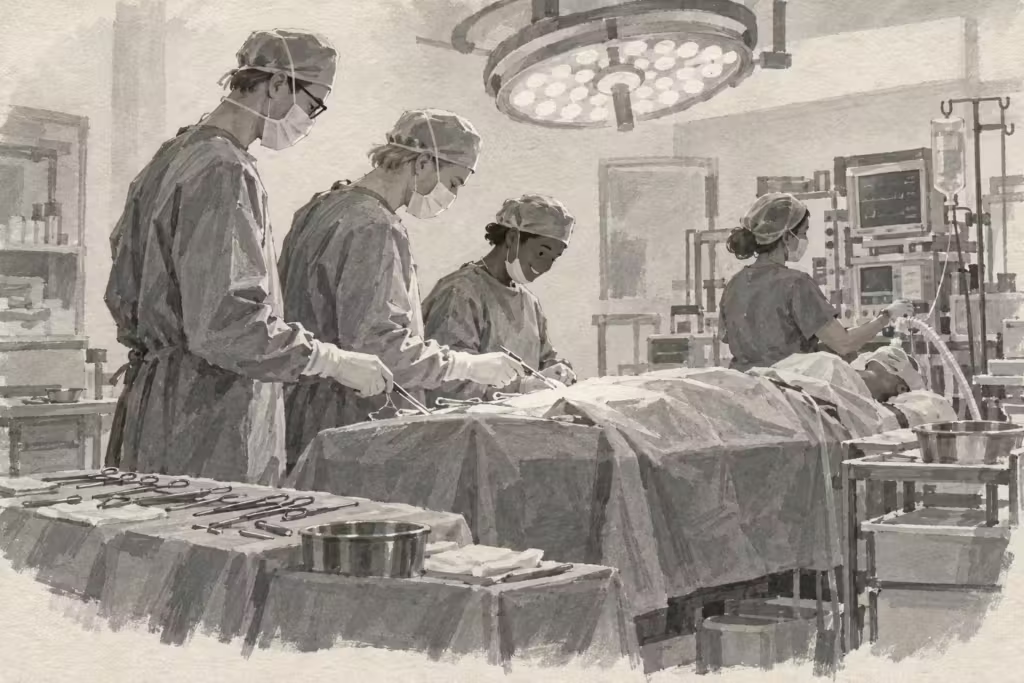
Then there is the third doctor. David describes him as even shorter, young, very dark-skinned, “sort of like someone from India,” and smiling a lot.
The surgeon answers: “No, there were only two of us.”
David insists that there were three, because he saw them in order of height. He asks whether the surgeon is joking. “I don’t like to joke, especially not about that kind of thing.”
Years later, when they had become friends, David asked the surgeon again. The surgeon told him there was no one like that on his team.
To David, that third doctor was an angel overseeing his operation. He never found out who he was.
Step 10
The following weeks · David’s account
The man in the next bed
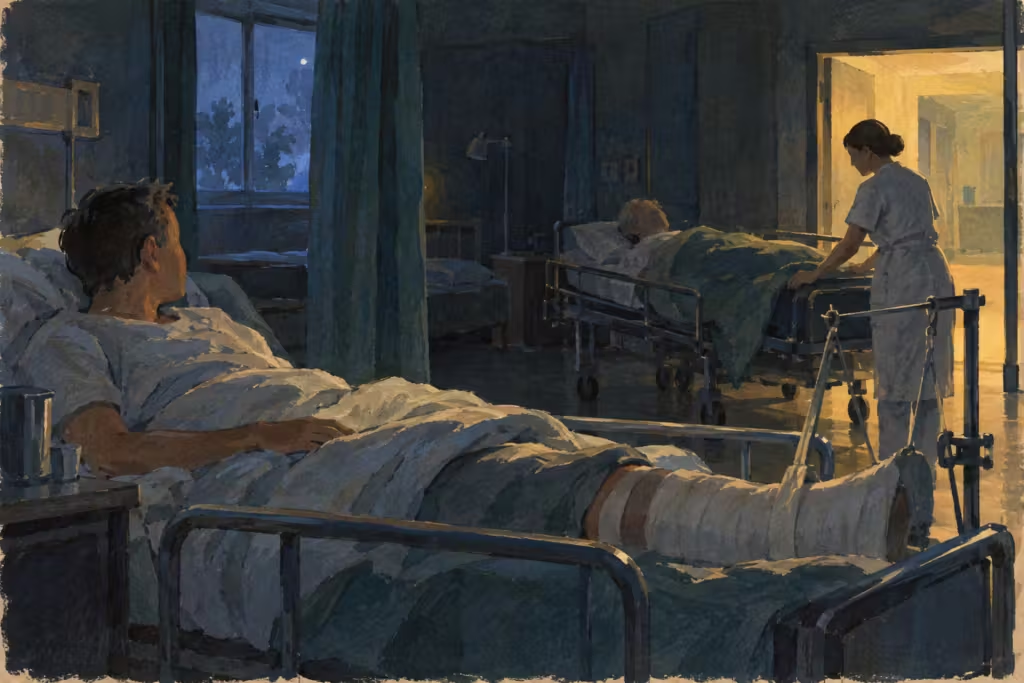
He spends three or four weeks in the hospital, with his leg in traction. A plate with 12 screws has been put in his femur.
In the bed next to him is an older man, very ill. David chats with him. He thinks the man’s name was Don Lázaro. Early one morning, the man is taken to surgery. He says that later he sees the man brought back to the next bed on a gurney. He asks how it went, and the man only murmurs.
In the morning the bed is empty. A nurse tells him the man died during the operation and was never returned to the ward: “We never brought him back.”
“To this day, I don’t have the answer,” he says. There is no way to check this part.
Step 11
Afterward and today · David’s account
He talks about death with people who are afraid of it

David says that since then he has had encounters with “spirit beings.” He says he sees them and has recorded them. Today he calls himself a “ghostologist.” He has been on television since 1999 or 2000 and has a show, Historias de fantasmas [Ghost Stories].
He gives free talks in hospitals and nursing homes. In them he says: “I was dead, and for me it was a pleasant experience.”
Once, after a show, a woman sat and waited until the line had cleared. She had terminal cancer and three weeks to live. She asked him: “What does it feel like to be dead?” He hugged her and told her she could go in peace.
His story needs someone else to tell it. That could be the surgeon, Dr. Alegre, the anesthesiologist, or the operative report.
How many people remember seeing their own resuscitation?
David says he saw the doctors while his heart was stopped. AWARE is a large hospital study. It did in-depth interviews with people who had survived a cardiac arrest.
Picture 100 of those people:
Each dot is one person. The study interviewed 101 people in depth at hospitals in the United Kingdom, the United States, and Austria. The 2 filled dots are the people who remembered seeing and hearing real things from their resuscitation.
Almost half remembered nothing:
| What they remembered | How many |
|---|---|
| Nothing, AWARE, 2014 (101 people) | 46% |
| A near-death experience, AWARE, 2014 | 9% |
| Seeing or hearing real things from their resuscitation, AWARE, 2014 | 2% |
| Seeing real things from their resuscitation, AWARE II, 2023 (28 people) | 1 of 28 |
What these figures don’t tell you
- Very few make it to the interview. The first study began with 2,060 cardiac arrests. Only 140 survivors were able to answer questions, and 101 completed the in-depth interview.
- The hidden images were never put to the test. The study placed images on high shelves that could only be seen from the ceiling. The two people who described seeing their resuscitation had their cardiac arrest in rooms without a shelf.
- David’s situation was different. He was in surgery, under anesthesia. It is not known whether the figures would be the same in an operating room.
Of those two people, one could be checked against his medical records. That is the story of the patient in the blue cap. What David saw could not be checked that way.
Where this story comes from
Interview
- Interview on the Experiencias Cercanas a la Muerte [Near-Death Experiences] channel (2026), in SpanishWatch on YouTube
Studies
- Parnia et al. (2014), AWARE, Resuscitation 85:1799-1805View in the journal (paywalled)
- Parnia et al. (2023), AWARE II, Resuscitation 191:109903Read for free
To understand more
Our archive
- His record and our assessment of what he saw in the operating room, as of October 10, 2026
Keep reading

California, United States, 1987
John Davis
He says that in 1987 his heart stopped for seven minutes. He says a guide showed him the afterlife, with a library of soulmates and a planetarium with millions of worlds. At the end he heard: “There is no death.”
California, 1997
Lucky Pettersen
At 4, Lucky came out of a coma and said his friend Big Gino had walked him back from heaven. Two weeks later, his family learned that Big Gino had died.
Montreal, 2008
Patient J.S.
In 2008, a pregnant woman had surgery on her aorta in Montreal with her circulation stopped. She said that, with her eyes taped shut, she saw a nurse and some machines. According to the researchers, the surgeon confirmed it.
Reincarnation: The top 5 people who remember past lives
We asked them the same five questions as this story. A 32-page PDF, free in your inbox.
Check your email
We have sent you an email. Open it and press the button to confirm. If you cannot see it, check your spam folder.