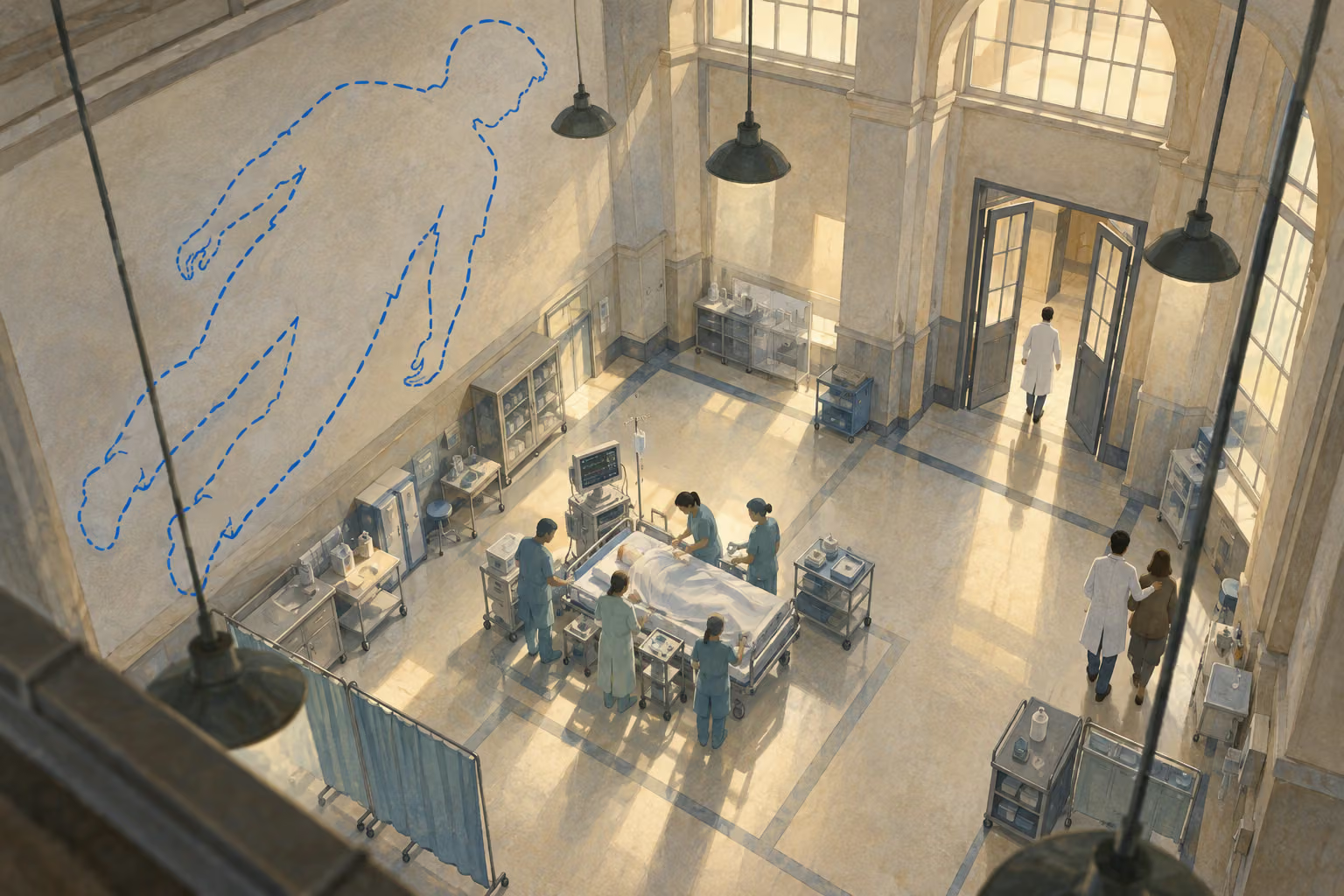
A real-life story · Málaga, Spain, 2007
Miguel Ángel Pertierra’s near-death experience
Dr. Miguel Ángel Pertierra says that in 2007 he had a motorcycle accident. He was taken to the hospital in Málaga, Spain, where he worked. In the emergency room his blood pressure crashed. He later said he saw himself from the ceiling while his colleagues worked on him. He also said he saw the colleague on call walk in. The colleague turned around when he saw that the patient was Miguel Ángel. And he said he later checked what he had seen.
This story has something unusual: an exact date, a specific hospital, and a witness who could be identified. That witness is the colleague who was on call that day. And Miguel Ángel says he checked it himself afterward. How much of what he saw can be shown today?
Step 1
Before · 2007 · He is well · Miguel Ángel’s account
A doctor who was already studying these experiences

Miguel Ángel Pertierra is an ENT at a large hospital in Málaga. An ENT is an ear, nose, and throat doctor.
He has been researching near-death experiences for years. He got into it by chance. One day, during a break after an emergency operation, the staff started telling stories about patients. “You always think that happens somewhere else in the world,” he recalls (translated from Spanish).
He has heard many accounts. But he has never had one himself.
Step 2
July 25, 2007 · Morning · Miguel Ángel’s account
That day he switches motorcycles

It is summer, and it is hot. That day he is working at a different clinic, by the sea. From the office you can see the harbor. In three days he goes on vacation.
He rides to work. He owns three motorcycles. He was going to take a big, tall one, but at the last minute he changes his mind. Since the weather is so nice, he takes a lower one, with lots of metal and steel crash bars.
Today he believes that switch saved his life.
Step 3
Shortly before 3 p.m. · Miguel Ángel’s account
A car cuts across the traffic island

He is heading home. He is already very close. Then a car cuts across a traffic island and knocks him down. Back then, the island was only painted on the road. Today it is made of stone.
He lands on his right side, a few centimeters from the curb. The steel crash bars protect his leg. He believes that on the tall motorcycle, his neck would have hit the curb.
He feels a stabbing pain under his ribs, around his liver. His arm hurts badly. Someone calls an ambulance.
Step 4
In his hospital’s ER · Critical and awake · Miguel Ángel’s account
In the ER, his own colleagues treat him
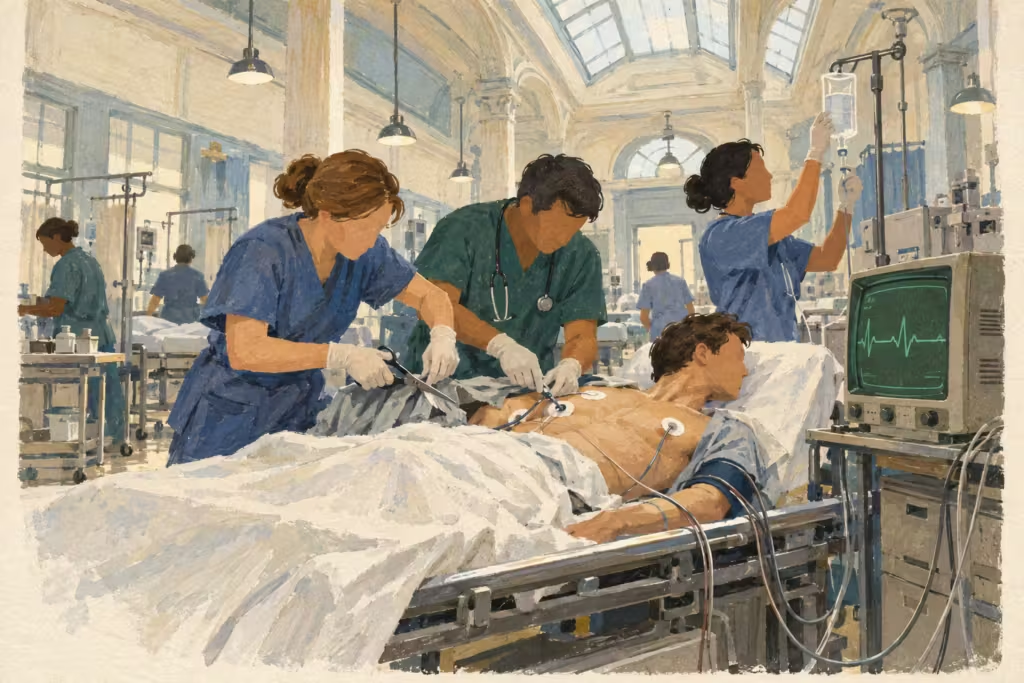
He is taken to his own hospital, four kilometers away. He arrives in a cold sweat. They take him straight to the ER’s critical care area.
His colleagues all go to work on him at once. One cuts off his clothes with scissors. Another puts in an IV. Another hooks up the ECG. And another hooks up the blood pressure monitor.
He has a clip on his finger that measures the oxygen in his blood. He hears it start beeping at a lower pitch. He knows that means his oxygen level is dropping. He turns his head toward the monitor.
His systolic blood pressure has crashed into double digits. “That’s the last thing,” he recalls. Up to this point, he has seen and heard everything while awake.
Step 5
His blood pressure crashes · Unconscious, he says · Miguel Ángel’s account
Miguel Ángel says he peels away from his body like Velcro
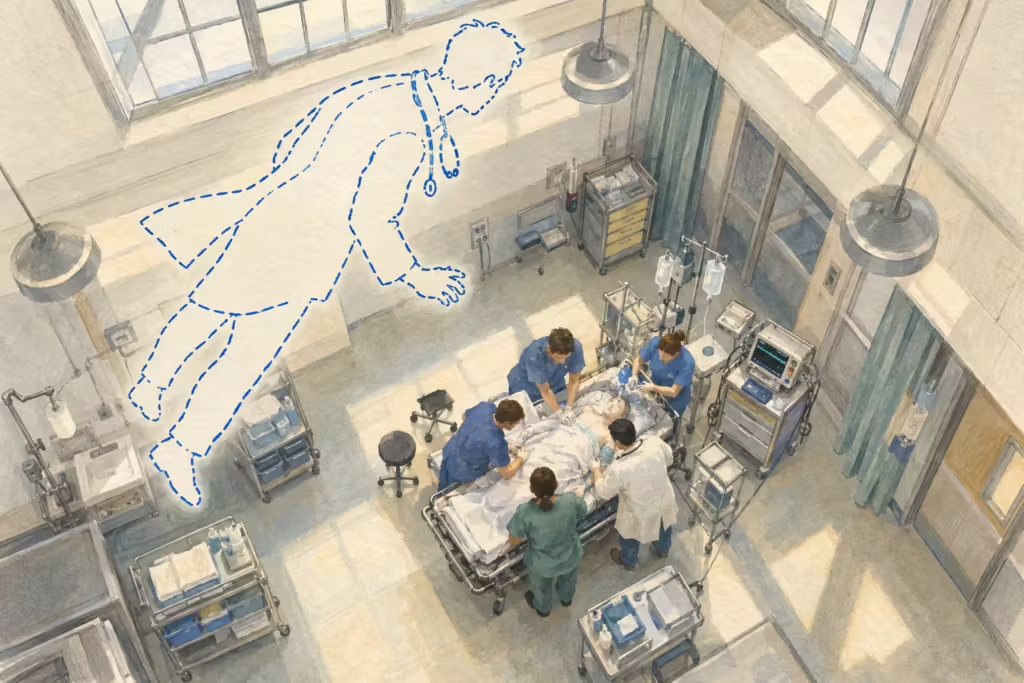
He feels himself separate from his body from head to toe, the way Velcro or tape peels away. He has no time to think anything.
Suddenly he is up by the ceiling lights, four or five meters up. He watches his colleagues working on his body, like someone watching a play from a theater box.
The difference is that the actors are the colleagues he works with every day. And the body is his.
Step 6
Unconscious, he says · Miguel Ángel’s account
Miguel Ángel says he sees a relative and the on-call colleague come in
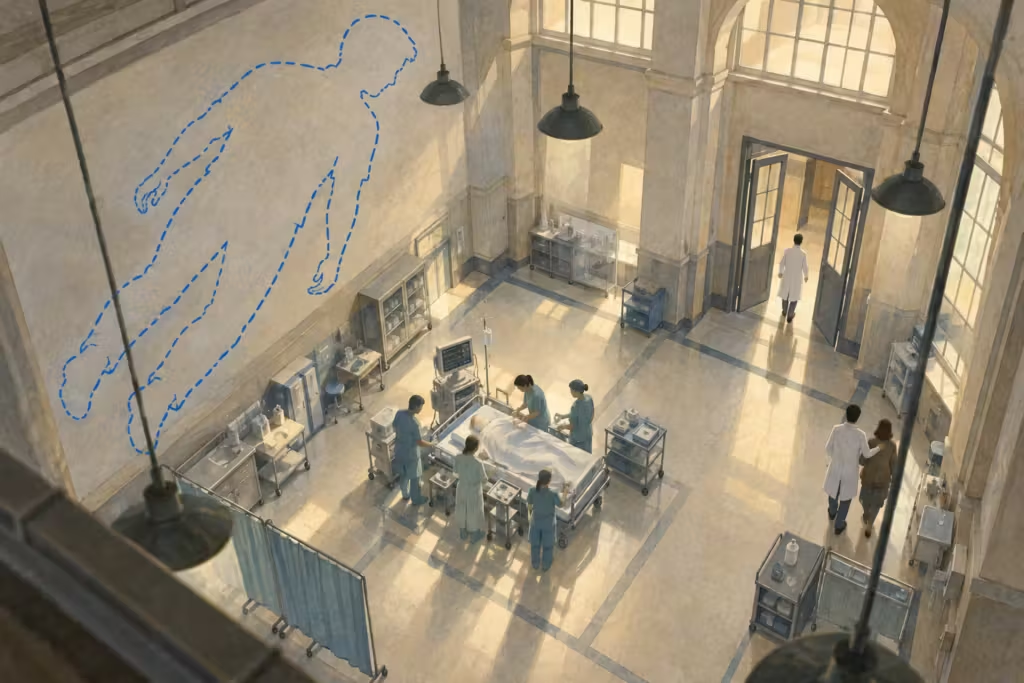
From up above, he sees a relative of his come in. Someone has let them know. One of the doctors takes hold of the relative, leads them out of the room, and takes them away.
Then the swinging doors open. They are two and a half meters tall. The ENT who was on call walks into the room. He is a colleague in his specialty. He sees that the patient is Miguel Ángel, turns around, and leaves.
In a 2026 interview, Miguel Ángel added a detail. He said he saw which room they took the relative to, as if looking at a stage set with no ceiling. It was a room some distance away, and it was not the doctor’s office. In that interview he didn’t mention the on-call colleague.
Step 7
Unconscious, he says · Miguel Ángel’s account
Miguel Ángel says he goes through a tunnel with no light at the end
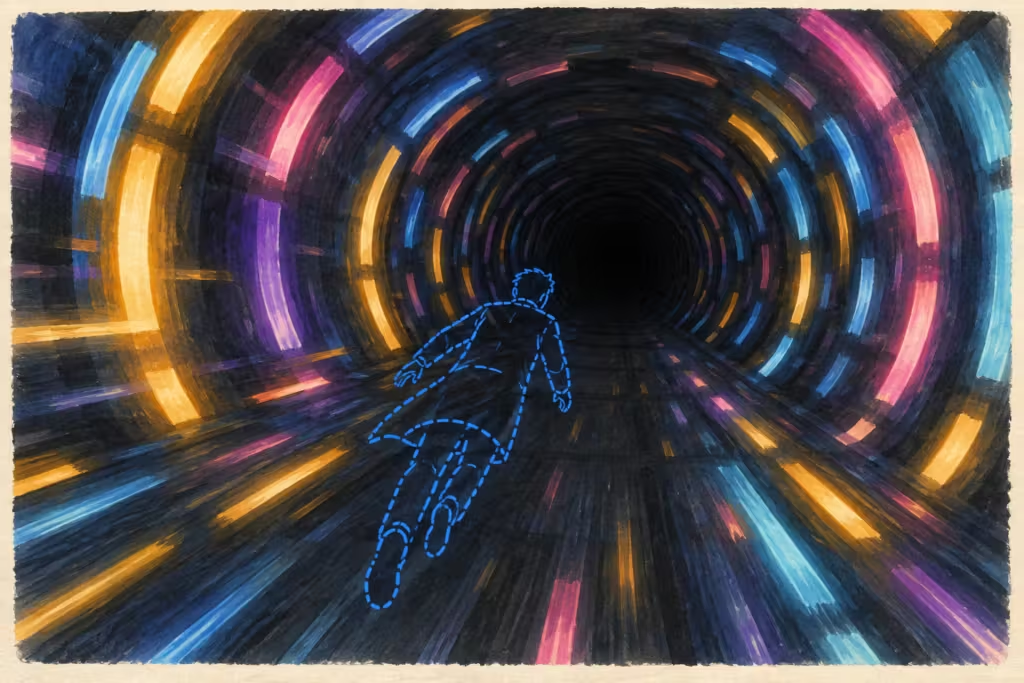
Suddenly he is in a tunnel. It is like a movie cutting from one scene to the next. There are lights spinning, some clockwise and others counterclockwise.
He moves very fast, as if on a motorcycle, but without feeling the wind.
There is no light at the end of the tunnel. It is an endless tube. He himself uses that detail to argue against the idea that the tunnel is an effect of the eye.
Step 8
Unconscious, he says · Miguel Ángel’s account
Miguel Ángel says he reaches an orange mist with figures in it
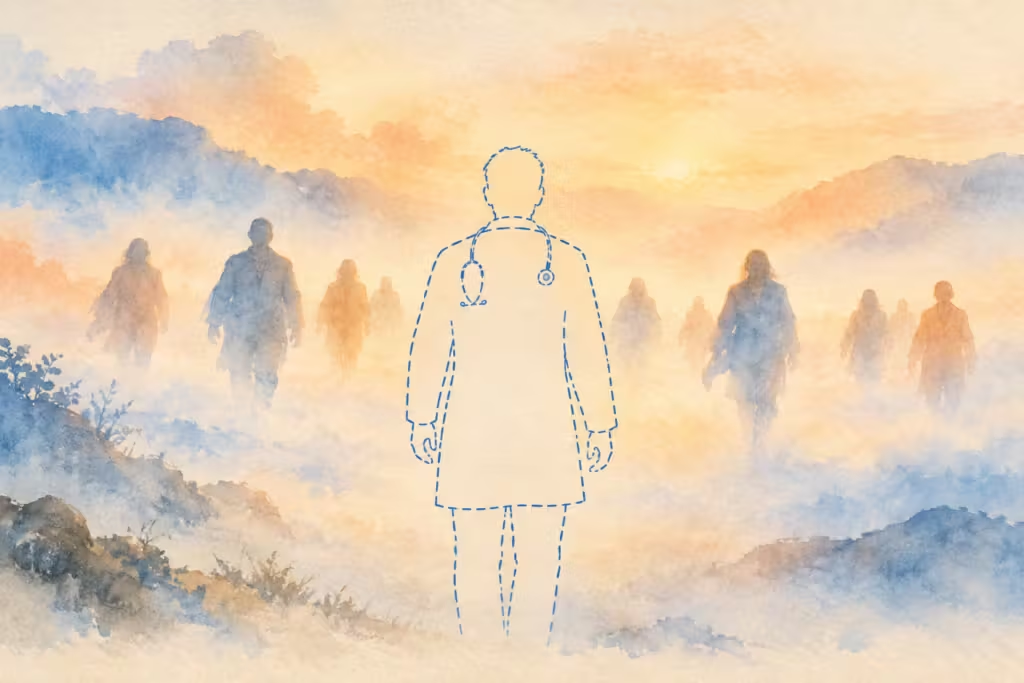
He jumps again and finds himself in a very pleasant orange and bluish mist. Human-shaped figures pass by. He can’t tell whether they are men or women, or whether he knows them.
It reminds him of a scene in the movie The Others. In it, the main character’s husband comes toward her through the fog, and his face can’t be seen until he is very close.
“If paradise can be anywhere, it must be there.”
He feels no pain in his abdomen or in his arm. And he insists that he had not been given any medication. He only got IV fluids and resuscitation maneuvers.
Step 9
Back · Awake · Miguel Ángel’s account
He drops back into his body all at once
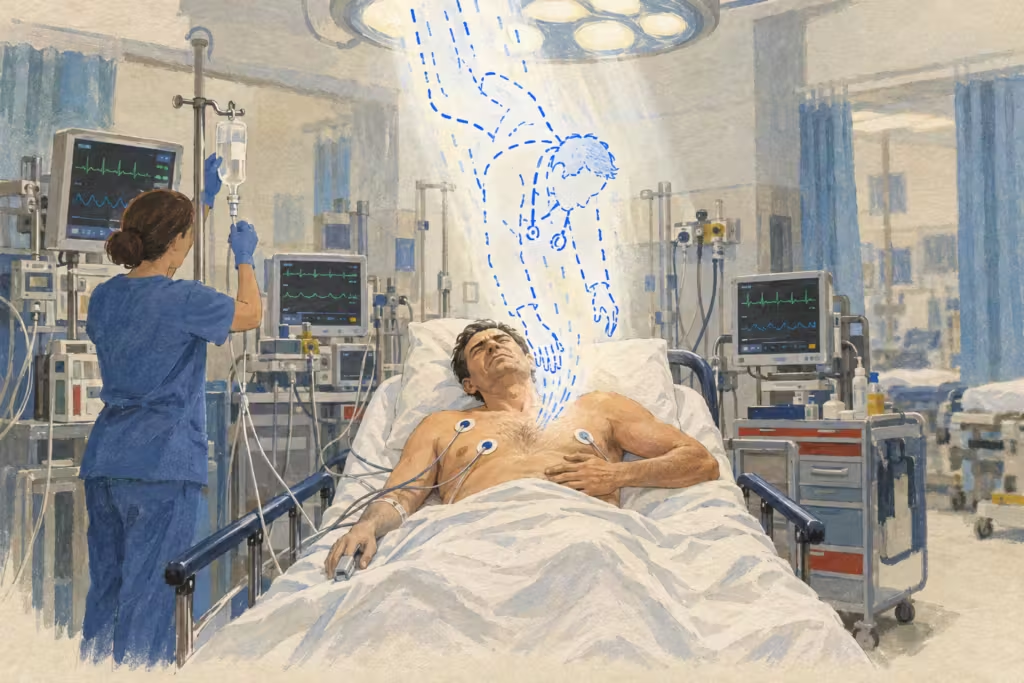
Suddenly he is back in his body, “pressed in,” like a sausage crammed into a jar. He drops in all at once, the same way he had come out.
And everything comes back. The pain in his abdomen, the pain in his arm and the discomfort all come back. He is naked, with a sheet over him.
In 2026 he said he has the critical care unit’s reports. And he said that, according to those reports, the whole thing lasted about fifteen minutes. Those reports have not been published.
Step 10
The next nine months · Miguel Ángel’s account
He waits nine months to tell anyone

He has spent years researching these experiences. Even so, at first he doesn’t believe it has happened to him. The first thing he wants to know is whether it was a hallucination.
He says that is why he goes to look at the medical records. He asks whether those people came in and went out. And he asks whether his on-call colleague had come in or not. In 2026 he adds that he also spoke with the doctors and with the relative.
He says he checked and found that what he had seen was real.
He waits nine months before telling anyone. The person who saw it, the person who checked it, and the person telling it are the same person.
Step 11
Afterward · Miguel Ángel’s account
He loses his fear of death
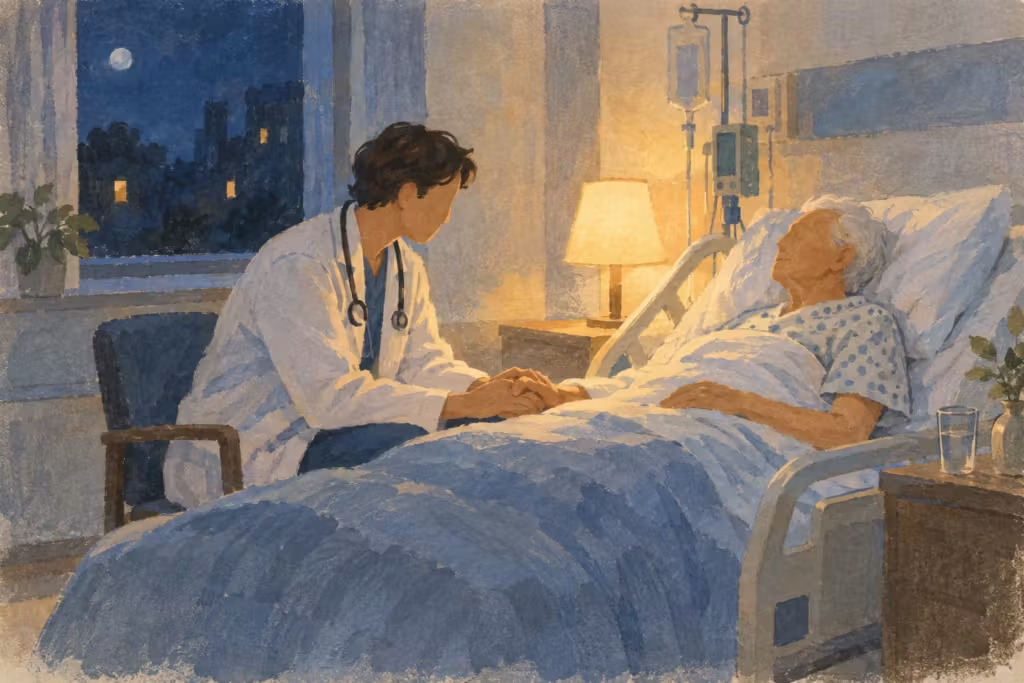
He says his life turned completely around. He was left with physical, social, and psychological aftereffects, and many people don’t understand him.
As a doctor, he had been with many patients in their final moments. Sometimes they had no one else but him. Now he sees it differently.
He loses his fear of death. “For me, death is not the end,” he says. And he adds that this doesn’t take away his wish to enjoy this life.
Step 12
Today · Miguel Ángel’s account
He writes a book and gives talks
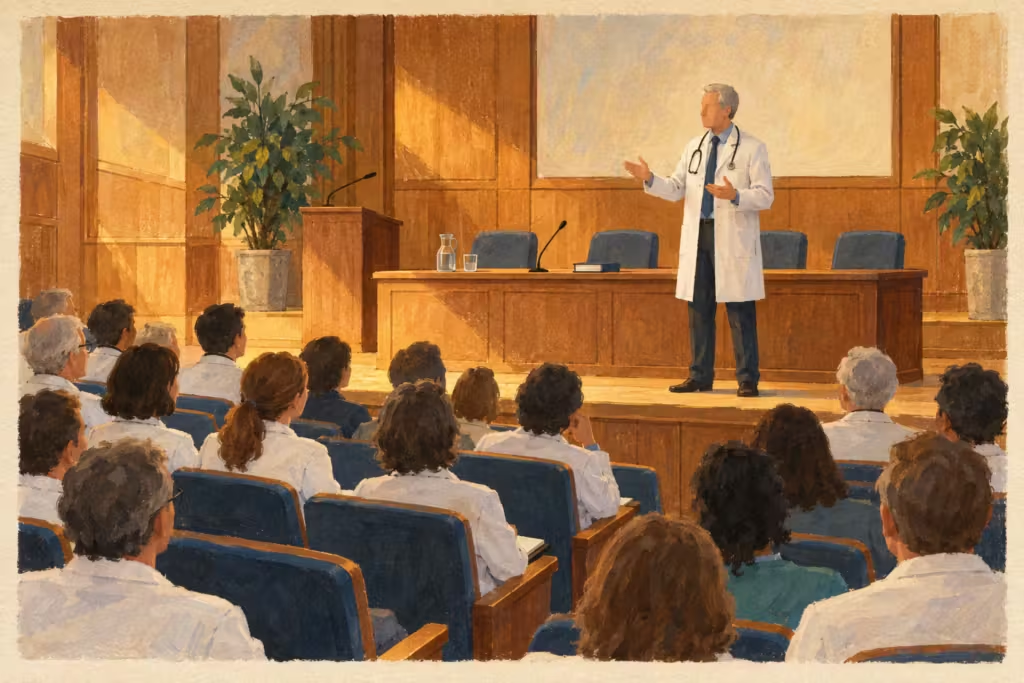
In 2014 he publishes a book about these experiences, La última puerta [The last door]. In the book he tells cases from his own patients. And in the last chapter he tells about his own accident. He says he saw himself from the ceiling and could see everything that was happening. But the colleague on duty does not appear in the book. The Málaga Medical Association invites him three times to talk about what he went through.
He is still doing research. We have reviewed two interviews with him. In both, he tells the core of what he went through the same way.
What his account lacks is someone else telling it. That could be the on-call colleague, the relative, or the reports from that day.
Do you have to be dead to have an NDE?
Miguel Ángel is not a one-off case. In his book he says it clearly: “I had not had a cardiac arrest, but rather an episode of hypotension.” Hypotension is a very sharp drop in blood pressure. And you don’t need a cardiac arrest to have an experience like this.
Picture 100 people leaving intensive care after more than seven days there:
Each dot is one person. The 15 filled-in dots are the people who described a near-death experience. The data come from a hospital in Liège (Belgium), in 2023. Almost none of them had had a cardiac arrest.
The figure changes a lot depending on who is asked:
| Who was asked | How many |
|---|---|
| General population of Germany, 2001 | over 4% |
| Online survey in 35 countries, 2019 | 10% |
| Patients after more than 7 days in the ICU, Liège, 2023 | 15% |
| Cardiac arrest survivors, the Netherlands, 2001 | 18% |
What these figures don’t tell you
- Not all of them were near death. In the German survey, many people had one without being in danger.
- People who answer online are not a random sample. Those who already have something to tell are more likely to answer.
- Each study measures differently. Some use a strict scale, and others count any memory.
That is why no one knows the real figure. There is more in How many people have an NDE? Miguel Ángel’s case has something unusual. The person telling it is a doctor, he was already researching these experiences, and it all happened in his own hospital.
Frequently asked questions
Has Miguel Ángel Pertierra’s near-death experience been verified?
No. Miguel Ángel Pertierra says he saw a relative and the on-call ENT doctor walk into the ER, and that he later checked this himself. No one else has confirmed it publicly. No colleague and no hospital record has confirmed it. That doesn’t mean it didn’t happen. We go through it in “What can be checked.”
What books has Miguel Ángel Pertierra written?
We found two books by Miguel Ángel Pertierra, both in Spanish. The first is La última puerta [The last door], published by Anaya in 2014. It is about near-death experiences. It tells cases from his own patients. In the last chapter it tells about his own accident, but without the scene with the colleague on duty. The second is Milagros médicos [Medical miracles], published by Ediciones Luciérnaga in 2017. It is about healings that medicine has not been able to explain.
Where is Miguel Ángel Pertierra from, and what kind of doctor is he?
Miguel Ángel Pertierra is an ENT doctor at a large hospital in Málaga, Spain. An ENT doctor treats the ear, nose, and throat. He is also an honorary associate professor at the University of Málaga. We have not found where he was born.
Where this story comes from
Books
- Miguel Ángel Pertierra, La última puerta [The last door] (2014), his book, in SpanishBuy the book
Interviews
- Interview on the channel Experiencias Cercanas a la Muerte [Near-Death Experiences] (2025), in SpanishWatch on YouTube
- Interview on the podcast Así es como tú (2026), in SpanishWatch on YouTube
Studies
- Knoblauch, Schmied, and Schnettler (2001), survey in Germany, Journal of Near-Death Studies 20(1):15-29View in the journal (paywalled)
- Kondziella et al. (2019), survey in 35 countries, PeerJ 7:e7585Read for free
- Rousseau, Martial, et al. (2023), Liège ICU, Critical Care 27:76Read for free
- Van Lommel et al. (2001), ten hospitals in the Netherlands, The Lancet 358:2039-2045View in the journal (free with registration)
To understand more
- What does dying feel like?Read
Our archive
- Our record on him, with both interviews, and the assessment of what he saw, as of October 10, 2026
Keep reading

Idaho, 1982
Kristle Merzlock
She nearly drowned at 7. Three weeks later she said she saw a tunnel, a woman who took her to heaven, and her dead relatives.

New York, United States, 1978
Tom Sawyer
A pickup truck crushed his chest in 1978. He says he traveled to a light and relived his life. Years later he said he knew a plane would crash. On the day of the crash he called a psychiatrist, and the psychiatrist remembers the call.

Houston, United States, 1988
Elizabeth Krohn
Lightning struck Elizabeth Krohn’s umbrella. She says she spent two weeks in a garden. She says that in September 1988 she was told there that George Bush would be president.

Reincarnation: The top 5 people who remember past lives
We asked them the same five questions as this story. A 32-page PDF, free in your inbox.
Check your email
We have sent you an email. Open it and press the button to confirm. If you cannot see it, check your spam folder.