
A real-life story · Wales, United Kingdom
The near-death experience of Patient 10
A 60-year-old man became critically ill in the intensive care unit and lay unconscious for hours. He later said he had floated above his bed and seen what the doctor, the nurse, and the physical therapist were doing. Afterward, he was able to open a hand that had been clenched since birth.
His case stands apart from almost all others because it happened in the middle of a study, and the researcher was right beside him. She was his nurse. The researcher saw what happened while he was unconscious. And she took notes on what he said when he woke up. How could he describe it with his eyes closed?
Step 1
Before · In the intensive care unit
A 60-year-old man is recovering from major surgery
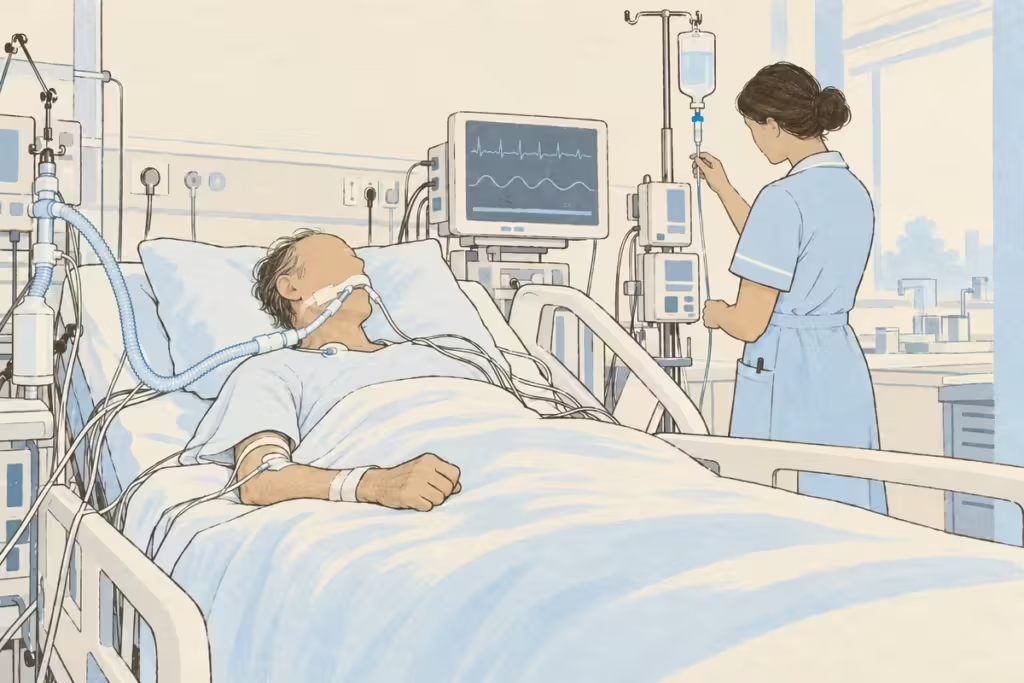
He had emergency surgery for bowel cancer. Afterward he became very sick. He had a blood infection, and several of his organs were failing.
He had been in intensive care for eight days, in a hospital in Wales. After five days he began to improve. His kidneys were working again.
The study that reports his case calls him Patient 10.
This man had had cerebral palsy since birth. His right hand was always clenched, like a claw.
That day, everything seemed to be going well.
Step 2
The day of the experience · He is awake
He is moved to a chair and becomes critically ill
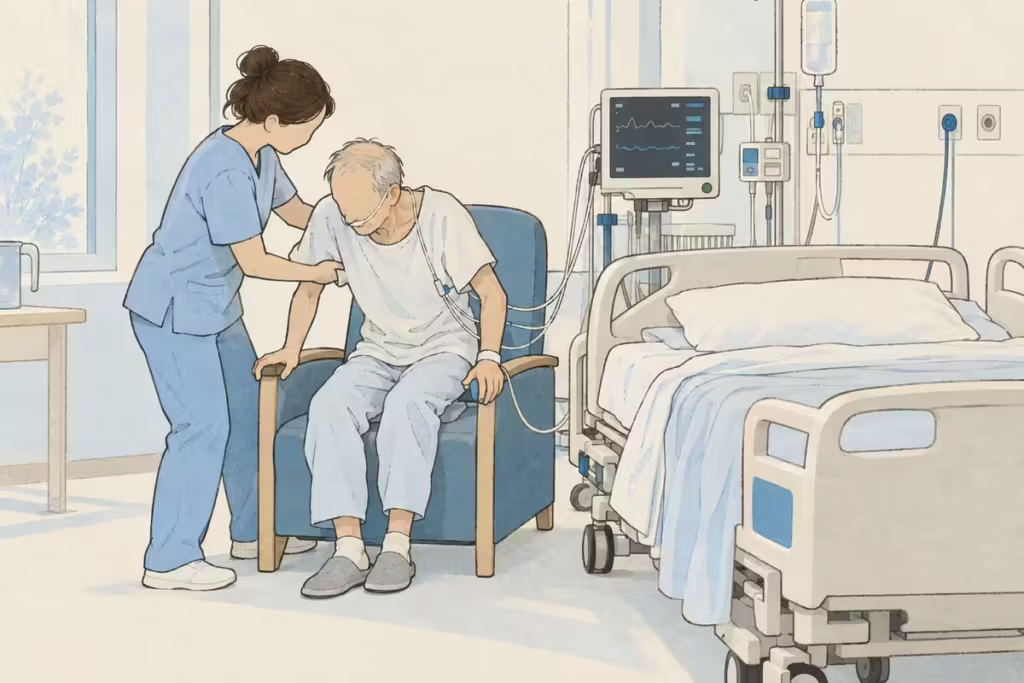
He was improving so fast that the physical therapist encouraged him to get out of bed and sit in an armchair. It would help him get his muscle strength back.
He didn’t want to. He felt weak.
Five minutes after he sat down, he started breathing very fast. The oxygen in his blood dropped sharply. The doctors feared his heart would stop.
They put him back in bed at once. Soon after, he was deeply unconscious. His eyes were closed, and he did not respond to voices or to pain.
His heart never stopped.
Step 3
He is unconscious · Recorded by the researcher, who was there
While he is unconscious, three things happen around him
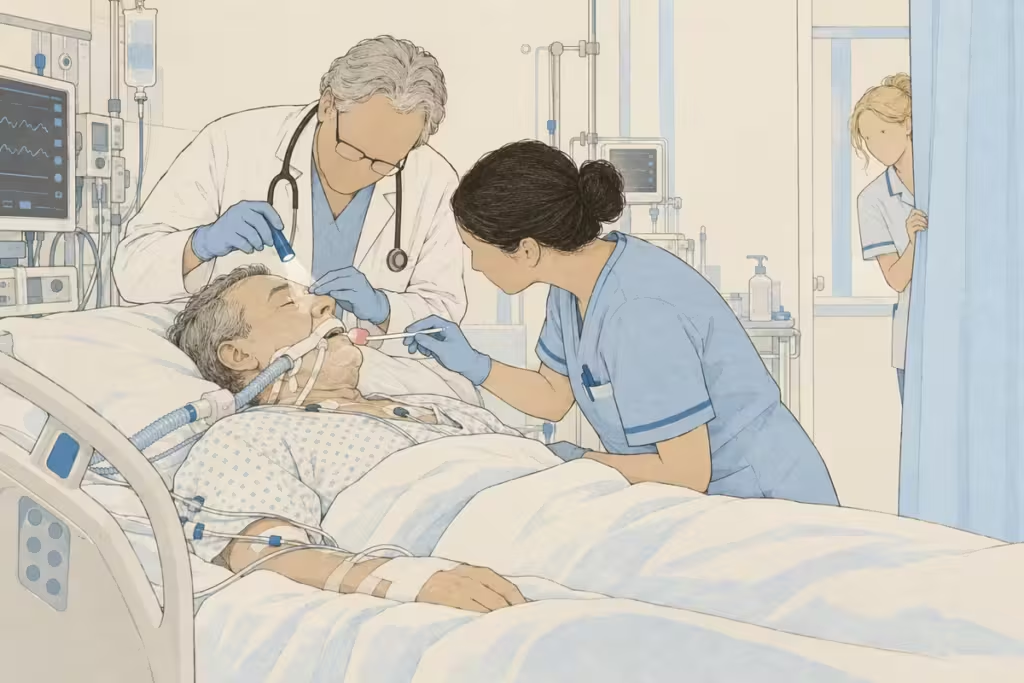
Everyone was trying to work out what was wrong. The nurse looking after him that day was Penny Sartori. She was running a study on what intensive care patients experience. This is what she saw:
- The eye. A senior doctor shone a flashlight into his eyes. That doctor had just arrived on the unit that day. He said the pupils were reacting, but that they were unequal.
- The physical therapist. She was very nervous, because she felt guilty for having moved him to the chair. She stayed behind the curtain and poked her head around it now and then to check on him.
- The mouth. Once the patient was stable, Sartori cleaned his mouth. First she cleaned it with a long, soft suction tube. Then she cleaned it with a wet pink sponge.
Sartori says he was given no medication during that time. He was only given IV fluids.
Half an hour later, his eyelids began to flicker and he started moving his arms and legs. It took him three to four hours to wake up fully.
Step 4
He is unconscious · His account
He says he floats in a pink room and sees his body in the bed
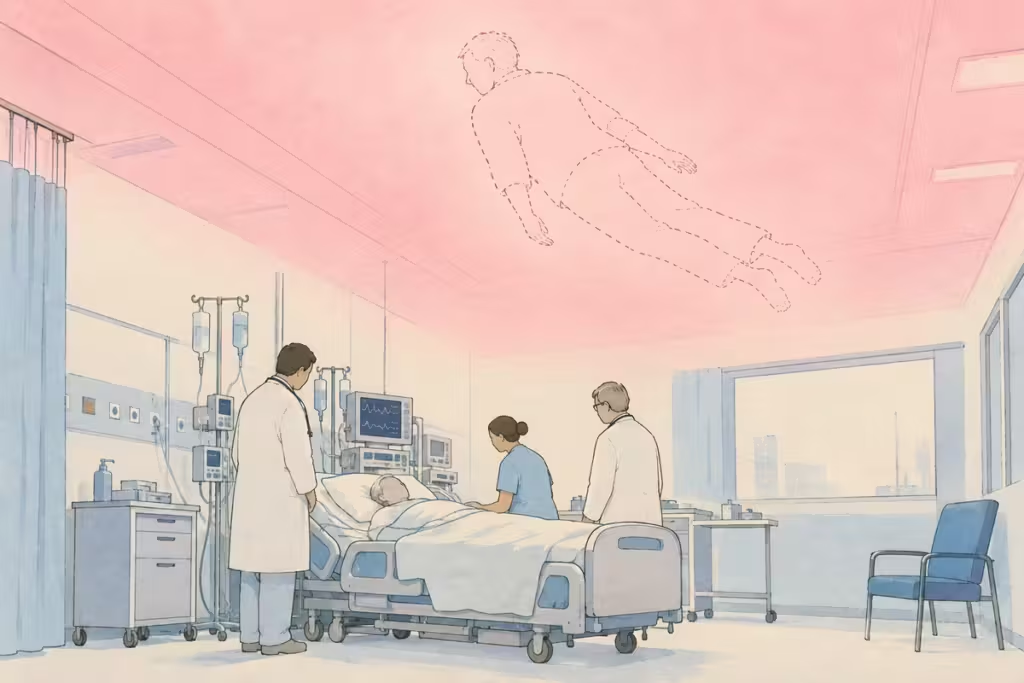
All of a sudden, he was out. He found himself looking down from the air, floating in a bright pink room.
He was rising. Nothing hurt. He was happy.
Above him he saw his father and his mother-in-law. Next to them was a man with long, black, messy hair. “I don’t know who he was, maybe Jesus,” he said. He talked with his father without words, with his mind. He had never met his mother-in-law, because she died before he met his wife. He recognized her later from photographs.
Then he felt that someone else was there. He looked back and saw his bed. And he saw his body in the bed.
From above he could see the doctors and nurses around him. He felt someone checking one of his eyes. He saw one of the doctors doing it. He heard the doctor say something like there was life in the eye.
He saw the physical therapist, “the blonde lady.” She was hiding behind the curtains and poking her head around to look at him. To him, she looked frightened.
And he saw Penny, the nurse, drawing something out of his mouth. To him it looked like “a long, pink lollipop,” on a stick. He didn’t know what it was.
Then he heard the man tell his father: “He’s got to go back; he’s not ready yet.” And he slowly came back into his body.
Step 5
Coming back · His account
He says he comes back into his body in terrible pain
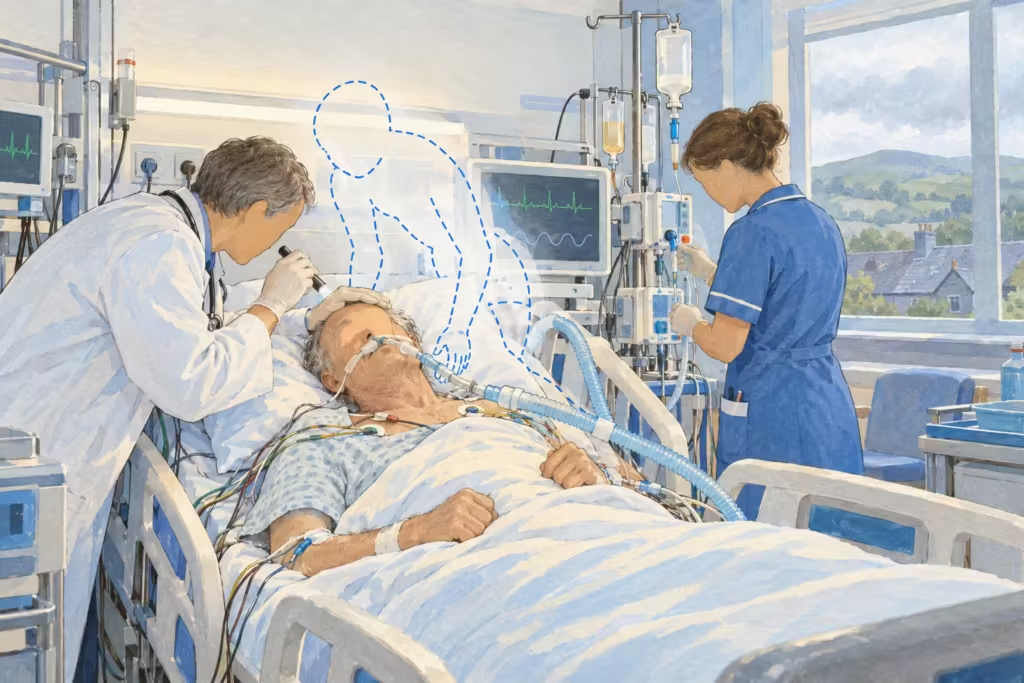
He went back into his body and felt terrible pain, worse than before. He could feel all the tubes and cables again.
He couldn’t speak, because he had one tube in his throat and another in his nose. He heard voices but couldn’t make out what they were saying. He could only make out something about his eye.
Step 6
A few hours later · Now awake
On a letter board he spells out: “I died and I watched it all from above”
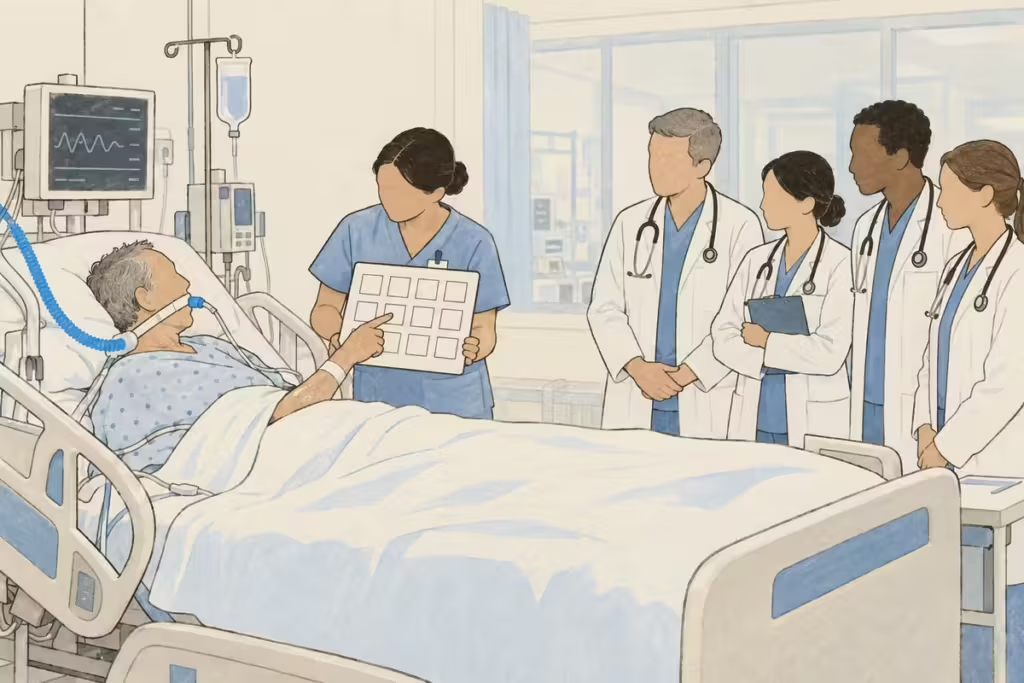
When he was fully awake, about four hours later, the doctors on rounds were at his bedside. He was excited. He was trying to tell them something, but the breathing tube kept him from speaking.
Before anyone spoke to him, he began to point. He pointed at the senior doctor, the one who had checked his eye. He had not seen that doctor before that morning. He did know the junior doctors, because they had been treating him for days. He pointed at the physical therapist and said he had seen her looking nervous, peeking around the curtain. And he said the nurse had cleaned his mouth with something long and pink.
The physical therapist brought him a letter board. He pointed to the letters one by one. This is what he spelled out:
“I died and I watched it all from above.”
Sartori was not there at that moment. She arrived as the group was moving on to the next bed. Someone told her what he had said, and she took notes while he repeated it to her. Sartori says the senior doctor wrote down in the medical record what the patient had spelled out on the board.
Step 7
Once he could talk · His account and Sartori’s
In the interview, the nurse asks him what he saw
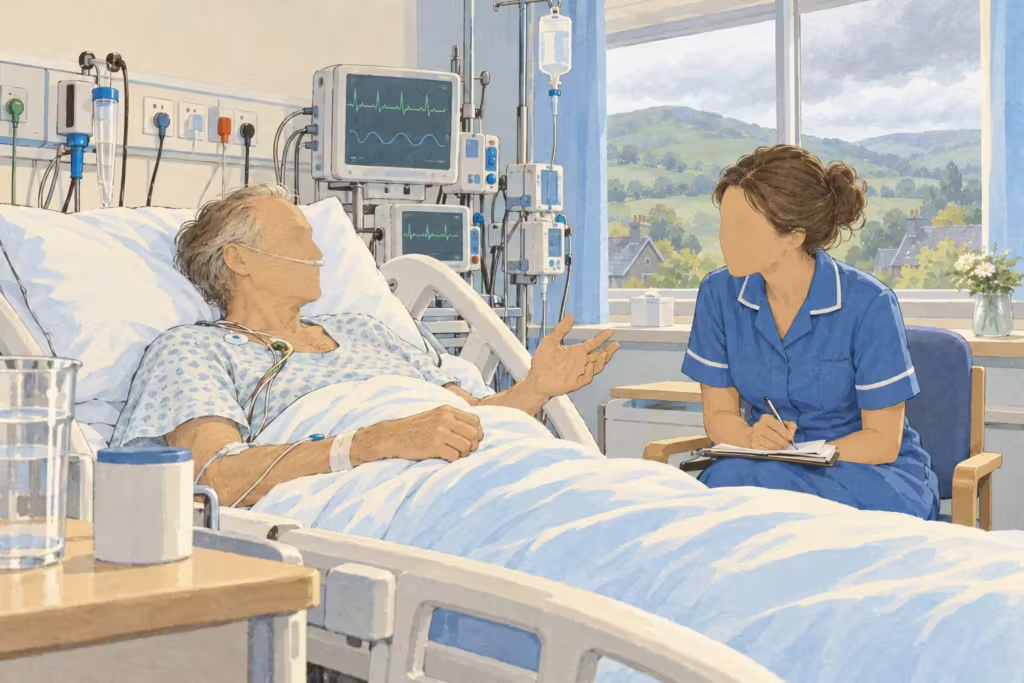
Once the breathing tube was out and he could talk, Sartori interviewed him at length. He told her everything he had seen from above. And they talked about the lollipop. Here it is in our own words:
HimYou were there, Penny, and two doctors. You had the lollipop, the sponge, like a mouthwash.
SartoriI remember. But at that point you were unconscious, with your eyes closed.
HimI know, but I saw it as clearly as I see you now.
SartoriDid you hear me say I was going to clean your mouth?
HimNo, I didn’t hear anything. I saw you doing something with my mouth, and I saw that long, pink thing.
The pink sponge isn’t long. The suction tube Sartori used first is. He may have “seen” both at once.
Step 8
After the experience · His account, his sister’s, and Sartori’s
He opens the hand that had been clenched since birth
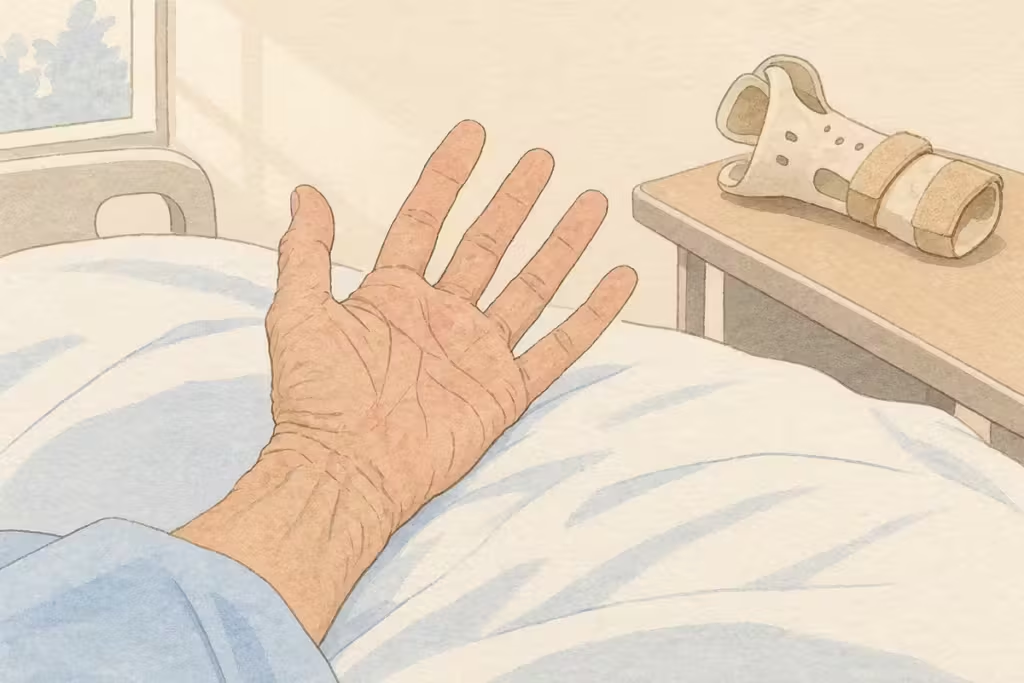
Patient 10 had had cerebral palsy since birth. His right hand was always clenched, like a claw. He had lived that way for sixty years.
After the experience, he could open it all the way.
No one had noticed. It came out almost by chance. In the interview, Sartori asked whether, outside his body, he had been able to do anything he normally couldn’t. He misunderstood the question and showed her his hand: “Now I can open it.”
According to the physical therapist, that shouldn’t have been possible. After sixty years clenched, the hand would not open without surgery on the tendons. And he had not had surgery. He had not had intensive physical therapy on that hand either.
In his words: “It feels a bit tight, but I do open it.” And: “I can do everything with it, all the cooking.” According to Sartori, he was able to open it from then on. In 2013, Sartori interviewed him for her book. He said he could still open it, but that over the past year it had been getting harder. His sister signed a statement. It says he had never been able to open his hand before. He also said he was walking straighter. The article describes it as a marked improvement.
What the records show:
- His medical record said he had had cerebral palsy since birth, with weakness and stiffness on the right side. The medical name is “right spastic hemiparesis.”
- Years earlier, the hospital had made him a splint for that hand. He said it did nothing for him.
- No one had measured the state of the hand just before the experience.
- Before his discharge, the physical therapy notes record “increased muscle tone in his contracted hand.” The article does not explain what that means.
Sartori wrote that it remains unexplained. In 2013, another researcher, Michael Rush, replied that it could have been a spontaneous improvement. Rush added that there is little information about the state of the hand just before.
Step 9
Years later
He still tells it the same way

Sartori spoke with him again several times, between one and five years later. He still remembered it vividly and accurately.
His case was published in 2006 in a scientific journal devoted to near-death experiences. It is one of the few that happened in the middle of a study: Penny Sartori’s five years in a Welsh ICU.
The question remains: how could he describe what happened around him with his eyes closed?
How many people have an NDE in intensive care?
Patient 10 is not a one-off. And the heart does not have to stop. A team at a hospital in Liège, Belgium, questioned everyone leaving intensive care. All of them had been there for more than seven days, like him.
Picture 100 of those people:
Each dot is one person. The 15 filled dots are the people who reported a near-death experience. In the study, published in 2023, they were 19 of 126 patients.
Of those 19 people, only one had had a cardiac arrest. NDEs were more common among those who had been sedated or on a ventilator.
We cover more studies in “How many people have a near-death experience?” What sets Patient 10 apart is that the person who confirms what he saw was right beside him, taking notes for a study.
Where this story comes from
Books
- Titus Rivas, Anny Dirven, and Rudolf Smit, El yo no muere [The Self Does Not Die] (2019, in Spanish), cases 1.9 and 8.1, with the patient’s and Sartori’s words in Spanish translation (we cite the first edition; the link goes to the English edition, where case numbers may differ)Buy the book
- Penny Sartori, The Near-Death Experiences of Hospitalized Intensive Care Patients (2008), the five-year studyOur page on the study
- Penny Sartori, The Wisdom of Near-Death Experiences (2014)Buy the book
Interviews
- Penny Sartori on Buddha at the Gas Pump (2022). She tells the story of the case from minute 34 to minute 40Watch on YouTube
Studies and articles
- Sartori, Badham, and Fenwick (2006), the Patient 10 case report, Journal of Near-Death Studies 25(2):69-84Read for free
- Michael Rush (2013), a critique of the case, Journal of Near-Death Studies 32(1):3-14Read for free
- Penny Sartori (2013), reply to the critique, Journal of Near-Death Studies 32(1):15-36Read for free
- Rousseau, Martial, et al. (2023), NDEs in an ICU in Liège, Critical CareRead for free
To understand more
- What does dying feel like?Read
Our archive
- Our assessment of the case with the five questions, as of October 9, 2026
Keep reading

Madrid, Spain, 2019
Luis Miguel Domínguez
He says he was in a coma after a stroke and that he drank “fossil water” in New York. While he was in the coma, a large reservoir of water under the sea off the coast of New York was announced. He and his wife, Mónica, say no one told him about it.
Virginia, United States, 1973
Holly
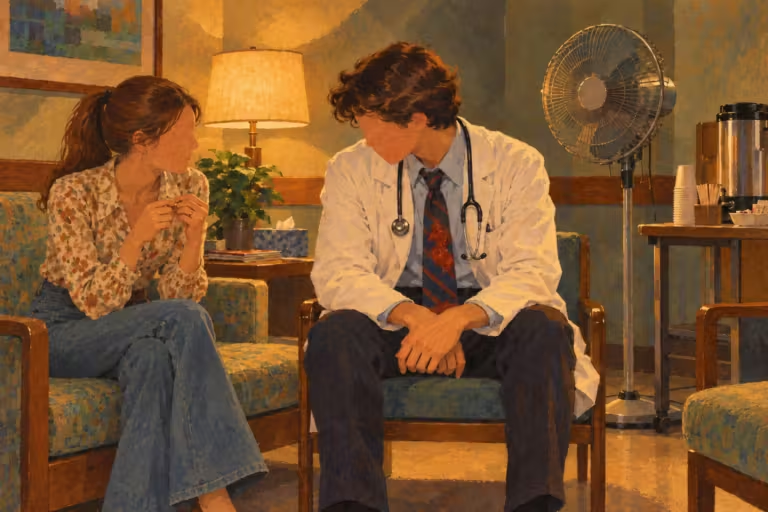
Holly was unconscious in the emergency room after an overdose. She later said she had seen her doctor talking with her roommate in another room. And she said the doctor’s tie had a tomato stain on it.

United States, 2008
Eben Alexander
Eben Alexander was in a coma with meningitis. He says a young woman was with him. Later he recognized that young woman in a photo of a sister he never met. The coma is in his medical records. The resemblance appears only in Eben’s own account.
Reincarnation: The top 5 people who remember past lives
We asked them the same five questions as this story. A 32-page PDF, free in your inbox.
Check your email
We have sent you an email. Open it and press the button to confirm. If you cannot see it, check your spam folder.