
A study · Liège (Belgium), published in 2013
Thonnard’s study: the memory of a near-death experience, compared with real and imagined events
A near-death experience, or NDE, is a very intense experience that some people have when they are about to die. Many say it was “more real than real.” In 2013, a team from the University of Liège set out to measure how it is remembered. They asked 21 people who had come out of a coma and 18 healthy people about several of their memories. Eight of the people who had come out of a coma had had an NDE. They remembered it with more detail, more clarity, and more emotion than their memories of things they had lived through or imagined. The authors conclude that the NDE is not an imagined memory. They propose that it is the very vivid memory of something the brain produced. According to them, the person truly perceived it, even though it did not happen in reality.
The study’s question is: is an NDE remembered as something that happened, or as something that was imagined? We tell, step by step, who they asked, how they measured the memories, and what came out. Then we tell about the three studies that made the same comparison. If you only want to know what is known, skip straight to the results.
Step 1
Before 2013 · The question
Some say the NDE was more real than real, and others that it may have been imagined

Many people who have had an NDE say it was something real, or even more real than everyday life.
Some researchers have proposed something else. In 1993, the psychologist Susan Blackmore wrote that the core of the experience is produced by the body. According to her, the details come from what the person knows and believes. We cover this in our page on Blackmore’s book. According to that idea, the memory of an NDE could be, at least in part, imagined.
Memory psychologists had a way of looking at this. In 1988, the psychologist Marcia Johnson and her team studied memories. They found that, on average, memories of imagined things have fewer details than memories of things that were lived through. They have fewer images, fewer sounds, less information about place and time, and less emotion.
A team in Liège decided to measure NDE memories in that same way.
Step 2
Before 2013 · University of Liège · As the study tells it
They look for people who came out of a coma, with and without an NDE

The Liège group that studies coma brought together 21 people. All of them had been in a coma because of a serious brain injury. Some had suffered a blow to the head. Others had gone without oxygen for a while, or had had a bleed in the brain or a serious illness. On average, about twelve years had passed since the injury, and about eight in the people with an NDE.
They were divided into three groups:
- 8 people who reported an NDE. Their experience scored 7 points or more on the Greyson scale. That scale is a 16-question questionnaire that researchers use to decide whether an experience is an NDE.
- 6 people who remembered something from the coma, but not enough to count as an NDE.
- 7 people who remembered nothing from the coma.
They were compared with 18 healthy people of a similar age.
All of them were asked to recall five things.
Step 3
The interviews · As the study tells it
Each person rates five memories with the same 15 questions

Each person chose five memories:
- Two things they had lived through, one recent and one from long ago. For example, a visit or a trip.
- Two things they had imagined, one recent and one from long ago. For example, a dream, a fantasy, or a plan that never came true.
- One main memory. For the NDE group, it was the NDE. For the group that remembered something from the coma, it was that memory. For everyone else, it was their first childhood memory, because it is a memory that may have been imagined or that others may have told them about.
The team asked them to choose real and imagined memories with as much emotion as the main memory.
Then each person rated each memory from 1 to 7 on a 15-question questionnaire. It asked, for example, how many visual details they had and whether they remembered the place and the time. It also asked whether they remembered it as a continuous story, and whether recalling it made them feel the same as they did back then. And it asked how many times they had thought about it or talked about it, and whether they were sure it happened just as they remembered it.
The questionnaire measures how each person experiences their memory. It does not check whether what they remember happened.
First, they checked that the questionnaire gave the same results as in other studies.
Step 4
2013 · The results · As the study tells it
The 8 people with an NDE remember it in more detail than their real and imagined memories

In all four groups, memories of things lived through had more details than memories of imagined things. It is the same thing Johnson’s team had seen in 1988. The questionnaire worked.
Then came the main comparison:
- Within the NDE group, the NDE scored higher than all the other memories of those people, both the real ones and the imagined ones.
- When one group was compared with another, the real memories scored the same in every group, and so did the imagined ones. Only the main memory changed. The NDE scored higher than the coma memory without an NDE and higher than the first childhood memory.
- What stood out most in the NDE. It had more clarity and more emotion. And people remembered better what they themselves had done, said, and thought. On details of what is seen and heard, the NDE and the coma memory scored the same. Both scored higher than the first childhood memory.
- What did not change. The NDE did not stand out in how many times people had thought about it or talked about it, or in how sure they were that it happened that way.
The study gives these results in graphs, without publishing a table with each person’s scores.
With these data, the team proposed an explanation.
Step 5
March 2013 · The conclusion · As the study tells it
The authors think the NDE is not imagined, and that it is the very vivid memory of something the brain produced
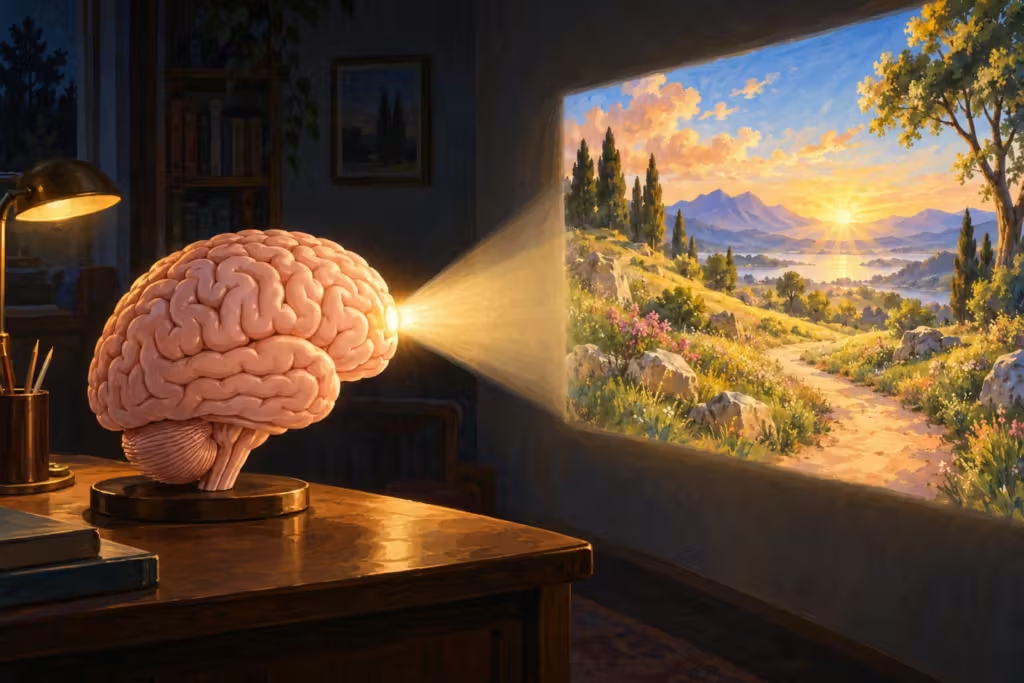
The authors’ conclusion has two parts, and both come in the same passage:
“In our opinion, the presented data demonstrate that NDEs cannot be considered as imagined events. We rather propose that the physiological origins of NDEs lead them to be really perceived although not lived in reality.”
By “physiological origins,” they mean that NDEs are produced by the body.
For the authors, the NDE resembles a hallucination. A hallucination is when someone sees or hears something with all the force of something real, even though it is not there. They think the brain would produce it, for example in the areas that give us a sense of where our own body is. And they call it a “flashbulb memory” of a hallucination that was truly perceived. A flashbulb memory is a memory that is very sharply etched, like the one many people keep of the day they heard a big piece of news.
The authors give two reasons why the NDE has more details than what was lived through. It is a memory with an enormous amount of emotion, and emotion makes people store more details. And it has a lot to do with the person’s identity, which also helps memory.
The study did not measure anything in the brain. The hallucination idea is the explanation the authors propose, not a result.
They themselves point out two limitations. The sample is small. And although they asked for memories with similar emotion, the NDE carried an enormous amount of emotion. That is why comparing it with the same person’s other memories may not be a fair comparison.
The following year, an Italian team made the same comparison.
Step 6
2014 and 2017 · What came next
An Italian study finds the NDE as detailed as real events, and an American one finds it more detailed

In 2014, the psychologist Arianna Palmieri and her team at the University of Padua, in Italy, repeated the comparison. They asked 10 people with an NDE and 10 without one. The people with an NDE were found through an association of people who have had NDEs. They used Thonnard’s same questionnaire. They also hypnotized each person to help them remember, and measured the memories before and after. The NDE had as many details as a real memory of the same people, but not more. The people with an NDE did not rate any imagined memory, so the NDE was compared with the imagined memories of the people without an NDE. Before hypnosis, the difference was so small that it could have been chance. After hypnosis, the NDE had more details. The authors write that the NDE is stored like the memory of something lived through “in a peculiar state of consciousness,” not necessarily related to the physical world.
In 2017, the researcher Lauren Moore and the psychiatrist Bruce Greyson, from the University of Virginia, in the United States, repeated the comparison with 122 people. These were people who had written to them on their own to tell them about their NDE, and they answered the questionnaires by mail. The NDE scored higher than an important real event from the same period of their lives. For example, the death of a relative or the birth of a child. And the real event scored higher than an imagined one.
Moore and Greyson write that their result does not say whether the NDE really happened. It says that it is remembered as something lived through and not as something imagined. They acknowledge that the people volunteered themselves, and that they may have guessed what was expected of them.
In 2020, the same Liège group compared the NDE with another kind of memory.
Step 7
2020 · What came next
Compared with the memory of a big piece of news, the NDE has three times as many details

In 2020, the researcher Héléna Cassol and the Liège group interviewed 25 people who had had an NDE many years earlier. They volunteered after notices in the press and in associations. Each one told three memories from the same period of their life:
- The NDE.
- The day they heard a big piece of news, such as the September 11 attacks or the first landing on the Moon.
- Another personal memory.
This time they did not only ask how people experienced each memory. They recorded what people told, and two members of the team counted the details in each account. The NDE had 53 details on average. The memory of the big news had 16, and the other personal memory, 18.
On the other hand, when each person rated how they experienced their memories, the NDE and the other personal memory came out similar. Both were just as clear and just as certain, had been thought about or talked about just as often, and the person considered them just as important. The NDE came out ahead in only one thing. It was much more important to the person’s identity, to their sense of who they are.
The question from the beginning remains: is an NDE remembered as something that happened, or as something imagined? Let’s see what is known and what isn’t.
Who took part in each study
How many people with an NDE compared their memories in Thonnard’s study and in the three that came after it, and what came out.
| Study | People with an NDE | The NDE, compared with real events |
|---|---|---|
| Thonnard, Liège, 2013 | 8 | more detail |
| Palmieri, Padua, 2014 | 10 | the same |
| Moore and Greyson, Virginia, 2017 | 122 | more detail |
| Cassol, Liège, 2020 | 25 | similar to another personal memory when rated, and with three times as many details as a big piece of news when told |
What these figures don’t tell
- In three of the four studies, people came forward on their own or through associations. The 2013 study does not say how it found its 8 people.
- These are memories from years ago. In Thonnard’s study, about eight years on average since the injury. In Moore and Greyson’s, 34 years.
- Thonnard’s study did not publish each person’s scores. It gave its results only in graphs.
Frequently asked questions
What did Thonnard’s study find about NDE memories?
In 2013, a team from the University of Liège studied 8 people who had had an NDE during a coma. It compared their memory of the NDE with their memories of real and imagined events. The NDE had more detail, more clarity, and more emotion than all the others. The authors conclude that it is not an imagined memory.
Does Thonnard’s study show that NDEs are real?
No. It shows that those 8 people remember the NDE as something lived through, not that what they experienced happened outside the person. The authors themselves think the NDE resembles a hallucination that is truly perceived. The study does not show that either, because it did not measure the brain.
Why is an NDE said to be “more real than real”?
Many people who have had an NDE describe it that way. Several studies have measured it with a questionnaire about how a memory is experienced. In two of those studies, the NDE had more detail and more emotion than memories of real events. They are the 2013 Liège study and the 2017 Virginia study.
Has Thonnard’s study of NDE memories been repeated?
Yes. In 2017, the researcher Lauren Moore and the psychiatrist Bruce Greyson, from the University of Virginia, found the same thing with 122 people. In 2014, a team in Padua, with 10 people, found the NDE as detailed as real events, but not more. In 2020, the Liège group found that the account of the NDE had three times as many details as the memory of a big piece of news.
Where this page comes from
The study
- Marie Thonnard, Vanessa Charland-Verville, Serge Brédart, Hedwige Dehon, Didier Ledoux, Steven Laureys, and Audrey Vanhaudenhuyse, “Characteristics of near-death experiences memories as compared to real and imagined events memories,” PLoS ONE 8(3):e57620 (2013)Download for free (PDF, CC BY license)
The studies that came after
- Arianna Palmieri and others, “‘Reality’ of near-death-experience memories: evidence from a psychodynamic and electrophysiological integrated study,” Frontiers in Human Neuroscience 8:429 (2014)Read for free
- Lauren Moore and Bruce Greyson, “Characteristics of memories for near-death experiences,” Consciousness and Cognition 51:116–124 (2017)View in the journal (paywalled)
- Héléna Cassol and others, “Near-death experience memories include more episodic components than flashbulb memories,” Frontiers in Psychology 11:888 (2020)Download for free (PDF, CC BY license)
To understand more
- Greyson’s study: the same NDE told twice, 19 years apartRead
- Susan Blackmore’s book on the brain and NDEsRead
- What is a near-death experience?Read
- What does science say about near-death experiences?Read
Our archive
- A full reading of the studies by Thonnard, Palmieri, Moore and Greyson, and Cassol, compared page by page, as of October 29, 2026
More studies
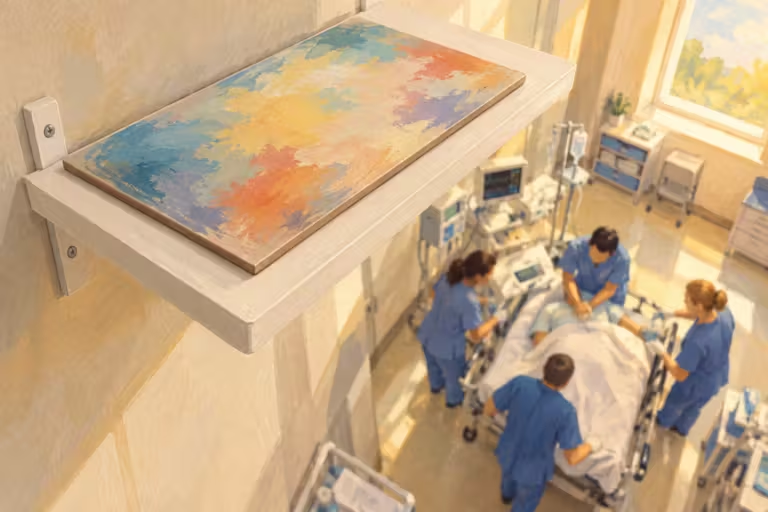
AWARE: the pictures hidden on the shelves
Fifteen hospitals put up pictures that could only be seen from the ceiling, to check whether anyone saw them during a cardiac arrest.
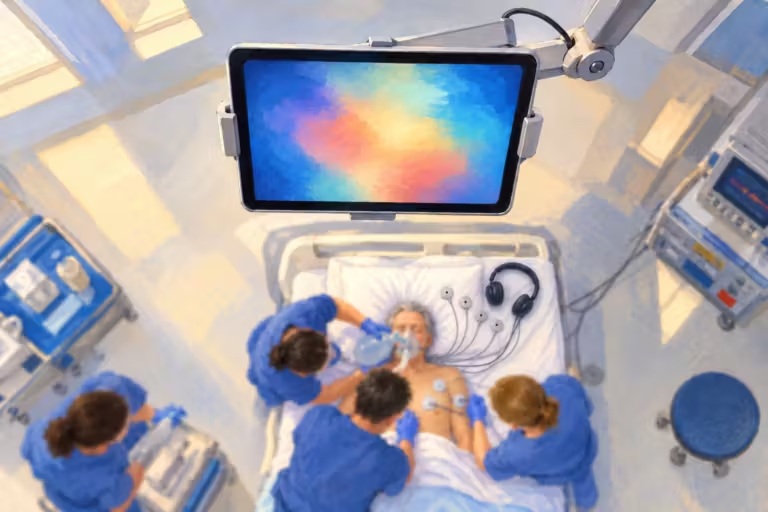
AWARE II: a random picture and the brain on the screen
Above the patient was a tablet with a random picture. Headphones said the names of three fruits. And the doctors measured the brain during resuscitation.

Van Lommel: 344 cardiac arrest survivors in ten hospitals
Ten hospitals asked every cardiac arrest survivor what they remembered. They saw them again after 2 and 8 years.