Two studies · London (United Kingdom) and Liège (Belgium), 2018 and 2019
Drugs that resemble a near-death experience: DMT in 13 volunteers (2018) and 165 substances compared (2019)
In 2018, a team in London injected 13 healthy volunteers with DMT. DMT is a drug that causes visions. Then it gave them the questionnaire used to measure near-death experiences. All 13 volunteers reached the score of a near-death experience. In 2019, another team compared 625 accounts of near-death experiences with about 15,000 accounts from people who had taken 165 different substances.
The question is: can a drug produce the same thing people go through in an NDE? Both studies find a resemblance. But they cannot test whether NDEs are caused by a substance made by the body itself. We tell it step by step, with what they measured and what they couldn’t find out. If you only want to know what they found, skip straight to the results.
Step 1
Before 2018 · The question
For decades, people have said DMT resembles an NDE

DMT is a substance that causes very intense visions. It is found in some plants and in ayahuasca. Ayahuasca is a brew used in ceremonies in the Amazon.
People who take DMT describe things that recall an NDE. They feel they leave their body and enter another world. They say they meet presences or beings. Some say it felt “more real than real”, just like many people with an NDE.
In 2001, the psychiatrist Rick Strassman proposed an idea. According to this idea, when we die, the body releases its own DMT, and this produces the NDE. Other scientists criticized the idea. One of them was the pharmacologist David Nichols, in 2017.
Is what people go through on DMT really like an NDE? Until 2018, no one had measured it with the same questionnaire.
A team in London decided to do it.
Step 2
2018 · London · From the study
They look for 13 healthy volunteers who have already taken drugs that cause visions
The study was led by Christopher Timmermann, of Imperial College London. The team also included Charlotte Martial and Steven Laureys, who study NDEs at the University of Liège.
They found the volunteers by word of mouth. Thirteen healthy people took part: 6 women and 7 men. They were about 34 years old on average.
- All of them had taken a drug of this kind before, such as LSD, mushrooms or ayahuasca. That was a condition for joining.
- Before starting, they had a medical and a psychiatric check-up. No one with a mental illness or a heart condition could take part.
- No one was in danger of dying. It was an experiment in a hospital, with doctors close by.
All the volunteers already knew these drugs. They knew what people usually feel on them, and they may have known about the comparison with NDEs.
Step 3
First session · From the study
In the first session, they are all injected with salt water without knowing it
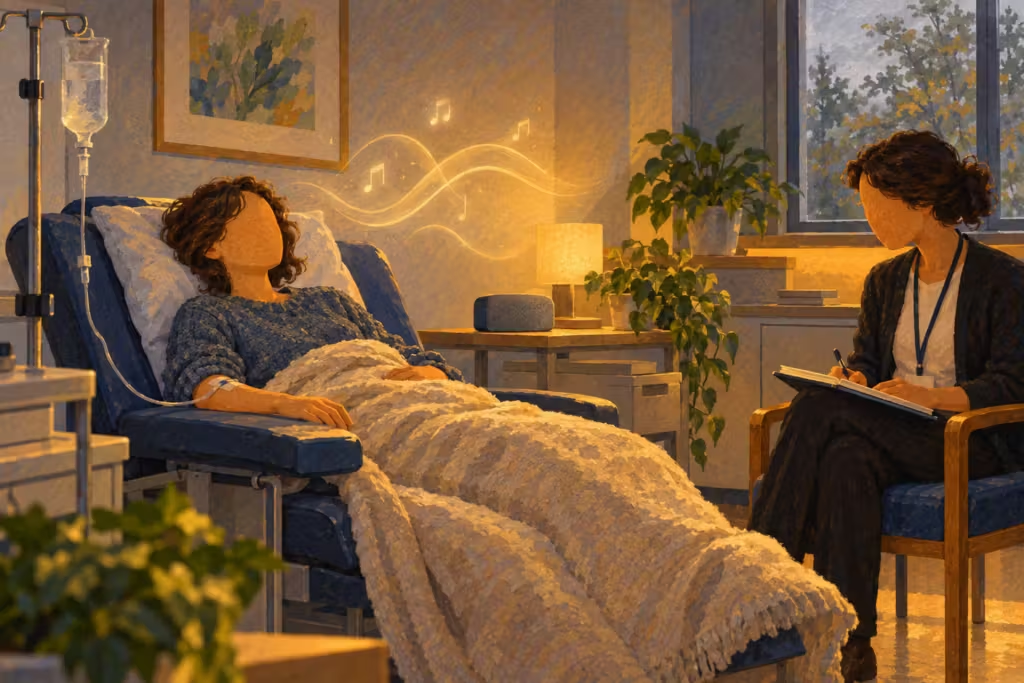
The sessions took place in a hospital research unit. Each volunteer lay on a reclining bed, in a dimly lit room with soft music in the background.
In the first session, all 13 were injected in a vein with salt water. Salt water is a placebo. A placebo is something that does nothing and is used for comparison. The volunteers did not know whether they were getting the placebo or the drug. The team did know.
The order was always the same. First they were given the placebo and, a week later, the DMT. They did it that way for safety, so each volunteer got to know the room and the team first.
Afterwards, the volunteers filled in the NDE questionnaire. One of the 13 reached the score of an NDE on the placebo alone.
Step 4
A week later · They are injected with DMT
They are injected with DMT, and within two or three minutes it is at its strongest
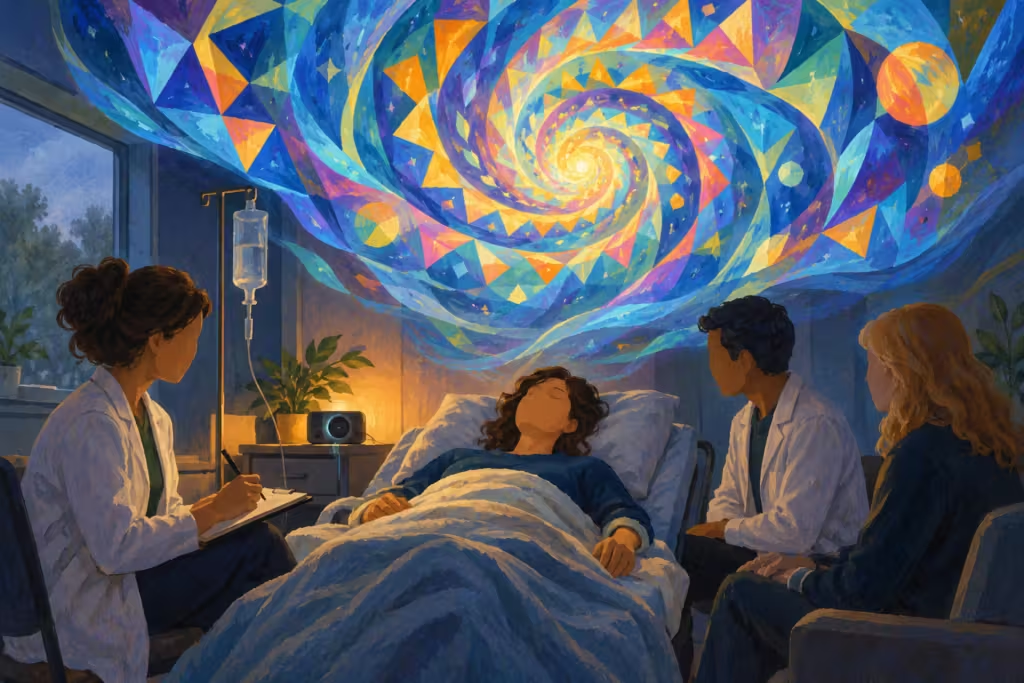
A week later, the DMT was injected into a vein over 30 seconds. Not everyone got the same amount. It was a study to test doses before doing a larger one. So some received 7 milligrams and others received up to 20.
The volunteers felt the effect right away. It was strongest after 2 or 3 minutes. After 20 minutes it had almost worn off. Two researchers and a doctor stayed with each volunteer for the whole session.
That same year, the BBC told the story of Iona, a volunteer in this team’s DMT studies. Iona said everything was rotating and spiralling and that she felt she was in a realm different from her ordinary one, even in dreams. About her body, this is what she told the BBC:
“My body just didn’t seem relevant anymore.”
Once the effect had passed, each volunteer had an open interview. Then they filled in the same questionnaire they had filled in after the placebo.
Step 5
After each session · The measure
They measure what the volunteers went through with the questionnaire used for NDEs

The questionnaire is the Greyson scale. The psychiatrist Bruce Greyson created it in 1983 to tell whether a person has had an NDE. It is the most widely used scale in the world.
- It has 16 questions. For example: “Did you have a feeling of peace?”, “Did you see a light?”, “Did you feel separated from your body?”, “Did you see people who had died?”.
- Each question scores 0, 1 or 2 points. The maximum is 32.
- With 7 points or more, the person is considered to have had an NDE.
The scale asks whether something happened, but not what it was like. Two very different experiences can get the same score.
They used this scale on all 26 sessions: 13 with placebo and 13 with DMT.
Step 6
The results · From the study
On DMT, all 13 reach the score of an NDE
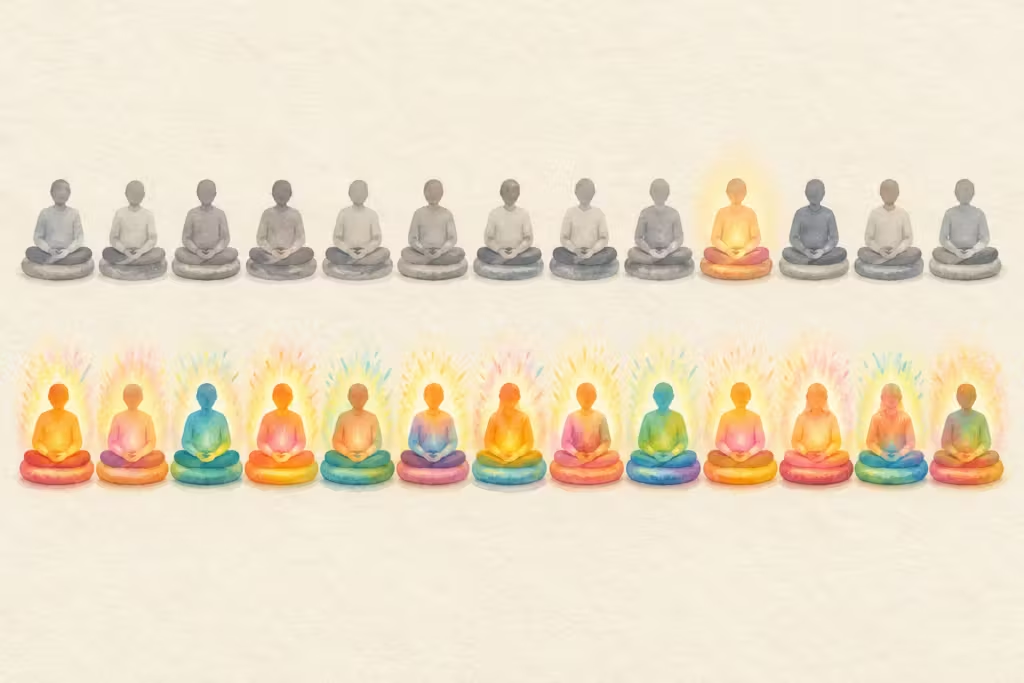
On DMT, all 13 volunteers scored above 7 points. On the placebo, only one volunteer managed it.
The difference between DMT and placebo was huge. The score went up on 15 of the 16 questions.
On five questions, the difference between DMT and the placebo was not clear:
- Seeing scenes from their past.
- Seeing people who had died.
- Knowing things that were happening far away.
- Seeing things from the future.
- Thinking faster.
Those scores still had to be compared with the scores of people who had had a real NDE.
Step 7
The results · The comparison
They compare the 13 volunteers with 13 people who had an NDE

The Liège group had questionnaires from people who had had an NDE. The team chose 13 of these people, of the same age and sex as the volunteers.
- Those 13 people had answered the questionnaire by mail. They answered it between a few months and 15 years after their NDE. On average, they answered it 7 years after.
- Only people who had scored above 7 points were chosen. The DMT volunteers were not required to.
The people with an NDE scored 16 points on average. The volunteers on DMT scored 13.3. With only 13 people in each group, that difference is not large enough to count as clear in the statistics.
The authors wrote that the two experiences had a “comparable” profile. But that does not mean they are the same. It means that, with so few people, they did not find a difference they could be sure of.
The averages are similar. The interesting part is in each question.
Step 8
The results · Question by question
They are similar in what people feel, but not so much in the border and the dead
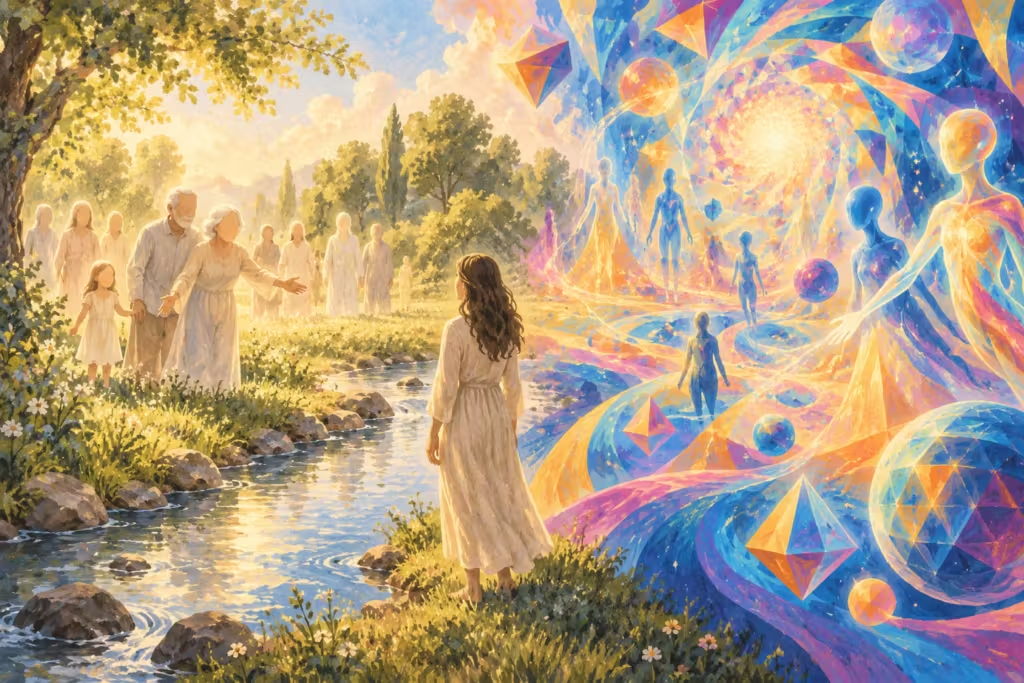
DMT scored the same as NDEs or a little higher for peace, joy and a sense of unity with everything. The question about entering another world scored higher on DMT.
But some very typical features of NDEs scored lower on DMT:
- Coming to a border or a point of no return. In NDEs, the average was 1 point. On DMT, it was 0.23. It is the largest difference in the table.
- Seeing people who had died. In NDEs, the average was 0.92. On DMT, it was 0.46.
- Seeing scenes from one’s own life. In NDEs, the average was 0.54. On DMT, it was 0.15.
- Feeling that everything made sense. In NDEs, the average was 1. On DMT, it was 0.38.
The authors think the border may be missing because of the setting. On DMT, the person is calm in a laboratory. In an NDE, the person is seriously ill or has had an accident.
With 13 people, none of these differences could be taken as certain. Nor can anyone be sure they don’t exist.
Step 9
The same paper · What the authors acknowledge
The authors themselves say what may have inflated the resemblance

In the paper, Timmermann’s team explains what may be wrong with their study:
- The doses were not the same for everyone.
- The placebo always came first. The volunteers had already seen the NDE questionnaire before taking DMT.
- These drugs make people more suggestible. They may have said yes to anything unusual. The authors reply that the volunteers answered when the effect had almost completely worn off. And they answered after an open interview.
- The Greyson scale is easy to pass. One volunteer reached the score of an NDE on salt water.
- It is risky to use one experience to explain another.
There is something else. Injected DMT is felt immediately, and salt water is not. So the volunteers could easily tell what they had been given. And the study was not registered before it began, nor were its data made public.
Even so, the difference from the placebo was so large that it is hard for it to come only from what the volunteers expected.
Step 10
2019 · Liège and Buenos Aires · Another approach
Another team compares 625 NDE accounts with 15,000 accounts of 165 drugs

A year later, Charlotte Martial led another study. This time, the team gave no drug to anyone. It compared written accounts. Bruce Greyson, who created the scale, was on the team.
- 625 NDE accounts. They came from the University of Virginia and the Liège group. On average, they were written about 20 years after the experience.
- About 15,000 accounts from people who had taken one of 165 substances. They come from Erowid. Erowid is a website where people describe what they went through on a drug. No one checks what each person took or how much.
Among the NDEs whose cause was known, 3 in 10 had happened under anesthesia or drugs. And among the people who said how ill they were, almost 3 in 10 said it had not been serious.
With so many accounts, the question changes: which drug does an NDE resemble most?
Step 11
2019 · How they compared them
A program compares the words each account uses

A computer program analyzed all the accounts. It counted which words appear together in the accounts of each drug and in the NDE accounts. Then it measured how similar those lists were.
Before that, the team deleted the names of the drugs and slang words. That way, those words could not give away which drug each account was about. The team did not delete the words about death and dying.
This compares how people tell their experience. It does not compare the experience itself. If many people describe a drug trip as “I thought I was dying”, the account will look like an NDE even if what they lived through was different.
They repeated the analysis in many ways to see whether the result changed.
Step 12
2019 · The results
The most similar drug is ketamine, not DMT

The accounts most similar to NDEs were the ketamine accounts. Ketamine is an anesthetic. At certain doses, it makes people feel the mind is separating from the body. Next came salvia and several drugs that cause visions. These were peyote, 5-MeO-DMT, mushrooms, DMT, iboga, ayahuasca and LSD.
The least similar were sedatives, stimulants such as cocaine, and antidepressants.
Ketamine came first almost every time. The exception was NDEs during cardiac arrest. For those NDEs, LSD came so close to ketamine that the two were almost level.
The authors wrote that their analysis “neither validates nor refutes” the idea that NDEs are produced by a substance in the body. It can only say that the way people describe some drugs resembles the way they describe an NDE.
Both studies say that NDEs and these drugs resemble each other. The studies that followed looked at how they differ.
Step 13
2024 and 2025 · What came after
Two new studies find similar themes and different content

In 2024, Martial, Timmermann and Robin Carhart-Harris surveyed 31 people online. All of them had had both an NDE and an experience with a drug of this kind, almost always LSD or mushrooms. Each person compared their two experiences. We cover this in Martial’s study.
- In both, they felt the same peace and saw a light just as often.
- Both seemed to them “more real than daily life.” 25 of 31 people said so of their NDE, and 23 of 31 said so of the drug.
- Feeling dead was more common in the NDE. 26 of 31 people felt dead in the NDE, and 17 did on the drug.
- After the NDE, they were less afraid of death than after the drug.
In 2025, Pascal Michael, David Luke and Oliver Robinson, of the University of Greenwich, compared 36 sessions with inhaled DMT with 34 NDE accounts.
- In 34 of the 36 DMT sessions, some typical NDE theme appeared.
- On DMT, nearly everyone met beings, but people who had died appeared in only 2 of 36 sessions. In NDEs, people who had died appeared in 9 of 34 accounts.
- On DMT, no one reached a border or felt they were coming back to life. In NDEs, 19 of 34 described coming back.
And no one has yet measured DMT in the brain of a person while they are having an NDE.
The question from the start remains: can a drug produce the same thing people go through in an NDE? Let’s see what could be found out and what couldn’t.
From 13 volunteers to 13 NDE scores
On DMT, all of them reached the score of an NDE. On placebo, one did.
So these figures say that DMT produces that score, but not whether what people went through is the same as an NDE.
| Step | People |
|---|---|
| Healthy volunteers who had taken drugs of this kind before | 13 |
| Reached the score of an NDE on placebo | 1 |
| Reached the score of an NDE on DMT | 13 |
| People with an NDE they were compared with | 13 |
The features that differ most
Average score for each question, from 0 to 2. With 13 people per group, no difference could be taken as certain.
| Question | NDE | DMT |
|---|---|---|
| Total score (0 to 32) | 16 | 13.3 |
| Feeling peace | 1.38 | 1.46 |
| Entering another world | 1.31 | 1.69 |
| Coming to a border | 1 | 0.23 |
| Seeing people who had died | 0.92 | 0.46 |
| Seeing scenes from one’s own life | 0.54 | 0.15 |
What these figures don’t tell
- The scale measures whether something happened, not what it was like. Seeing otherworldly beings and seeing a dead grandfather can score the same on some questions.
- The two groups were not chosen the same way. People with an NDE had to score above 7 points to be included in the study. The DMT volunteers did not have to. And the people with an NDE answered years after their NDE.
- Scoring above 7 is not the same as having an NDE. One volunteer did it on salt water. To learn how many people report an NDE after cardiac arrest, read How many people have an NDE? To learn what science says about their cause, read What does science say about these experiences?
Where this page comes from
The studies
- Christopher Timmermann, Leor Roseman, Luke Williams, David Erritzoe, Charlotte Martial, Héléna Cassol, Steven Laureys, David Nutt and Robin Carhart-Harris (2018), “DMT models the near-death experience”, Frontiers in Psychology 9:1424Read for free
- Charlotte Martial, Héléna Cassol, Vanessa Charland-Verville, Bruce Greyson, Enzo Tagliazucchi and others (2019), “Neurochemical models of near-death experiences: A large-scale study based on the semantic similarity of written reports”, Consciousness and Cognition 69:52-69Read for freeView in the journal
The studies that came after
- Charlotte Martial, Robin Carhart-Harris and Christopher Timmermann (2024), “Within-subject comparison of near-death and psychedelic experiences: acute and enduring effects”, Neuroscience of Consciousness 2024(1):niae033Read for free
- Pascal Michael, David Luke and Oliver Robinson (2025), “An encounter with death: a comparative thematic and content analysis of naturalistic DMT experiences and the near-death experience”, Frontiers in Psychology 16:1532937Read for free
- Charlotte Martial and others (2025), the NEPTUNE model, “A neuroscientific model of near-death experiences”, Nature Reviews Neurology 21:297-311View in the journal
Press
- Ben Bryant (2018), “A DMT trip ‘feels like dying’ – and scientists now agree”, BBC Three, with Iona’s accountRead for free
Assessments and critiques
- Sam Parnia, Lucid Dying (2024), the chapter on drugsBuy the book
To understand more
- Gamma waves in the dying brain: Borjigin and XuRead
- What does science say about these experiences?Read
- What is an NDE?Read
Our archive
- A full reading of the two papers, the 2024 and 2025 studies and the BBC article, as of October 19, 2026
More studies
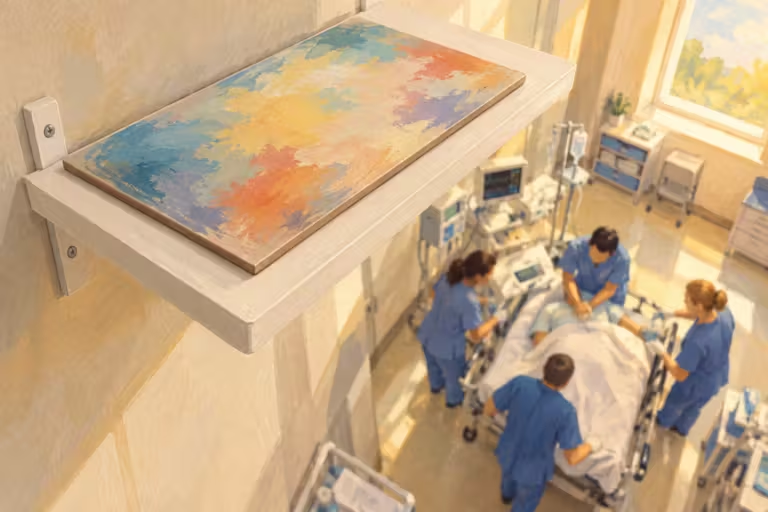
AWARE: the pictures hidden on the shelves
Fifteen hospitals put up pictures that could only be seen from the ceiling, to check whether anyone saw them during a cardiac arrest.
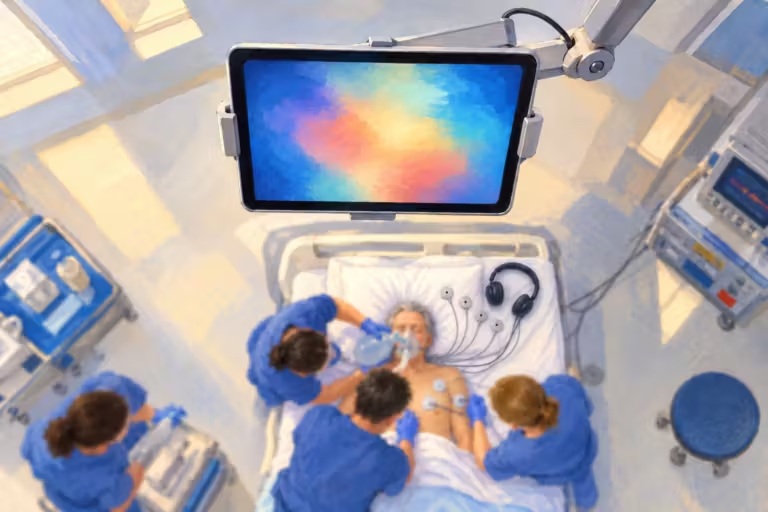
AWARE II: a random picture and the brain on the screen
Above the patient was a tablet with a random picture. Headphones said the names of three fruits. And the doctors measured the brain during resuscitation.
Van Lommel: 344 cardiac arrest survivors in ten hospitals
Ten hospitals asked every cardiac arrest survivor what they remembered. They saw them again after 2 and 8 years.