A study · one case in Geneva (Switzerland), published in 2002
The Blanke experiment: a woman says she sees herself from above when her brain is stimulated
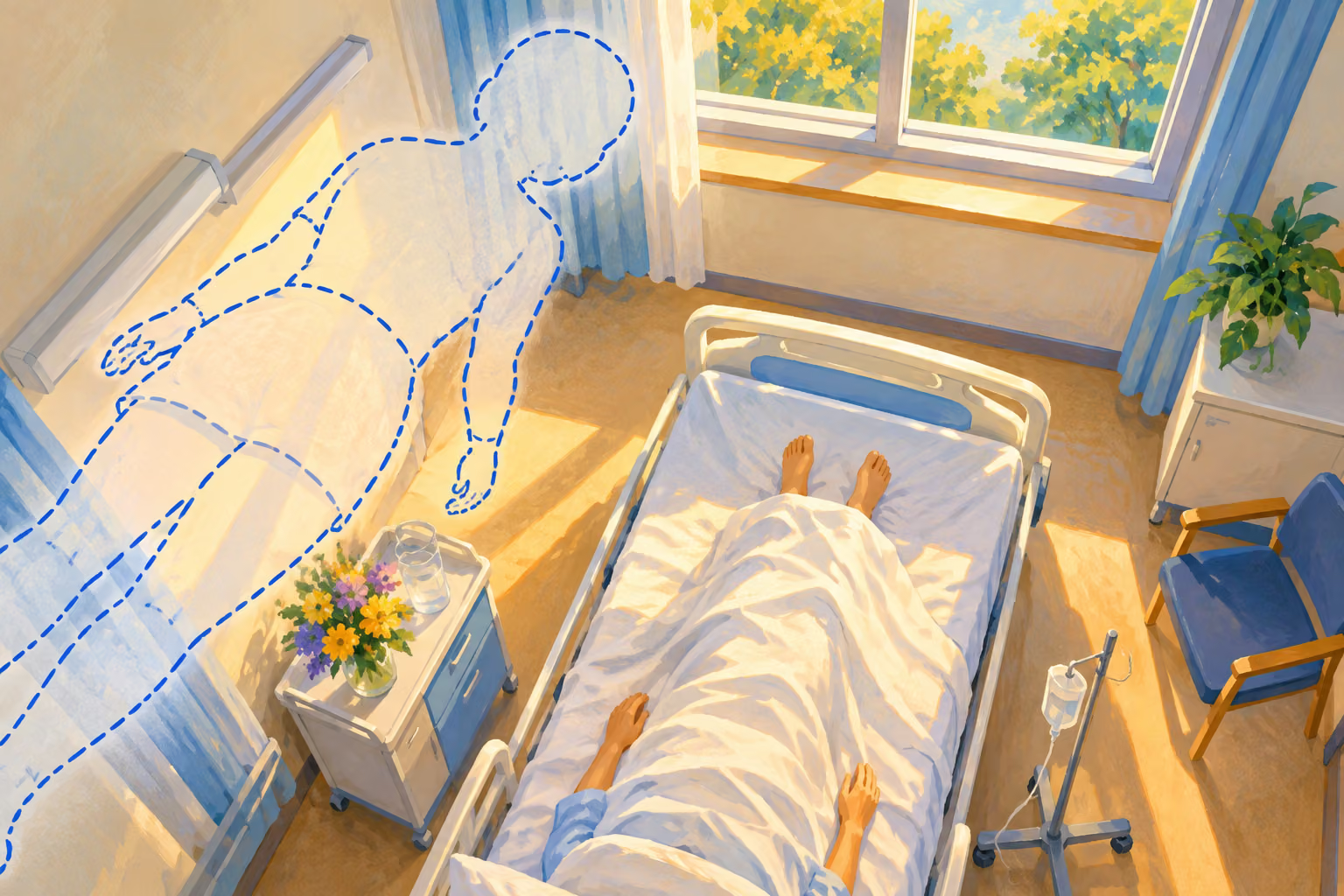
A near-death experience, or NDE, is a very intense experience that some people have when they are about to die. Many say they left their body and saw themselves from above. In 2002, the neurologist Olaf Blanke and his team in Geneva, Switzerland, used electrodes to stimulate the brain of a woman with epilepsy. When they turned the current up a little at one particular spot, she said she saw herself lying in bed, from above. She saw only her legs and the lower part of her trunk. The authors wrote that they had induced an out-of-body experience. Since then, the experiment has been cited to explain the out-of-body experience in NDEs through the brain. Other researchers reply that what the patient went through has little in common with the out-of-body experience of an NDE.
The experiment’s question is: can an out-of-body experience be induced by stimulating one spot in the brain? For NDEs, one more question matters. Is it the same out-of-body experience that people who were about to die describe? We tell it step by step: what the team did, what the patient said, and what came after. If you only want to know what is known, skip straight to the results.
Step 1
Before 2002 · The question
Many people say they have left their body, and no one knew what happens in the brain
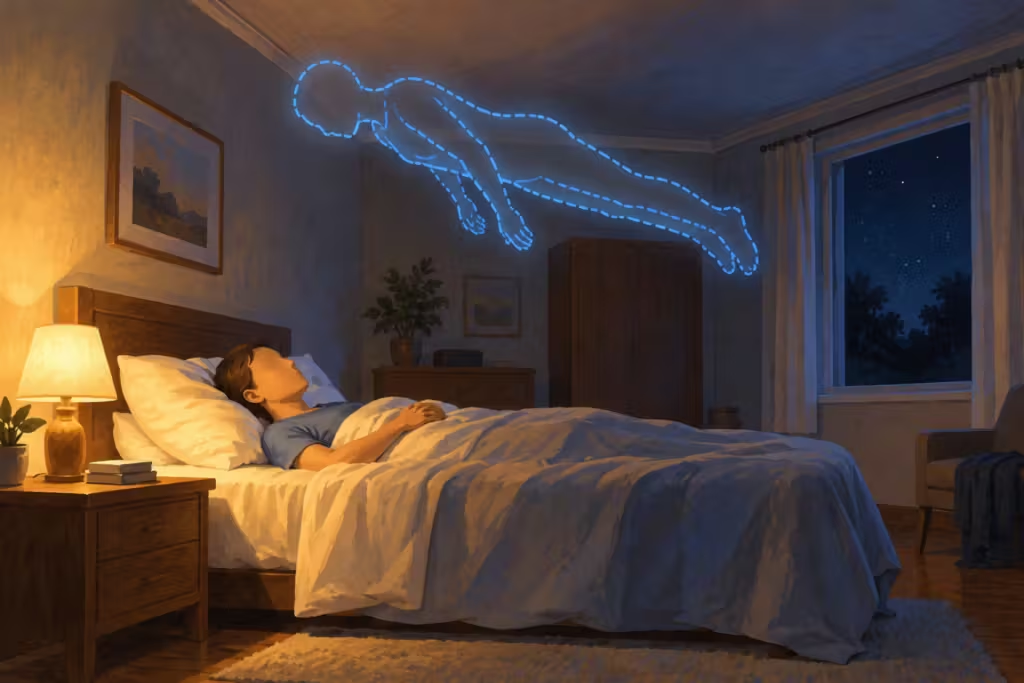
An out-of-body experience is when a person who is awake feels that they are outside their body. They see it from somewhere else, almost always from above. It can happen during an NDE, but also when there is no danger at all. According to the studies Blanke cites, about 1 in 10 healthy people have one at some point.
In 2005, Blanke included an example. A person was in bed, about to fall asleep. Suddenly they had the clear impression of being up at the level of the ceiling, looking down at their body in the bed. They were very frightened, and a moment later they felt back inside the bed.
Doctors also knew of cases in patients with epilepsy, migraines, or brain injuries. In 1955, the Canadian neurosurgeon Wilder Penfield described a patient whose brain he was stimulating during an operation. The patient cried out: “Oh God! I am leaving my body.”
Even so, according to Blanke, there was no brain-based explanation that could be put to the test.
In a hospital in Geneva, a patient with epilepsy was about to offer a clue.
Step 2
Before her surgery in 2000 · Geneva · As the study tells it
A woman with epilepsy has electrodes placed on her brain to find where her seizures start

The patient was 43 years old and had had epileptic seizures for 11 years. The seizures seemed to come from the right temporal lobe. An MRI scan showed no injury. The article was published in 2002, but the tests were done before her surgery, in 2000.
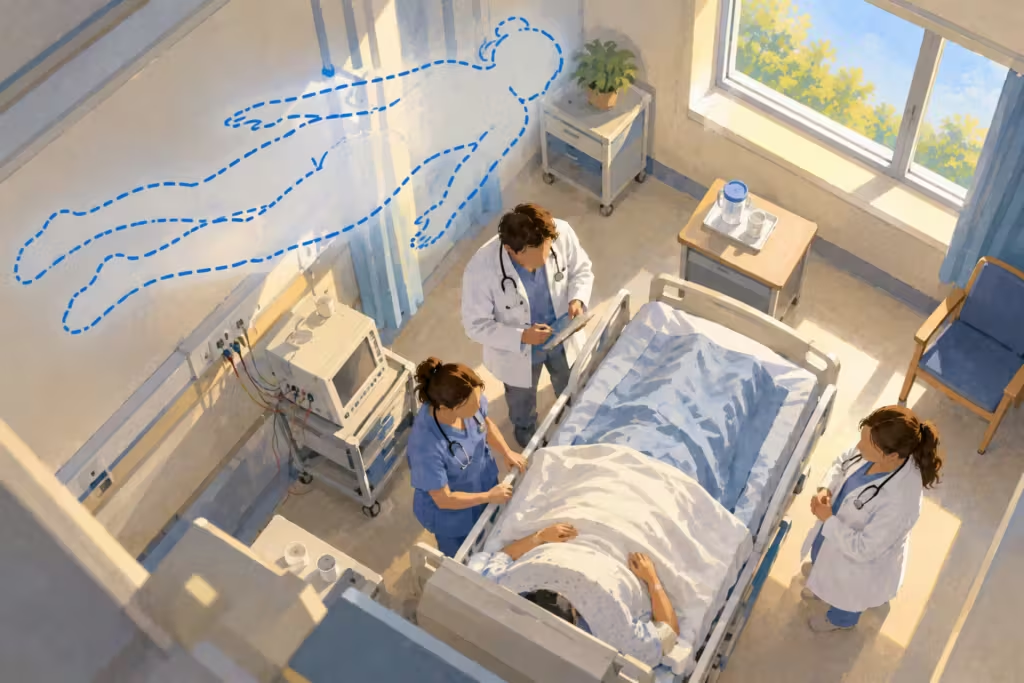
To find the exact spot, the doctors placed electrodes under her skull, on the surface of the brain. They used them to record her seizures. They also sent a two-second electric current through particular spots to learn what each one did. That way they knew which areas they must not touch during the surgery. The brain feels no pain, and the patient was awake and could say what she felt.
In a 2004 article, Blanke added that she had never had an out-of-body experience. Very occasionally she had had the impression of flying and of being light, as in a dream. And she had sensed someone behind her, but when she turned around there was no one.
The doctors tested the spots one by one. At one of them, the patient began to feel strange things in her body.
Step 3
Before her surgery in 2000 · Geneva · As the study tells it
With a little more current, the patient says she sees herself lying in bed, from above
The spot was in the right angular gyrus. This is a fold of the brain that sits above and behind the right ear, near where the temporal and parietal lobes meet.
The first three times, at the lowest current, the patient said she was “sinking into the bed” or “falling from a height.”
The doctors turned the current up a little. This is what the patient said: “I see myself lying in bed, from above, but I only see my legs and lower trunk.”
Two more stimulations gave her the same sensation. During them she suddenly felt light and felt that she was floating about two meters above the bed, near the ceiling.
That spot was not where her seizures came from. Her seizures started more than 5 centimeters further forward, in another part of the brain. Stimulating the place where the seizures started did not produce these sensations. And she did not have them during her usual seizures either.
In the 2004 article, Blanke gave more details. From above, the patient also saw the table next to the bed, the window, and the three people who were in the room. She did not see her face. She said “I am at the ceiling” and “I am looking down at my legs.” According to Blanke, she was very intrigued and surprised.
Next, the doctors asked her to look at her own body.
Step 4
Before her surgery in 2000 · Geneva · As the study tells it
When she looks at herself, she sees her legs getting shorter and her arms moving toward her face

The doctors asked her to look at her actual legs while they sent the current. She was lying down, with her back raised and her legs stretched out. This time she said she saw her legs “becoming shorter.”
When her knees were bent before the stimulation, she felt her legs coming quickly toward her face. She pulled back to dodge them.
With her arms stretched out, she felt her left arm was shorter, and her right arm the same as always. With her elbows bent, she felt her left forearm and hand coming toward her face. With her eyes closed, she felt the upper part of her body moving toward her legs, which were not moving.
Each of these tests was done twice, with somewhat more current than when she saw herself from above. The authors link these tests to what she saw from above. When she saw herself from above, she “saw” only the part of her body that she also felt changing in these tests.
With these data, the team wrote its conclusions.
Step 5
September 19, 2002 · The conclusion · As the study tells it
The authors think the out-of-body experience comes from a failure to bring together what the senses say
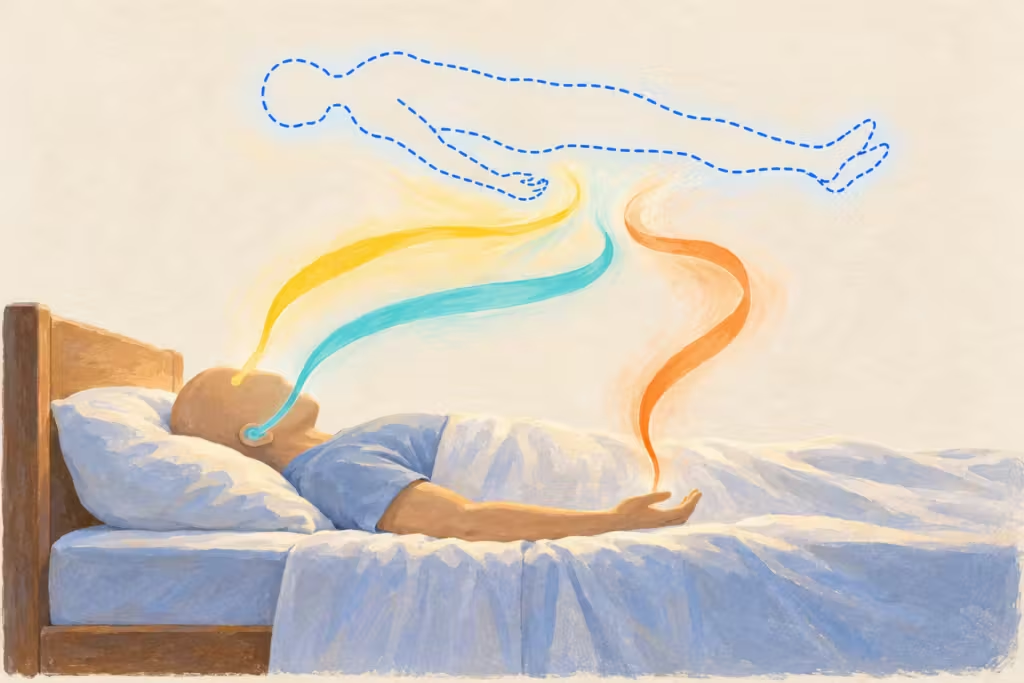
The authors write that their observations indicate that out-of-body experiences can be induced by stimulating the brain. The sensations of floating, of falling, and of the body changing all came from the same spot. That is why they think all of them have a common origin in the way the brain handles a person’s own body.
Their explanation goes like this. The brain knows where the body is because it combines several signals. Some come from touch and from the position of each part of the body. Others come from balance, which is sensed in the inner ear. If the brain fails to combine them, the person might feel separated from their body.
They also admit that they do not fully understand how this happens. They suggest that the spot could be a key part of a larger circuit in the brain.
The press in many countries covered the experiment. The BBC’s headline said that doctors had created out-of-body sensations. The news website of Nature presented it as an illusion “often attributed to the paranormal.”
It was a single case. Blanke looked for more.
Step 6
2004 and 2005 · Geneva and Lausanne · As Blanke tells it
Blanke brings together six patients and proposes that it all starts at the same junction in the brain

In 2004, Blanke and his team published six cases in the journal Brain. One was the 2002 patient. The other five were not experiments. They were patients who had had these experiences during their seizures or during other brain problems. Most had epilepsy.
Three of the six described an out-of-body experience. Four described something similar, seeing a double of themselves. That adds up to seven because one of the patients had both. She had the out-of-body experience before her surgery and saw the double afterward. One of the men drew what he went through. He was sitting down when he felt himself rising into the air with the chair, and he saw a second body of his own come out.
In five of the six, the part of the brain linked to these experiences was in the same region. It was an injury, the spot where the seizures started, or, in the 2002 patient, the spot that was stimulated. This region is the temporoparietal junction, where the temporal and parietal lobes meet. The 2002 spot lies within it. In the sixth patient, no injury was found.
In 2005, Blanke and Shahar Arzy, from his team, turned this into a theory. According to the theory, the out-of-body experience is a failure of that region to bring together what the senses say about a person’s own body.
That same year, the team tested the idea in healthy volunteers. They asked 11 volunteers to imagine themselves in the position, and from the point of view, of someone leaving their body. While they did so, the temporoparietal junction became active. In another 7, they disrupted that region with magnetic stimulation from outside the head. Imagining themselves in that position became harder than when the stimulation was applied to another spot on the head.
It remained to be seen whether something similar could be induced in healthy people without touching their brain.
Step 7
August 2007 · Lausanne and London · As the studies tell it
With video goggles, healthy people feel they are not entirely where their body is
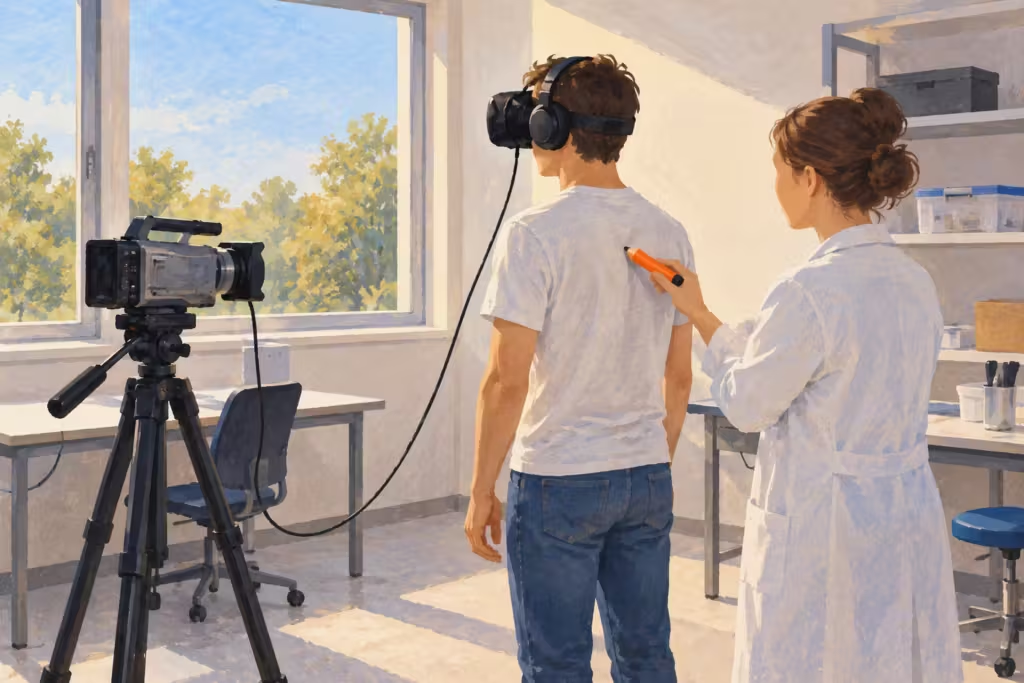
In August 2007, the journal Science published two similar experiments. One came from Blanke’s team, which by then was working at the Swiss Federal Institute of Technology in Lausanne. Its first author was the researcher Bigna Lenggenhager. The other came from Henrik Ehrsson, a neuroscientist who was working in London and Stockholm.
In both, the person wore video goggles. A camera filmed them from behind at a distance of two meters, and the goggles showed them that image.
In Lenggenhager’s experiment, 14 people stood and saw their own back two meters in front of them. Meanwhile, someone stroked their back with a large marker, and they saw the back in the image being stroked. At the end, they were blindfolded, moved, and asked to go back to their spot. When the stroking and the image were in sync, they ended up on average about 24 centimeters in front of where they had started. That put them closer to the body they had seen. When the two were out of sync, they ended up about 12 centimeters in front. Those 12 centimeters could have been chance.
None of those 14 people said they had left their body or were seeing from somewhere else. The authors wrote that they had induced only some aspects of an out-of-body experience.
In Ehrsson’s experiment, the people were seated. Ehrsson wanted them to see in the goggles a rod coming toward them just as they felt a touch on the chest. To do that, he touched their chest with one rod. At the same time, he moved another rod toward a point just below the camera. They said they felt they were sitting behind their body, looking at it. Afterward, Ehrsson swung a hammer toward the area below the camera, as if to strike. Their skin sweated more if, before that, the rod they saw and the touch on the chest had been in sync. If they had been out of sync, it sweated less. Ehrsson took this as evidence that they felt they were behind their body.
In 2008, Kaspar Meyer, a researcher at the University of Southern California, compared the two experiments on the Science website. In his view, people place themselves mainly where they see themselves being touched. Ehrsson replied that in Lenggenhager’s experiment people were perhaps just recognizing themselves on video. It would be like seeing yourself on the security camera screen in a store. According to Ehrsson, Lenggenhager’s own team had written in another letter that people moved between 17 and 25 centimeters. The image was two meters away. Blanke’s team replied that new experiments were needed, using the same questions and the same measures in both setups.
Meanwhile, a few more cases turned up in hospitals.
Step 8
2006 to 2023 · Other patients · As the studies tell it
Other patients and other parts of the brain give similar sensations, but the cases are very few
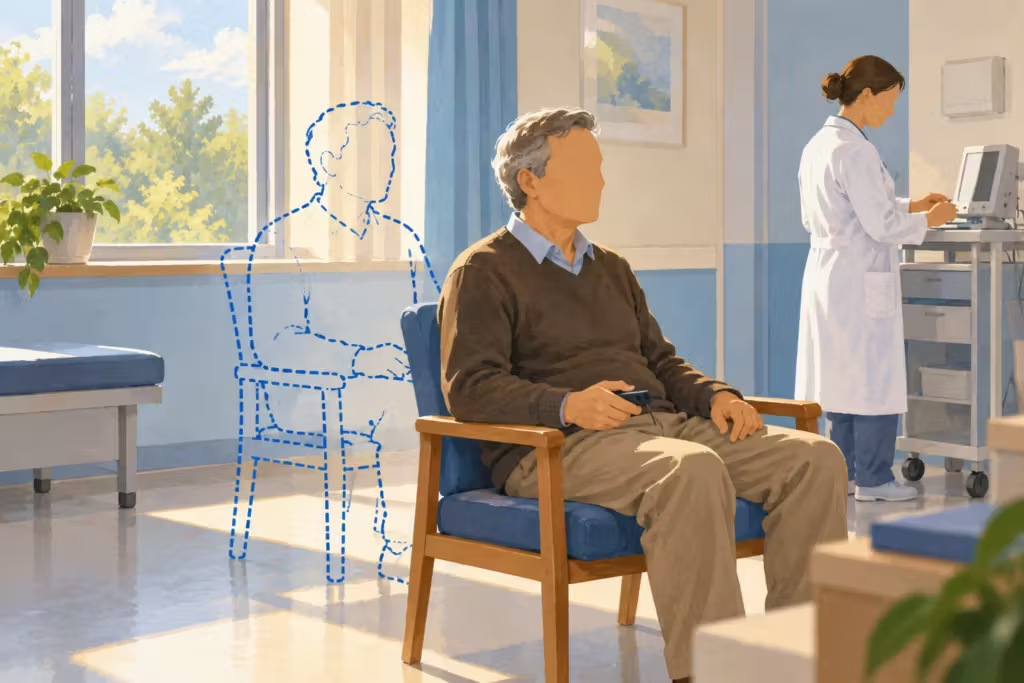
In 2006, Blanke’s team stimulated a 22-year-old woman with epilepsy, this time on the left side of the temporoparietal junction. She felt that someone was behind her, a “shadow” who copied her posture. When she sat up and hugged her knees, she said the “man” was also sitting and was hugging her. It was not an out-of-body experience. The authors think she was perceiving her own body as if it belonged to someone else.
In 2007, a team in Antwerp, Belgium, published the case of a 63-year-old man. He had been given an electrode to get rid of a ringing in his ear. The ringing did not go away. With certain current settings, he felt that he was about 50 centimeters behind his body and to the left. He did not see himself, and he still saw the room through his own eyes. Each time it lasted about 17 seconds. The electrode was on the right side, next to the angular gyrus, but not at the same spot as in 2002.
Another case was published in 2016. It was a 50-year-old woman who was having a tumor removed while awake, also on the left side. During the stimulation, she said three times that she was floating just below the ceiling and saw her body on the operating table. Estelle Nakul and Christophe Lopez, two researchers in Marseille, describe it in a 2017 commentary.
In that commentary, Nakul and Lopez counted the published cases of out-of-body experiences induced by brain stimulation. They found only five in all of history. They write that no one knows why it appears so rarely when the brain is stimulated. According to the studies they cite, between 5 and 10 out of 100 people with no brain problems have had an out-of-body experience at some point.
In 2023, another review brought together 42 articles describing what 221 stimulated patients reported. The patients reported many changes in the sense of their own body. Only 10 were out-of-body experiences, about 3 out of 100. That same year, a team at Stanford stimulated another area, the precuneus, which lies on the inner surface of the brain. Of nine patients, three felt they were becoming detached from themselves. One of them described it as being thrown up on the clouds and out of the body.
While these cases were being published, other researchers were questioning what had been concluded in 2002.
Step 9
2002 to 2007 · As the critics tell it
The critics reply that what the patient went through is not like the out-of-body experience of an NDE

The first response came from the psychiatrist Vernon Neppe, in Seattle, soon after the article. He wrote that a single case cannot be generalized. The patient had had epilepsy for years, and that part of her brain might not work like that of a healthy person. He recalled that Penfield’s patient had his experience when a different area was stimulated. He pointed out that the words “out-of-body” were not the patient’s, but the doctors’. And he wrote that finding the area of the brain does not tell us whether what is perceived starts inside the brain or comes from outside.
In 2006 another critique came, signed by three authors. Janice Miner Holden was a professor at the University of North Texas. Jeffrey Long is a physician who founded NDERF, a website of NDE accounts. Jason MacLurg is a psychiatrist. It appeared in the Journal of Near-Death Studies, the journal of NDE research. They accept that, by the usual definitions, what the patient went through is an out-of-body experience. But they think it is not a typical one. According to them, in a spontaneous out-of-body experience the person usually sees their whole body, undistorted. The patient saw only part of her body, and she felt her legs and one arm getting shorter and moving. Blanke, in his 2004 article, wrote that the patient did see the room from above.
For Holden and her colleagues, a single case is not enough to say that the part of the brain that causes these experiences has been found. They add that a typical out-of-body experience induced with electrodes would not explain other cases either. They mean people who, during an NDE, say they saw something they could not have seen with their eyes, which was later checked.
In 2007, Emily Williams Kelly, Bruce Greyson, and Edward Kelly, from the University of Virginia, wrote about Blanke in the book Irreducible Mind. They say his data are important and his conclusions are premature. According to them, that common region is not each patient’s injury. It is only the area where the injuries of the five patients overlap, and in each of them the injury covered wider areas. They recall that only 2 of Penfield’s 1,132 patients described anything vaguely like leaving the body. And they think an electrical stimulation is more likely to disrupt what that area does. That would explain why the area stops working properly, but not why a new experience appears. According to them, what produces the experience could be somewhere else.
The question from the beginning remains: can an out-of-body experience be induced, and is it the same as the one in an NDE? Let’s see what is known and what isn’t.
One session, test by test
What the patient felt at each current, at the same spot in the brain. The current is measured in milliamperes, and each stimulation lasted two seconds.
| What she felt | Current | Times |
|---|---|---|
| She was sinking into the bed or falling from a height | 2 to 3 | 3 |
| She saw herself from above and floated near the ceiling | 3.5 | 3 |
| Looking at her legs, she saw them getting shorter | 4 and 4.5 | 2 |
| With her knees bent, her legs came toward her face | 4 and 5 | 2 |
| With her arms stretched out, she felt her left arm was shorter | 4.5 and 5 | 2 |
| With her elbows bent, her left hand came toward her face | 4.5 and 5 | 2 |
| With her eyes closed, her trunk moved toward her legs | 4 and 5 | 2 |
What these figures don’t tell
- It is a single patient. She had had epilepsy for 11 years, although her seizures started at another spot in the brain.
- The article does not say how many stimulations were given at that spot with no response. It only reports the ones that produced something.
- The 2002 article does not give the current for the last two times she saw herself from above. The 2004 article says all three were at 3.5.
Frequently asked questions
Can an out-of-body experience be induced by stimulating the brain?
Yes, in some patients, although it is very rare. In 2002, Olaf Blanke’s team stimulated a spot in the brain of a patient with epilepsy. She said she saw herself from above. In 2017, two researchers in Marseille found only five such cases published in all of history.
Does the Blanke experiment explain the out-of-body experience in near-death experiences?
No one knows. The experiment shows that the brain can produce the sensation of seeing yourself from above. But no one has measured that area of the brain during an NDE. And what the patient went through was brief, partial, and with a distorted body. It does not show that the out-of-body experience of an NDE happens outside the brain either.
What did Blanke’s patient see when she said she saw herself from above?
The patient said she saw herself lying in bed, from above, but only her legs and the lower part of her trunk. According to a 2004 article by the same team, from above she also saw the table, the window, and the three people in the room. She did not see her face.
What is the temporoparietal junction, and what does it have to do with leaving the body?
The temporoparietal junction is the area of the brain where the temporal and parietal lobes meet, above and behind the ear. According to the neurologist Olaf Blanke, it brings together what the senses say about a person’s own body. According to a 2025 review, it is the area of the brain whose link to out-of-body experiences has been checked most thoroughly.
Has Blanke’s 2002 experiment been repeated?
Not exactly. Other cases of out-of-body experiences induced by brain stimulation have been published. They involve other people, and other areas or the other side of the brain. In 2007, two experiments with video goggles made healthy people feel they were not entirely where their body was. The two teams later argued over whether that was really an out-of-body experience.
Where this page comes from
The study
- Olaf Blanke, Stéphanie Ortigue, Theodor Landis, and Margitta Seeck, “Stimulating illusory own-body perceptions,” Nature 419:269-270 (2002)Read for free
- Olaf Blanke, Theodor Landis, Laurent Spinelli, and Margitta Seeck, “Out-of-body experience and autoscopy of neurological origin,” Brain 127:243-258 (2004). The six patients, with more details on the 2002 caseRead for free
What came after
- Olaf Blanke and Shahar Arzy, “The out-of-body experience: disturbed self-processing at the temporo-parietal junction,” The Neuroscientist 11:16-24 (2005)Read for free
- Olaf Blanke and others, “Linking out-of-body experience and self processing to mental own-body imagery at the temporoparietal junction,” The Journal of Neuroscience 25:550-557 (2005)Read for free
- Shahar Arzy and others, “Induction of an illusory shadow person,” Nature 443:287 (2006)View in the journal (paywalled)
- Bigna Lenggenhager, Tej Tadi, Thomas Metzinger, and Olaf Blanke, “Video ergo sum: manipulating bodily self-consciousness,” Science 317:1096-1099 (2007)Read for free
- H. Henrik Ehrsson, “The experimental induction of out-of-body experiences,” Science 317:1048 (2007)Read for free
- Kaspar Meyer, and the replies from Henrik Ehrsson and Valeria Petkova and from Blanke’s team, letters on the Science website (June 2008)Read for free
- Dirk De Ridder and others, “Visualizing out-of-body experience in the brain,” The New England Journal of Medicine 357:1829-1833 (2007)View in the journal
- Estelle Nakul and Christophe Lopez, “Commentary: Out-of-body experience during awake craniotomy,” Frontiers in Human Neuroscience 11:417 (2017)Read for free
- Zoé Dary and others, “Neural bases of the bodily self as revealed by electrical brain stimulation: a systematic review,” Human Brain Mapping 44:2936-2959 (2023)Read for free
- Dian Lyu and others, “Causal evidence for the processing of bodily self in the anterior precuneus,” Neuron 111:2502-2512 (2023)View in the journal
Assessments and critiques
- Vernon M. Neppe, “‘Out-of-body experiences’ (OBEs) and brain localisation: a perspective,” on the website of the Pacific Neuropsychiatric InstituteRead for free
- Janice Miner Holden, Jeffrey Long, and Jason MacLurg, “Out-of-body experiences: all in the brain?,” Journal of Near-Death Studies 25:99-107 (2006)Read for free
- Emily Williams Kelly, Bruce Greyson, and Edward F. Kelly, “Unusual experiences near death and related phenomena,” chapter 6 of Irreducible Mind (2007), pages 397 to 399Buy the book
- Susan Blackmore, “Seeing myself: the new science of out-of-body experiences,” Western Morning News (July 15, 2017)Read for free
- Jenny Moix, Samantha Baldaccini, and Marta Isern, “Out of body experiences: scoping review,” Explore 21:103196 (2025)Read for free
To understand more
- The NEPTUNE model: a 2025 attempt to explain NDEs through the brainRead
- Kevin Nelson’s study of NDEs and sleepRead
- “Dying to Live”: Susan Blackmore explains NDEs with the brainRead
- The AWARE II study: a random image and the brain on screenRead
- What does science say about near-death experiences?Read
Our archive
- A full reading of the 2002 article and of the studies and critiques that came after it, as of October 30, 2026
More studies

AWARE: the pictures hidden on the shelves
Fifteen hospitals put up pictures that could only be seen from the ceiling, to check whether anyone saw them during a cardiac arrest.
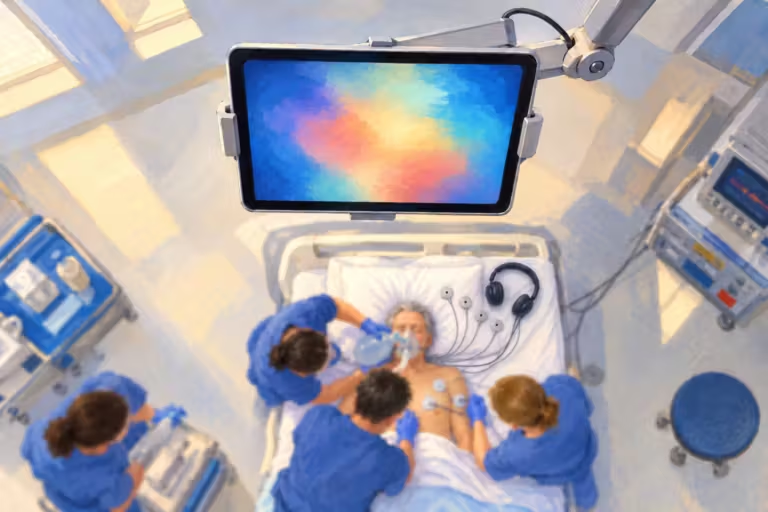
AWARE II: a random picture and the brain on the screen
Above the patient was a tablet with a random picture. Headphones said the names of three fruits. And the doctors measured the brain during resuscitation.

Van Lommel: 344 cardiac arrest survivors in ten hospitals
Ten hospitals asked every cardiac arrest survivor what they remembered. They saw them again after 2 and 8 years.