A book · London, 1926
What the dying see: William Barrett’s book “Death-Bed Visions” (1926)
In 1926, a book came out in London with about 60 accounts. They are accounts of people who said they saw relatives who had already died while they themselves were dying. The physicist William Barrett wrote the book, but he died before he could finish it. Barrett cared most about a few cases. In them, a dying person saw someone who had died without knowing that person had died.
The question is: can a dying person see someone who has died without knowing that person had died? Barrett believed so. For him, that would be evidence of life after death. We tell it step by step, with his best case and with what the book lacks. If you only want to know what can be checked, skip straight to the results.
Step 1
London, January 1924 · A doctor in a hospital
A doctor watches a young mother die and tells her husband about it
Florence Barrett was an obstetric surgeon at a maternity hospital in Clapton, in London. The hospital was called the Mothers’ Hospital.
In January 1924, she cared for a young mother who was dying after giving birth. Before she died, the woman said she could see her dead father. Soon afterward, the doctor wrote down what she had heard.
She told her husband, William Barrett. He was very interested in accounts like this.
That case is the first one in the book. We tell it in step 5.
Step 2
From 1844 to 1925 · Who William Barrett was
A physicist who helped found a society to study these phenomena
William Barrett was born in 1844. He was a professor of physics in Dublin, Ireland, from 1873 to 1910.
In 1882, Barrett called a meeting in London. That meeting gave rise to a society that studies phenomena such as telepathy, apparitions, and what people go through as they die. It is called the Society for Psychical Research.
- Barrett believed the mind lives on after death. He wanted to find evidence.
- He collected accounts for years. Some came to him by letter, and others he took from magazines and books.
Barrett died suddenly in May 1925, before he finished the book.
Step 3
Before 1925 · Barrett’s question
He looks for dying people who saw someone without knowing that person had died
When a dying person says they see their dead mother, it isn’t very surprising. They knew her, they missed her, and they knew she had died. Their mind could imagine her.
Barrett focused on another kind of case. In these cases, the dying person sees someone who, as far as they knew, was still alive. Later it turns out that this person had already died, and that no one had told them.
These cases are called Peak in Darien cases. The name comes from an 1882 book by the writer Frances Power Cobbe, which discussed them.
Barrett thought these cases were one of the strongest arguments for life after death.
Step 4
April 1926 · The book
Barrett’s widow publishes the unfinished book
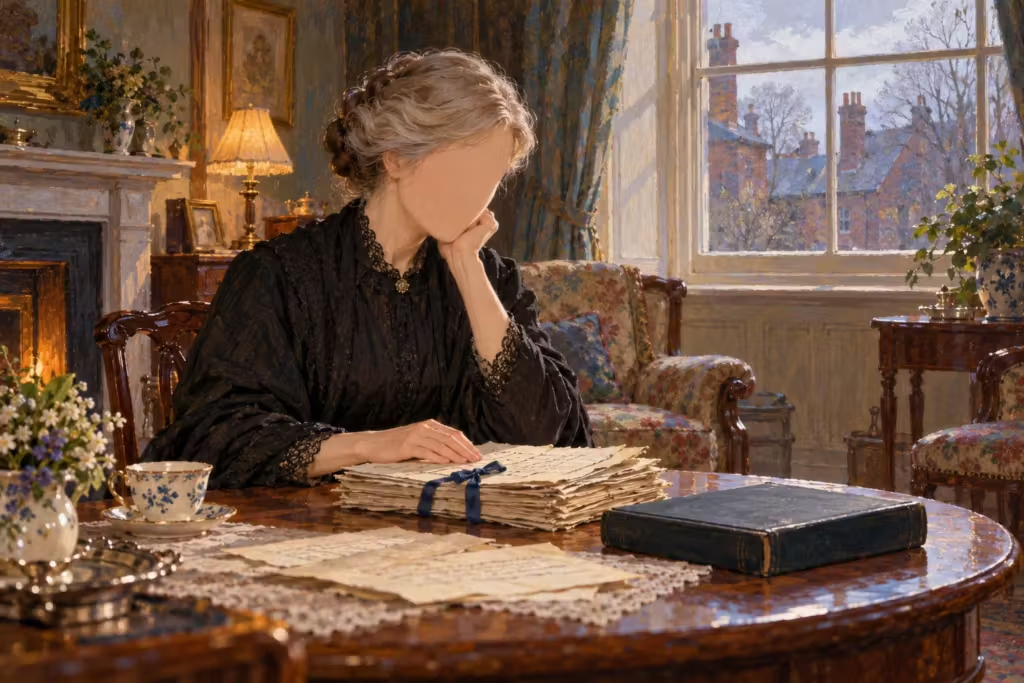
Florence Barrett published the book in 1926, just as her husband had left it. The introduction is only half written. She explains that she chose not to complete it, so as not to change what he thought.
The book has six chapters:
- Chapter 2. Dying people who saw someone without knowing that person had died. There are 9 cases.
- Chapter 3. Dying people who saw relatives they knew had died. There are about 37 cases.
- Chapters 4, 5, and 6. Dying people who saw living people who were far away, music heard at the moment of death, and what some people said they saw leave the body. There are about 15 cases.
In all, the book has about 61 accounts. The first is that of Florence Barrett’s patient.
Step 5
January 12, 1924 · Doris’s case
A mother dying after childbirth says she sees her sister, and no one had told her that her sister had died
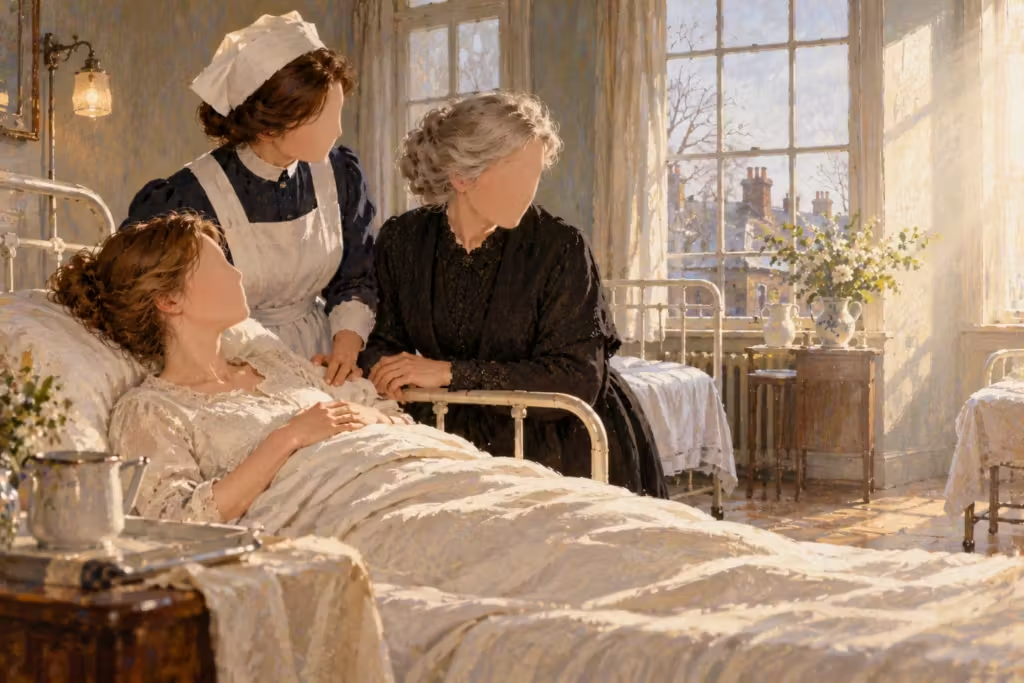
The patient’s name was Doris. The book calls her “Mrs. B.” As she was dying, Doris said she could see her dead father. She said her sister Vida was with him.
Vida had died 18 days earlier. The family had kept it from Doris, because she was very ill. When they visited her, they took off their mourning clothes. And her husband went through her letters before giving them to her.
- There are three signed statements: from Florence Barrett, from the hospital matron (the head nurse), and from Doris’s mother.
- The matron was not part of the family. She wrote that she heard Doris say Vida’s name.
- Vida’s death can be checked today. It is in the civil register of England. Vida died in the last months of 1923, before the vision.
It is the strongest case in the book. But the note Florence Barrett wrote soon afterward doesn’t mention Vida. The full story is on her page.
Step 6
Chapter 2 · The other eight cases
The other dying people who saw someone without knowing that person had died
Chapter 2 has eight more cases of the same kind. They are not as strong as Doris’s.
- The best is John Ogle’s, in Leeds. In 1880, John Ogle said the name of an acquaintance, George Hanley, before he died. No one in the room knew Hanley had died, except Ogle’s mother. The civil register lists a George Hanley from that area who died before John. He is probably the same man, but this is not certain. Ogle’s sister told the story four years later. She said it was in 1879, and it was in 1880. We tell the full story in John Ogle’s story.
- Another is told by a father who doesn’t give his name. His three-year-old son said he saw his brother. That brother had died of scarlet fever the day before, in another town.
- Six are secondhand or thirdhand. They are told by someone who heard the story, or by a magazine. They have no named witnesses or no checked dates.
Barrett presents these cases as one of the strongest arguments in the book. The argument rests mainly on two cases, Doris’s and Ogle’s.
Step 7
Chapter 3 · Relatives they knew had died
Many dying people say they see their dead, and sometimes the people with them see them too
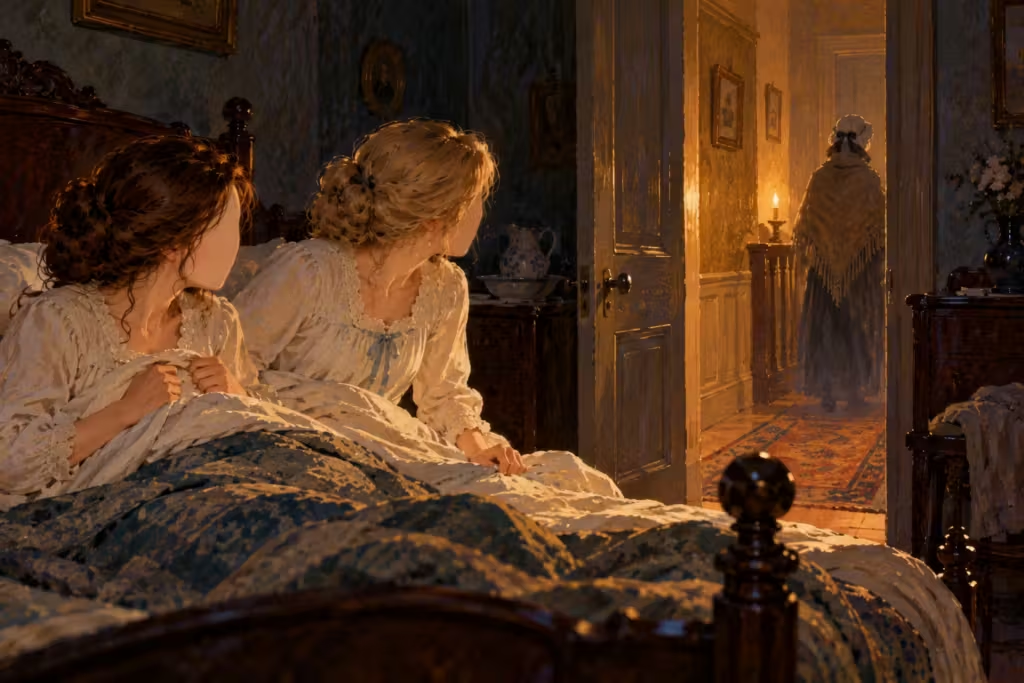
The longest chapter has about 37 cases. They are dying people who say they see parents, children, or brothers and sisters they knew had died. Many of these cases are told by a nurse or a relative who was there.
At the end of the chapter come stranger cases. In them, the people sitting with the dying person say they themselves saw the dead person.
- London, 1864. Harriet Pearson was dying at home. Her sister Ann had died years before. According to the account, three relatives who were caring for her saw Ann pass by the door in the early hours of the morning. That day, Harriet said she had seen her sister. The account was published about 25 years later.
- Massachusetts, 1890. A nurse was sitting up at night with an unconscious patient. She had never met the patient before. The nurse saw a man standing still in the doorway of the room, and then he disappeared. The nurse described him. According to a niece of the patient, the man in that description looked like the patient’s first husband, who had died 35 years earlier.
Barrett included these cases because it is harder to say it is only the dying person’s imagination if other people see the same thing.
Step 8
Chapters 4, 5, and 6 · Other accounts
Living people far away, music, and “something” leaving the body
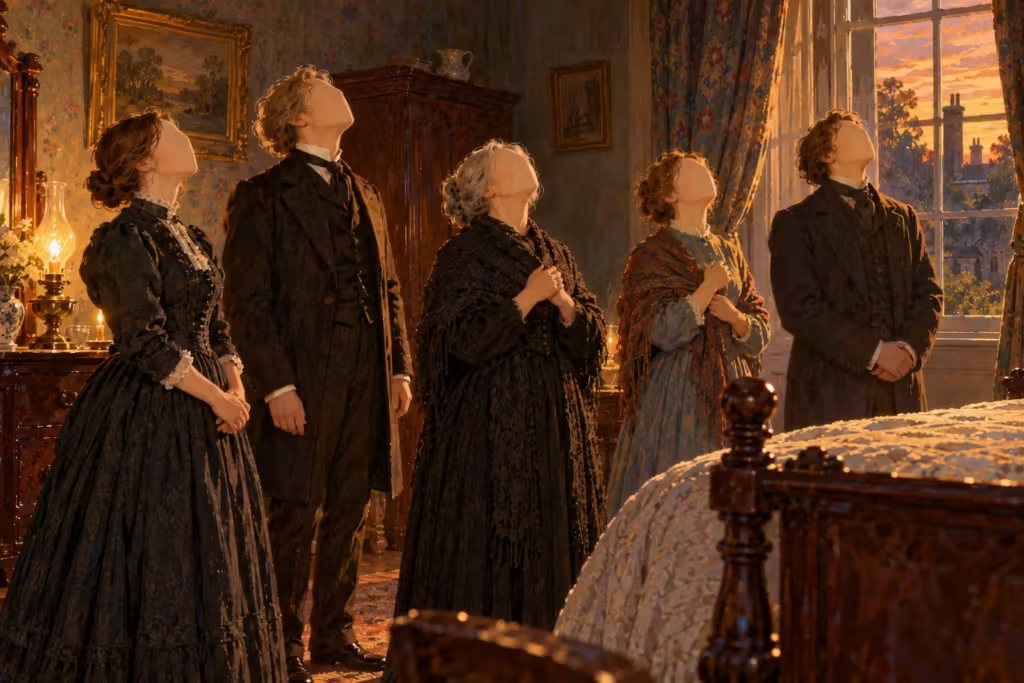
The last chapters are shorter and mix very different accounts.
- Living people far away. Dying people who say they see a living relative who was far away. In some cases, that relative says they saw the dying person at the same time. Two are from the 17th and 18th centuries.
- Music. People who heard singing or playing when someone died. In Eton, in 1881, five people say they heard singing right after a death. One of them wrote it down that same day.
- Something leaving the body. Witnesses who say they saw a mist or a figure leave the dying person. Three of these accounts come from the same nurse, Joy Snell. Joy Snell said she often saw angels.
Barrett didn’t expect each case to be convincing on its own. His argument was a different one.
Step 9
1926 · The book’s argument
One stick breaks, but a bundle of sticks doesn’t

Barrett admits that a single case could be explained without anything unusual. The dying person might have a hallucination. And if it matches a death, that might be chance. He writes this about Doris’s case.
But he adds that many witnesses who don’t know each other tell the same thing. He explains it with an image. A single stick breaks easily, but a bundle of sticks tied together doesn’t.
- Barrett discusses other explanations: hallucination, the images people see as they fall asleep, chance, and telepathy with the people in the room.
- He doesn’t mention drugs or lack of oxygen as possible causes. The word delirium comes up often in the book. But it almost always comes up to say that the dying person was not delirious.
The bundle of sticks only works if the sticks are sound. Let’s look at them.
Step 10
The 61 accounts · What is missing
Few accounts were written down at the time, and few have a named witness

To trust an account like this, you need two things. You need to know the name of the person who saw it. And that person must have written it down soon, before memory changes it.
- The book mixes accounts by named witnesses with secondhand accounts. Some are signed only with initials, and others are taken from magazines.
- Few accounts were written down the same day or in the weeks that followed. Most were written years or decades later, or we don’t know when.
- In the best case, Doris’s, Vida’s name is not in the note written soon afterward. The matron and Doris’s mother wrote it later, with no date.
And we still need to know how often a dying person sees someone who is still alive.
Step 11
Today · What wasn’t counted
Barrett didn’t count the dying people who see living people

If dying people often see people who are still alive, Barrett’s cases carry less weight. If a dying person sees a dead person, that could be just one more of the faces the mind sees as it dies.
- The widow writes in the preface that Barrett knew of no case of a dying person who saw a living friend by the bed.
- But the book itself has one. In 1869, a father dying in London said he saw the head of his son, who was alive in Australia. The book doesn’t point out that this case contradicts the preface.
- Today there is a study that measured it. In 2014, the doctor Christopher Kerr and his team interviewed 59 patients at a hospice in New York State, in the United States. They spoke with them almost every day. 52 had dreams or visions. What they saw most often were relatives or friends who had died. They also saw relatives or friends who were alive. The dreams and visions of the dead were the most comforting. We cover it in full in our page on Kerr’s study.
The question from the beginning remains: can a dying person see someone who has died without knowing that person had died? Let’s see what can be said.
The accounts in the book, by chapter
The table shows how many accounts each part of the book has. It also shows how many are told by someone who was there and gives their name.
The figures are approximate, because some accounts bring two or three cases together.
| Chapter | Accounts | With a named witness |
|---|---|---|
| 2. Saw someone without knowing they had died | 9 | 3 |
| 3. Saw relatives they knew had died | 37 | about 15 |
| 4. Saw living people who were far away | 5 | about 2 |
| 5. Music at death | 4 | 1 |
| 6. Something leaving the body | 6 | 3 |
| Total | about 61 | about 24 |
What these figures don’t tell
- How many dying people saw no one, or saw living people. The book only includes the accounts that reached it.
- Whether the witnesses remembered correctly. If a witness gives their name, that doesn’t mean their memory is accurate.
Where this page comes from
The book
- William Barrett, Death-Bed Visions (Methuen, London, 1926), at the Wellcome Collection. Doris’s case, on pages 10-15; the bundle-of-sticks argument, on page 5Read for free
Assessments and later studies
- Gerald Woerlee, Mortal Minds: A Biology of the Soul and the Dying Experience (2003). Doris’s case, in chapter 17
- Christopher Kerr and others, “End-of-Life Dreams and Visions: A Longitudinal Study of Hospice Patients’ Experiences,” Journal of Palliative Medicine 17 (2014), pages 296-303View in the journal (paywalled)
To understand more
- Doris: the sister no one had told her had died, the best case in the bookRead
- What does science say about near-death experiences?Read
- What is a near-death experience?Read
Our archive
- A reading of the book’s 61 accounts, the search for Doris, Vida, John Ogle, and George Hanley in the civil register of England, and the comparison with today’s studies, as of October 21, 2026
More studies

AWARE: the pictures hidden on the shelves
Fifteen hospitals put up pictures that could only be seen from the ceiling, to check whether anyone saw them during a cardiac arrest.
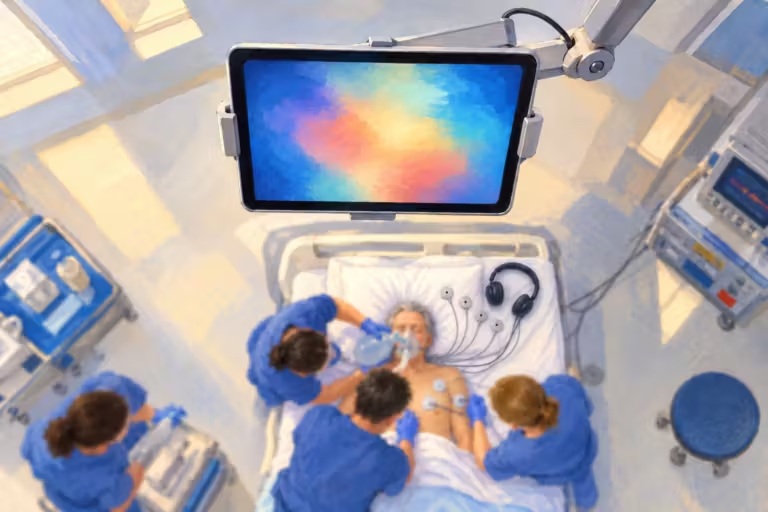
AWARE II: a random picture and the brain on the screen
Above the patient was a tablet with a random picture. Headphones said the names of three fruits. And the doctors measured the brain during resuscitation.

Van Lommel: 344 cardiac arrest survivors in ten hospitals
Ten hospitals asked every cardiac arrest survivor what they remembered. They saw them again after 2 and 8 years.