
A real-life story · Madrid, Spain, 2025
Eduardo Muñoz’s near-death experience
Eduardo Muñoz, a 33-year-old engineer, had a heart attack in February 2025, after playing tennis. His heart stopped three times, and doctors spent 65 minutes resuscitating him. He later said he stood before a tribunal, with his late grandfather at his side. There he was told he had to go back. He also said he saw, from above, the ambulance taking him from one hospital to another, with a police car in front and another behind.
Eduardo’s experience is one of the few that were recorded on video on the same day the person woke up. His mother filmed him in the ICU while he described it. But what convinces him most that his experience was real is the ambulance with the police. And that is not in the video. How did Eduardo know he had been taken that way?
Step 1
Monday, February 3, 2025 · In the morning · He is fine · Eduardo’s account
A tennis match with his uncle

Eduardo Muñoz is an engineer and lives in Madrid. He has worked for motor racing teams. A week earlier, he was on a trip to Rome.
That Monday he has a simple plan. In the morning he plays tennis with his uncle. Afterward he wants to drive out to the countryside with his little dog, who is waiting for him in the van.
He plays hard. When the match is over, he hugs his uncle goodbye. Then he feels a very sharp pull in his chest, like something tearing. He can’t breathe for two or three seconds.
He thinks he must have pulled a muscle from the effort. It passes, and he gets on with his day.
Step 2
Shortly afterward · Driving · Eduardo’s account
He drives to the emergency room as his vision fades
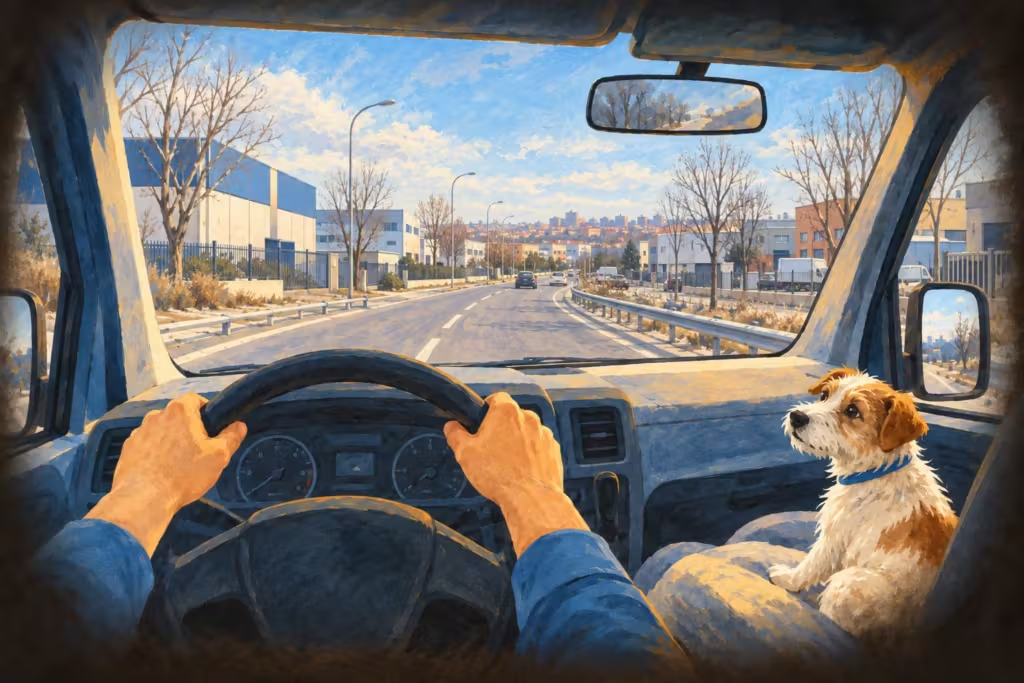
He drives his uncle home, and they stay and talk for a while. Then he gets back in the van and sets off for the countryside.
Soon after he starts driving, his whole body begins to shake, his arms and his legs. His vision slowly fades. Nothing like this has ever happened to him, and he doesn’t know what is wrong.
He doesn’t like hospitals. But he feels that something is very wrong. He is about ten minutes from the Hospital Universitario de Fuenlabrada, in the south of Madrid, and he heads there.
It gets harder and harder for him to stay awake. He remembers gripping the steering wheel and telling himself, “I have to get there, I have to get there” (translated from Spanish).
Step 3
Around 1:30 p.m. · In the emergency room · Eduardo’s account
An orderly takes him inside without waiting
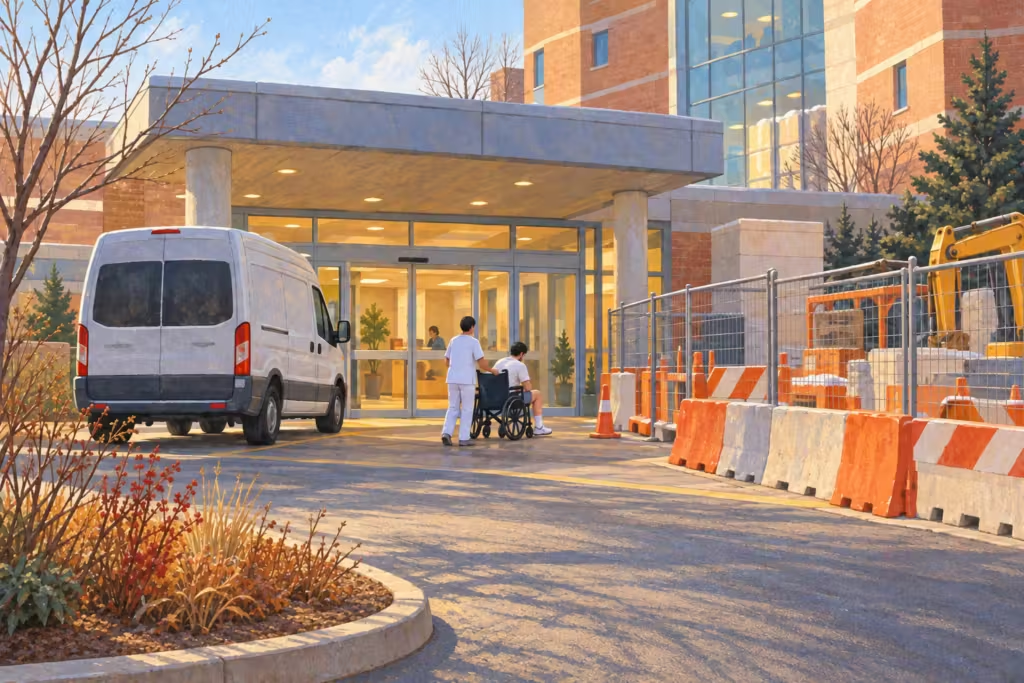
He parks the van at the emergency entrance, where the ambulances pull up. A hospital orderly comes out to tell him to move it. But as soon as the orderly sees him, he realizes that Eduardo is in very bad shape.
The orderly puts him in a wheelchair and takes him inside. At the admissions desk, they tell him to wait in the waiting room. The orderly answers, “This young man is in no state to wait even a minute.” And he takes him straight to the nurses. Today Eduardo calls him his guardian angel.
They lay him on a stretcher. He sees a white coat next to him. He feels relief, because now he is somewhere safe. He lets out his breath, like a sigh.
That is the last thing he remembers. He knows what happens next because the hospital staff told him.
Step 4
February 3, in the afternoon · His heart stops · As Eduardo was told
Doctors spend 65 minutes resuscitating him
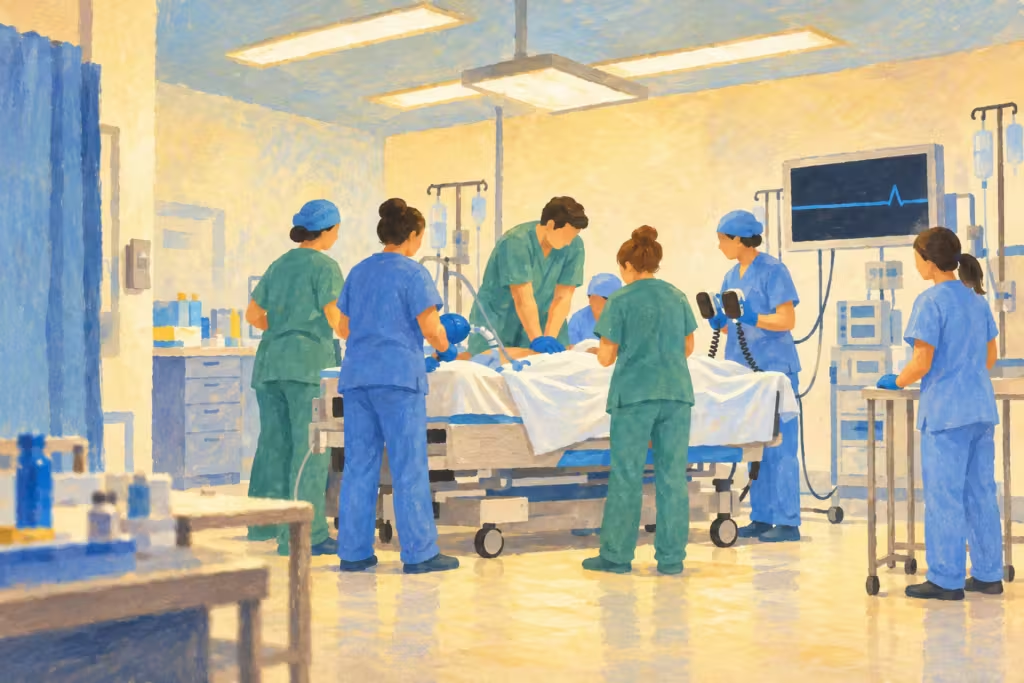
A nurse starts putting the patches on him for an electrocardiogram. She doesn’t have time to put on the second one, because his heart stops.
They take him to the room for the most serious cases. There they work for 65 minutes to resuscitate him. He was told that more than twenty people took turns doing chest compressions on him. They give him adrenaline and electric shocks.
According to what he was told, his heart doesn’t beat even once for 24 minutes. Then the cardiologist decides to give him a drug to dissolve a possible blood clot. After that, his heart receives electrical impulses, but it doesn’t pump blood.
After 65 minutes, his heart starts beating again. Eduardo says the medical report uses the word “resucitar,” which in Spanish means “to bring back to life.” That report has not been published.
Step 5
February 3, in the afternoon · Unconscious · As Eduardo was told
In the ambulance, his heart stops again
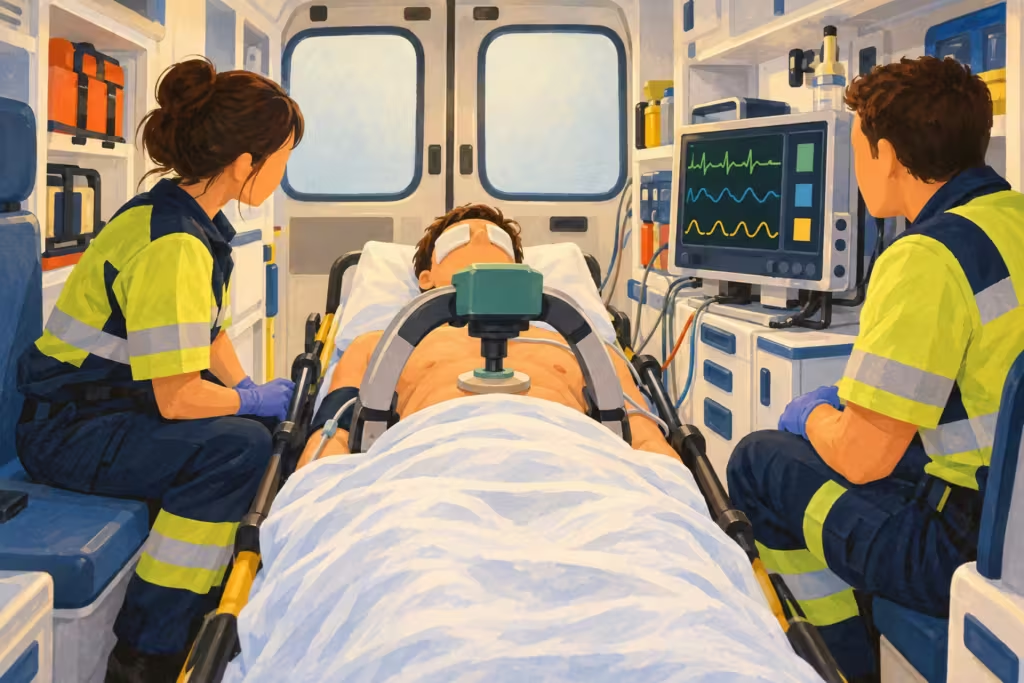
He urgently needs a cardiac catheterization. Doctors pass a very thin tube through an artery up to the heart, to open the artery that is blocked. The hospital in Fuenlabrada can’t do it. They decide to take him to the Hospital 12 de Octubre, in Madrid.
His heart stops again when they move him from the stretcher onto the ambulance stretcher. They revive him right away.
In the ambulance, they put a machine called LUCAS on top of him. It is a box that does the chest compressions on its own. During the trip, his heart stops for the third time. The machine resuscitates him again.
Eduardo is unconscious. He says his eyes were covered with gauze pads, so he could not see anything that was happening outside the ambulance.
Step 6
The night of February 3 to 4 · In the ICU, sedated · Eduardo’s account
His parents sleep beside his bed
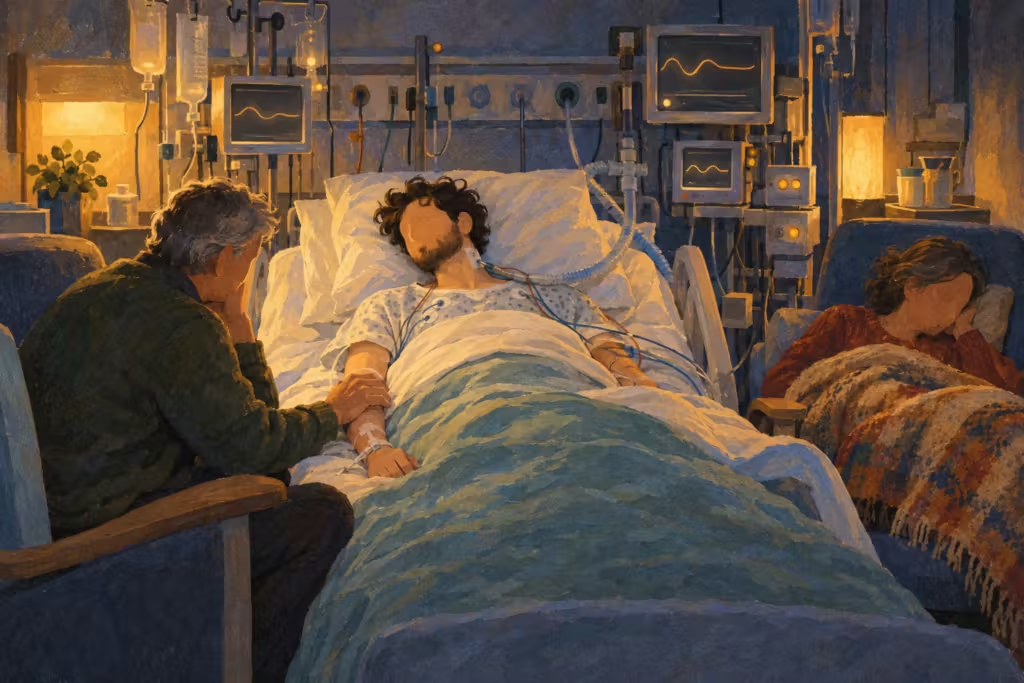
That night he has the catheterization. Afterward, doctors keep him asleep with medication in the ICU, the intensive care unit.
The doctors tell his family they don’t know whether he will wake up, or when, or in what condition. Usually no one stays overnight in the ICU. That night, his father and his mother are allowed to stay.
Around three in the morning, Eduardo wakes up with a start. He sees his father beside him. His father tells him, “Easy, son, everything’s all right.” And Eduardo falls back asleep.
His parents knew how the ambulance trip had gone. And when Eduardo wakes up, he says he remembers something else.
Step 7
While he was unconscious · Eduardo’s account
Eduardo says he saw the ambulance from above
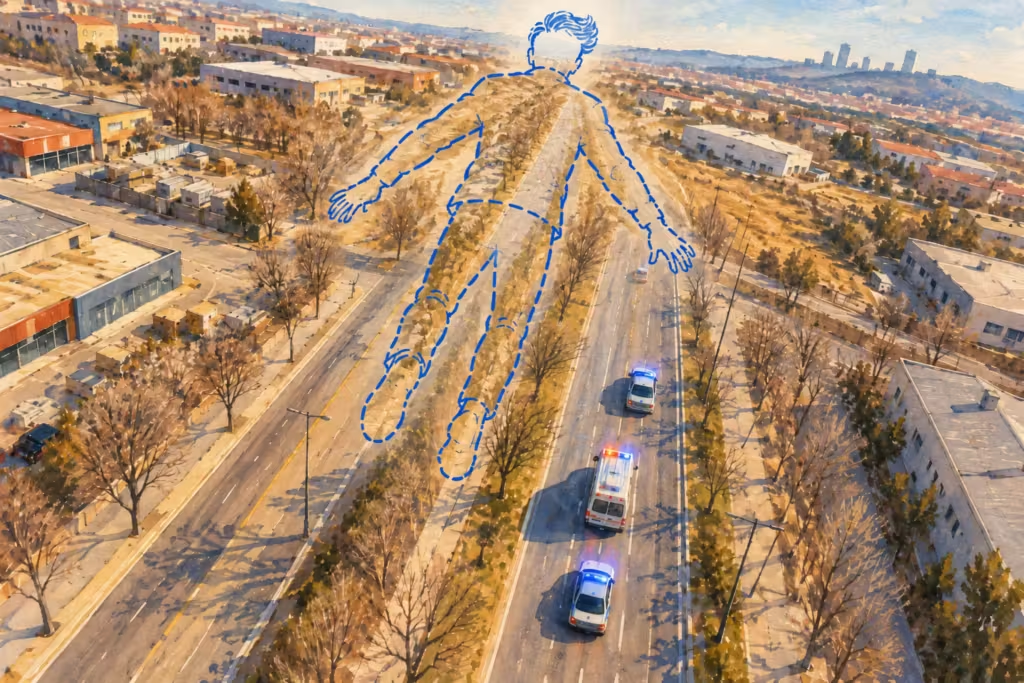
The first thing he remembers is an image. He sees an ambulance from above, the way a drone would see it. A police car is driving in front of it. Another one is behind it.
He says that is all it is: a still image, “like a photo.” He doesn’t remember leaving his body. He doesn’t remember anything before it or after it.
He believes he saw it when his heart stopped in the ambulance. That is his own idea, because he doesn’t know at what moment he saw it.
Later, Eduardo wonders whether he really was taken that way. But first, he says, he was somewhere else.
Step 8
While he was unconscious · Eduardo’s account
Eduardo says he stood before a tribunal, with his grandfather beside him
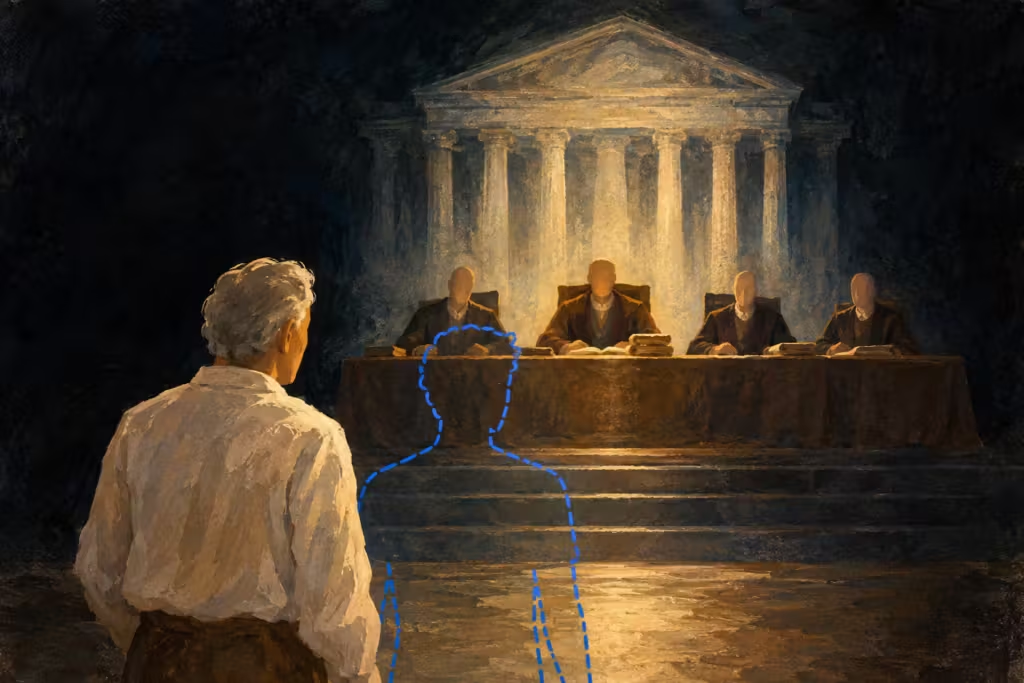
He is standing in front of a table. Some judges are sitting behind it. He doesn’t recognize any of them and doesn’t remember their faces. Behind the judges there is a Roman temple. Everything else is dark.
On his left is his grandfather, his mother’s father. His grandfather died about twenty years earlier, when Eduardo was twelve or thirteen. Eduardo sees him just as he was. He senses that his grandfather is someone important there, someone with great strength.
Eduardo is calm. He isn’t afraid, and he doesn’t miss anyone. He knows very well who he is: Eduardo, with his family and his life. There is no sound at all. No one moves their lips, but he understands what the judges are telling him.
He says that a week earlier he had been in Rome. He himself wonders whether the temple has something to do with that trip. He waits for the judges to decide.
Step 9
While he was unconscious · Eduardo’s account
Eduardo says he is told he has to go back
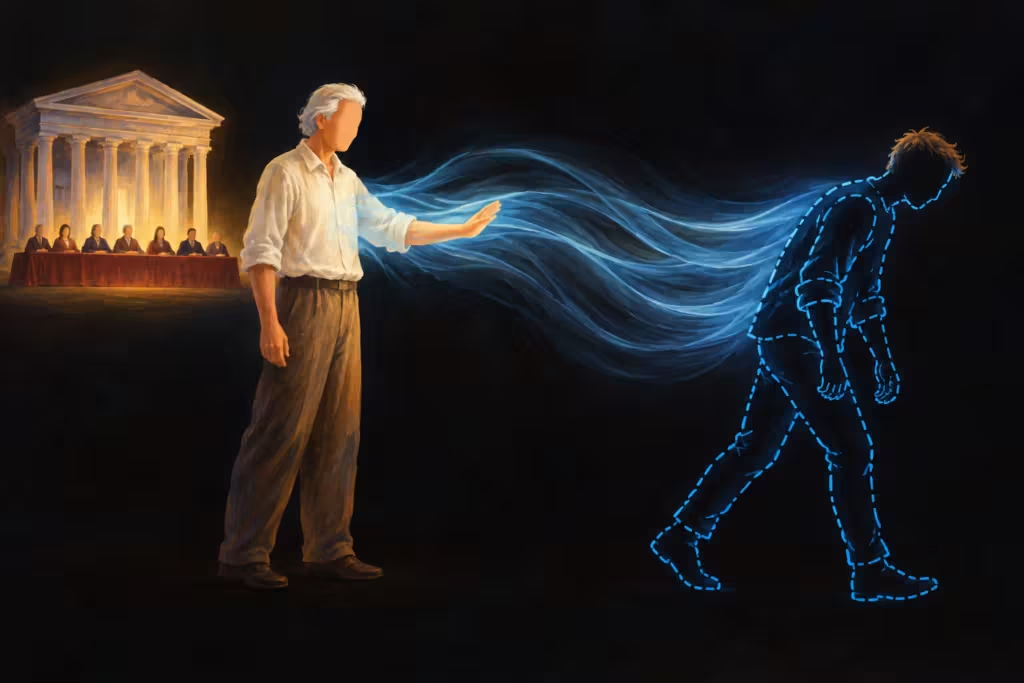
No one asks him whether he wants to stay. The judges tell him he can’t stay there and that he has to go back. They tell him it will be very hard and that he will suffer.
To go back, he has to leave to the right. He turns and tries to walk, but he can’t. His whole body hurts. He compares it to pushing a cart with square wheels.
His grandfather hasn’t said a word the whole time. Now he helps him. He pushes him like a breeze, like a wave, and gives him the strength he is missing.
When Eduardo woke up, he had broken ribs and fluid in his lungs. He connects that with the pain he felt there. He wakes up the next morning.
Step 10
February 4, in the morning · He wakes up in the ICU · Eduardo’s account
Eduardo says he asks whether he came with the police
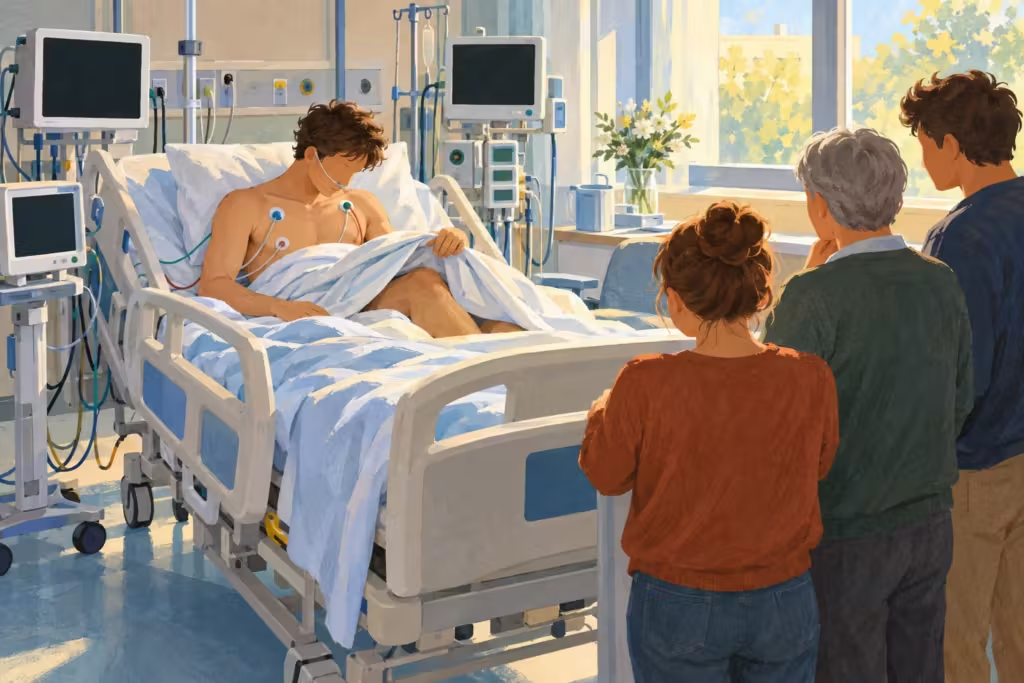
In the morning, the doctors stop the medication that was keeping him asleep. Less than a day has passed since the heart attack. The doctors did not expect him to wake up so soon.
He doesn’t remember arriving at the hospital. He thinks he has been in a car accident. The first thing he does is lift the sheet to see whether his legs are still there, and to move them. He asks whether he hurt anyone. His family tells him there was no accident.
He is dazed, “like I was drunk,” he says. He is very thirsty, and they won’t let him drink.
And he asks his family whether he was brought in an ambulance with a police car in front and another behind. According to Eduardo, they are taken aback: “How do you know?” They tell him yes, that is how he was taken.
That is how he tells it in almost all of his interviews. In a 2026 interview, he says he asked that question a little later, at another moment when his head was clear. And he himself says that this question was not recorded.
Step 11
February 4 · In the ICU · This part is on video
His mother films him on her phone
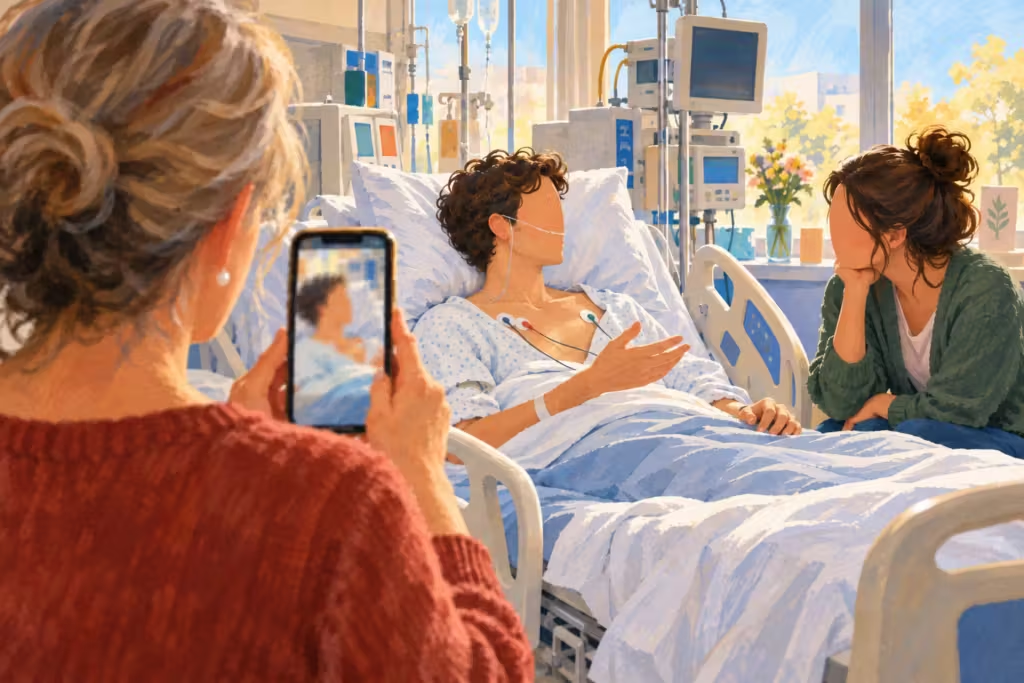
His mother is a nurse. According to Eduardo, she is “very skeptical.” That day she films him on her phone so that he can tell the family himself how he is doing. She starts like this: “Good morning. Reporter Maribel here, with Eduardo’s update.”
Eduardo has a thin tube in his nose and wires on his chest. He speaks slowly and with effort. His mother asks him questions. He tells her that his grandfather was with him that night. His grandfather didn’t say anything, but he looked at him and gave him strength, “like a wave pushing me.” Eduardo also tells her he saw “another realm,” a tribunal. He says it “looked more like ancient Rome than the Bible.”
This recording exists. Eduardo posted all of it on Instagram. It lasts about seven minutes. The grandfather, the tribunal, and the push to go back are in it. The police are not.
Nineteen days after the heart attack, Eduardo explained why the police are not in the video. He said the ambulance part “isn’t recorded anywhere, because I didn’t say it” in that video. In his interviews he says he asked about the police before the recording, and that in the video he said whatever came to him.
Step 12
Afterward · Eduardo’s account
He goes home and begins to tell his story

He spends seven days in the ICU and another seven on a regular ward. He has pneumonia, and his kidneys and liver are slow to recover. On February 17 he is discharged. He says the only lasting effect is some memory loss. For two or three days he kept asking, “What happened to me?” because he couldn’t hold on to what people explained to him.
While he is in the hospital, one of his uncles brings him a book on near-death experiences by the cardiologist Manuel Sans Segarra. Eduardo says that as he reads it, he recognizes what he went through. He had already studied out-of-body experiences and astral travel before.
He says that later, someone who works in emergency services explained to him when the police escort an ambulance. The police escort it when the patient is so ill that they could die on the way. He says he didn’t know this and had never seen an ambulance with a police escort.
Eduardo tells his story on Instagram nineteen days after the heart attack. Since then he has told it on the radio, on television, and in many interviews.
He is an engineer, and he says he likes to check things. For him, the ambulance is the proof. The question from the beginning remains: how did he know he was taken with the police? Let’s look at what can be checked.
How many people have an NDE?
Eduardo is not a one-off. Several teams of doctors have spent more than thirty years asking people who survive a cardiac arrest what they remember. They do it in the hospital, a few days afterward.
Picture 100 of those people:
Each dot is a person. The 18 filled-in dots are the people who described a near-death experience. That is what the largest study found. It was done in the Netherlands in 2001, with 344 people.
The other 82 didn’t describe one. Many remember nothing of their cardiac arrest.
| Where and when | People interviewed | Described an NDE |
|---|---|---|
| England, 2001 | 63 | 6% |
| Netherlands, 2001 | 344 | 18% |
| United States, 2002 | 30 | 23% |
| United States, 2003 | 116 | 10% |
| United Kingdom, United States, and Austria, 2014 | 101 | 9% |
| Vienna, Austria, 2023 | 126 | 4% |
| United States and United Kingdom, 2023 | 28 | 21% |
What these figures don’t tell you
- Only some people are asked. In the 2014 study, 330 people survived, but only 140 could be interviewed, and 101 reached the second interview. The rest died later, were too ill, or didn’t respond.
- Most cardiac arrests are never counted. These studies run in a few hospitals for a limited time. Outside them, no one keeps track. Also, the 2003 study interviewed 1,595 cardiology patients, not just the 116 with cardiac arrest in the table, and 81 of them described an NDE from an earlier occasion. The study did not count them, because it only counted those from that hospital stay.
- Some people keep quiet. In the accounts in our archive, at least 13 people say they kept their experience to themselves for a while. They kept quiet because they weren’t believed, or because they were afraid of how others would react.
- It depends on how you count. If any memory of the cardiac arrest counts, there are more cases. If a strict scale is used, there are fewer. 7 of the 63 people in the 2001 English study remembered something. But on the scale, only the memories of 4 people qualified as an NDE.
That’s why no one knows the real figure. But every study shows that it isn’t rare. Between 4 and 23 of every 100 survivors who are asked describe an NDE. Eduardo’s case stands out because of the recording. His mother filmed him in the ICU on the same day he woke up, while he talked about the tribunal and his grandfather.
Where this story comes from
His videos
- The full ICU recording, in seven parts (June 2026), in SpanishWatch on Instagram
- The first video in which he describes the experience, with a few minutes of the recording (February 22, 2025), in SpanishWatch on Instagram
- The video in which he tells what happened to him in the hospital (February 18, 2025), in SpanishWatch on Instagram
Interviews
- On Lo Invisible [The Invisible], with Esteban Vigouroux (October 2026), in SpanishWatch on YouTube
- On La hora de cerrar [Closing Time] (August 2026), in SpanishWatch on YouTube
- On the podcast Los Tarapeutas (November 2025), his earliest long interview, in SpanishListen for free
- On Dando Luz [Giving Light] (July 2026), in SpanishWatch on YouTube
- On Blessing Indigo (June 2026), in SpanishWatch on YouTube
- On La Tarde [The Afternoon], on the Spanish radio network COPE (September 8, 2026), with a clip from the recording, in SpanishListen for free
- On Y ahora Sonsoles [And Now, Sonsoles], on the Spanish TV channel Antena 3 (August 19, 2026), in SpanishWatch on Antena 3
Articles
- Telecinco, a Spanish TV channel (August 19, 2026), his account, in SpanishRead for free
When the police escort an ambulance
- SAMUR-Protección Civil, Madrid’s city emergency medical service: its joint procedure with the Policía Municipal de Madrid (the city police) for escorting critically ill patients, in SpanishRead for free
Learn more
- How many people have an NDE?Read
Our archive
- His record, with twelve interviews compared and the ICU recording transcribed, and our assessment of what he said about the ambulance, as of October 14, 2026
Keep reading
Seattle, United States, 1977
Maria
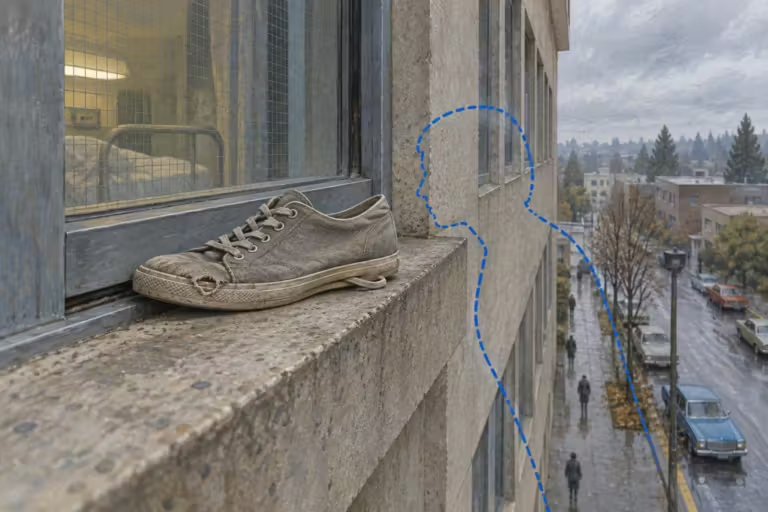
Her heart stopped, and afterward she said she had seen a tennis shoe on the outside ledge of a third-floor window. Kimberly Clark, the social worker who was caring for her, says she went upstairs to look for it and found it.
Seattle, 2006
Dean Braxton
Dean Braxton’s heart stopped in 2006, and doctors worked to resuscitate him for more than an hour. He said he stood before Jesus, who told him three times to go back.
Bogotá, 2021
Andrés Arévalo
Andrés Arévalo says that while he was in a COVID coma he dreamed Trump would be president again. Trump returned in 2025. There is nothing to show that Andrés told anyone about his dream before it happened.
Reincarnation: The top 5 people who remember past lives
We asked them the same five questions as this story. A 32-page PDF, free in your inbox.
Check your email
We have sent you an email. Open it and press the button to confirm. If you cannot see it, check your spam folder.