
A real-life story · Canada, 1873
The day a young woman dreamed that her sweetheart was drowning: a shared-death experience
In June 1873, a footman of Lord and Lady Dufferin drowned while fishing on a remote river in Canada. Days later, a letter arrived from his sweetheart, who worked as a maid in Ottawa. She had written it a week after the accident, and in it she told him that she had dreamed he was drowning. Lady Dufferin copied that letter into her journal.
This case has something that almost no other case has. The young woman wrote down her dream before she knew anything. Someone outside the family saw the letter and copied it into her journal within days. But the dream doesn’t get everything right. We tell the story step by step and then look at what can be checked. How could she dream of his death from so far away?
Step 1
June 1873 · The Mingan River · Lady Dufferin’s account
Lord and Lady Dufferin go fishing on an uninhabited coast, with their servants

Lord Dufferin governed Canada on behalf of the British queen. In June 1873, he and his wife went fishing on the Mingan River, on an uninhabited coast in eastern Canada.
The place was more than 500 miles from Ottawa, the capital. There was no telegraph and no mail there.
Their servants traveled with them. One of them was a footman, a household servant. His sweetheart worked as a maid in Ottawa.
Lady Dufferin kept a journal in the form of letters, and she wrote everything down.
Step 2
Monday, June 30, 1873 · On the riverbank · Lady Dufferin’s account
The footman starts fishing from some rocks, and the steward warns him that they are slippery

That Monday, the footman went out fishing. He was on the rocks by the river, eating a piece of bread.
Then he got up and stood at the edge of the water with his rod. The steward asked him if he could swim. The footman said no.
The steward told him to be careful, because the rocks were slippery and the water was very deep. The footman told him not to worry.
At that very moment, he slipped.
Step 3
That same day · Lady Dufferin’s account
He slips, falls into the river, and drowns

He was wearing a veil against the mosquitoes. He raised his hands to take it off and disappeared into the water.
The steward jumped into the river to look for him, but the footman never came up again. Someone brought a boat, and the men saw the handle of the fishing rod sticking out of the water. They pulled on it and brought up the body. The footman was still holding the rod in his hand.
That same day, the news reached the Dufferins.
Step 4
June 30, 1873 · Lady Dufferin’s account
A canoe brings the news to the Dufferins, who go back to the place of the accident

It was a very hot day. The gentlemen of the expedition went for a swim, and when they got into the canoe, it overturned and all their clothes got wet. The Dufferins were fishing at another spot on the river. They were about to start again when a canoe with Indigenous people arrived with the news.
They went back right away and saw the place where the accident happened. The piece of bread the footman had been eating was still on the rocks.
Lady Dufferin wrote it down in her journal that same Monday.
Step 5
July 1873 · Lady Dufferin’s account
No one knows whom to tell, and Lord Dufferin asks for the footman’s letters to be given to him
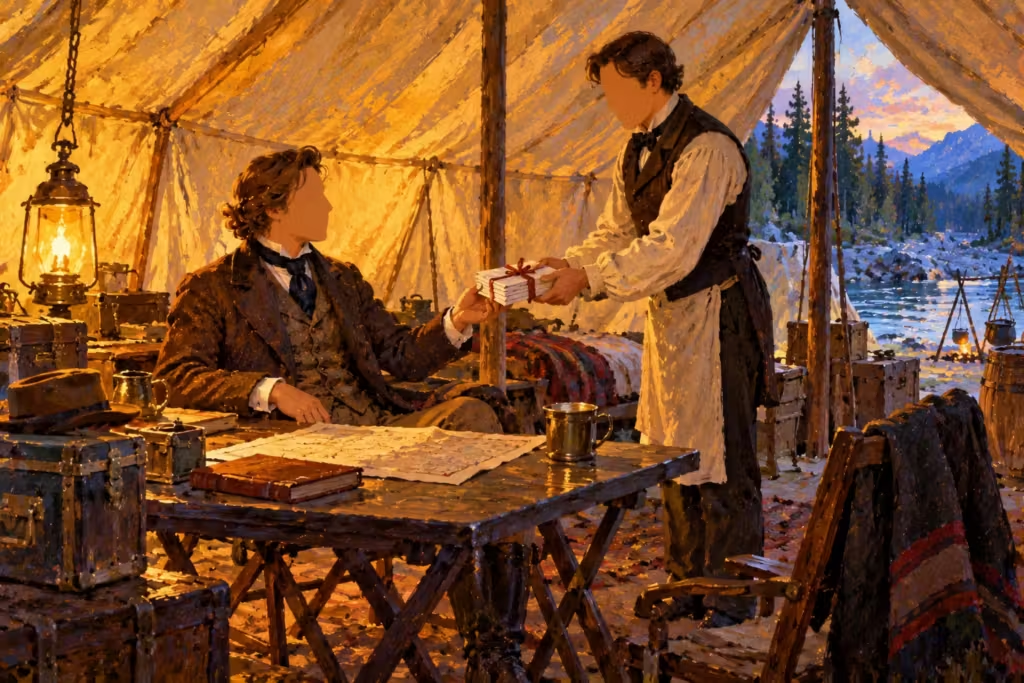
The Dufferins knew nothing about the footman’s family. They had no one to tell about his death.
That is why Lord Dufferin ordered that every letter that arrived for the footman be brought to him.
The first letter that arrived was from his sweetheart.
Step 6
A week after the accident · According to his sweetheart’s letter
His sweetheart writes that on the day she started her new job, she dreamed he was drowning

The letter was dated seven days after the accident, exactly one week. The young woman was writing from Ottawa. She said she had been for a week in the house where she had just started working, and that she was happy there. And she told him this:
“I had such a dreadful dream on the day of my arrival. I dreamt that you and Nowell were upset in a boat together, and that Nowell was saved, but you were drowned.”
If she had been there for a week, the dream was on the same day he drowned, or very close to it.
Elsewhere in her journal, Lady Dufferin calls Nowell “our English servant” and says he was Lord Dufferin’s valet. The letter shows that they both knew him.
Step 7
Friday, July 11, 1873 · Lady Dufferin’s account
Lady Dufferin copies the letter into her journal and notes that the young woman could not have known anything

Lady Dufferin read the letter and copied it into her journal on July 11. She wrote that the young woman could not have known that her sweetheart had died. The place was more than 500 miles away, on an uninhabited coast, with no telegraph and no mail.
Lady Dufferin published her journal in 1891, in a book called My Canadian Journal. In 1893, an English society that studied cases like this reprinted the two journal entries in its periodical. They were the entry about the accident and the entry about the letter.
The question remains: how did the young woman dream that her sweetheart was drowning, from so far away?
Where this story comes from
Books
- The Marchioness of Dufferin (1891), My Canadian Journal, pages 82-83 and 88, with the entries of June 30 and July 11, 1873Read for free
Periodicals
- Journal of the Society for Psychical Research, volume 6, May 1893, pages 85-86, case G. 236Read for free
Case documents
- The letter from the footman’s sweetheart, July 1873, partly copied by Lady Dufferin into her journal
Learn more
- Frederick Wingfield: the dream of his brother, another shared-death experienceRead
- More shared-death experiencesRead
Our archive
- Our full reading of the case and its scoring against our five criteria, as of October 27, 2026
Keep reading

England, 1879
The captain’s voice
One morning in 1879, a woman heard the distressed voice of an old friend calling her, and she wrote it down in her diary. He died that same day in India.
England, 1908
The Rome Stock Exchange dream
In the early hours of January 1, 1908, a woman wrote down a dream of injured people and blood. In the morning, the newspaper reported an explosion at the Rome Stock Exchange, with about twenty injured.
France and England, 1880
Frederick Wingfield
One night in 1880, in France, Frederick Wingfield dreamed that his brother was sitting in front of him, and he wrote it down in his notebook. Three days later he learned that his brother had died that night in England.

Reincarnation: The top 5 people who remember past lives
We asked them the same five questions as this story. A 32-page PDF, free in your inbox.
Check your email
We have sent you an email. Open it and press the button to confirm. If you cannot see it, check your spam folder.