A real-life story · Denmark, 1907
The man who dreamed his friend would be “free” in four years, and had two witnesses sign the note
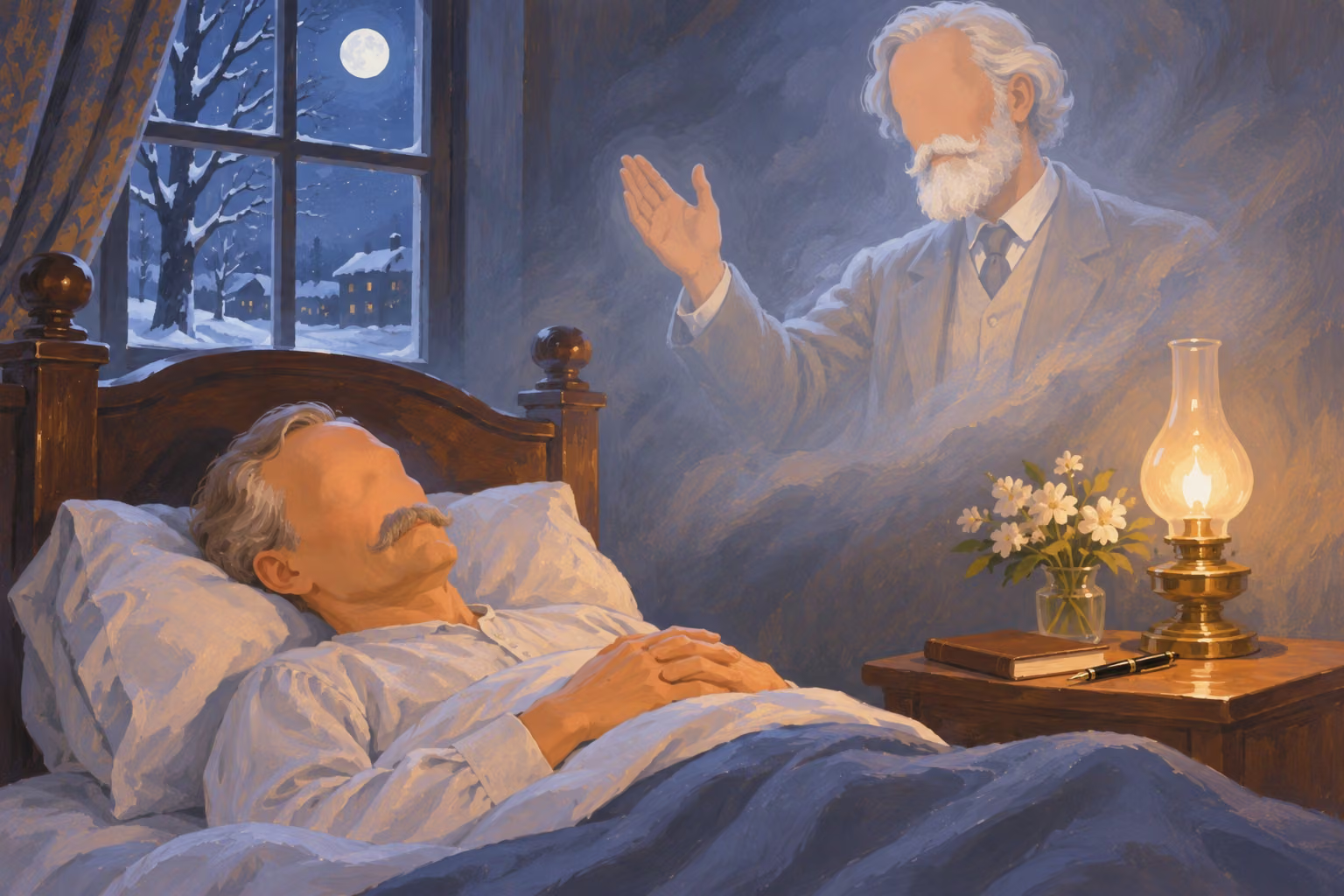
In February 1907, Severin Lauritzen, a Dane, dreamed that his friend Frederik Fugmann told him, full of joy, that in four years he would be free. Lauritzen understood that “free” meant dying. He wrote it down in a notebook and asked two members of his family to read it and sign it. Fugmann died in February 1911, four years after the dream.
In this story, the dream comes four years before the death. We include it with the shared-death stories because it is similar. One person dreams of another person’s death, although here the dream comes long before. The note of the dream, signed by two witnesses the same day, reached researchers in London. We tell the story step by step and then look at what can be checked. Did Lauritzen dream when his friend would die, or was it a coincidence?
Step 1
Summer of 1906 · Denmark · Severin Lauritzen’s account
A friend of Lauritzen’s tells him it cannot be long now before he is free

Severin Lauritzen lived in Holte, in Denmark, and was an engineer at a large Danish telegraph company. He also investigated psychic phenomena. In 1905 he was one of the founders of the Danish society that studied them, and in 1911 he was its president. In addition, he was a member of the Society for Psychical Research, a society in London that studied cases like this.
Lauritzen had a friend named Frederik Fugmann. The London society published the case in its journal, and there it calls him only F. F.
Fugmann was a solitary, wealthy man who never married. He lived in a large house by the sea, near the village of Hellebæk. The house was called Villa Elleborg and was about 17 miles from Lauritzen’s home. Fugmann had a passion for philosophy. Lauritzen and his family were the only people he felt truly close to.
Fugmann was not afraid of death. Once, in front of several friends, he said that if he were told he would die in ten minutes, he would die of joy in five. One summer, talking with Lauritzen, he told him this:
“Well, it cannot be long now before I shall be free.”
Lauritzen understood him to mean “before I die.” From then on, whenever he remembered those words, he wondered when it would be.
Step 2
Around February 7, 1907 · Severin Lauritzen’s account
Lauritzen dreams that his friend tells him, full of joy, that in four years he will be free

A few months later, Lauritzen dreamed of Fugmann In the dream, his friend told him, full of joy, that in four years he would be free. He did not give him any date.
Another acquaintance of Lauritzen’s from his student years also appeared in the dream. This man had died many years before. He looked strong and healthy, although in life he had been very frail.
Lauritzen says his dreams were usually vague and blurry. But in this one, he was struck by how clearly he heard the words “four years.” It caught his attention while he was still dreaming.
Step 3
Sunday, February 10, 1907 · Holte · According to his notebook
A few days later, Lauritzen writes down the dream, and two members of his family sign the note

The more he thought about the dream, the more it struck him. A few days later, he decided to write it down in a notebook. This is how the note begins:
“Sunday, February 10th, 1907.—About three days ago I dreamt that F. F. full of joy told me that he should be free in four years.”
The journal also had the note translated independently. According to that translation, Fugmann “expressed his joy at the prospect of being free from this life in four years.”
In the note, Lauritzen added that there was nothing strange about the dream. Fugmann had already said the summer before that he hoped to be free soon.
As soon as he had written it, he asked two members of his family to read it and sign it. One was his daughter Helga Lauritzen. The other was his son-in-law J. A. Kemp. Underneath, they wrote “Read 10/2/07” and their signatures.
Lauritzen showed it to them casually, as if it didn’t matter. Helga and Kemp forgot about it completely.
Step 4
1907 to 1911 · Severin Lauritzen’s account
For four years, Lauritzen does not tell his friend about the dream

Lauritzen did not tell Fugmann about the dream. He says that, for several reasons, it did not seem fitting or wise to him. Helga and Kemp could not have told him either, because they did not even remember the note.
Fugmann was hardly ever ill, and he never called the doctor.
Step 5
February 1911 · Denmark · According to Lauritzen and a Danish newspaper
Fugmann falls seriously ill and dies on February 11, 1911
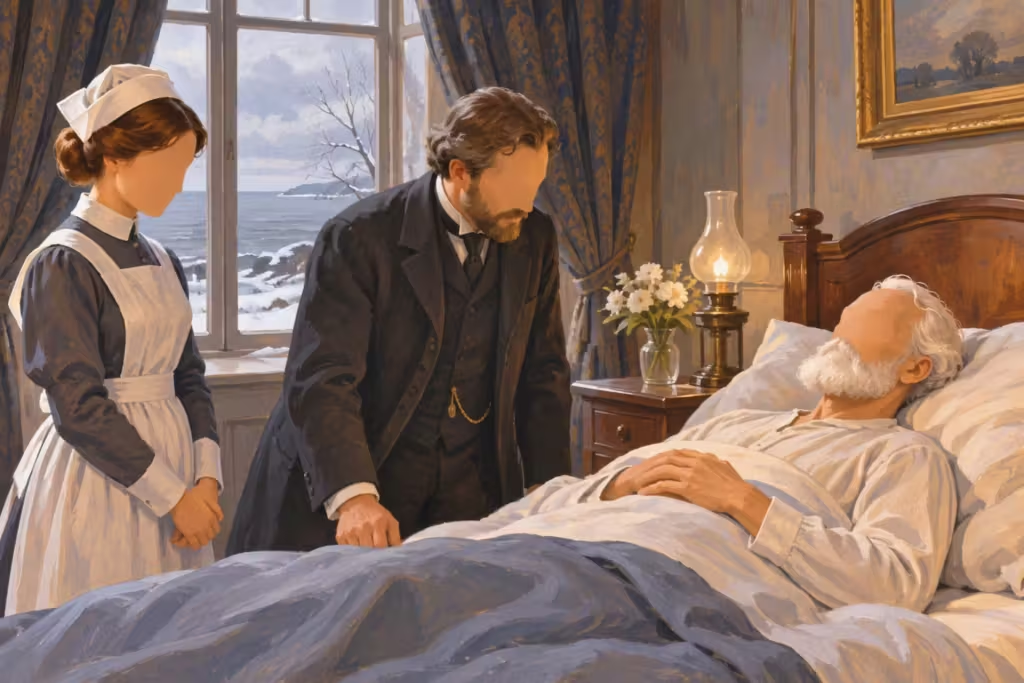
In early 1911, Fugmann fell seriously ill. His friends made him see a doctor. Fugmann surprised the doctor with these words:
“I am most curious as to finding out soon what the next life is really like.”
When Fugmann became so ill, Lauritzen showed the note to Helga and Kemp again. Only then did they remember that they had read it and signed it.
During his last illness, Fugmann would not let any friend in. Only his doctor and the women who nursed him saw him. He died on February 11, 1911. According to Lauritzen, he died at half past eleven in the morning, at the age of 64, of heart and kidney disease. His villa was in the parish of Hornbæk. The register where that parish recorded his death gives his age as 63.
The Danish newspaper Nationaltidende published his death notice on February 15. It was signed by his sister. It said that Fugmann had died on February 11 at Villa Elleborg “after 14 days of illness.” The notice gave neither his age nor the time of death.
Lauritzen worked out that almost exactly four years and four days had passed since the dream.
Step 6
1911 to 1934 · Holte and London · According to his letters, the journal and a Danish newspaper
Lauritzen sends the notebook page to London, and the Society publishes the case with a caution

In October 1911, Lauritzen wrote to the Society for Psychical Research. He sent the page he had cut out of the notebook, with the two signatures, and the death notice from the newspaper.
Helga and Kemp wrote too. They confirmed that the signatures were theirs. They said they had never known Lauritzen to write down any other dream. Lauritzen says it is the only dream of his life that he thought worth writing down.
Lauritzen said his family had scolded him for not saying anything about the dream. They thought that, if they had known, they might have been able to do more for Fugmann in his last years. He believes it would not have changed anything.
The Society’s journal published the case in December 1911. The researchers warned that the case loses force because Lauritzen knew his friend wanted to die and often recalled his words. Even so, they published it as a remarkable and very well documented coincidence.
In April 1912, Lauritzen told the story of the dream in a Danish newspaper. There he wrote that in the dream his friend told him that in four years he would die.
In 1934, the English researcher H. F. Saltmarsh reviewed 349 cases of premonition. He counted this one among the dreams that foretold a natural death, and he did not rule it out.
The question remains: did Lauritzen dream when his friend would die, or was it a coincidence?
Where this story comes from
Periodicals
- Journal of the Society for Psychical Research, volume 15, December 1911, pages 173-175, case P. 282, “Dream,” in EnglishRead for free
- H. F. Saltmarsh, “Report on cases of apparent precognition,” Proceedings of the Society for Psychical Research, volume 42, 1934, index of cases on page 95, in EnglishRead for free
About Severin Lauritzen
- P. Borberg, “Severin Lauritzen,” Dansk Biografisk Leksikon, in DanishRead
Press
- Frederik Fugmann’s death notice in the Danish newspaper Nationaltidende, February 15, 1911, page 10, in DanishView the page
- The death register of Hornbæk parish, 1911, men, entry 2: Frederik Michael Thorvald Fugmann, died February 11 at Ellekilde, aged 63, in DanishView the page
- Severin Lauritzen, “En Drøm, der gik i Opfyldelse,” reprinted from Politiken in the Vestsjællands Social-Demokrat, April 10, 1912, page 3, in DanishView the page
Case documents
- Severin Lauritzen’s notebook note of February 10, 1907, signed by Helga Lauritzen and J. A. Kemp, received by the Society and translated in the journal
- Lauritzen’s letters of October 21 and 28, 1911, and the letter from Helga Lauritzen and J. A. Kemp of October 21, published in the journal
- The death notice in the Danish newspaper Nationaltidende of February 15, 1911, received by the Society
Learn more
- Lady Dufferin’s footman: a sweetheart’s dream, copied into a diary in those same daysRead
- Boirac’s book: a dream told in a letter the next dayRead
- More shared-death experiencesRead
Our archive
- Our full reading of the case and its scoring against our five criteria, as of October 21, 2026
Keep reading

Boston, 1899
The Columbia yacht race
On the night of October 1, 1899, a Boston bookkeeper dreamed that the Columbia won a yacht race by 10 minutes and 14 seconds, and wrote it down in the office pool. Two weeks later, the Columbia won by that time.
California and England, 1892
John Owen
He dreamed in California of the funeral of his mother, who lived in England. He wrote it in a letter before learning she had died.

England, 1925
The nephew in the ditch
On the night of Monday, January 26, 1925, a woman dreamed that her nephew fell into a ditch with the pony on top of him, and she wrote it down in a notebook. A few hours earlier, her other nephew had fallen from his horse during a hunt.

Reincarnation: The top 5 people who remember past lives
We asked them the same five questions as this story. A 32-page PDF, free in your inbox.
Check your email
We have sent you an email. Open it and press the button to confirm. If you cannot see it, check your spam folder.