A real-life case · England, 1958
The Pollock twins’ reincarnation case
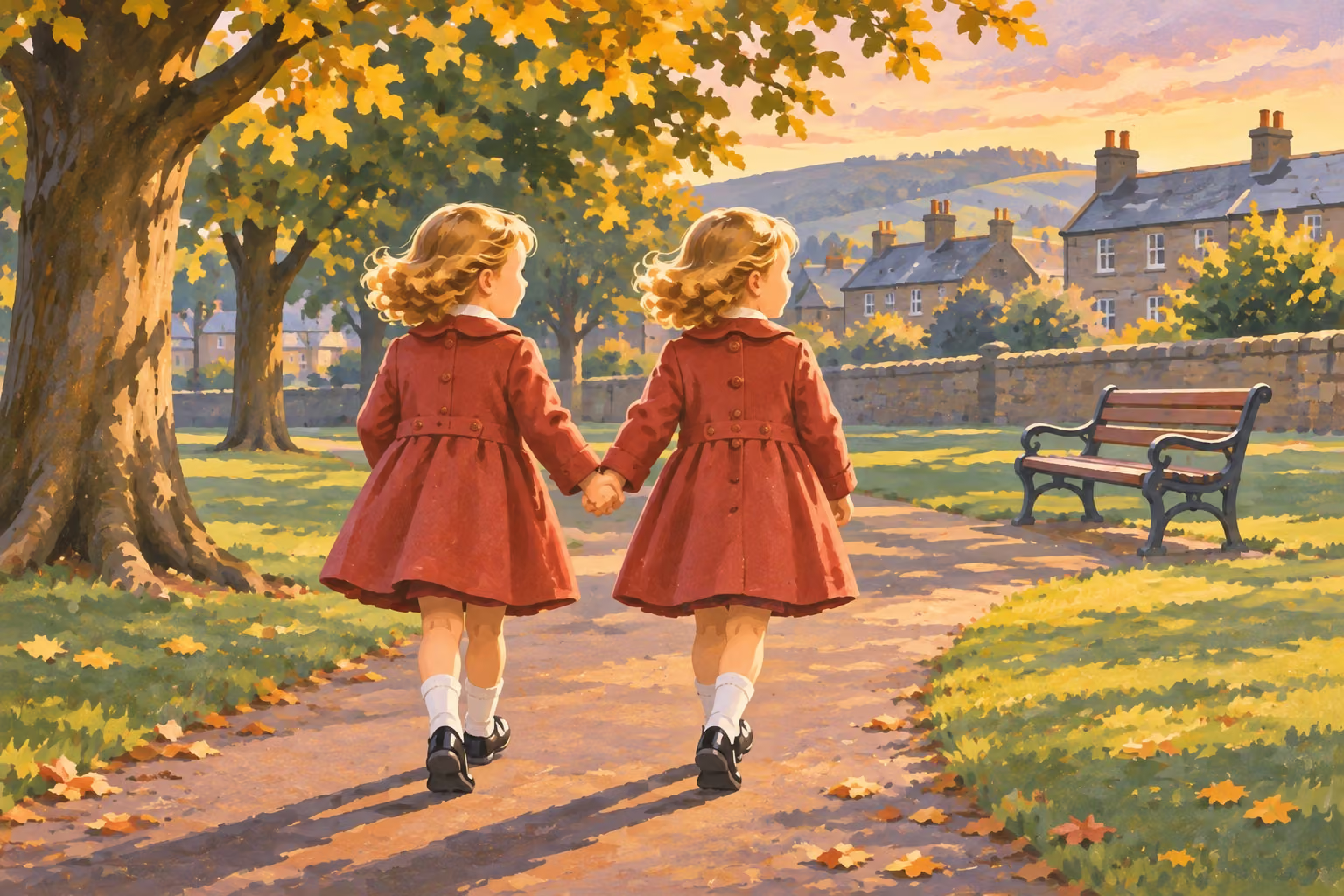
In 1957, a car killed Joanna and Jacqueline Pollock, two English sisters aged eleven and six. Their father believed in reincarnation and announced that they would come back as twins. The next year, Gillian and Jennifer were born, and Jennifer had a mark on her forehead in the same place as a scar of Jacqueline’s.
It is the best-known reincarnation case in Europe. The psychiatrist Ian Stevenson studied it for twenty years and counted it among the strongest he knew, because of the birthmarks. In 2024, a podcast talked to the surviving twin and to other members of the family, who don’t agree on whether the father made it up. We tell it step by step and then look at what can be checked. If you only want the evidence, skip straight to what can be checked. Did Joanna and Jacqueline come back as their twin sisters?
Step 1
May 5, 1957 · Reported in the next day’s Daily Mirror
A car kills two sisters on their way to Mass

John and Florence Pollock lived in Hexham, a town in the north of England, with their four sons and two daughters. Joanna was eleven and Jacqueline was six. On Sunday, May 5, 1957, the girls were walking to Mass along the sidewalk when a car drove up onto it. Both girls died, and so did a nine-year-old boy, Anthony Layden.
The driver was a widow. In 2024, a podcast pieced together what the press reported about the trial. According to those reports, she had taken pills to kill herself before she got into the car. She pleaded guilty and was sentenced to three years’ probation.
The girls’ father had believed in reincarnation since he was a boy.
Step 2
1958 · Told by the parents to the psychiatrist Ian Stevenson
The father announces that his wife will have twin girls, and twin girls are born
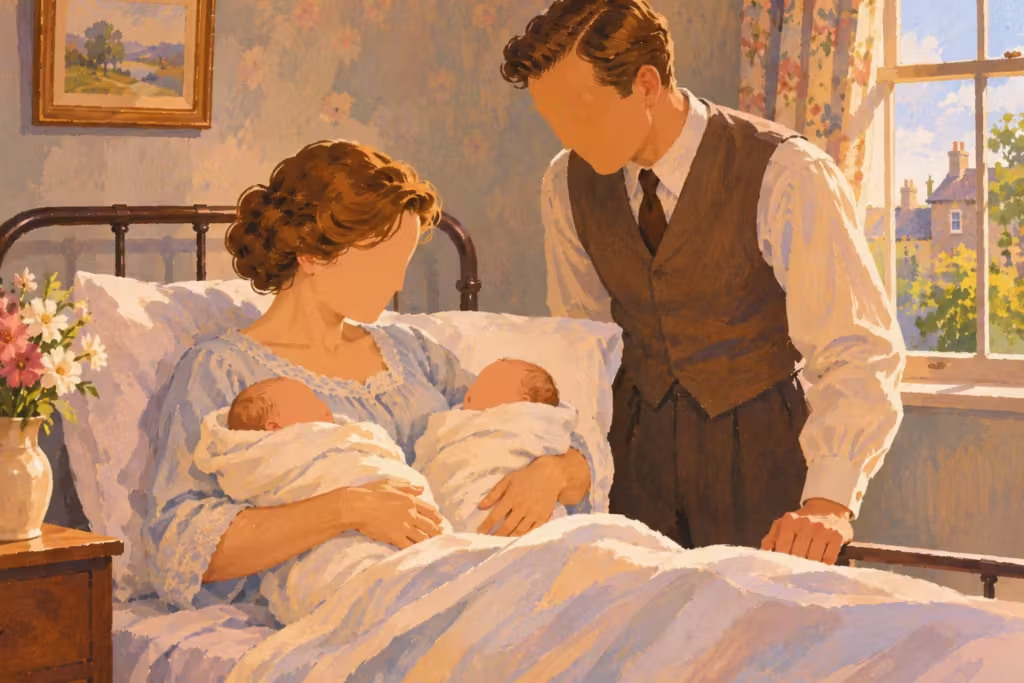
John Pollock had believed in reincarnation ever since he read a novel as a child, and in his prayers he asked for proof. In early 1958, Florence became pregnant. According to both of them, John said she would have twin girls and that they would be Joanna and Jacqueline. According to John, the doctor could hear only one heartbeat. In his view, Jacqueline would come back in one of the twins and Joanna in the other. As far as is known, no one wrote that prediction down before the birth.
On October 4, 1958, Florence gave birth at home to two girls, Gillian and, ten minutes later, Jennifer. A 1978 blood test indicated that they were identical twins.
Jennifer was born with two marks that Gillian didn’t have.
Step 3
October 1958 · Told by the parents to Stevenson
Jennifer is born with a mark on her forehead where Jacqueline had a scar
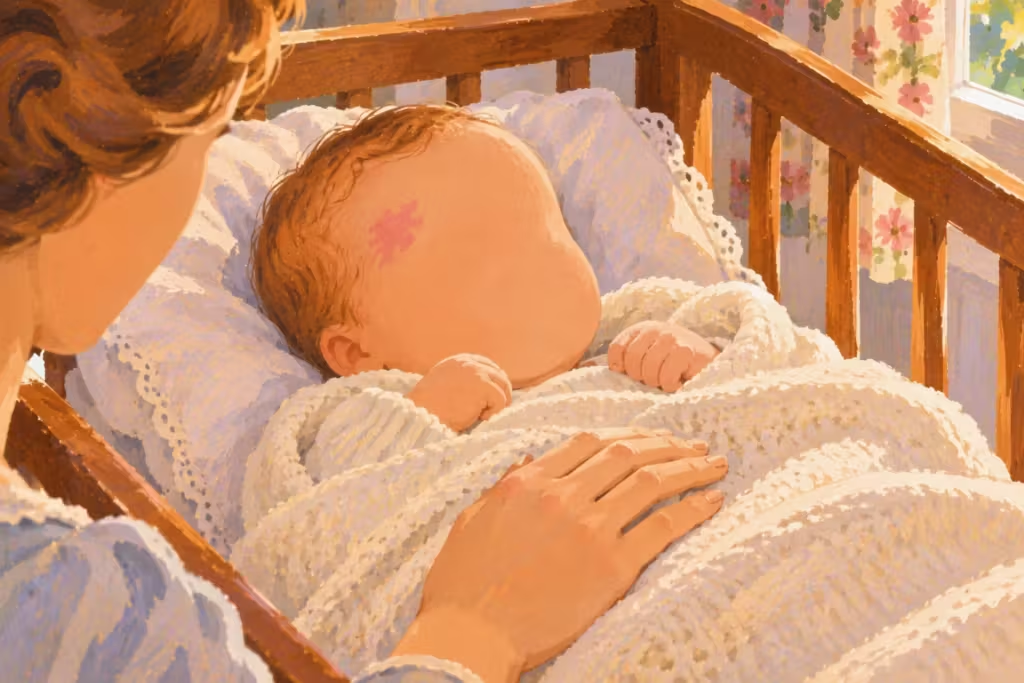
When she was about three, Jacqueline had fallen and cut her forehead, above her right eye, next to her nose. She got three stitches and was left with a scar. According to her mother, it showed more in the cold.
According to the mother, Jennifer was born with a mark in that same place, with a white line in the middle. It also showed more in the cold. And she had a brown mole on the left side of her waist. The parents say Jacqueline had a mole just like it in the same place. It was the father who, when the girls were born, linked the marks to Jacqueline’s. He didn’t write it down. Stevenson published a photo from the christening, a few weeks later, in which the forehead mark can already be seen.
When the twins were about nine months old, the family left Hexham.
Step 4
1961 to 1963 · The twins are three to five years old · Told by the parents
According to their parents, the girls recognize toys and places in Hexham
According to the parents, they never talked to the twins about their dead sisters, and they kept the photos in a drawer. According to them, during those years the girls saw Joanna’s and Jacqueline’s dolls, and each one took the doll of the sister who matched her. The parents also said that the girls gave the dolls names. According to the mother, one day Gillian touched the mark on Jennifer’s forehead and said it was the cut she got when she fell, as if Jennifer were Jacqueline.
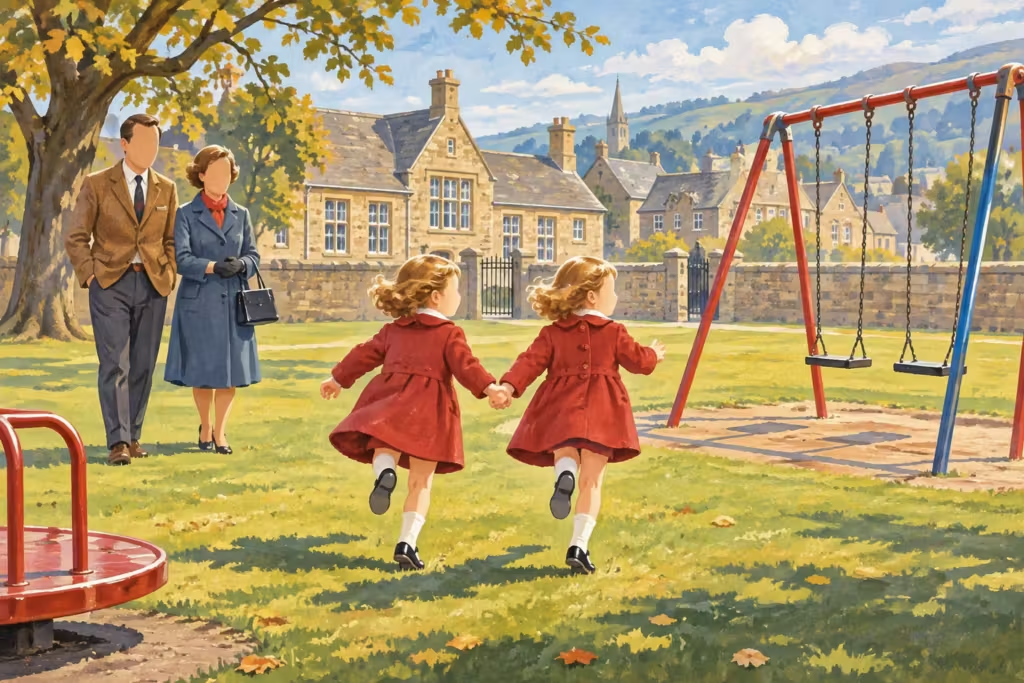
In 1962, the family went back to Hexham for a visit. According to the parents, the girls said the school and the swings were there before they came into view. The twins had lived there for their first months, and they had been taken to the park in a baby carriage. The mother heard them talk about the accident more than once. And both of them were afraid of cars.
In 1963, the case appeared in the press, and a psychiatrist from the United States came to see them.
Step 5
1963 to 1985 · Told by Ian Stevenson
A psychiatrist examines the marks and studies the case for twenty years
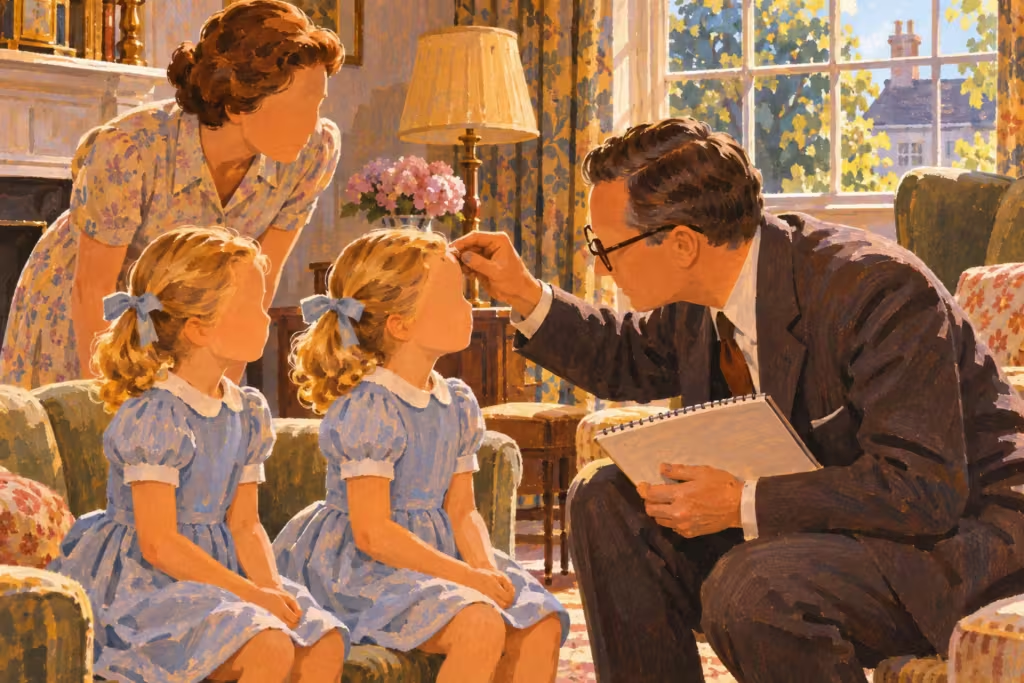
Ian Stevenson was a psychiatrist at the University of Virginia, in the United States, who studied children who talked about another life. In August 1963, he examined Jennifer’s two marks and drew the one on her forehead, which was one centimeter long. He saw them again in 1978. In 1967, he was shown a photo of Jacqueline in which the scar could be seen, and he drew it. According to him, the two were in the same place. He didn’t publish that photo.
Stevenson followed the case until John died, in 1985, and published it in full in 1997. He wrote that the only witnesses to what the girls said were their parents, and that the father expected it to happen. That is why, in 2003, he agreed to give almost no weight to what the girls said and kept only the marks. For him, the explanation competing with reincarnation was that the father’s wish had somehow influenced the marks.
Other researchers found problems in what the father said.
Step 6
1963 to 1982 · Told by Stevenson, the researcher Ian Wilson, and the press
The father tells the facts differently depending on who is listening
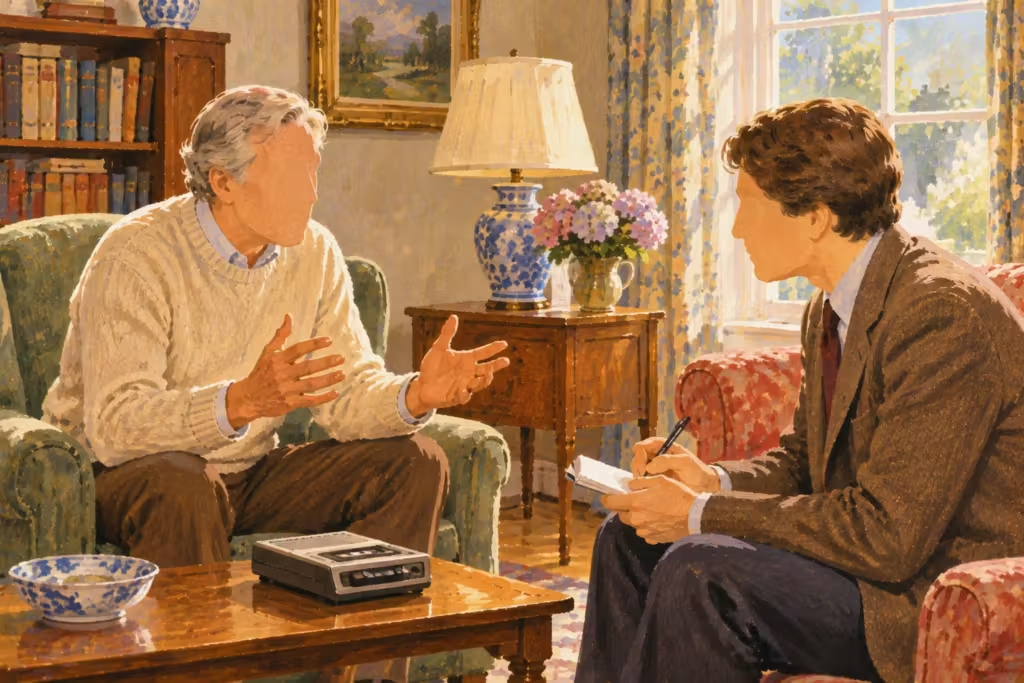
John told Stevenson that the driver ran the girls down on purpose. According to the press reports of the trial, she had tried to kill herself. The mother told Stevenson that she wasn’t sure any of the dolls had been called Mary. On a television program, the parents told a different story. They said the girls gave the names of the two dolls, Mary and Susan, and that those were exactly the names.
Around 1981, the British writer Ian Wilson interviewed John. Wilson said John was sincere. John said that under hypnosis he remembered a past life of his own. Wilson looked into it and found nothing. Wilson suggested that the mother, by thinking so much about her dead daughters, might have influenced the marks. It is the same kind of explanation as Stevenson’s, with the mother instead of the father. For neither of them is it known how it could happen.
In 2024, a podcast went looking for the family again.
Step 7
2024 · Told by Jennifer and other relatives on the podcast Extrasensory
Jennifer at 66, and a family that can’t agree
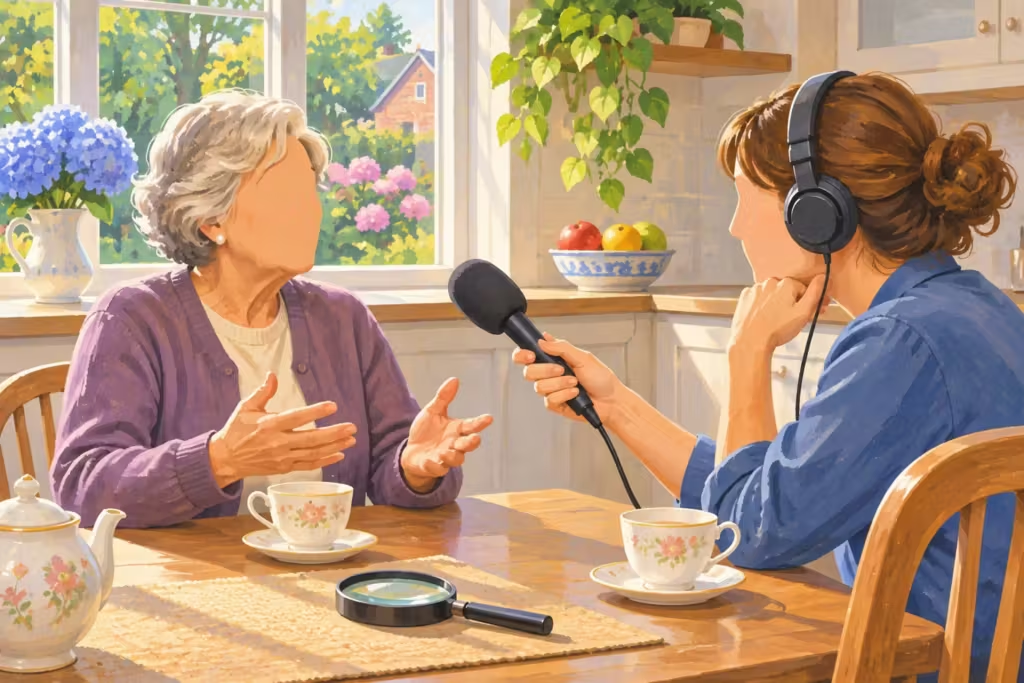
Gillian died in 2002, at the age of 43. In 2024, Apple’s podcast Extrasensory got the first interview Jennifer had given in forty years. The podcast’s producer, Poppy Damon, looked at her marks with a magnifying glass. The one on her forehead was still there, pink and small, between her eyebrows. Jennifer said her father didn’t make up lies, and that she is 80% sure she was her sister’s reincarnation. She doesn’t remember anything about Hexham, but she does remember being afraid to cross the street, and she still is.
Two of John’s granddaughters, daughters of another of his sons, said the opposite. They say their grandfather made it all up to be somebody. One of them says that her grandmother, Florence, told her the reincarnation story was a lie, and that she, Florence, had to tell it to reporters as the truth. Florence died in 1979, and no one else has confirmed that conversation.
That leaves the question from the beginning. Did Joanna and Jacqueline come back as their twin sisters?
Frequently asked questions
Who are the Pollock twins?
Gillian and Jennifer Pollock are identical twins born in 1958 in Hexham, England. Their father believed they were the reincarnation of their sisters Joanna and Jacqueline, who were killed by a car in 1957. The psychiatrist Ian Stevenson studied the case. Gillian died in 2002.
What birthmarks did Jennifer Pollock have?
Jennifer was born with a mark on her forehead, above her right eye, in the place where her sister Jacqueline had a scar. And she had a mole on her waist where, according to the parents, Jacqueline had one too. Stevenson saw both of Jennifer’s marks in 1963 and drew the one on her forehead.
Has the Pollock twins case been proven?
No. A researcher from outside the family saw Jennifer’s forehead mark. But what the girls said comes only from their parents, and the father expected it. Also, the family doesn’t agree on whether the father made it up. Here we explain what can be checked.
Where this story comes from
The books
- Ian Stevenson, Reincarnation and Biology (1997), volume 2, chapter 25. The full report on the case
- Ian Stevenson, European Cases of the Reincarnation Type (2003). His final assessment
- Ian Stevenson, Children Who Remember Previous Lives (1987). A summary of the case
The press and the podcast
- Daily Mirror, May 6, 1957, page 3. The news report on the accident
- Extrasensory, an Apple podcast (2024), eight episodes. With Jennifer and other relatives
The articles
- KM Wehrstein, “Pollock Twins (reincarnation case),” Psi Encyclopedia, from the Society for Psychical ResearchRead
Learn more
- Reincarnation: the cases we have studiedRead
Our archive
- Our reading of Stevenson’s three books, the 1957 press, the Psi Encyclopedia, and the whole podcast, and the scoring against our five criteria, as of November 11, 2026
Keep reading

Sri Lanka, 1983
Subashini Gunasekera
Subashini Gunasekera was three years old when she began saying that, in another life, a hill fell on her house in Sinhapitiya. The landslide happened, in 1977. The researchers found the family of a girl who died in it.
Germany, 1952
Ruprecht Schulz
Ruprecht Schulz was a Berlin businessman when, in the middle of the war, he began seeing a ruined merchant shoot himself. In 1952 he wrote letters to find him. The city hall of Wilhelmshaven answered that a timber merchant had killed himself there.
United States, 2009
Ryan Hammons
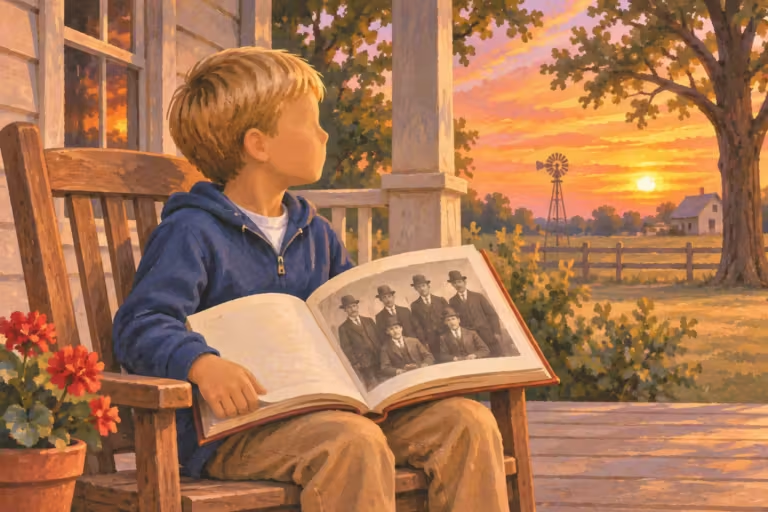
Ryan Hammons was five when he pointed to an extra from a 1932 movie in a book and said “that guy’s me.” No one knew who the man was. Months later, a film archive expert found his name on the back of another photo: Marty Martyn.

Reincarnation: The top 5 people who remember past lives
We asked them the same five questions as this story. A 32-page PDF, free in your inbox.
Check your email
We have sent you an email. Open it and press the button to confirm. If you cannot see it, check your spam folder.