A real-life case · Germany, 1952
Ruprecht Schulz’s reincarnation case
Ruprecht Schulz was a Berlin businessman, about 55 years old, when he began seeing a scene he took for a memory of another life. In it, a ruined merchant shot himself in his office. In 1952 he wrote to several ports in northern Germany to find him. The city hall of Wilhelmshaven answered that a timber merchant had killed himself there.
It is the second in our top 5 reincarnation cases, and the only one about an adult. It has something almost no other case has. Schulz’s letters from 1952 survive with their dates, and other people received them and answered them. And it has an oddity. Schulz was born five weeks before the man he said he had been died. We tell it step by step and then look at what can be checked. If you only want the evidence, skip straight to what can be checked. Did Schulz remember the life of a merchant from Wilhelmshaven?
Step 1
From 1887 to 1939 · Told by Ruprecht Schulz
A boy in Berlin pretends to shoot himself
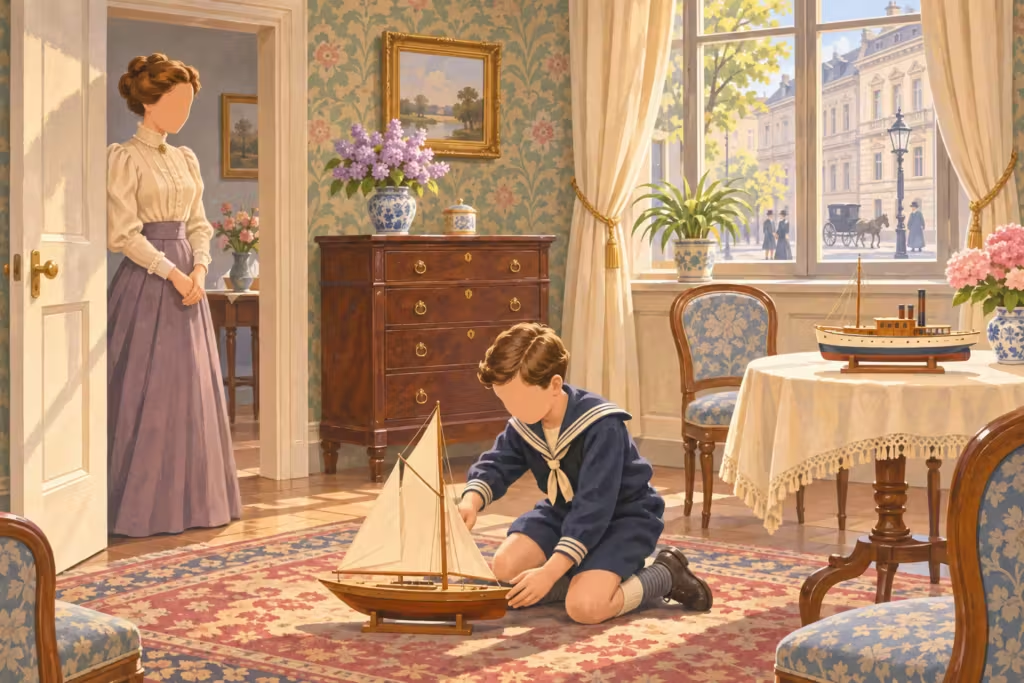
Ruprecht Schulz was born in Berlin on October 19, 1887. According to what he said as an adult, he had a habit as a boy that frightened his mother. When he was scolded or sad, he shaped his hand like a pistol, pointed it at his temple, and said, “I shoot myself.” His mother took it for a bad omen and forbade it.
Schulz also said that as a boy he loved ships. He collected model ships and drawings of ships, even though Berlin has no sea.
He left school at 18 and started a business renting out clothes and diapers. It grew to 200 employees, several buildings, and a villa with a chauffeur. He was a rich man.
Then the Second World War came.
Step 2
1942 and 1943 · Schulz is about 55 · Told by Schulz
During the bombings, Schulz sees a ruined man in front of a safe
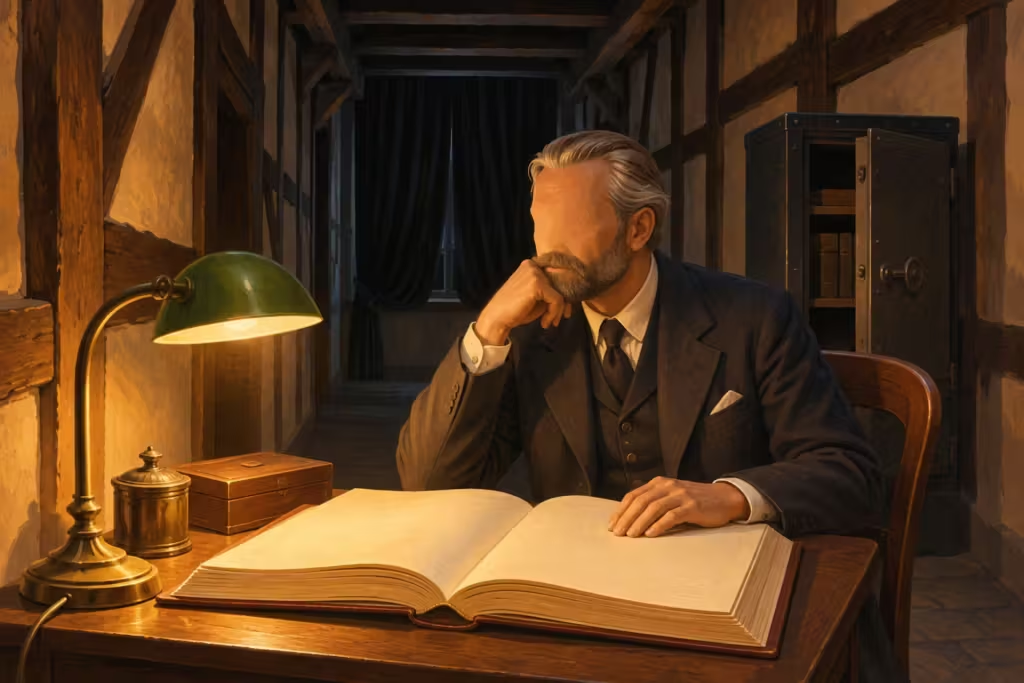
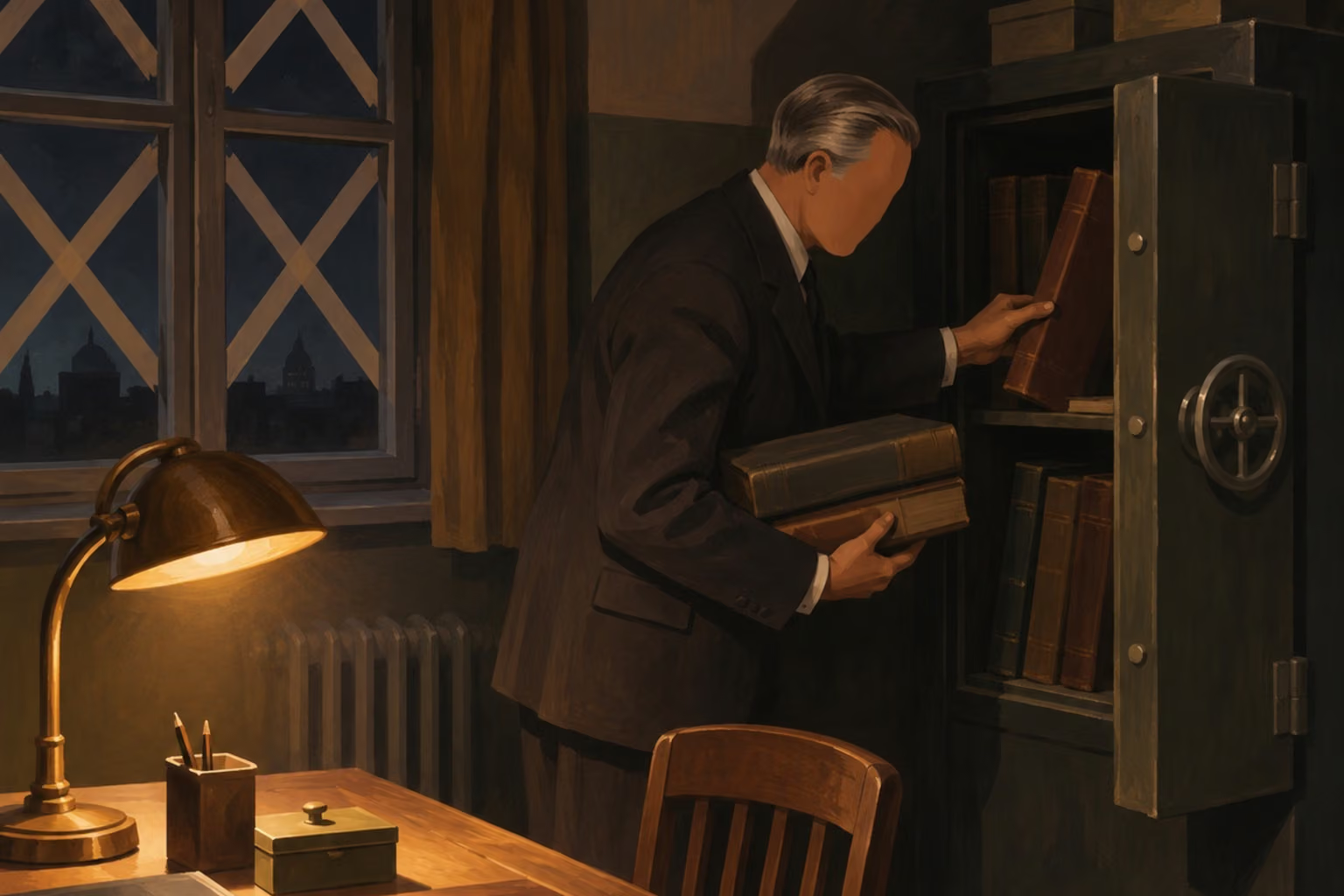
Allied bombs were destroying his properties in Berlin. On weekend nights, Schulz stood watch in his office, a very old building, to raise the alarm if a fire broke out. He used the time to go over the accounts. He kept the account books in an old safe in a dimly lit hallway.
According to Schulz, every time he took out the books, he felt he had already lived through that same situation once. Little by little, he began to see a scene. A businessman connected with ships was in a dark office. He took the account books out of an old safe, found that he was ruined, and shot himself.
Schulz said he wrote these memories in a diary and dictated them to his secretary, Ingrid Wollensach. The diary was lost in the bombings, and what he dictated does not survive.
He could not look for that man until 1952.
Step 3
May to August 1952 · Told by his letters and the city hall’s replies
Schulz writes to ten ports, and Wilhelmshaven answers
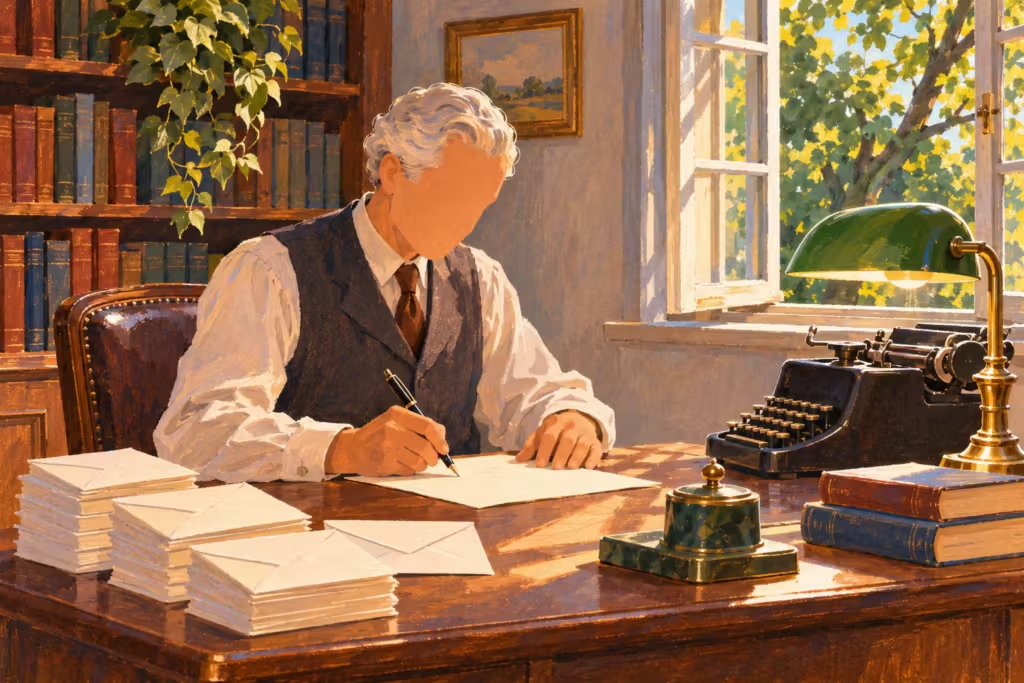
On his 1952 vacation, Schulz wrote to the city halls of ten ports in northern Germany. He believed the scene took place in a small port, and he thought it might be Wilhelmshaven. So he wouldn’t have to explain himself, he said he was looking for an ancestor of his family.
The letter to Wilhelmshaven is dated May 30, 1952. It is the first thing written by him that survives. He asks about a man of about 40 who lived in a German port and worked with ships or the transport of goods. He says the man died between 1870 and 1885, and that on coming back from a celebration he shot himself over money problems. He gives no name.
Every port answered no, except one. On July 24, the city hall of Wilhelmshaven wrote to him that a timber merchant, who also worked with ships, had killed himself there. The city hall misspelled the surname and gave a wrong year, 1890.
On August 1, Schulz wrote more details of his scene. He mentioned the old safe, the shot in the right temple, and the formal clothes of the period, with a stiff white collar. By then he already knew about the merchant from Wilhelmshaven.
In September, the city hall gave him the full name.
Step 4
September 1952 · Told by the letters of Schulz and Ludwig Kohler
The merchant’s son answers Schulz

On September 11, the city hall wrote him the merchant’s full name and the address of his son, Ludwig, who was still alive. The psychiatrist Ian Stevenson studied the case years later. In his book, he changed the family’s surname to protect their privacy. He calls the merchant Helmut Kohler.
Six days later, on September 17, Schulz wrote to Ludwig. He told him he saw himself in an old house, in a small room with a safe where he kept papers, account books, and money. The man in his scene wore dark clothes, as if coming back from an important event. And he said he had never been to Wilhelmshaven and had no family or acquaintances there.
Ludwig answered on September 21. He was 12 when his father died. He remembered his father’s office, dark and with small windows, and in a corner an old-fashioned safe. He said his father lost a lot of money buying timber, and that he falsified the accounts together with his bookkeeper. The bookkeeper fled to America with the money, and his father shot himself on the Day of Prayer and Repentance, a religious holiday.
Schulz asked him whether the shot was in the right temple or in the heart. Ludwig answered that he only knew it was in the head.
Four years later, Schulz went to Wilhelmshaven for the first time.
Step 5
1956 · Told by Schulz
Schulz visits Wilhelmshaven, and his story reaches the press

In October 1956, Schulz and his wife traveled to Wilhelmshaven, about 370 kilometers from Berlin, and met Ludwig. Schulz thought he recognized the city hall and an old arch, and the merchant’s sons in a school photo. He did not recognize his daughters. No one confirmed what he thought he recognized.
According to what Schulz said afterward, he was told there that the family went to church on the Day of Prayer and Repentance and ate at home. Afterward, the merchant got up, went to his office, and shot himself.
That same year, a German newspaper asked its readers for stories of past lives. It received hundreds and published Schulz’s, with a different surname for the family. Ludwig was upset, because he had asked that it not be told.
The story reached the researchers.
Step 6
From 1960 to 1971 · Told by Ian Stevenson and the documents
Stevenson finds that Schulz was born before the merchant died

In 1960, two German researchers interviewed Schulz and copied his letters. One of them wrote to Schulz’s former secretary. She answered that Schulz had told her in the 1940s about a small port like Wilhelmshaven. She also remembered a timber business, a holiday, and an employee who cheated him. By then, the story had been in the press for four years. And in his letter, the researcher had asked her whether Schulz named Wilhelmshaven.
Stevenson interviewed Schulz in 1964. In 1970, Schulz’s widow let him see the original letters, and Stevenson compared them with his copies. He asked the registry offices of Berlin and Wilhelmshaven for the birth and death records. The merchant died on November 23, 1887, at age 53. Schulz had been born on October 19, 1887, five weeks earlier. The Day of Prayer and Repentance fell on November 16. For the two dates to fit, Stevenson supposes that the merchant lived a week after the shot.
The death notice in the city’s only newspaper says he died “suddenly and unexpectedly.” It does not say of what.
In 1971, Stevenson spoke with two of Ludwig’s children, the merchant’s grandchildren. They said the house was modern, not old, and denied that their grandfather falsified the accounts.
The original question remains. Did Schulz remember that merchant’s life?
Frequently asked questions
Who was Ruprecht Schulz?
Ruprecht Schulz was a German businessman, born in Berlin in 1887, who died in Frankfurt in 1967. In 1942 and 1943, he began seeing a scene he took for a memory of another life. In 1952, he wrote letters to find the man in that scene, and he found a merchant from Wilhelmshaven who killed himself in 1887. The psychiatrist Ian Stevenson published the case in 2003.
How could Ruprecht Schulz remember the life of someone who died after he was born?
No one knows. Schulz was born on October 19, 1887, and the merchant from Wilhelmshaven died on November 23, 1887. Stevenson points this out as an oddity of the case, but gives no explanation.
Has the Ruprecht Schulz case been proven?
No. His 1952 letters are dated, and they led to a merchant who killed himself in Wilhelmshaven. But he wrote the most specific details, such as the safe, when he already knew about him, and only the merchant’s son confirms them. Here we explain what can be checked.
What did Ian Stevenson think of the Ruprecht Schulz case?
Ian Stevenson, the University of Virginia psychiatrist who studied the case, counted it among the strongest he investigated. He thinks it very unlikely that another man would fit everything Schulz said. He also acknowledges that many details would fit other merchants and that almost the only witness to the memories is Schulz himself.
Where this story comes from
The book
- Ian Stevenson, European Cases of the Reincarnation Type (2003). The “Ruprecht Schulz” case, in Part III, with his letters, Table 2, and the conclusionsBuy the book
Learn more
- Reincarnation: the cases we have studiedRead
- Reincarnation: the top 5 people who remember past livesRead
Our archive
- Our reading of the case in Stevenson’s book, and the scoring against our five criteria, as of November 10, 2026
Keep reading

Sri Lanka, 1989
Dilukshi Nissanka
Dilukshi Nissanka was not yet two years old when she began saying that in another life she had drowned near Dambulla. A letter and a newspaper recorded what she said in 1989. Days later, the father of a girl who drowned in 1983 wrote to Dilukshi’s family.

England, 1958
Pollock twins
In 1957, a car killed Joanna and Jacqueline Pollock. Their father announced they would come back as twins. In 1958, Gillian and Jennifer were born, and Jennifer had a mark on her forehead where Jacqueline had had a scar.

Sri Lanka, 1960
Gnanatilleka
Gnanatilleka Baddewithana talked from a young age about other parents in Talawakele, in Sri Lanka. In 1960, a journalist wrote down 57 things she said before identifying anyone. Then a truck driver who read the story pointed to the family of a boy who died in 1954.

Reincarnation: The top 5 people who remember past lives
We asked them the same five questions as this story. A 32-page PDF, free in your inbox.
Check your email
We have sent you an email. Open it and press the button to confirm. If you cannot see it, check your spam folder.