
A real-life case · Sri Lanka, 1989
Dilukshi Nissanka’s reincarnation case
Dilukshi Nissanka was not yet two years old when she began talking about another life. She said she lived in Dambulla, in Sri Lanka, and that she had drowned in a stream. In September 1989, a letter and a newspaper article recorded what she said. Days later, the father of a girl who drowned in 1983 read the article and wrote to Dilukshi’s family.
It is the fourth in our top 5 reincarnation cases. It has something almost no other case has. What the girl said was written down in a letter and in a newspaper, with dates, before anyone knew who she was talking about. Afterward, a psychologist checked, one by one, what those two documents said. We tell it step by step and then look at what can be checked. If you only want the evidence, skip straight to what can be checked. Did Dilukshi remember the life of a girl she never met?
Step 1
1986 to 1989 · Dilukshi is between two and almost five years old · Told by her mother
A two-year-old girl asks to go back to her other mother
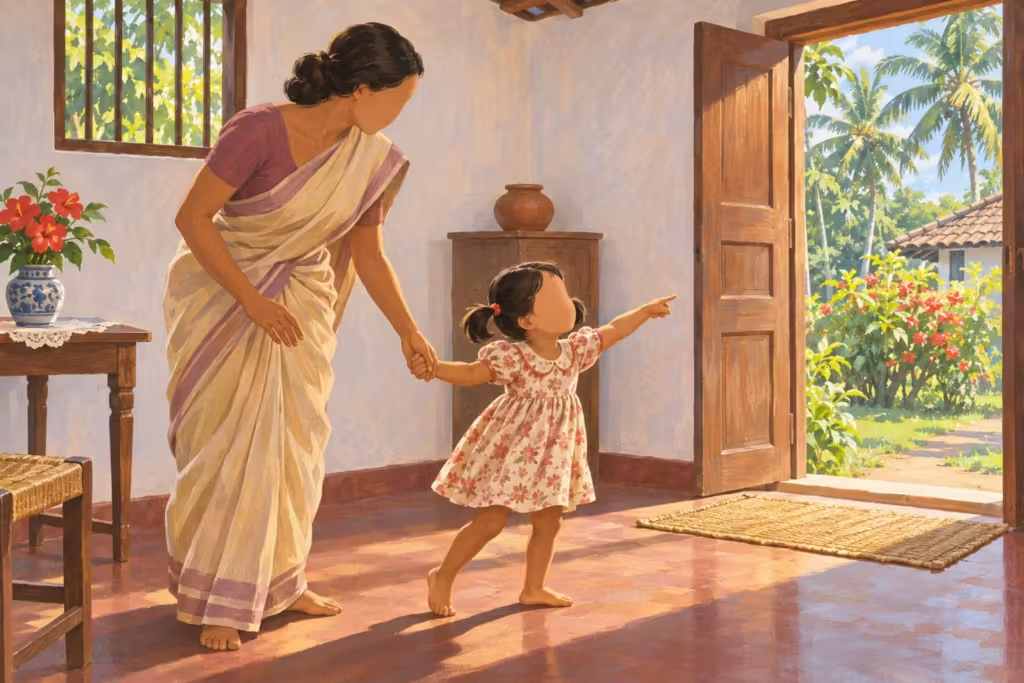
Dilukshi Nissanka was born on October 4, 1984, in Veyangoda, a town near Colombo, the capital of Sri Lanka. She is an only child.
According to her mother, before she turned two she began talking about another life. She said she lived in “Perawatte, Dambulla” and that she had drowned in a stream. She didn’t want to call her parents Mom and Dad, and she asked to be taken to her earlier mother.
Her parents tried to make her stop talking about it, even with threats, but they didn’t succeed. Her family had no friends or relatives in Dambulla, about 130 kilometers away. Her parents had been through there only once, in early 1984, before she was born, on their way back from a pilgrimage.
When Dilukshi was almost five, her parents gave up and asked for help.
Step 2
September 6, 1989 · Told by a letter from a relative
A relative writes to the abbot of the Dambulla temple
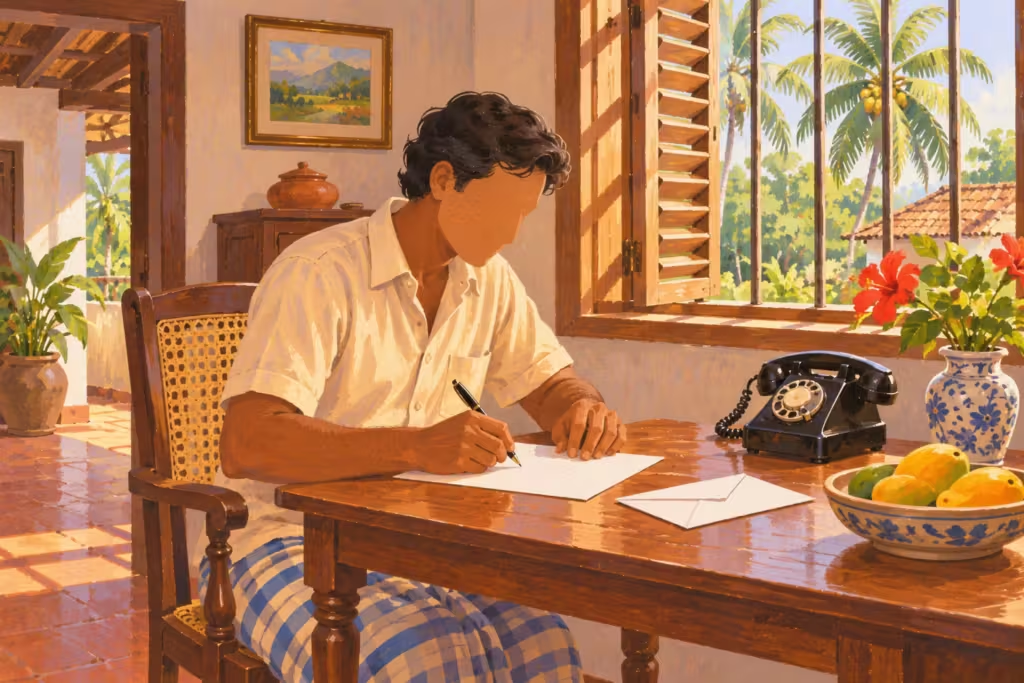
A relative of the family, B. A. Sunil, phoned the abbot of the Dambulla rock temple, one of the most visited pilgrimage sites in Sri Lanka. The abbot, Inamaluwe Sumangala, asked Sunil to write him a letter with everything the girl said.
Sunil wrote the letter on September 6, 1989. He wrote down from memory 13 things the parents had told him. For example, that near her house in the other life there was a vegetable shop with a very thin boy. According to the letter, the girl also said her father in that life had a stone quarry and a lot of money, and that she was in grade 5.
The abbot looked around the Dambulla area for a dead girl who fit, and didn’t find one. There was also no village called Perawatte. So he told the case to a journalist he knew.
Four days later, the story was in the newspaper.
Step 3
September 10, 1989 · Published by the newspaper “Weekend”
A newspaper publishes what the girl says
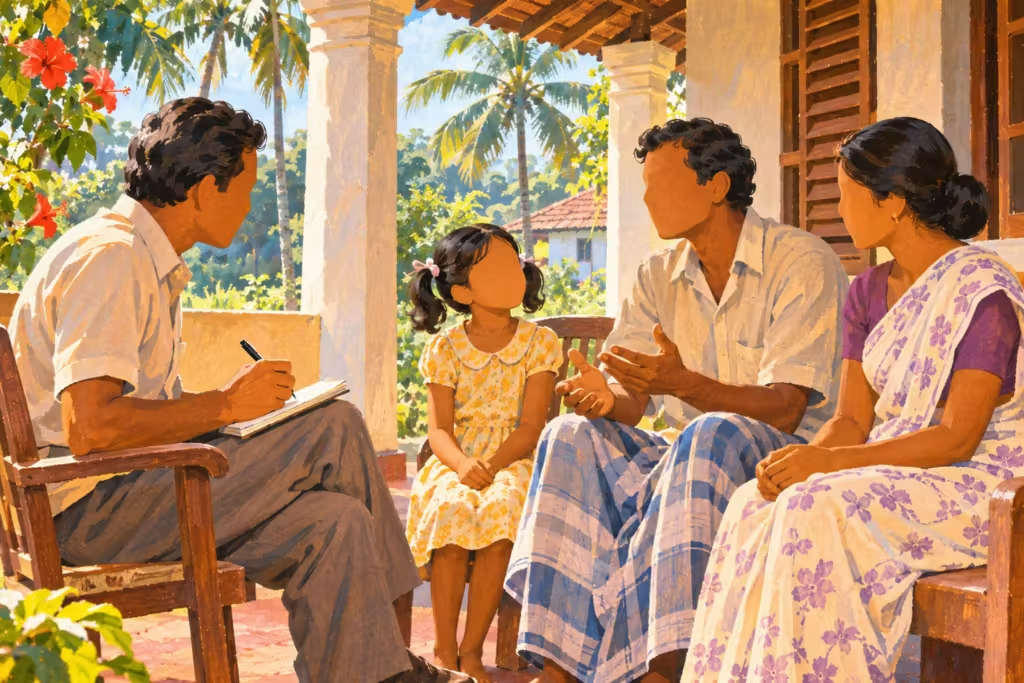
The journalist H. W. Abeypala talked with the parents and published the story in “Weekend,” the weekend edition of a major Sri Lankan newspaper. The article records 22 things the girl said.
According to the article, Dilukshi said that from “the little rock of Dambulla” you could see the roof of her house in the other life, and that she played on that rock. She said her siblings from that life waited for her at the little shop where they played, and that she fell into the stream with her brother. She also said her father back then took her to school in a van, and that there was a public water fountain at the temple. And she gave names. She said her name was Suwanna, that her mother’s name was Swarna, and that her brothers were Mahesh and Thushara.
The two documents record what the parents remembered from two and a half years of listening to their daughter, since she began talking about that life.
A man from near Dambulla read the article.
Step 4
September 15, 1989 · Told by the father’s letter and the two families
The father of a drowned girl writes to the family

Dharmadasa Ranatunga lived in a village about 6 kilometers from Dambulla. On September 15 he wrote to Dilukshi’s father and sent a copy to the abbot. He said his daughter Shiromi had drowned on September 27, 1983, at age nine.
A few days later, Dilukshi’s father and Shiromi’s father met. Soon after, the journalist and Dilukshi’s parents took her to Dambulla, and the abbot went with them. According to them, the girl led them to the Ranatunga house. There, according to those present, she recognized some people and objects, and Shiromi’s family accepted her as their daughter.
Who was Shiromi?
Step 5
Up to 1983 · Told by Shiromi’s family and her aunt
Shiromi, the girl who drowned in a canal in 1983

Shiromi lived with her family in the countryside near Dambulla. Her father was an office manager at a tile factory in another town and came home only on weekends. Shiromi had a younger brother, Manju Siri.
Wimala, her mother’s sister, lived with them for two years and spent almost all day with Shiromi. According to Wimala, Shiromi called a place near the house full of guava trees “Perawatte,” which means “guava orchard.” It was a name only she used.
On September 27, 1983, Shiromi went with Wimala and some other children to the canal that ran near the house, a stream about three meters wide. They went to bathe and wash clothes. After a while, Wimala realized Shiromi wasn’t there. A few hours later they found her drowned at the bottom of the canal, with a head wound. Shiromi knew how to swim, and the family believes she hit a rock. According to Wimala, Manju Siri, who was three, was also at the canal that day.
Two months after the visit, a researcher arrived.
Step 6
November 1989 to 2006 · Told by the psychologist Erlendur Haraldsson
A psychologist compares the letter and the newspaper with Shiromi’s life

Erlendur Haraldsson, a psychologist at the University of Iceland who studied these cases in Sri Lanka, learned of the case from the article. In November 1989 he interviewed both families. He got copies of the letter, the journalist’s notes, and the article, and he published the case in 1991.
Haraldsson checked that near Shiromi’s house there was a vegetable shop licensed since 1977. According to the shopkeeper’s brother, the youngest of the brothers was called “the skinny little brother.” That fits the very thin boy in the letter. In 1990, Haraldsson met that younger brother, Heen Malle. He was 27 and slim, and he said he remembered Shiromi buying in his shop. Haraldsson climbed a low rock nearby, the one Shiromi called “the little rock of Dambulla,” and from there he saw the roof of the house. The abbot confirmed that at the foot of the climb to the temple there was a public water fountain.
He also checked what didn’t fit. None of the names Dilukshi gave matches those of Shiromi’s family. The drowned girl was named Shiromi, and her mother, Zeila. Her father didn’t have a quarry, and the family wasn’t rich and had no van.
Of the newspaper’s 22 statements, Haraldsson considered that 17 could be checked. Of those 17, he counted 12 that fit at least partly and 4 that were plainly wrong. He did not put the remaining one in either group.
In 2006, Haraldsson saw Dilukshi again. She still had some of her memories, and others had faded. From time to time she visited Shiromi’s family, and they exchanged gifts.
The question from the beginning remains. Did Dilukshi remember Shiromi’s life?
Frequently asked questions
Who is Dilukshi Nissanka?
Dilukshi Nissanka was born in Sri Lanka in 1984. Before she turned two, she began saying that in another life she lived near Dambulla and had drowned. In 1989, a letter and a newspaper article recorded what she said, and the psychologist Erlendur Haraldsson published the case in 1991.
Who was Shiromi, the girl Dilukshi Nissanka said she had been?
Shiromi was a nine-year-old girl who lived near Dambulla, in Sri Lanka. She drowned in a canal near her house on September 27, 1983, a year before Dilukshi was born. In 1989, her father read the article about Dilukshi and wrote to Dilukshi’s family.
Has the Dilukshi Nissanka case been proven?
No. What Dilukshi said was written down before the family of Shiromi, the girl who drowned in 1983, was found, and several places fit. But all the names of people are wrong, and some hits need interpretation. Here we explain what can be checked.
What did Erlendur Haraldsson conclude about the Dilukshi Nissanka case?
Haraldsson pointed out that what fits best are the places. For example, the shop and the rock from which you can see the roof of the house. He also pointed out that the names of the people are wrong, and he proposed that the two “brothers” Dilukshi named, Mahesh and Thushara, could have been playmates. He found no contact between the two families.
Where this story comes from
The study
- Erlendur Haraldsson (1991), “Children Claiming Past-Life Memories: Four Cases in Sri Lanka,” Journal of Scientific Exploration, 5(2), pages 233 to 261. It reproduces B. A. Sunil’s letter and the “Weekend” article, sentence by sentence
- Erlendur Haraldsson and James G. Matlock (2016), I Saw a Light and Came Here: Children’s Experiences of Reincarnation, White Crow Books, chapter 7. It gives the count of statements that fit and what happened afterward, up to 2006
Learn more
- Reincarnation: the cases we have studiedRead
- Reincarnation: the top 5 people who remember past livesRead
Our archive
- Our reading of Haraldsson’s article and the scoring against our five criteria, as of November 10, 2026
Keep reading
Germany, 1952
Ruprecht Schulz
Ruprecht Schulz was a Berlin businessman when, in the middle of the war, he began seeing a ruined merchant shoot himself. In 1952 he wrote letters to find him. The city hall of Wilhelmshaven answered that a timber merchant had killed himself there.

Sri Lanka, 1983
Subashini Gunasekera
Subashini Gunasekera was three years old when she began saying that, in another life, a hill fell on her house in Sinhapitiya. The landslide happened, in 1977. The researchers found the family of a girl who died in it.

Louisiana, United States, 2000
James Leininger
James Leininger was two years old when he began screaming in his sleep that a plane was going down in flames. His parents say he talked about a ship called “Natoma” and a pilot named Jack Larsen. In 2002 his father found a pilot who fit, James Huston, who died in 1945.
Reincarnation: The top 5 people who remember past lives
We asked them the same five questions as this story. A 32-page PDF, free in your inbox.
Check your email
We have sent you an email. Open it and press the button to confirm. If you cannot see it, check your spam folder.