A real-life case · United States, 2009
Ryan Hammons’ reincarnation case
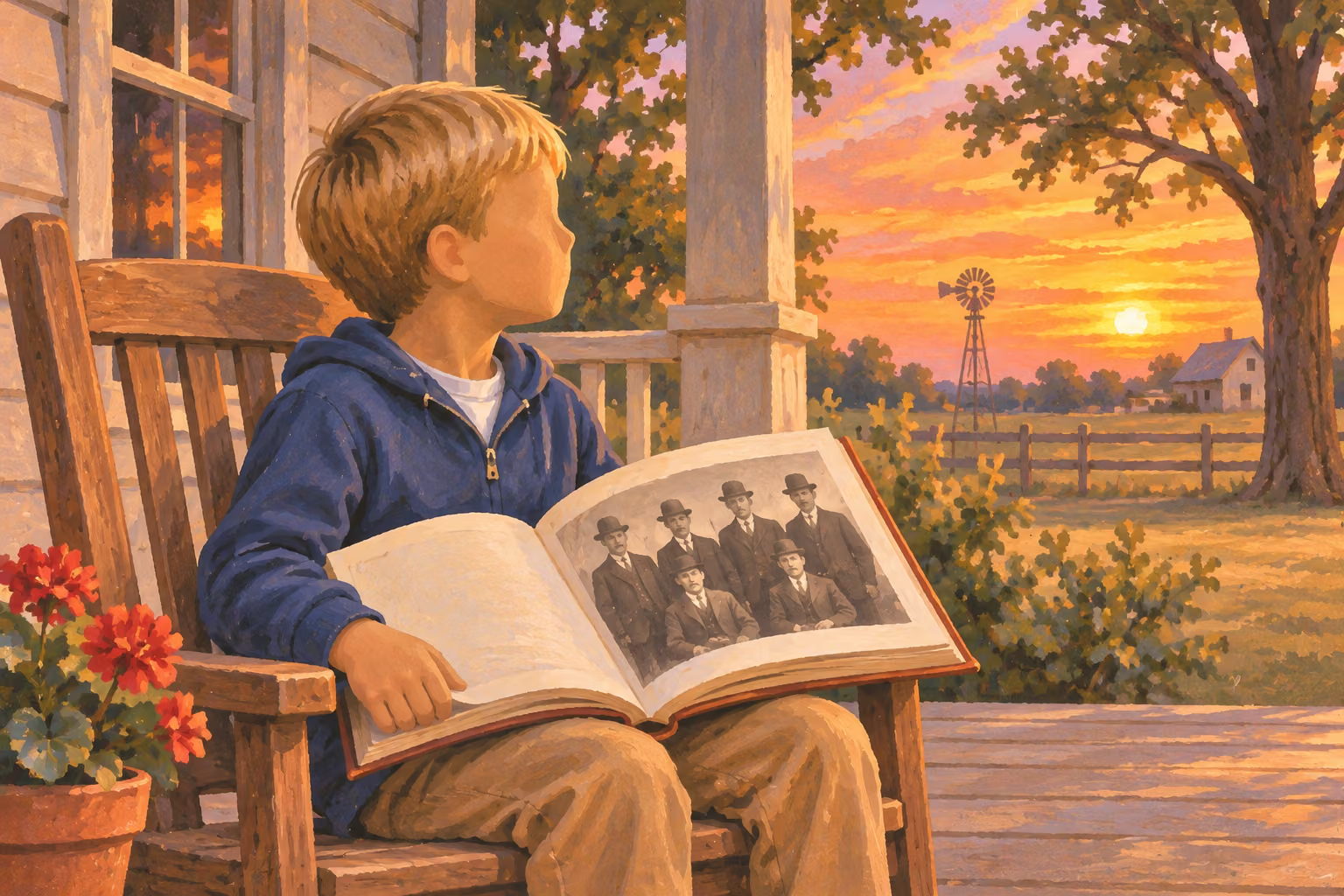
Ryan Hammons was a four-year-old boy in Oklahoma who cried because he wanted to go “home,” to Hollywood. At five, in a library book, he pointed to a man in a 1932 movie and told his mother: “That guy’s me.” The man was an extra without a single line, and no one knew his name.
In almost all of these cases, the child gives a name or a place from the start. By the time the researcher arrives, the child’s family and the dead person’s family already know each other. In this one, the child picked out a man in a photo. His mother wrote down what he said, and a psychiatrist recorded a conversation with the family, months before anyone knew who that man was. We tell it step by step and then look at what can be checked. If you only want the evidence, skip straight to what can be checked. Did Ryan remember the life of a man who died forty years before he was born?
Step 1
Around 2009 · Ryan is four years old · Told by his mother, Cyndi
A boy in Oklahoma cries because he wants to go back to Hollywood

Ryan Hammons lived in Muskogee, a city in Oklahoma, in the United States. His father, Kevin, was a police officer, and his mother, Cyndi, worked in the county offices. She grew up in a Baptist church, and he was the son of a Protestant minister. No one in the family believed in reincarnation.
When he was about four, Ryan began asking to be taken “home,” to Hollywood. He cried and begged to be taken to see his other family. When he played, he shouted “Action!” and directed imaginary movies. A few months later, he started having nightmares. He would wake up clutching his chest and saying he couldn’t breathe. He said that in Hollywood his heart had exploded.
His mother looked for help at the town library.
Step 2
Late 2009 or early 2010 · Ryan is five years old · Told by his mother
In a movie book, Ryan points to a man in a bowler hat: “That guy’s me”
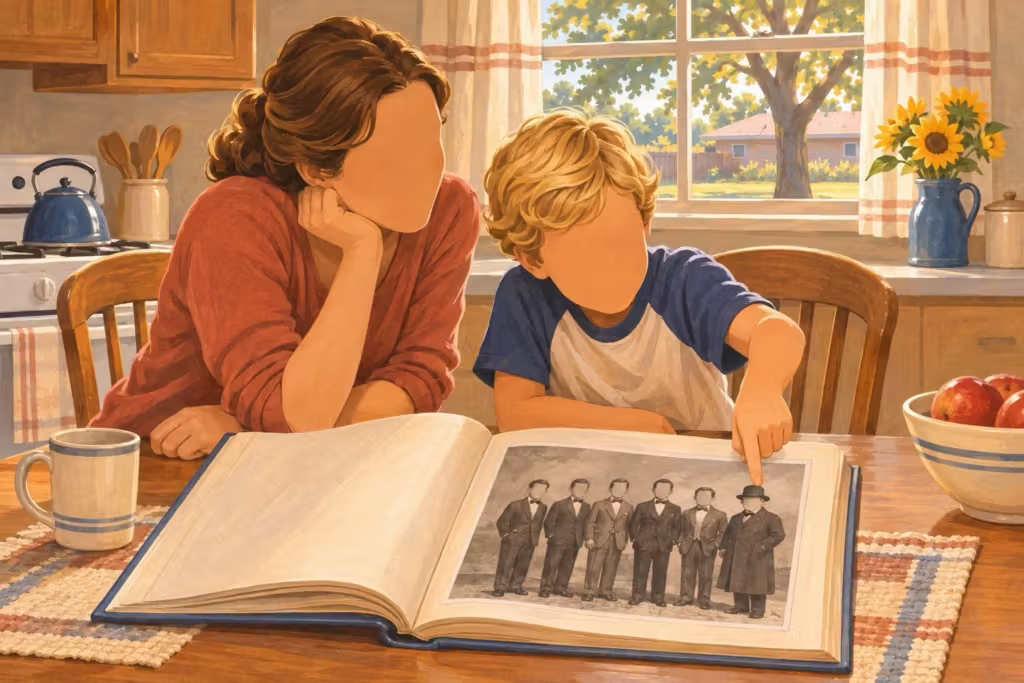
Cyndi checked out some books of Hollywood photos from the library, in case Ryan recognized a place. One of them had a photo from Night After Night, a 1932 gangster movie. It shows six men in bow ties, and two of them are arguing in the middle. Ryan pointed to one and said he was George, and that they had made a movie together. Then he pointed to another man, who stood to one side in a bowler hat and an overcoat. “Mama, that guy’s me. I found me,” he told her.
The caption said it was Night After Night, with George Raft, a star of 1930s gangster movies. He was the first one Ryan had pointed to. It said nothing about the second. According to the mother, her husband later found the movie on YouTube and they watched it together. Then they called Ryan in and showed him part of it, the scene with a closet full of guns that he had already talked about. The man in the bowler hat appears in several scenes, but he doesn’t say a single line. At the end of the movie comes the cast list, with names and no faces.
Cyndi decided to write to some researchers who studied cases like this.
Step 3
February 2010 · From the mother’s letters and e-mails, according to Jim Tucker
The mother writes to a psychiatrist and tells him what the boy says

Cyndi wrote to the University of Virginia, where a group has been studying children who talk about another life since the 1960s. She sent the photo and asked for help finding out who that man was. Jim Tucker, a child psychiatrist in that group, wrote back. She told him she had started keeping a journal of everything Ryan said.
In her e-mails over the following weeks, Cyndi told him more. Ryan had nightmares about a man he called “Senator Five.” He said this man was the worst villain who had ever lived. He talked about an “agency” and about a cemetery in New York he went to with a friend who worked for that agency. He also started tap dancing and said he had danced on Broadway, in New York. And before a family trip, when his mother told him he could dress up to go to a show, he answered: “Oh Mom, I hate auditions.”
In April, Tucker went to meet him.
Step 4
April 2010 · Ryan is five years old · Told by Tucker
The psychiatrist visits the family and records the conversation

Tucker traveled to Oklahoma with a small camera that a television production company had lent him. He recorded the conversation at the kitchen table. Cyndi had already sent him a copy of her notes. According to Tucker, Ryan usually talked about his other life at night, after his bath, and sometimes with a grown-up’s vocabulary.
According to the mother’s notes, Ryan said that in his other life his mother had curly brown hair. He also had a sister. He had been to Paris and China, traveled on big ships, and danced with ladies. He brought coloring books to three children, and he wasn’t sure if they were his. And he lived somewhere with the word “Rock” or “Mount” in the name.
Tucker and Cyndi had assumed the boy was talking about a spy agency. But Ryan had never said that. According to his mother, he had said he worked at an agency “where people changed their names.” Some time later, Tucker searched for towns with “Rock” or “Mount” in the name. The mother explained that Ryan wasn’t talking about a town but about a street.
They still didn’t know who the man in the bowler hat was.
Step 5
Spring 2010 · Told by Tucker
The TV team picks the wrong actor, and Ryan doesn’t recognize his houses

A few weeks later, the production company decided to make a program about the case. Its team believed the man in the bowler hat was Ralf Harolde, an actor of the period, only because the two looked alike. Tucker wasn’t sure. He checked the census records and saw that Harolde was an only child, while Ryan talked a lot about a sister.
The team took the family to Hollywood and showed Ryan two houses where Harolde had lived. The boy didn’t react. On camera, his father asked him if anything looked familiar, and Ryan said no. Later, when he learned the man wasn’t Harolde, Ryan complained that they hadn’t listened to him and had given him the wrong name.
The program’s producer hired a film archive expert.
Step 6
Summer 2010 · Told by Tucker
An archive expert finds a name on the back of a photo: Marty Martyn

Kate Coe, the film archive expert the producer hired, sent the photo to other researchers, and no one knew who the man was. Then she went to the library of the Hollywood Academy, the one that gives out the Oscars, and asked for everything it had on Night After Night. There she found another photo of the same man, with the bowler hat and a cigar. On the back, a note said he was Marty Martyn, playing a mobster.
Tucker watched the movie again. Only two characters wear bowler hats. One is the man Ryan pointed to, and the other, his boss in the movie, is played by the actor Bradley Page. Marty Martyn’s name is in the cast list, but with a character name that no one says in the movie. That’s why it was so hard to put a face to it.
With the name, the team found his life. Marty Martyn was born in Philadelphia and danced on Broadway with one of his two sisters. In Hollywood he was an extra and then a talent agent, with his own agency, the Marty Martyn Agency. A talent agency is a place where many people change their names to appear in movies. He married four times and lived in a big house with a swimming pool on Roxbury Drive, in Beverly Hills. He died in Los Angeles on Christmas Day 1964.
Before telling the family, Tucker wanted to run some tests.
Step 7
Summer 2010 · Ryan has just turned six · Told by Tucker
Ryan picks out “Senator Five” from four photos

Tucker didn’t tell the family the man’s name, so that no one could look him up beforehand. He went back to Oklahoma with a television crew and photos of people Marty Martyn knew, mixed with photos of strangers. He showed them to Ryan four at a time and asked if anyone looked familiar. Tucker himself knew which photo was the right one.
In the afternoon, Ryan didn’t want to do it and pointed at photos at random. In the evening, he asked to try again. Among four women, he pointed to Martyn’s last wife and said she looked familiar. Among four men, he pointed to one and said: “That’s Senator Five.” Tucker asked him if he was sure, and Ryan said yes. It was Irving Ives, a senator from New York in the 1940s and 1950s. According to Martyn’s daughter, her father met him, and she has a photo of the two of them together. Then Ryan started missing again, and they stopped.
The next morning, his father read him a list of four names. Three were made up, and the fourth was Marty Martyn. The father didn’t know which one was right. Ryan said no to the three made-up names and chose Marty Martyn.
What remained was to compare everything he had said with Martyn’s life.
Step 8
2010 to 2016 · Told by Tucker and Martyn’s daughter
Many things fit Martyn’s life, and others don’t

Martyn’s daughter agreed to meet with Tucker and Ryan, but she didn’t want to appear on camera. She was eight when her father died. She confirmed some things. Her father hated cats, sunbathed and got sunburned, and traveled with his wife to Paris and on big ships. Martyn had a daughter and five stepchildren, and he adopted three of them. Ryan had talked about three children he wasn’t sure were his.
Other things don’t fit. Ryan said his heart exploded. According to his daughter, Martyn had leukemia and died of a brain hemorrhage, in the hospital and with no one there to see it. Ryan talked about a father who grew corn and died when he was little. That doesn’t fit either. Martyn’s daughter doubts he was ever in China. And Ryan said he gave his daughter a guard dog, but it was a Yorkshire terrier.
In 2016, Tucker did the count. The mother had written down about 230 things Ryan said about his other life. Of those, 55 fit, 15 were wrong, and the other 160 couldn’t be checked.
That leaves the question from the beginning. Did Ryan remember Marty Martyn’s life?
Frequently asked questions
Who is Ryan Hammons?
Ryan Hammons was born in 2004 in Oklahoma, in the United States. At four, he said he had lived in Hollywood, and at five, he pointed in a 1932 photo to the man he said he had been. The psychiatrist Jim Tucker, of the University of Virginia, studied the case and published it in 2013.
Who was Marty Martyn, the man Ryan Hammons said he had been?
Marty Martyn was a Broadway dancer who became a Hollywood extra and then a talent agent, with his own agency. He appears without saying a word in the 1932 movie Night After Night. He died in Los Angeles on Christmas Day 1964.
What does Ryan Hammons think of his case today?
In 2024, by then in college, Ryan told The Washington Post that he can’t be sure reincarnation is real. Since he was seven, he has hardly talked about Marty Martyn.
Has the Ryan Hammons case been proven?
No. Ryan picked out the man in a photo, and many things he said before the name was known fit Martyn’s life. But the mother’s journal hasn’t been published, and of about 230 things he said, only 55 were found to fit. Here we explain what can be checked.
Where this story comes from
The books
- Jim B. Tucker, Return to Life (2013). Chapter 5, “He Came from Hollywood,” tells the caseBuy the book
- Leslie Kean, Surviving Death (2017). Chapters 4 and 5: the account by the mother, Cyndi Hammons, and the list of what she wrote down
- Erlendur Haraldsson and James G. Matlock (2016), I Saw a Light and Came Here: Children’s Experiences of Reincarnation, White Crow Books, chapter 25. It gives Tucker’s 2016 count
The articles
- James G. Matlock, “Ryan Hammons (reincarnation case),” Psi Encyclopedia, from the Society for Psychical ResearchRead
- Sean Lyons, “The Science of Reincarnation,” Virginia Magazine, from the University of Virginia, 2013Read
- Rebecca Nathanson, “The Hard Science of Reincarnation,” VICE, 2021Read
- Caitlin Gibson, “The children who remember their past lives,” The Washington Post, May 2, 2024
Learn more
- Reincarnation: the cases we have studiedRead
Our archive
- Our reading of Tucker’s book, Kean’s book, Haraldsson and Matlock’s book, the Psi Encyclopedia, and six press articles, and the scoring against our five criteria, as of November 11, 2026
Keep reading

India, 1935
Shanti Devi
Shanti Devi was eight years old when she gave the address of the husband she said she had had in another life, in the city of Mathura. A school principal wrote to that address, and the man existed. Then she was taken to Mathura.

Turkey, 1997
Kemal Atasoy
Kemal Atasoy was six years old when he told a psychologist that in another life he was Karakas, a rich Armenian from Istanbul. The psychologist wrote it down before looking for anyone. Then he found the house, and a local historian who remembered Karakas.

England, 1958
Pollock twins
In 1957, a car killed Joanna and Jacqueline Pollock. Their father announced they would come back as twins. In 1958, Gillian and Jennifer were born, and Jennifer had a mark on her forehead where Jacqueline had had a scar.

Reincarnation: The top 5 people who remember past lives
We asked them the same five questions as this story. A 32-page PDF, free in your inbox.
Check your email
We have sent you an email. Open it and press the button to confirm. If you cannot see it, check your spam folder.