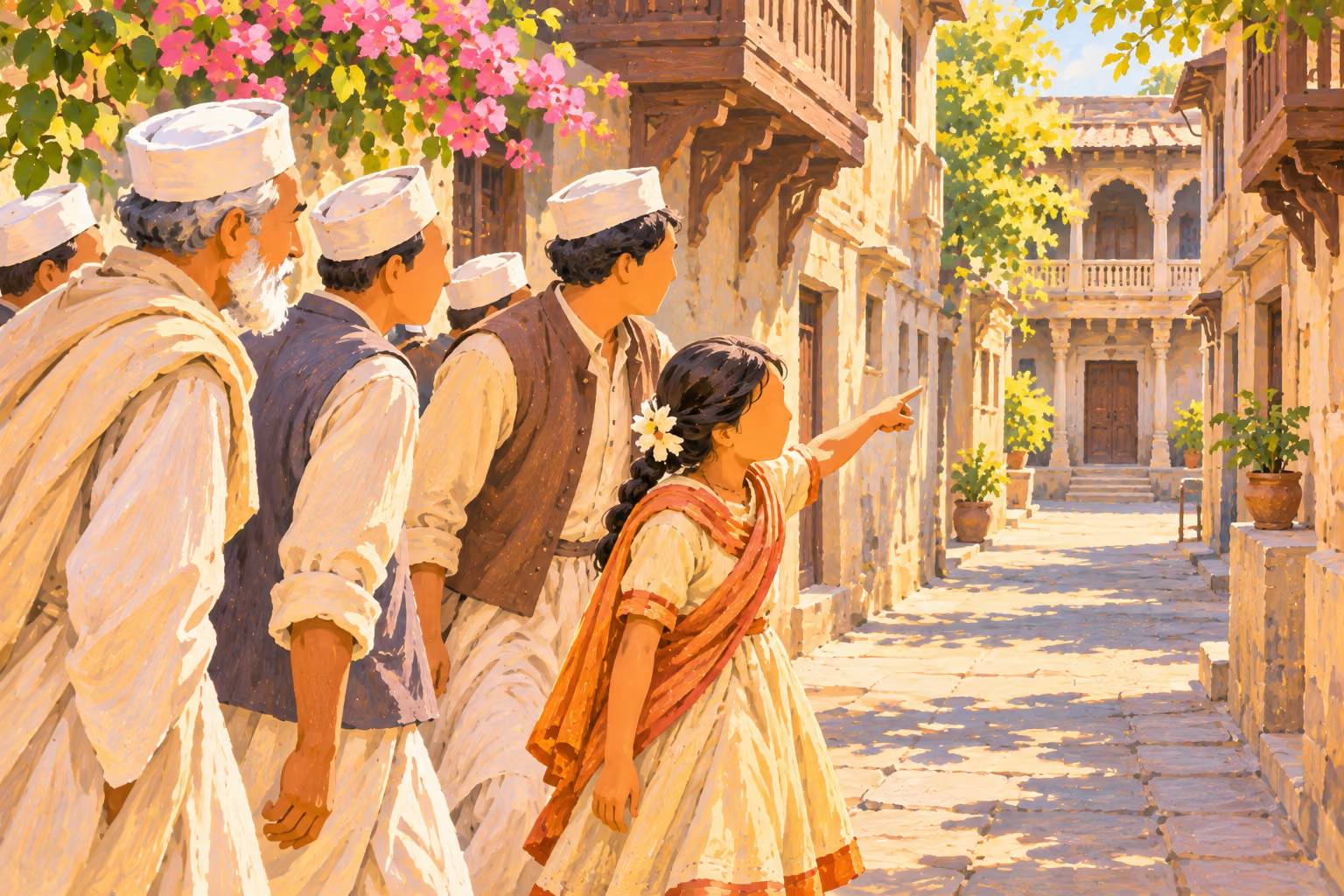
A real-life case · India, 1935
Shanti Devi’s reincarnation case
Shanti Devi was a girl from Delhi, in India. From the age of four, she said she had lived in another city, Mathura, married to a cloth merchant. At seven, she gave her husband’s name, and at eight, his address. A retired school principal wrote to that address. The reply came from a man whose wife had died ten years before that letter, shortly after giving birth.
It is the most famous reincarnation case in the world. In 1935, three Delhi residents took the girl to Mathura and wrote down everything she did. Indian newspapers reported it in those same days. We tell it step by step, with the 1935 press in front of us, and then look at what can be checked. If you only want the evidence, skip straight to what can be checked. Did Shanti Devi remember the life of a woman who died a year before she was born?
Step 1
Around 1930 · Shanti is about four years old · Told by the three residents who studied the case, in 1936
A Delhi girl says her home is in Mathura
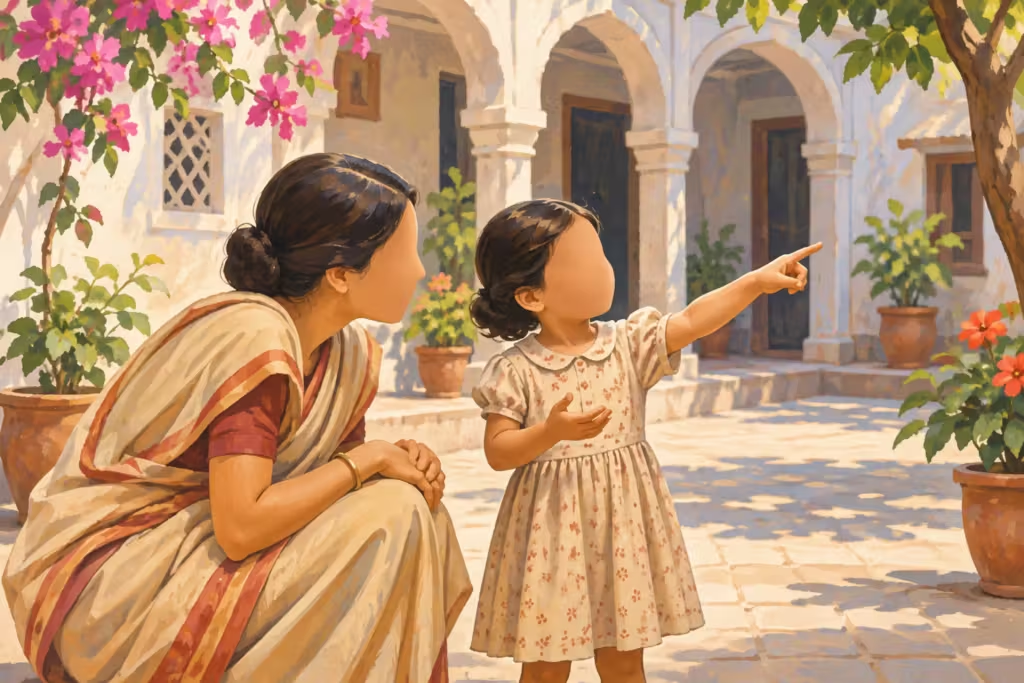
Shanti Devi was born in December 1926 in Chirakhana, an old neighborhood of Delhi, in India. Her father was Rang Bahadur Mathur. According to her family, the girl hardly spoke until she was four. When she began to talk, she also began to say that she had lived in Mathura, a holy city about 145 kilometers from Delhi.
She said that there she belonged to the Chaube caste, a community of Brahmins closely tied to Mathura. Her husband had a cloth shop, and her house was yellow. She talked about the sweets she ate there and the clothes she wore. Her parents didn’t take it seriously, but she kept asking them to take her there.
For years, the girl didn’t say her husband’s name.
Step 2
Around 1934 · Shanti is seven years old · Told by the three residents, in 1936
Shanti whispers her husband’s name to an uncle
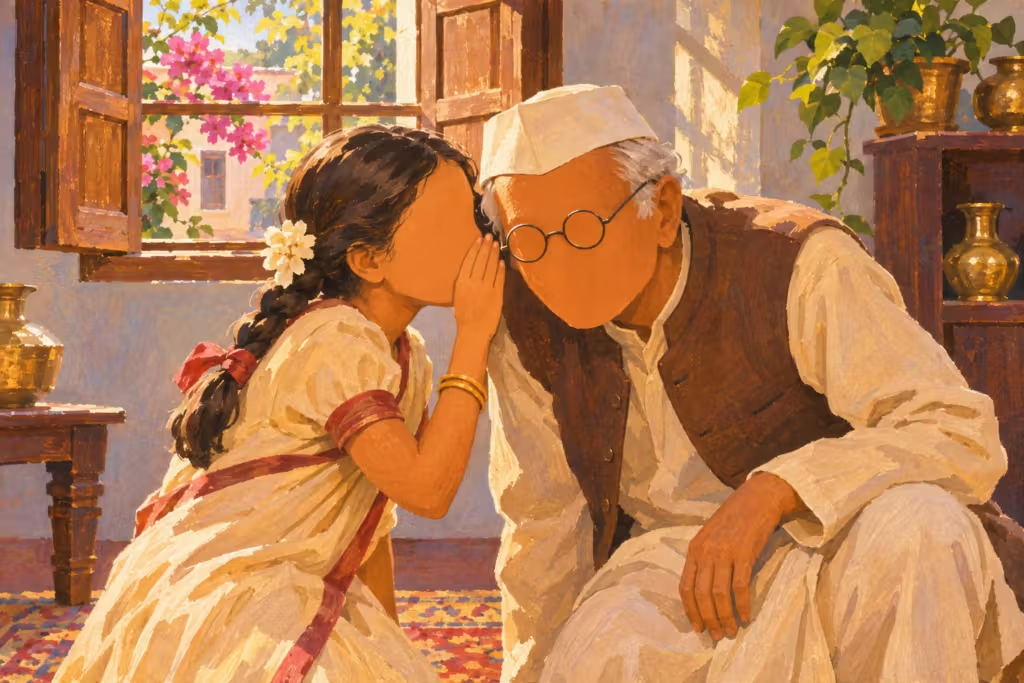
In India, a married Hindu woman doesn’t say her husband’s name, out of modesty. Shanti didn’t say it either. When her parents asked her, she answered that she would recognize him if she saw him. A great-uncle of hers, Bishan Chand, who was a teacher at a school in Delhi, promised to take her to Mathura if she told him. According to the three residents who studied the case, the girl whispered it in his ear: Kedar Nath Chaubey.
Bishan Chand didn’t take her. More than a year went by.
In the fall of 1935, someone decided to write to Mathura.
Step 3
October 1935 · Shanti is eight years old · Told by the three residents and the November newspaper
A school principal writes to the address the girl gives, and someone replies
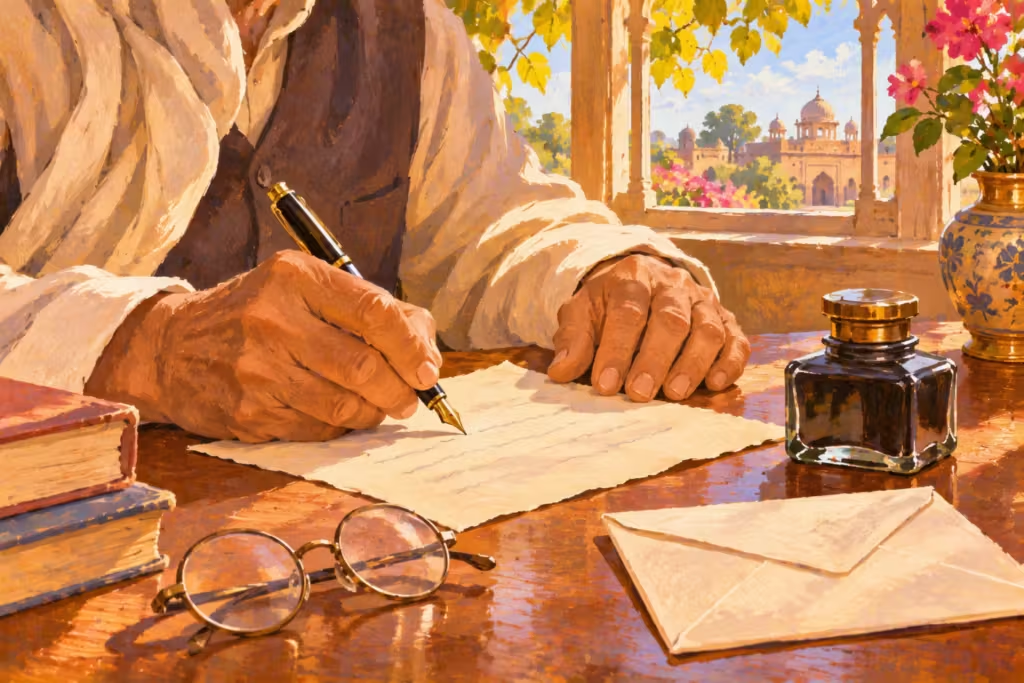
Bishan Chand told the story to a friend, Lala Kishan Chand, a retired school principal who wasn’t part of the family. Kishan Chand went to see the girl. She gave him her husband’s address in Mathura and described the house. He wrote it down and sent a letter to that address.
The reply came from Kedar Nath Chaubey, a merchant in Mathura. He answered that what the letter said about the girl was true in its essentials. According to both families, his first wife, Lugdi, had died in October 1925 in Agra, a few days after giving birth to their son. Kedar Nath had later remarried.
No one has ever published that letter or the reply. They are known from what the three residents told later and from a newspaper of November 1935.
Kedar Nath suggested that a relative of his in Delhi go and see the girl.
Step 4
November 13, 1935 · Told by the three residents and the press of those days
Kedar Nath arrives in Delhi, and the girl cries for an hour
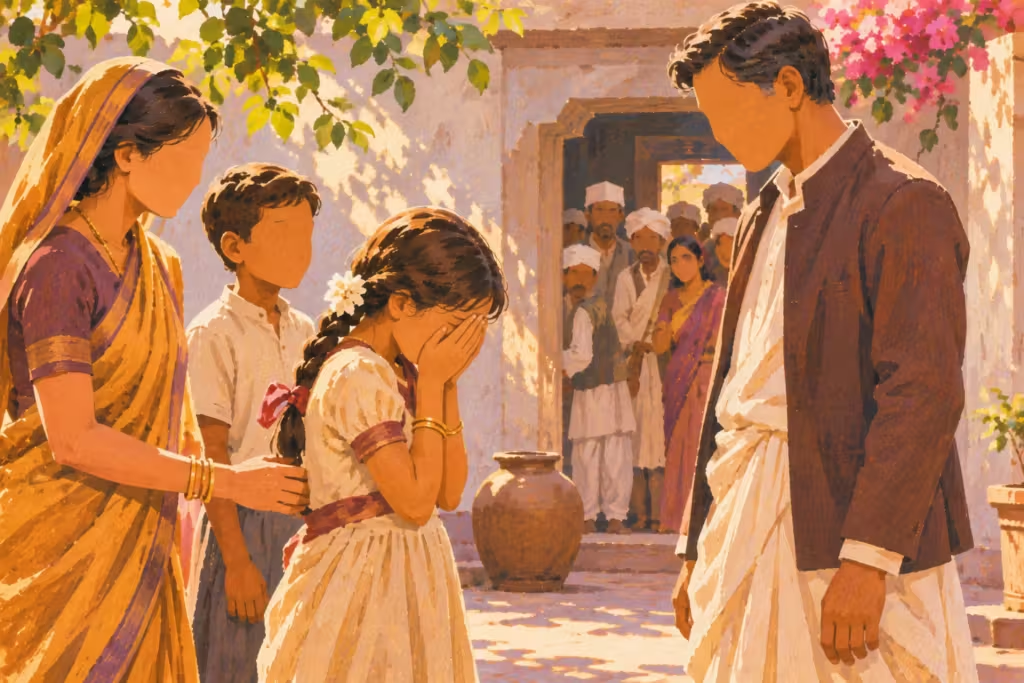
The first to see her was Kanji Mal, a relative of Kedar Nath who worked in Delhi. According to the three residents, the girl recognized him as her husband’s cousin and answered questions about the couple’s private life. According to a newspaper, she also told him about some money she had left buried in the house in Mathura.
On November 13, Kedar Nath arrived, with his son and his second wife. According to the three residents and the newspaper, Shanti recognized him as soon as she saw him and cried for an hour. The girl told Kedar Nath that, in her other life, she had promised to give 100 rupees of that money to the Dwarkadhish temple in Mathura. Kedar Nath and his son stayed in Delhi until November 15.
The news spread through Delhi. According to a newspaper, more than a hundred thousand people came by the girl’s house in a week.
Three Delhi residents decided to take her to Mathura.
Step 5
November 24, 1935 · Told by the three residents, in 1936
At Mathura station, the girl greets a man she had never met
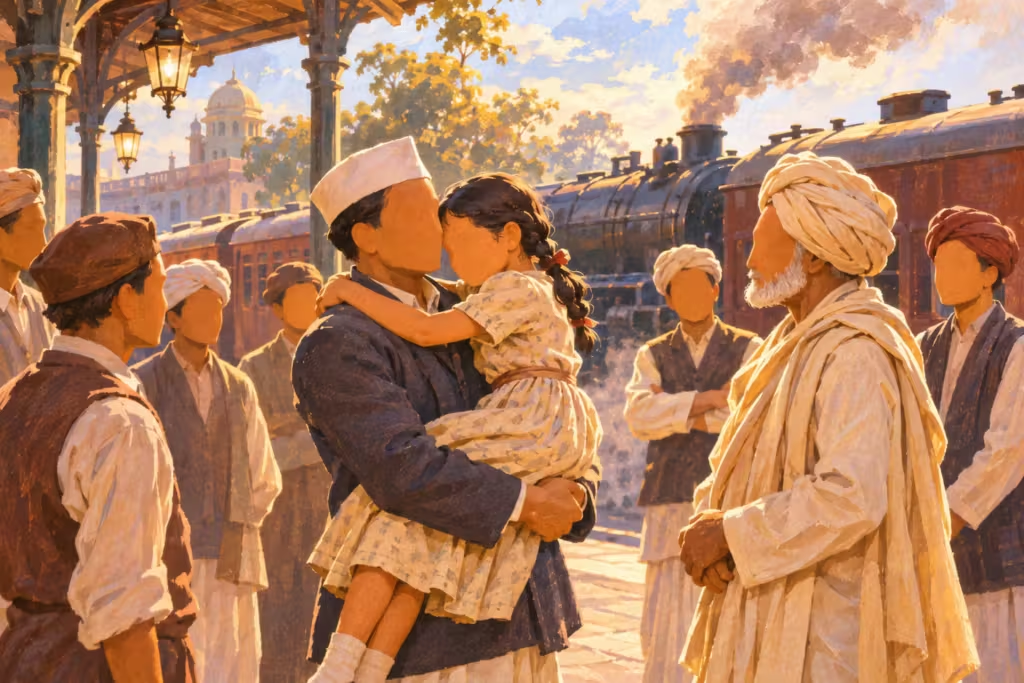
The three residents were Deshbandhu Gupta, who ran a Delhi newspaper, and Tara Chand Mathur, a lawyer. The third was Neki Ram Sharma, a well-known nationalist leader with the title of pandit. They didn’t belong to either family. They traveled with the girl, her parents, and other people, fifteen in all, and a photographer. During the trip, they wrote down everything she did and said.
As the train approached Mathura, Shanti said that by the time they arrived, the doors of the Dwarkadhish temple would already be closed. She said it with an expression used in Mathura. On the platform, an older man dressed like the people of Mathura stopped in front of her. According to the three residents, the girl had never seen him. They asked her if she recognized him, and she got down from Gupta’s arms and touched his feet as a sign of respect. She whispered to them that he was her husband’s older brother. He was Babu Ram Chaubey, Kedar Nath’s brother.
Then they asked her to guide the car to her house.
Step 6
November 24, 1935 · Told by the three residents, in 1936
Shanti guides the car to the house and looks for her hidden money
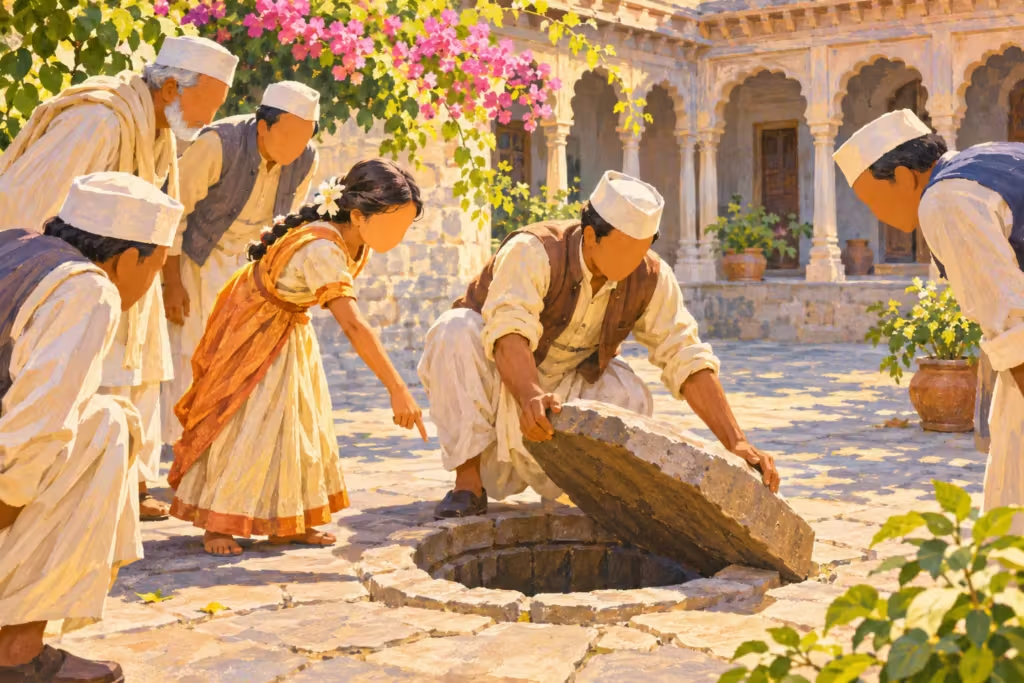
The girl showed the way. Along the route, she pointed out buildings that, she said, hadn’t been there before, and she described a city gate to them before they reached it. She stopped the car at the entrance to an alley and pointed to a house. An older man, about 75 years old, was there. She called him father-in-law and bowed to him. He was Kedar Nath’s father. The house wasn’t yellow.
Then they took her to the family’s second house. In Delhi, the girl had talked about a well. She looked for it in the courtyard of that house and didn’t find it, but she pointed to a corner and said the well was there. Kedar Nath lifted a stone slab, and a well appeared that had been covered for years. Then the girl went upstairs, entered a room, and said the money was buried under a corner. They dug and, about thirty centimeters down, found an old hiding place for keeping valuables. It was empty. Later, according to the three residents, they learned that Kedar Nath had taken the money out when Lugdi died.
Finally, they took her to the house of Lugdi’s parents. According to the three residents, the girl recognized them among more than fifty people.
The case became famous all over India.
Step 7
1935 to 1987 · Told by the press, a skeptic in 1936, and the researchers
The three residents publish what they saw, and a skeptic isn’t convinced
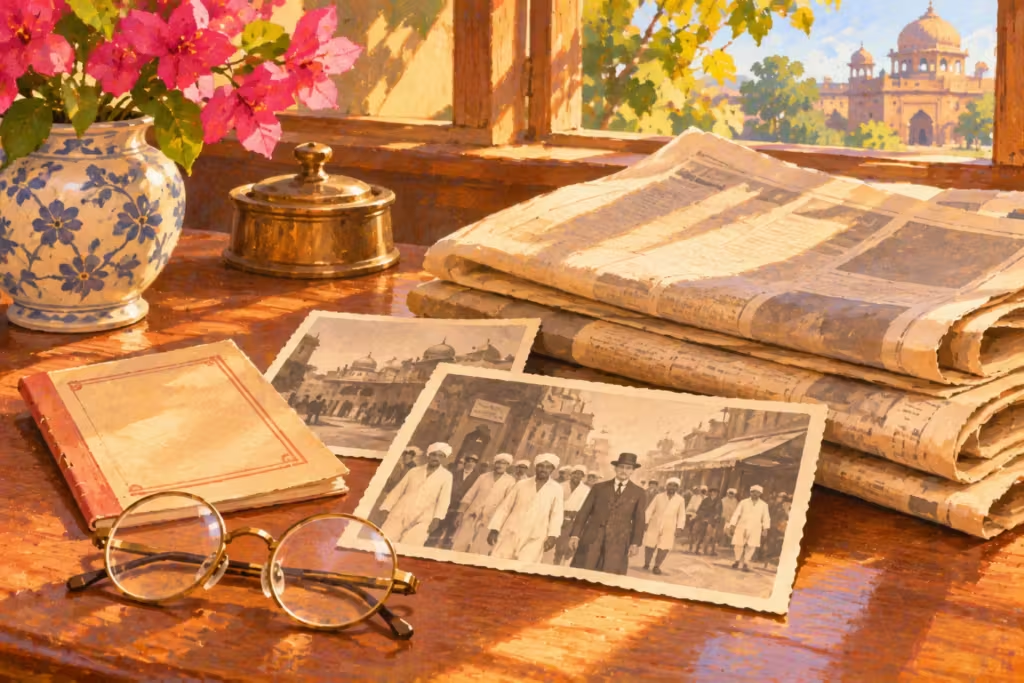
On December 1, 1935, more than twenty thousand people went to a public meeting in a Delhi park. Gupta, Sharma, and Tara Chand said they were convinced and called for a scientific investigation. In March 1936, they published their account in the press, and later in a pamphlet.
In February 1936, Bal Chand Nahata, a skeptic, interviewed the girl and other people. He published a pamphlet in Hindi. He concluded that what was known didn’t allow anyone to say that Shanti remembered a previous life. In that interview, the girl also told him what she said she remembered between one life and the next. She spoke of smoke and of three men dressed in yellow. She said she saw the god Krishna sitting on a throne, reading a paper with the number of her house in Delhi.
Many books and websites today say that Gandhi chose those three residents. No newspaper or document from 1935 or 1936 says so. In November 1935, Gandhi was hundreds of kilometers away, in the town of Wardha. The story appears decades later. According to books from the 1940s, two of the three residents were indeed associates of his.
Shanti Devi never married. In 1986, she was interviewed by the psychiatrist Ian Stevenson, of the University of Virginia, together with the Indian researcher K. S. Rawat. She died in Delhi on December 27, 1987.
The question from the beginning remains. Did Shanti Devi remember Lugdi’s life?
Frequently asked questions
Who was Shanti Devi?
Shanti Devi was born in Delhi in 1926 and died there in 1987. As a child, she said she had been Lugdi, a woman from Mathura who died in 1925, and in 1935 she was taken to that city to check. It is the most famous reincarnation case in the world.
Did Gandhi appoint the committee that investigated Shanti Devi?
There is no evidence from the time. The 1935 newspapers speak of three Delhi residents, and the account they published in 1936 doesn’t name Gandhi. The story of the appointment appears decades later.
What happened to the money Shanti Devi said she had hidden?
In the house in Mathura, she pointed to a corner, and under it an old hiding place for valuables turned up, but it was empty. According to the three residents who were with her, they later learned that the widower, Kedar Nath, had taken the money out when his wife died.
Has the Shanti Devi case been proven?
No. The girl gave the name and address of a real man, and in Mathura she recognized people and places. But what she said before the letter wasn’t written down, and before the trip she spent days with the family of the man she called her husband. Here we explain what can be checked.
Where this story comes from
The press of the time
- The Bombay Chronicle, November 20 and 27 and December 2, 1935. The news about the case, from the same days
- Deshbandhu Gupta, Neki Ram Sharma, and Tara Chand Mathur, the three residents’ account, published in The Bombay Chronicle on March 22, 1936
- The same account, reproduced in the magazine The Theosophist, May 1936 (pp. 139-144) and September 1936 (pp. 549-550)Read for free
The books and studies
- John Helen Manas, Metempsychosis (1941), chapter 16. It reproduces the three residents’ accountRead for free
- Manly P. Hall, Reincarnation: The Cycle of Necessity (1946). It includes the part about the name and the letterRead for free
- Ian Stevenson (1960), “The Evidence for Survival from Claimed Memories of Former Incarnations,” Journal of the American Society for Psychical Research
- K. S. Rawat (1997), “The Case of Shanti Devi,” Venture Inward magazine. With his 1986 and 1987 interviewsRead
- K. S. Rawat and Titus Rivas (2005), “The Life Beyond,” Journal of Religion and Psychical Research. It includes the skeptic Nahata’s interview
- KM Wehrstein, “Shanti Devi (reincarnation case),” Psi Encyclopedia, from the Society for Psychical ResearchRead
Learn more
- Reincarnation: the cases we have studiedRead
Our archive
- Our reading of 446 issues of The Bombay Chronicle from 1935 and 1936, of the books and articles above, and of Gandhi’s schedule in his collected works, and the scoring against our five criteria, as of November 11, 2026
Keep reading

United States, 2009
Ryan Hammons
Ryan Hammons was five when he pointed to an extra from a 1932 movie in a book and said “that guy’s me.” No one knew who the man was. Months later, a film archive expert found his name on the back of another photo: Marty Martyn.

Lebanon, 1964
Imad Elawar
Imad Elawar was five years old and talked about another life in Khriby, a village in the mountains of Lebanon. In 1964, Ian Stevenson wrote down what his family said and went with him to look for that person. It is Stevenson’s most famous case, and one of his most disputed.

Sri Lanka, 1983
Subashini Gunasekera
Subashini Gunasekera was three years old when she began saying that, in another life, a hill fell on her house in Sinhapitiya. The landslide happened, in 1977. The researchers found the family of a girl who died in it.
Reincarnation: The top 5 people who remember past lives
We asked them the same five questions as this story. A 32-page PDF, free in your inbox.
Check your email
We have sent you an email. Open it and press the button to confirm. If you cannot see it, check your spam folder.