
A real-life case · Lebanon, 1964
Imad Elawar’s reincarnation case
Imad Elawar was a five-year-old boy from a mountain village in Lebanon. From a very young age he talked about another life in Khriby, a different village 24 kilometers away. In 1964, the psychiatrist Ian Stevenson wrote down what his parents said, and went with him to look for the man the boy said he had been. It is Stevenson’s most famous case. It is also one of his most disputed.
Stevenson wrote down what the boy said before he knew who he was talking about, and then checked it himself. That is why the case is cited so often. But the family had already asked around in Khriby, and their first idea of who Imad had been in that other life turned out to be wrong. We tell it step by step and then look at what can be checked. If you only want the evidence, skip straight to what can be checked. Did Imad remember the life of a man from Khriby?
Step 1
From 1960 · Imad is a year and a half old · Told by his parents
A boy in Lebanon talks about another life in Khriby

Imad Elawar was born on December 21, 1958, in Kornayel, a village in the mountains of Lebanon, about 25 kilometers from Beirut. His family was Druze, a religious community in Lebanon that believes in reincarnation.
According to his parents, Imad began talking about another life when he was between a year and a half and two years old. His first words were two names, “Jamileh” and “Mahmoud.” “Jamileh” is the name Stevenson uses in his book so as not to give the real one. He often talked about Jamileh, and said she was prettier than his own mother.
He said he had lived in Khriby, another mountain village, and that he belonged to the Bouhamzy family. He told of an accident in which a truck ran over a man and broke both his legs. And he kept saying how happy he was to be able to walk, as if he hadn’t been able to before.
His father scolded him and told him these were lies. So Imad stopped telling him, and told his mother and his grandparents instead.
Before any researcher arrived, the family had already started learning things about Khriby.
Step 2
Until December 1963 · Told by his parents to Stevenson
The family hears about Khriby before the researcher arrives

One day, a man from Khriby walked down a street in Kornayel. According to Imad’s grandmother, who was with him, the boy recognized the man. Later, a woman from a village near Khriby confirmed to the parents that people with the names the boy gave lived, or had lived, in Khriby.
In December 1963, an important man from Khriby died, Said Bouhamzy, and the invitation to the funeral reached Kornayel. Imad’s father went with an uncle, out of curiosity. In Khriby, people pointed out two men whose names Imad had said, but he didn’t speak to them. According to him, it was his first time in Khriby.
From everything the boy said, the family formed an idea. They believed Imad had been a man named Mahmoud Bouhamzy, married to Jamileh, who was killed by a truck after a fight with the driver.
Three months later, Stevenson arrived, by chance.
Step 3
March 16 and 17, 1964 · Imad is five years old · Told by Ian Stevenson
Stevenson writes down what the parents say before going to Khriby
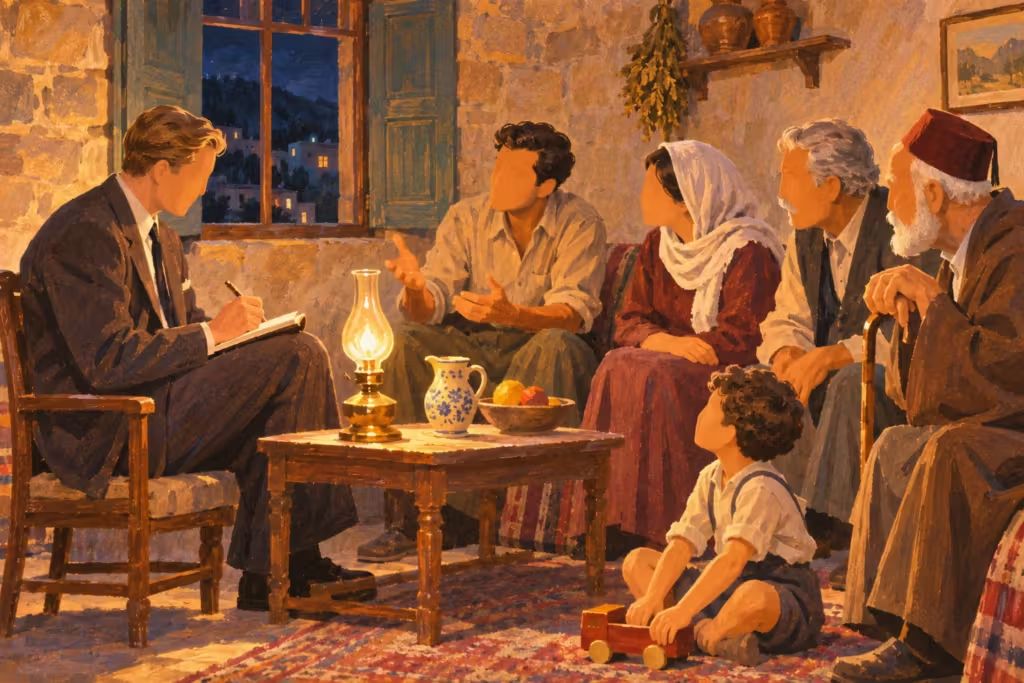
Ian Stevenson was a psychiatrist at the University of Virginia, in the United States, who studied children who say they remember another life. A Lebanese interpreter he had met in Brazil had told him about his village, Kornayel. Stevenson went there on March 16, 1964, to look for that interpreter’s brother. When he asked for directions on the way, some neighbors told him about Imad.
That night, Stevenson wrote down everything the parents said the boy had told them. The next day he went over it with them and with a better interpreter. On the way to Khriby, in the car, he wrote down other things that Imad and his father said. In all, he gathered 57 items.
Stevenson writes that he couldn’t always tell apart what the boy had said from what the parents had worked out. Later he saw that part of what they told him were the parents’ ideas, not Imad’s words.
In Khriby, the family’s idea fell apart.
Step 4
March 17 and 18, 1964 · Told by Stevenson
The man hit by the truck was not the one the boy talked about

In Khriby, Stevenson learned that Mahmoud Bouhamzy was still alive. The man killed by a truck was someone else, and he died in 1943. He was also named Said Bouhamzy, and he was a friend of the Said from the 1963 funeral. And the Said who was run over had nothing to do with any Jamileh. The family’s first idea was wrong on all three points: the name, the woman, and the death.
Haffez Bouhamzy, the son of the Said who was run over, tried to match what Imad said with other men in the family. According to him, it fit Ibrahim Bouhamzy, a cousin of the Said who was run over, who lived about 90 meters from his house. Ibrahim had a very pretty lover named Jamileh, whom he never married. The death of Said, who was his friend, affected him deeply. He died of tuberculosis on September 18, 1949, at about age 25, after a year in a sanatorium.
Still unexplained was why Imad was so happy to be able to walk. Stevenson asked Haffez whether Ibrahim had had tuberculosis of the spine, which can leave a person unable to walk. Haffez said yes, and that in his last months he couldn’t walk. But later, Ibrahim’s brother told him the tuberculosis was in the lungs and the heart, and that Ibrahim could walk until shortly before he died.
The next day, Imad walked into Ibrahim’s house.
Step 5
March 19, 1964 · Told by Stevenson and his interpreter
Imad walks through Ibrahim’s house with his mother and sister
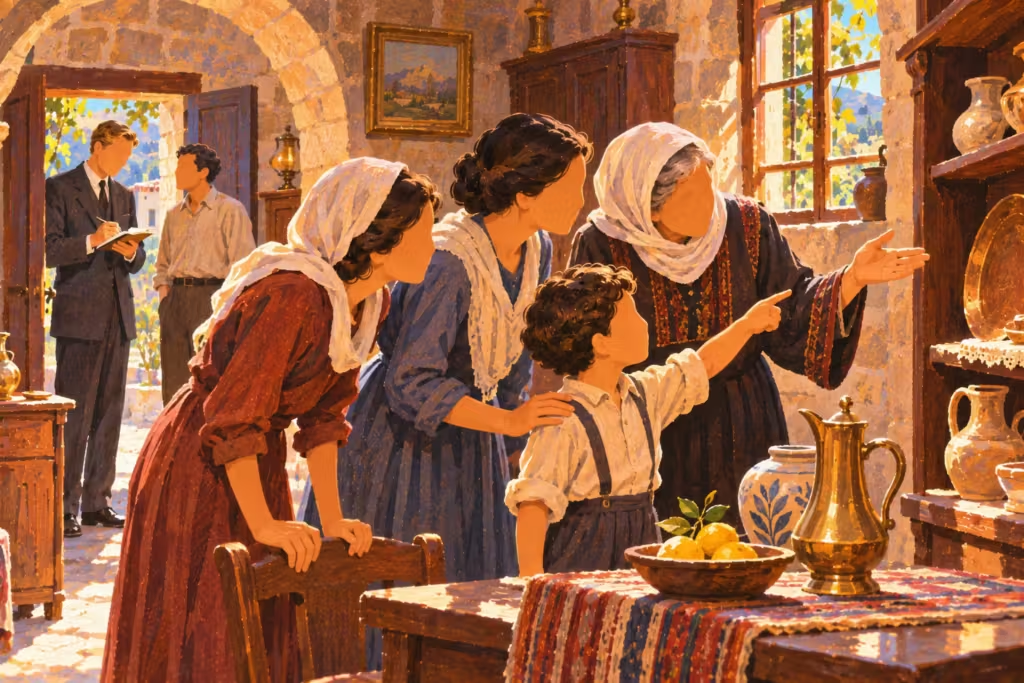
Stevenson wanted to introduce Imad to each of Ibrahim’s relatives separately, with no one giving him hints. He couldn’t. When they reached the house, three women appeared, Ibrahim’s mother and sister and a neighbor, and they took the boy to walk through it. Stevenson and the interpreter followed behind.
According to Stevenson, Imad made thirteen correct recognitions or remarks about Ibrahim’s life. The interpreter believes that in most of them no one gave him hints. In others, the interpreter wasn’t close enough to hear, and Stevenson learned of them from what the women said.
Earlier, at the home of the Said who was run over, Imad had recognized nothing, nor anyone in some family photos.
Stevenson returned to Lebanon in August, and again in 1968.
Step 6
August 1964 to 1994 · Told by Stevenson and the philosopher Leonard Angel
Stevenson publishes the case, and then more visits between the villages come to light

In August 1964, Stevenson spoke with Ibrahim’s brother and sister and with other neighbors in Khriby. According to him, they confirmed almost everything Haffez had said. He reported that, of the 47 items written down before the trip, Imad got only three wrong. Of the ten he said in the car, he got three wrong. He doesn’t count the parents’ ideas as errors.
In 1968 he spoke with two relatives of Imad’s family. One knew a cousin of Ibrahim’s in Khriby. The other told him that he and four or five people from his family had gone from Kornayel to Khriby for the funeral of Said Bouhamzy. Stevenson doesn’t make clear which of the two Saids. Stevenson writes that there had been more visits between the two villages than he thought. Even so, he still believes that no one close to Imad knew the intimate details of Ibrahim’s life.
Stevenson published the case in 1966, in his book Twenty Cases Suggestive of Reincarnation, and expanded it in 1974. In 1994, the philosopher Leonard Angel criticized it. He pointed out that the family’s first idea was wrong from start to finish, that Stevenson’s question about the spine already suggested the answer, and that there is no way to know what the boy said before the family asked around in Khriby.
The question from the beginning remains. Did Imad remember the life of Ibrahim Bouhamzy?
Frequently asked questions
Who is Imad Elawar?
Imad Elawar was born in 1958 in Kornayel, a mountain village in Lebanon. As a young child he said he had lived in another village, Khriby, and that he belonged to the Bouhamzy family. Ian Stevenson studied the case in 1964, and it is the most famous of his investigations.
Who was Ibrahim Bouhamzy, the man Imad Elawar said he had been?
According to his family, Ibrahim Bouhamzy was a young man from Khriby, in Lebanon, who had a lover. Stevenson calls her Jamileh so as not to give her real name. He died of tuberculosis on September 18, 1949, at about age 25. Imad was born nine years later.
Has the Imad Elawar case been proven?
No. Stevenson wrote down what the family said before he identified Ibrahim, and many things fit. But the family had already asked around in Khriby, and their first idea of who the dead man was turned out to be wrong. Also, there were more visits between the two villages than was believed. Here we explain what can be checked.
Where this story comes from
The study and the debate
- Ian Stevenson (1974), Twenty Cases Suggestive of Reincarnation, 2nd edition, University Press of Virginia, chapter on Imad Elawar
- Leonard Angel (1994), critique of the Imad Elawar case, Skeptical Inquirer, 18(5), 481-487
Learn more
- Reincarnation: the cases we have studiedRead
Our archive
- Our reading of Stevenson’s book and the scoring against our five criteria, as of November 10, 2026
Keep reading

Turkey, 1997
Kemal Atasoy
Kemal Atasoy was six years old when he told a psychologist that in another life he was Karakas, a rich Armenian from Istanbul. The psychologist wrote it down before looking for anyone. Then he found the house, and a local historian who remembered Karakas.

India, 1935
Shanti Devi
Shanti Devi was eight years old when she gave the address of the husband she said she had had in another life, in the city of Mathura. A school principal wrote to that address, and the man existed. Then she was taken to Mathura.

Japan, 2020
Takeharu
Takeharu was three years old when he began asking to be taken to see the Yamato, a Japanese battleship sunk in 1945. He said he had died on it. When he was eight, a researcher gave him some tests to look for that man.

Reincarnation: The top 5 people who remember past lives
We asked them the same five questions as this story. A 32-page PDF, free in your inbox.
Check your email
We have sent you an email. Open it and press the button to confirm. If you cannot see it, check your spam folder.