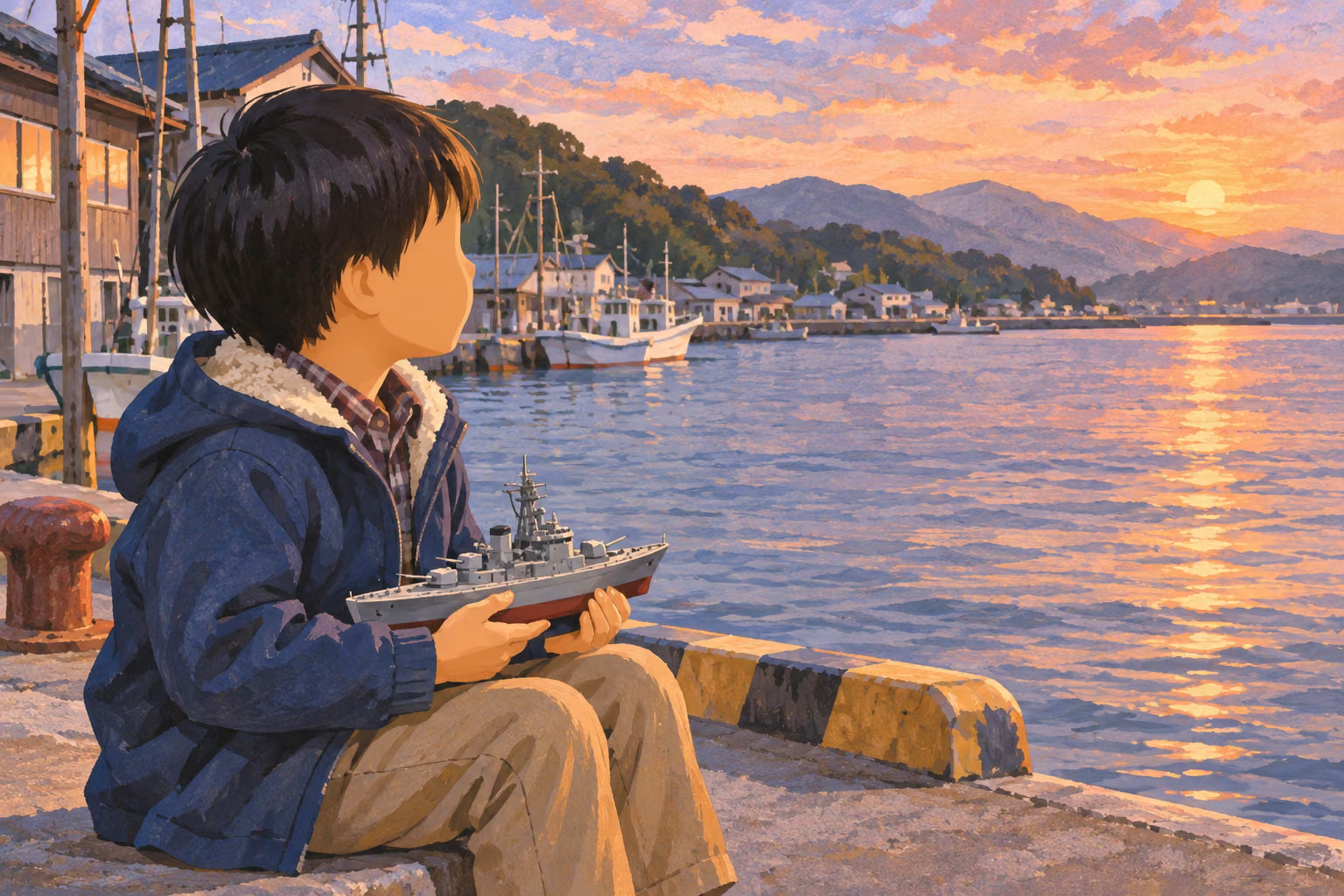
A real-life case · Japan, 2020
Takeharu’s reincarnation case
Takeharu is a boy from Hiroshima, Japan. At two, he played at sinking battleships in the bathtub. At three, he kept asking to see the Yamato, a Japanese warship sunk in 1945. When he was eight, a researcher gave him some tests to look for the man from the Yamato he said he had been.
It is one of the most recent cases published in a scientific journal, and his mother wrote down what he said for years. The researcher found a young officer from the Yamato who fit what the boy had pointed to. But the researcher himself says the identification is not conclusive. We tell it step by step and then look at what can be checked. If you only want the evidence, skip straight to what can be checked. Did Takeharu remember the life of a man who died on the Yamato?
Step 1
Around 2014 · Takeharu is two years old · Told by his family
A boy from Hiroshima plays at sinking battleships in the bathtub
Takeharu was born in May 2012 in Hiroshima, Japan. He is the third son of a dentist and a high school teacher. According to his parents, neither of them really believed in reincarnation, and they had no interest in anything military. Takeharu is the name given to him by the researcher who studied the case.
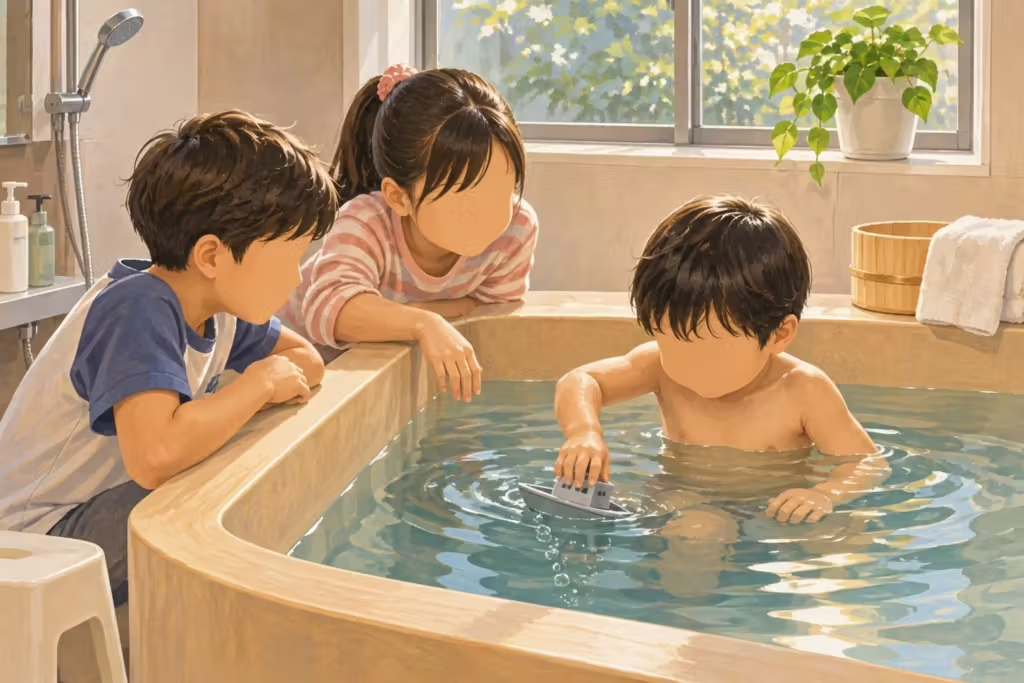
According to his family, at around two Takeharu didn’t want to take baths. When he did, he played at sinking battleships with his brothers. And he told his mother that this time he wouldn’t die before her.
The next year, he began to name a ship.
Step 2
2015 · Takeharu is three years old · Told by his family
At three, he asks again and again to see the Yamato
The Yamato was the largest battleship in the Japanese Navy. On April 7, 1945, on its way to Okinawa, it was sunk by American planes. Of about 3,300 men aboard, 269 survived.
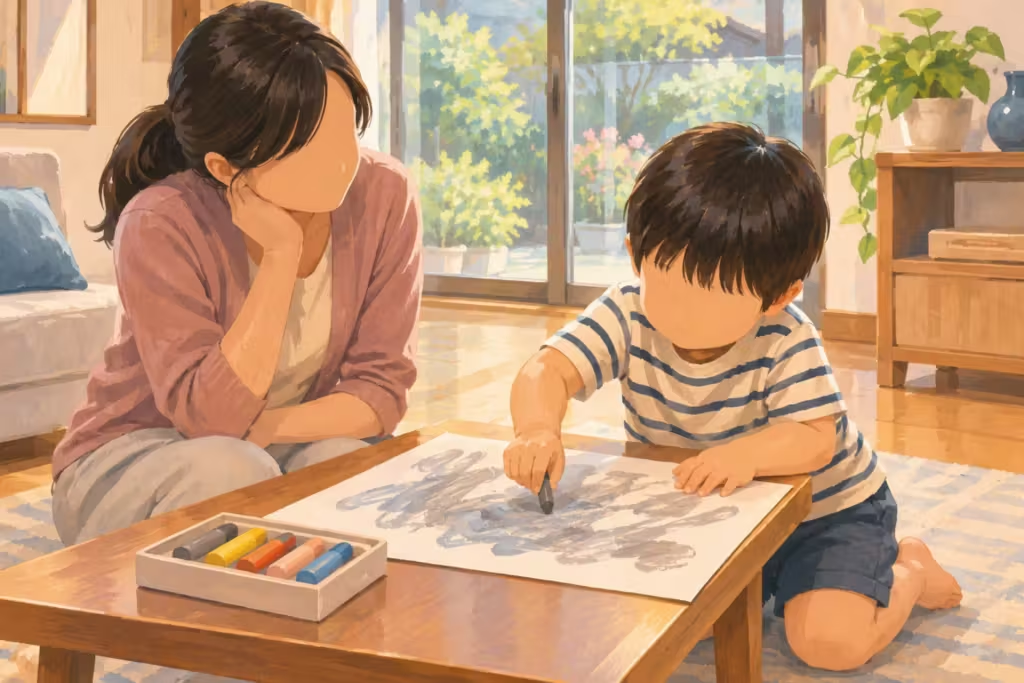
According to his family, at three Takeharu asked over and over to “see the Yamato.” On his third birthday, he made a drawing of blotches and lines. Some time later, the family thought it showed the Yamato being attacked by planes. When he was three or four, they took him for the first time to the Hiroshima Peace Memorial Museum, the museum about the atomic bomb. From then on, he asked to go back every August 6, the anniversary of the bomb.
At four, he began to give details.
Step 3
2016 and 2017 · Takeharu is four years old · Told by his parents
Takeharu tells how the ship sank, and makes a little booklet
According to his parents, at four Takeharu was afraid of swimming pools. He said the ship was attacked on the left side, that it exploded, and that he drowned. When he met a boy named Musashi at kindergarten, he started shouting that they were “brothers.” The Musashi was the Yamato’s sister ship.
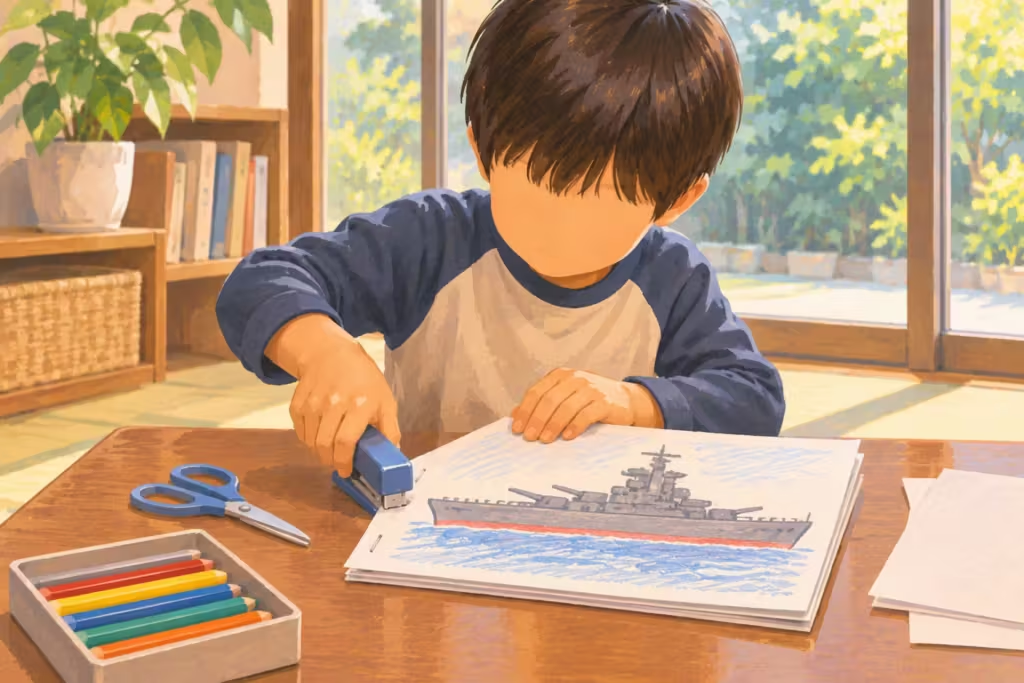
His father remembers something Takeharu said around that time, probably before he went to the Yamato museum. Takeharu told him the ship had six big guns in the front and three in the back, and that it carried aircraft. That is true. In January 2017, he made a six-page booklet with a title: “Battleship Yamato is Actually Alive.”
In April 2017, they took him to see the ship.
Step 4
April 29, 2017 · Takeharu is almost five · Told by his family
At the Yamato museum, the boy cries in front of the model: “The Yamato was much much bigger!”
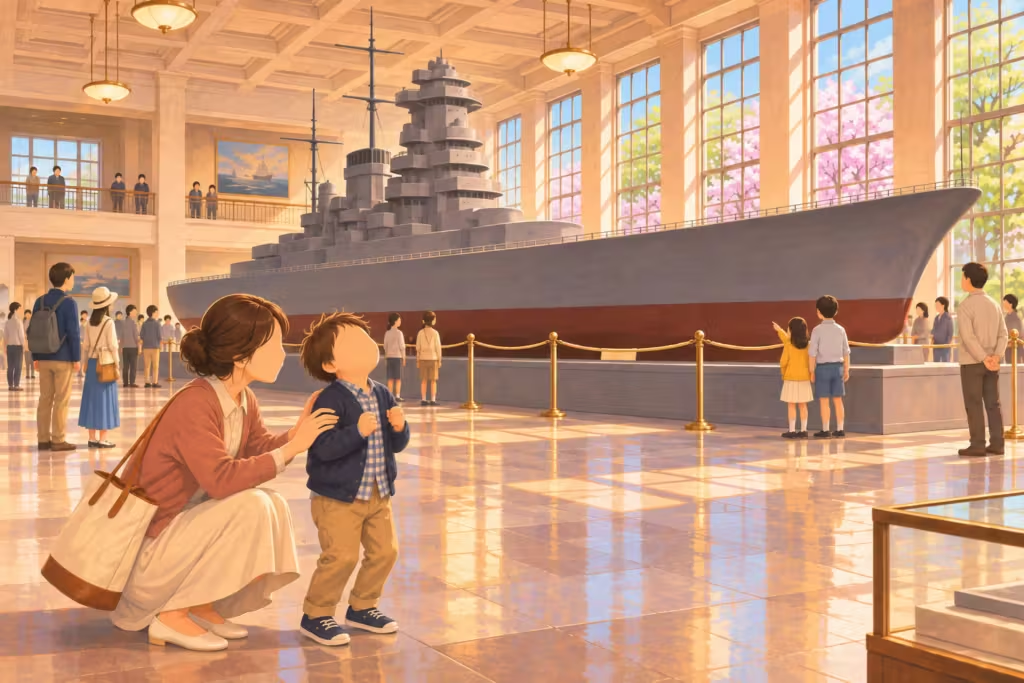
Half an hour from his home, in the city of Kure, there is a museum devoted to the Yamato, with a 26-meter model of the ship. According to his family, it was the first time Takeharu had seen an exhibition about the Yamato. In front of the model, he cried and shouted: “It’s a fake! The Yamato was much much bigger!”
That day they bought him a small model kit of the ship, and he put it together himself. For two years he played with it in the bathtub, pretending that planes were sinking it.
His mother began writing down what he said, with dates.
Step 5
2018 to 2019 · Takeharu is five to seven years old · From his mother’s diary
“I died at the age of 19”: what his mother writes down in a diary
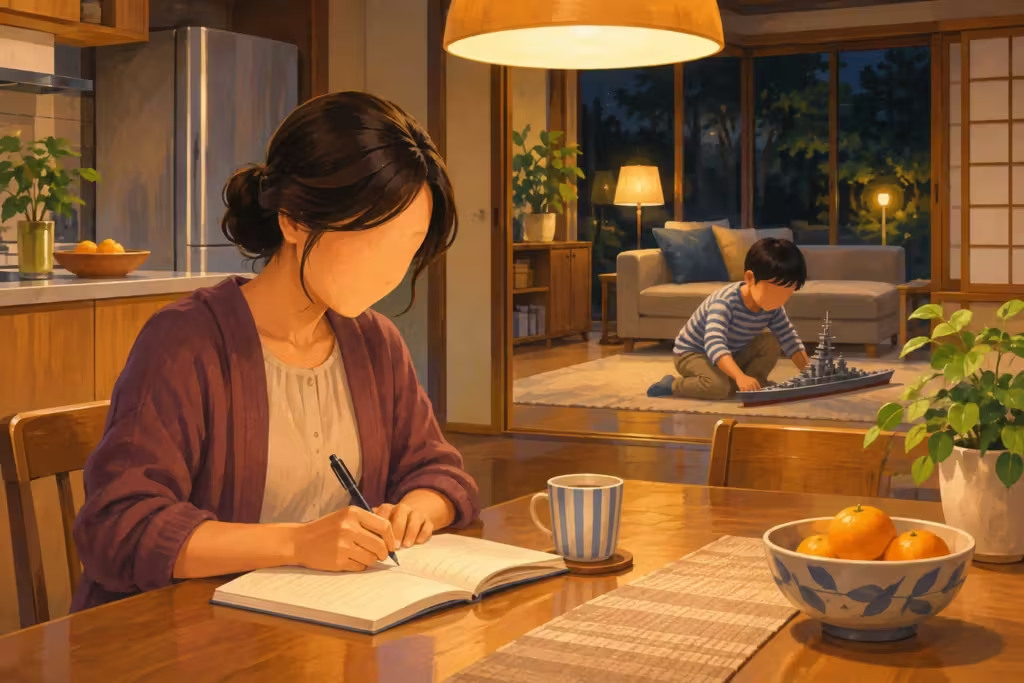
His mother kept a diary. The first statements with an exact date are from February 2018, almost a year after the museum visit. Takeharu said the Americans had killed him, and that the ship was on its way to Okinawa and was attacked on the port side, the left side.
On May 1, 2019, Japan changed emperors, and TV was talking about the era of each one. While watching, Takeharu said he had died at 19 and had been born in the first year of the Shōwa era. That year lasted only a week, at the end of 1926. The two statements don’t quite fit together, because someone born then was 18 in April 1945.
In November 2020, his mother looked for a researcher.
Step 6
November 2020 · Takeharu is eight years old · Told by the researcher Masayuki Ohkado
A researcher talks with the boy and looks for an officer
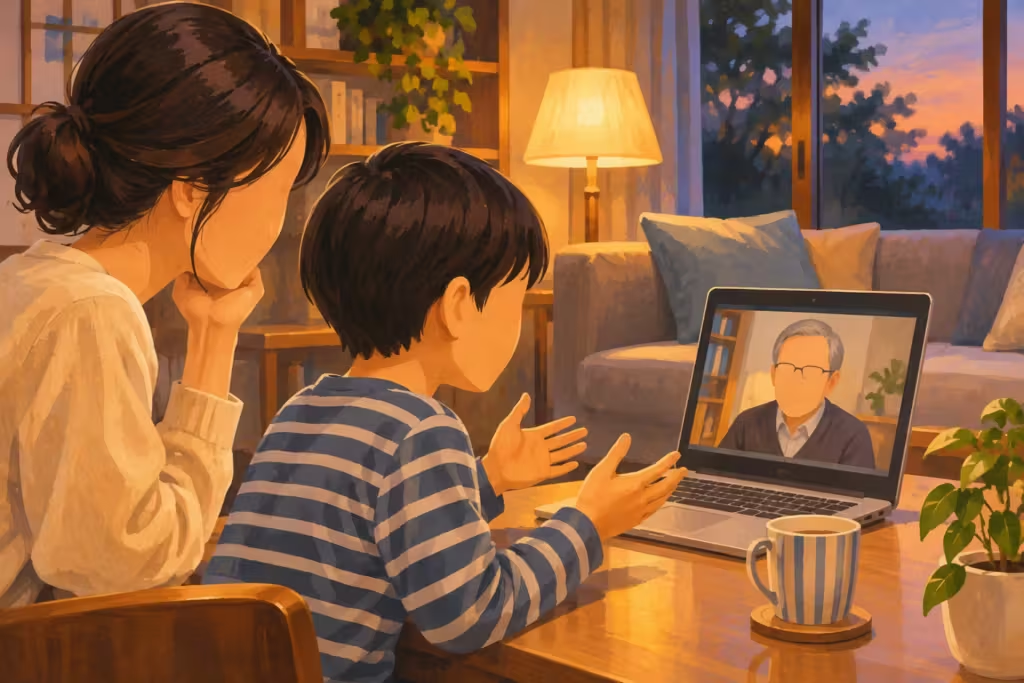
The mother searched online and wrote to Masayuki Ohkado, a linguist at Chubu University in Japan. Ohkado studies these cases and works with a group at the University of Virginia, in the United States, that has been investigating them since the 1960s. Ohkado believes in reincarnation and has said so publicly.
He talked with the boy by video call on November 29, 2020. According to Ohkado, Takeharu told him he had been in charge of some guns, not the main ones, toward the back of the ship. Ohkado says that, before the tests, the boy had also said he graduated from a school shortly before going aboard. That is why Ohkado searched among the young officers, who came from naval schools. Besides, there is almost no information on ordinary sailors.
Then came the tests.
Step 7
December 2020 to January 2021 · Told by Ohkado
Out of eight photos, the boy picks an officer from the Yamato
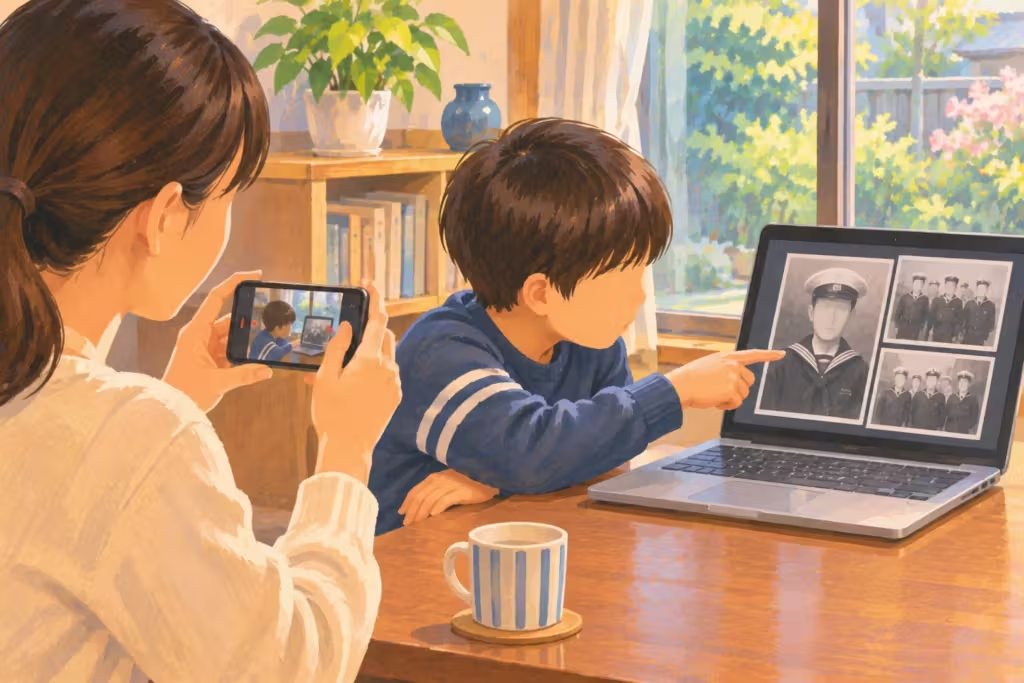
The mother gave him the tests at home and recorded them. First she played him the school songs of three naval schools, one after another, and the boy reacted to the last one, the Naval Academy’s. Ohkado then gathered the photos of the eight officers from one graduating class of that academy who died on April 7, 1945, in the battle in which the Yamato sank. Five were from the Yamato, two from the cruiser Yahagi, and one from another ship. The photos were shown to the boy on a computer screen. They were available online.
In the first two rounds, Takeharu didn’t pick any of them. In the third, with the photos enlarged, he picked one and said it was him. It was one of the five from the Yamato. Ohkado acknowledges that this very photo came up on the screen more times than the others, and that this may have influenced the boy. When they read him the eight names, he didn’t react to any of them.
In another test, with the school songs of four high schools, he remembered a word, “kenji,” that was in the song of the school that officer had attended. It is an old-fashioned word meaning “brave child,” and the boy said he remembered asking a teacher what it meant. And he pointed to another of the eight photos as a friend of his who had been on the Yahagi. It was one of the two from the Yahagi. Ohkado didn’t tell the family anything until January 25, 2021, after all the tests.
Ohkado published the case, but he didn’t give the officer’s name.
Step 8
2021 to 2023 · Told by Ohkado
The researcher publishes the case and calls it not conclusive
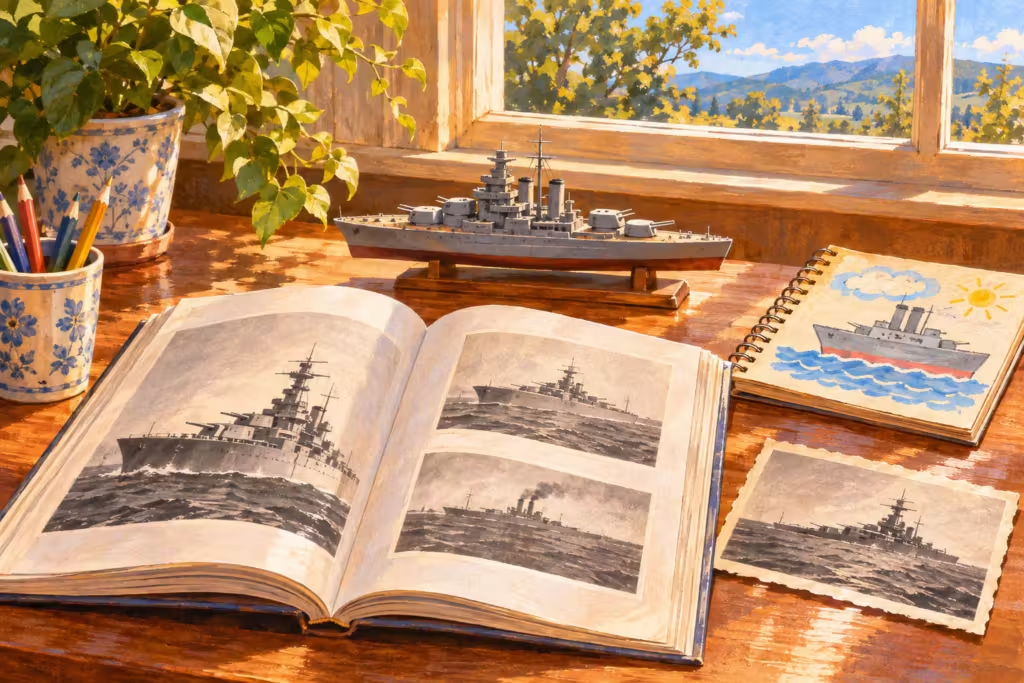
Ohkado published the case in a Japanese book in 2021 and in the scientific journal Explore in 2023. According to him, that officer appears in an alumni directory from 1965 and in a book from 2015. The book places him at the station that passed orders on to the secondary guns. Ohkado doesn’t publish his name, out of respect for the family. He says the identification “is not conclusive.”
Ohkado also notes what doesn’t fit. Takeharu said he wore a sailor suit, and officers didn’t wear one. Later he denied it. And the age he gave doesn’t match the officer’s, who was 20 or 21. According to Ohkado, the boy was happy to learn who he had been, even though he couldn’t meet his other family. His memories were fading.
That leaves the question from the beginning. Did Takeharu remember the life of an officer from the Yamato?
Frequently asked questions
Who is Takeharu, the boy who said he had died on the Yamato?
Takeharu is a Japanese boy born in 2012 in Hiroshima. From a young age, he said he had died on the battleship Yamato, sunk in 1945. The researcher Masayuki Ohkado studied his case and published it in 2023 in the journal Explore. Takeharu is the name Ohkado gives him.
What was the battleship Yamato?
The Yamato was the largest battleship in the Japanese Navy in World War II. It was sunk by American planes on April 7, 1945, on its way to Okinawa. Of about 3,300 men aboard, 269 survived.
Has Takeharu’s case been proven?
No. The boy picked out an officer from the Yamato in some photos. But the tests weren’t blind, and what had been written before didn’t identify anyone. The researcher himself says the identification is not conclusive. Here we explain what can be checked.
Where this story comes from
The study
- Masayuki Ohkado (2023), “A Japanese case of the reincarnation type with written records made before verifications: A child claiming to have fought on the battleship Yamato,” Explore, 19Read for free
The books and articles
- Masayuki Ohkado, Katsugoro and Other Reincarnation Cases in Japan (2024), chapter 5. It tells the case in more detail
- Masayuki Ohkado, “Japanese Children with Past-Life Memories,” Psi Encyclopedia, Society for Psychical ResearchRead
Learn more
- Reincarnation: the cases we have studiedRead
Our archive
- Our reading of Ohkado’s article and book, the Psi Encyclopedia, and two reports in the Japanese press, and the scoring against our five criteria, as of November 11, 2026
Keep reading
India, 1958
Swarnlata Mishra
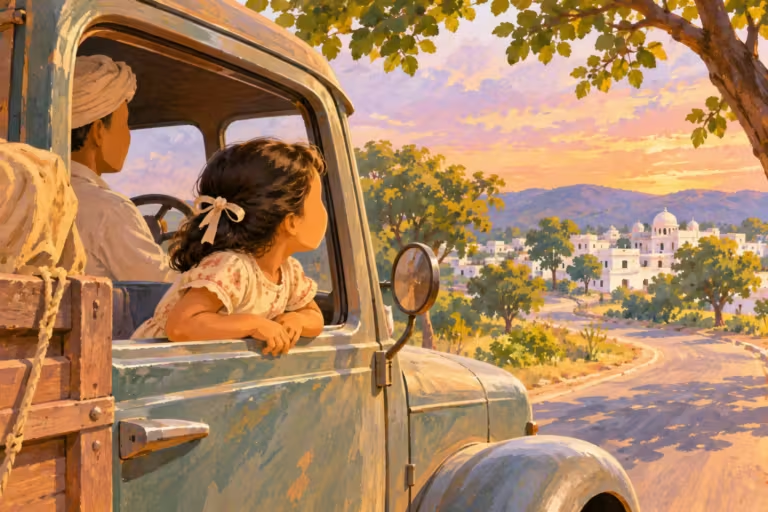
Swarnlata Mishra was three years old when she asked for the truck to turn toward “my house” in Katni, a city where she had never lived. Years later, a researcher wrote down how she described the house, went to Katni, and found it.

Sri Lanka, 1972
Sujith Jayaratne
Sujith Jayaratne was about two years old when he began saying that he was called “Gorakana Sammy” and that a lorry had run him over. A Buddhist monk wrote down what he said before checking it. In Gorakana he found the family of Sammy Fernando, who died that way in 1969.

Lebanon, 1964
Imad Elawar
Imad Elawar was five years old and talked about another life in Khriby, a village in the mountains of Lebanon. In 1964, Ian Stevenson wrote down what his family said and went with him to look for that person. It is Stevenson’s most famous case, and one of his most disputed.
Reincarnation: The top 5 people who remember past lives
We asked them the same five questions as this story. A 32-page PDF, free in your inbox.
Check your email
We have sent you an email. Open it and press the button to confirm. If you cannot see it, check your spam folder.