A real-life case · Sri Lanka, 1972
Sujith Jayaratne’s reincarnation case
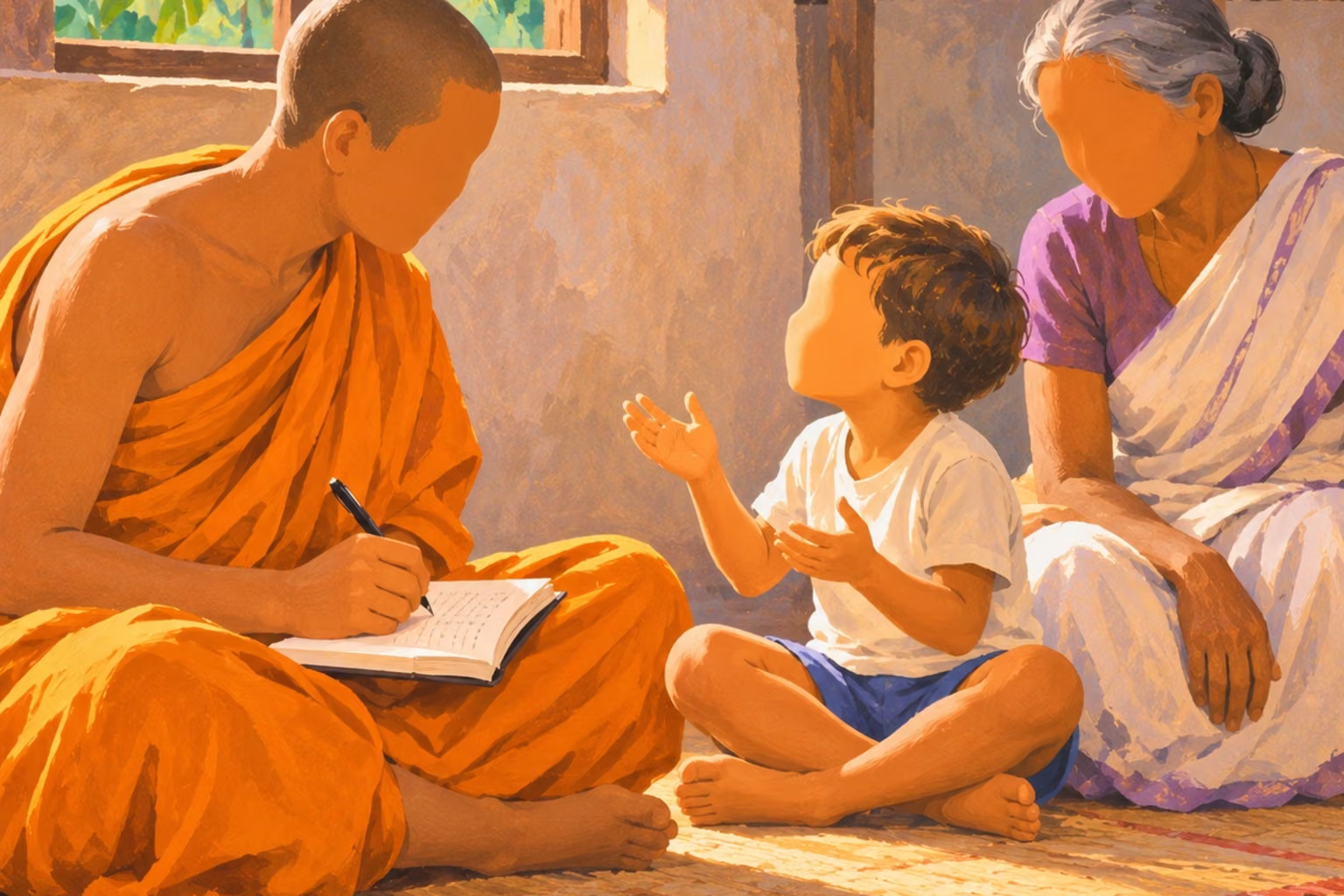
Sujith Jayaratne was about two years old when he began saying that in another life he was called “Gorakana Sammy” and that a lorry had killed him. A Buddhist monk wrote down what he said, with dates, and then went looking for that family. In Gorakana he found that a man named Sammy Fernando had died after being run over by a lorry six months before Sujith was born.
It is the third in our top 5 reincarnation cases. It has something almost no other case has. A monk who belonged to neither family wrote down what the boy said before checking anything. His notes are dated. Almost everything he wrote down turned out to be true. We tell it step by step and then look at what can be checked. If you only want the evidence, skip straight to what can be checked. Did Sujith remember the life of a man he never met?
Step 1
1970 · Sujith is eight months old · Told by his mother
A baby who only drinks his milk if he hears the word “lorry”
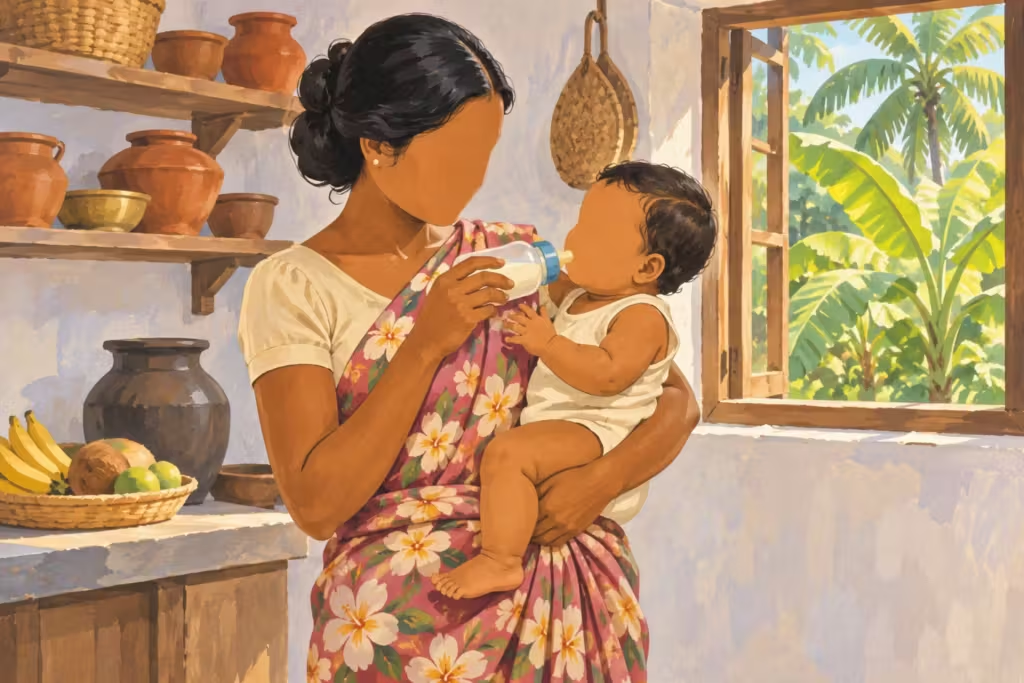
Sujith Lakmal Jayaratne was born on August 7, 1969, in Sri Lanka, near the capital, Colombo. His parents separated within a few months. Sujith stayed with his mother at his grandmother’s house in Mount Lavinia, a seaside city south of Colombo.
When Sujith was eight months old, his mother found something out by chance. One day the boy wouldn’t drink his milk. While talking to someone else, she said the word “lorry,” which is what a truck is called in Sri Lanka. Then the boy drank his milk. From then on, whenever he refused it, she said that word. According to his mother, it was the only way to get him to drink it. She thought the boy was afraid of lorries.
Soon after, Sujith began to talk.
Step 2
1971 · Sujith is about two years old · Told by his mother and his grandmother
Sujith says he was called “Gorakana Sammy” and that a lorry killed him
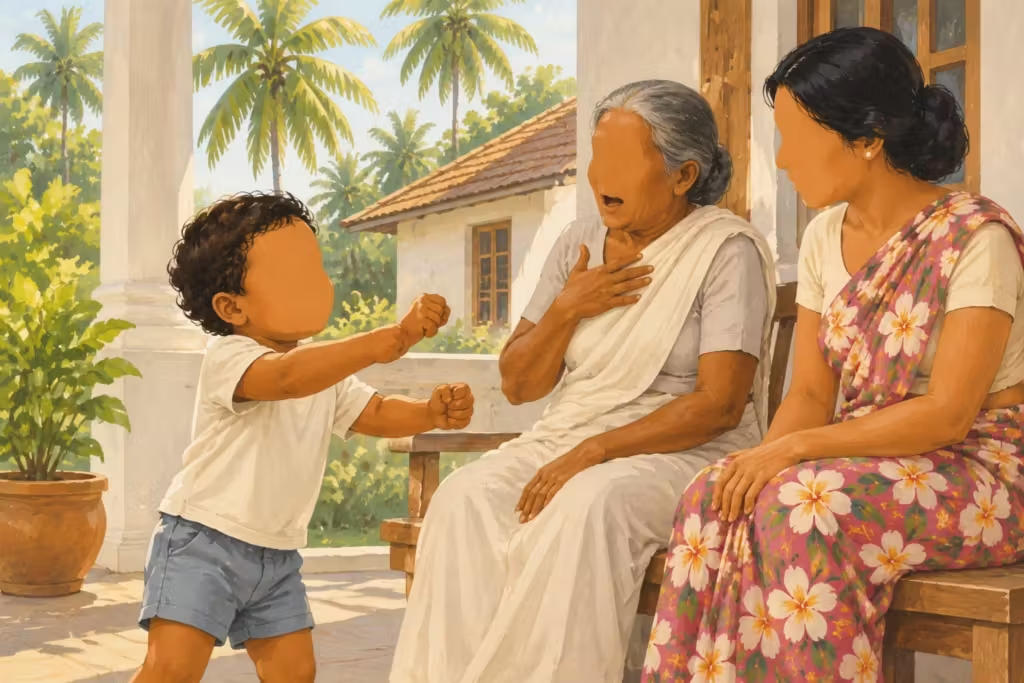
According to his mother and his grandmother, as soon as he began to speak in sentences, Sujith talked about another life. He said he lived in a place called Gorakana and that he was called “Gorakana Sammy.” He said his father was named Jamis and had a bad eye, and that he had a wife, Maggie, who he argued with.
He also said he had worked on the trains and sold arrack, a local liquor. One day he went to a shop to buy tobacco, stepped onto the road, and a lorry hit him. His grandmother gave two versions. In one, the boy also talked about an argument with Maggie just before. In the other, he didn’t. He still spoke very little, so he sometimes used noises and gestures. To say he had worked on the trains, he imitated the sound of a locomotive.
He asked to be taken to Gorakana, and he asked for arrack and cigarettes. His family didn’t know anyone in Gorakana and didn’t know whether any of it was true.
A great-uncle of the boy was a monk at a nearby temple.
Step 3
March 10 and 11, 1972 · Told by the notes of the monk Wattarappola Nandaratana
A monk writes down, with dates, what the boy says
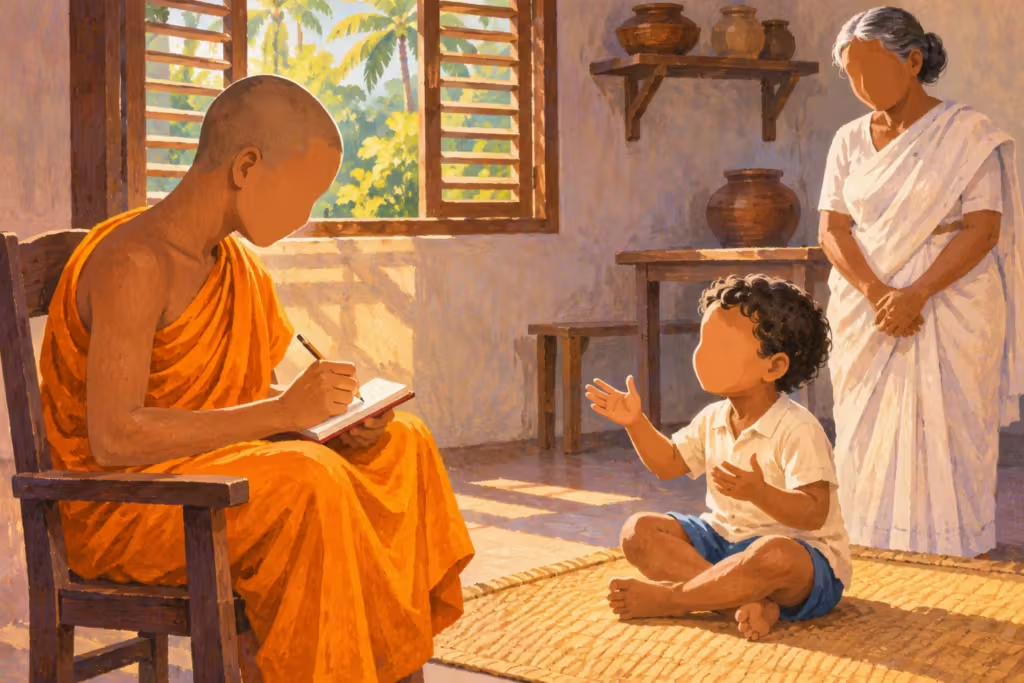
Sujith’s great-uncle heard the boy and told a younger monk at his temple, Wattarappola Nandaratana. This monk was not part of the family, and he wanted to check what Sujith said. On March 10 and 11, 1972, he talked with the boy and wrote down in his notes, with dates, 13 things he said.
Sujith said he lived in Gorakawatte, a part of Gorakana, and that his father, Jamis, was missing his right eye. He said that in that other life he gave money to a woman named Kusuma to cook him a dish of steamed dough. And he said he gave money to the Forest Temple, where two monks lived, and one was called Amitha.
On March 13, the monk went to Gorakana to look for that family.
Step 4
March 13 to 18, 1972 · Told by the monk’s notes and the psychiatrist Ian Stevenson
The monk goes to Gorakana and finds Sammy Fernando’s family

Gorakana is 12 kilometers south of Mount Lavinia. On March 13, the monk did not find the family. There he talked with a girl named Kusuma Dabare and told her some of the things the boy said. At that moment, she didn’t connect them with her family. The next day, the monk saw Sujith again and wrote down 3 more things. According to the monk, before checking anything, the boy also told him that his house had a tiled roof, and the monk did not write that down.
On March 15, Kusuma went to Mount Lavinia. She confirmed some of the things Sujith said and asked to meet him. The psychiatrist Ian Stevenson, who studied the case afterward, assumes Kusuma had talked it over with her own family beforehand.
Kusuma was the niece of Sammy Fernando, a man from Gorakana. The monk went back there on March 16 and 18, and said he had checked almost everything he had written down. He checked it alone, and it is not known who he talked to.
The monk now knew who Sammy Fernando had been.
Step 5
1919 to 1969 · Told by Sammy’s family and the police records
Sammy Fernando, the man a lorry ran over in 1969

Sammy Fernando was born in Gorakana in 1919. He was the eldest son of Jamis Fernando. He worked on the state railways until he was fired, around the age of 25. After that he made his living by secretly making arrack and selling it along the river by boat. The police arrested him eight times.
According to his family, Sammy drank heavily and became violent. When he argued with his wife, Maggie, she left the house and walked down the road, and sometimes he followed her. He was generous to the poor and to monks, and he gave money to his favorite niece, Kusuma.
On January 29, 1969, Sammy came home drunk and argued with Maggie. She went out onto the road and he went after her. He stopped at a shop to buy tobacco with his brother-in-law, stepped onto the road, and a lorry hit him. He died an hour or two later in the hospital. Stevenson checked the date in the police records.
Sujith was born six months later, 12 kilometers away. His mother said the pregnancy had lasted seven months.
The news spread through Gorakana, and the visits began.
Step 6
1972 to 1973 · Told by the monk, the families, and Ian Stevenson
The families meet, and Stevenson checks the case
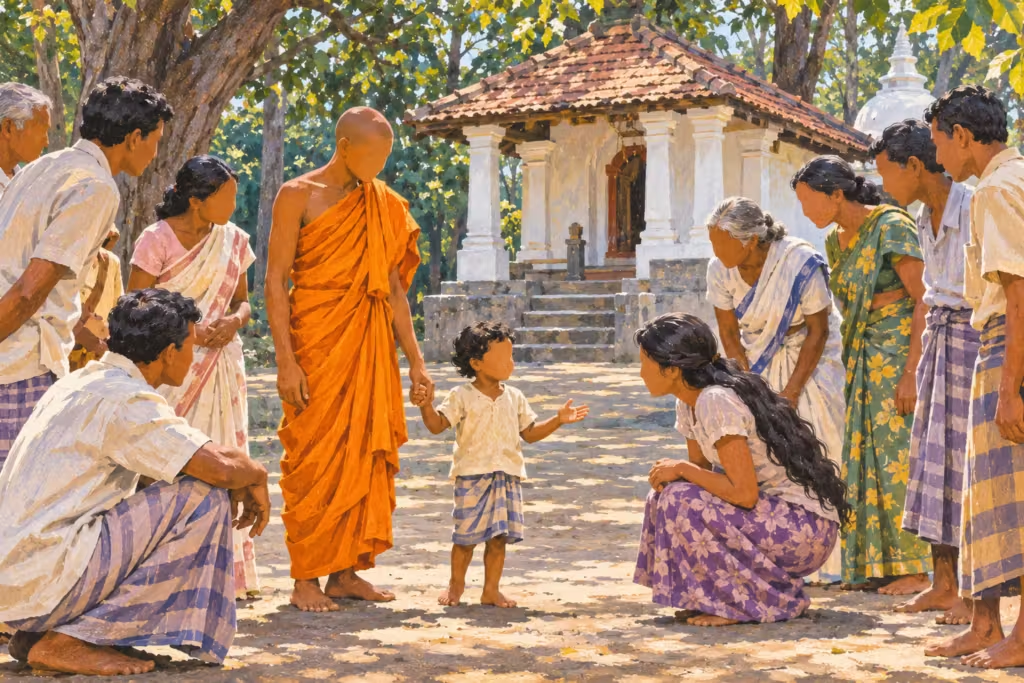
On March 30, Kusuma arrived in Mount Lavinia with ten people from Gorakana. Sujith got scared, clung to his mother, and said nothing. The next day she came back with only four, and according to the monk, Sujith called her by her name. In April, the monk took the boy to Gorakana, and the case appeared in the Sri Lankan newspapers.
Stevenson investigated the case in 1973 and saw the monk’s original notes. He checked that in a photo Jamis had a spot on his right eye. The neighborhood of Sammy’s parents used to be called Gorakawatte. And when Sammy was alive, two monks lived at the Forest Temple, and one was called Taldena Amithasara. That name, Forest Temple, had fallen out of use around 1910, except among older people.
Stevenson also found two people from Sujith’s neighborhood who knew Sammy. A former drinking companion of Sammy’s had lived less than 100 meters away since 1971 and sometimes came into the boy’s house. And one of Sammy’s sisters lived about 250 meters away. Both of them, and Sujith’s family, say they never talked about Sammy in front of the boy.
The question from the beginning remains. Did Sujith remember the life of Sammy Fernando?
Frequently asked questions
Who is Sujith Jayaratne?
Sujith Lakmal Jayaratne was born in Sri Lanka in 1969. At about age two, he began saying that in another life he was called “Gorakana Sammy” and that a lorry had killed him. A Buddhist monk wrote down what he said in 1972, and the psychiatrist Ian Stevenson published the case in 1977.
Who was Sammy Fernando?
Sammy Fernando was a man from Gorakana, in Sri Lanka, born in 1919. He worked on the trains and later made and sold arrack, a liquor. He died after being run over by a lorry on January 29, 1969, six months before Sujith was born.
Has the Sujith Jayaratne case been proven?
No. A monk wrote down what the boy said before checking it, and almost all of it fit Sammy’s life. But the same monk did the checking, and two people who knew Sammy lived near the boy. Here we explain what can be checked.
What did Ian Stevenson think of the Sujith Jayaratne case?
Stevenson wrote that this case is more reliable than most in one respect: almost everything the boy said, he said before the two families met. After talking with Sammy’s drinking companion, who lived near the boy, he thought it unlikely that Sujith knew about Sammy through him.
Where this story comes from
The books and the studies
- Ian Stevenson, Cases of the Reincarnation Type. Volume II: Ten Cases in Sri Lanka (1977). Sujith’s case is on pages 235 to 280
- H. H. Jürgen Keil and Jim B. Tucker (2005), “Children Who Claim to Remember Previous Lives: Cases with Written Records Made before the Previous Personality Was Identified,” Journal of Scientific Exploration
- Brooke Noel Moore, The Philosophical Possibilities Beyond Death (1981), pages 167 to 178. The critique of the case. We have not read it. We cite it from the summary by James Matlock, a researcher of these cases, in the Psi Encyclopedia, an encyclopedia on parapsychology, and from the one by Paul Edwards
- Paul Edwards, Reincarnation: A Critical Examination (1996), pages 258 and 259. He summarizes Moore’s critique, including the point about the length of the pregnancy
Learn more
- Reincarnation: the cases we have studiedRead
- Reincarnation: the top 5 people who remember past livesRead
Our archive
- Our reading of the case in the books by Stevenson and Edwards and in the article by Keil and Tucker, and the scoring against our five criteria, as of November 10, 2026
Keep reading
Sri Lanka, 1992
Chatura Karunaratne
Chatura Karunaratne was three years old when he began saying that in another life he was a soldier who was attacked in a truck. A national newspaper published what he said in June 1992. Then the father of a soldier who died in 1986 read the article and recognized his son.

Louisiana, United States, 2000
James Leininger
James Leininger was two years old when he began screaming in his sleep that a plane was going down in flames. His parents say he talked about a ship called “Natoma” and a pilot named Jack Larsen. In 2002 his father found a pilot who fit, James Huston, who died in 1945.
Japan, 2020
Takeharu
Takeharu was three years old when he began asking to be taken to see the Yamato, a Japanese battleship sunk in 1945. He said he had died on it. When he was eight, a researcher gave him some tests to look for that man.
Reincarnation: The top 5 people who remember past lives
We asked them the same five questions as this story. A 32-page PDF, free in your inbox.
Check your email
We have sent you an email. Open it and press the button to confirm. If you cannot see it, check your spam folder.