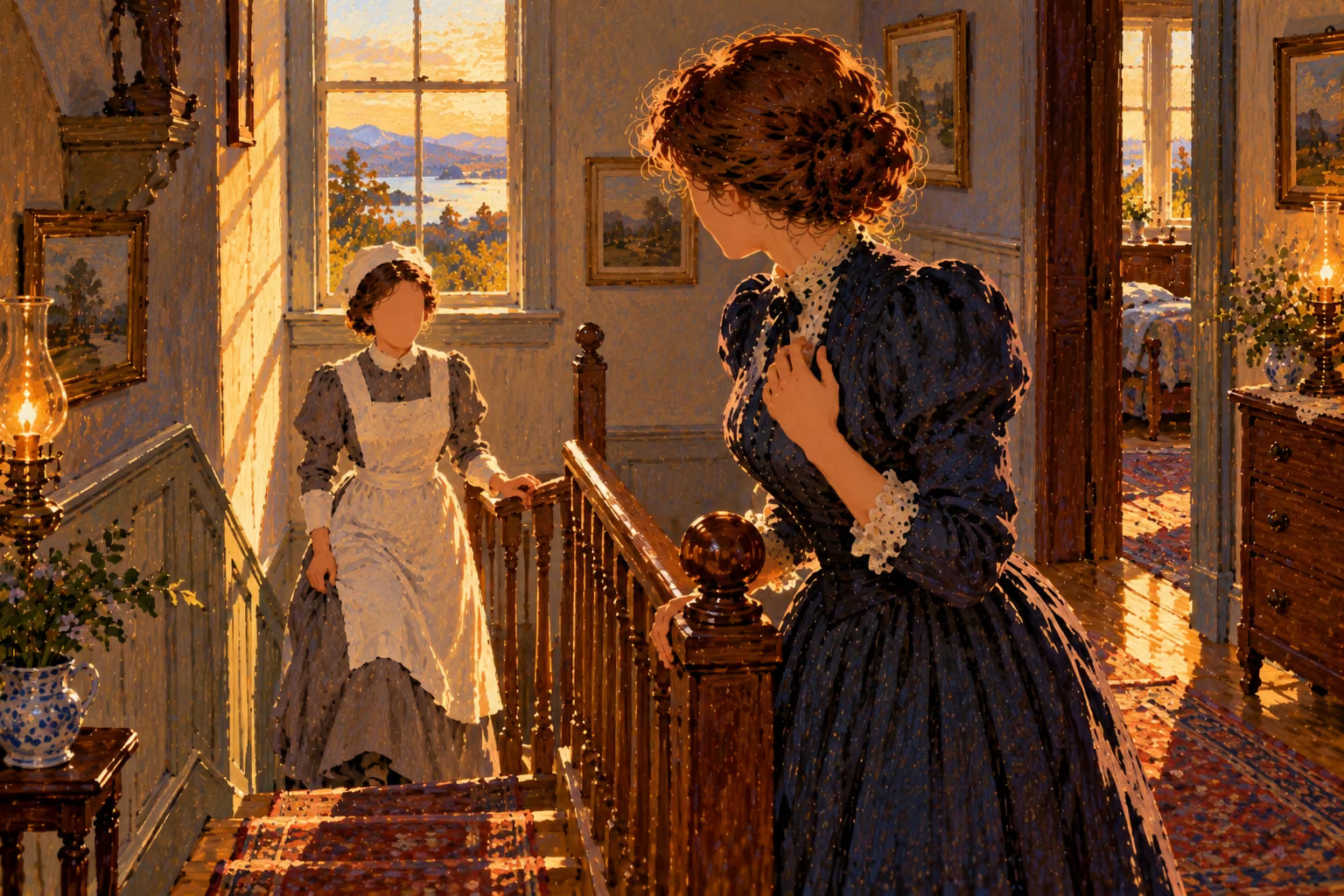
A real-life story · Tasmania, 1888
The evening Rose Hervey saw her cousin coming up the stairs, on the other side of the world: a shared-death experience
In April 1888, Rose Hervey was living in Tasmania, an island south of Australia. One evening she saw her cousin Ethel coming up the stairs of the house, dressed in gray. Ethel was a nurse in Dublin, on the other side of the world. Rose wrote it down in her diary that same evening. Ethel was ill with typhus, and she died about 32 hours later.
According to the Society for Psychical Research, which published it, this is one of the few cases of its time in which the note written that same day was kept. A researcher later saw the diary page, with the date and the time. The vision doesn’t match the death. It came more than a day earlier, when Ethel was already ill. We tell the story step by step and then look at what can be checked. How could Rose see her cousin from the other side of the world?
Step 1
1887 · Dublin and Tasmania · Rose Hervey’s account
Rose Hervey moves to Tasmania and leaves her cousin Ethel, her best friend, behind in Dublin

Rose Hervey and her cousin Ethel had lived together and were very close friends. Ethel was a nurse at a hospital in Dublin.
In 1887, Rose went to live in Tasmania, an island south of Australia. There she lived in the house of a friend, whom the journal that published the case calls only Lady H. Rose was 31.
A letter took weeks to get from Dublin to Tasmania.
Step 2
Saturday, April 21, 1888, between 6 and 7 in the evening · Tasmania · Rose Hervey’s account
As she crosses the landing, Rose sees her cousin Ethel coming up the stairs, dressed in gray
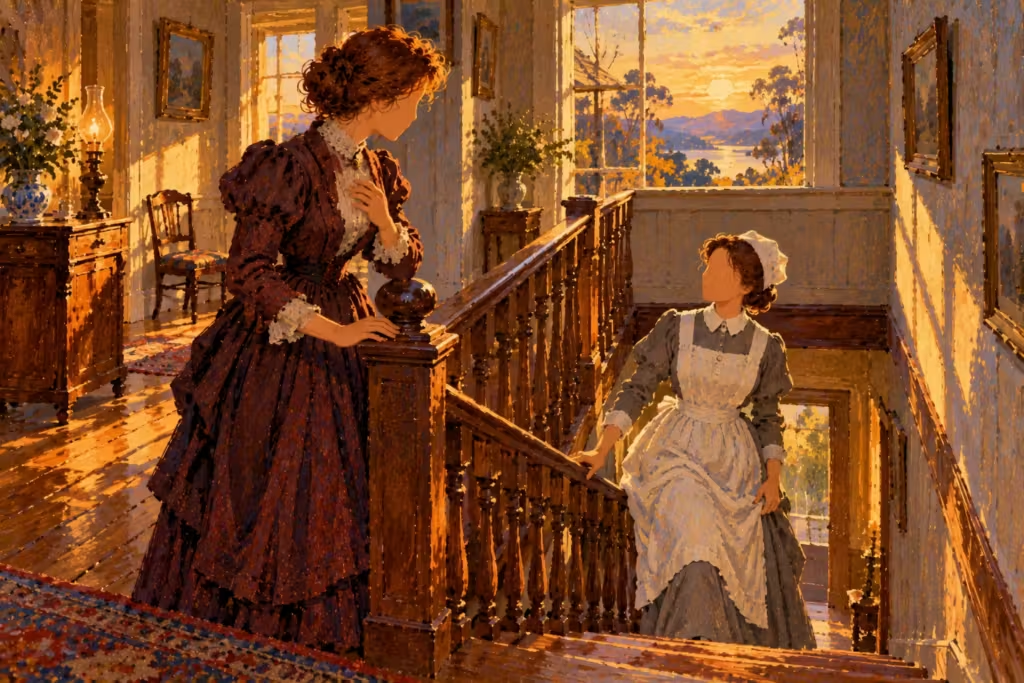
Rose had just come back from an outing with Lady H., and she was in very good health and spirits. She was about to cross the upstairs landing to have tea in Lady H.’s room.
As she passed the stairs, she saw her cousin Ethel coming up. She recognized her at once. Ethel was dressed in gray. No one else was with Rose.
Rose didn’t wait to see what would happen. She ran off to find Lady H.
Step 3
That same evening · Rose Hervey’s account
Lady H. laughs, but tells her to write it down in her diary, and Rose writes it down with the time
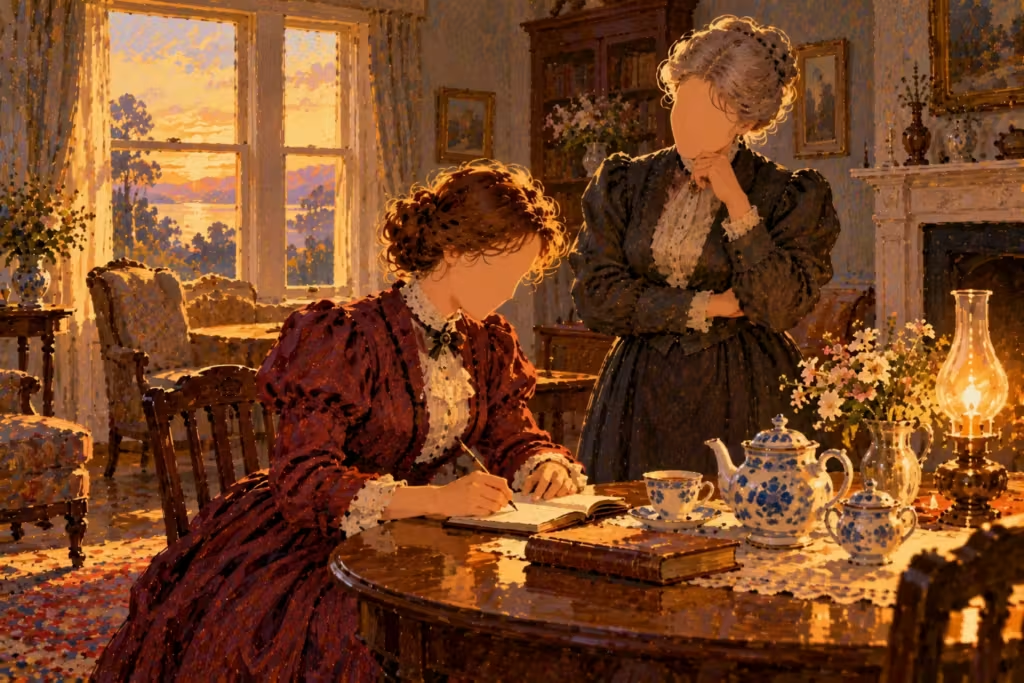
Rose told Lady H. what she had seen. Lady H. laughed at her, but told her to write it down in her diary. Rose wrote:
“Saturday, April 21st, 1888, 6 p.m. Vision of [Ethel] on landing in grey dress.”
Rose asked Lady H. why her cousin would be dressed in gray. Lady H. told her that was the uniform of the nurses at that hospital. Rose says she hadn’t known that.
That night, Rose wrote Ethel a long letter telling her about the vision.
Step 4
April 1888 · Dublin · According to a letter written in Dublin on the day of the death
In Dublin, Ethel has been ill with typhus for several days, and she dies the next day
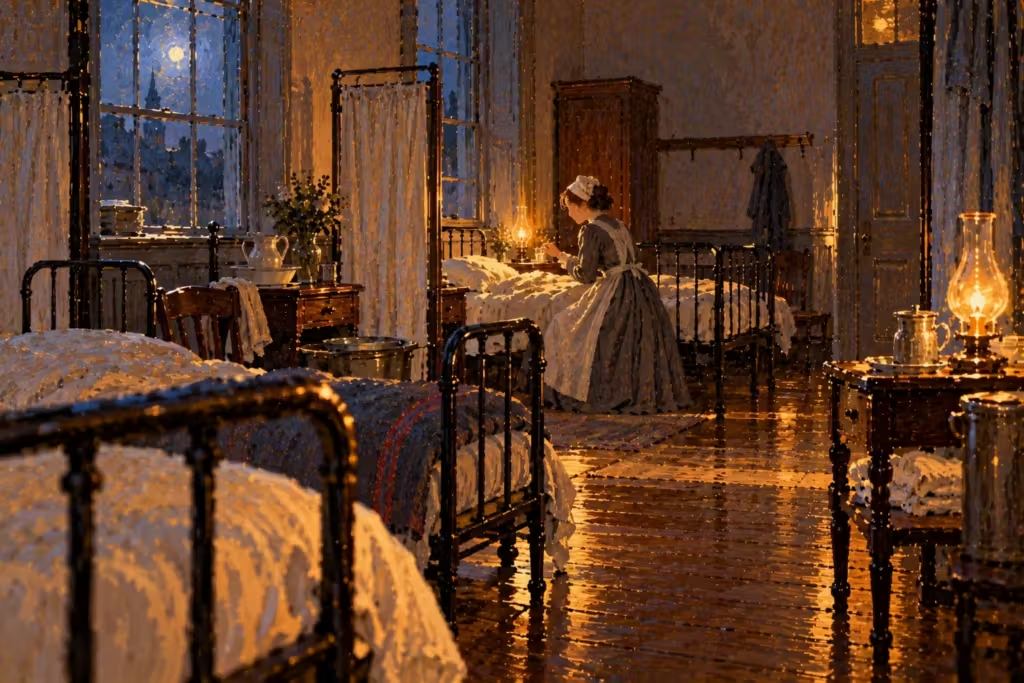
Meanwhile, in Dublin, Ethel was ill with typhus. Her illness lasted only five days. Her fever was very high the whole time.
On Sunday, April 22, at 4 in the morning, the crisis began. At around 10 in the morning she became much worse, and she died at half past four in the afternoon. Her family could not be with her.
Dublin and Tasmania are about ten hours apart. When it was 6 in the evening on Saturday in Tasmania, it was about 8 in the morning in Dublin. Rose saw her cousin about 32 hours before Ethel died, when she was already ill.
Rose knew nothing about the illness.
Step 5
June 1888 · Tasmania · Rose Hervey’s account
Six weeks later, the news of the illness and the news of the death arrive together

The news reached Tasmania in June, six weeks after the death. Rose learned at the same time that Ethel had been ill and that she had died.
The letter Rose had written to Ethel that night reached Dublin after Ethel had already died. It was sent back, and Rose tore it up.
The diary, however, Rose kept.
Step 6
1892 · London · The researcher Frank Podmore’s account
A researcher visits Rose in London and sees the diary page
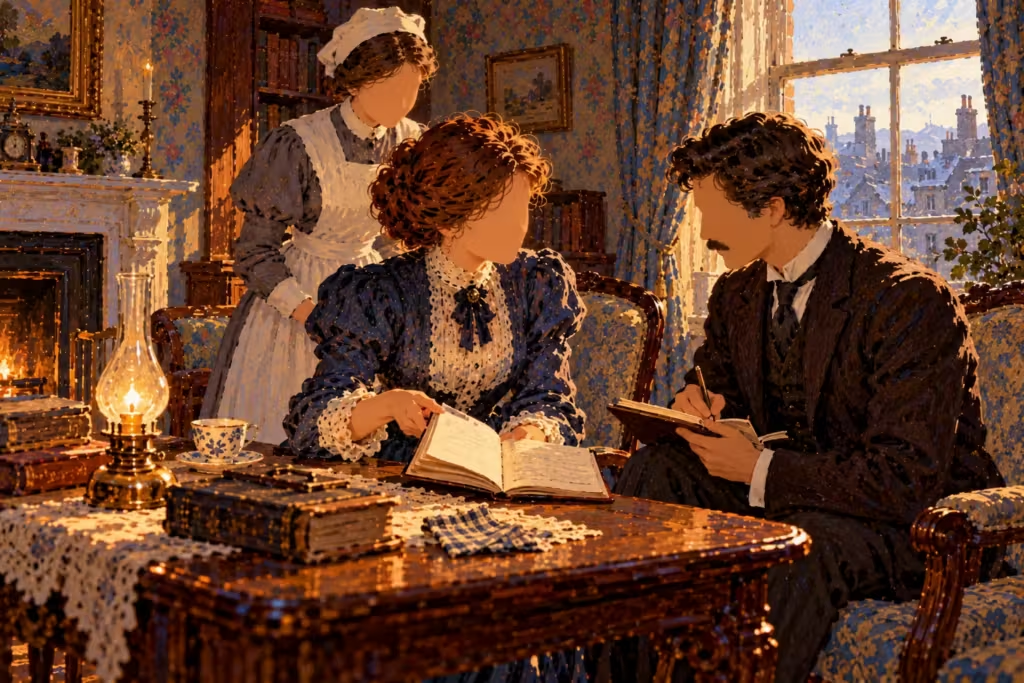
By 1892, Rose was living in London. That year she wrote her account for the Society for Psychical Research, a society in London that studied cases like this. One of its researchers, Frank Podmore, visited her and saw the diary page. He copied the entry. Below it was a note added later, with the date and time of the death.
The researchers also saw a copy of the letter that told how Ethel died. The letter was written in Dublin on the afternoon of Sunday, April 22, the same day as the death, and Rose had kept the copy.
They also examined a sample of the cloth of the nurses’ uniform at that hospital. It was a check of white, navy blue, and a little red, and from a distance it looked gray. The researchers concluded that the likeness in color had no value as evidence, because up close the cloth was not gray.
Next, they wrote to Lady H. to ask her to confirm it.
Step 7
1893 and 1894 · According to Lady H. and the Society for Psychical Research
Lady H. barely remembers it, and the Society publishes the case in 1894

In 1893, Lady H. replied. Her son remembered that Rose had spoken of the vision at the time. Lady H. said she remembered something, but nothing specific.
Rose told the researchers that at 14 she had had another vision, of an angel carrying a schoolmate in its arms. That vision would have coincided with the girl’s death. But it was already known that the girl was dying, and there is no way to confirm it. Rose had also heard voices several times. The researchers say that two of those times seemed to coincide with something real, although she didn’t think much of them.
The Society published the case in 1894, in its large study of visions, the Census of Hallucinations. The Census presents the case as one of the few in which the note taken at the time was kept.
The question remains: how could Rose see her cousin, ill in Dublin, from Tasmania?
Where this story comes from
Periodicals
- Henry Sidgwick and others (1894), “Report on the Census of Hallucinations,” Proceedings of the Society for Psychical Research, volume 10, pages 282-283, case 660.6Read for free
Case documents
- Rose Hervey’s account of April 28, 1892, published in the journal
- Her diary entry of April 21, 1888, copied by Frank Podmore on July 21, 1892
- The copy of the letter of April 22, 1888, about Ethel’s death, seen by the researchers
- Lady H.’s letter of July 30, 1893
Learn more
- The study: the 1894 Census of HallucinationsRead
- The captain’s voice: another experience written down in a diary before anything was knownRead
- More shared-death experiencesRead
Our archive
- Our full reading of the case and its scoring against our five criteria, as of October 28, 2026
Keep reading
United States, 1910
Sister Dorothy
In December 1910, Mrs. Sutton dreamed of her old teacher, Sister Dorothy, in a coffin. She believed the nun had already died, but the nun was alive and died eighteen days later.
New York, 1907
Boirac’s book
On the night of October 10, 1907, a New York woman dreamed of a French professor who was going to write something. She described it in a letter the next day. Months later, she wrote to him, and he replied that he was preparing a book and that he was in mourning.
England, 1908
The Rome Stock Exchange dream
In the early hours of January 1, 1908, a woman wrote down a dream of injured people and blood. In the morning, the newspaper reported an explosion at the Rome Stock Exchange, with about twenty injured.

Reincarnation: The top 5 people who remember past lives
We asked them the same five questions as this story. A 32-page PDF, free in your inbox.
Check your email
We have sent you an email. Open it and press the button to confirm. If you cannot see it, check your spam folder.