A study · Vienna (Austria), published in 2023
The Vienna study: 126 cardiac arrest survivors and a screen hidden above a bed
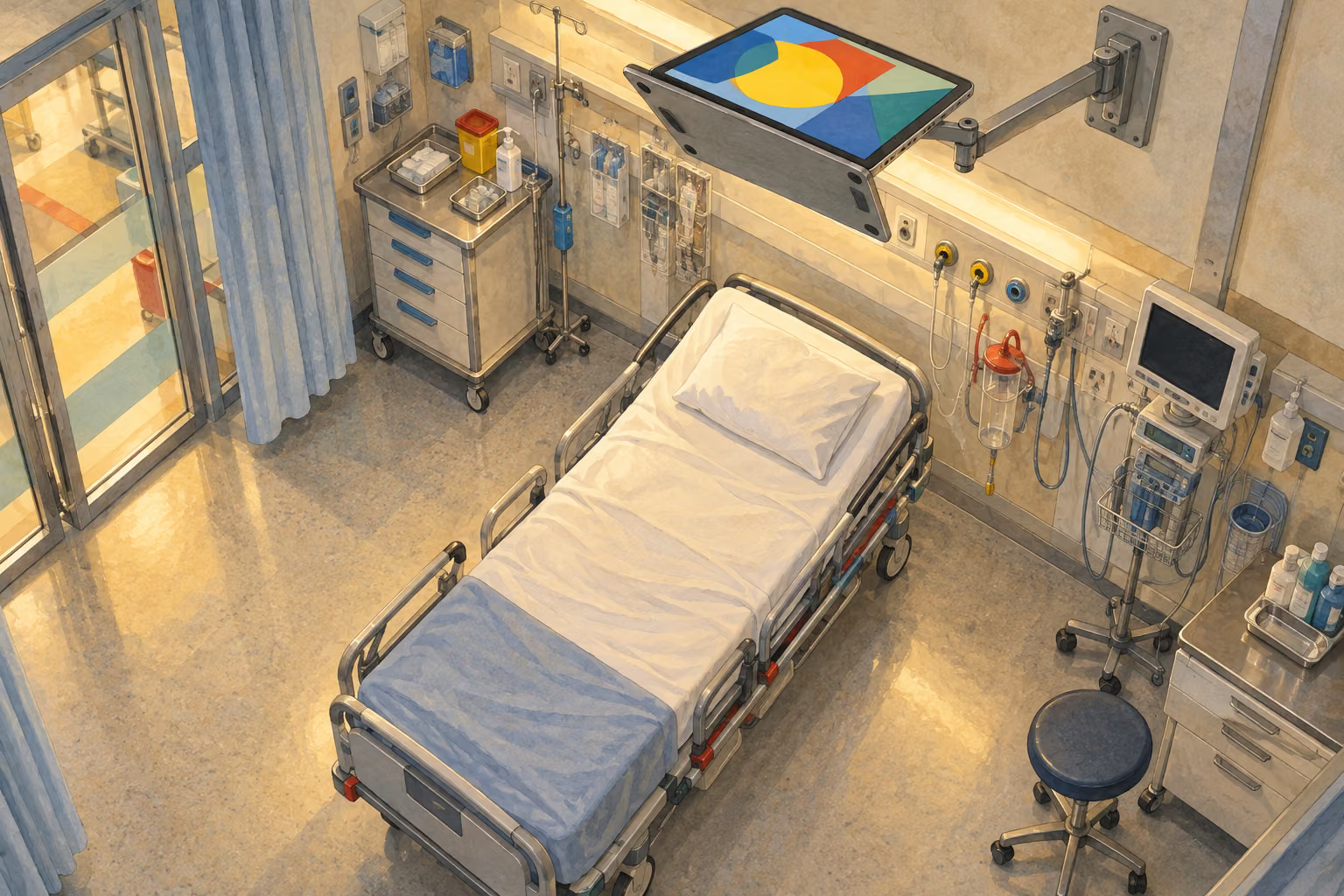
An emergency team at Vienna’s main hospital spent about eight years talking to people who survived a cardiac arrest. It asked them what they remembered. 126 people did the interview. A laptop sat above one of the beds, with its screen facing the ceiling. It showed images picked at random.
The authors wanted to know what these people remember when nobody mentions NDEs to them. They also wanted to know whether anyone who said they had left their body would see the image on the screen. The patients were never told the study was about NDEs. We go through it step by step. If you only want to know what it found, skip to the results.
Step 1
Before the study · The question
The study began as part of AWARE, with one new idea

Some people who have had an NDE say they saw themselves from above while they were being resuscitated. To test this, the AWARE study placed images on high shelves in hospitals in several countries. Those images could only be seen from the ceiling.
The Vienna hospital was one of them, but it changed one thing. Instead of paper images, it used a computer that picked them at random. That made it much harder for anyone to find out which image was showing.
The authors say they expected to find few cases. And they thought that if any turned up, there would be a natural explanation.
In the first year they did 23 interviews and found no interesting case. They carried on for seven more years on their own.
Step 2
About eight years, until 2021 · According to the study
The emergency department of a large Vienna hospital
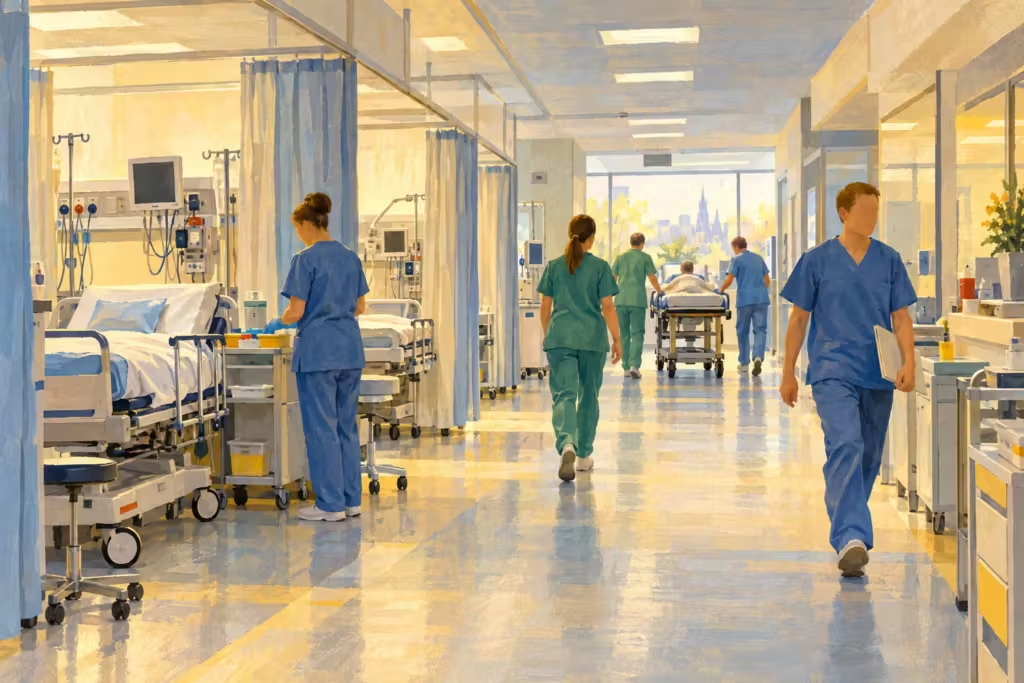
The study took place in the emergency department of the Medical University of Vienna, at the city’s General Hospital. It was funded by the Austrian Science Fund. It ended in 2021.
The study included people who came to the emergency department after a cardiac arrest and who had lost consciousness. These are the places where most of them had their arrest:
- At home: about 36 in 100.
- In a hospital: about 14 in 100.
- In the street: about 10 in 100.
- While playing sports: about 9 in 100.
The only people left out were those who couldn’t answer the questions and those who didn’t want to be interviewed.
126 people completed the interview. They were 91 men and 35 women. Their average age was 58.
Step 3
Throughout the study · According to the study
A screen facing the ceiling, with random images
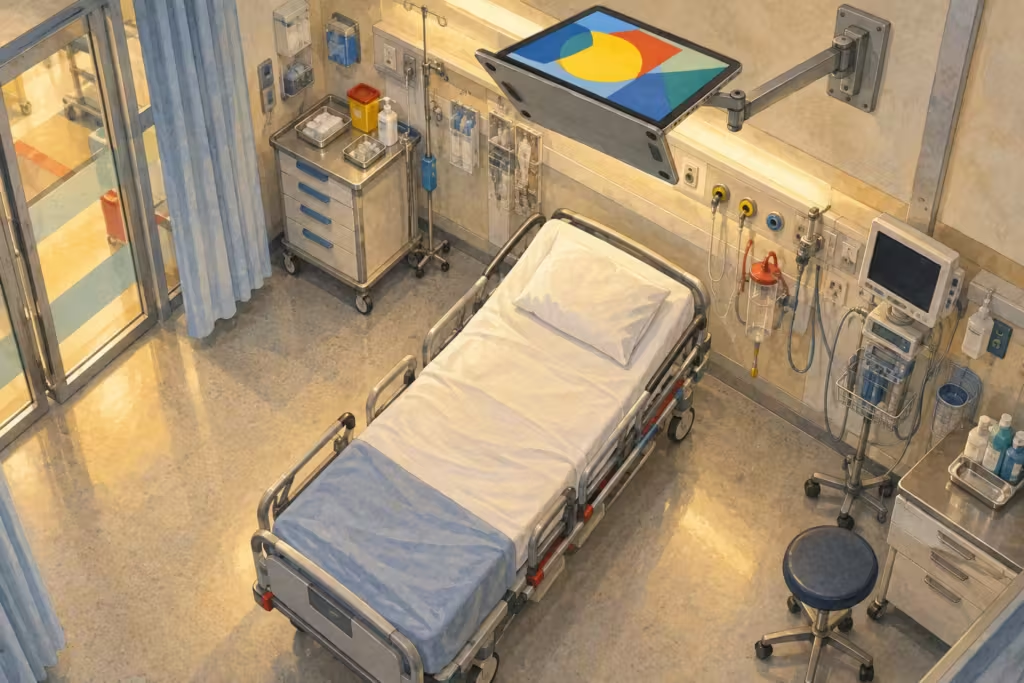
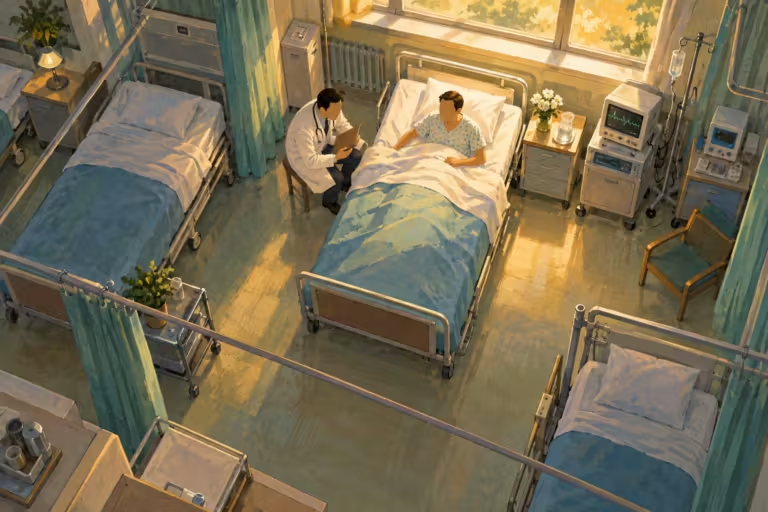
The team mounted a laptop above one emergency bed, 2 meters off the floor, with its screen facing the ceiling. It couldn’t be seen from the bed.
- It held 29 images. The screen showed one of them, chosen at random.
- Every few hours it switched to another, on no schedule anyone could predict.
- Nobody on the team knew which image was showing at any moment. Some had never even seen the images. One of them was the person who did the interviews.
- The computer kept a record of what it had shown and when. If anyone looked at that record, it left a trace.
The team agreed not to look at that record until the study was over.
It was a single screen, above a single bed. To put it to the test, someone’s cardiac arrest had to happen right underneath it.
Step 4
During a cardiac arrest · The heart isn’t pumping
A cardiac arrest, and then the cold
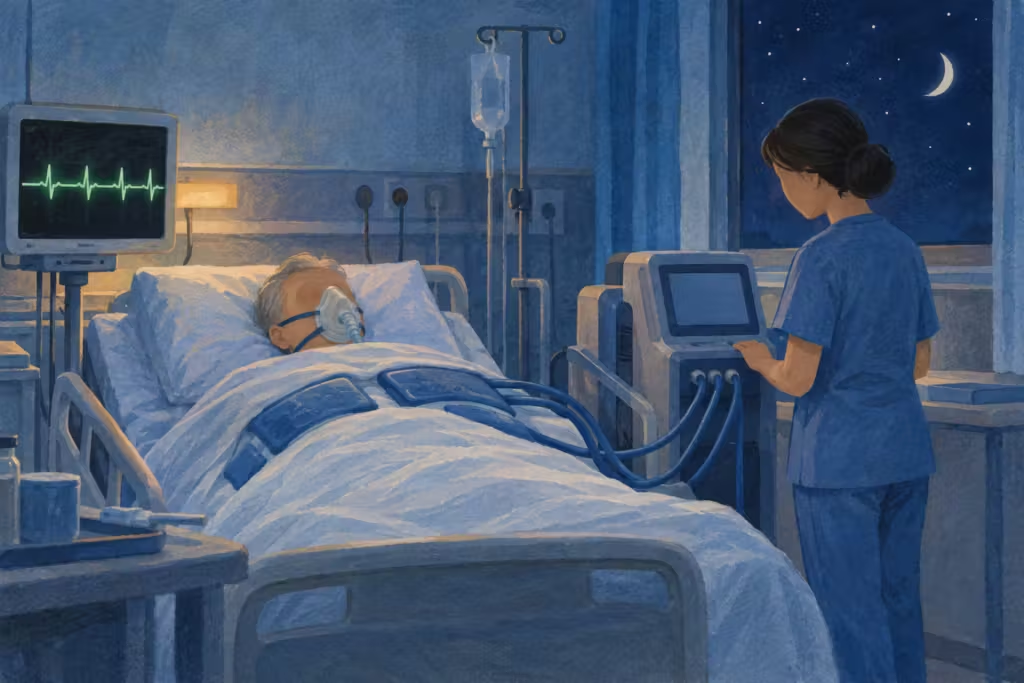
A cardiac arrest is when the heart stops pumping blood. The brain stops getting oxygen, and the person loses consciousness within seconds.
Many of these people had their arrest outside the hospital. Then they had at least one more in the emergency department.
Once the heart was beating again, doctors often cooled their body. They brought it down to 32–34 °C for 12 to 24 hours. It is a treatment to protect the brain.
When they had recovered and could talk, someone asked them for an interview.
Step 5
After the cardiac arrest · According to the study
An interview on “memory processes,” with no mention of NDEs
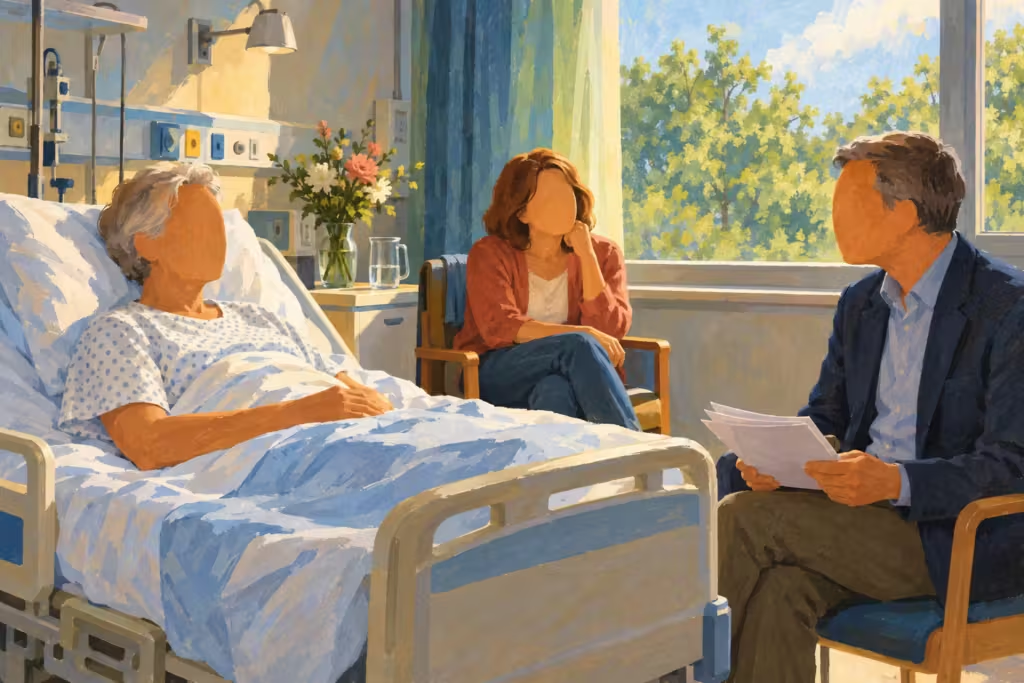
Michael Berger did the interviews. He used the AWARE questions, in German. Each interview took 20 to 30 minutes. (The patients’ words quoted on this page are the authors’ English translation.)
The patients were told the project’s title: “Memory processes in CA patients” (CA stands for cardiac arrest). Nobody ever mentioned NDEs to them.
They were asked about their life and their religion, the last thing they remembered before the arrest, the first thing they remembered on waking up, and their dreams. Near the end came the 16 questions of the scale devised by Bruce Greyson, an American psychiatrist. Each thing a person experienced adds points, for example peace, a light, seeing a relative who had died or leaving the body. 7 points or more counts as an NDE.
Finally, they were asked whether they had seen or heard anything similar on TV, on the radio, or in the newspapers.
- Some interviews took place a few days later, and others much later. The latest was 588 days after the arrest.
- When possible, a family member was present.
- 40 people they couldn’t reach were sent a short version of the interview by mail. Nine agreed.
Step 6
In the interviews · According to the study
Of 126 people, 20 described something in detail and 5 described an NDE
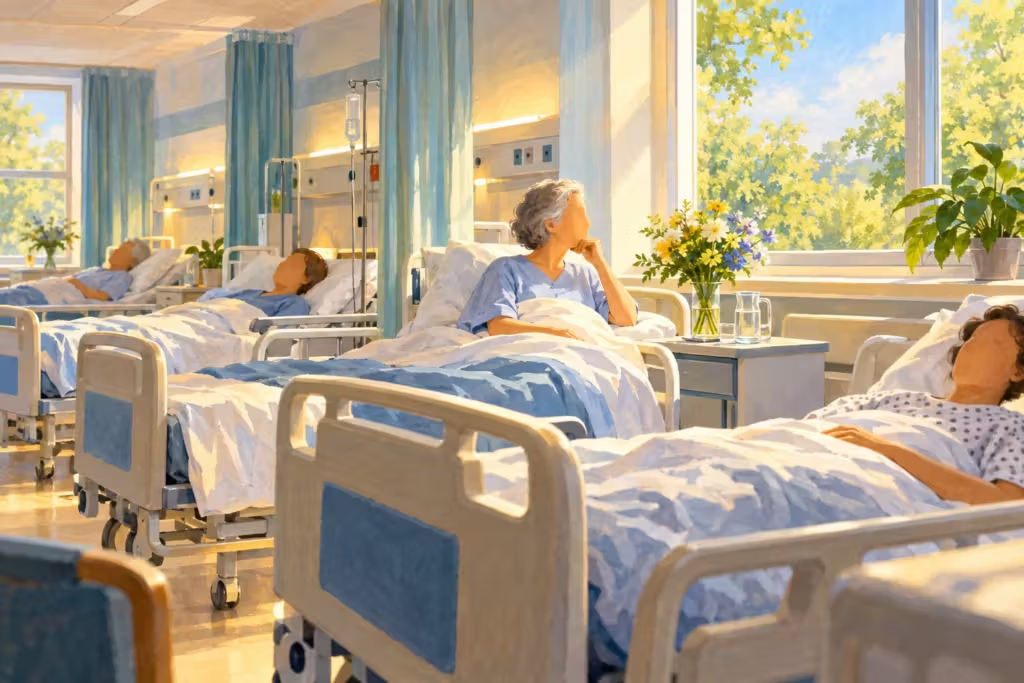
- 91 people said they remembered “nothing,” or that it was a “blackout.”
- 20 described a memory in detail. That is 16 in 100.
- 5 of those 20 reached 7 points or more. That is about 4 in 100.
Each dot stands for one person in 100. The 4 filled dots are those who described an NDE. That was 5 of the 126 people.
The paper doesn’t explain what the other 15 people said.
There is one detail about those 5 NDEs. Two of those people were never asked the 16 questions. The authors gave them points based on their account. If you count only the people who answered the scale, the number is 3.
The authors think the scale falls short, because it leaves out accounts that are very striking. That is why they studied all 20 people.
Step 7
Timing unknown · The patients’ accounts
What they describe: a father at the top of a stairway, a tunnel of colors
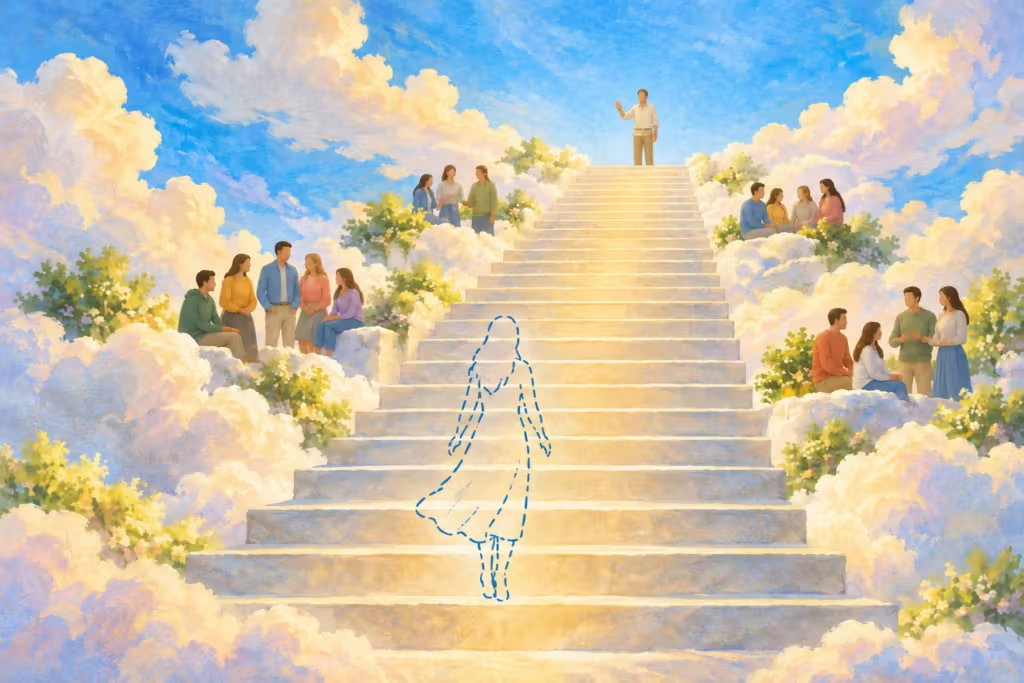
These are the accounts of the 5 people with an NDE:
- A 46-year-old woman, with 18 points. It was the highest score in the whole study. She was floating toward a stairway in the middle of a vast sky. At the top was her father, who had died 27 years earlier. Other people were there too, in a good mood. She began to go up, but her father sent her back, because it wasn’t her time yet. She said it didn’t feel like a dream. She had never heard of NDEs.
- A 68-year-old woman, with 7 points. She saw a bright light. She also saw her husband and her daughter, who had died. Her daughter let her know, without words, that she could go back to life.
- A 45-year-old man, with 9 points. At first he was floating in darkness, “full of love.” Then he felt uneasy. And suddenly a tunnel appeared, shining in every color. The tunnel pulled him along very fast. For a moment he saw the blue sky and some rooftops from above. Then he opened his eyes in the emergency department.
- A 47-year-old woman, with 8 points. She was in paradise, with Allah. Everything was fine and she was happy.
- A 59-year-old man, with 11 points. He was the only one who said he had left his body. His story is in step 10.
Another man, with 6 points, saw his mother and his aunt, who had died. They were dressed in white and laughing: “Fine that you’re here.” Then a woman’s voice spoke. It sounded like the voice of the person resuscitating him. The voice said: “No, no, he comes later.”
Three of the 20 people met relatives who had died.
Step 8
Timing unknown · The patients’ accounts
Not all were like that: dreams, a nightmare, two weeks of partying

Many of the 20 memories looked nothing like an NDE. Several were dreams from the days of recovery:
- A train racing down a hill in a spiral, very fast, toward a fork in the tracks.
- A god of death from Thai mythology, standing by the bed, waiting. He left without taking her.
- The top half of a head with eyes watching him. It had a silver plate connected to the ceiling by a tube. Next to it was a clock with running numbers.
- A man believed for two weeks that he was out in the countryside and that the hospital staff were his guests. He cooked and sang for them, without getting out of bed.
A 39-year-old woman had a nightmare: “bone men,” with bones in their hands, threatened her with death.
Every time she closed her eyes, they came closer to her bed. So she fought to keep them open. She never felt peace, and she didn’t like talking about it. On the Greyson scale she scored 0 points.
Step 9
August 2017 · According to the study
A meadow of pink flowers, and the screen
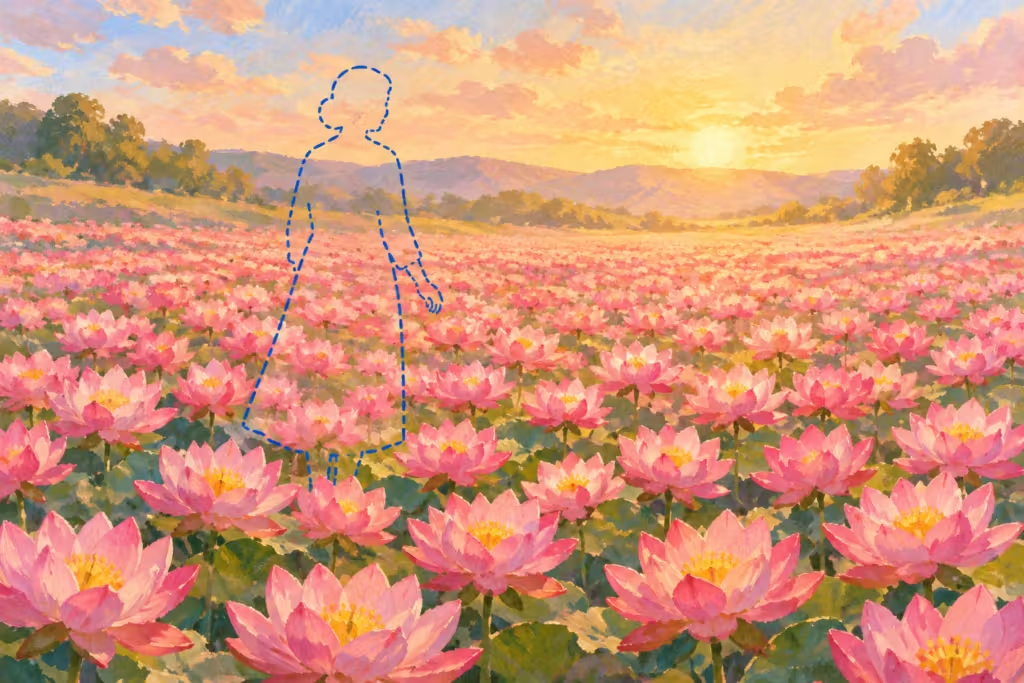
The screen showed image after image to the ceiling for more than five years. Nobody said anything that made the team think of it.
A 79-year-old woman had a cardiac arrest in late August 2017. It happened at night, on the hospital’s pulmonology ward. Resuscitation started within the first minute, and she was taken to the emergency department. She was put in the very bed with the screen.
Eighty-three days later, the woman was at home, with her husband present. There she said she remembered a beautiful meadow, with pink flowers that looked like water lilies, all the same size. When she saw them, she knew she would come back.
She said it was the first thing she saw “during waking up.” And she added: “It was great that the medical staff was capable to display it for me.”
The team suspected for the first and only time that someone was talking about one of their images. They waited until the study was over. In 2021 they looked at the computer’s record.
- Her cardiac arrest didn’t happen under the screen. It happened on another ward. Meanwhile, the image changed above the empty bed.
- None of the images shown while she was in that bed looked like her meadow.
She didn’t say she had left her body or seen the room. She described a meadow.
The authors write that this result vindicated the idea that consciousness depends only on the brain. But the screen could only be tested by someone who said they had seen it from above. And she didn’t say that.
Step 10
During surgery, at another hospital · The patient’s account
The only one who left his body wasn’t in that bed
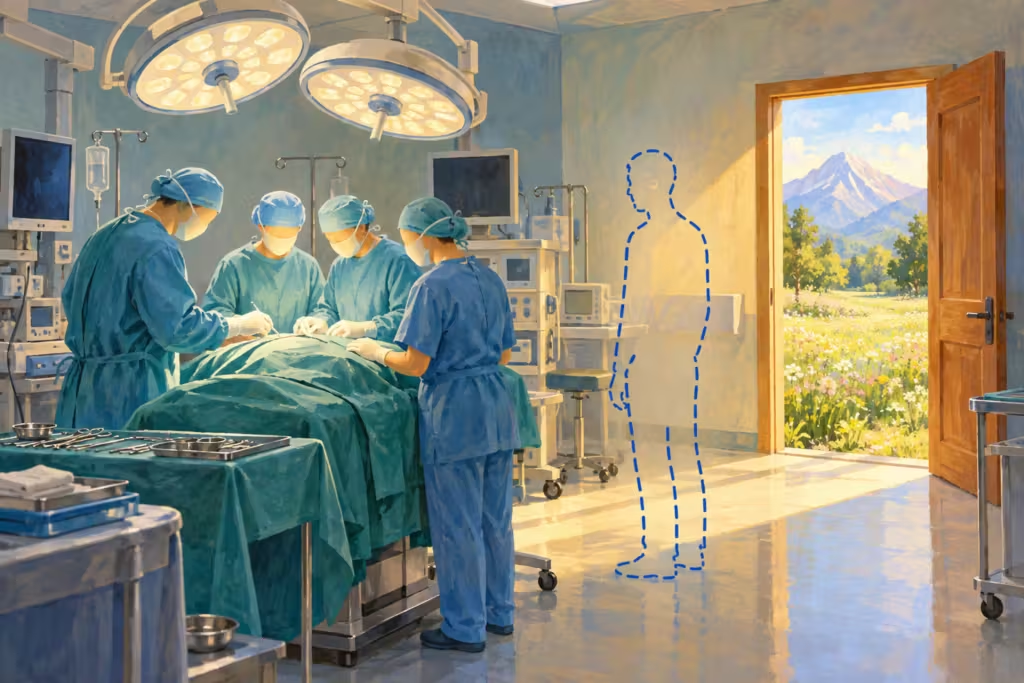
A 59-year-old man had his cardiac arrest during orthopedic surgery. It happened at another hospital in Vienna, Herz-Jesu. There was no screen there. He was interviewed 553 days later.
He said he was standing about a meter from the operating table, watching the scene. He heard the surgeon call his name 3 or 4 times. The surgeon was telling him to wake up, but he didn’t want to. A kind of “energy” led him to a meadow with flowers, beyond a garden gate. In the distance he saw a huge mountain. Then the same energy took him back to the operating room.
He was asked what the person lying on the table looked like, and he couldn’t say anything.
According to the authors, the surgeon and the staff later agreed that they had called his name that way. They don’t say who confirmed it or when. Doctors usually call someone by name as they wake up from surgery. And the paper doesn’t say whether he heard it during the arrest or as he was waking up.
This man didn’t believe in God before. Since then he has believed in a guiding energy.
Step 11
Comparing the data · According to the study
More memories when resuscitation started right away
The authors sorted people by how quickly their resuscitation started.
- Of the 20 with memories, 11 had resuscitation within the first minute, inside a hospital or clinic. That is 55 in 100.
- Of the other 106, only 23 in 100 did.
The authors think that when oxygen-rich blood reaches the brain early, some areas wake up before others. If they wake up without working together, a person might feel outside their body. And the most important memories, such as those of a relative who has died, would be the first to come back.
The 5 NDEs don’t show the same thing. Only one of them had resuscitation within the first minute.
Three had it within a few minutes. For the last one, it isn’t known. These data are in the table the study published separately. With only 5 people, it may be chance. This finding neither confirms nor contradicts the authors’ idea.
They found two more things:
- Those who remembered something took longer to get their everyday memory back: 10 of the 20 needed more than 2 days. Of the other 106, 19 needed that long.
- Memories turned up somewhat more often when the interview took place a long time afterward than when it took place soon.
Step 12
At the end of the interview · According to the study
Knowing about NDEs from TV didn’t change the results, and some people changed their minds about an afterlife

Nearly two in three people in the study knew about NDEs from TV, the radio, or the newspapers. Among the 20 with memories, the proportion was the same: 13 knew about them and 4 didn’t.
The woman with the highest score in the whole study scored 18. She had never heard of them. She started searching the internet after her experience.
They were also asked whether they would have answered the same way about religion before their cardiac arrest.
- 91 people said yes.
- 16 changed their minds.
- 4 of them came to believe there is nothing after death. They thought that if there were something, they would have noticed.
- Others went from doubting to being sure there is an afterlife. All of them had memories of the arrest, and three of them had had an NDE.
Step 13
March 2023 · According to the authors
The study is published and finds fewer NDEs than other studies

The paper was published in March 2023 in the Journal of Clinical Medicine. It is free to read.
The authors compare their figure with those of other studies. Those studies asked cardiac arrest survivors in hospitals. In them, NDEs ranged from 6 to 9 in 100:
- Southampton (2001): 4 of 63, about 6 in 100.
- Van Lommel (2001): about 7 in 100. The Vienna authors count only the deep NDEs: 23 of 344.
- AWARE (2014): 9 of 101, about 9 in 100.
- Vienna: 5 of 126, about 4 in 100.
The authors give two possible reasons. The figure may vary from place to place. Or fewer NDEs may come up because NDEs were not mentioned when the study was introduced.
At the end, the authors write that it will soon be possible to measure the brain during resuscitation. For that, sensors are needed that are easy to attach and don’t get in the way of those trying to save the patient.
From 126 people to no test of the screen
The study lasted about eight years, but it had a single screen, above a single bed.
So its figures show what people remember when nobody mentions NDEs to them. But they don’t show whether anyone sees from above.
| Stage | People |
|---|---|
| Survived a cardiac arrest and were interviewed | 126 |
| Said “nothing” or “blackout” | 91 |
| Described a memory in detail | 20 |
| Described an NDE, with 7 points or more | 5 |
| Said they left their body | 1 |
| Had their cardiac arrest under the screen | 0 |
| Named an image on the screen correctly | 0 |
What these figures don’t tell you
- The figure of 4 in 100 only counts those who could talk. The total number of cardiac arrests isn’t known. More in How many people have a near-death experience?
- Nobody got the image on the screen right, but that isn’t a failure. Nobody had their arrest underneath it and said they saw it.
- In two of the 5 NDEs, the authors gave the points, without asking the questions. More in What does science say about near-death experiences?
Where this page comes from
The study
- Fritz Sterz, Michael L. Berger, Gerhard Ruzicka, and Roland Beisteiner (2023), “Lapses of the Heart: Frequency and Subjective Salience of Impressions Reported by Patients after Cardiac Arrest,” Journal of Clinical Medicine 12(5):1968Read for free
- The paper’s supplementary material: the data table for the 126 people and the accounts of the 20 who remembered somethingView for free
To understand more
- The AWARE study: the images hidden on the shelvesRead
- The AWARE II study: a random image and the brain on screenRead
- The Southampton study: 63 cardiac arrest survivors and boards on the ceilingRead
- The van Lommel study: 344 cardiac arrest survivors in ten hospitalsRead
- What does science say about near-death experiences?Read
- How many people have a near-death experience?Read
Our archive
- Our reading of the full paper and its supplementary material, with the table of the 126 people and the 20 accounts, as of October 13, 2026
More studies
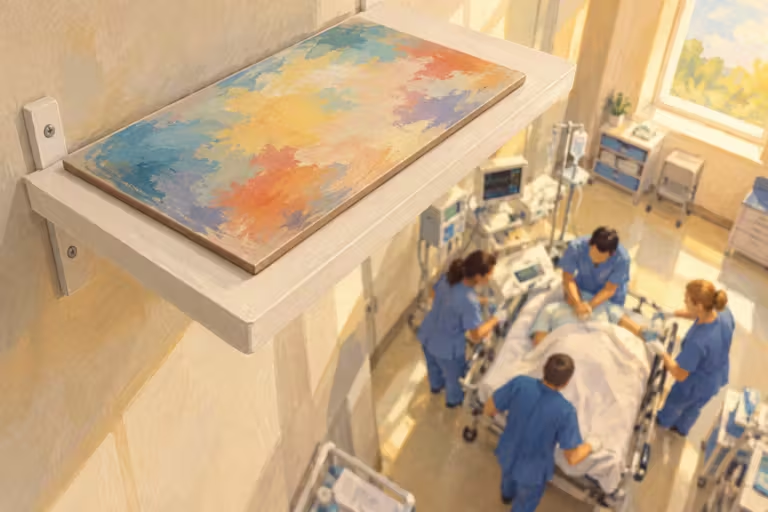
AWARE: the pictures hidden on the shelves
Fifteen hospitals put up pictures that could only be seen from the ceiling, to check whether anyone saw them during a cardiac arrest.
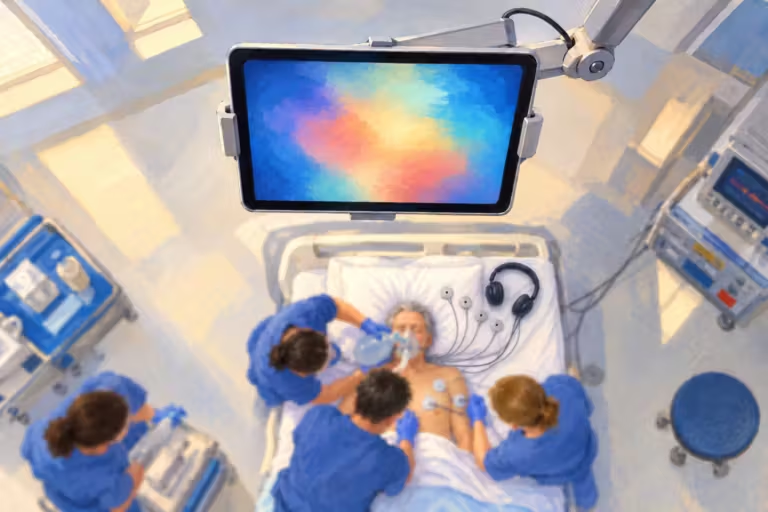
AWARE II: a random picture and the brain on the screen
Above the patient was a tablet with a random picture. Headphones said the names of three fruits. And the doctors measured the brain during resuscitation.
Van Lommel: 344 cardiac arrest survivors in ten hospitals
Ten hospitals asked every cardiac arrest survivor what they remembered. They saw them again after 2 and 8 years.