A real-life story · London, 1882
The night a man felt that someone in his friend’s family had died, and wrote it down with the time
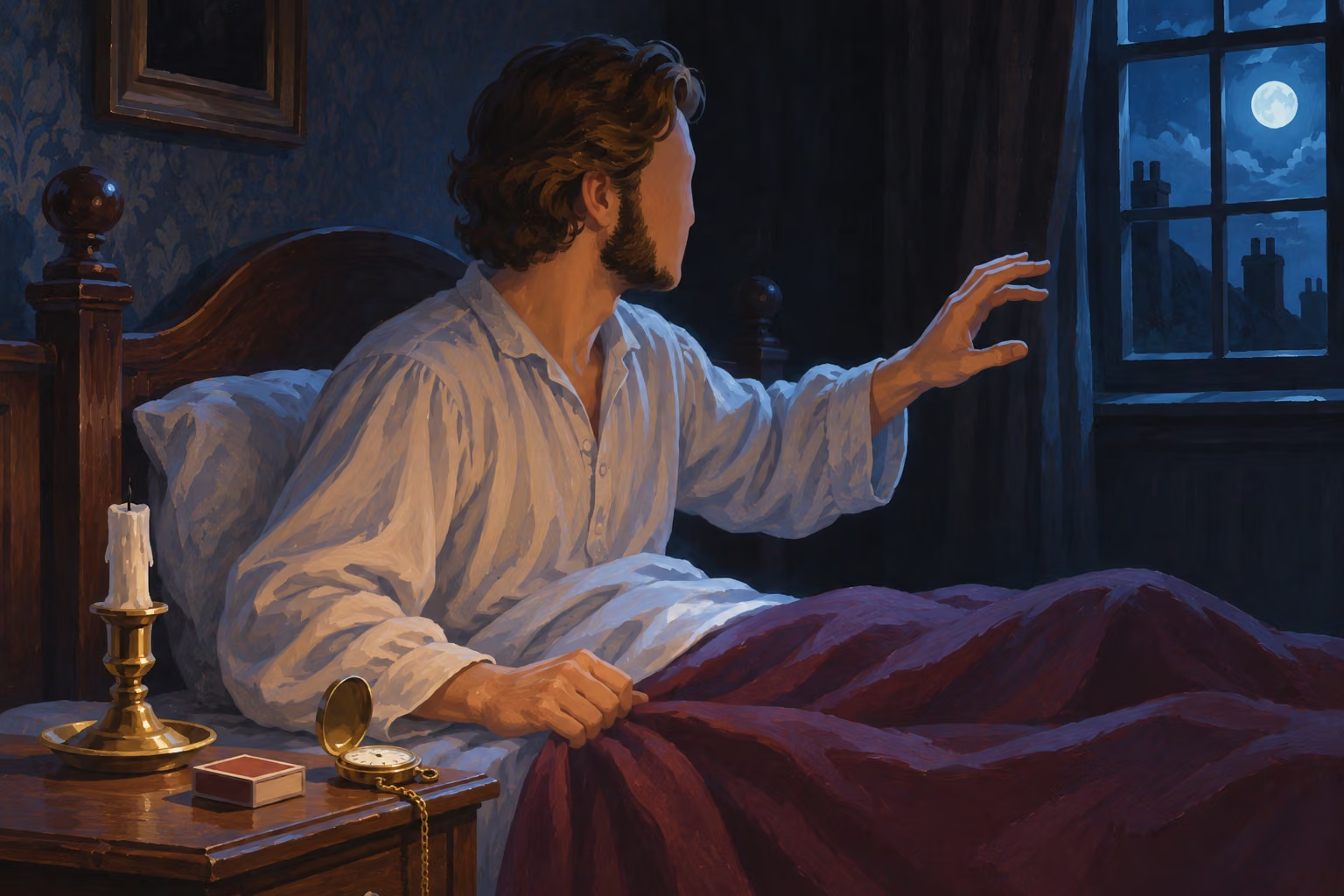
On the night of April 10, 1882, J. C. Grant woke up in London sure that there was a presence in his room. He felt it had to do with his friend Bruce, and he thought that Bruce’s father, who was very ill, had died. He looked at the clock and wrote it down in his diary. Four days later he learned that Bruce’s brother had died, in China.
This case has something few cases have. Grant looked at the clock that night, and the next day he wrote it down, with the time, in his diary. Over the next few days, before the news arrived, he told several people, and he wrote their names in his diary. We tell the story step by step and then look at what can be checked. Did Grant sense a death far away, or was it his worry about a sick man?
Step 1
April 1882 · London · J. C. Grant’s account
A London man keeps a very full diary and knows that his friend’s father is very ill

J. C. Grant lived in London and kept a very full diary. He did not want the names of the people in it to be published. That is why, in the book where the case was published, his friend appears only by his first name, Bruce. Bruce’s brother appears by his initials, E. T. R.
Bruce was a very close friend of Grant’s. His brother was also a close friend of Grant’s, though not as close as Bruce.
Grant knew that Bruce’s father was gravely ill.
Step 2
Monday, April 10, 1882 · China · According to the newspaper The Times
In China, Bruce’s brother dies

Bruce’s brother, E. T. R., died in China. According to the death notice in the newspaper The Times, he died on Monday, April 10, 1882.
Gurney gives only the date of death published in the death notice, not the time.
Step 3
The night of April 10 to 11, 1882, at 12:14 a.m. · London · According to his diary
That night, Grant wakes up sure that there is a presence in his room
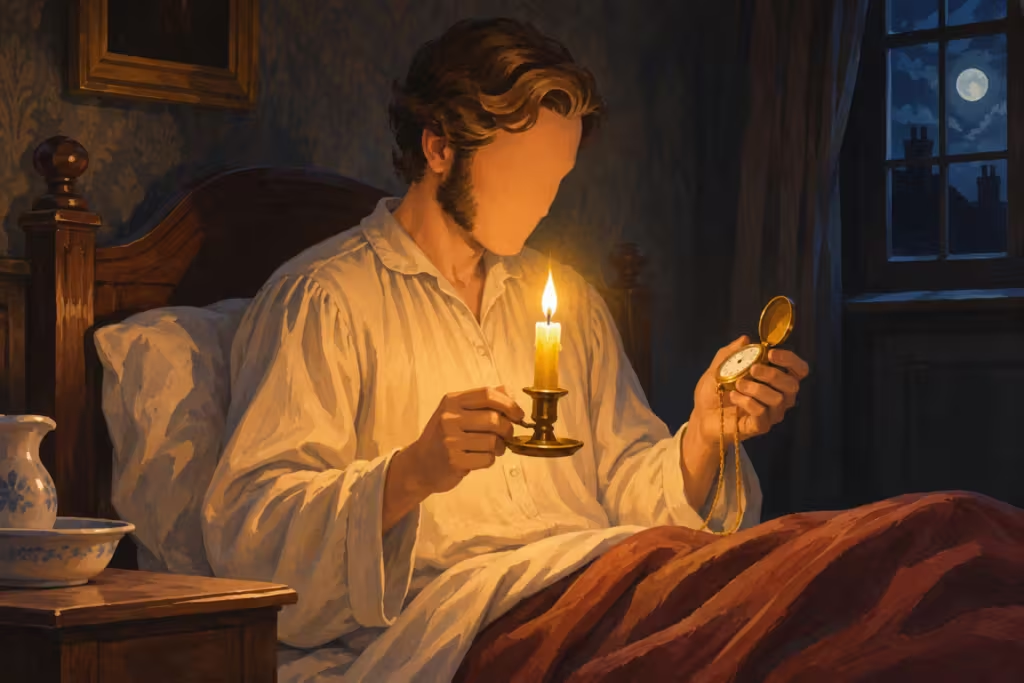
Grant had been asleep for a while when he woke up. He woke up calm, without fear, but sure that there was a presence in his room. He looked all around in the dark and begged it to show itself, but he saw nothing. That is how he wrote it in his diary the next day. According to him, it was the presence that let him know:
“I felt certain, in fact was told by it, that it was to do with Bruce. I thought it was his father—I was sure it was: I thought he must be dead.”
It all happened in a couple of minutes. Grant got up, struck a match, lit the candle on his bedside table, and looked at the clock. It was exactly fourteen minutes past twelve. He put out the candle, and the feeling of the presence was already gone.
Grant later explained why he thought of the father. He knew the father was very ill, and he believes that is why his thoughts went that way.
Step 4
April 11 to 13, 1882 · London · According to his diary
Grant tells his cousins, an aunt, and other people, before he knows anything

The next day, Grant was in low spirits all day, saddened about Bruce. He wrote him a letter that same morning. He told two people what he had felt that night. The diary calls them M. and R. R. was probably his housekeeper. A few days later, the diary calls his housekeeper Mrs. R.
On April 12 he spoke with his cousins, Mr. and Mrs. M., and he later remembered telling them. On the 13th he went to the house of an aunt whom the diary calls M. that day. He told her, his cousin J., and some other people. That day he wrote in his diary that he still had no news of Bruce.
Grant was waiting for a letter.
Step 5
Friday, April 14, 1882 · London · According to his diary
A letter arrives with a black border: it isn’t Bruce’s father who has died, but his brother

Grant got up early, at half past seven, waiting for the letter. The letter came with a wide black border, as was done at the time to announce a death. This is what he wrote in his diary:
“it is not his father, but his brother, that has died, poor old E., date and all, on Tuesday.”
Grant understood that Bruce’s brother had died on Tuesday. Later it turned out that it was on Monday.
Grant wrote to Bruce that same morning, but he decided not to tell him what had happened to him that night. In his diary he wrote down the names of his witnesses. They were his housekeeper, Mrs. R., and an aunt, Mrs. C. Also his cousin J., who was a captain, his cousins Mr. and Mrs. M., and two other people, Mr. H. R. and Madame G.
On April 15, Grant wrote a long letter to his own father and told him what had happened to him.
Step 6
1882 to 1886 · London · Edmund Gurney’s account
A researcher copies out the diary and publishes the case in an 1886 book

Edmund Gurney, one of the researchers who studied cases like this in London, copied out the pages of Grant’s diary himself. He published the case in 1886, in the book Phantasms of the Living.
Gurney looked up the death notice in The Times. It said that Bruce’s brother died on Monday, April 10, not on Tuesday, as Grant had understood. Gurney believes Grant confused the day Bruce heard the news with the day of the death.
Gurney worked out whether the death could have matched the time Grant wrote down. China was about eight hours ahead of London. When it was 12:14 a.m. in London, it was already about eight o’clock on Tuesday morning in China. So the death comes within twelve hours of what Grant felt in only one case. For that, it would have had to happen in the last hours of Monday, China time. That leaves roughly the last four hours of that Monday.
In June 1886, his cousin M. wrote Grant a letter. He said they remembered well that Grant had told them about something strange before the death of a friend of his. They had already forgotten the details.
Grant told Gurney that, as far as he could remember, he had felt something like this only three times. According to Gurney, the other two also coincided with the death of someone close to him.
The question remains: did Grant sense a death far away, or was it his worry about a sick man?
Where this story comes from
Books
- Edmund Gurney, Frederic Myers, and Frank Podmore, Phantasms of the Living, vol. 2 (Trübner, London, 1886), case 692, pages 688 to 690, in the public domainRead for free
- Edmund Gurney, Frederic Myers, and Frank Podmore, Phantasms of the Living, abridged edition by Eleanor Sidgwick (Kegan Paul, London, 1918), pages 175 to 177, in the public domainRead for free
Case documents
- J. C. Grant’s diary, April 11 to 15, 1882, copied out by Edmund Gurney, in the book
- The letter from his cousin M. to Grant, dated June 3, 1886, copied out by Gurney, in the book
- The death notice of E. T. R. in The Times, which gives April 10, 1882, as the date of death, cited in the book
Learn more
- The 24 dreams in “Phantasms of the Living”: how they were gathered and what can be checkedRead
- More shared-death experiencesRead
Our archive
- Our reading of the case in the original book and its score on our five criteria, as of October 21, 2026
Keep reading
India, 1868
Vicary Boyle
In 1868, in India, Vicary Boyle dreamed of his father-in-law lying pale in a bed in Brighton and wrote it down in his diary. His father-in-law had died that same day, a few hours earlier.
England, 1882
Mrs. Williams
One night in 1882, Mrs. Williams dreamed that her uncle was asking her to come and see him, and then she saw him in a coffin. Seven weeks later she learned that her uncle had died that same night.

England, 1882
Young Tracy
A nine-year-old blind boy was living at a boarding school far from home. He dreamed that his mother had died on the same night she died suddenly. The letter came two days later.

Reincarnation: The top 5 people who remember past lives
We asked them the same five questions as this story. A 32-page PDF, free in your inbox.
Check your email
We have sent you an email. Open it and press the button to confirm. If you cannot see it, check your spam folder.